

Industrial Automation and Control Systems Market Analysis & Forecast: 2026 to 2033
Industrial Automation and Control Systems Market is estimated to be valued at USD 226.44 Bn in 2026 and is expected to reach USD 419.28 Bn in 2033, exhibiting a compound annual growth rate (CAGR) of 9.2% from 2026 to 2033.
Key Takeaways
- Based on Component Type, the industrial Robots segment is expected to lead the market with largest share in 2026, driving mass production with strength, speed, and precision.
- Based on Control System, the DCS segment is expected to hold 54% share of the market in 2026, ensuring safe, efficient automation in process industries.
- Based on Vertical, Automative segment is projected to account for the highest share of the market in 2026, powered by robots and PLCs driving smart, efficient manufacturing.
- Based on Region, Asia Pacific is set to lead the industrial automation and control systems market with 46.2% share in 2026. While, Europe is projected to be the fastest growing region.
Market Overview
The rapid industrialization in countries such as China and India is further boosting the demand for industrial automation and control systems market. Furthermore, the positive economic outlook of these regions is expected to drive the demand for these systems, as they enable greater production and support productivity in various sectors. A rise in demand for automation systems is also a major factor driving the market.
Current Events and Its Impacts on the Industrial Automation and Control Systems Market
Current Event | Description and its Impact |
Europe's Green Deal and Industrial Decarbonization Push |
|
Artificial Intelligence and Edge Computing Integration |
|
Role Of Artificial Intelligence (AI) In Industrial Automation and Control Systems Market
- Artificial Intelligence (AI) is transforming the Industrial Automation and Control Systems (IACS) market by making operations smarter, more autonomous, and more efficient.
- AI makes traditional automation better by adding predictive analytics, digital twins, robotics, and real-time optimization to control systems. It helps businesses move from rule-based automation to self-learning systems that can adjust to changing conditions.
- For instance, AI-powered predictive maintenance finds equipment failures before they happen, which cuts down on downtime. AI-powered machine vision and robotics also make manufacturing more precise. AI also makes edge computing and industrial IoT integration stronger, which lets people make decisions faster on the factory floor. Industrial AI is speeding up the use of smart factories, hyperautomation, and sustainability projects in 2025. Businesses have begun investing more funds into connected, smart systems to make them more productive and competitive.
- For instance, in June 2025, Honeywell added AI-powered solutions to speed up industrial autonomy through integrating AI to control systems so that they can make better decisions and do predictive maintenance. The new ideas are meant to improve production and efficiency in the manufacturing and process industries. They also strengthen Honeywell's role in moving industrial automation and control systems closer to fully automated, self-optimizing operations.
- Current Industry Events of 2026
- Market Size Estimation
- Regional Breakdown
- Competitive Landscape
- Customer Intelligence
- Segmental Analysis
- Pricing Analysis
- Key Market Drivers, Challenges & Future Trends
- Customized Insights Section
Segmental Insights
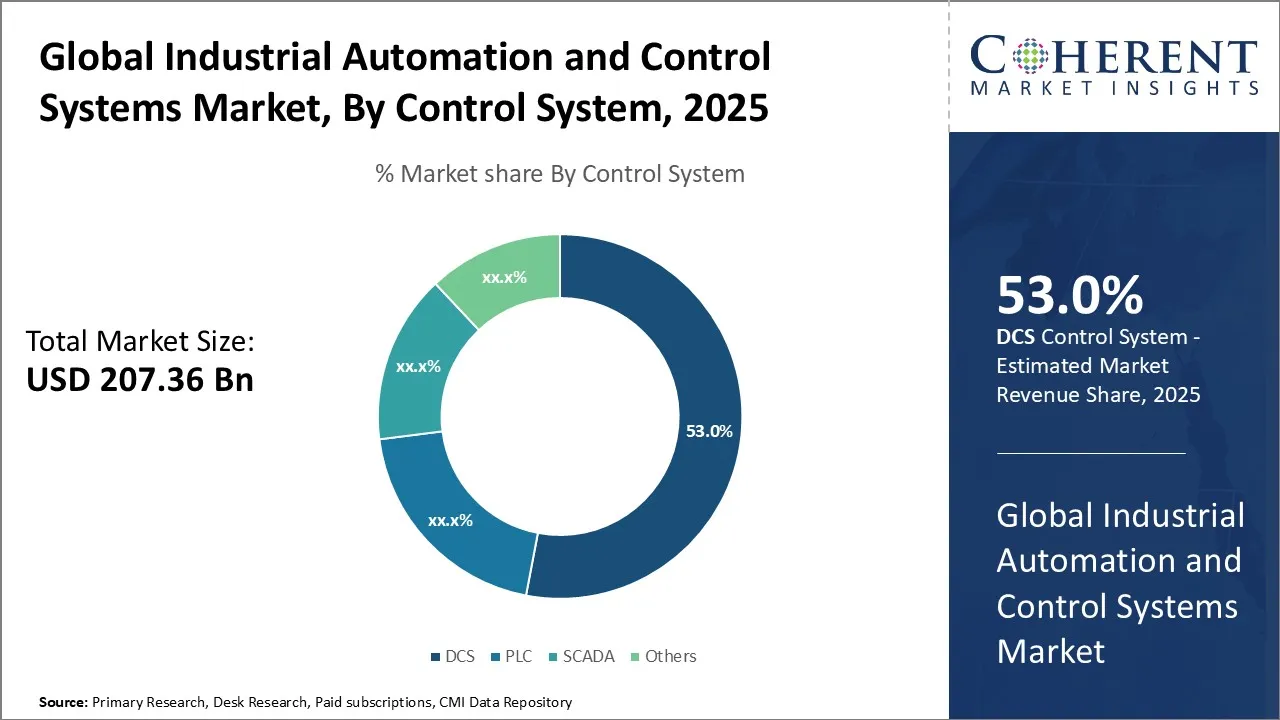
Global Industrial Automation and Control Systems Market Insights, By Control System - DCS dominates, ensuring safe, efficient automation in process industries
In terms of control system, the DCS segment is expected to capture 54% share of market in 2026, as it does an exceptional job of managing complicated, ongoing processes in fields like oil, gas, and chemicals. It makes sure that operations are safe and efficient by providing centralized monitoring, high reliability, and scalability. It is an essential tool in process-driven industrial settings since it can handle large-scale automation.
For instance, in February 2023, ABB launched its newest Distributed Control System (DCS), which is meant to speed up the process of going digital in process automation. The new platform adds advanced digital technologies like AI, IoT, and cloud connectivity to improve centralized monitoring, reliability, and scalability. Its goal is to make process-driven industries more efficient, safe, and flexible
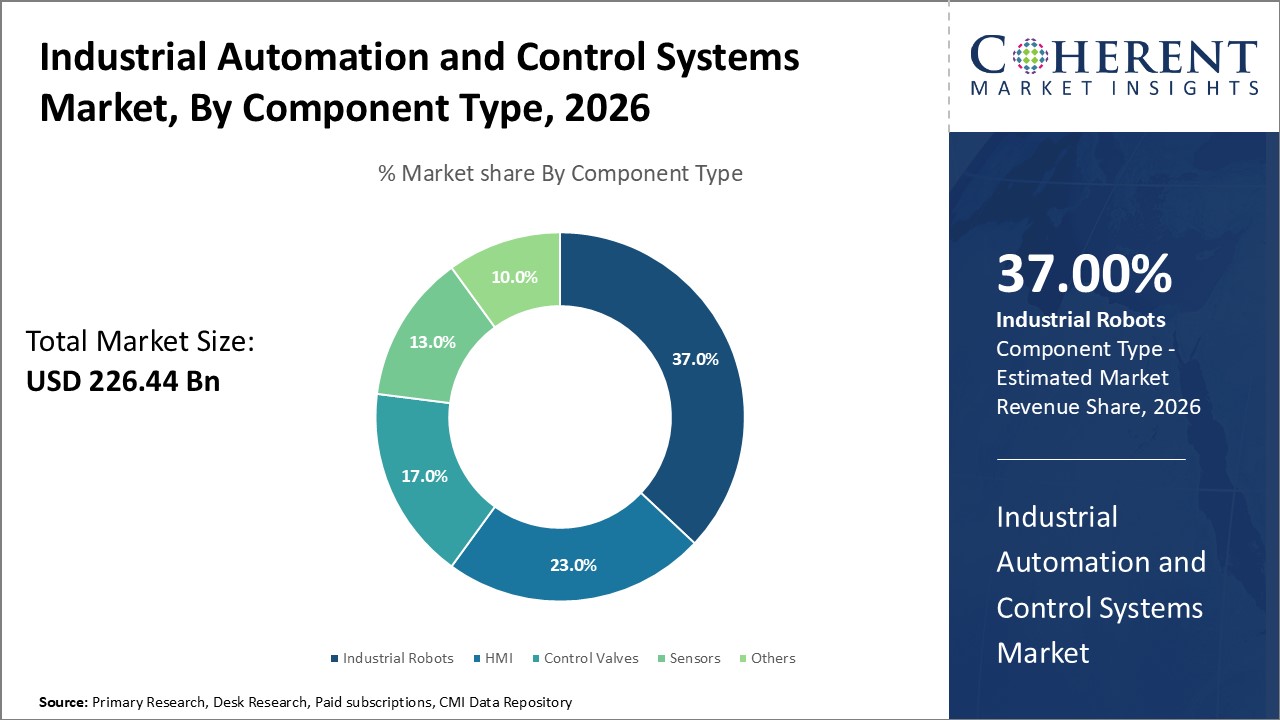
Global Industrial Automation and Control Systems Market Insights, By Component Type - Industrial Robots Lead Is Driving Mass Production with Strength, Speed, And Precision
In terms of component type, the industrial robots segment is also expected to hold the highest share of the market in 2026, owing to the growing focus of companies on optimizing the manufacturing capabilities and achieving mass production. The use of industrial robots and state-of-the-art machinery is high in manufacturing companies for optimization of operations requiring strength, speed, and accuracy. As industrial automation using robots can offer various benefits, the demand for this segment is increasing rapidly, which in turn is supporting its growth.
For instance, in November 2025, Agile Robots launched Agile ONE, a humanoid robot made for use in factories. It has advanced dexterity, fingertip sensors, and layered AI, and its goal is to change manufacturing by making it safer, more efficient, and more accurate. Agile ONE will go into full-scale production in Bavaria, Germany, in early 2026. It will work with AgileCore software.
Global Industrial Automation and Control Systems Market Insights, By Vertical - Automotive Sector Leads, Powered by Robots and PLCs Driving Smart, Efficient Manufacturing
In terms of vertical, the automotive segment is expected to lead the market with the largest share in 2026, driven by large investments in building vehicles, making electric vehicles, and smart factory projects. Robots and PLCs are the most common types of technology used on manufacturing lines. They make things more efficient, precise, and scalable. This vertical's quick adoption of advanced automation technologies makes it the strongest driver in the market.
For instance, in September 2026, DXC Technology announced that it intends to partner with startups to help AI progress in the automotive and manufacturing industries. The goal of the project is to improve smart factories and intelligent production systems by making them more efficient, scalable, and accurate. DXC wants to speed up digital transformation in automotive manufacturing by adding AI to industrial automation and control systems.
Regional Insights
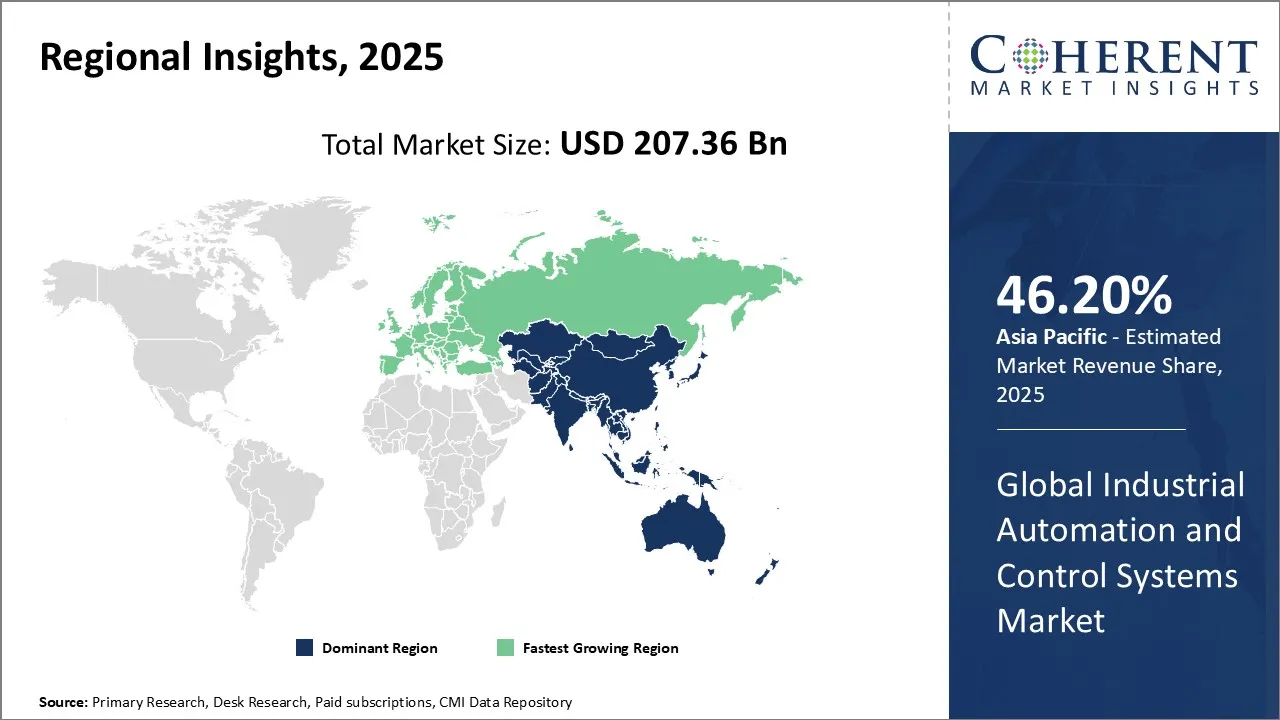
Asia Pacific Industrial Automation and Control Systems Market Analysis & Trends
Asia Pacific is anticipated to gain major share in the global industrial automation and control systems market with 46.2% share in 2026. This is owing to rise in demand for better solutions for managing industrial plants in countries such as South Korea, India, and China. Moreover, developing countries such as Vietnam, Indonesia, and Thailand have presence of largely untapped market, due to which, investments for development of manufacturing plants are increasing in the region. These factors are further expected to drive growth of the global industrial automation and control systems market demand over the forecast period.
For instance, in October 2026, Azbil Corporation announced improvements to its automation solutions, which strengthens its position in the field of industrial automation and control systems. The company's most recent projects are all about making the oil, gas, and chemicals industries more efficient, safe, and scalable. These new ideas show that Azbil is dedicated to using modern control technologies to speed up digital transformation.
Europe Industrial Automation and Control Systems Market Analysis & Trends
Europe is also expected to gain significant growth in the global industrial automation and control systems market over the forecast period. The implementation of the latest technological advances and digital transformation abilities are increasing in manufacturing unities in the region to obtain effective business processes as the competition in the regional market is increasing. Moreover, with increasing end user needs, the adoption of advanced technologies is increasing in the region, which is also expected to support growth of the market in the coming years.
For instance, in October 2026, Siemens teamed up with Rhobot AI to add edge AI features to its Xcelerator platform. The goal of the partnership is to improve industrial automation by allowing real-time decision-making, predictive maintenance, and better production. This integration makes control systems stronger, which helps manufacturing and process industries run smarter, faster, and more efficiently.
Industrial Automation and Control Systems Market Outlook Country-Wise
China Industrial Automation and Control Systems Market Trends
China's demands for Industrial Automation and Control Systems in 2026 is due to the country's rapid industrialization, the growth of smart factories, and government-supported Industry 4.0 projects. As more electric cars, electronics, and semiconductors are made, more people are using robotics, PLCs, and DCS. China is the biggest market in the world because it has made a lot of investments in AI-driven automation that improve efficiency, scalability, and competitiveness.
For instance, in Septmber 2026, Inovance released 17 new industrial automation products. These include its first collaborative robot, a smart conveyance system, and advanced machine vision solutions. The release also adds more PLCs, drives, and motors, which shows that the company is moving toward high-growth automation markets. Inovance wants to become a full automation system provider and expand its presence around the world.
Germany Industrial Automation and Control Systems Market Trends
Germany's demands for Industrial Automation and Control Systems in 2026 is due to its strong Industry 4.0 initiatives, advanced automotive and machinery sectors, and focus on sustainability and energy efficiency. Germany is a major European center for automation innovation and global competitiveness given that it focuses on smart factories, robotics, and digitalization. Some of the largest businesses in the world, like Siemens and Bosch, are based there.
For instance, in November 2026, At SPS 2026 in Nuremberg, INVT launched its next-generation industrial automation portfolio, which includes advanced PLCs, drives, motion control systems, and robotics solutions. The launch shows that INVT is focused on smart manufacturing, AI-driven automation, and digital factory integration.
Market Report Scope
Industrial Automation and Control Systems Market Report Coverage
| Report Coverage | Details | ||
|---|---|---|---|
| Base Year: | 2025 | Market Size in 2026: | USD 226.44 Bn |
| Historical Data for: | 2020 To 2024 | Forecast Period: | 2026 To 2033 |
| Forecast Period 2026 to 2033 CAGR: | 9.2% | 2033 Value Projection: | USD 419.28 Bn |
| Geographies covered: |
| ||
| Segments covered: |
| ||
| Companies covered: | ABB, Emerson Electric Co., Honeywell International, Inc., Kawasaki Heavy Industries, Ltd., Mitsubishi Electric Corporation, OMRON Corporation, Rockwell Automation, Inc., and Schneider Electric | ||
| Growth Drivers: |
| ||
| Restraints & Challenges: |
| ||
Global Industrial Automation and Control Systems Market Drivers
Convergence of IT, OT, and M2M systems to propel the market growth
The management of industrial technology has always been between Operation Technology (OT) and Information Technology (IT). IT focuses more on a top-down approach, and thus deploys and maintains the data-based infrastructure on the management side of the business. While OT uses a bottom-up approach that starts from machinery, equipment, and assets which goes up to monitoring and controlling systems. With the emergence of industrial internet and big data, the business in several industries is transforming. Thus, this factor is further expected to support growth of the global industrial automation and control systems market over the forecast period.
Growing inclination toward smart manufacturing to boost the market growth
Several manufacturing plants and factories are shifting to factory automation and implementation of smart processes. For these, these factories are making use of multiple PLCs distributed in the whole manufacturing plant for communicating with one another instead of having a centralized PLC. With this, companies can create a communication between all the machineries, as a result, it creates an ecosystem that can be controlled remotely from anywhere. Thus, adoption of smart manufacturing is increasing rapidly, which is further likely to aid in growth of the global industrial automation and control systems market over the forecast period.
Global Industrial Automation and Control Systems Market Opportunities
Advent of industry 4.0 is likely to generate growth opportunities in the global industrial automation and controller systems market over the forecast period. Due to the advent of Industry 4.0, the adoption of automation and control system has increased rapidly. Several industries are adopting smart manufacturing for high precision and low error rates. This in turn is creating growth opportunities in the market.
Growing penetration of Internet of Things (IoT) in factory automation is also expected to generate growth opportunities in the global industrial automation and control systems market over the forecast period. With the growing penetration of IoT, smart manufacturing is growing for embracing and obtain advantages of internet connectivity.
Global Industrial Automation and Control Systems Market Trends
Increasing use of industrial control systems in food and beverage sector is a recent trend
With increasing growth of economy and disposable incomes all over the world, the demand for the food and beverage industry is growing rapidly. Moreover, the rise in global population also adds into the growth of this industry. Thus, the industry is witnessing increased shift to automation. As a result, the use of industrial control systems is increasing in this industry. This trend is expected to boost growth of the global industrial automation and control systems market over the forecast period.
Growing focus of companies on R&D, and joint ventures, in modern technologies is another trend
Major players in the market are increasingly making heavy investments in joint ventures, R&D of modern technologies. For instance, in September 2025, Yokogawa secured a deals with Toyota to make prototype measurement and control tools for a lunar rover that is going to be manned. Yokogawa's knowledge of industrial automation is being used in the partnership to work on research and development of control platforms and battery measurement systems. These new ideas, made for extreme conditions, will also make Yokogawa's industrial automation and control systems stronger for industries on Earth.
Analyst Opinion (Expert Opinion)
- The Industrial Automation and Control Systems market is expanding steadily due to more factories are going digital, more robots are being used, and more AI-driven control architectures are being used. Several independent studies show that the market makes up a large part of global industrial capital spending. It is growing because of strong investment in equipment, software, and integration services. Independent studies also show that AI-powered automation, which includes predictive maintenance, computer vision quality inspection, and process optimization, is one of the fastest-growing areas. This shows that the way value is captured is changing to focus more on software.
- Asia-Pacific still has the biggest share of global automation spending. This is because of a lot of manufacturing, a lot of robots, and strong government-backed modernization programs. The region's dominance is strengthened by the growth of its semiconductor, automotive, electronics, and food processing industries, all of which depend heavily on advanced control systems.
- Ongoing line modernization, rising labor costs, and the need for real-time process visibility are some of the main things that drive demand. Vendors are putting more and more emphasis on lifecycle services, analytics platforms, and digital-twin environments. This is because customers want long-term performance solutions that work together. The competition among major automation OEMs stays strong, but system integrators are getting stronger by doing specialized turnkey deployments. In general, the market is still moving away from investing in hardware and toward intelligent, software-driven automation ecosystems.
Speak to the analyst
Want personalized insights?
Take the findings above to one of our principal consultants, or have the report rebuilt around the segments, geographies and competitors you actually track.
Global Industrial Automation and Control Systems Market: Key Developments
- In December 2025, Aetina released an industrial MXM module that operates on NVIDIA's Blackwell platform. Its goal is to increase the use of AI-driven automation in the manufacturing and medical fields. The solution improves autonomous mobile robots by adding real-time processing and intelligent control. This makes industrial automation and control systems stronger and helps factories and healthcare operations run smarter, safer, and more efficiently.
- In December 2025, Quaker Houghton released new automation technologies that are going to alter the way fluids are managed in manufacturing. The solutions use smart sensors and automated controls to make the best use of fluids, cut down on waste, and boost efficiency. This new technology makes industrial automation and control systems stronger, which helps the automotive, aerospace, and heavy machinery industries be more productive and environmentally friendly.
- In October 2025, Rockwell Automation released FactoryTalk Design Workbench, a free program that helps you make micro control systems. The platform helps engineers design, test, and put automation solutions into action more quickly and effectively. Rockwell wants to speed up the use of industrial automation and control systems by making development easier. This will help manufacturing operations become more efficient and scalable.
Market Segmentation
- By Component Type (Revenue, USD Bn, 2021 - 2033)
- HMI
- Industrial Robots
- Control Valves
- Sensors
- Others
- By Control System (Revenue, USD Bn, 2021 - 2033)
- DCS
- PLC
- SCADA
- Others
- By Vertical (Revenue, USD Bn, 2021 - 2033)
- Aerospace & Defense
- Automotive, Chemical
- Energy & Utilities
- Food & Beverage
- Healthcare
- Manufacturing
- Mining & Metal
- Oil & Gas
- Transportation
- Others
- By Region (Revenue, USD Bn, 2021 - 2033)
- North America
- U.S.
- Canada
- Latin America
- Brazil
- Argentina
- Mexico
- Rest of Latin America
- Europe
- Germany
- U.K.
- Spain
- France
- Italy
- Russia
- Rest of Europe
- Asia Pacific
- China
- India
- Japan
- Australia
- South Korea
- ASEAN
- Rest of Asia Pacific
- Middle East & Africa
- GCC Countries
- Israel
- Rest of Middle East & Africa
- North America
- Global Industrial Automation and Control Systems Market: Key Companies Insights (Revenue, USD Bn, 2021 - 2033)
- ABB
- Emerson Electric Co.
- Honeywell International, Inc.
- Kawasaki Heavy Industries, Ltd.
- Mitsubishi Electric Corporation
- OMRON Corporation
- Rockwell Automation, Inc.
- Schneider Electric
Sources
Primary Research Interview
- Industrial Automation Solution Providers
- PLC, SCADA & DCS Manufacturers
- Robotics & Motion Control System Integrators
- Industrial IoT (IIoT) Platform Developers
- Process Control & Instrumentation Engineers
- Factory Automation Consultants
- Others
Databases
- Bloomberg Terminal
- Thomson Reuters Eikon
- Others
Magazines
- Control Engineering Magazine
- Automation World
- Manufacturing Automation Magazine
- Industrial Equipment News (IEN)
- Process Engineering Magazine
- Others
Journals
- IEEE Transactions on Industrial Informatics
- Journal of Manufacturing Systems
- ISA Transactions (Instrumentation & Automation)
- Journal of Industrial Information Integration
- Control Engineering Practice
- Others
Newspapers
- Financial Times
- The Wall Street Journal
- Reuters
- Bloomberg News
- The Economic Times – Industry & Manufacturing
- Others
Associations
- International Society of Automation (ISA)
- IEEE Industrial Electronics Society (IES)
- Manufacturing Enterprise Solutions Association (MESA) International
- OPC Foundation
- Automation Federation
- Others
Public Domain Sources
- U.S. Department of Energy (DOE) – Advanced Manufacturing Office
- International Energy Agency (IEA)
- European Commission – Industry & Manufacturing
- World Bank Open Data
- National Institute of Standards and Technology (NIST)
- Others
Proprietary Elements
- CMI Data Analytics Tool
- Proprietary CMI Repository of Industrial Automation & Control Systems Market Data (Last 8 Years)
*Definition: The Industrial Automation and Control System (IACS) market consists of various automation equipment, machines, and components that monitor and perform multiple industrial tasks and automate them for improving product quality and efficiency.
Get access to 250+ pages report
Every segment, forecast, competitor profile and data table behind the analysis above — available for instant download.
- ESOMAR Member
- ISO 9001:2015 Certified
- D-U-N-S Registered
- GDPR & CCPA Compliant
Missing comfort of reading report in your local language? Find your preferred language:
Transform your Strategy with Exclusive Trending Reports
Frequently Asked Questions
The Industrial Automation and Control Systems Market is estimated to be valued at USD 226.44 Bn in 2026, and is expected to reach USD 419.28 Bn by 2033.
The CAGR of the Industrial Automation and Control Systems Market is projected to be 9.2% from 2026 to 2033.
Convergence of IT, OT, and M2M systems and growing inclination toward smart manufacturing are fuelling the growth of market.
The DCS segment is the leading segment in the market.
Concerns regarding security threats and high cost of implementation are the major factors restraining growth of the market.
ABB, Emerson Electric Co., Honeywell International, Inc., Kawasaki Heavy Industries, Ltd., Mitsubishi Electric Corporation, OMRON Corporation, Rockwell Automation, Inc., and Schneider Electric