

Global Industrial Chips Market Size and Forecast – 2026 To 2033
The global industrial chips market is expected to grow from USD 63.50 Bn in 2026 to USD 110 Bn by 2033, registering a compound annual growth rate (CAGR) of 7% from 2026 to 2033. The global industrial chips market growth is primarily driven by a sharp increase in the adoption of IIoT and edge computing applications.
On March 10, 2026, Synaptics Incorporated announced the launch of SYN765x, an AI-native wireless solution that redefines Edge intelligence. As an industry-leading single-chip device combining AI-optimized compute with integrated Wi-Fi 7, the SYN765x is designed to bring scalable, real-time intelligence directly to smart appliances, home automation systems, and Industrial IoT (IIoT) applications.
(Source: Synaptics Incorporated)
Key Takeaways of the Global Industrial Chips Market
- The Microcontrollers (MCUs) segment is expected to account for 36.0% of the global industrial chips market share in 2026. Major manufacturers are expanding their production capacities to meet the growing demand of microcontrollers. For instance, on February 11, 2026, Semiconductor Manufacturing International Corporation (SMIC) announced it is expanding wafer capacity by 40,000 12‑inch equivalents through 2026 to meet domestic and broader chip demand, which directly scales filtration needs for gas and liquid delivery systems, tool environments, and UPW systems. (Source: Reuters)
- The CMOS chips segment is estimated to capture 33.0% of the market share in 2026. Growing demand of advanced processors for smartphones is a major factor driving the growth of the segment. On May 7, 2026, Qualcomm launched the new Snapdragon 6 Gen 5 and Snapdragon 4 Gen 5 chipsets with upgrades focused on gaming, AI cameras, smoother performance, and better battery life. The new processors are set to power upcoming phones from Oppo, Redmi, Xiaomi, Realme, and Honor. (Source: India Today)
- The manufacturing segment is estimated to capture 31.0% of the market share in 2026. The increasing demand for SiC and GaN power semiconductors is a major factor driving the growth of the manufacturing segment. On July 2, 2025, Infineon Technologies AG announced that its scalable GaN manufacturing on 300-millimeter wafers is on track. With first samples available for customers as of the fourth quarter of 2025, Infineon is well-positioned to expand its customer base and reinforce its position as a leading GaN powerhouse. (Source: Infineon Technologies AG)
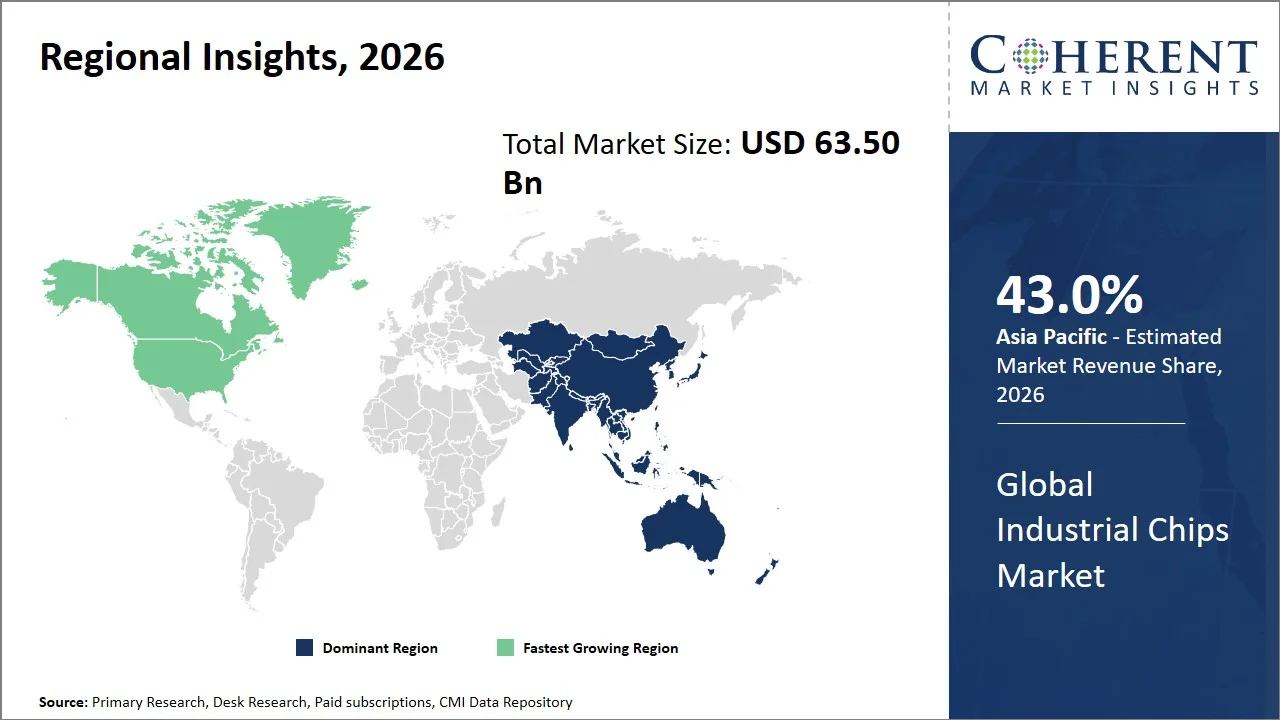
- Asia Pacific is expected to dominate the global industrial chips market in 2026 with a market share of 43%. There has been increasing numbers of global market players investing in facilities in Asia Pacific. On June 13, 2024, Pall Corporation held its opening ceremony for a new state-of-the-art manufacturing facility in Singapore that will serve regional and global customers within the growing semiconductor industry. (Source: Pall Corporation)
- North America is expected to account for 24% share in 2026 and is projected to record the fastest growth over the forecast period. Multiple market players are introducing advanced portfolio of their products in North America, particularly in the U.S. On October 2, 2025, FUJIFILM Corporation announced that its U.S.-based subsidiary for semiconductor materials, FUJIFILM Electronic Materials U.S.A., Inc. (Fujifilm), will participate in SEMICON West 2025, an international exhibition of semiconductor manufacturing equipment and materials, where it will highlight its broad portfolio of advanced high-purity chemicals & semiconductor materials. (Source: FUJIFILM)
- Shift Toward Chiplet and Heterogeneous Integration: Instead of relying on single large monolithic chips, the industry is increasingly adopting chiplet-based architectural services, where multiple smaller dies are combined in a single package to improve yield, reduce cost, and enhance flexibility in performance scaling.
- Geographic Diversification of Manufacturing: Governments and companies are actively expanding semiconductor fabrication beyond traditional hubs like Taiwan and South Korea, with new investments in the U.S., Europe, and India aimed at strengthening supply chain resilience and reducing geopolitical risk.
Segmental Insights
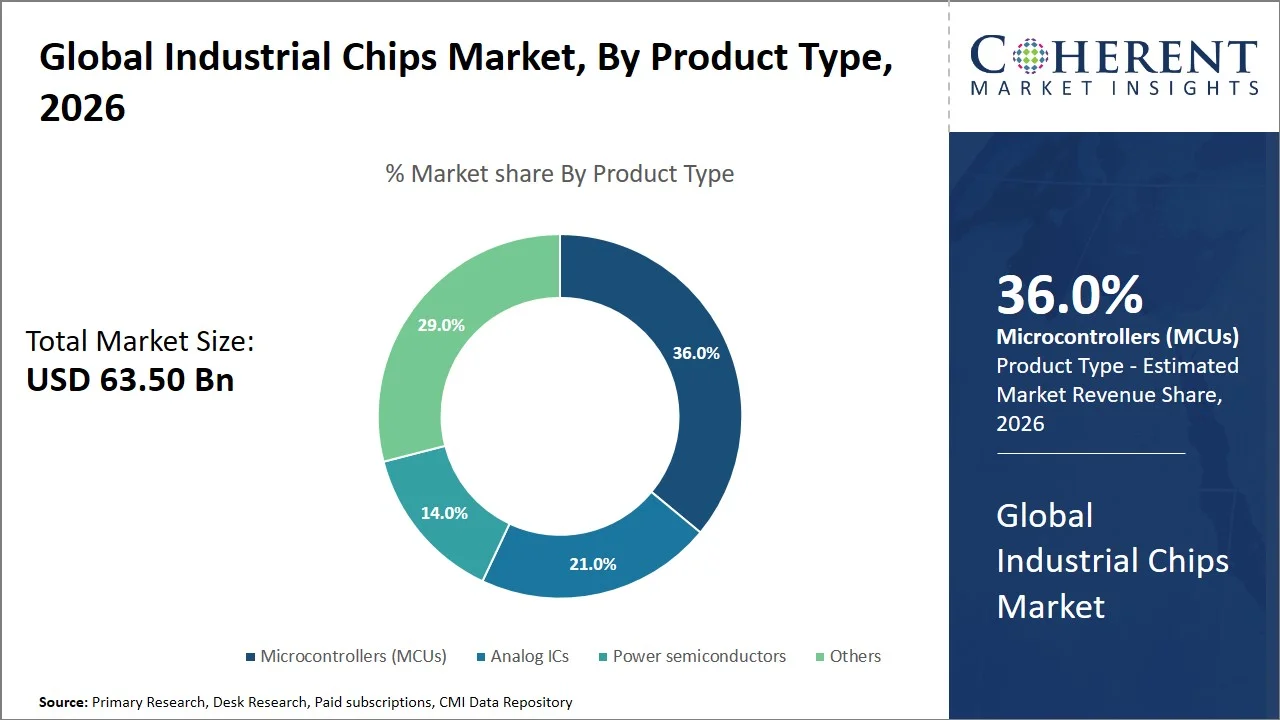
Why Does Microcontrollers (MCUs) Segment Dominate the Global Industrial Chips Market?
The Microcontrollers (MCUs) segment is expected to account for 36.0% of the global industrial chips market share in 2026. The increasing need of high purity solvents for complex microcontroller manufacturing is a major factor driving the segment growth. On September 15, 2025, Solvay officially opened a significant expansion at its Zhenjiang, China, facility, doubling its production capacity for electronic grade hydrogen peroxide (H2O2) annually. This investment underscores Solvay's commitment to supporting the semiconductor industry, which relies on this ultra-pure chemical for integrated circuit manufacturing.
(Source: Solvay)
- Current Industry Events of 2026
- Market Size Estimation
- Regional Breakdown
- Competitive Landscape
- Customer Intelligence
- Segmental Analysis
- Pricing Analysis
- Key Market Drivers, Challenges & Future Trends
- Customized Insights Section
Why is CMOS Chips the Most Preferred Technology?
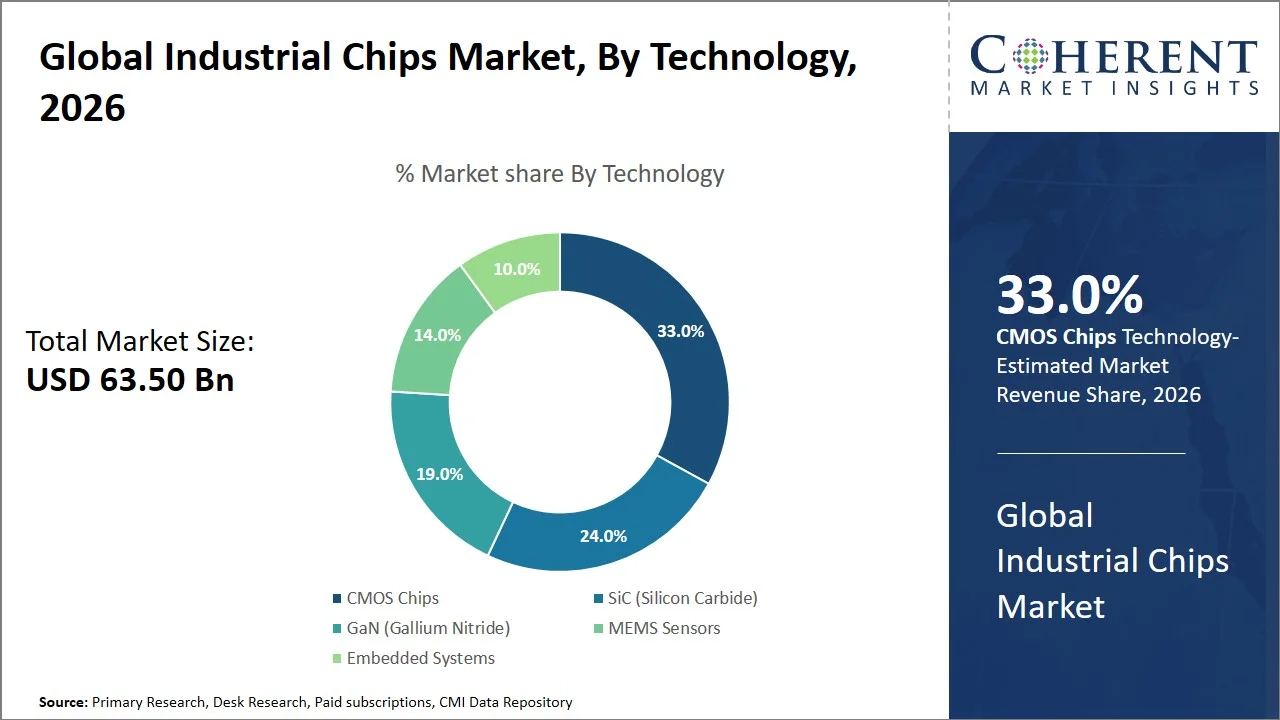
The CMOS chips segment is expected to account for 33.0% of the global industrial chips market share in 2026. Growing need of advanced processors and microprocessors for modern smartphones is a key factor pushing the growth of the consumer electric segment. On January 15, 2026, MediaTek announced the launch of Dimensity 9500s and Dimensity 8500. As the latest members of the Dimensity family, both products focus on delivering outstanding performance, efficiency, AI, imaging, gaming, and wireless connectivity, driving new momentum into the flagship and premium smartphone segments.
(Source: Mediatek)
Manufacturing Segment Dominates the Global Industrial Chips Market
The manufacturing segment is expected to account for 31.0% of the global industrial chips market share in 2026. Growing adoption of SiC and GaN power semiconductors is a major growth factor. On February 13, 2025, Infineon Technologies AG announced it has made significant progress on its 200 mm silicon carbide (SiC) roadmap. The company will already release the first products based on the advanced 200 mm SiC technology to customers in Q1 2025. (Source: Infineon Technologies AG)
Currents Events and their Impact
Current Events | Description and its Impact |
BASF Expansion Plans |
|
(Source: BASF)
Global Industrial Chips Market Dynamics
Market Drivers
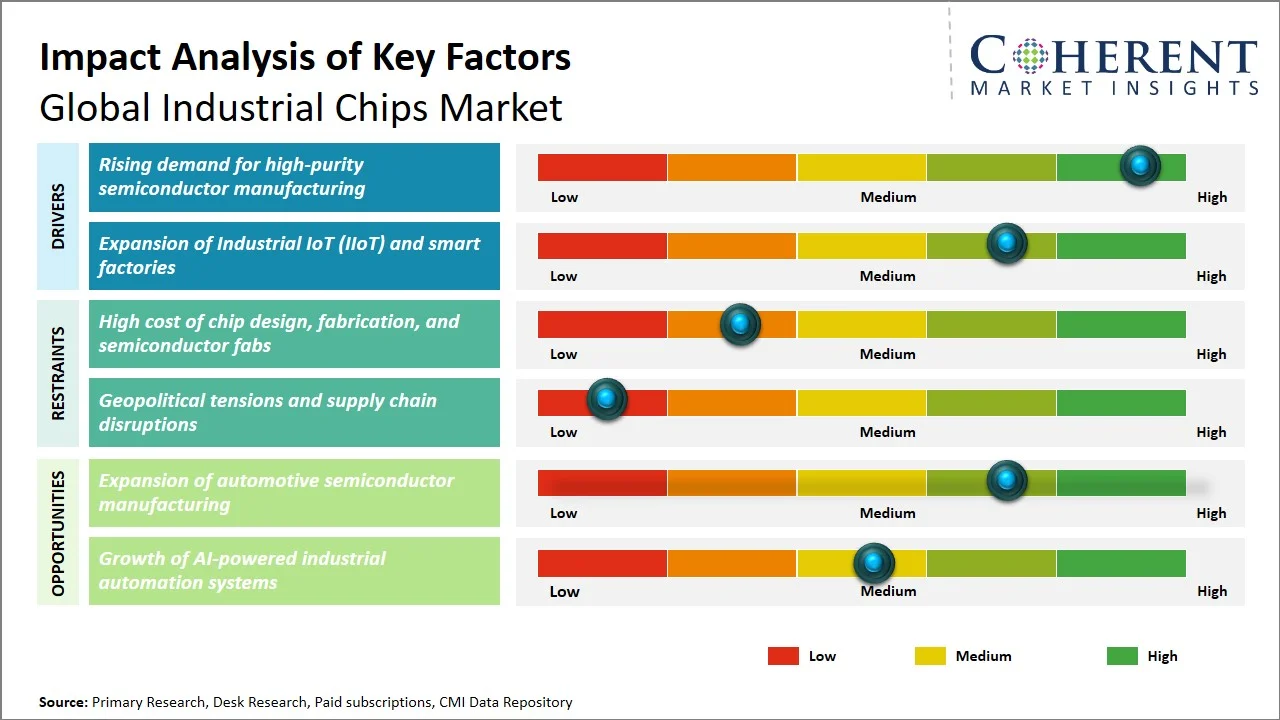
- Rising demand for high-purity semiconductor manufacturing: At 3 nanometers or below, chip structures demand pure materials, any small impurity interferes with operation, lowering efficiency. This change means fabrication leans further on wafers processed to extreme accuracy, along with ultra-refined compounds, while cleanroom conditions tighten during build phases. Device intricacy increasing leads directly to a greater need for almost absolute sanitation across every production step. Reliable behavior in parts used for artificial intelligence machines, transportation units, and data center equipment rests entirely upon such rigorous requirements. For instance, on November 25, 2025, FUJIFILM Corporation announced the successful completion of a new building for development and evaluation at the Shizuoka Factory of FUJIFILM Electronic Materials Co., Ltd. (FFEM), the core company that leads Fujifilm’s semiconductor materials business. (Source: FUJIFILM)
- Expansion of Industrial IoT (IIoT) and smart factories: As industrial systems connect more, specialized processors become essential, sensor-driven equipment requires rapid chips to manage continuous information streams. Since automated processes expand across factories, a steady need emerges for durable computation units that enable persistent monitoring alongside smooth device coordination. Gains in performance increasingly stem from smart configurations where internal responses detect issues ahead of breakdowns. These changes lead semiconductor producers to develop resilient control units, sensing elements, and communication hardware built for demanding environments. On March 13, 2026, STMicroelectronics unveiled plans to retrain workers and deploy robots in its older chip manufacturing plants, avoiding closures as the European semiconductor giant navigates industry challenges. (Source: Reuters)
Emerging Trends
- AI-Driven Demand for Advanced Nodes: The rapid growth of artificial intelligence, machine learning, and generative AI is driving strong demand for advanced semiconductor nodes such as 3nm and 2nm, as companies require higher performance, lower power consumption, and greater transistor density for AI accelerators and data center chips.
- Expansion of Advanced Packaging Technologies: Technologies such as 2.5D and 3D packaging, including high-bandwidth memory (HBM) integration, are becoming critical as they enable higher interconnect speeds and better performance, especially for AI and high-performance computing applications.
Regional Insights
Why is Asia Pacific a Strong Market for Industrial Chips?
Asia Pacific is expected to account for a market share of 43% in 2026. Despite global shifts, Asia Pacific holds a central position in industrial chip production because of tightly linked supply chains spanning Taiwan, South Korea, China, and Japan. Growth here stems not just from rising demand but also sustained funding in AI-ready networks, alongside increasing output of electric vehicles. Major fabrication hubs like those run by TSMC and Samsung have broadened capabilities, contributing to regional momentum. By 2025, more than half of the area's semiconductor activity was concentrated in China, measured by the market share. On December 1, 2025, Merck inaugurated its Semiconductor Solutions megasite in Kaohsiung, Taiwan. With this investment, the company is strengthening its global supply chain resilience while deepening its leading role in the semiconductor ecosystem. (Source: Merck)
Why Does North America Industrial Chips Market Exhibit High Growth?
North America is projected to account for 24% of the global industrial chips market and expected to register the fastest growth. The North American industrial chips market is being driven by domestic semiconductor manufacturing expansion supported by the U.S. CHIPS Act and rising investment in AI data centers and industrial automation. Companies such as Intel are increasing advanced packaging and fabrication capabilities in the region to reduce reliance on Asian supply chains. The region is also seeing increased demand for industrial processors and AI accelerators used in manufacturing and defense systems. For instance, on January 5, 2026, AMD introduced the AMD Ryzen AI Embedded processors, a new portfolio of embedded x86 processors designed to power AI-driven applications at the edge. From automotive digital cockpits and smart healthcare to physical AI for autonomous systems, including humanoid robotics, the new P100 and X100 Series processors provide OEMs, tier-1 suppliers and system and software developers in automotive and industrial markets with high performance and efficient AI compute. (Source: AMD)
Why is China Emerging as a Major Hub in the Industrial Chips Market?
China’s industrial chips market is expanding rapidly through aggressive investments in mature-node semiconductor production and domestic chip substitution strategies. The country is focusing heavily on industrial automation, EV semiconductors, and power electronics while increasing local manufacturing capacity despite export restrictions. By the end of 2025, China was expected to account for nearly 28% of global mature-chip production capacity, strengthening its role in industrial and automotive semiconductor supply.
Is U.S. the Next Growth Engine for the Industrial Chips Market?
Growth within the U.S. industrial chips sector emerges alongside rising funding in artificial intelligence frameworks, sophisticated component assembly, yet domestic production efforts. Support arises through military-related hardware needs, robotic process integration, along with intelligent factory programs driving usage. Firms including Intel advance complex packaging methods, EMIB being one example, to accommodate powerful computing tasks tied to industry functions, even those involving machine learning operations.
Germany Industrial Chips Market Analysis and Trends
Among European nations, Germany stands out for heavy reliance on chip-powered machinery within vehicle production lines. Owing to expansion in electric car assembly, pressure grows on suppliers to deliver advanced microelectronics. Automation inside factories spreads steadily, accelerated by digital integration efforts under national modernization plans. Instead of conventional materials, firms now test silicon carbide components for better electrical performance. Efficiency gains in motors and drives shape decisions, influenced by tightening environmental standards.
India sees sharp expansion in its industrial chips sector. Driven by national programs, fabrication efforts gain momentum without reliance on foreign supply chains. Rather than import dependence, domestic output rises through targeted investment frameworks. In 2025, official channels greenlighted several chipmaking and assembly ventures under a centralized mission structure. One focus area involves materials for electric vehicles using advanced ceramic-based semiconductors. Alongside these moves, regional rankings place India near the top for growth speed within Asia Pacific circuits commerce. Policy continuity strengthens investor confidence in homegrown production capacity.
Global Industrial Chips Market - Industrial Edge AI Workload
AI Workload Area | Deployment Status | Estimated Industry Adoption |
AI Inference Deployment at Factory Edge | Rapid shift from cloud-based analytics to on-device AI inference for low-latency decision-making | More than 55% of smart factories are expected to deploy edge AI inference systems by 2027 |
Real-Time Industrial Analytics Workloads | Increasing use of edge processors for instant operational analytics and process optimization | Around 60–65% of manufacturers are investing in real-time analytics infrastructure |
Predictive Maintenance AI Processing | AI chips increasingly deployed for vibration analysis, thermal monitoring, and predictive diagnostics | Predictive maintenance can reduce equipment downtime by nearly 30 - 50% in smart factories |
Edge TPU/NPU Penetration | Rising adoption of dedicated AI accelerators such as TPUs and NPUs in industrial edge devices | Edge AI accelerator market is projected to exceed USD 8 - 10 billion by 2030 |
Industrial Robotics AI Processing | AI-enabled robotic systems increasingly use embedded inference chips for adaptive automation | Global industrial robot installations exceeded 500,000 units annually in recent years |
How is Expansion of Automotive Semiconductor Manufacturing Creating New Growth Opportunities in the Global Industrial Chips Market?
Electronics inside modern vehicles grow increasingly complex, pulling output upward at manufacturing sites that make chips. Owing to exacting needs in electric power delivery, factories producing semiconductors attract greater attention. Microchips play a central role in managing battery performance, adding forward motion to industry activity. Rather than relying on physical parts, current vehicle designs apply smart circuitry to improve protection measures. As the automotive industry shifts toward electric and software-defined vehicles, demand for reliable, high-performance, and safety-certified semiconductors are rising rapidly, pushing automakers and Tier-1 suppliers to depend more on foundries for stable and scalable chip production. On October 28, 2025, GlobalFoundries announced plans to expand its manufacturing capabilities at its Dresden, Germany site. The new manufacturing capacity will focus on GF’s highly differentiated technologies, all essential for meeting Europe’s chip demand for automotive, internet of things (IoT), defense and critical infrastructure applications. (Source: GlobalFoundries)
Market Players, Key Development, and Competitive Intelligence
Key Developments
- On July 8, 2025, Murata Manufacturing Co., Ltd. announced the mass production and commercial shipment of the world’s first 1 high-frequency filter using XBAR technology. Developed by combining Murata’s proprietary Surface Acoustic Wave (SAW) filter expertise with XBAR technology from Murata's subsidiary Resonant Inc., it enables the extraction of desired signals while achieving both low insertion loss and high attenuation.
- On September 9, 2024, Wolfspeed, Inc unveiled a silicon carbide module semiconductor designed to transform the renewable energy, energy storage, and high-capacity fast-charging sectors through improved efficiency, durability, reliability, and scalability.
Competitive Landscape
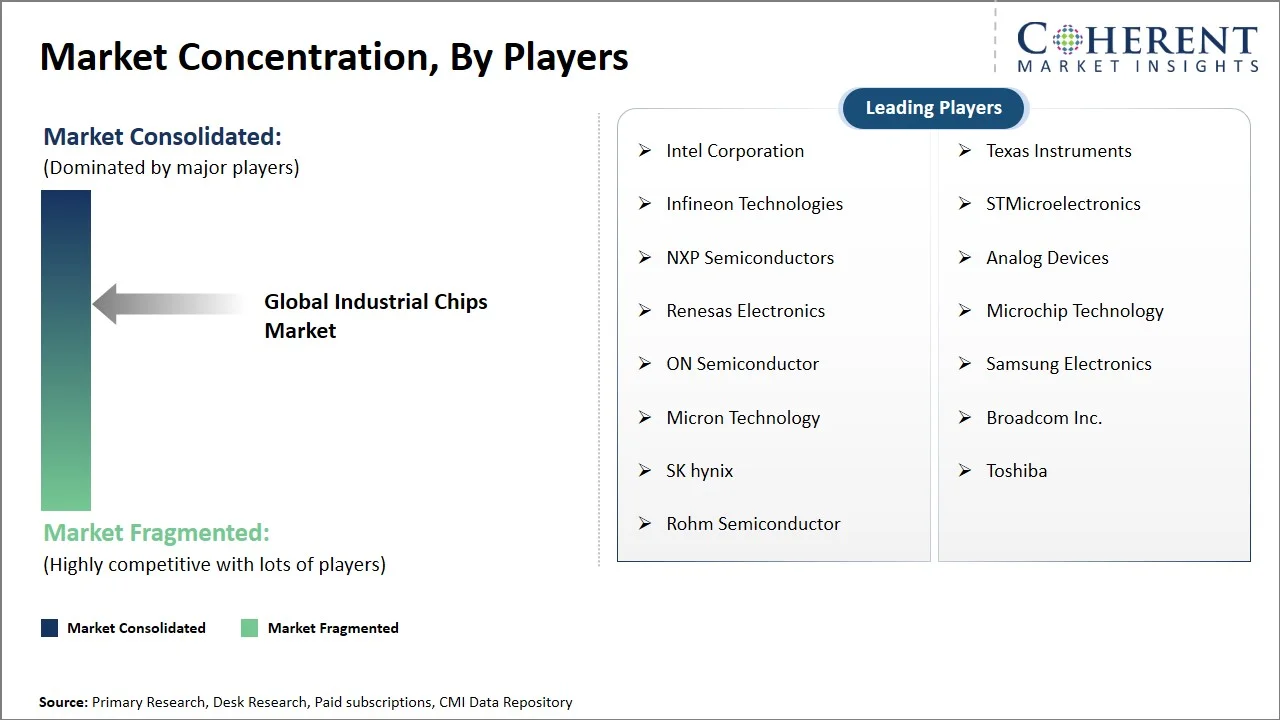
Despite moderate consolidation, the industrial chips sector sees intense rivalry among leading firms including Intel Corporation, Texas Instruments, Infineon Technologies, NXP Semiconductors, and STMicroelectronics - each relying on cutting-edge production methods, novel products, alongside joint ventures to maintain position. Focus has shifted toward processors powered by artificial intelligence, components for vehicle electronics, systems supporting factory automation, along with next-generation assembly techniques like chiplets and mixed-technology integration.
Market Report Scope
Industrial Chips Market Report Coverage
| Report Coverage | Details | ||
|---|---|---|---|
| Base Year: | 2025 | Market Size in 2026: | USD 63.50 Bn |
| Historical Data for: | 2020 To 2024 | Forecast Period: | 2026 To 2033 |
| Forecast Period 2026 to 2033 CAGR: | 7% | 2033 Value Projection: | USD 110 Bn |
| Geographies covered: |
| ||
| Segments covered: |
| ||
| Companies covered: | Intel Corporation, Texas Instruments, Infineon Technologies, STMicroelectronics, NXP Semiconductors, Analog Devices, Renesas Electronics, Microchip Technology, ON Semiconductor, Samsung Electronics, Micron Technology, Broadcom Inc., SK Hynix, Toshiba, and Rohm Semiconductor | ||
| Growth Drivers: |
| ||
| Restraints & Challenges: |
| ||
Analyst Opinion (Expert Opinion)
- The industrial chips market will continue to witness strong long-term growth due to rising demand from AI infrastructure, industrial automation, EVs, and smart manufacturing systems. It is projected that semiconductor revenues will continue expanding significantly through the end of the decade, supported by increasing adoption of AI accelerators, edge computing chips, and industrial IoT devices. At the same time, shifts in demand driven by economic cycles raise caution. These pressures combine with heavy spending needs on infrastructure. Such conditions might lead to unpredictable movements in pricing over coming months. Volatility appears likely unless underlying risks ease.
- Ahead of 2035, AI-integrated machinery may redefine how industrial chips evolve, alongside progress in high-efficiency power components. Instead of traditional setups, newer frameworks like RISC-V and modular chip layouts could gain ground gradually. Because machines require faster switching and lower losses, materials such as silicon carbide and gallium nitride might see stronger demand. Driven by shifts toward electric systems and automated production lines, these semiconductors may become more central.
Speak to the analyst
Want personalized insights?
Take the findings above to one of our principal consultants, or have the report rebuilt around the segments, geographies and competitors you actually track.
Market Segmentation
- Product Type Insights (Revenue, USD Billion, 2021 - 2033)
- Microcontrollers (MCUs)
- Analog ICs
- Power semiconductors
- Others
- Technology Insights (Revenue, USD Billion, 2021 - 2033)
- CMOS Chips
- SiC (Silicon Carbide)
- GaN (Gallium Nitride)
- MEMS Sensors
- Embedded Systems
- Aerospace & Defense
- End User Insights (Revenue, USD Billion, 2021 - 2033)
- Manufacturing
- Automotive
- Energy & Utilities
- Oil & Gas
- Electronics & Telecom
- Aerospace & Defense
- Regional Insights (Revenue, USD Billion, 2021 – 2033)
- North America
- U.S.
- Canada
- Latin America
- Brazil
- Argentina
- Mexico
- Rest of Latin America
- Europe
- Germany
- U.K.
- Spain
- France
- Italy
- Russia
- Rest of Europe
- Asia Pacific
- China
- India
- Japan
- Australia
- South Korea
- ASEAN
- Rest of Asia Pacific
- Middle East
- GCC Countries
- Israel
- Rest of Middle East
- Africa
- South Africa
- North Africa
- Central Africa
- North America
Sources
Primary Research Interviews
- Industrial chip manufacturers and suppliers
- Electronics equipment manufacturers
- Technology integrators and system developers
- End-user industry representatives (automotive, aerospace, telecommunications)
Magazines
- Electronic Design Magazine
- EE Times
- Semiconductor Engineering
- Electronics Weekly
- EDN Magazine
Journals
- IEEE Journal of Solid-State Circuits
- Microelectronics Reliability
- Semiconductor Science and Technology
Associations
- Semiconductor Industry Association (SIA)
- Electronic Industries Alliance (EIA)
- IEEE Computer Society
- International Electronics Manufacturing Initiative (iNEMI)
Public Domain Sources
- U.S. Securities and Exchange Commission (SEC) filings
- Company annual reports and investor presentations
- Government statistical databases
- Patent databases (USPTO, WIPO)
Proprietary Elements
- CMI Data Analytics Tool
- Proprietary CMI Existing Repository of information for last 10 years
Get access to 250+ pages report
Every segment, forecast, competitor profile and data table behind the analysis above — available for instant download.
- ESOMAR Member
- ISO 9001:2015 Certified
- D-U-N-S Registered
- GDPR & CCPA Compliant
Missing comfort of reading report in your local language? Find your preferred language:
Transform your Strategy with Exclusive Trending Reports
Frequently Asked Questions
The global industrial chips market is expected to stand at USD 63.50 Bn in 2026 and is expected to reach USD 110 Bn by 2033.
The CAGR of the global industrial chips market is projected to be 7% from 2026 to 2033.
Rising demand for high-purity semiconductor manufacturing and expansion of Industrial IoT (IIoT) and smart factories are the major factors driving the growth of the global industrial chips market.
High cost of chip design, fabrication, and semiconductor fabs and geopolitical tensions and supply chain disruptions are the major factors hampering the growth of the global industrial chips market.
In terms of product type, Microcontrollers (MCUs) segment is estimated to dominate the market revenue share in 2026.
SiC semiconductors provide higher energy efficiency, faster switching, and better thermal performance in power applications.
Industry 4.0 increases demand for connected devices, smart sensors, and advanced processors used in automated factories.