

Global Silicone Cable Market Size and Forecast – 2026 To 2033
The global silicone cable market is expected to grow from USD 4.50 Bn in 2026 to USD 6 Bn by 2033, registering a compound annual growth rate (CAGR) of 3% from 2026 to 2033. The global silicone cable market is driven by growth in renewable energy installations and power distribution infrastructure. On July 28, 2025, Prysmian announced that it has been awarded a framework agreement with Terna to support the strengthening of the Italian power grid. As part of the agreement, Prysmian will supply Terna with HVAC cables, as well as maintenance of high voltage cables.
Key Takeaways of the Global Silicone Cable Market
- The multi core silicone cable segment is expected to account for 46.0 % of the global silicone cable market share in 2026. Expanding aerospace and railway applications using flexible silicone cables is driving the growth of the segment. On June 27, 2024, Nexans, announced a partnership with SNCF Réseau to deploy a superconducting fault current limiter. This technological innovation will secure and optimize electric rail traction on the line between Belfort and Delle, including the cross-border link with Switzerland.
- The low segment is estimated to capture 67.0 % of the market share in 2026. Greater use in medical equipment due to superior insulation performance is majorly driving the growth of the segment. On August 25, 2025, GE HealthCare entered a multi-year strategic partnership with Ascension to expand advanced medical imaging and connected healthcare technologies across hospitals.
- The industrial equipment segment is estimated to capture 31.0 % of the market share in 2026. Increasing investments in semiconductor manufacturing facilities is driving the growth of the segment. On June 4, 2025, GlobalFoundries announced plans to invest USD 16 billion to expand its semiconductor manufacturing and advanced packaging capabilities across its facilities in New York and Vermont in the U.S.
- Asia Pacific is expected to dominate the silicone cable market in 2026 with a market share of 42.0 %. Growing deployment of robotics and factory automation in Asia Pacific is driving the growth of the regional market. On April 10, 2025, South Korea launched the K-Humanoid Alliance, bringing together Doosan Robotics, Rainbow Robotics, HD Hyundai Robotics, Robotis, LG Electronics, Samsung Display, and more than 40 robotics and manufacturing organizations to accelerate industrial humanoid robot deployment across factories and advanced manufacturing facilities.
- North America is expected to account for 28.0 % of the market share in 2026 and is projected to record the fastest growth over the forecast period. Rising demand from offshore wind and solar energy projects in North America is driving the growth of the regional market. On August 24, 2025, Ørsted announced that it is continuing to develop the Sunrise Wind offshore wind project, despite schedule modifications.
- Rapid adoption of silicone cables in electric vehicle and battery manufacturing: The use of high-temperature silicone cables is rapidly increasing for electric vehicle battery packs, power electronics, charging systems, and thermal management assemblies because of their flexibility, flame resistance, and durability in harsh conditions.
- Growing demand for halogen-free and low-smoke silicone cable solutions: Manufacturers are expanding their ranges of halogen-free, low smoke and fire resistant silicone cables to meet strict safety requirements in railways, commercial buildings, tunnels, offshore platforms and public infrastructure projects where enhanced fire performance is critical.
Segmental Insights
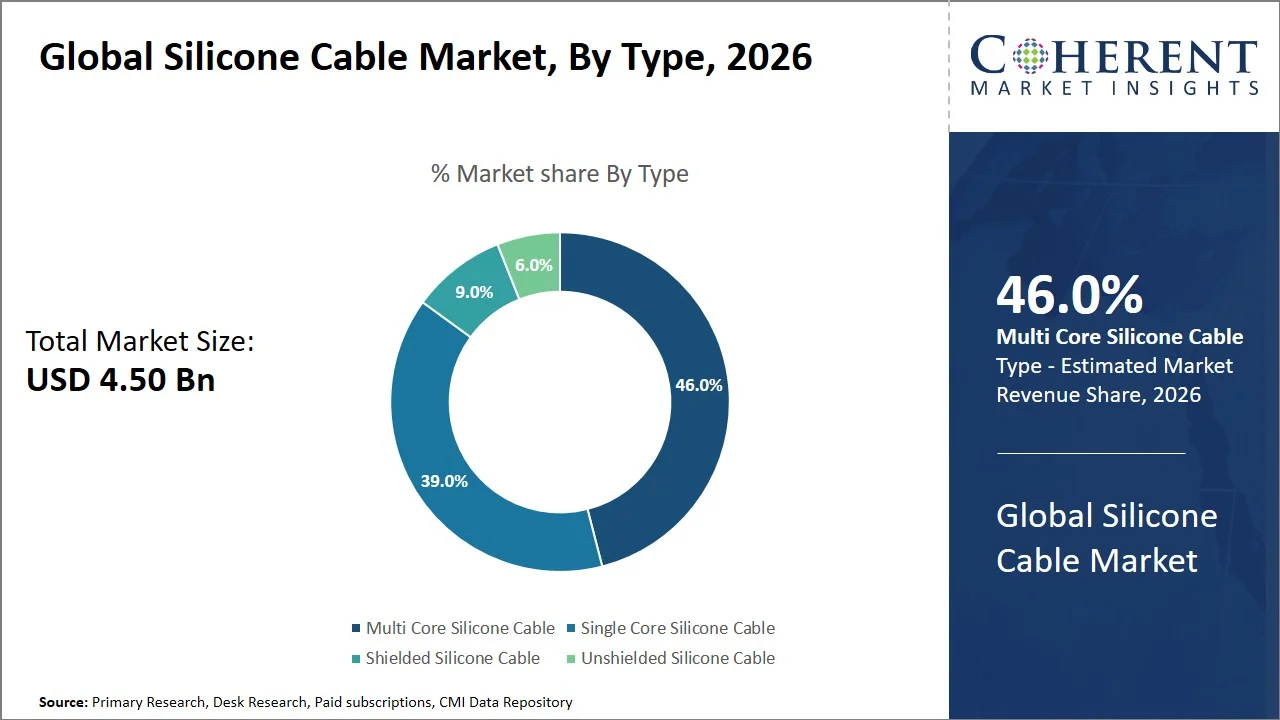
Why Does Multi Core Silicone Cable Dominate the Global Silicone Cable Market?
The multi core silicone cable segment is expected to account for 46.0% of the global silicone cable market share in 2026. Multi core silicone cable is commonly preferred since it allows numerous power, control and signal circuits to be incorporated into a single compact cable assembly, thus decreasing installation complexity and space requirements. This design enhances cable management, shortens installation time, increases system reliability and reduces maintenance across industrial automation equipment, robotics, railway systems, renewable energy installations and advanced manufacturing facilities making it the preferred solution for applications requiring high flexibility and dependable performance at elevated temperatures. On August 28, 2025, Belden Inc. announced the launch of several new products designed to enhance performance, security and reliability across automation and smart infrastructure environments. The launch includes the Belden Classics Essential-Lite - LSZH IEC-EN Rated Cables which offer enhanced analog and serial data performance, along with a Low Smoke Zero Halogen rating for standard indoor environments.
- Current Industry Events of 2026
- Market Size Estimation
- Regional Breakdown
- Competitive Landscape
- Customer Intelligence
- Segmental Analysis
- Pricing Analysis
- Key Market Drivers, Challenges & Future Trends
- Customized Insights Section
Why is Low the Most Preferred Voltage?
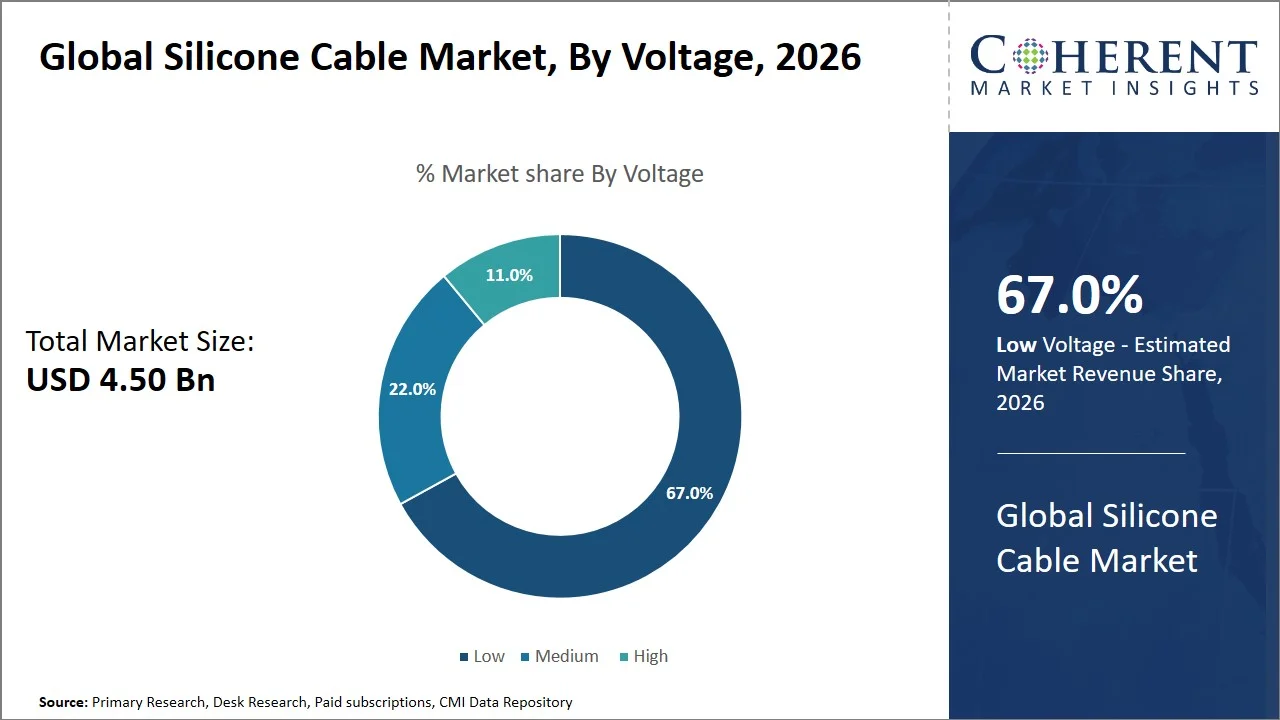
The low segment is expected to account for 67.0% of the global silicone cable market share in 2026. Low voltage silicone cable is favored, since it is widely used in industrial automation, machinery, consumer electronics, medical equipment, electric vehicles and building electrical systems. Reliable power transfer, flexibility and high temperature resistance are necessary. Its ease of installation, cheaper system costs and compliance to high electrical safety regulations combined with its adaptability to the biggest established base of low voltage electrical infrastructure has made it the favored choice for a broad range of commercial and industrial applications. In October 2025, Nexans announced the launch of its Nexans Protect low-voltage cable series dedicated to commercial buildings and high-rise infrastructure. The new range delivers improved fire-resistant low-voltage cable technology that aims to increase electrical safety and meet with more demanding European fire protection standards. Nexans’ new range solidifies its position in premium low voltage construction and industrial cable applications.
Industrial Equipment Dominates the Global Silicone Cable Market
The industrial equipment segment is expected to account for 31.0% of the global silicone cable market share in 2026. The greatest demand is seen in industrial equipment where cables must endure constant exposure to high temperatures, mechanical stress, vibration, oils and harsh chemicals without losing electrical performance in manufacturing facilities, process plants, robotics and automated production lines. For motors, control panels, sensors, furnaces and automated machines working in harsh environments, silicone cables are the wiring choice because of their better thermal stability, flexibility and long service life under tough industrial settings. In March 2026, HELUKABEL has expanded its industrial cable portfolio with increased logistics and product availability for automation, robotics and machine-building customers throughout North America. The expansion increases the availability of flexible industrial cables for control panels, automated machinery and production equipment in harsh conditions.
Current Events and their Impact
Current Events | Description and its Impact |
European Union - Ecodesign for Sustainable Products Regulation (ESPR) (Regulation (EU) 2024/1781) |
|
European Union - Construction Products Regulation (EU) 2024/3110 |
|
Global Silicone Cable Market Dynamics
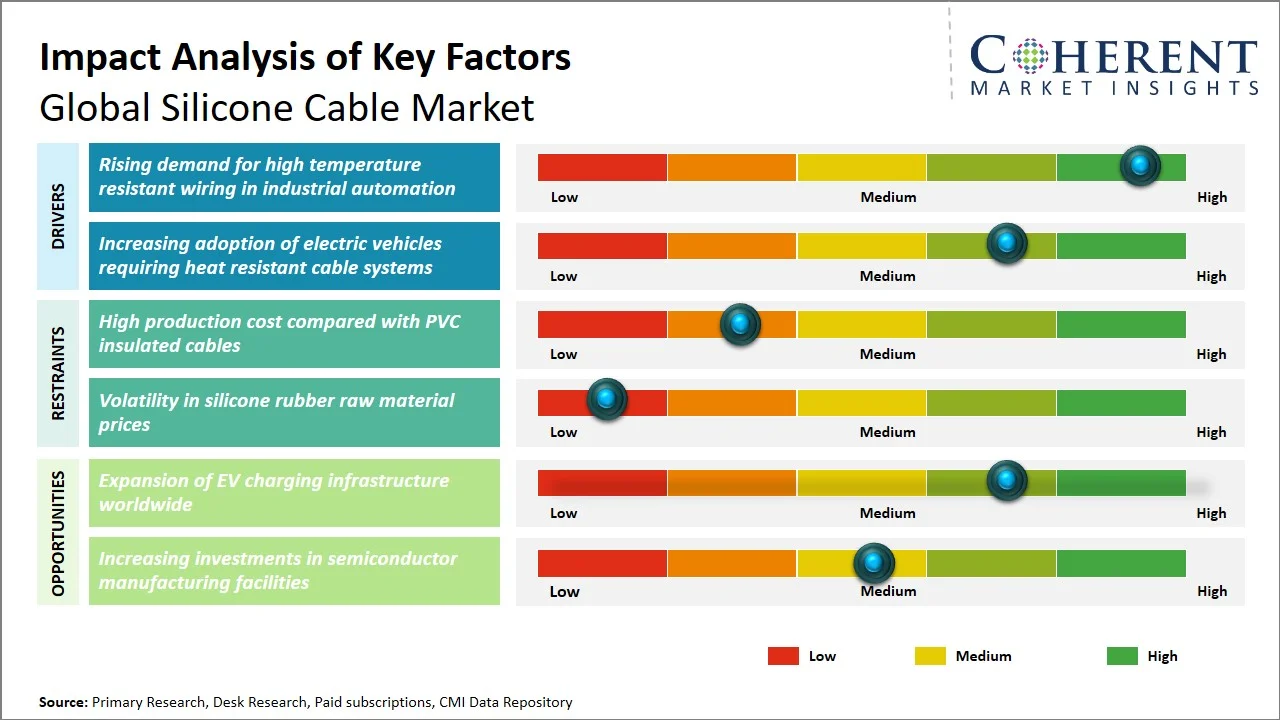
Market Drivers
- Rising demand for high temperature resistant wiring in industrial automation: Industrial automation systems are increasingly operating in environments with high temperature, frequent vibration, oils, chemicals, and constant mechanical movement, creating a significant demand for highly durable wiring solutions. Silicone cables offer excellent electrical insulation, flexibility and mechanical properties at temperatures beyond the range of conventional PVC cables, making them ideal for robotics, conveyor systems, furnaces, CNC machines, process automation equipment and automated production lines where continuous operation and long service life are required. In September 2025, SAB Bröckskes expanded its portfolio of Besilen silicone high-temperature cables with continuous-flex cable solutions for steel plants, foundries, robotics, conveyor systems and automated processing equipment for temperatures up to +180 °C with halogen-free insulation.
- Increasing adoption of electric vehicles requiring heat resistant cable systems: The exponential growth in electric vehicle manufacturing is fueling the demand for silicone cables owing to the high heat generated during the operation of battery packs, power electronics, charging systems, electric motors and thermal management units. Silicone insulated cables offer excellent thermal stability, flame resistance, flexibility and electrical reliability in high temperature environments, making them ideal for safer, more efficient power distribution, supporting the industry’s focus on vehicle performance, lightweight designs and long-term durability. On July 22, 2025, HUBER+SUHNER, a leading global supplier of electrical and optical connectivity solutions, announced the debut of its new Direct Current (DC) high-power charging system RADOX HPC200, as an extension of the company’s renowned RADOX HPC portfolio.
Emerging Trends
- Expansion of automation, robotics, and semiconductor manufacturing facilities: The proliferation of smart factories, industrial robots and semiconductor fabrication plants is driving demand for silicone cables capable of continuous flexing, higher temperatures and chemically aggressive production environments while delivering signal integrity.
- Increasing use in renewable energy and grid modernization projects: Silicone cables are finding more and more applications in solar power plants, wind turbines, battery energy storage systems and smart grid infrastructure due to their excellent UV resistance, weatherability and ability to perform reliably in extreme temperature ranges and outdoor conditions.
Regional Insights
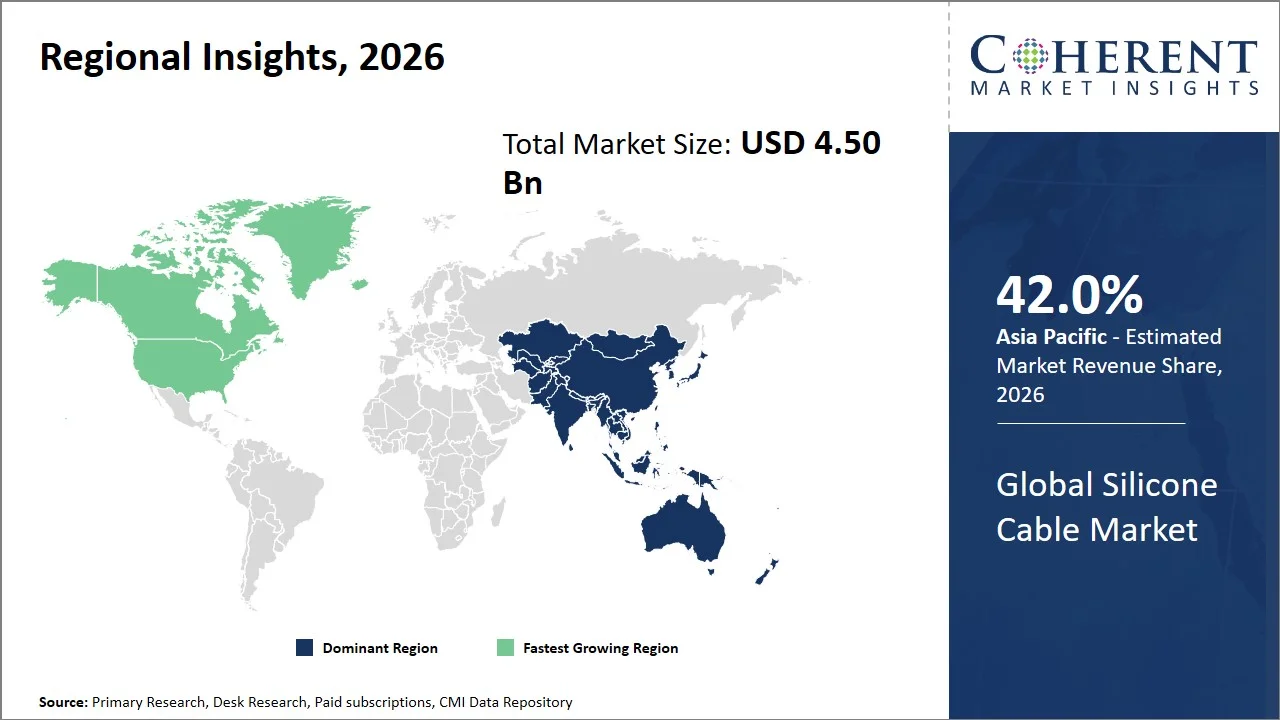
Why is Asia Pacific a Strong Market for Silicone Cables?
Asia Pacific is expected to account for a market share of 42.0% in 2026. Asia Pacific is the greatest manufacturing hub for silicone cables due to the concentration of electronics industry, electric vehicle manufacturing, investments in renewable energy and industrial automation initiatives. China, Japan, South Korea and India have big production sites for electric motors, robotics, semiconductors, solar modules and battery systems which require silicone cables that can operate continuously at high temperatures. LS Cable & System, Sumitomo Electric, Furukawa Electric and local Chinese makers are all increasing output of high-performance cables to serve automation equipment, rail infrastructure and photovoltaic systems. The region also benefits from large-scale railway electrification projects, semiconductor fabrication investments, and increasing deployment of battery energy storage systems requiring flame-resistant and flexible silicone insulated wiring.
Why Does the North America Silicone Cable Market Exhibit High Growth?
North America is projected to account for 28.0% of the global silicone cable market in 2026 and is expected to register the fastest growth. North America represents a technologically advanced market driven by aerospace, electric vehicles, semiconductor manufacturing, industrial automation, and renewable energy infrastructure. The U.S. hosts major manufacturing facilities operated by Tesla, Intel, Micron, Texas Instruments, and aerospace manufacturers that require high-temperature cable systems for production equipment and critical electrical installations. Silicone cable demand is also supported by expanding battery manufacturing projects in states such as Nevada, Texas, Ohio, and Tennessee, while modernization of power infrastructure and increasing deployment of industrial robots across automotive manufacturing plants continue to strengthen consumption of heat-resistant flexible cables.
Global Silicone Cable Market Outlook for Key Countries
Why is China Emerging as a Major Hub in the Silicone Cable Market?
China is the world's largest consumer of silicone cable due to its massive manufacturing base for electric vehicles, industrial machinery, renewable energy equipment and consumer electronics. Silicone cables are needed by BYD, CATL, Huawei Digital Power, LONGi Green Energy and Goldwind to make batteries, solar inverters, wind turbines and energy storage devices that must operate in extreme heat circumstances. The government’s investment in advanced manufacturing, high-speed rail expansion, semiconductor fabrication facilities, and intelligent factory development has driven a huge need for fire-resistant and high-flexibility silicone cables in industrial applications.
Is the U.S. the Next Growth Engine for the Silicone Cable Market?
The U.S. silicone cable market is being pushed by strong investment in manufacture of electric vehicles, aerospace, data centers, semiconductor fabrication and industrial automation. A large battery manufacturing facility has been set up by Tesla, Panasonic, LG Energy Solution, Samsung SDI and General Motors, where battery assembly equipment, thermal management systems and automated production lines need silicone insulated wires. Growth is also driven by semiconductor fabrication initiatives like Intel, TSMC Arizona, Micron and Texas Instruments where silicone cables are widely employed in cleanroom automation equipment, process control systems and high temperature manufacturing environments.
Germany Silicone Cable Market Analysis and Trends
With Germany being the largest market for silicone cables in Europe, it leads the way in industrial automation, automotive engineering, railway technology and machinery manufacture. In highly automated manufacturing facilities operated by companies such as Siemens, Bosch, BMW, Mercedes-Benz, Volkswagen and BASF, the robots, conveyor systems and industrial control equipment are dependent upon durable high temperature cable systems. The demand for quality silicone insulated cables that can handle continuous heat and mechanical stress continues to be driven by the significant adoption of Industry 4.0 technologies in the country, as well as the growth of electric vehicle production and renewable energy infrastructure.
Japan Silicone Cable Market Analysis and Trends
Japan has a strong position in the areas of advanced manufacturing, robotics, electronics, railway systems and car manufacture, all of which require extremely durable silicone cable solutions. Silicone cables are used in robotic systems, factory automation equipment, semiconductor production machinery and electric vehicle components. Manufacturers such as Toyota, Honda and Nissan, Mitsubishi Electric, FANUC, Yaskawa Electric and Keyence use silicone cables where thermal stability and long operational life are critical. Continued investment in the manufacture of semiconductors, factory automation and next generation mobility technologies further boosts the demand for specialized high temperature silicone cable products.
India Silicone Cable Market Analysis and Trends
Supported by expanding domestic manufacturing, renewable energy growth, railway modernization and electric car production, India is becoming a fast-growing silicone cable industry. Manufacturing facilities of Tata Motors, Mahindra Electric, Ola Electric, TVS Motor, Siemens India, ABB India and Bharat Heavy Electricals require silicone cables for automated production lines, battery manufacturing, electrical equipment and industrial machinery. The widespread adoption of high-performance silicone insulated cable systems in industrial and infrastructure sectors is being propelled by a variety of government initiatives such as production-linked incentive schemes for electronics, advanced chemistry cell battery manufacturing, semiconductor fabrication, and the expansion of metro rail and solar power projects.
Global Silicone Cable Market - Global Production Capacity By Manufacturer (2025)
Manufacturer | Headquarters | Estimated production capacity (Million meters/year) |
Prysmian Group | Italy | 520–560 |
Nexans | France | 440–480 |
LEONI AG | Germany | 340–370 |
LS Cable & System | South Korea | 300–330 |
Furukawa Electric | Japan | 250–280 |
Sumitomo Electric | Japan | 230–260 |
LAPP Group | Germany | 210–240 |
HELUKABEL | Germany | 180–210 |
Belden Inc. | U.S. | 170–190 |
SAB Bröckskes | Germany | 110–130 |
How is the Expansion of EV Charging Infrastructure Worldwide Creating New Growth Opportunities in the Global Silicone Cable Market?
The rapid deployment of ultra-fast DC charging infrastructure is creating big opportunities for silicone cable manufacturers as charging stations in the 150 kW to 400 kW range generate a lot of heat inside power distribution units, liquid-cooled charging connectors and high-current cable assemblies. Silicone insulated cables are increasingly used in charging cabinets, power conversion modules, transformer connections, battery energy storage interfaces and thermal management systems, as they can maintain flexibility and electrical insulation over a wide range of operating temperatures and repetitive charging cycles. Large charging network operators such as Tesla Supercharger, Ionity, Electrify America, ChargePoint, ABB E-mobility, Siemens and Kempower are deploying high power charging systems that require flame-resistant, UV-resistant and weather-resistant wiring capable of operating continuously outdoors. The integration of renewable energy and battery storage with EV charging hubs is further driving the demand for high-performance silicone cable solutions in next-generation charging infrastructure.
On February 4, 2025, IONNA, the joint venture founded by the world’s leading automakers BMW, General Motors, Honda, Hyundai, Kia, Mercedes-Benz, Stellantis, and Toyota, announced its transition from public beta to full-scale national release. This milestone marks a historic moment for the American road, as eight global automakers join at the first ever IONNA Rechargery in Apex, NC, and new HQ and Customer Experience Lab in Durham, NC.
Market Players, Key Development, and Competitive Landscape
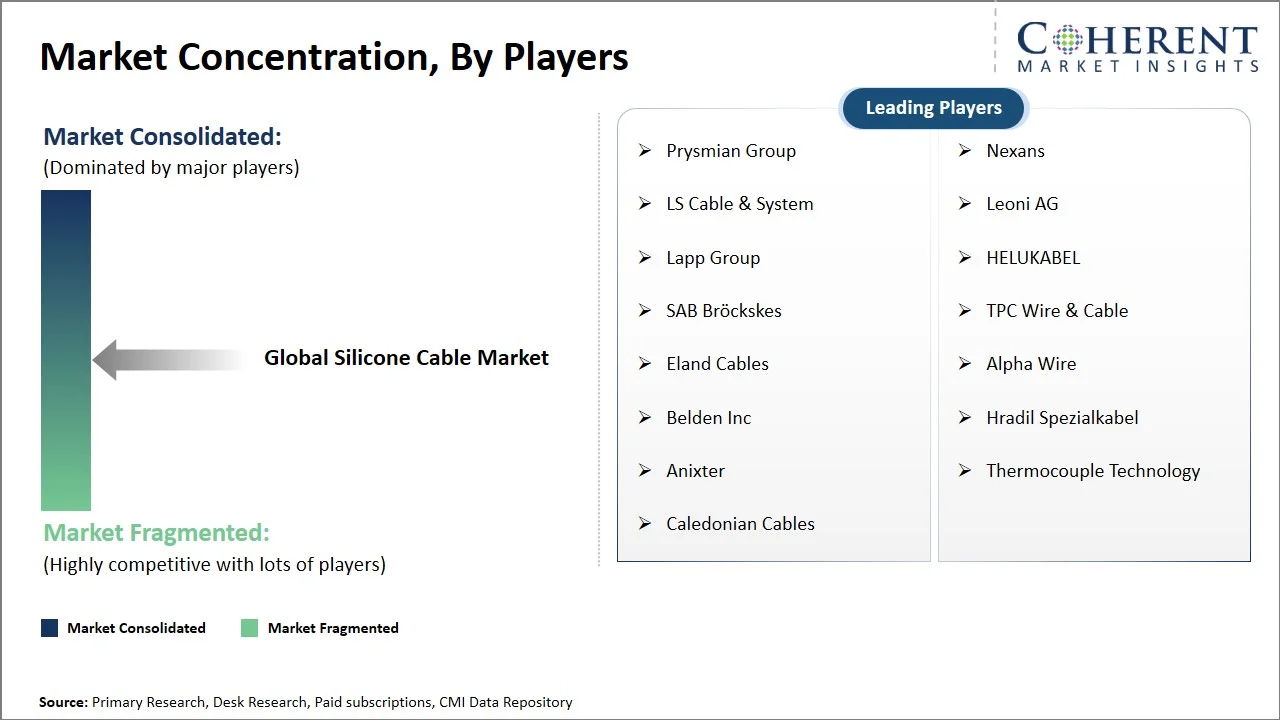
Key Developments
- On July 20, 2026, Prysmian announced that it has completed the acquisition of Encore Wire Corporation. The acquisition will strengthen Prysmian’s leadership position in North America. Prysmian will benefit from enhanced cross-selling opportunities, as well as the efficiency and innovation within Encore Wire’s unique production, distribution process and service levels.
- On July 2, 2024, Prysmian signed an up to USD 6.27 billion long-term agreement, which includes a USD 626.7 million upfront payment, with Molex, part of the large private U.S. company Koch Inc., for a period of up to 10 years, for the supply of optical cables to be deployed inside data centers.
Competitive Landscape
The global silicone cable market is led by Prysmian Group, Nexans, Leoni AG, LS Cable & System, LAPP Group, HELUKABEL, SAB Bröckskes, Belden Inc., and Alpha Wire, with competition centered on high-temperature industrial cables, EV-grade wiring, railway-certified products, and renewable energy applications rather than commodity cable production. Prysmian has expanded its focus on electrification and grid infrastructure while strengthening its fire-resistant and industrial cable portfolio, Nexans continues investing in electrification and sustainable cable manufacturing for renewable energy and industrial facilities, and LS Cable & System is leveraging its expertise in EV charging infrastructure and battery manufacturing supply chains across Asia. LAPP Group and HELUKABEL are emphasizing factory automation, robotics, and motion-control cables for Industry 4.0 applications, while Belden and Alpha Wire continue developing high-flexibility silicone cables for semiconductor manufacturing equipment, medical devices, and process automation where thermal stability, chemical resistance, and continuous flex performance are critical purchasing factors.
Market Report Scope
Silicone Cable Market Report Coverage
| Report Coverage | Details | ||
|---|---|---|---|
| Base Year: | 2025 | Market Size in 2026: | USD 4.50 Bn |
| Historical Data for: | 2020 To 2024 | Forecast Period: | 2026 To 2033 |
| Forecast Period 2026 to 2033 CAGR: | 3% | 2033 Value Projection: | USD 6 Bn |
| Geographies covered: |
| ||
| Segments covered: |
| ||
| Companies covered: | Prysmian Group, Nexans, LS Cable & System, Leoni AG, Lapp Group, HELUKABEL, SAB Bröckskes, TPC Wire & Cable, Eland Cables, Alpha Wire, Belden Inc, Hradil Spezialkabel, Anixter, Thermocouple Technology, and Caledonian Cables | ||
| Growth Drivers: |
| ||
| Restraints & Challenges: |
| ||
Analyst Opinion (Expert Opinion)
- The strongest long-term growth is expected to come from the convergence of electric vehicle manufacturing, battery gigafactories, semiconductor fabrication plants, and industrial automation rather than from traditional electrical wiring applications. Demand is likely to shift toward premium silicone cables capable of operating continuously in high-temperature, chemically aggressive, and high-flex environments, creating higher value opportunities than conventional insulated cable products.
- The most attractive opportunity is expected to be multi core silicone cable used in industrial equipment and EV battery manufacturing in China, where large-scale investments in battery production, robotics, semiconductor fabrication, and renewable energy equipment continue to expand. Additional high-growth opportunities are expected in the U.S. for semiconductor fabs and EV charging infrastructure, and in Germany for automated manufacturing systems and industrial robotics.
- Manufacturers should focus less on price competition and more on developing halogen-free, low-smoke, high-flex silicone cables that are certified for robots, cleanroom equipment, battery production lines and ultra-fast EV charging systems. Building partnerships with OEMs such as industrial robot manufacturers, EV charging equipment suppliers, battery system integrators, and semiconductor equipment manufacturers, while expanding application-specific certifications for railway, aerospace, and medical industries, will provide a stronger competitive advantage than increasing production capacity alone.
Speak to the analyst
Want personalized insights?
Take the findings above to one of our principal consultants, or have the report rebuilt around the segments, geographies and competitors you actually track.
Market Segmentation
- Type Insights (Revenue, USD Billion, 2021 - 2033)
- Multi Core Silicone Cable
- Single Core Silicone Cable
- Shielded Silicone Cable
- Unshielded Silicone Cable
- Voltage Insights (Revenue, USD Billion, 2021 - 2033)
- Low
- Medium
- High
- Application Insights (Revenue, USD Billion, 2021 - 2033)
- Industrial Equipment
- Automotive
- Aerospace
- Railway
- Medical Devices
- Renewable Energy
- Electronics
- Power Generation
- Regional Insights (Revenue, USD Billion, 2021 - 2033)
- North America
- U.S.
- Canada
- Latin America
- Brazil
- Argentina
- Mexico
- Rest of Latin America
- Europe
- Germany
- U.K.
- Spain
- France
- Italy
- Russia
- Rest of Europe
- Asia Pacific
- China
- India
- Japan
- Australia
- South Korea
- ASEAN
- Rest of Asia Pacific
- Middle East
- GCC Countries
- Israel
- Rest of Middle East
- Africa
- South Africa
- North Africa
- Central Africa
- North America
- Key Players Insights
- Prysmian Group
- Nexans
- LS Cable & System
- Leoni AG
- Lapp Group
- HELUKABEL
- SAB Bröckskes
- TPC Wire & Cable
- Eland Cables
- Alpha Wire
- Belden Inc
- Hradil Spezialkabel
- Anixter
- Thermocouple Technology
- Caledonian Cables
Sources
Primary Research Interviews
- Industrial automation system manufacturers
- Electric vehicle OEMs and battery manufacturers
- Railway rolling stock manufacturers
- Renewable energy EPC contractors
Magazines
- IEEE Electrical Insulation Magazine
- Electrical Review
- Power Engineering International
- Transmission & Distribution World
- Electrical Products & Solutions
Journals
- IEEE Transactions on Dielectrics and Electrical Insulation
- IEEE Transactions on Power Delivery
- Journal of Materials Science: Materials in Electronics
Associations
- International Electrotechnical Commission
- Institute of Electrical and Electronics Engineers
- Insulated Cable Engineers Association
Public Domain Sources
- U.S. Department of Energy (DOE)
- U.S. Energy Information Administration (EIA)
- Eurostat
Proprietary Elements
- CMI Data Analytics Tool
- Proprietary CMI Existing Repository of Information for the Last 10 Years
Get access to 250+ pages report
Every segment, forecast, competitor profile and data table behind the analysis above — available for instant download.
- ESOMAR Member
- ISO 9001:2015 Certified
- D-U-N-S Registered
- GDPR & CCPA Compliant
Missing comfort of reading report in your local language? Find your preferred language:
Transform your Strategy with Exclusive Trending Reports
Frequently Asked Questions
The global silicone cable market is expected to stand at USD 4.50 Bn in 2026 and is expected to reach USD 6 Bn by 2033.
The CAGR of the global silicone cable market is projected to be 3% from 2026 to 2033.
Rising demand for high temperature resistant wiring in industrial automation and increasing adoption of electric vehicles requiring heat resistant cable systems are the major factors driving the growth of the global silicone cable market.
High production cost compared with PVC insulated cables and volatility in silicone rubber raw material prices are the major factors hampering the growth of the global silicone cable market.
In terms of type, the multi core silicone cable segment is estimated to dominate the market revenue share in 2026.
They withstand continuous flexing, vibration, and elevated temperatures without performance loss.
Yes, they offer excellent resistance to many industrial oils, chemicals, and environmental conditions