

Global Single Origin Coffee Market Size and Forecast – 2026 To 2033
The Global Single Origin Coffee Market is estimated to be valued at USD 5.68 Bn in 2026 and is expected to reach USD 10.18 Bn by 2033, growing at a compound annual growth rate (CAGR) of 8.7% from 2026 to 2033. Market expansion reflects stronger consumer preference for premium, traceable, and ethically sourced coffee, alongside wider availability through specialty retail, cafés, e-commerce, and convenient brewing formats. Interest in origin-specific flavor characteristics and transparent sourcing is also encouraging roasters to differentiate offerings by country and producing region.
In August 2025, Nespresso Professional launched Indonesia Fairtrade coffee, produced from single-origin Arabica beans sourced from Aceh, Indonesia, under Fairtrade standards and its AAA Sustainable Quality Program; the coffee’s distinctive profile is also linked to the region’s traditional wet-hulling process. This development illustrates how ethical sourcing, provenance, and distinctive sensory characteristics are being combined within commercially scaled single origin portfolios
Key Takeaways of the Global Single Origin Coffee Market
- Whole Bean Coffee is estimated to expand at a 9.4% CAGR during 2026–2033 and is expected to capture 42.8% of the global single origin coffee market in 2026, because grinding immediately before preparation preserves volatile aromatics and lets consumers match grind size to brewing method. In January 2025, Starbucks introduced Single-Origin Ethiopia as packaged whole bean coffee across North America, validating format-led origin merchandising.
- Medium Roast is estimated to grow at an 8.9% CAGR during 2026–2033 and is projected to hold 43.6% of the market in 2026, as its roast development preserves recognizable origin character while delivering the sweetness and body needed for broad brewing versatility. In June 2025, the Specialty Coffee Association reported medium roast as the preferred roast among U.S. specialty coffee drinkers, reinforcing mainstream specialty appeal.
- Single Country Origin is estimated to advance at a 9.1% CAGR during 2026–2033 and is expected to represent 46.7% of the market in 2026, because country-level provenance offers a scalable bridge between anonymous blends and narrower estate lots while supporting recognizable origin stories. In May 2025, Lavazza Group documented the international launch of its fully traceable La Reserva de ¡Tierra! Cuba coffee, backed by blockchain-enabled supply-chain information.
- North America is estimated to register an 8.2% CAGR during 2026–2033 and is expected to account for 34.6% of the global single origin coffee market in 2026, supported by frequent coffee consumption, developed specialty-roaster networks, premium at-home preparation, and strong direct-to-consumer discovery. In April 2026, the National Coffee Association reported that nearly 195 million U.S. adults drank coffee each week, sustaining a deep addressable buyer base.
- Europe is estimated to post a 10.0% CAGR during 2026–2033 and is expected to hold 31.7% of the market in 2026, making it the fastest-growing region as local roasting capacity, direct green-coffee sourcing, certification demand, and tighter traceability requirements improve conditions for differentiated origins. In February 2026, CBI identified particular European opportunities for specialty and certified coffee and highlighted value expansion through premiumization.
Segmental Insights
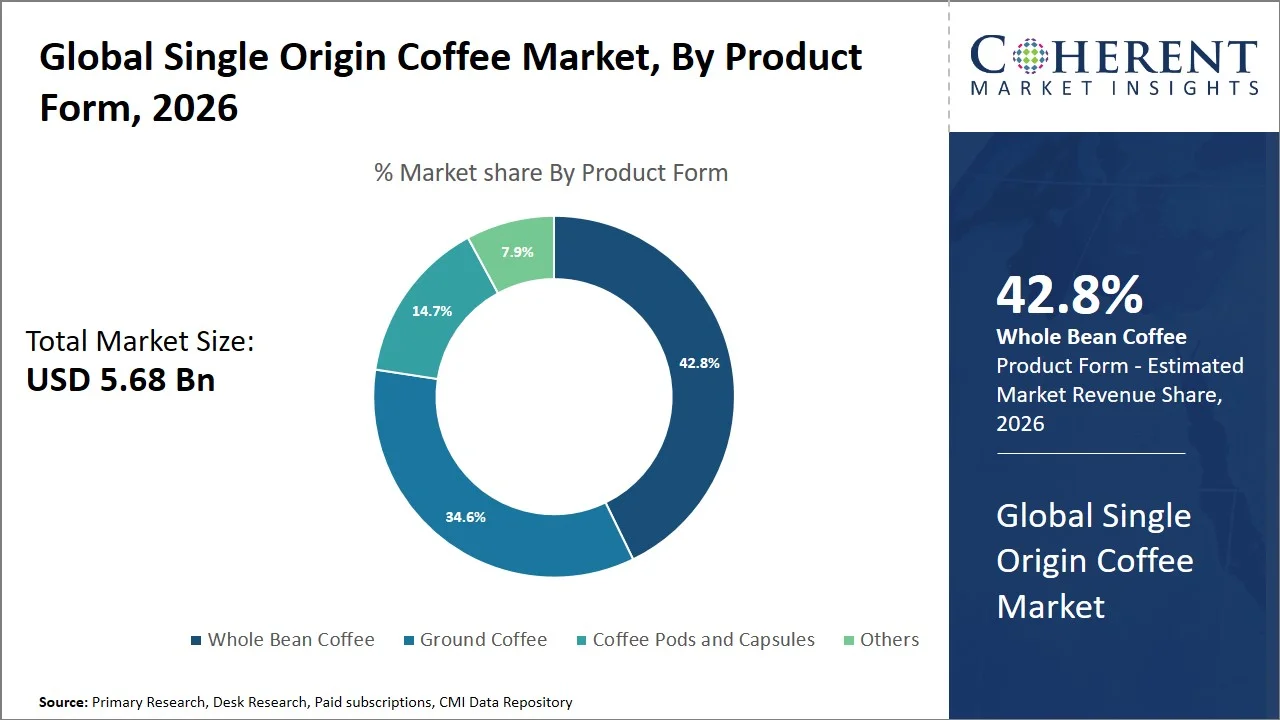
Why Does Whole Bean Coffee Dominate the Global Single Origin Coffee Market?
Whole Bean Coffee is expected to account for 42.8% of the global single origin coffee market in 2026 because the format gives buyers greater control over grind size, extraction, and freshness while protecting volatile aromatics until preparation. This makes whole beans particularly suitable for pour-over, French press, espresso, and bean-to-cup machines, where consumers can adjust brewing variables to showcase origin-specific character. On the supply side, specialty roasters can sell the same roasted lot across multiple brewing occasions without maintaining separate grind inventories, supporting assortment flexibility and premium pricing. Subscription and direct-to-consumer models further favor fresh bean delivery. In July 2026, Peet’s Coffee released Panama Don Bosco as a limited single-origin coffee with a whole-bean purchase option, hand-roasted and sealed after roasting, demonstrating how premium origin releases are commercialized around freshness and home grinding.
- Current Industry Events of 2026
- Market Size Estimation
- Regional Breakdown
- Competitive Landscape
- Customer Intelligence
- Segmental Analysis
- Pricing Analysis
- Key Market Drivers, Challenges & Future Trends
- Customized Insights Section
Why Does Medium Roast Represent the Largest Roast Type in the Global Single Origin Coffee Market?
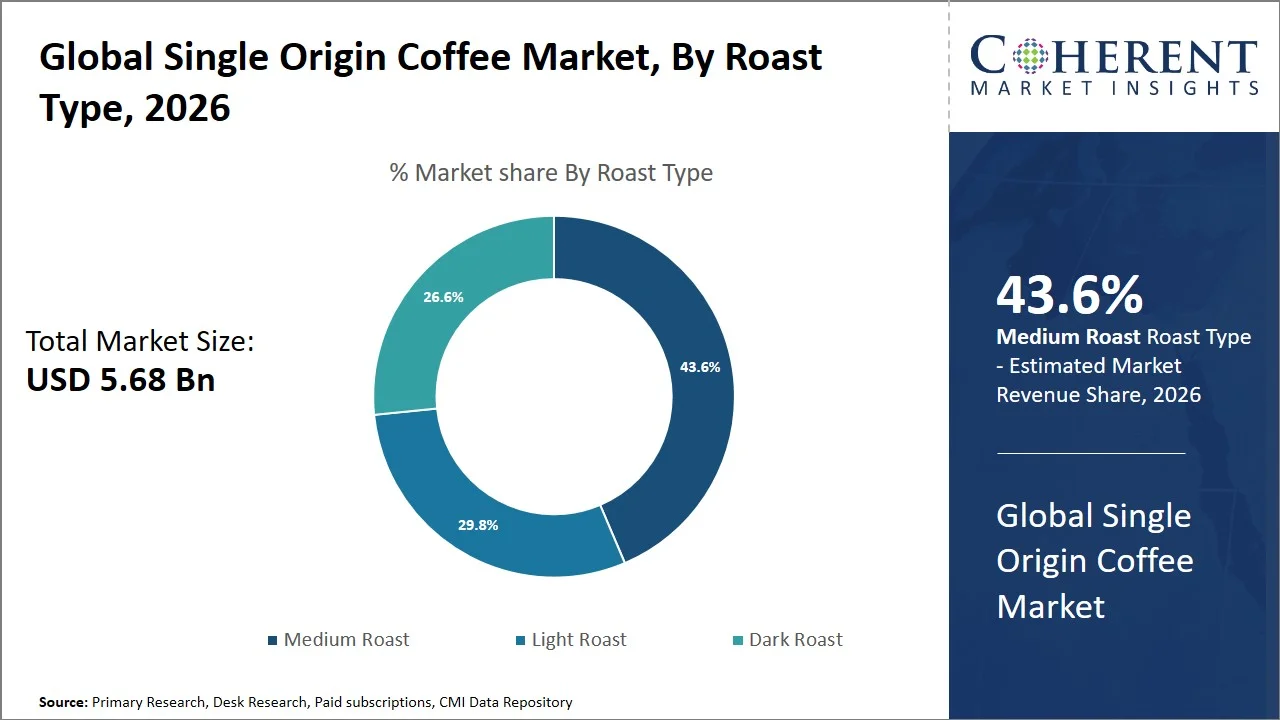
Medium Roast is expected to represent 43.6% of the global single origin coffee market in 2026 because it provides a commercially useful middle ground between preserving origin-specific acidity and developing sweetness, body, and roast-derived complexity. This balance broadens its suitability across filter coffee, espresso, milk-based beverages, and everyday café menus, allowing roasters to serve both specialty consumers and buyers seeking approachable flavor. Medium roasting also gives producers and roasters room to highlight processing characteristics without the sharper acidity associated with lighter profiles or heavier roast influence of darker coffees. Its versatility supports retail, hospitality, and foodservice adoption. In June 2025, Bangchak Retail’s Inthanin showcased Single Origin Doi Mae Salong, a premium medium-roast Arabica produced from Royal Project highland coffee using washed processing, directly illustrating the use of medium roasting to communicate regional origin and refined sensory attributes.
Why Does Single Country Origin Dominate the Origin Type of the Global Single Origin Coffee Market?
Single Country Origin is expected to capture 46.7% of the global single origin coffee market in 2026 because country-level sourcing offers stronger scalability and recognition than highly restricted farm or micro-lot programs while retaining a clear provenance proposition. Buyers can associate established origins such as Colombia, Ethiopia, Brazil, or Costa Rica with recognizable sensory expectations, making labeling, merchandising, and consumer education more straightforward. For roasters and distributors, sourcing across multiple farms within one country also reduces dependence on a single harvest while preserving an origin-specific claim, improving continuity for grocery, foodservice, and institutional accounts. In April 2026, Green Coffee Company disclosed in an SEC annual filing that Colombia represented approximately 70% of U.S. single-origin coffee sales and detailed its vertically integrated supply of traceable Colombian coffee into U.S. and Canadian channels, demonstrating the commercial scalability of country-defined origin positioning.
Current Events and their Impact
Current Event | Description and Its Impact |
|
EU Deforestation Regulation Implementation Measures – July 2026 |
| |
United Kingdom Sets Out New Deforestation-Regulation Approach Covering Coffee – June 2026 |
| |
EU Packaging and Packaging Waste Regulation Begins General Application – August 2026 |
| |
Global Single Origin Coffee Market Dynamics
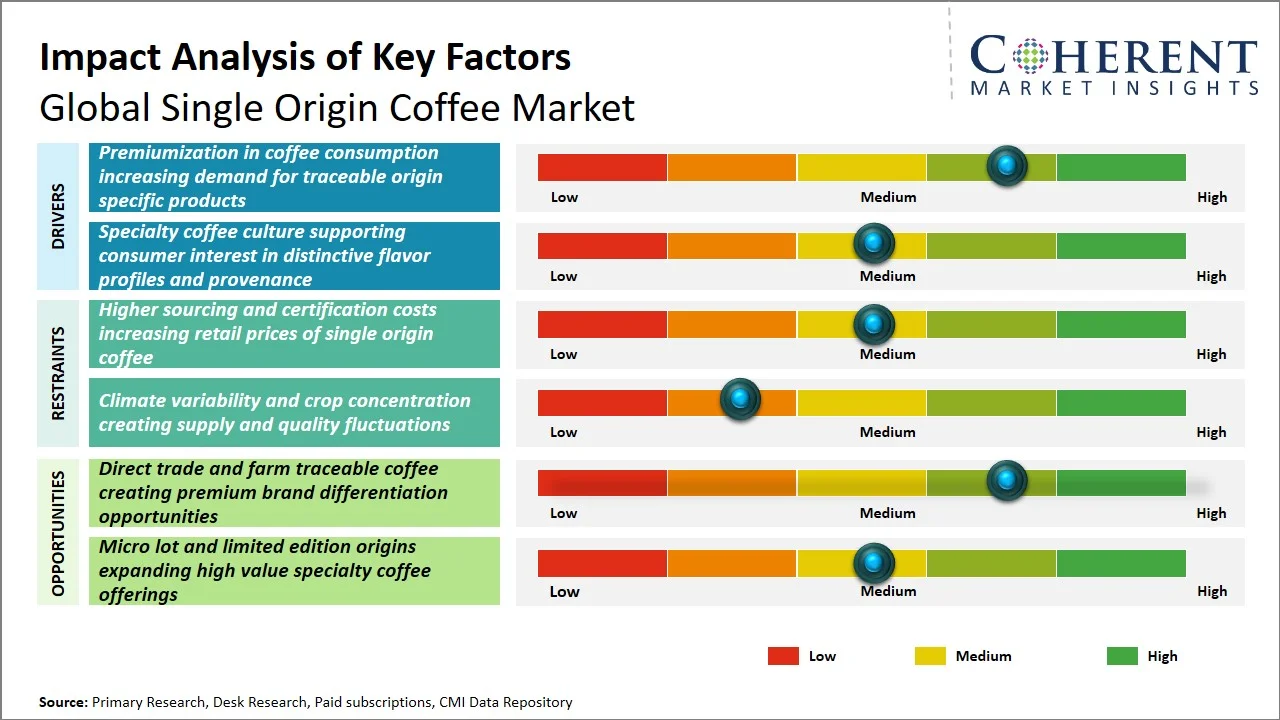
Key Market Drivers
- Premiumization in Coffee Consumption Increasing Demand for Traceable Origin Specific Products: Premiumization in coffee consumption is shifting single origin coffee from a niche tasting proposition into a value-accretive category in which provenance, rarity, producer identity, processing method, and sensory distinction justify wider price ladders. This mechanism benefits estate owners, specialty exporters, importers, roasters, cafés, and direct-to-consumer brands because differentiated lots can be merchandised with clearer quality narratives instead of competing primarily on commodity benchmarks. It also encourages tighter lot separation, better post-harvest handling, and more selective green-bean procurement, supporting margin expansion where quality is verifiable. In August 2025, the Specialty Coffee Association of Panama reported that a 20-kilogram washed Geisha lot from Hacienda La Esmeralda sold for US$ 604,080 at the Best of Panama auction, illustrating how exceptional origin-linked quality can attract global buyers willing to pay extraordinary premiums for scarce, traceable coffees.
- Specialty Coffee Culture Supporting Consumer Interest in Distinctive Flavor Profiles and Provenance: Specialty coffee culture is broadening the commercial meaning of origin by training consumers to recognize differences created by altitude, variety, processing, harvest timing, and roast profile. As buyers become more comfortable with sensory language and brew-specific preparation, single origin products gain relevance beyond enthusiast cafés and can move through subscriptions, premium retail, espresso programs, and home-brewing channels. Roasters, specialty cafés, green-coffee importers, washing stations, and quality-focused growers benefit because distinctive flavor becomes a basis for assortment planning and repeat discovery rather than a one-time novelty. In May 2025, Intelligentsia released its Ethiopia Guji Jigesa Single Origin Espresso, detailing village-level sourcing, premium cherry selection, washed processing, and a defined black-cherry, baking-spice, and honey profile, demonstrating how specialty operators convert provenance and processing detail into a consumer-facing product proposition.
Emerging Market Trends
- Processing Method Is Becoming a Front-of-Pack Differentiator: Experimental post-harvest processing is moving from producer-side experimentation into a structured differentiation tool for single origin portfolios. Controlled anaerobic fermentation, extended fermentation, honey processing, natural drying, selective yeast use, and closely monitored washed protocols can create flavor signatures that are difficult to reproduce through roast changes alone. Over the forecast period, roasters are likely to merchandise processing method alongside country, region, estate, altitude, and variety, increasing the informational value of each lot. Producers with disciplined fermentation control and drying infrastructure can capture stronger relationships with specialty buyers, while roasters need better sensory validation to prevent inconsistency or over-fermented profiles from damaging trust. The commercial effect is a broader premium ladder: conventional washed origins can serve repeat purchase, while more experimental lots support limited editions, tasting flights, high-value subscriptions, and hospitality programs seeking differentiation without relying solely on rare varieties.
- Origin Quality Is Moving into Convenience-Led Formats: Single origin coffee is increasingly migrating into convenience-led formats without abandoning its premium identity. The category is expanding beyond traditional whole-bean rituals toward capsules, single-serve drip formats, precision-ground packs, concentrated preparations, and other formats designed to preserve origin character while reducing preparation complexity. This changes product development because roasters must optimize grind distribution, extraction behavior, oxygen control, portion consistency, and packaging protection for each brewing system rather than simply repackaging the same roast. It also changes customer expectations: consumers can seek provenance and distinct flavor while still prioritizing speed and repeatability. Established roasters with formulation, packing, and channel capabilities should gain an advantage, while smaller specialty brands may need contract manufacturing or co-packing partners to enter these formats economically. Through the forecast period, convenience is likely to become a route for premium single origin coffee to reach workplaces, hotels, travel, and less equipment-intensive households.
Regional Insights
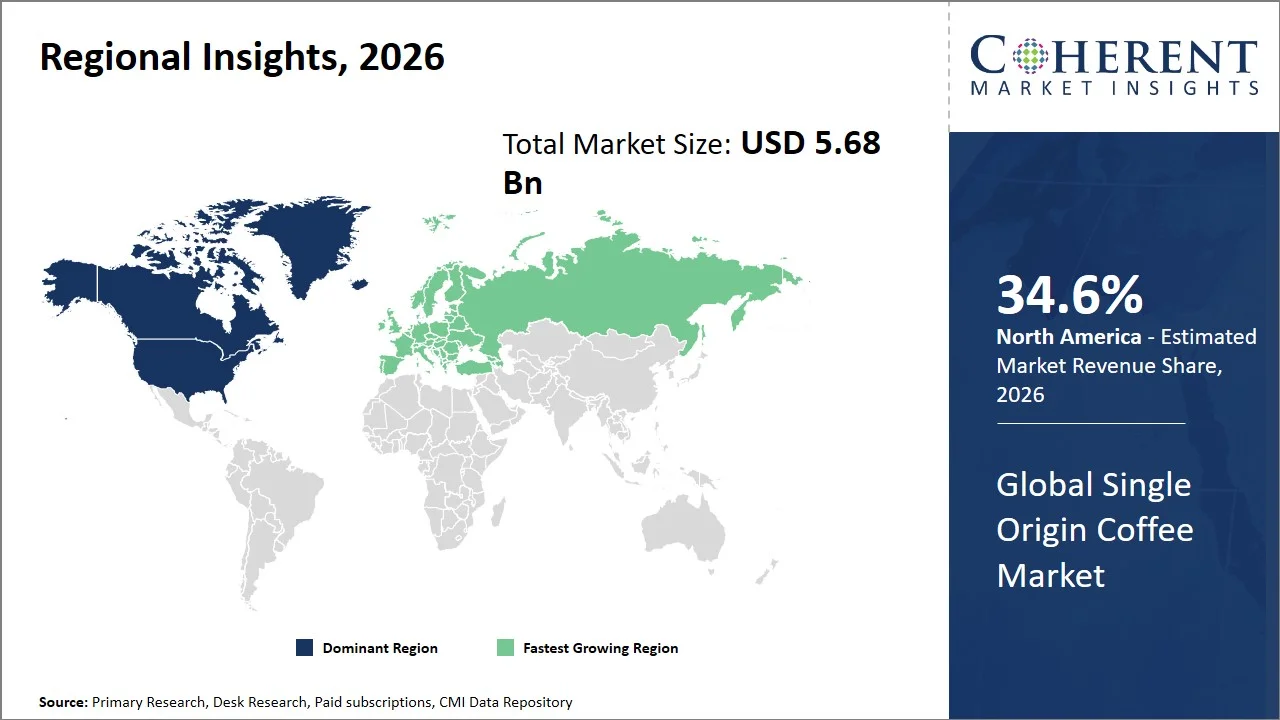
Why Does North America Dominate the Global Single Origin Coffee Market?
North America is expected to account for 34.6% of the global single origin coffee market in 2026, supported by deep specialty-coffee penetration, high household brewing frequency, mature café and roaster networks, and broad availability of premium imported Arabica. The region also has well-developed e-commerce, subscription, grocery, and direct-to-consumer channels that make rotating origin portfolios commercially viable beyond specialty cafés. U.S. consumers provide scale, while Canada adds a premium-oriented market with strong at-home coffee habits. This combination helps roasters monetize traceability, freshness, roast differentiation, and producer stories across multiple price points. In February 2026, the Coffee Association of Canada reported that 71% of Canadians had consumed a coffee beverage the previous day in its 2025 drinking-trends study, showing the resilience of regional coffee demand even as consumers adjusted purchasing behavior in response to higher prices.
Why Is Europe Emerging as the Fastest-Growing Region in the Global Single Origin Coffee Market?
Europe is expected to hold 31.7% of the global single origin coffee market in 2026 and emerge as the fastest-growing region as established roasting markets increasingly combine premium origin selection with sustainability, traceability, and quality-focused retailing. Germany, Italy, the Nordics, Benelux, France, and the U.K. support a dense network of importers, independent roasters, cafés, and specialty retailers capable of commercializing country-, region-, and estate-specific coffees. Growth is also supported by consumer familiarity with whole-bean preparation, espresso equipment, certified sourcing, and premium foodservice. In May 2025, the European Coffee Federation reported that Western Europe imported USD 3.82 million tons of green coffee in 2024, up 8.1% year over year, while EU27 imports increased 9.2%. The recovery strengthens access to diverse origins and gives European roasters greater flexibility to build differentiated single origin portfolios.
Global Single Origin Coffee Market Outlook for Key Countries
Why Is the U.S. a Key Market for the Global Single Origin Coffee Market?
The U.S. is expected to account for an estimated 28.9% share of the global single origin coffee market in 2026, making it the largest individual country market. Its importance comes from a large specialty-roaster base, widespread pour-over and espresso adoption, premium grocery distribution, subscription commerce, and strong consumer familiarity with origin labels such as Ethiopia, Colombia, Guatemala, and Brazil. The market also benefits from diversified import relationships that give roasters access to distinct harvest calendars and flavor profiles. This import structure directly supports origin-specific assortment planning rather than dependence on a narrow supplier base. In September 2024, the U.S. Department of Agriculture’s Economic Research Service reported that the U.S. was the world’s second-largest coffee importer and that historically more than 92% of its coffee imports were Arabica, underscoring the country’s strong structural fit with higher-value single origin offerings.
Why Does China Support Growth in the Global Single Origin Coffee Market?
China is expected to represent an estimated 8.8% share of the global single origin coffee market in 2026 as coffee consumption expands from first-tier cities into a broader café, retail, and digital ecosystem. Single origin demand is supported by younger urban consumers exploring flavor differentiation, rapid specialty-café formation, app-based ordering, and growing interest in domestic Yunnan coffee alongside imported origins. China also has an increasingly capable roasting and processing base, helping brands shorten product-development cycles and localize origin storytelling for domestic buyers. The clearest evidence is visible in Shanghai and Yunnan. In April 2026, the Shanghai municipal government reported that Shanghai had 10,336 coffee outlets in 2025, while the specialty rate of Yunnan-grown coffee had increased to 31.6%. This combination of consumption density and improving domestic bean quality creates a larger addressable market for traceable origin-specific coffee.
Why Is Germany a Strategic Country in the Global Single Origin Coffee Market?
Germany is expected to capture an estimated 7.6% share of the Global Single Origin Coffee Market in 2026, supported by its position as a major European coffee-importing, roasting, and consumption hub. German buyers have strong access to green coffee through established port and trading infrastructure, while household use of bean-to-cup machines and espresso equipment favors whole-bean products where origin differentiation is easier to communicate. The country also has a mature specialty-roaster scene and growing attention to certified and transparently sourced coffee, helping premium origins move beyond niche cafés into broader retail. In April 2026, the German Coffee Association reported that whole-bean coffee sales reached a record 193,800 tons in 2025, more than doubling over ten years. This structural shift toward whole beans provides a favorable format base for country-, region-, and farm-specific coffees.
Why Is Japan Important in the Global Single Origin Coffee Market?
Japan is expected to hold an estimated 6.2% share of the global single origin coffee market in 2026, reflecting a mature coffee culture built around quality, precision brewing, premium retail, and strong appreciation of provenance. The country has long-standing import relationships with multiple producing nations and a sophisticated network of roasters, kissaten-style cafés, specialty shops, department-store food halls, and convenience formats. Japanese consumers’ familiarity with hand-drip preparation and seasonal premium products creates room for carefully differentiated farm, region, and country origins. Import diversity is particularly important because domestic coffee production is limited. In August 2026, the All Japan Coffee Association reported that Japan consumed 397,272 tons of coffee in 2025 and ranked fourth globally by consumption, while green-bean imports reached 359,382 tons. This substantial imported supply base supports continuous rotation of origin-specific offerings.
Why Is Brazil an Important Growth Market for the Global Single Origin Coffee Market?
Brazil is expected to account for an estimated 3.7% share of the global single origin coffee market in 2026, with a distinctive position as both a major consuming country and the world’s largest coffee producer. Unlike import-dependent markets, Brazil can build single origin value around domestic terroirs such as Cerrado Mineiro, Mantiqueira de Minas, Matas de Minas, Mogiana, Espírito Santo, and Bahia. This gives local roasters direct access to differentiated varieties, processing styles, and producer lots while also supporting export-oriented premiumization. Domestic specialty cafés and quality competitions are improving consumer recognition of regional identity within Brazilian coffee. In November 2025, the Brazilian Specialty Coffee Association announced the winners of Cup of Excellence Brazil 2025, where 30 producers across 17 specialty coffee varieties were recognized. The breadth of winning origins reinforces Brazil’s capacity to commercialize differentiated domestic single origin portfolios.
Technology Adoption Landscape in the Global Single Origin Coffee Market
Technology | Adoption Level | Key Application Area | Business Impact |
Electronic Optical Bean Sorting | High | Green-bean defect and color sorting | Removes defective or inconsistent beans before roasting, improving cup cleanliness, lot uniformity, and premium-grade yield. |
Digital Roast-Profile Control and Curve Logging | High | Origin-specific roasting | Allows roasters to reproduce temperature, airflow, development-time, and roast parameters while adapting profiles to individual origins and harvests. |
Near-Infrared Quality Analysis | Medium | Moisture, composition, and roast verification | Accelerates non-destructive quality checks and supports tighter specifications across incoming green coffee and finished roasted batches. |
Controlled Fermentation with pH and Temperature Monitoring | Medium | Post-harvest processing at estates and washing stations | Gives producers greater control over fermentation progression, helping develop differentiated sensory characteristics while reducing uncontrolled processing variation. |
Nitrogen-Flushing and One-Way Degassing-Valve Packaging | High | Whole-bean and ground coffee preservation | Limits oxidation while allowing roasted coffee gases to escape, extending aroma retention and supporting longer-distance premium distribution. |
Precision Capsule Dosing and Hermetic Sealing Systems | Medium | Single-origin pods and capsules | Improves dose consistency, extraction repeatability, oxygen protection, and scalable production of origin-specific single-serve products. |
How Are Premium Decaffeination Capabilities Creating New Growth Opportunities in the Global Single Origin Coffee Market?
Decaffeinated and lower-caffeine single origin coffee represents an underdeveloped opportunity because most premium origin programs still organize choice around geography, roast, and processing rather than caffeine intensity. A stronger offer could serve evening coffee drinkers, wellness-oriented consumers, hospitality guests, office users, and customers who want specialty flavor without a full stimulant load. Companies can capture this space by sourcing high-quality lots that remain expressive after decaffeination, developing origin-specific roast profiles, and clearly separating decaf quality from commodity decaf positioning. Water-based, carbon-dioxide, and other selective decaffeination approaches should be evaluated for flavor retention, cost, minimum lot size, and scalability. Commercial success will also require disciplined green-bean selection, sensory testing after processing, dedicated messaging, and distribution through subscriptions, specialty cafés, premium retail, and foodservice. The opportunity should favor specialty roasters and vertically coordinated suppliers that can combine producer relationships, processing control, quality assurance, and consumer education without treating reduced caffeine as a compromise product.
Market Players, Key Development, and Competitive Landscape
Key Developments
- In July 2026, Peet's Coffee featured Panama Don Bosco as its July limited-release single origin, sourced from Finca Don Bosco in Panama and positioned within its Small Batch program. This is important for the global single origin coffee market because it demonstrates how established roasters can commercialize farm-specific harvests through controlled limited-release programs, creating scarcity while maintaining recurring customer engagement around origin-specific sensory characteristics.
- In December 2025, illycaffè introduced Arabica Selection Brasile Cerrado Mineiro in compatible capsules, extending an origin-specific Arabica offering into a convenient single-serve format. This is important for the global single origin coffee market because it connects geographic differentiation with capsule-based preparation, enabling premium origin positioning to reach consumers who prioritize consistency and convenience alongside identifiable sourcing.
- In October 2025, Nonda Coffee launched a single-origin Ugandan coffee café in Riyadh as part of its Uganda–Saudi Arabia Value-at-Source Coffee Project. This is important for the global single origin coffee market because it illustrates an origin-country brand moving further downstream into roasting, retail experience, and international distribution, allowing producing economies to capture more consumer-facing value rather than relying predominantly on green-bean exports.
Competitive Landscape
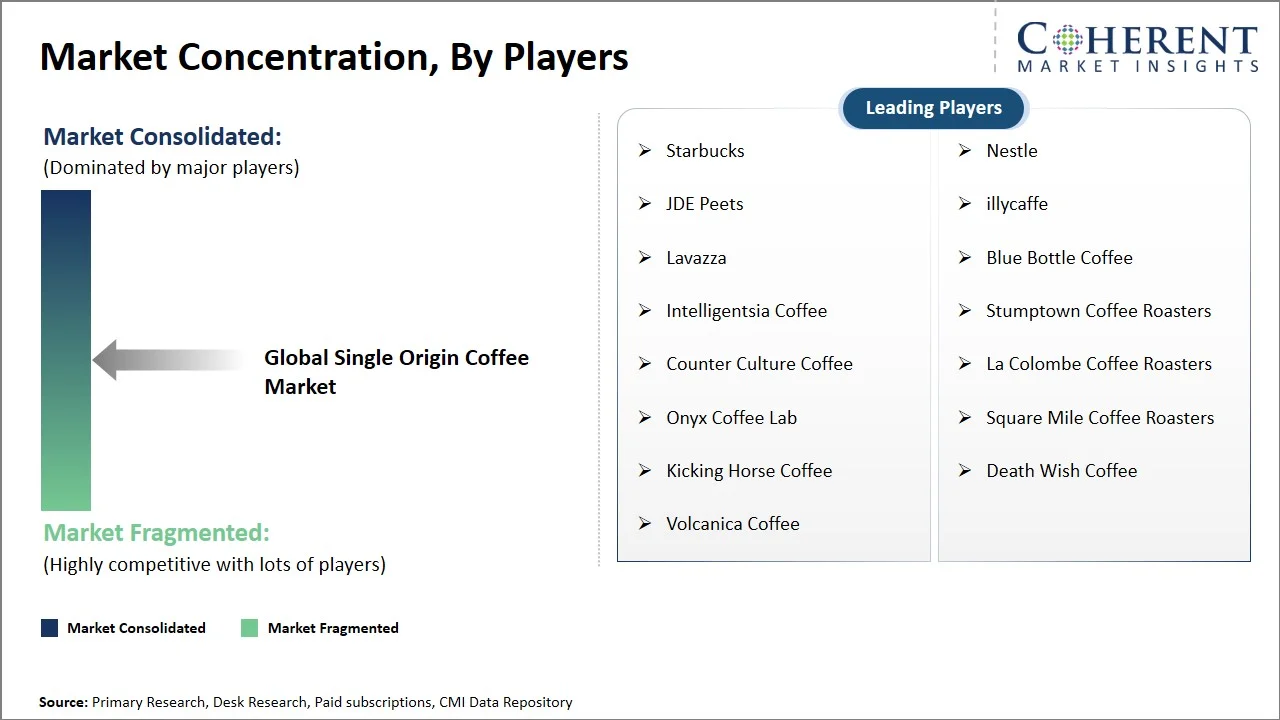
The global single origin coffee market is fragmented, comprising multinational coffee groups, specialty roasting chains, independent micro-roasters, estate-linked brands, green-coffee specialists, regional café operators, and digitally native sellers. Scale alone does not determine leadership because individual harvests vary in availability and sensory performance. Competitors therefore differentiate through green-bean access, roasting precision, freshness management, quality assurance, seasonal inventory discipline, distribution execution, and the ability to translate agricultural attributes into an understandable customer proposition. Regional and specialist roasters remain influential because they can move quickly on smaller lots, unusual processing styles, and local relationships, while larger participants benefit from purchasing scale, packaging infrastructure, retail access, and broader fulfillment networks.
Key focus areas include
- Cup-quality consistency: Maintaining clean, repeatable sensory performance remains fundamental to premium positioning.
- Exclusive origin access: Direct producer and exporter relationships can improve access to desirable estates, regions, varieties, and harvest lots.
- Roasting capability: Competitors increasingly require flexible roast development rather than applying standardized profiles across different origins.
- Supply reliability: Forward planning and green-bean inventory management are important where individual harvests have limited availability.
- Format capability: Whole beans, ground coffee, capsules, and other convenient formats require different production and packaging competencies.
- Distribution reach: Specialty retail, cafés, foodservice, subscriptions, e-commerce, and premium grocery channels support different customer acquisition economics.
- Quality assurance and sourcing governance: Strong cupping, incoming-lot testing, supplier management, and regulatory readiness help protect both product consistency and market access.
Market Report Scope
Single Origin Coffee Market Report Coverage
| Report Coverage | Details | ||
|---|---|---|---|
| Base Year: | 2025 | Market Size in 2026: | USD 5.68 Bn |
| Historical Data for: | 2020 To 2024 | Forecast Period: | 2026 To 2033 |
| Forecast Period 2026 to 2033 CAGR: | 8.7% | 2033 Value Projection: | USD 10.18 Bn |
| Geographies covered: |
| ||
| Segments covered: |
| ||
| Companies covered: | Starbucks, Nestle, JDE Peets, illycaffe, Lavazza, Blue Bottle Coffee, Intelligentsia Coffee, Stumptown Coffee Roasters, Counter Culture Coffee, La Colombe Coffee Roasters, Onyx Coffee Lab, Square Mile Coffee Roasters, Kicking Horse Coffee, Death Wish Coffee, Volcanica Coffee | ||
| Growth Drivers: |
| ||
| Restraints & Challenges: |
| ||
Analyst Opinion (Expert Opinion)
- The market is likely to separate more clearly into scalable premium origins and collectible specialty lots. Scalable offerings will depend on reliable availability, recognizable sensory profiles, and multi-channel suitability, while scarce estate and micro-lot coffees will increasingly function as seasonal premium releases. Leading brands will need balanced portfolios that combine exclusivity with dependable repeat-purchase products.
- Climate variability could gradually reshape the commercial map of recognized coffee origins. Changes in flowering, yield, and cup quality may pressure established terroirs while creating opportunities for higher-altitude and emerging production areas. Roasters, exporters, and producers with strong sensory scouting, varietal evaluation, agronomic adaptation, and flexible sourcing networks should be better positioned to respond.
- Market participants should prioritize producer relationships, diversified sourcing, sensory capabilities, flexible roasting systems, and tighter green-bean inventory management. Margin pressure from raw coffee costs, logistics, and crop variability will remain important. Companies should avoid excessive dependence on prestige origins or very small lots that generate attention but cannot support reliable supply, efficient distribution, or sustained customer retention.
Speak to the analyst
Want personalized insights?
Take the findings above to one of our principal consultants, or have the report rebuilt around the segments, geographies and competitors you actually track.
Market Segmentation
- Product Form Insights (Revenue, USD Bn, 2021 - 2033)
- Whole Bean Coffee
- Ground Coffee
- Coffee Pods and Capsules
- Others
- Roast Type Insights (Revenue, USD Bn, 2021 - 2033)
- Medium Roast
- Light Roast
- Dark Roast
- Origin Type Insights (Revenue, USD Bn, 2021 - 2033)
- Single Country Origin
- Single Region Origin
- Single Estate or Farm Origin
- Micro lot and Nano lot
- Distribution Channel Insights (Revenue, USD Bn, 2021 - 2033)
- Specialty Coffee Stores and Roasters
- Online Retail
- Supermarkets and Hypermarkets
- Cafes and Foodservice
- Others
- Regional Insights (Revenue, USD Bn, 2021 - 2033)
- North America
- U.S.
- Canada
- Latin America
- Brazil
- Argentina
- Mexico
- Rest of Latin America
- Europe
- Germany
- U.K.
- Spain
- France
- Italy
- Russia
- Rest of Europe
- Asia Pacific
- China
- India
- Japan
- Australia
- South Korea
- ASEAN
- Rest of Asia Pacific
- Middle East
- GCC Countries
- Israel
- Rest of Middle East
- Africa
- South Africa
- North Africa
- Central Africa
- North America
- Key Players Insights
- Starbucks
- Nestle
- JDE Peets
- illycaffe
- Lavazza
- Blue Bottle Coffee
- Intelligentsia Coffee
- Stumptown Coffee Roasters
- Counter Culture Coffee
- La Colombe Coffee Roasters
- Onyx Coffee Lab
- Square Mile Coffee Roasters
- Kicking Horse Coffee
- Death Wish Coffee
- Volcanica Coffee
Sources
Primary Research Interviews
- Coffee growers, estate owners, producer cooperatives, washing stations, specialty exporters, green-coffee traders, importers, and specialty roasters
- Coffee brands, cafés, specialty stores, e-commerce sellers, distributors, supermarkets, hospitality operators, and subscription providers
- Q-graders, roast masters, agronomists, sourcing managers, procurement executives, sustainability teams, exporters, quality managers, and sales executives
Stakeholders
- Arabica and specialty coffee growers; single-estate, regional, micro-lot, and cooperative producers
- Green-bean exporters/importers, specialty roasters, private-label manufacturers, capsule/pod suppliers, and packaging companies
- Specialty cafés, foodservice operators, retailers, online platforms, distributors, certification bodies, laboratories, and logistics providers
End-use Sectors
- Household Consumption: whole beans, ground coffee, pour-over, espresso, pods, and capsules
- Cafés & Specialty Coffee Shops: espresso, filter, pour-over, and rotating-origin programs
- Foodservice & Hospitality: restaurants, hotels, workplaces, premium hospitality, and institutional coffee programs
- Retail & E-commerce: specialty stores, supermarkets, D2C websites, subscriptions, and online marketplaces
Regulatory and Government Bodies
- International Coffee Organization (ICO)
- USDA Foreign Agricultural Service, U.S. FDA, and U.S. Customs authorities
- European Commission, including EUDR-related authorities and EU food/packaging regulators
- Brazil Ministry of Agriculture and Livestock (MAPA) and CONAB
- China General Administration of Customs and relevant food-safety authorities
- Japan Ministry of Agriculture, Forestry and Fisheries and Ministry of Health, Labour and Welfare
- The ICO maintains official global coffee statistics covering production, consumption, exports, imports, inventories, and prices.
Databases
- ICO World Coffee Statistics Database, Coffee Market Report, trade and price statistics
- USDA-FAS Coffee: World Markets and Trade and country Coffee Annual reports
- FAOSTAT coffee production, harvested area, yield, and agricultural statistics
- UN Comtrade, ITC Trade Map, Eurostat, and national customs databases
- Specialty Coffee Association research, sensory, consumer, and coffee-value resources
- Company annual reports, sustainability reports, sourcing disclosures, product databases, and producer/exporter records
Magazines and Journals
- Journal of Agricultural and Food Chemistry
- Food Chemistry
- Coffee Science
- International Journal of Gastronomy and Food Science
- Global Coffee Report
- Roast Magazine
- Barista Magazine
- SCA 25 Magazine
Associations
- International Coffee Organization (ICO)
- Specialty Coffee Association (SCA)
- National Coffee Association (U.S.)
- European Coffee Federation
- German Coffee Association
- Brazilian Specialty Coffee Association
- All Japan Coffee Association
- National producer, exporter, roaster, and specialty-coffee associations in key origin and consuming countries
- The SCA provides industry research and standards covering coffee quality, sensory evaluation, value assessment, sustainability, and specialty coffee practices.
Public Domain Sources
- Coffee production, harvested area, yield, Arabica/Robusta mix, exports, imports, consumption, and inventories
- Green-coffee and retail pricing, origin differentials, specialty-grade supply, and trade flows
- Single-origin launches, micro-lot programs, estate sourcing, processing methods, roast profiles, and brewing formats
- Specialty café expansion, online subscriptions, retail distribution, consumer preferences, and premiumization
- Traceability, producer relationships, sustainability programs, certifications, climate risks, and supply-chain investments
Key Standards and Regulations
- EU Deforestation Regulation (EUDR): covers coffee and requires applicable operators to demonstrate deforestation-free and legally produced supply chains.
- Fairtrade Standard for Coffee: requirements covering certified Arabica and Robusta green-coffee producers and traders, including trade, production, environmental, and development provisions.
- Rainforest Alliance Certification: sustainability, farm, traceability, and certification requirements applicable to certified coffee supply chains.
- Food Safety & Labeling Requirements: applicable national regulations covering roasted coffee, ground coffee, packaging, labeling, contaminants, and consumer information
- Organic Certification: USDA Organic, EU Organic, and equivalent national certification requirements for organic coffee
- Phytosanitary & Import Requirements: plant-health, customs, residue, traceability, documentation, and border-control requirements governing internationally traded coffee
Proprietary Elements
- CMI Data Analytics Tool, Proprietary CMI Existing Repository of information for last 10 years.
Get access to 250+ pages report
Every segment, forecast, competitor profile and data table behind the analysis above — available for instant download.
- ESOMAR Member
- ISO 9001:2015 Certified
- D-U-N-S Registered
- GDPR & CCPA Compliant
Missing comfort of reading report in your local language? Find your preferred language:
Transform your Strategy with Exclusive Trending Reports
Frequently Asked Questions
The CAGR of global single origin coffee market is projected to be 8.7% from 2026 to 2033.
The global single origin coffee market is estimated to be valued at USD 5.68 billion in 2026 and is expected to reach USD 10.18 billion by 2033.
Single origin coffee is sourced from a specific country, region, estate, farm, or micro-lot, allowing consumers to identify its provenance and distinctive flavor characteristics. In contrast, blended coffee combines beans from multiple origins to achieve a more standardized taste profile.
Specialty coffee stores and roasters, online retail platforms, supermarkets and hypermarkets, and cafés and foodservice outlets are the key distribution channels. Specialty roasters remain particularly important because they provide origin information, brewing guidance, freshness, and curated coffee selections.
Greater emphasis on farm-to-cup traceability, sustainable sourcing, experimental processing methods, direct-to-consumer subscriptions, premium micro-lot offerings, and convenient single-origin formats such as coffee pods and capsules are shaping market opportunities. These trends are encouraging suppliers and roasters to compete through provenance, quality differentiation, transparency, and customer education.
Premiumization in coffee consumption increasing demand for traceable origin specific products and Specialty coffee culture supporting consumer interest in distinctive flavor profiles and provenance are the major factor driving the growth of global single origin coffee market.
Higher sourcing and certification costs increasing retail prices of single origin coffee and Climate variability and crop concentration creating supply and quality fluctuations are the major factor hampering the growth of global single origin coffee market.