

Smart Fabric Market Size and Share Analysis – 2026 To 2033
The Smart Fabric Market size is anticipated to grow at a CAGR of 13.6%, with a market valuation of USD 3.59 Bn in 2026, and is expected to reach USD 8.75 Bn by 2033. The primary growth drivers are largely defined by the rising adoption of wearable technologies, increasing demand for smart textiles in healthcare and sports applications, growing integration of sensors and electronic components into fabrics, and expanding use of intelligent textiles in military, defense, and industrial applications. According to the American College of Sports Medicine (ACSM), wearable technology ranked as the No. 1 global fitness trend for 2026, based on a survey of approximately 2,000 clinicians, researchers, and exercise professionals.
Key Takeaways
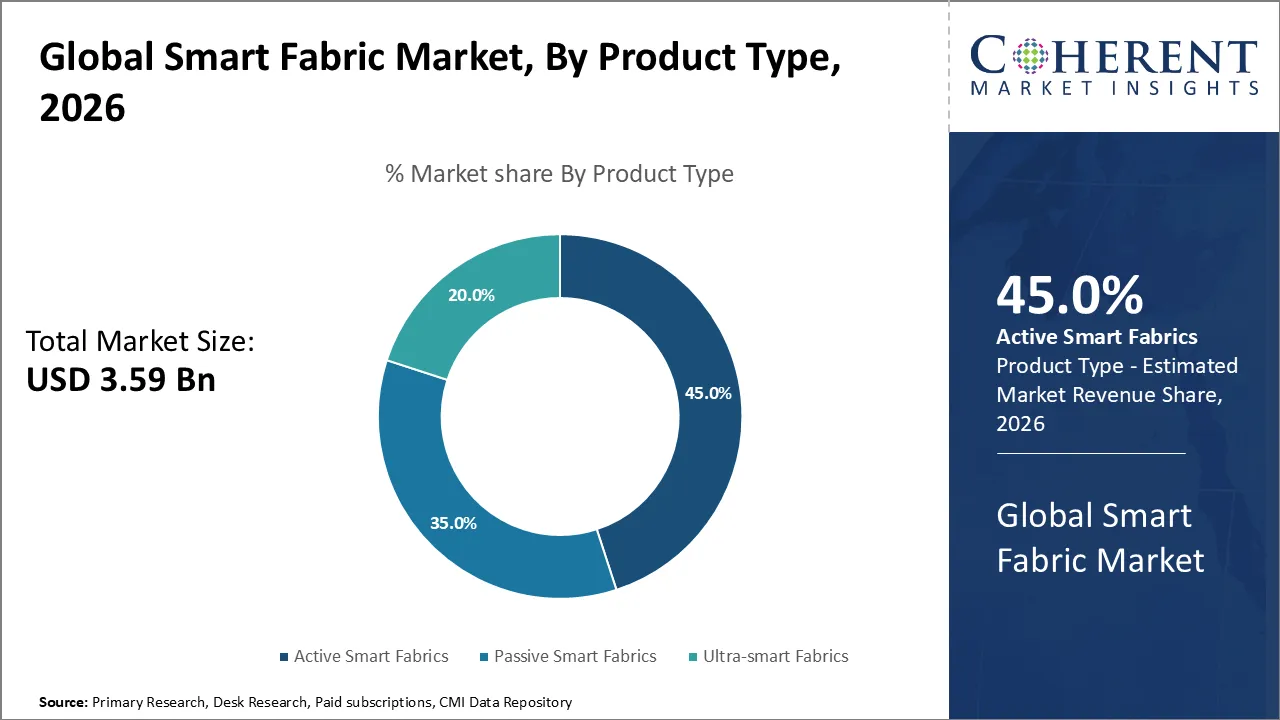
- The active smart fabrics segment is expected to account for a 45% significant share of the market in 2026. The segment’s growth is owing to the increasing integration of flexible sensors, conductive fibers, and wearable electronics that enable real-time physiological monitoring and adaptive responses.
- The sensing segment is anticipated to hold a prominent position in the market with 40% share in 2026. The segment’s growth is driven by increasing demand for continuous health monitoring, biometric tracking, motion detection, and sensor-integrated protective clothing. The U.S. National Science Foundation awarded USD 187,378 in 2025 for a Phase I research project on flexible sensor arrays for smart fabrics and surfaces. Carbon nanotube sensors for deformation and movement detection.
- The sports segment is expected to hold the largest share of the end-use industry in 2026, with 35%. The segment is expected to grow on account of growing adoption of performance monitoring apparel, biometric sensing garments, temperature regulating textiles and connected sportswear. The Sports & Fitness Industry Association reported in March 2026 that 250 million Americans participated in at least one sports, fitness, or leisure activity in 2025, up 1.2% year over year, lending credence to a potential market for technology-integrated sports apparel.
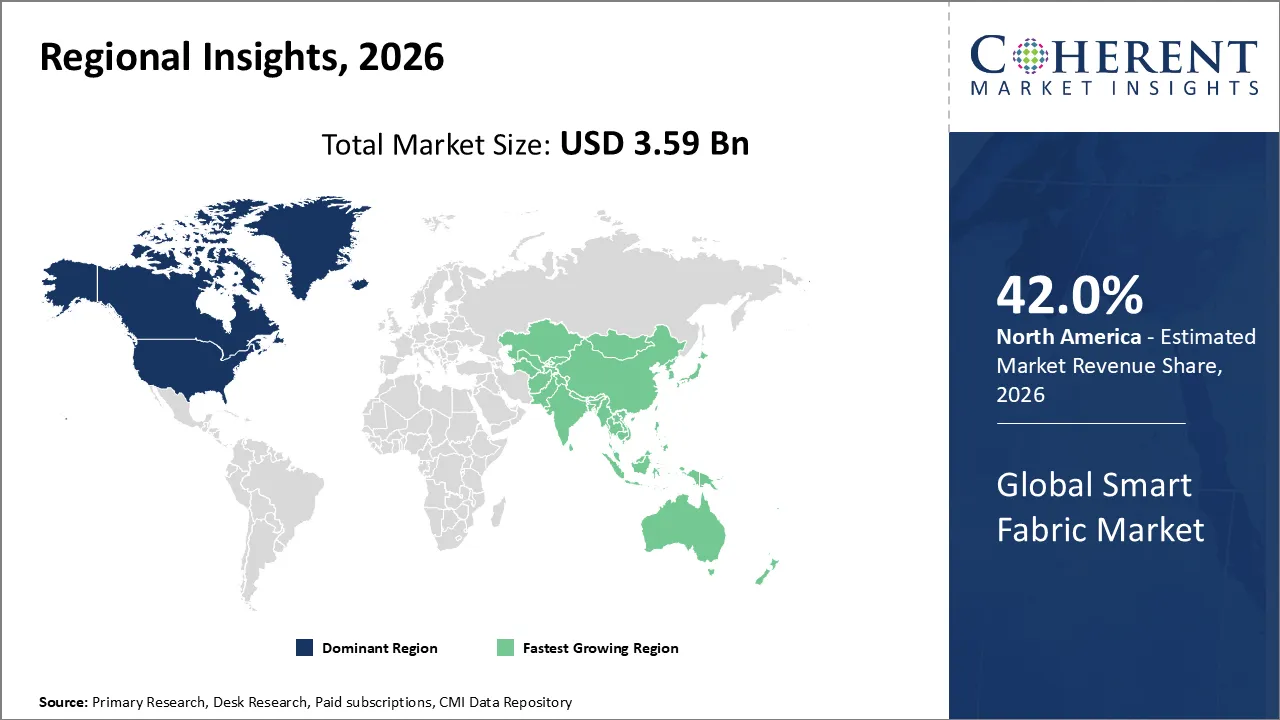
- North America is expected to be a leading regional market with a 42% share in 2026, supported by an established ecosystem of wearable technology, increasing investments in textile-integrated electronics, and research into smart materials. According to Circana’s retail tracking data for September 2025, U.S. sales revenue for fitness trackers grew 88% year-over-year and more than 1.3 million fitness-tracking devices were purchased in the first seven months of 2025, representing a 35%-unit sales growth.
Market Drivers
Increasing Adoption of Smart Fabrics in Healthcare and Continuous Patient Monitoring
The Smart Fabric Market is witnessing significant growth on account of the rising demand for wearable healthcare technologies, continuous physiological monitoring and sensor integrated medical textiles. Healthcare providers are increasingly looking into smart fabrics that can monitor heart rate, respiratory activity, body temperature, and other physiological parameters without restricting patient mobility.
In May 2025, Researchers’ study on SonoTextiles, an acoustic smart textile technology based on piezoelectric transducers and glass microfibers, was published in Nature Electronics. The technology has been demonstrated in applications such as respiratory rate monitoring, gesture recognition and distributed tactile sensing, with progress in multifunctional healthcare textiles highlighted.
Rising Defense Investments and Advanced Textile Manufacturing Are Accelerating Smart Fabrics Innovation
Growing defense expenditure on functional textiles, wearable electronics and next generation military clothing is expected to drive the smart fabric market. The military is exploring the incorporation of sensing, communication and environmental monitoring capabilities into fabrics to enhance soldier safety, operational awareness and equipment performance. Advanced domestic textile manufacturing is under pressure, but also promotes research partnerships and scalable production technologies.
In August 2026 Drexel University announced it was joining the U.S. FutureTEX initiative, a 10-year defense textile manufacturing program worth up to USD 480 million with USD 36 million in first-year funding. The program is intended to modernize the domestic textile industry, strengthen defense supply chains and develop new textile production technologies.
In March 2025, NextFlex, a U.S. Department of Defense-sponsored manufacturing innovation institute, announced a USD 5 million funding opportunity for hybrid electronics development. The associated project portfolio was expected to exceed USD 10 million, including cost-sharing contributions, supporting advanced manufacturing innovations relevant to flexible electronic and textile-integrated systems.
Current Events and Their Impact on the Smart Fabric Market
Current Event | Description and its Impact |
U.S. Department of Defense Supports Advanced Textile Manufacturing Through FutureTEX (2026) |
|
European Commission Advances Digital Product Passport Regulations for Textile Products (2026) |
|
- Current Industry Events of 2026
- Market Size Estimation
- Regional Breakdown
- Competitive Landscape
- Customer Intelligence
- Segmental Analysis
- Pricing Analysis
- Key Market Drivers, Challenges & Future Trends
- Customized Insights Section
Segmental Insights
Why is Active Smart Fabrics Acquiring the Largest Market Share?
On the basis of product type, the active smart fabrics segment is projected to account for the largest Smart Fabrics Market share of 45% in 2026. The segment’s growth is owing to increasing demand for stimulus-responsive textiles, temperature-regulating garments, electrically conductive fabrics, and intelligent materials capable of responding to environmental changes. Advances in electrothermal heating, adaptive cooling and shape-memory technologies are enabling them to be used in healthcare, sports, defense and industrial applications.
In April 2026 A new smart textile that could be powered by two sources and reach 84.13°C when exposed to both solar irradiation and an electrical input of 4.5 V was presented in a paper in Composites Part A: Applied Science and Manufacturing. The fabric also had automatic temperature regulation, a demonstration of the advances in responsive textile technologies for personal thermal management.
In June 2026, the Chemical Engineering Journal published research on a temperature- and humidity-responsive smart textile, which can achieve an outdoor cooling effect of 9.3°C and has an estimated annual energy-saving potential of 235.98 MJ/m2.
Why is the Sensing Segment Holding the Largest Market Share?
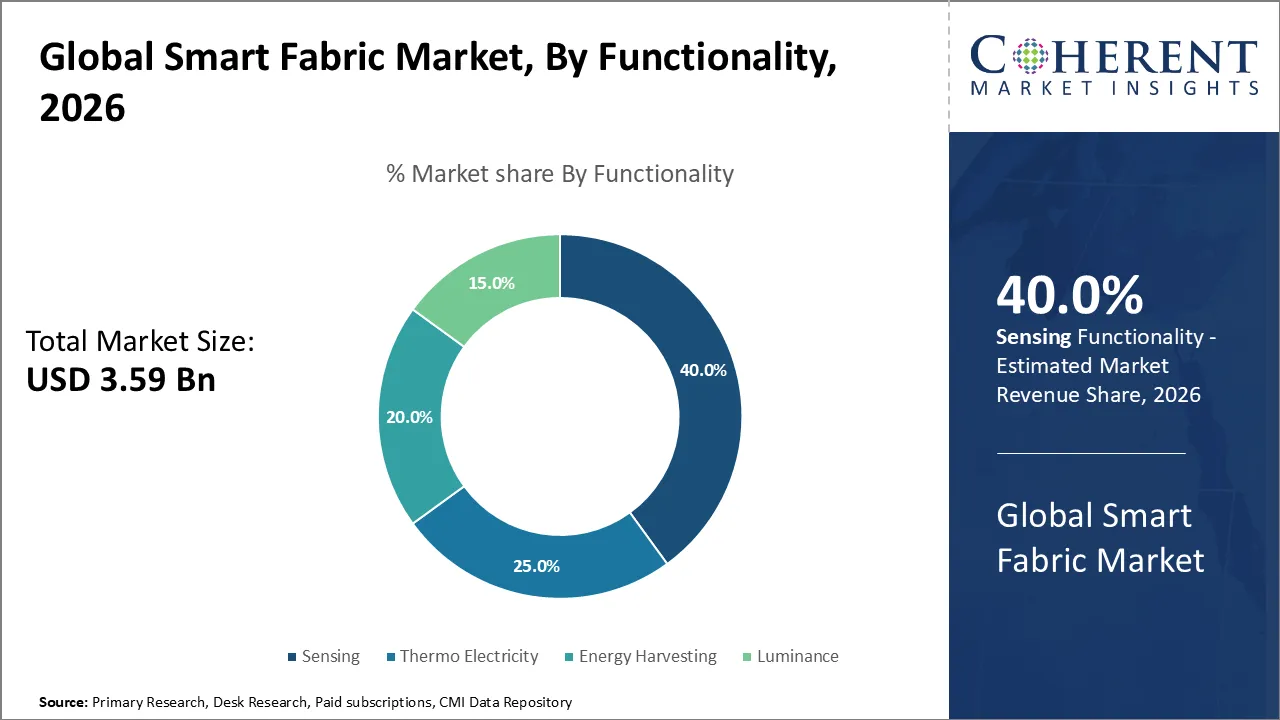
On the basis of functionality, the sensing segment is anticipated to dominate the Smart Fabrics Market with a 40% share in 2026. The segment’s growth is driven by the increasing integration of textile-based sensors into healthcare garments, sportswear, protective clothing, and human-machine interfaces. The increasing demand for continuous physiological monitoring, motion tracking, pressure detection and temperature sensing is leading manufacturers to develop flexible and multifunctional sensing fabrics.
In July 2026 Researchers published a study in Advanced Fiber Materials showing a fiber sensor decorated with wool that can monitor strain, pressure and temperature. The sensor showed strain detection up to 110% with stable performance over 2500 operating cycles, which means it has increased flexibility and durability for applications in smart textile.
Why is the Sports Segment Leading the Smart Fabric Market?
On the basis of end-use industry, the sports segment is expected to account for the largest Smart Fabrics Market share of 35% in 2026. The segment’s growth is owing to increasing demand for intelligent sportswear, real-time performance monitoring, muscle activity tracking, and injury prevention technologies. The integration of textile-based strain sensors, conductive fibers, and AI-enabled motion recognition systems is helping athletes and fitness enthusiasts monitor exercise quality, biomechanics, and physiological responses.
According to research published in IEEE Transactions on Biomedical Engineering, which will publish its final issue in February 2026, researchers developed AI-enabled smart sportswear with graphene-based textile strain sensors that achieved a 92.1% classification accuracy for six exercise conditions. The technology may be able to detect uneven muscle use and breathing patterns when you’re exercising.
In December 2025, a study published in the Textile & Leather Review tested a smart textile-based sports training system for 6 weeks. In the experimental group there was 18.5% improvement in shooting form consistency and 8.2% in vertical jump height compared to the control group. The results suggest the potential of sensor-integrated apparel to improve athletic training and performance.
Smart Fabric Market Trends
- The increasing use of artificial intelligence and interactive fiber technologies is resulting in the development of intelligent garments with sensing, information processing and real-time feedback capabilities. In July 2026, Nano Letters published advances in interactive fibers with four essential capabilities: sensing, interconnection, computing, and feedback. These developments are enabling next generation human machine interfaces and smart clothing applications.
- Increased attention to washable, durable and commercially scalable electronic textiles is driving progress in conductive fibers and flexible electronic materials. A 2025 study in Flexible Electronics found that the waterproof conductive fibers with 6.42 kS/cm conductivity were still functioning after 100 washes and 24 days in water. Innovations are making smart fabrics more practical for everyday wear in clothing, health care monitoring and industrial use.
- The increasing interest in self-powered smart fabrics and energy harvesting textiles is stimulating the design of triboelectric and thermoelectric materials capable of converting body motion and heat into electrical energy.
Regional Insights
North America Dominates Owing to Advanced Smart Textile Technologies and Strong Manufacturing Innovation
North America is expected to hold the largest share of the Smart Fabric Market in 2026 with 42%. The growth of the region is attributed to the mature ecosystem of wearable technology, advanced textile manufacturing capabilities, and increasing adoption of sensor integrated fabrics in healthcare, sports, defense, and industrial applications. Strong collaboration between research institutions, technology developers and textile manufacturers is leading to the increasing commercialization of intelligent fabrics.
In June 2026, Advanced Functional Fabrics of America (AFFOA) announced four companies. The LYCRA Company, Gentex Corporation, Ecotune, and MacroCycle Technologies, as awardees under its Product Accelerator for Functional Fabrics (PAFF 3.0) programme. The initiative supports advanced fabric development, scaling up manufacturing, and validation of materials performance, thereby strengthening the commercialization ecosystem for functional and intelligent textiles.
In August 2026, the U.S. National Science Foundation introduced its updated Materials Research Programs funding solicitation, explicitly identifying smart fabrics and linings among the advanced material applications supported by foundational research.
Asia Pacific Smart Fabric Market Trends
Asia Pacific is expected to emerge as the fastest-growing region in the Smart Fabric Market during 2026–2033. The region’s growth is driven by expanding textile manufacturing capabilities, increasing investments in flexible electronics, growing demand for intelligent healthcare and sportswear, and government initiatives supporting advanced technical textiles. Countries such as China, India, Japan, and South Korea are strengthening their capabilities in conductive fibers, sensor-integrated fabrics, and next-generation textile manufacturing.
In August 2026, Indian Ministry of Textiles Union announced INR 256 crore has been allocated for the FY 2026-27 under the National Technical Textiles Mission. Research projects range from nanofiber-based energy harvesting textiles, smart sensing fabrics, and shape memory electronic textiles for healthcare applications.
Advanced Wearable Technologies and Functional Textile Research Are Accelerating the Smart Fabrics Market in the United States
The U.S. Smart Fabric Market is expected to grow at significant pace due to the development of wearable electronics, functional textile coatings and intelligent protective clothing. The country’s strong research environment, the increasing demand for multifunctional fabrics and the greater integration of advanced materials into military and industrial wear are driving innovations in conductive textiles, responsive fabrics and next-generation wearable systems.
In September 2026, Northwestern University researchers developed a nanoparticle-based material that could be used in clothing dyes to help protect against toxic chemicals and nerve agents. The study found the toxic chemical byproduct could be reduced by half in 10 minutes. The findings have implications for protective clothing in the fields of agriculture, industrial safety and military uniforms.
In March 2026, the U.S. National Institute of Standards and Technology (NIST) released its Manufacturing USA 2025 Annual Report, which highlighted the work of 17 public-private manufacturing innovation institutes. The report highlights the joint efforts of AFFOA, NextFlex and the ARM Institute to address challenges of design and manufacturing scalability of electronic textiles to drive commercially viable smart fabrics.
China Smart Fabric Market Trends
China is poised for significant growth in the Smart Fabrics Market over the forecast period 2026-2033, fueled by its vast textile manufacturing base, expanding flexible electronics ecosystem, and increasing adoption of intelligent textile technologies. The country’s focus on conductive yarns, clothing integrated with sensors, advanced textile manufacturing and product standardization is opening up opportunities in healthcare, sportswear, industrial safety and consumer apparel.
In January 2026, China’s State Administration for Market Regulation (SAMR) issued an interpretation of the first comprehensive smart textile standard, GB/T 46755—2025, covering textile products with heating, monitoring, interactive, lighting, color-changing and communication functions. The standard addresses electrical safety, thermal safety, electromagnetic compatibility, and durability, supporting improvements in product reliability and large-scale commercialization of smart fabrics.
Who are the Major Companies in Smart Fabric Industry
Some of the major key players in Smart Fabrics Market are AIQ Smart Clothing Inc., E. I. Du Pont De Nemours and Company, Kolon Glotech, Interactive Wear AG, Ohmatex, Schoeller Textil AG, Sensoria, Textronics, Inc. Adidas Group, Outlast Technologies LLC, Milliken & Company, KCWW, and International Fashion Machines.
Key News
- In June 2026 Adidas launched its CLIMACOOL+ performance tennis apparel fabric that incorporates three-dimensional, body-mapped raised structures that improve airflow, moisture evaporation and thermal comfort.
- In October 2026, Huawei unveiled an upgraded Stellar Intelligent Fabric for the European market at the Huawei Network Summit 2026 Europe in Florence, Italy, highlighting improvements in intelligence, performance, and reliability for data center networks.
Market Report Scope
Smart Fabric Market Report Coverage
Report Coverage | Details | ||
Base Year: | 2025 | Market Size in 2026: | USD 3.59 Bn |
Historical Data for: | 2020 to 2024 | Forecast Period: | 2026 to 2033 |
CAGR: | 13.6% | 2033 Value Projection: | USD 8.75 Bn |
Geographies covered: |
| ||
Segments covered: |
| ||
Companies covered: | AIQ Smart Clothing Inc., E. I. Du Pont De Nemours and Company, Google, Texas Instruments, Kolon Glotech, Interactive Wear AG, Ohmatex, Schoeller Textil AG, Sensoria, Textronics, Inc. Adidas Group, Outlast Technologies LLC, Milliken & Company, KCWW, and International Fashion Machines. | ||
Growth Drivers: |
| ||
Restraints & Challenges: |
| ||
Analyst Opinion
- Government backed textile innovation programs and growing commercialization of smart wearable technologies are majorly supporting the growth of the Smart Fabric Market. In December 2025, the Ministry of Textiles, India announced the Tex-RAMPS scheme with an outlay of ₹305 crore for FY 2025–26 to FY 2030–31 to support research in smart textiles, sustainable manufacturing and textile startups. The initiative aims to boost research commercialization, domestic manufacturing capabilities and the development of next-generation smart fabrics.
- Progress in textile-integrated biosensors is enhancing the commercial prospects of smart fabrics for healthcare and sports applications. In May 2026, a study showed that the Prevayl smart textile heart-rate monitor can achieve correlation coefficients of 0.94–0.96 against a three-lead ECG with median agreement of about 100.5% during running tests. The results confirm the potential of clothing with integrated sensors for continuous physiological monitoring, fitness tracking and performance evaluation.
- The large scale commercialization of smart fabrics will need better washability, electrical stability and durability of the material. A research article in September 2026 showed that the electrical conductance of silver-coated conductive embroidered textiles was still at 82.3% after 10 washing cycles. Such advances point to the need for robust conductive fibers, optimal textile architectures and reliable electronic integration methods to extend product lifetimes and speed commercial uptake.
Speak to the analyst
Want personalized insights?
Take the findings above to one of our principal consultants, or have the report rebuilt around the segments, geographies and competitors you actually track.
Market Segmentation
- By Product Type (Revenue, USD Bn, 2021-2033)
- Active Smart Fabrics
- Passive Smart Fabrics
- Ultra-smart Fabrics
- By Functionality (Revenue, USD Bn, 2021-2033)
- Thermo Electricity
- Energy Harvesting
- Sensing
- Luminance
- By End Use Industry (Revenue, USD Bn, 2021-2033)
- Healthcare
- Military & Defense
- Construction
- Sports
- Transportation & Logistics
- Entertainment
- Others
- By Region (Revenue, USD Bn, 2021-2033)
- North America
- U.S.
- Canada
- Latin America
- Brazil
- Mexico
- Argentina
- Rest of Latin America
- Europe
- Germany
- U.K.
- France
- Italy
- Spain
- Russia
- Rest of Europe
- Asia Pacific
- China
- India
- Japan
- Australia
- South Korea
- ASEAN
- Rest of Asia Pacific
- Middle East
- GCC
- Israel
- Rest of Middle East
- Africa
- South Africa
- Central Africa
- North Africa
- North America
Sources
Primary Research Interviews
- Smart fabric and electronic textile manufacturers
- Conductive fiber and advanced textile material developers
- Wearable electronics and textile-integrated sensor manufacturers
- R&D heads from smart textile and functional apparel companies
- Healthcare wearable technology and biomedical textile experts
- Sportswear, military & defense, healthcare, and industrial procurement managers
- Key opinion leaders (KOLs) in smart textiles, flexible electronics, and advanced materials
Databases
- World Bank
- Organisation for Economic Co-operation and Development (OECD)
- National Science Foundation (NSF)
- European Commission – CORDIS Research and Innovation Database
- U.S. National Institute of Standards and Technology (NIST)
- United Nations Comtrade Database
- U.S. Bureau of Economic Analysis (BEA)
Magazines
- Textile World
- Technical Textiles International
- Innovation in Textiles
- Advanced Textiles Source
- Textile Technology Source
- Smart Textile & Wearables
Journals
- Smart Materials and Structures
- Advanced Functional Materials
- Advanced Fiber Materials
- npj Flexible Electronics
- ACS Applied Materials & Interfaces
- Textile Research Journal
- Sensors and Actuators A: Physical
Newspapers
- The New York Times
- The Guardian
- The Wall Street Journal
- Financial Times
- The Economic Times
Associations
- Advanced Functional Fabrics of America (AFFOA)
- Industrial Fabrics Association International (IFAI/Advanced Textiles Association)
- American Association of Textile Chemists and Colorists (AATCC)
- Textile Exchange
- European Technology Platform for the Future of Textiles and Clothing (Textile ETP)
- ASTM International – Smart Textiles and Wearable Technologies Standards
- Smart Fabrics Alliance
Public Domain Sources
- Company Annual Reports and Investor Presentations
- Government Textile Research and Innovation Publications
- University Research Publications on Smart Textiles and Wearable Electronics
- Patent Databases such as WIPO, USPTO, and Google Patents
- Publicly Available Smart Textile Research and Development Project Reports
- Regulatory and Standards Publications Related to Electronic Textiles, Wearable Devices, and Textile Safety
- Product Launch Announcements and Technical Specifications from Smart Fabric Manufacturers
- Government Technical Textile Policies and Advanced Manufacturing Funding Announcements
Proprietary Elements
- CMI Data Analytics Tool
- Proprietary CMI Existing Repository of Information for the Last 10 Years
Get access to 250+ pages report
Every segment, forecast, competitor profile and data table behind the analysis above — available for instant download.
- ESOMAR Member
- ISO 9001:2015 Certified
- D-U-N-S Registered
- GDPR & CCPA Compliant
Missing comfort of reading report in your local language? Find your preferred language:
Transform your Strategy with Exclusive Trending Reports
Frequently Asked Questions
The Smart Fabrics Market is expected to reach USD 8.75 Bn by 2033, compared to USD 3.59 Bn in 2026.
Major players operating in the global Smart Fabrics Market include AIQ Smart Clothing Inc., E. I. Du Pont De Nemours and Company, Kolon Glotech, Interactive Wear AG, Ohmatex, Schoeller Textil AG, Sensoria, Textronics, Inc., Adidas Group, Outlast Technologies LLC, Milliken & Company, KCWW, and International Fashion Machines.
High manufacturing and integration costs, limited washability and durability of electronic components, complex sensor integration, and technological limitations are the key factors hampering growth of the Smart Fabrics Market.
The increasing adoption of wearable technologies, rising demand for continuous health monitoring, growing integration of electronic sensors into textiles, and expanding applications in sports, healthcare, and military & defense are driving market growth.
The Smart Fabrics Market is anticipated to grow at a CAGR of 13.6% between 2026 and 2033.
North America is expected to dominate the global Smart Fabrics Market, accounting for the largest market share of 42% in 2026, while Asia Pacific is anticipated to emerge as the fastest-growing region during the forecast period.
Smart fabrics are advanced textiles integrated with sensors, conductive fibers, electronic components, or responsive materials that enable them to detect, monitor, or respond to environmental and physiological changes such as temperature, pressure, movement, and moisture.