

Global Soda Maker Market Size and Forecast – 2026 To 2033
The Global Soda Maker Market is estimated to be valued at USD 1,682.7 Mn in 2026 and is expected to reach USD 3,056.3 Mn by 2033, exhibiting a compound annual growth rate (CAGR) of 8.9% from 2026 to 2033. Market growth is supported by increasing consumer preference for homemade carbonated beverages, rising health consciousness encouraging low-sugar soda alternatives, and ongoing product innovation that improves ease of use, safety, and daily convenience.
The global soda maker market is also profiting from the shift toward reusable beverage systems, as households look to reduce dependence on packaged sparkling water and single-use plastic soda bottles. Strong adoption of countertop and manual soda makers is further supported by their compact design, lower operating complexity, and suitability for residential kitchens, offices, and small hospitality spaces. For instance, Philips’ GoZero soda maker highlights no-electricity operation, a built-in safety relief valve, and BPA-free material, reflecting how brands are improving user safety and convenience in home carbonation devices.
Key Takeaways of the Global Soda Maker Market
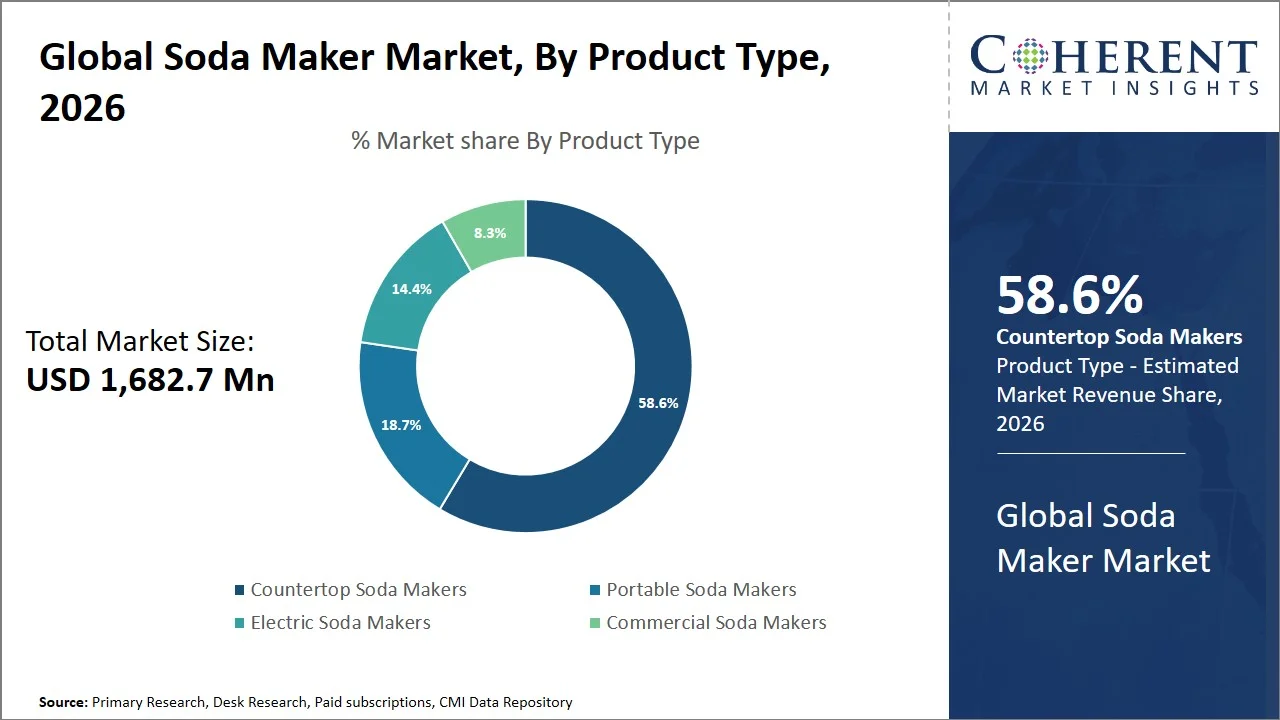
- Countertop soda makers are expected to dominate the global soda maker market with 58.6 % share in 2026, supported by their strong fit with kitchen countertops, premium appliance styling, and at-home beverage customization. In April 2024, Breville launched its InFizz Fusion and InFizz Aqua, highlighting compact countertop placement, premium finishes, and compatibility with standard CO₂ canisters.
- Manual soda makers are expected to account for 63.8 % of the market share in 2026, as consumers prefer simple, non-electric devices with lower maintenance, flexible placement, and better affordability versus automatic machines. In May 2025, WIRED reviewed Smeg’s SKC01 soda maker, noting its no-electricity operation, simple twist control, and suitability for countertop or bar-cart use.
- CO₂ cylinder based systems are expected to lead the carbonation type segment with 72.4 % of the market share in 2026, owing to stronger refill infrastructure, consistent carbonation performance, and compatibility across leading soda maker brands. In July 2026, Aarke’s official Carbonator Pro Starter Kit listing included a CO₂ cylinder and stated that one cylinder carbonates up to 60 liters.
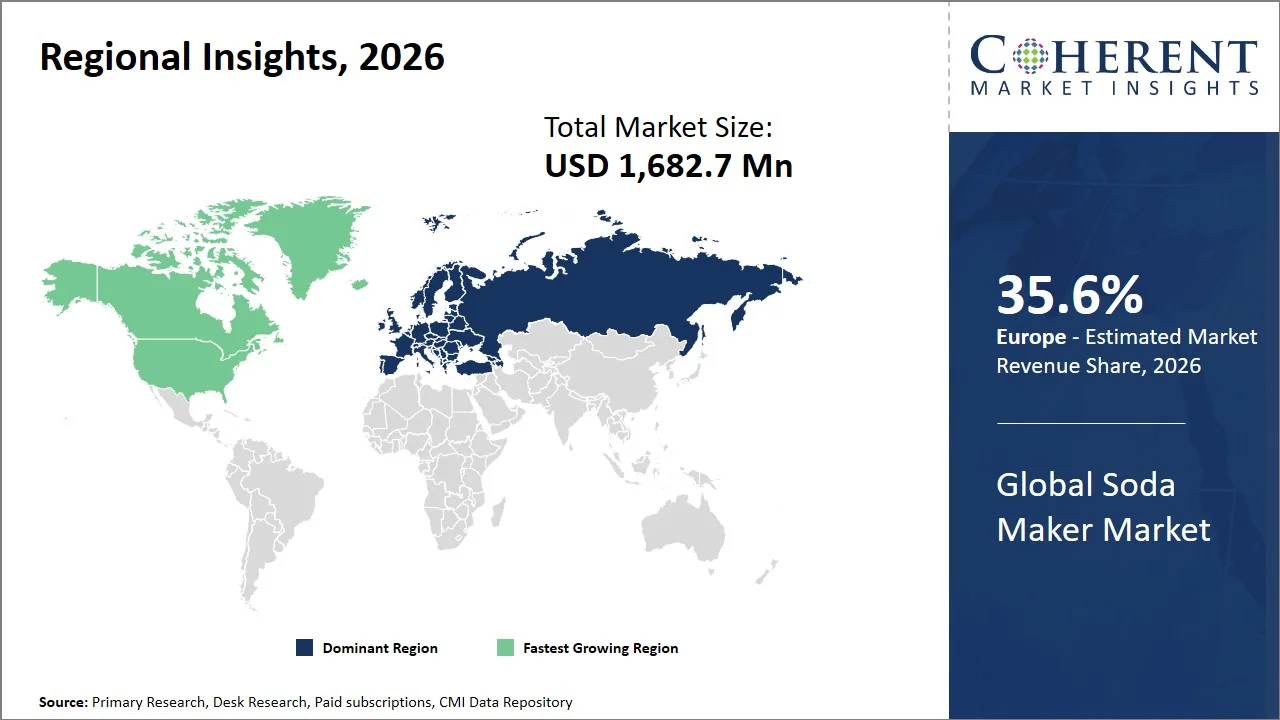
- Europe is expected to remain the dominant region with 35.6 % of the market share in 2026, supported by premium kitchen appliance adoption, sustainability-oriented households, and strong acceptance of home carbonation formats. In August 2024, SodaStream introduced the Enso premium drink maker in the U.K., featuring stainless-steel design, Quick Connect technology, and exclusive Amazon availability.
- North America is expected to be the fastest-growing region with 32.8 % share in 2026, supported by strong online retail visibility, gifting-led appliance purchases, and rising interest in personalized at-home beverages. In November 2025, SodaStream launched ART Mint, MIX, and Enso Black across Amazon, Target, and SodaStream.com for the holiday season.
- Premiumization of Home Beverage Appliances: Soda makers are moving beyond utility into design-led kitchen appliances. Brands are focusing on compact formats, metallic finishes, glass bottles, and appliance-matching aesthetics to justify higher price points. This trend is improving category margins, widening appeal among urban households, and positioning soda makers as lifestyle products rather than basic carbonation devices.
- Refill Ecosystem and Customization-Led Loyalty: The market is increasingly shaped by repeat revenue from CO₂ refills, flavor concentrates, bottles, and accessories. This shifts the business model from one-time appliance sales to recurring consumption. Brands that build convenient refill access, subscription options, and flavor variety are likely to strengthen customer retention and improve long-term profitability.
Segmental Insights
Why Do Countertop Soda Makers Dominate the Global Soda Maker Market?
Countertop soda makers are expected to account for 58.6% of the global soda maker market in 2026, as they serve as permanent home beverage stations rather than occasional-use gadgets. Their leadership is supported by higher bottle compatibility, better stability during carbonation, and stronger fit with kitchen, pantry, and home-bar layouts. Demand is concentrated among households that make sparkling water daily and want multiple beverage options without storing packaged bottles. Other supply-side strengths include existing CO₂ cylinder exchange programs, established retail partners like grocery stores, electronics stores, and direct-to-consumer sales. The EU Packaging and Packaging Waste Regulation will come into force in February 2025 and applies to all packaging and imposes requirements on reusable or recoverable packaging placed on the market in the EU. This helps to drive demand for low waste and reusable beverage systems like soda makers.
- Current Industry Events of 2026
- Market Size Estimation
- Regional Breakdown
- Competitive Landscape
- Customer Intelligence
- Segmental Analysis
- Pricing Analysis
- Key Market Drivers, Challenges & Future Trends
- Customized Insights Section
Why Do Manual Soda Makers Represent the Largest Operation Mode in the Global Soda Maker Market?
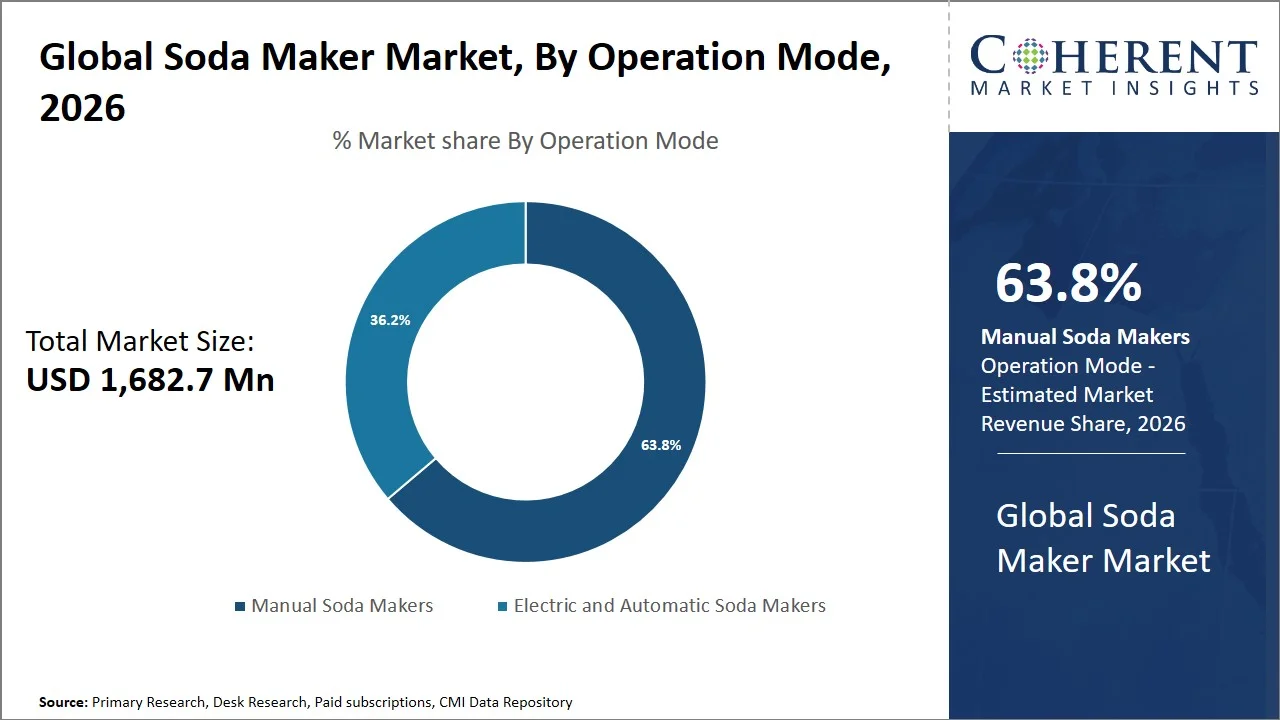
Manual soda makers are expected to represent 63.8% of the market in 2026 because they align with the category’s core value proposition: simple, fast, and power-free carbonation. Consumers favor manual systems where electricity access, counter wiring, or complex presets are not necessary, especially in kitchens, home offices, patios, and small hospitality settings. Their dominance is also supported by lower component complexity, easier maintenance, and stronger price accessibility compared with automatic machines. Suppliers benefit from lighter designs, fewer electronic parts, and easier color/material customization, enabling broader retail placement. In January 2025, iSi North America showcased Twist’n Sparkle Virtuoso at The Inspired Home Show; the product carbonates cold drinks with a twist, supports water, juices, teas, wines, and cocktails, and was scheduled for availability from June 2025.
Why Do CO₂ Cylinder Based Systems Dominate the Global Soda Maker Market?
CO₂ cylinder based systems are expected to dominate carbonation type with 72.4% share in 2026, as they offer the most scalable carbonation model for regular users. Cylinders provide consistent gas delivery, support multiple liters per refill, and create a predictable replenishment cycle for both consumers and suppliers. Demand is strongest among residential users, offices, and small foodservice buyers that need reliable carbonation without frequent cartridge replacement. The segment also benefits from a mature aftermarket of replacement cylinders, refill boxes, and mail-back exchange programs, which strengthens customer retention beyond the initial machine purchase. In December 2024, Soda Sense listed its SENSEation Sparkling Water Maker as a CO₂-powered home system bundled with threaded CO₂ canisters and free Refill Club membership, reinforcing how cylinder infrastructure supports repeat use.
Current Events and their Impact
Current Events | Description and its Impact |
U.K. Deposit Return Scheme Regulations, January 2025 |
|
U.S. EPA National Strategy to Prevent Plastic Pollution, November 2024 |
|
Canada Federal Plastics Registry Reporting Guidance, May 2025 |
|
Global Soda Maker Market Dynamics
Key Market Drivers
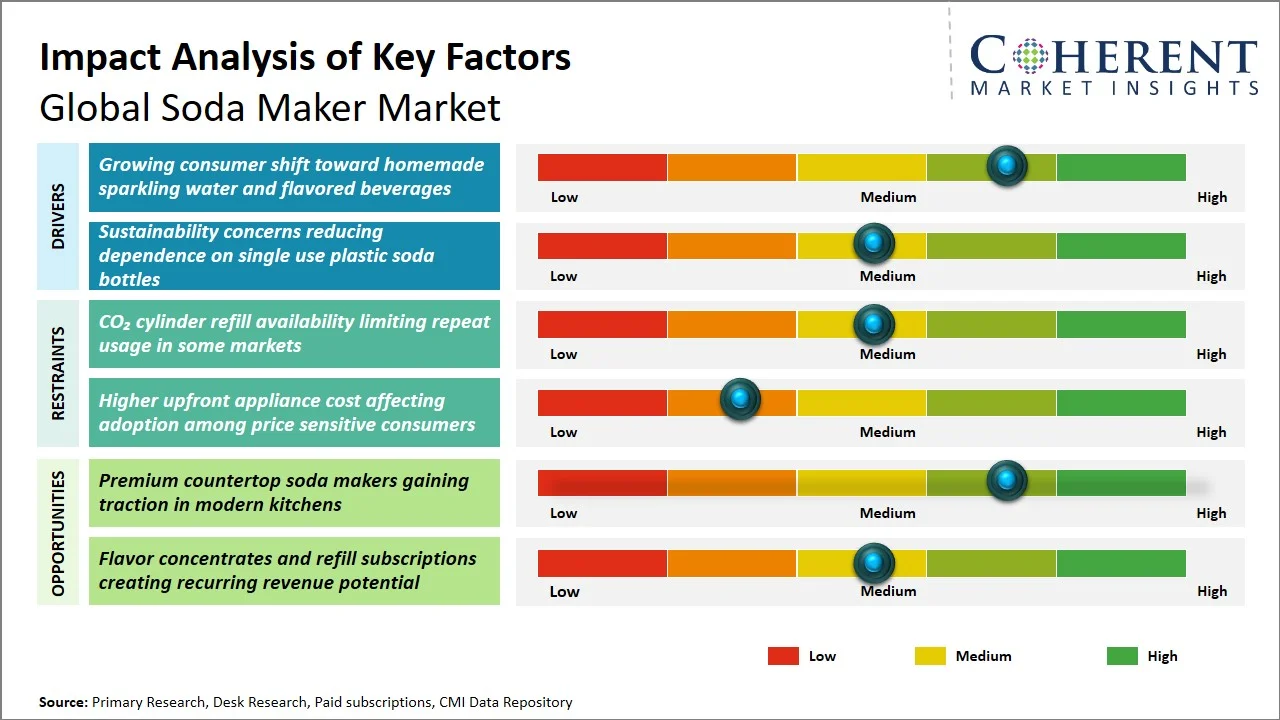
- Growing Consumer Shift Toward Homemade Sparkling Water and Flavored Beverages: The soda maker market is benefiting from a clear consumer shift away from conventional high-sugar carbonated drinks toward customizable, lower-sugar, and experience-led sparkling beverages. Households increasingly prefer preparing sparkling water, mocktails, flavored sodas, and functional drinks at home, as this gives them better control over sweetness, flavor intensity, carbonation level, and ingredient quality. This driver directly supports demand for residential soda makers, countertop systems, flavor concentrates, and refillable CO₂ formats. It also encourages brands to position soda makers as everyday beverage platforms rather than occasional kitchen gadgets. In February 2026, PepsiCo announced that poppi would launch in the U.K. in March 2026, marking its first launch outside the U.S. and reinforcing mainstream demand for modern, low-sugar sparkling soda formats.
- Sustainability Concerns Reducing Dependence on Single-Use Plastic Soda Bottles: Sustainability has emerged as a critical consideration in soda acquisitions, as consumers and retailers look to find more sustainable options to replace the dependence on packaged soda and sparkling water bottles. The soda manufacturers have a reusable beverage model that utilizes enduring bottles, repeatable CO₂ cylinder refilling and repeat home-made soda creation to minimize the necessity to consistently buy single-use plastic bottles. The driver applies especially in Europe and North America where packaging waste legislations, plastic reduction targets and consumer pressure are driving changes in the consumption of beverages. It also bolsters a premium positioning strategy for brands that can make a credible sustainability claim while delivering convenience. In March 2025, Oceana published a report on the brand, environmental and regulatory risks associated with the continued use of single-use plastic packaging by large beverage companies, driving the demand for reusable packaging options. Oceana released a report in March 2025 that emphasized the brand, environmental and regulatory risks of continued single-use plastic packaging by large beverage companies, further fueling demand for reusable alternatives.
Emerging Market Trends
- Premium Countertop Appliances Moving Soda Makers into Lifestyle Kitchen Categories: Soda makers are becoming more than just utilitarian appliances. These are no longer just assessed on carbonation levels but are increasingly being considered by consumers when making their purchase decision, in terms of design, material finish, compactness, bottle quality, ease of use, and kitchen compatibility. This trend is conducive to an increase in average selling prices, gifting demand and brand differentiation in developed markets. It also enables manufacturers to break free from the price race and add features such as stainless-steel bodies, glass bottle compatibility, silent operation, and bar-style styling. The premiumization positively impacts the shelf value and allows for products to be sold in a bundle with flavors, CO₂ cylinders and accessories for retailers. Brands which sell soda makers as a system for home drinking, not just a single-purpose product, will be able to earn higher profit margins and gain greater loyalty from consumers during the forecast period.
- Recurring Revenue Models Around CO₂ Refills, Bottles, and Flavor Ecosystems: The market is shifting toward a recurring consumption model that has the machine as the first step. More and more revenue is generated in the long run via refilling CO₂ cylinders, replacement bottles, flavor syrups, functional additives and combined subscription services. It enhances customer lifetime value and provides brands greater insight into repeat demand. It also boosts direct-to-consumer pathways, allowing businesses to integrate refill reminders, cylinder exchange programs, loyalty rewards, and accessory up-sells into the customer experience. For consumers, the value proposition improves when refills are easy, affordable, and widely available. For manufacturers and retailers, the refill ecosystem reduces dependence on one-time hardware sales and creates a more defensible business model in a category where basic machine designs can be easily replicated.
Regional Insights
Why Does Europe Dominate the Global Soda Maker Market?
Europe is expected to dominate the global soda maker market with 35.6% share in 2026, supported by high household acceptance of sparkling water, mature premium kitchen appliance retailing, and strong sustainability-led consumption behavior. Consumers in the region increasingly view soda makers as a practical replacement for packaged sparkling water, especially in urban homes where reusable bottles, compact appliances, and design-led countertop products are widely accepted. Supply-side strength also comes from established CO₂ cylinder exchange systems, supermarkets, electronics retailers, and direct-to-consumer channels. In February 2025, the EU Packaging and Packaging Waste Regulation entered into force, covering all packaging and setting requirements for reusable or recoverable packaging placed on the EU market. This supports demand for refillable, low-waste beverage systems such as soda makers. (Source: European Commission)
Why is North America Emerging as the Fastest-Growing Region in the Global Soda Maker Market?
North America is projected to be the fastest growing region with 32.8% of the market in 2026 as consumers are increasingly interested in customized beverages, reduction of sugar content in hydration and convenient home carbonation. Rapid adoption of CO₂ refill models and subscriptions, widespread gifting of appliances, and high online retail penetration stimulate the region's growth. Before just sparkling water, consumers are using soda makers to make flavored beverages, mocktails, iced tea and experimenting with functional beverages. On the supply side, brands are improving customer retention through digital refill management and loyalty ecosystems. In June 2026, Drinkmate launched its official mobile app, allowing users to purchase and manage CO₂ cylinder exchanges, track orders, and generate prepaid return labels.
Global Soda Maker Market Outlook for Key Countries
Why is the U.S. a Key Market for the Global Soda Maker Market?
The U.S. is a key market for soda makers due to its large beverage consumption base, mature home appliance retail channels, and strong shift toward health-oriented hydration. The country has a well-developed ecosystem of e-commerce, warehouse clubs, kitchenware retailers, and direct-to-consumer refill programs, helping brands convert one-time machine buyers into recurring CO₂ and flavor customers. U.S. consumers are also receptive to personalization, making soda makers relevant for flavored water, zero-sugar drinks, cocktails, and family-use beverage stations. In May 2025, Beverage Marketing Corporation reported that U.S. liquid refreshment beverage volume grew again in 2024, while bottled water remained the largest U.S. beverage category by volume and expanded by 2.9%. This strengthens the addressable base for at-home sparkling hydration.
Why is India Important in the Global Soda Maker Market?
India is important in the global soda maker market because of its expanding urban middle class, rising exposure to premium kitchen appliances, and strong cultural familiarity with fizzy beverages. Adoption is still at an emerging stage, but the opportunity is significant in metro households, cafés, quick-service restaurants, and modern retail formats where consumers are experimenting with flavored, low-sugar, and homemade beverages. Demand can also benefit from India’s strong price sensitivity, as soda makers offer long-term value versus repeated packaged beverage purchases. In March 2025, India’s Ministry of Commerce and Industry announced APEDA’s support for the global launch of Goli Pop Soda, with trial shipments to the U.S., the U.K., Europe, and Gulf markets, highlighting international interest in Indian carbonated beverage formats.
Why Does China Support Growth in the Global Soda Maker Market?
China supports growth in the global soda maker market through its strong OEM and ODM manufacturing base, cost-efficient appliance production, and export-oriented supply chain. The country plays a critical role in supplying soda maker bodies, bottles, valves, CO₂-compatible parts, and private-label systems for international brands. Its manufacturing clusters are relevant for both premium and value-priced models, enabling global brands to scale quickly across online and retail channels. China’s advantage also lies in fast design customization, certification readiness, and flexible production volumes for global distributors. In June 2025, Zhejiang Hongfeng Precision stated that it mainly produces soda machines, exports to Europe, North America, and Asia, and holds certifications including ISO9001, BSCI, CE, GS, ETL, FDA, LFGB, RoHS, and REACH.
Why is Germany a Strategic Country in the Global Soda Maker Market?
Germany is a strategic country for the soda maker market due to its strong sustainability culture, high acceptance of reusable beverage systems, and preference for durable, design-oriented household products. German consumers are familiar with deposit, refill, and reusable beverage formats, making soda makers commercially relevant as an extension of low-waste consumption. The country also supports premium appliance adoption through strong kitchenware retailing, electronics stores, and sustainability-conscious households. Policy pressure on single-use plastic further improves the positioning of home carbonation systems as a reusable alternative. In December 2024, Germany’s Federal Environment Agency stated that manufacturers of certain single-use plastic products must register under the Single-Use Plastic Fund, with annual levy obligations and possible sales restrictions for non-compliance.
Why is Japan an Important Growth Market for the Global Soda Maker Market?
Japan is an important growth market for soda makers because of its compact urban households, high appliance quality expectations, and rising interest in health-conscious nonalcoholic beverages. The market favors products that combine space efficiency, precise functionality, and premium design, making compact countertop carbonation systems relevant for kitchens, home bars, and small apartments. Japanese consumers also show strong interest in beverages that support moderation, wellness, and convenience, which aligns with at-home sparkling water and low-sugar drink preparation.
Technology Adoption Landscape in the Global Soda Maker Market
Technology | Adoption Level | Key Application Area | Business Impact |
CO₂ Cylinder Carbonation Systems | High | Residential and office soda makers | Ensures consistent carbonation, repeat refill revenue, and broader compatibility across leading machines. |
Quick-Connect Cylinder Mechanisms | High | Consumer soda maker installation | Reduces user friction, improves safety perception, and supports higher repeat usage. |
Manual Push-Button Carbonation | High | Entry and mid-range soda makers | Keeps product cost lower, avoids electricity dependence, and expands household adoption. |
Automatic Carbonation Control | Medium | Premium electric soda makers | Enables controlled fizz levels, supports premium pricing, and improves beverage consistency. |
Reusable BPA-Free and Glass Bottles | High | Daily beverage preparation and storage | Strengthens sustainability positioning, improves user safety perception, and drives accessory sales. |
Bottom-Up or Multi-Point Carbonation Design | Medium | Premium and multi-beverage carbonation | Improves bubble distribution, supports carbonation of broader beverage types, and differentiates products. |
How are Refill Ecosystems and At-Home Beverage Customization Creating New Growth Opportunities in the Global Soda Maker Market?
The strongest growth opportunity lies in converting soda makers from standalone appliances into integrated at-home beverage platforms. Consumers are seeking more control over hydration, flavor, sugar content, and beverage occasions, while brands are looking for higher retention beyond the initial machine sale. This creates scope for bundled starter kits, flavor portfolios, functional drink concentrates, refill subscriptions, reusable bottles, and app-enabled cylinder exchange programs. The opportunity is commercially important because it combines hardware revenue with recurring consumables, improving customer lifetime value and reducing dependence on seasonal appliance demand. It also allows brands to segment the market more effectively, from basic sparkling water users to premium home-bar consumers and family beverage users. Companies that can make refills convenient, expand flavor choice, and maintain strong bottle and CO₂ compatibility are likely to gain a stronger competitive position across both mature and emerging markets.
Market Players, Key Development, and Competitive Landscape
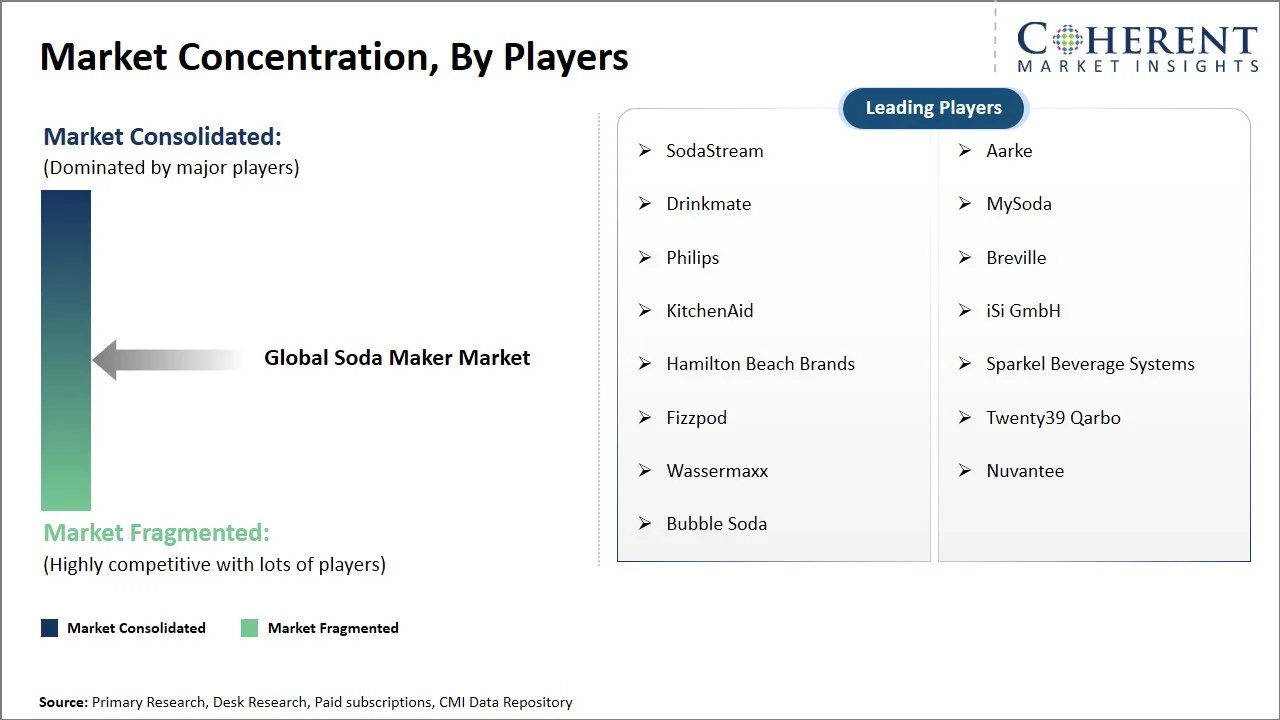
Key Developments
- In April 2026, Drinkmate expanded its presence in Germany by launching its OmniFizz sparkling beverage maker, CO₂ cylinders, and reusable bottles on the Netto online marketplace. This development improves Drinkmate’s European retail access and supports wider adoption of multi-beverage carbonation systems among German households.
- In September 2025, Mysoda introduced the Ruby 2 All Black, a premium sparkling water maker designed with a matte black finish, durable aluminum body, quiet operation, and quick-lock bottle mechanism. This launch strengthens the premium design-led soda maker category and shows how brands are using aesthetics, durability, and ease of use to attract urban households and high-end kitchen appliance buyers.
Competitive Landscape
The global soda maker market is moderately concentrated at the brand premium end, but more concentrated among value-priced, private-label, and regional appliance suppliers. Machine design, carbonation uniformity, CO₂ refill access, retail access, price, and the strength of the consumable ecosystem all drive competition. The established brands tussle for trust of their brands and refill supply chains, while newer brands emphasize on looks, price, multi-beverage carbonation, and e-commerce penetration.
Key focus areas include
- Product quality, carbonation consistency, and long-term durability
- Differentiation through design, bottle material, and countertop aesthetics
- CO₂ cylinder compatibility, refill convenience, and exchange infrastructure
- Competitive pricing across manual, electric, portable, and commercial formats
- Retail reach through online platforms, supermarkets, kitchenware stores, and brand-owned channels
- Safety compliance, food-contact material quality, and pressure-system reliability
- Accessory ecosystem, including reusable bottles, flavors, syrups, and cleaning tools
- Sustainable positioning through reusable formats and lower packaging dependency
Market Report Scope
Soda Maker Market Report Coverage
| Report Coverage | Details | ||
|---|---|---|---|
| Base Year: | 2025 | Market Size in 2026: | USD 1,682.7 Mn |
| Historical Data for: | 2020 To 2024 | Forecast Period: | 2026 To 2033 |
| Forecast Period 2026 to 2033 CAGR: | 8.9% | 2033 Value Projection: | USD 3,056.3 Mn |
| Geographies covered: |
| ||
| Segments covered: |
| ||
| Companies covered: | SodaStream, Aarke, Drinkmate, MySoda, Philips, Breville, KitchenAid, iSi GmbH, Hamilton Beach Brands, Sparkel Beverage Systems, Fizzpod, Twenty39 Qarbo, Wassermaxx, Nuvantee, and Bubble Soda | ||
| Growth Drivers: |
| ||
| Restraints & Challenges: |
| ||
Analyst Opinion (Expert Opinion)
- The market outlook remains positive as soda makers are evolving from optional kitchen gadgets into recurring-use beverage systems. Future growth will depend less on basic carbonation functionality and more on how effectively brands create a complete ecosystem around refills, flavors, reusable bottles, and everyday beverage occasions.
- The most attractive growth pockets are expected in premium countertop systems, residential users, online retail, and CO₂ cylinder-based models. Europe will continue to benefit from sustainability-led consumption, while North America offers strong upside through customization, gifting, and direct-to-consumer refill programs.
- Key risks include refill inconvenience, high cylinder replacement cost, limited consumer awareness in emerging markets, and competition from ready-to-drink functional beverages. Players should focus on reducing refill friction, improving compatibility, expanding flavor portfolios, and building stronger retail and e-commerce partnerships to defend long-term customer retention.
Speak to the analyst
Want personalized insights?
Take the findings above to one of our principal consultants, or have the report rebuilt around the segments, geographies and competitors you actually track.
Market Segmentation
- Product Type Insights (Revenue, USD Mn, 2021 - 2033)
- Countertop Soda Makers
- Portable Soda Makers
- Electric Soda Makers
- Commercial Soda Makers
- Operation Mode Insights (Revenue, USD Mn, 2021 - 2033)
- Manual Soda Makers
- Electric and Automatic Soda Makers
- Carbonation Type Insights (Revenue, USD Mn, 2021 - 2033)
- CO2 Cylinder Based Systems
- CO2 Cartridge Based Systems
- Non Cylinder Carbonation Systems
- End User Insights (Revenue, USD Mn, 2021 - 2033)
- Residential
- Commercial and Foodservice
- Offices and Institutional Use
- Others
- Distribution Channel Insights (Revenue, USD Mn, 2021 - 2033)
- Online Retail
- Supermarkets and Hypermarkets
- Specialty Kitchenware Stores
- Brand Owned Stores
- Others
- Regional Insights (Revenue, USD Mn, 2021 - 2033)
- North America
- U.S.
- Canada
- Latin America
- Brazil
- Argentina
- Mexico
- Rest of Latin America
- Europe
- Germany
- U.K.
- Spain
- France
- Italy
- Russia
- Rest of Europe
- Asia Pacific
- China
- India
- Japan
- Australia
- South Korea
- ASEAN
- Rest of Asia Pacific
- Middle East
- GCC Countries
- Israel
- Rest of Middle East
- Africa
- South Africa
- North Africa
- Central Africa
- North America
- Key Players Insights
- SodaStream
- Aarke
- Drinkmate
- MySoda
- Philips
- Breville
- KitchenAid
- iSi GmbH
- Hamilton Beach Brands
- Sparkel Beverage Systems
- Fizzpod
- Twenty39 Qarbo
- Wassermaxx
- Nuvantee
- Bubble Soda
Source
Primary Research Interviews
- Soda maker manufacturers producing countertop, portable, electric, manual, and commercial systems
- CO₂ cylinder, cartridge, refill, exchange, and gas supply companies
- Kitchen appliance brands, beverage appliance OEMs, and reusable bottle suppliers
- Online retailers, supermarkets, specialty kitchenware stores, and brand-owned retail partners
- Residential users, cafés, restaurants, offices, hotels, and institutional buyers
Stakeholders
- Key companies: SodaStream, Aarke, Drinkmate, MySoda, Philips, Breville, KitchenAid, iSi GmbH, Hamilton Beach Brands, Sparkel Beverage Systems, Fizzpod, Twenty39 Qarbo, Wassermaxx, Nuvantee, Bubble Soda
- CO₂ and refill ecosystem participants, cartridge suppliers, reusable bottle suppliers, appliance retailers, foodservice operators, and office pantry buyers
Databases
- UN Comtrade, ITC Trade Map, Eurostat, USITC DataWeb
- World Bank, OECD, U.S. Census Bureau
- Company annual reports, investor presentations, sustainability reports, product brochures, technical datasheets, and press releases
Industry Publications and Journals
- Beverage Industry, Beverage Daily, Packaging Europe, HomePage News, The Inspired Home Show
- Appliance Retailer, Kitchenware International, Food Engineering, Journal of Cleaner Production, Resources, Conservation and Recycling
Associations
- International Housewares Association
- Association of Home Appliance Manufacturers
- APPLiA – Home Appliance Europe
- Compressed Gas Association
- European Industrial Gases Association
- International Bottled Water Association
- UNESDA Soft Drinks Europe
- British Soft Drinks Association
Public Domain Sources
- European Commission, U.S. EPA, U.K. DEFRA, Environment and Climate Change Canada
- U.S. Consumer Product Safety Commission, European Chemicals Agency, U.S. FDA
- Bureau of Indian Standards, Japan METI, China MIIT, U.S. Department of Commerce
Proprietary Elements
- CMI Data Analytics Tool, Proprietary CMI Existing Repository of information for last 10 years.
Get access to 250+ pages report
Every segment, forecast, competitor profile and data table behind the analysis above — available for instant download.
- ESOMAR Member
- ISO 9001:2015 Certified
- D-U-N-S Registered
- GDPR & CCPA Compliant
Missing comfort of reading report in your local language? Find your preferred language:
Transform your Strategy with Exclusive Trending Reports
Frequently Asked Questions
The CAGR of the global soda maker market is projected to be 8.9% from 2026 to 2033.
Consumers increasingly view soda makers as convenient, cost-effective, and sustainable appliances for preparing fresh sparkling water and customized beverages at home.
Consumers are adopting soda makers to reduce packaged beverage purchases, control sugar and flavor levels, and enjoy fresh carbonated drinks without depending on ready-to-drink soda bottles.
The market outlook remains positive, supported by rising demand for reusable beverage systems, premium countertop appliances, CO₂ refill ecosystems, and home-based beverage customization.
The global soda maker market is estimated to be valued at USD 1,682.7 million in 2026 and is expected to reach USD 3,056.3 million by 2033.
Growing consumer shift toward homemade sparkling water and flavored beverages and sustainability concerns reducing dependence on single use plastic soda bottles are the major factors driving the growth of the global soda maker market.
CO2 cylinder refill availability limiting repeat usage in some markets and higher upfront appliance cost affecting adoption among price sensitive consumers are the major factors hampering the growth of the global soda maker market.