

Global Craft Soda Market Size and Forecast – 2026 To 2033
The global craft soda market is estimated to be valued at USD 802.5 Mn in 2026 and is expected to reach USD 1,182.9 Mn by 2033, exhibiting a compound annual growth rate (CAGR) of 5.7% from 2026 to 2033. Growth is mainly supported by rising consumer spending on premium, natural, and functional beverages. For instance, studies reported in January 2026 that 51% of consumers are willing to pay more for soft drinks with functional health benefits, rising to 68% among Millennials and 61% among Gen Z, directly supporting demand for craft sodas with natural ingredients, botanicals, prebiotics, low sugar, and unique flavors.
Key Takeaways of the Global Craft Soda Market
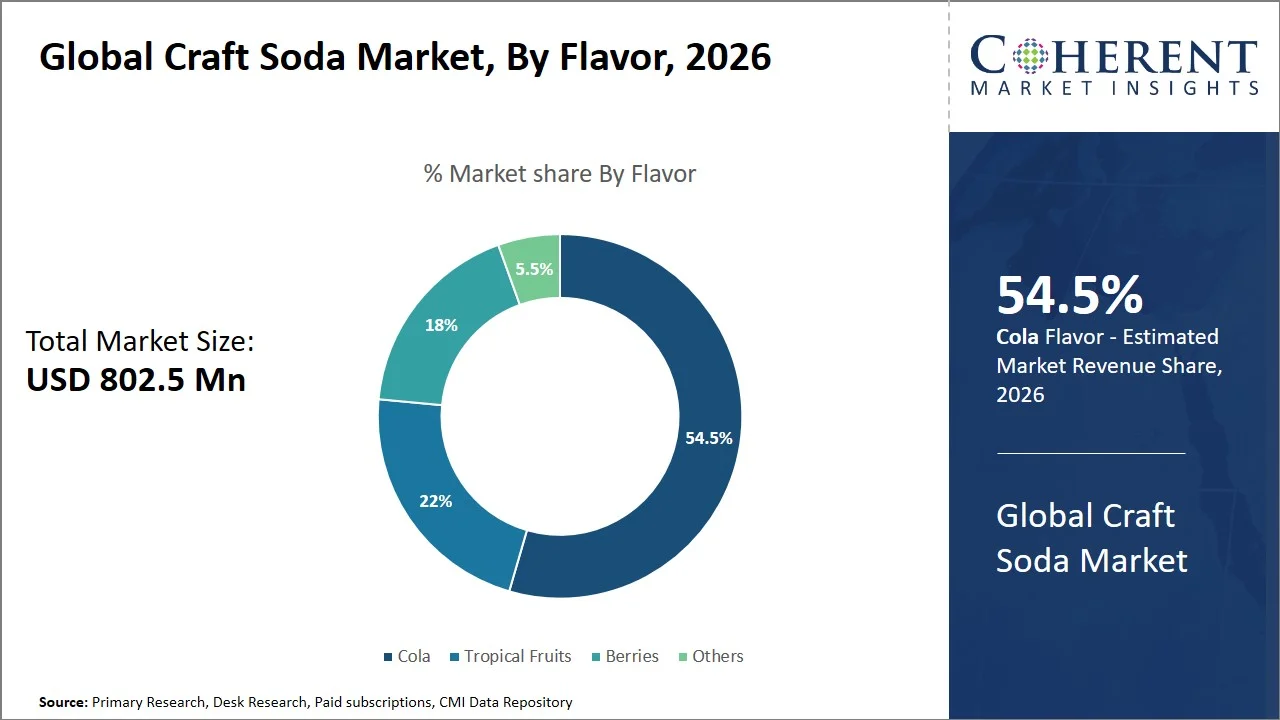
- Cola segment is expected to account for 54.5 % of the global craft soda market share in 2026, making it the dominant flavor segment. The key driving factor is the strong familiarity of cola taste combined with healthier, premium reformulations such as cane sugar, low sugar, natural caffeine, and prebiotic fiber. For example, OLIPOP offers Vintage Cola with caramel, vanilla, cinnamon, and green tea caffeine notes, while Poppi’s Classic Cola uses organic cane sugar, cassava root fiber, apple cider vinegar, agave inulin, and natural caffeine. PepsiCo’s 2026 nationwide launch of Pepsi Prebiotic Cola in Original Cola and Cherry Vanilla also shows how traditional cola flavors are being repositioned toward functional and better-for-you soda demand. (Source: Olipop, Inc.)
- Glass segment is expected to hold 34.8 % share of the global craft soda market in 2026, supported by premium packaging appeal, recyclability, and stronger association with authentic craft beverages. The key driving factor is that glass bottles help craft soda brands differentiate from mass-market canned soft drinks and support a premium, retro, and small-batch image. For example, Jones Soda highlights pure cane sugar and unique packaging as part of its premium craft soda identity, while Boylan Bottling positions its craft soda around pure cane sugar and a long heritage since 1891. (Source: Jones Soda)
- The off-trade segment commands 72.7 % share of the global craft soda market in 2026, making it the leading distribution channel. The key driving factor is the rapid expansion of craft and functional soda brands through supermarkets, grocery chains, convenience stores, club stores, and online platforms, where consumers can discover premium beverages for at-home consumption. For example, OLIPOP states that it is available in over 65,000 retailers nationwide, including Target, Walmart, Kroger, Whole Foods Market, Costco, Safeway, CVS, and others. Jones Soda’s 2025 filing also notes that its premium beverages are sold primarily through grocery stores, convenience and gas stores, independent accounts, and large national retailers.
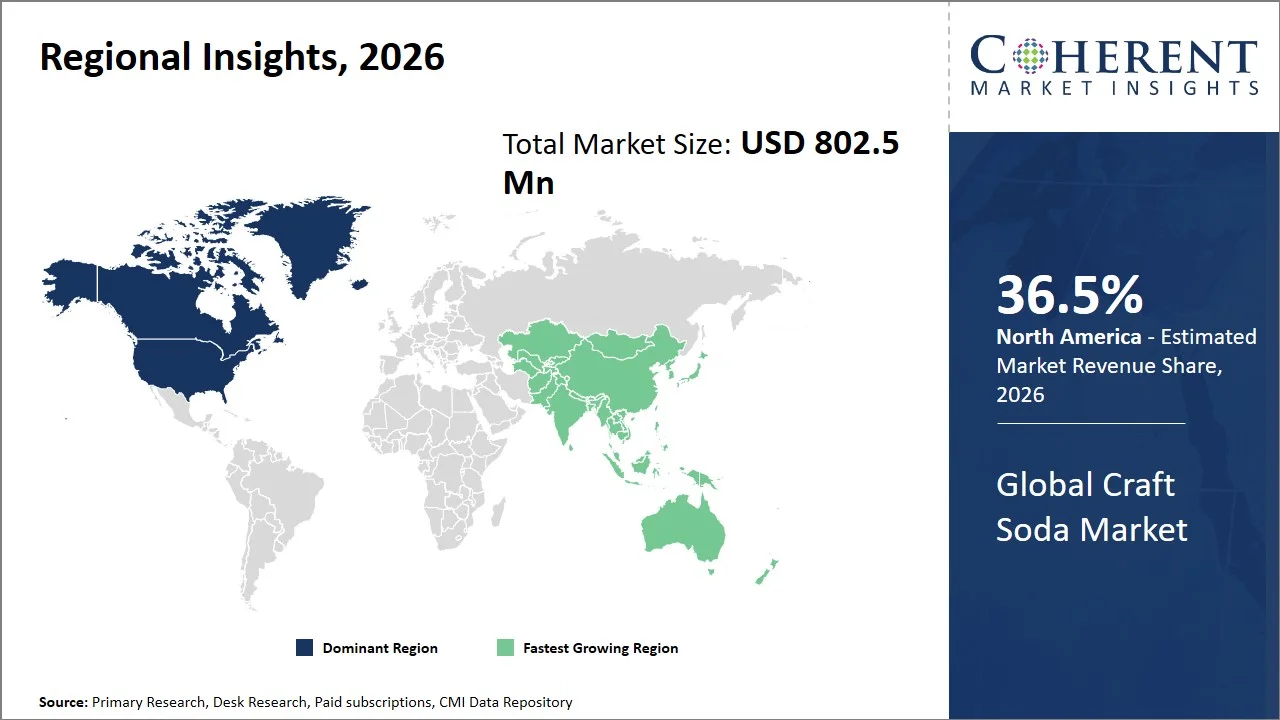
- North America leads the global craft soda market, accounting for an estimated 36.50 % share in 2026, supported by mature premium beverage consumption, strong retail infrastructure, established craft soda manufacturers, and rising demand for natural and clean-label beverages. The U.S. has a strong base of consumers willing to pay for premium and organic-positioned food and beverage products. USDA ERS reported that U.S. total organic food and beverage retail sales reached US$ 69.70 billion in 2023, showing sustained consumer interest in natural, clean-label, and premium consumable products. This directly supports craft soda brands using organic cane sugar, natural extracts, botanical flavors, and clean-label formulations. (Source: Organic Trade Association)
- Asia Pacific is expected to be the fastest-growing region in the global craft soda market, contributing an estimated 19.30 % share in 2026, owing to urbanization, rising disposable income, premium beverage adoption, and growing demand for new flavors among younger consumers. FAO, citing a report in 2023 by four UN agencies, stated that nearly 55% of Asia’s population is expected to live in urban areas by 2030. ADB also reported that developing Asia needs around US$ 1.7 trillion per year in infrastructure investment through 2030 to sustain growth. These trends support expansion of modern retail, cafes, foodservice, convenience stores, and online grocery platforms, creating strong growth opportunities for craft soda brands with localized flavors such as ginger, yuzu, calamansi, lychee, lemongrass, and botanical variants. (Sources: FAO)
- Clean-Label Beverage Alignment: Natural and premium craft sodas are increasingly addressing consumer demand for transparent ingredients, reduced artificial food additives, and better-for-you carbonated drinks, functional beverage.
- Market Expansion Catalysts: Innovations in low-sugar formulations, botanical flavors, fruit-based blends, and functional ingredients, combined with growing demand for premium non-alcoholic beverages, are propelling craft soda market expansion.
Segmental Insights
Why Does Cola Dominate the Craft Soda Market?
The cola segment is expected to account for 54.5% of the global craft soda market share in 2026, which is mainly attributed to its popularity and high consumer recognition. Artisanal versions of cola that stand out from the mass-produced ones appeal to the soda industry's heritage, as soda makers capitalize on the legacies of their predecessors. The enhanced flavor profile, with the inclusion of natural ingredients, lower sugar content, and distinctive spice combinations, resonates with health-conscious consumers seeking nostalgic yet high-quality options.
For instance, Boylan Bottling's Cane Cola is pure cane-sweetened and features a citrus blend of spices, including nutmeg, coriander, and lavender, which sets it apart from the mass-produced cola. (Source: Boylan Bottling)
- Current Industry Events of 2026
- Market Size Estimation
- Regional Breakdown
- Competitive Landscape
- Customer Intelligence
- Segmental Analysis
- Pricing Analysis
- Key Market Drivers, Challenges & Future Trends
- Customized Insights Section
Why is Glass Packaging Most Preferred in the Craft Soda Market?
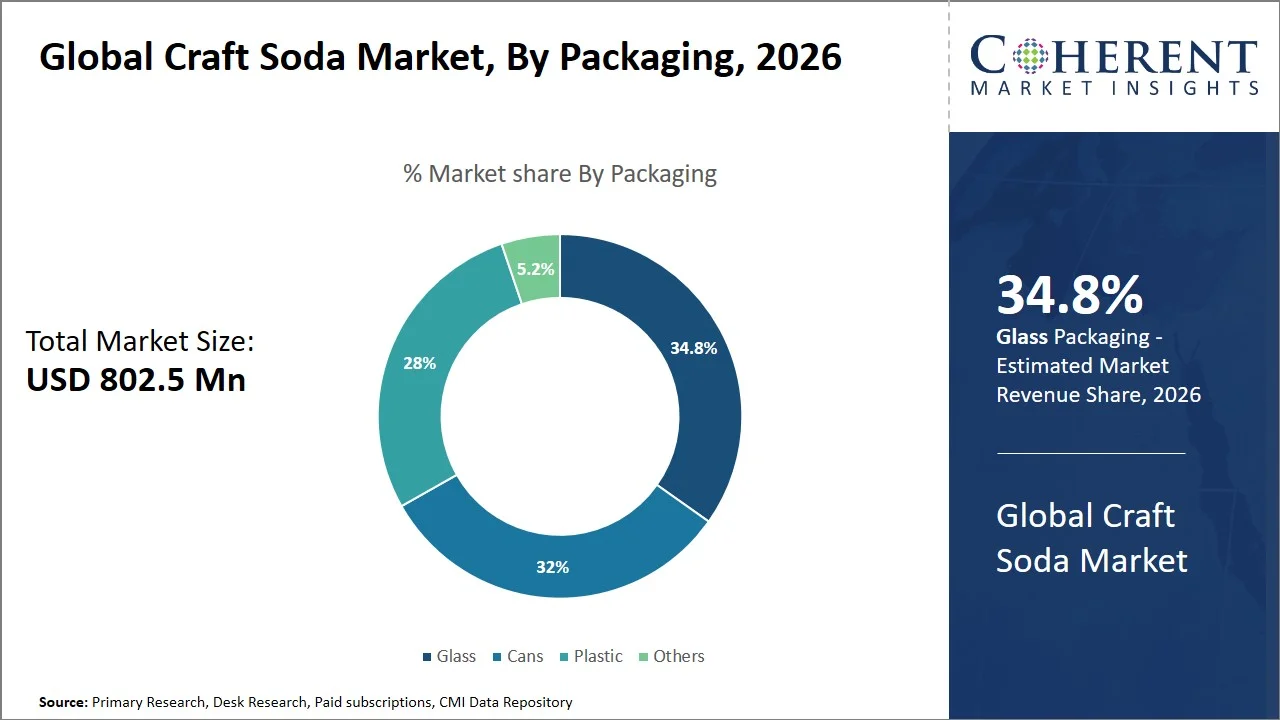
The glass segment is expected to hold 34.8% share of the market in 2026, fueled by evolving consumer preferences for premium experiences and sustainability. According to the U.S. EPA, beer and soft drink glass bottles are among the types of glass containers that are recyclable, and approximately 3.1 million tons of glass containers were recycled in 2018, which represents 31.30% of the total amount of glass containers generated in the U.S. in 2018. (Source: U.S. Environmental Protection Agency)
Off-Trade Distribution Channels Lead Due to Convenience and Expanding Retail Networks
The off-trade segment is projected to command 72.7% share of the global craft soda market in 2026, driven largely by shifting consumer purchasing behaviors and the expansive reach of retail networks. Off-trade sales take place in retail stores where beverages are bought for off-site consumption which includes stores such as supermarkets, grocery stores, convenience stores, and online stores. This channel's advantage is providing convenience, variety, and accessibility to the consumers in the context of their life's fast pace.
Jones Soda introduced its craft soda 4-pack in April 2026 in 650 high-volume Walmart stores throughout the U.S., making it more accessible to mass retailers.
Currents Events and their Impact
Current Events | Description and its Impact |
Functional and Better-for-You Soda Moves Mainstream |
|
Sugar-Tax Pressure Intensifies in the U.K. |
|
Market Dynamics
Market Driver
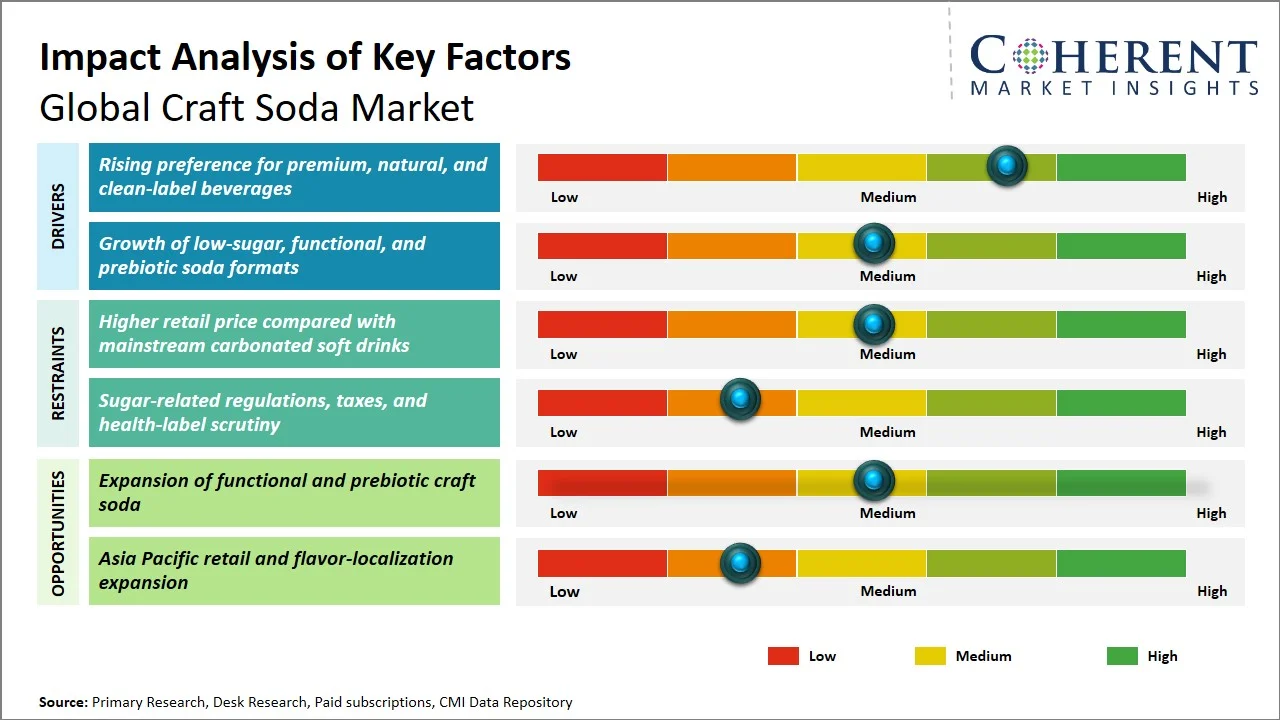
- Rising Preference for Premium, Natural, and Clean-Label Beverages: The growing consumer demand for premium, natural, and clean-label beverages is significantly driving the global craft soda market. As people get more aware of what's in their drinks, they are looking for alternatives to regular sodas that have lots of artificial flavors, preservatives and sugar. This transparency and quality is reflected in the creation of sodas that are made using natural sweeteners, real fruit extracts and organic ingredients.
- For example, according to Centers for Disease Control and Prevention (CDC), a 12-ounce regular soda has more than 10 teaspoons, or 42 grams of added sugar and according to U.S. FDA, 2,000 calories a day is the Daily Value for added sugar, meaning that 42 grams is the daily limit for 12-ounce regular soda. That is, a single regular soda can provide almost the whole daily added sugar allowance. (Source: CDC)
- Growth of low-sugar, functional, and prebiotic soda formats: The growth of low-sugar, functional, and prebiotic soda formats is a key driver for the craft soda market, as consumers are shifting from conventional high-sugar carbonated drinks toward beverages that offer taste with added health positioning. The CDC reports that regular soda (12 ounces) has over 10 teaspoons of added sugar, or 42 grams of added sugar per day, and the FDA sets a DV of 50 grams of added sugar per day. This is because one normal can of soda almost equals the added sugar content in a day's worth of servings, thus incentivizing people to opt for a reduced sugar or functional option.
- In February 2026, PepsiCo introduced Pepsi Prebiotic Cola across the country, which is low in sugar (5g per 12 oz) and low in calories (30), with 3g of prebiotic fiber. Likewise, Coca-Cola launched a first-of-its-kind prebiotic soda — called Simply Pop — featuring real fruit juice, zero added sugar and 6g of prebiotic fiber. The launches demonstrate that even large soda companies are exploring the low-sugar and prebiotic soda segments, confirming that it is an emerging key growth opportunity for craft and premium soda brands. (Source: PepsiCo)
Emerging Trends
- Premiumization and Artisanal Positioning: Craft soda is changing from a carbonated soft drink into a premium experience-based beverage. Brands are emphasizing small-batch production, glass bottle packaging, natural colors, cane sugar, botanicals and region-specific flavors to give their product a more authentic and high-quality look. Limited Edition flavors, seasonal options and café style versions are enabling producers to appeal to younger urban consumers and thus obtain improved prices.
- Shift Toward Health-Conscious Variants: Rising consumer concerns over sugar intake and artificial additives is pushing craft soda makers toward low-sugar, reduced-calorie, natural, and clean-label formulations. Producers are increasingly using fruit extracts, herbs, spices, fermented ingredients, and natural sweeteners to differentiate their products. This trend is especially strong among health-aware consumers seeking alternatives to conventional carbonated soft drinks while still wanting flavor, fizz, and indulgence.
Regional Insights
Why is North America a Strong Market for Craft Soda?
North America leads the global craft soda market, accounting for an estimated 36.5% share in 2026, which can be attributed to a mature consumer base that increasingly values artisanal and health-conscious beverage options. Established food and beverage environment, as well as availability of organic and natural ingredients, gives rise to a well-developed craft soda industry. The market has also been driven by progressive government policies, which have promoted small scale and sustainable food production. Also, the availability of pioneering companies like Reed's Inc., Boylan Bottling Co and Maine Root Soda keeps this region at the top.
Why Does the Asia Pacific Craft Soda Market Exhibit High Growth?
The Asia Pacific craft soda market is expected to exhibit the fastest growth with an estimated contribution of 19.3% share to the global market in 2026, driven by rising urbanization, increasing disposable incomes, and a growing awareness of health and lifestyle choices among younger demographics. This market environment is dynamic and new businesses from the region are increasingly pushing the boundaries of what's possible in terms of local flavor. In India, schemes such as Startup India, PMFME, and the USD 1.27 billion PLI scheme for food processing support food startups, micro-enterprises, formalization, and branded food product manufacturing. Singapore’s Food Manufacturing ITM 2025 also supports innovation, automation, and international expansion for food manufacturers.
Global Craft Soda Market Outlook for Key Countries
Why is the U.S. Leading Innovation and Adoption in the Craft Soda Market?
The U.S. craft soda market benefits from rising consumer attention to sugar content, clean-label claims, and organic/natural positioning. The U.S. FDA requires “added sugars” to be declared on Nutrition Facts labels and notes a Daily Value of 50 grams for added sugars on a 2,000-calorie diet, which supports demand for beverages positioned around reduced sugar, natural sweeteners, and transparent ingredient labeling.
According to CDC data, the consumption of sugar-sweetened beverages is also a key public health concern, as 63% of U.S. adults consume these beverages at least once a day. Resulting space for fruit extract, botanical, low-sugar, and high-quality natural fruity variants of craft soda. In 2024, the U.S. was further the world's largest market for organic foods and drinks at €60.4 billion, further solidifying the premium and organic beverage opportunity.
Is Germany a Favorable Market for Craft Soda Market?
Germany's craft soda sector is driven by the trust consumers have in organic, sustainable and quality certified food and drink goods. The German Federal Government's Öko-Barometer 2024 indicated that 84% of all consumers had purchased organic food at least occasionally, reflecting a wide consumer base for products that feature the organic mark, regional products and natural formulations. Germany's organic food and drink market was the second largest of all in the world in 2024, with US$19.78 Bn worth of sales. In the case of craft soda, this includes the positioning around ‘Bio’ certification, local fruits/herbal sodas, recyclable bottles and low-additive versions.
Why Does Brazil Top the Craft Soda Market?
The utilization of an abundance of tropical and sociobiodiversity raw materials, including fruits, guaraná, babassu, and other natural ingredients gives a boost to the Brazil craft soda market. The Amazon Fund mentions support for processing activities of sociobiodiversity products, such as fruits, babassu, pupunha, Brazil nuts and guaraná, directly contributing to differentiated local beverage innovation.
Brazil also boasts a sizable trade and retail sector, with IBGE estimating 1.5 million commercial companies in 2023 and 41.2% of the sector's net operating revenue being generated by retail. Beverage companies are also increasing their online commercial activity, growing from 1,900 in 2019 to 3,700 by 2023, helping small beverage companies to enhance reach via digital channels.
Is India Emerging as a Key Growth Hub for the Craft Soda Market?
India’s craft soda market is supported by a young consumer base, rising food processing investment, local ingredient availability, and expanding digital commerce. Press Information Bureau (PIB) states that about 65% of India’s population is below 35 years of age, creating a large base of younger consumers open to new beverage formats and indigenous flavors. The food processing sector is also a Make in India priority, with government-backed food parks and processing infrastructure supporting entrepreneurs.
In 2025, World Food India received food processing investment commitments of USD 11.9 billion, which includes non-alcoholic beverages and the packaged food category. Distribution too is enhancing with ONDC, which has reached more than 1100 cities with 0.7 million sellers and service providers as of September 2024, which helps in region's craft-beverage products to be discovered and distributed online.
How is the rising demand for functional and prebiotic beverages creating new growth opportunities in the craft soda market?
Rising consumer preference for beverages that offer added health benefits is creating strong opportunities for craft soda brands. Consumers are increasingly shifting from traditional sugary carbonated drinks to sodas positioned around gut health, low sugar, natural ingredients, botanicals, and prebiotic fiber. For example, Coca-Cola entered the prebiotic soda space with Simply Pop in February 2025, while PepsiCo acquired Poppi for US$1.95 billion to strengthen its position in functional beverages. These developments show that large beverage companies are actively validating the opportunity in functional craft-style sodas.
Gen Z and millennial premium beverage consumption
Consumer Indicator | Explanation |
68% of Millennials and 61% of Gen Z consumers are likely to pay more for soft drinks with added functional health benefits. | This strongly supports premium craft soda positioning. Brands offering low-sugar, botanical, probiotic/prebiotic, vitamin-added, natural-caffeine, or digestive-health claims can justify higher pricing than regular carbonated soft drinks. |
Non-alcoholic beverage spending grew 6.2%, higher than alcohol growth of 2.4%. | Younger consumers are expanding non-alcoholic beverage occasions beyond basic refreshment. Craft soda benefits from this shift because it offers a “treat” or social beverage without alcohol, making it suitable for sober-curious consumers, weekday consumption, family occasions, and premium dining. |
Market Players, Key Development, and Competitive Intelligence
Key Developments
- In February 2025, Lady Bird Soda Co., a craft soda company from Nashville, U.S. expanded its distribution through a new partnership that will bring its products into more retail and on-premise locations in the Metro Atlanta area, strengthening its presence in the Southeast and supporting its growth plans.
- In July 2024, Jones Soda introduced two new canned products, Jones Craft Cola (with cane sugar) and Jones Craft Zero Cola (no calories), marking its first move into the cola category through a multi-year collaboration with Nitrocross Motorsports, part of Thrill One Sports & Entertainment. The colas will debut September 6-7 at the Nitrocross season opener in Richmond, Virginia, be sold at other Nitrocross events, and later roll out nationwide, supporting Jones Soda’s broader growth initiatives and extending its existing action-sports partnerships, including Street League Skateboarding and the SLS youth development program.
Competitive Landscape
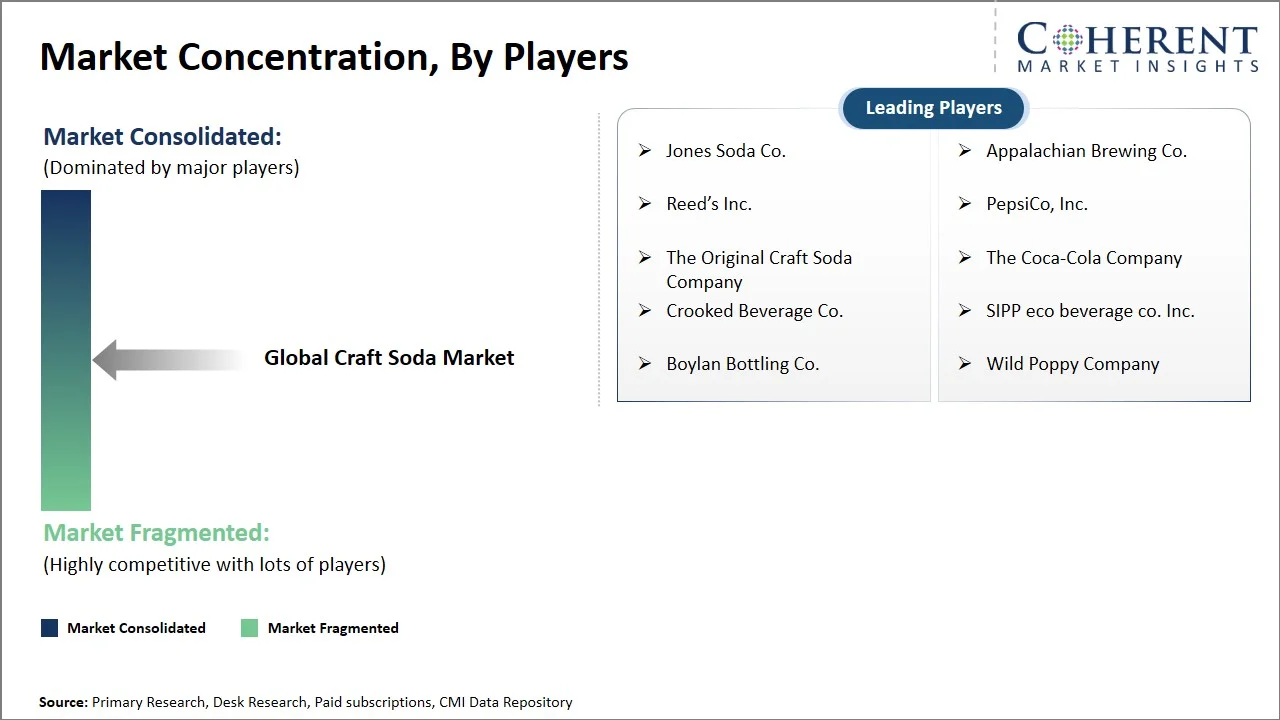
The craft soda market is moderately competitive, driven by rising demand for premium, natural, low-sugar, and flavor-led carbonated beverages. Established beverage manufacturers compete through distribution reach, retail shelf access, and production scale, while smaller craft producers differentiate through unique flavors, natural ingredients, regional positioning, and limited-batch offerings. Key focus areas include:
- Natural, clean-label, and low-sugar product formulations
- Flavor innovation using fruits, botanicals, spices, and regional ingredients
- Premium packaging, glass bottles, and artisanal brand positioning
- Expansion through cafés, restaurants, specialty stores, supermarkets, and online channels
Market Report Scope
Craft Soda Market Report Coverage
| Report Coverage | Details | ||
|---|---|---|---|
| Base Year: | 2025 | Market Size in 2026: | USD 802.5 Mn |
| Historical Data for: | 2020 To 2024 | Forecast Period: | 2026 To 2033 |
| Forecast Period 2026 to 2033 CAGR: | 5.7% | 2033 Value Projection: | USD 1,182.9 Mn |
| Geographies covered: |
| ||
| Segments covered: |
| ||
| Companies covered: | Jones Soda Co., Appalachian Brewing Co., Reed’s Inc., PepsiCo, Inc., The Original Craft Soda Company, The Coca-Cola Company, Crooked Beverage Co., SIPP eco beverage co. Inc., Boylan Bottling Co., and Wild Poppy Company | ||
| Growth Drivers: |
| ||
| Restraints & Challenges: |
| ||
Analyst Opinion (Expert Opinion)
- The craft soda market is expected to evolve from a niche premium beverage segment into a scalable, high-margin category within the broader non-alcoholic drinks industry. Future growth will be driven by rising consumer preference for differentiated, better-for-you, and experience-led beverages. Demand is likely to shift beyond conventional cola and lemon-lime formats toward natural, low-sugar, botanical, fruit-based, fermented, and regionally inspired flavors. This positions craft soda as a strong alternative to mass carbonated soft drinks, ready-to-drink mocktails, alcoholic mixers, and premium refreshment beverages. Going forward, brands that combine clean-label formulations, premium packaging, distinctive flavor architecture, and occasion-based positioning will be better placed to capture sustainable growth.
- The U.S. offers a mature premium beverage ecosystem with stronger consumer acceptance of adult soft drinks, botanical beverages, and non-alcoholic alternatives. India represents a high-growth emerging opportunity, particularly across metro and tier-1 cities where premium cafés, modern retail, gourmet stores, QSR chains, hotels, and casual dining formats are expanding. In India, localized flavors such as kokum, jamun, raw mango, ginger, masala citrus, rose, and spiced cola can create strong market differentiation.
Speak to the analyst
Want personalized insights?
Take the findings above to one of our principal consultants, or have the report rebuilt around the segments, geographies and competitors you actually track.
Market Segmentation
- Flavor Insights (Revenue, USD Mn, 2021 - 2033)
- Cola
- Tropical Fruits
- Berries
- Others
- Packaging Insights (Revenue, USD Mn, 2021 - 2033)
- Glass
- Cans
- Plastic
- Others
- Distribution Channel Insights (Revenue, USD Mn, 2021 - 2033)
- Off-Trade
- On-Trade
- Regional Insights (Revenue, USD Mn, 2021 - 2033)
- North America
- U.S.
- Canada
- Latin America
- Brazil
- Argentina
- Mexico
- Rest of Latin America
- Europe
- Germany
- U.K.
- Spain
- France
- Italy
- Russia
- Rest of Europe
- Asia Pacific
- China
- India
- Japan
- Australia
- South Korea
- ASEAN
- Rest of Asia Pacific
- Middle East
- GCC Countries
- Israel
- Rest of Middle East
- Africa
- South Africa
- North Africa
- Central Africa
- North America
- Key Players Insights
- Jones Soda Co.
- Appalachian Brewing Co.
- Reed’s Inc.
- PepsiCo, Inc.
- The Original Craft Soda Company
- The Coca-Cola Company
- Crooked Beverage Co.
- SIPP eco beverage co. Inc.
- Boylan Bottling Co.
- Wild Poppy Company
Sources
Primary Research Interviews
- Craft soda manufacturer (small-batch producer)
- Supply Chain Director of beverage company
- Founder of artisanal soda brand (e.g., Brooklyn Soda Works, Jones Soda)
- Sustainability Officer of beverage industry certification authority
Stakeholders
- Manufacturers of craft soda and artisanal beverages (e.g., Jones Soda, Reed's, Boylan Bottling, Q Drinks, Appalachian Brewing Company, JustCraft Soda, Crooked Beverage, SIPP eco beverage, Ozark Mountain, Sprecher Brewery, Fordham & Dominion Brewing)
- End-use Sectors
- Retail Grocers & Supermarkets (e.g., Whole Foods, Sprouts, Trader Joe's, Kroger)
- Convenience Stores & Gas Stations (e.g., 7-Eleven, Circle K, NACS members)
- Foodservice & Restaurants (e.g., casual dining chains, local eateries)
- Specialty Soda Shops & Gift Stores (e.g., KC Soda Co.)
- Online DTC Brands (craft soda subscription services)
- Regulatory & Certification Bodies
- FDA (food safety & labeling)
- USDA National Organic Program (organic certification)
- NSF International (food safety standards)
- Non-GMO Project (verification)
- USDA Organic (organic labeling)
- E-commerce Platforms and Retailers
- Amazon, Thrive Market, KC Soda Co. online store
- Specialized beverage distributors (e.g., Republic Technologies, Southern Glazer's)
- Wholesale clubs (e.g., Costco, Sam's Club for premium craft brands)
- Technology Integration Players
- Innovators in sustainable packaging (e.g., glass bottle manufacturers, aluminum can producers)
- Natural sweetener suppliers (e.g., cane sugar, honey, stevia, monk fruit producers)
Databases
- UN Comtrade Database (HS Code 2202 for non-alcoholic beverages, including carbonated soft drinks)
- India Import Export (EXIM) Database
- Statista Beverage Market Data
Magazines
- Beverage Industry – Craft soda trends and natural ingredient innovations
- Soft Drink International – Artisanal beverage market coverage
- Food Business News – Craft and natural soda spotlight
- Craft Beverage Magazine – Small-batch beverage production
- Progressive Grocer – Retail craft soda category trends
Journals
- Journal of Food Science – Natural ingredients in carbonated beverages
- Food Chemistry – Sugar alternatives and sweetener studies
- Journal of Agricultural and Food Chemistry – Natural flavor compounds
- Consumer Studies & Marketing – Consumer preferences for craft beverages
- Beverages Journal (MDPI) – Craft soda production and trends
Newspapers
- The Wall Street Journal – Craft beverage industry trends and investments
- USA Today – Consumer shift to natural/craft beverages
- Business Standard (India) – Growth in craft beverage imports
Associations
- American Beverage Association (ABA)
- InternationalFood Information Council (IFIC)
- National Craft Beverage Association (emerging)
- Specialty Food Association (SFA) – Craft beverage category
- Natural Products Expo (Natural Products Association)
- Small Batch Beverage Group (industry networking)
Public Domain Sources
- FDA – Food labeling guidelines, VOCs, artificial sweetener regulations
- USDA National Organic Program – Organic beverage standards
- EPA – Guidelines for beverage packaging sustainability
- International Code Council (ICC) – Food service establishment standards
- US Department of Agriculture – Agricultural ingredients for natural sodas
Proprietary Elements
- CMI Data Analytics Tool, Proprietary CMI Existing Repository of information for last 10 years.
Get access to 250+ pages report
Every segment, forecast, competitor profile and data table behind the analysis above — available for instant download.
- ESOMAR Member
- ISO 9001:2015 Certified
- D-U-N-S Registered
- GDPR & CCPA Compliant
Missing comfort of reading report in your local language? Find your preferred language:
Transform your Strategy with Exclusive Trending Reports
Frequently Asked Questions
The global craft soda market is estimated to be valued at USD 802.5 Mn in 2026 and is expected to reach USD 1,182.9 Mn by 2033.
The CAGR of global craft soda market is projected to be 5.7% from 2026 to 2033.
The craft soda market includes premium, small-batch, or specialty carbonated soft drinks made with unique flavors, natural ingredients, cane sugar, botanical extracts, and clean-label formulations.
Gen Z and millennials prefer premium, functional, and better-for-you beverages, making them key consumers for flavored, botanical, low-sugar, and alcohol-free craft soda products.
Rising preference for premium, natural, and clean-label beverages and growth of low-sugar, functional, and prebiotic soda formats are the major factors driving the growth of the global craft soda market.
Higher retail price compared with mainstream carbonated soft drinks and sugar-related regulations, taxes, and health-label scrutiny are the major factors hampering the growth of the global craft soda market.
In terms of flavor, cola is estimated to dominate the market revenue share in 2026.