

Global Soldering Robot Market Size and Forecast – 2026 To 2033
The global soldering robot market is expected to grow from USD 580 Mn in 2026 to USD 1,100 Mn by 2033, registering a compound annual growth rate (CAGR) of 7% from 2026 to 2033. The global soldering robot market is driven by the growing production of electric vehicles and automotive electronics. On July 16, 2025, Astemo UK Ltd. announced that it will build a new production line for inverters for next-generation EVs at its Bolton plant, which is based in Greater Manchester in Northern England.
Key Takeaways of the Global Soldering Robot Market
- The cartesian soldering robots segment is expected to account for 42.0 % of the global soldering robot market share in 2026. Increasing use of Industry 4.0 and smart factories is driving the growth of the segment. On January 23, 2026, TVS Next and Snowflake announced a partnership to integrate the Snowflake AI Data Cloud with the NexOps manufacturing intelligence platform, enabling real-time factory analytics, OT/IT integration, and AI-driven production optimization for smart manufacturing environments.
- The PCB assembly segment is estimated to capture 25.0 % of the market share in 2026. The expansion of semiconductor fabrication capacity worldwide is majorly driving the growth of the segment. On March 4, 2025, TSMC announced that its intention to expand its investment in advanced semiconductor manufacturing in the U.S. by an additional USD 100 billion.
- Asia Pacific is expected to dominate the soldering robot market in 2026 with a market share of 47.0 %. Rising investments in electronics manufacturing across Asia Pacific is driving the growth of the regional market. On June 25, 2024, Tata Electronics announced a Memorandum of Understanding with Synopsys to collaborate on process technology bring-up and foundry design platform to accelerate the successful ramp of customer products in India’s first fab being built by Tata Electronics in Dholera, Gujarat in India.
- North America is expected to account for 23.0 % of the market share in 2026 and is projected to record the fastest growth over the forecast period. Integration of AI-powered vision systems for quality inspection in North America is driving the growth of the regional market. On June 10, 2026, Ford Motor Co. installed IBM’s AI-powered Maximo Visual Inspection technology at 17 of its North American manufacturing facilities to catch any assembly line defects in real-time using pictures taken of vehicle components in various stages of production using an iPhone and cloud-based platform.
- AI-enabled vision guided soldering gaining rapid adoption: Manufacturers are rapidly adopting AI-enabled machine vision in combination with soldering robots for automatic component recognition, adaptive path correction, real-time solder joint inspection and predictive quality control, significantly reducing defect rates in high-density PCB assembly.
- Growing deployment of collaborative soldering robots in electronics manufacturing: Manufacturers are developing coreless Hall current sensors that do not require bulky magnetic cores and offer excellent measurement precision and rapid reaction times. They reduce system size, weight and manufacturing complexity and are increasingly useful for automotive electronics, industrial drives, renewable energy converters and space-constrained power electronic systems.
Segmental Insights
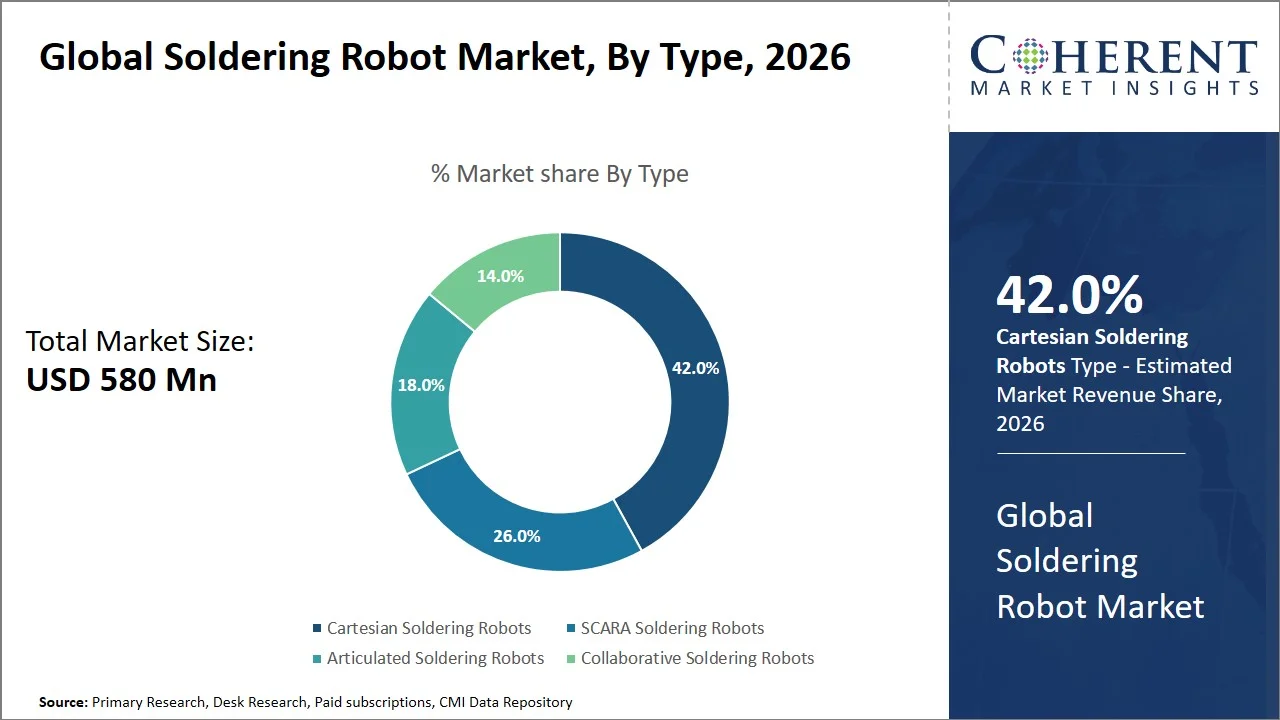
Why Do Cartesian Soldering Robots Dominate the Global Soldering Robot Market?
The cartesian soldering robots segment is expected to account for 42.0% of the global soldering robot market share in 2026. High volume printed circuit board assembly is largely responsible for this general preference for cartesian soldering robots because of their remarkable positioning accuracy and repeatability. Owing to their stiff linear motion technology, they are capable of positioning solder joints on high-density electronic components with accuracy and to keep quality stable during continuous production cycles. Cartesian soldering robots are the chosen solution for electronics manufacturers who need to implement an efficient and repeatable automated soldering process, owing to this combination of accuracy, dependability, lower programming complexity and cost effective operation. On December 3, 2025, Japan Unix showcased its UNIX-GF Cartesian soldering robot and dual-laser soldering platform at NEPCON Japan 2025, unveiling improved positioning accuracy, automatic height correction and vision-assisted soldering for high-density PCB assembly utilized in automotive and semiconductor electronics.
- Current Industry Events of 2026
- Market Size Estimation
- Regional Breakdown
- Competitive Landscape
- Customer Intelligence
- Segmental Analysis
- Pricing Analysis
- Key Market Drivers, Challenges & Future Trends
- Customized Insights Section
Why is PCB Assembly the Most Widespread Application?
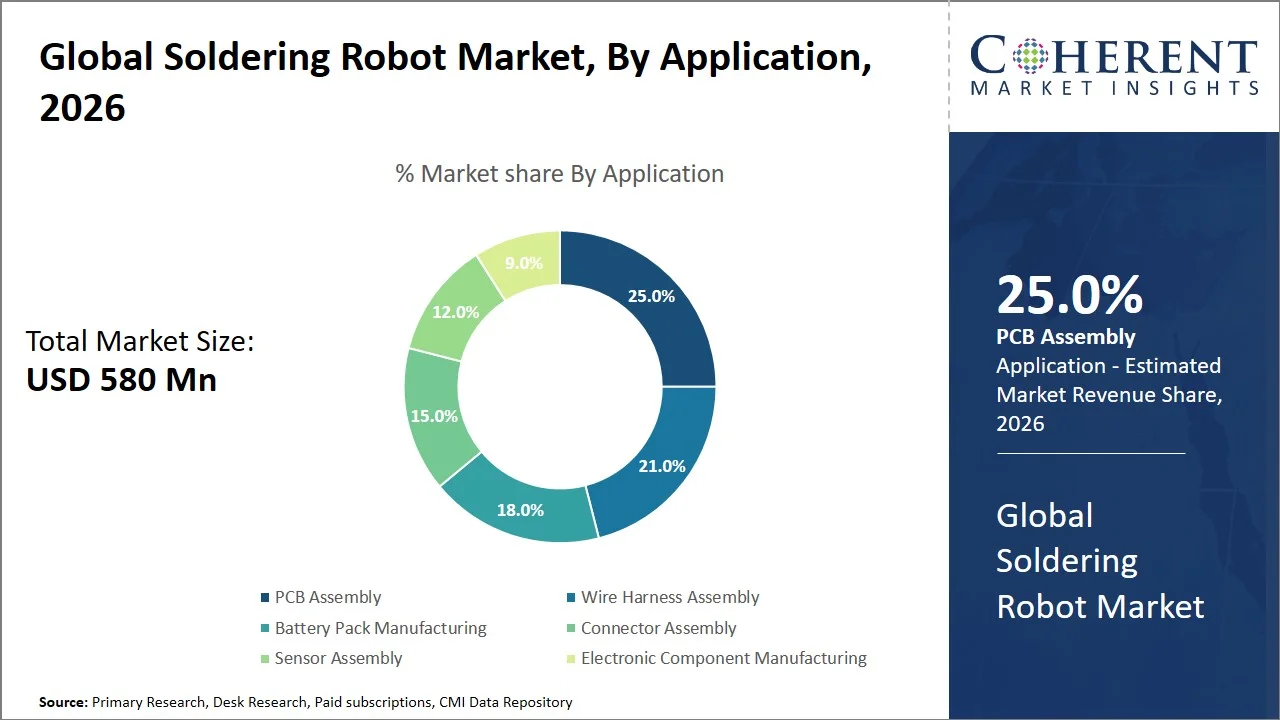
The PCB assembly segment is expected to account for 25.0% of the global soldering robot market share in 2026. The major contribution to the market position of PCB assembly is attributed to the growing manufacture of high-density and miniaturized electronic devices that demand highly accurate and repeatable soldering. Soldering robots provide consistent solder joint quality and lower production defects, and allow high throughput for the complex multilayer printed circuit boards used in smartphones, automotive electronics, industrial equipment, consumer electronics and communication devices, making PCB assembly the largest application area for soldering robot deployment. On April 1, 2025, Yamaha Motor expanded its 1 STOP SMART SOLUTION electronics manufacturing portfolio by adding high-speed SMT placement machines, automated optical inspection and robotic assembly technologies to support high-volume production of multilayer PCB for the automotive, industrial and communication electronics markets.
Currents Events and their Impact
Current Events | Description and its Impact |
European Union Cyber Resilience Act (Regulation (EU) 2024/2847) |
|
European Union Artificial Intelligence Act (AI Act) |
|
Global Soldering Robot Market Dynamics
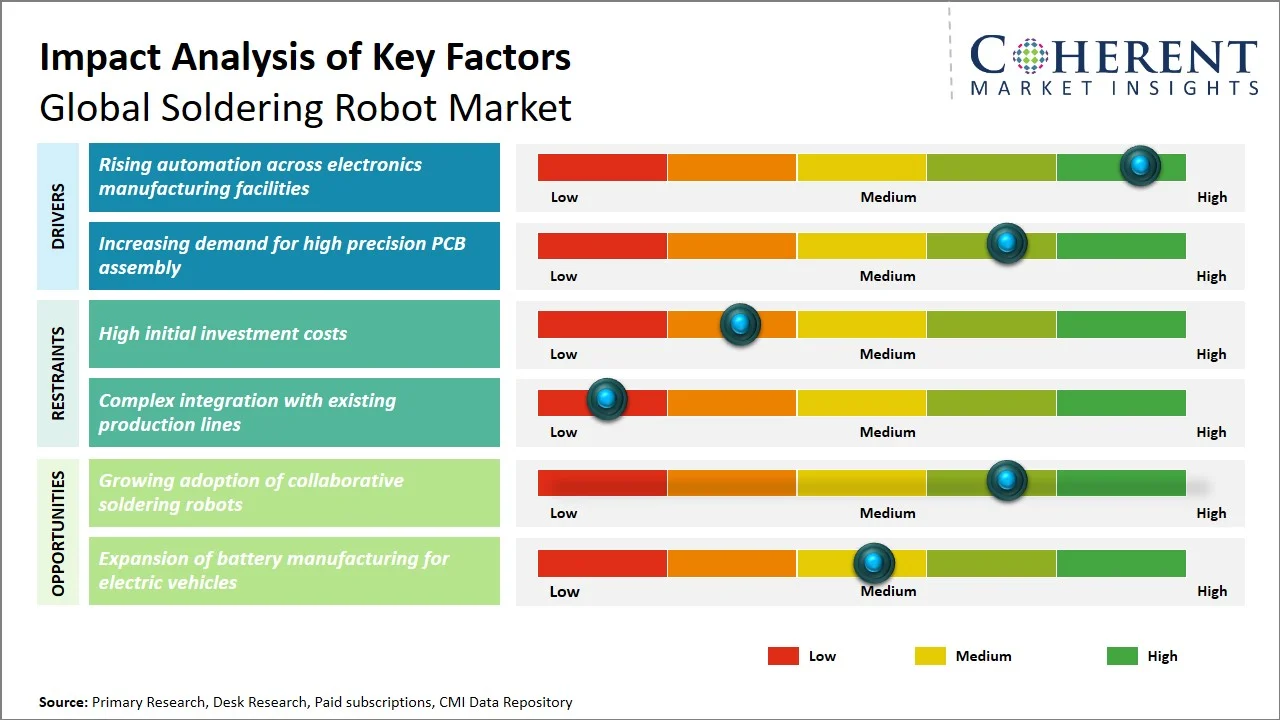
Market Drivers
- Rising automation across electronics manufacturing facilities: Electronics producers are turning to automation in their factories to boost production efficiency, minimize reliance on manual labor and ensure consistent product quality. Soldering robots continue to be a critical feature of automated production lines, providing accurate, repeatable and fast soldering with fewer human errors. The increased adoption of smart manufacturing, industrial robotics and integrated production systems is also pushing investments in automated soldering solutions in consumer electronics, automotive electronics, semiconductor and industrial equipment manufacturing facilities. On January 26, 2026, Micron Technology, Inc. announced an advanced wafer fabrication facility located within the company's existing NAND manufacturing complex in Singapore. This new facility represents a planned investment of approximately USD 24 billion over 10 years and is designed to ultimately provide 700,000 square feet of cleanroom space.
- Increasing demand for high precision PCB assembly: The fast downsizing of electronic components and the growing complexity of printed circuit board designs are fueling a significant demand for extremely accurate soldering procedures. Fine pitch components, dense layouts and multilayer structures on modern PCB assemblies demand precision heat management and uniform solder deposition to ensure product durability. With the use of modern motion control and vision guided technologies, soldering robots help manufacturers to achieve better quality of solder joints and reduce faults. Soldering robots are necessary for high precision PCB assembly. On February 6, 2026, JLCPCB showcased its integrated one-stop manufacturing solutions, centered on core PCB fabrication services and encompassing 3D printing and CNC machining. The exhibition provided an important platform to demonstrate JLCPCB’s commitment to supporting Japan’s Monozukuri manufacturing ecosystem.
Emerging Trends
- Expansion of laser soldering for miniaturized electronic components: The semiconductor packaging, automotive sensors, camera modules, wearable devices, and medical electronics markets are witnessing the growing adoption of laser soldering technology due to its localized heating, reduced thermal stress, and improved soldering accuracy for ultra-miniature components.
- Integration of soldering robots into smart factory ecosystems: Soldering robots are increasingly being integrated with Manufacturing Execution Systems (MES), Industrial IoT platforms, digital twins and cloud-based production monitoring systems, enabling real-time process optimization, remote diagnostics, predictive maintenance and full traceability of production.
Regional Insights
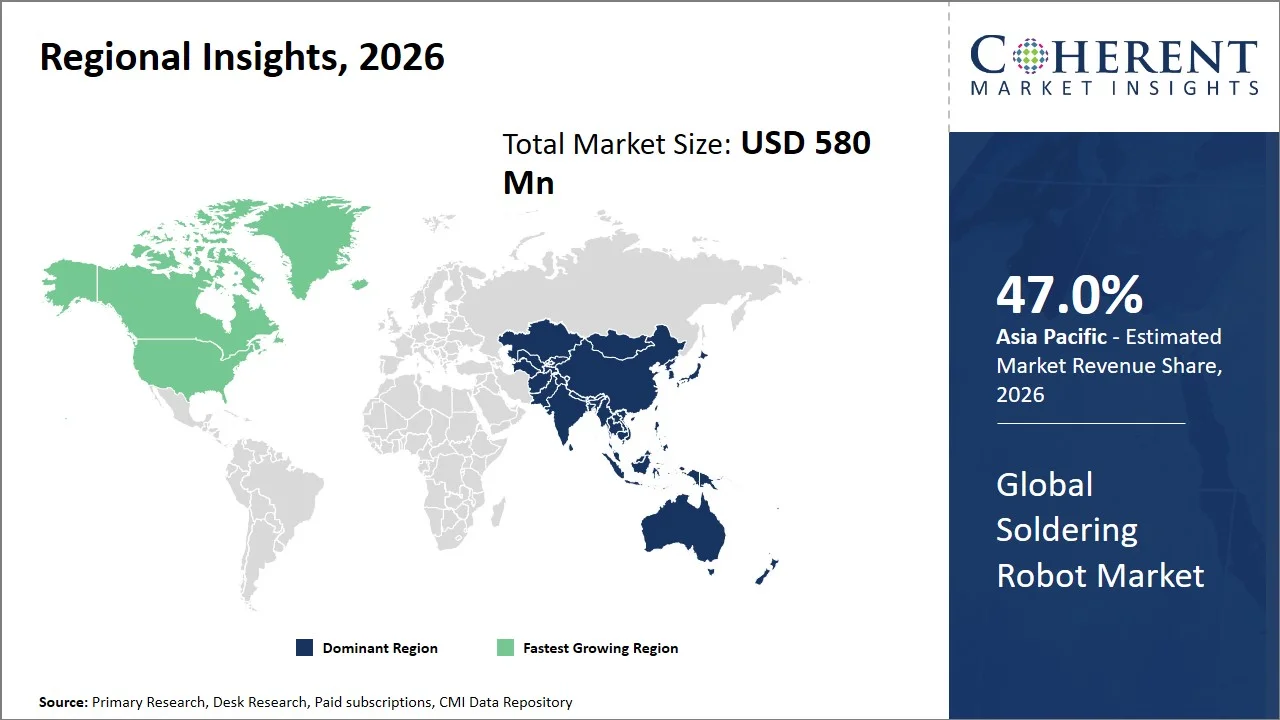
Why is Asia Pacific a Strong Market for Soldering Robots?
Asia Pacific is expected to account for a market share of 47.0% in 2026. Asia Pacific is the global manufacturing hub for soldering robots due to its concentration of electronics assembly, semiconductor fabrication and automotive electronics production. Demand is buoyed by Japan with Panasonic Connect, Sony Semiconductor Solutions, Murata Manufacturing, TDK and Rohm. China’s automated printed circuit board assembly continues to expand with manufacturers like Foxconn, Luxshare Precision, BYD Electronics, Wingtech Technology and Goertek. South Korea is adding more robots to its production lines at Samsung Electronics, Samsung Electro-Mechanics, LG Innotek and SK hynix, while Taiwan’s contract manufacturers, such as Foxconn, Pegatron, Wistron and Quanta Computer, are putting in precision robotic soldering systems to make high-volume electronics exports. With increasing expenditures in battery manufacture and better semiconductor packaging, more installations are happening across the region.
Why Does the North America Soldering Robot Market Exhibit High Growth?
North America is projected to account for 23.0% of the global soldering robot market and is expected to register the fastest growth. Soldering robots are being used at a fast rate in North America for high-value electronics, aerospace, defense, and electric car manufacturing. The U.S. is expanding automated electronics manufacturing through facilities operated by Tesla, Apple manufacturing partners, Jabil, Plexus, Sanmina, Benchmark Electronics, and Flex, where consistently high solder quality is essential for complex electronic assemblies. Automated soldering is also witnessing increased adoption among aerospace manufacturers including Lockheed Martin, RTX, Boeing, and Northrop Grumman for the production of mission-critical electronic modules. Mexico has also contributed to regional demand as businesses continue to build out electronics manufacturing facilities around Guadalajara and Monterrey in support of North American supply chain localization.
Global Soldering Robot Market Outlook for Key Countries
Why is China Emerging as a Major Hub in the Soldering Robot Market?
China is leading the world in deploying soldering robots, with a large ecosystem of electronics production and ongoing factory automation programs. Foxconn, BYD Electronics, Luxshare Precision, Goertek, Wingtech Technology, Lens Technology and TCL are scaling up intelligent manufacturing lines with automated soldering stations for smartphones, consumer electronics, electric cars and communication equipment. Domestic robot makers such as Efort Intelligent Equipment, Estun Automation and Inovance Technology are also advancing automation capabilities. Government support for advanced manufacturing under intelligent factory programs continues to spur the adoption of robotic soldering across electronics production clusters in Shenzhen, Dongguan, Suzhou and Chengdu.
Is the U.S. the Next Growth Engine for the Soldering Robot Market?
U.S. investments in semiconductor reshoring and sophisticated electronics manufacturing are bolstering its soldering robot business. Intel is boosting its semiconductor packaging capabilities in Arizona while Texas Instruments continues to invest in domestic chip making that needs highly automated soldering procedures. Apple vendors like Jabil, Plexus, Sanmina and Benchmark Electronics employ robotic soldering to produce high-reliability electronic assemblies. Automated soldering is also used by car makers, such as Tesla and Rivian, in battery management systems and vehicle control electronics, and defense companies continue to invest in precision robotic assembly of military-grade electronics.
Germany Soldering Robot Market Analysis and Trends
Germany is at the forefront of the deployment of soldering robots due to its automotive, industrial automation and electronics manufacturing industries. Bosch, Siemens, Continental, ZF Friedrichshafen, Hella and Infineon Technologies use robotic soldering systems for automotive electronic control units, industrial sensors and power electronics. Automotive vendors are scaling automated production of electric powertrain electronics and advanced driver assistance system modules that demand great repeatability of soldering quality. The country’s focus on smart factories and industrial automation will also further facilitate the integration of soldering robots into digitally connected production lines.
Japan Soldering Robot Market Analysis and Trends
Japan has continued to lead the market for soldering robots, due to a strong local robotics and precision electronics industry. Leading manufacturers such as Japan Unix, Apollo Seiko, Janome Corporation, Yamaha Motor, FANUC, DENSO Robotics, Panasonic Connect, Murata Manufacturing, Omron, and Keyence are still working on high-precision soldering automation for semiconductor devices, automotive electronics, industrial controls and medical equipment. Japanese manufacturers such as Toyota, Honda and Nissan are increasingly using automated soldering for vehicle electronics. Ongoing innovations in compact robotic systems and vision-guided soldering technologies ensure that Japan remains a leading provider of advanced soldering automation solutions.
South Korea Soldering Robot Market Analysis and Trends
South Korea is one of the most advanced countries in soldering robots. South Korea is a leader in semiconductor and consumer electronics manufacturing. Samsung Electronics, Samsung Electro-Mechanics, LG Electronics, LG Innotek, SK hynix and Hanwha Precision Machinery are investing in automated soldering technologies for memory chips, camera modules, display electronics and sophisticated packaging applications. The growing production of electric car batteries by Samsung SDI and LG Energy Solution is also resulting in increased demand for robotic soldering systems that can offer precise and repeatable interconnections within battery management circuits.
Global Soldering Robot Market - Soldering Robot Payload and Precision Benchmarking
Robot Type | Typical Payload Capacity (kg) | Positioning Repeatability (mm) | Typical Soldering Accuracy (mm) |
Desktop Cartesian Robot | 2–5 | ±0.01 | ±0.03 |
Industrial Cartesian Robot | 5–10 | ±0.02 | ±0.05 |
SCARA Soldering Robot | 3–10 | ±0.01 | ±0.03 |
Six-axis Articulated Robot | 6–20 | ±0.02 | ±0.05 |
Collaborative Soldering Robot | 3–10 | ±0.03 | ±0.05 |
Laser Soldering Robot | 2–8 | ±0.01 | ±0.02 |
How is the Growing Adoption of Collaborative Soldering Robots Creating New Growth Opportunities in the Soldering Robot Market?
The increased popularity of collaborative soldering robots is offering huge growth prospects by enabling automation in production conditions that were not viable for traditional industrial robots. Collaborative soldering robots are engineered to work safely with human workers, enabling firms to automate repetitive soldering activities without complex safety barriers or costly plant redesigns. This makes them especially appealing to small and medium-sized electronics producers who build high-mix, low-volume goods. These factors make collaborative robots ideal for printed circuit board assembly, cable harness soldering, sensor manufacture, and prototype production, and companies are increasingly deploying them for these purposes due to their quick programming, easy redeployment, and cheaper implementation costs. On September 15, 2025, Doosan Robotics announced the grand opening of the Doosan Robotics Innovation Center, a new facility designed to maximize synergy by integrating its robot research and development capabilities.
Market Players, Key Development, and Competitive Landscape
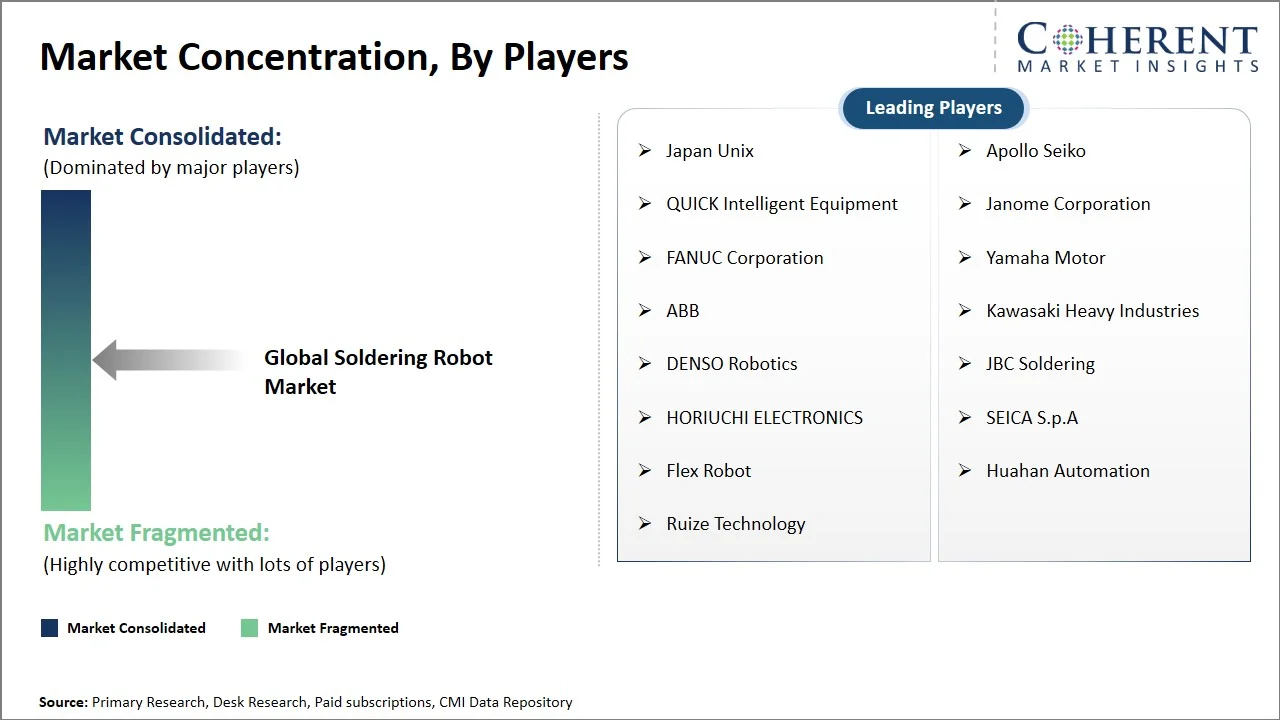
Key Developments
- On December 19, 2025, Apollo Seiko introduced the EF 3040A selective soldering platform, incorporating patented direct-drive technology, live teaching, Gerber data integration, remote assistance, and MES compatibility to strengthen Industry 4.0 manufacturing capabilities.
- On October 17, 2025, Japan Unix announced the establishment of new local offices in Mexico and Hungary, expanding its global sales and technical support network for automated soldering solutions to better serve electronics manufacturers.
Competitive Landscape
The soldering robot market is dominated by Japan Unix, Apollo Seiko, Janome Corporation, Yamaha Motor, FANUC, ABB, DENSO Robotics, Kawasaki Heavy Industries and QUICK Intelligent Equipment. Differentiation is based on soldering precision, motion control, machine vision and process intelligence rather than robot payload. Japan Unix is a specialist in multi-axis robotic soldering cells with integrated laser positioning, automatic tip cleaning and traceability software for automotive electronics and semiconductor assembly. Apollo Seiko manufactures selective soldering and point-to-point soldering equipment with patented temperature control and automatic solder feed for high density PCB fabrication. Yamaha Motor combines high-speed SCARA robots with vision-guided inspection for electronics assembly solutions, while Janome provides a tiny desktop robotic soldering platform for medical devices and precision electronics.
Market Report Scope
Soldering Robot Market Report Coverage
| Report Coverage | Details | ||
|---|---|---|---|
| Base Year: | 2025 | Market Size in 2026: | USD 580 Mn |
| Historical Data for: | 2020 To 2024 | Forecast Period: | 2026 To 2033 |
| Forecast Period 2026 to 2033 CAGR: | 7% | 2033 Value Projection: | USD 1,100 Mn |
| Geographies covered: |
| ||
| Segments covered: |
| ||
| Companies covered: | Japan Unix, Apollo Seiko, QUICK Intelligent Equipment, Janome Corporation, FANUC Corporation, Yamaha Motor, ABB, Kawasaki Heavy Industries, DENSO Robotics, JBC Soldering, HORIUCHI ELECTRONICS, SEICA S.p.A, Flex Robot, Huahan Automation, and Ruize Technology | ||
| Growth Drivers: |
| ||
| Restraints & Challenges: |
| ||
Analyst Opinion (Expert Opinion)
- While robotic hardware is improving, the trend of robotic soldering, automated optical inspection and real-time process analytics converging into a single manufacturing cell is helping to differentiate the market. There is also increased focus on adaptive soldering algorithms which can automatically compensate for component tolerances, solder volume variation and heat variations during manufacturing. There is increased usage in battery management systems, camera modules, semiconductor packaging and micro medical electronics where human soldering consistency cannot be achieved. The future of competitive difference will be decided not by traditional robot speed or axis configuration but by software intelligence, process repeatability and digital traceability capabilities.
- The market is predicted to expand in the future towards intelligent robotic soldering platforms that will be able to automatically optimize the parameters of the soldering process by using artificial intelligence and closed loop quality feedback. Further commercialization of laser soldering robots for advanced semiconductor packaging, silicon carbide power modules, and electric vehicle electronics is expected to be driven by component shrinking.
- More integration with manufacturing execution systems, digital twins and cloud-based production monitoring are projected to enable process predictive optimization and complete solder joint traceability. Suppliers are also expected to provide modular robotic soldering workstations for next-generation electronics manufacturing that include dispensing, soldering, inspection and automated rework in a single flexible production cell.
Speak to the analyst
Want personalized insights?
Take the findings above to one of our principal consultants, or have the report rebuilt around the segments, geographies and competitors you actually track.
Market Segmentation
- Type Insights (Revenue, USD Million, 2021 – 2033)
- Cartesian Soldering Robots
- SCARA Soldering Robots
- Articulated Soldering Robots
- Collaborative Soldering Robots
- Application Insights (Revenue, USD Million, 2021 - 2033)
- PCB Assembly
- Wire Harness Assembly
- Battery Pack Manufacturing
- Connector Assembly
- Sensor Assembly
- Electronic Component Manufacturing
- Regional Insights (Revenue, USD Million, 2021 - 2033)
- North America
- U.S.
- Canada
- Latin America
- Brazil
- Argentina
- Mexico
- Rest of Latin America
- Europe
- Germany
- U.K.
- Spain
- France
- Italy
- Russia
- Rest of Europe
- Asia Pacific
- China
- India
- Japan
- Australia
- South Korea
- ASEAN
- Rest of Asia Pacific
- Middle East
- GCC Countries
- Israel
- Rest of Middle East
- Africa
- South Africa
- North Africa
- Central Africa
- North America
- Key Players Insights
- Japan Unix
- Apollo Seiko
- QUICK Intelligent Equipment
- Janome Corporation
- FANUC Corporation
- Yamaha Motor
- ABB
- Kawasaki Heavy Industries
- DENSO Robotics
- JBC Soldering
- HORIUCHI ELECTRONICS
- SEICA S.p.A
- Flex Robot
- Huahan Automation
- Ruize Technology
Sources
Primary Research Interviews
- Soldering Robot Manufacturers & OEMs
- Electronics Contract Manufacturing Companies
- PCB Assembly & SMT Process Engineers
- Industrial Automation & Robotics Integrators
Magazines
- Robotics Business Review Magazine
- SMT007 Magazine (Surface Mount Technology)
- Electronics Weekly Magazine
- Assembly Magazine
Journals
- Journal of Manufacturing Systems (Elsevier)
- International Journal of Advanced Manufacturing Technology
- IEEE Transactions on Industrial Electronics
Associations
- International Federation of Robotics (IFR)
- Robotic Industries Association (RIA) / Association for Advancing Automation (A3)
- IPC – Association Connecting Electronics Industries
- Surface Mount Technology Association (SMTA)
Public Domain Sources
- U.S. International Trade Commission (USITC) – Trade Data on Robotics & Automation Equipment
- European Commission – Industrial Automation Policy & Trade Reports
- Japan Robot Association (JARA) – Robotics Market Statistics
- World Trade Organization (WTO) – Electronics & Manufacturing Trade Data
Proprietary Elements
- CMI Data Analytics Tool
- Proprietary CMI Existing Repository of Information for Last 10 Years
Get access to 250+ pages report
Every segment, forecast, competitor profile and data table behind the analysis above — available for instant download.
- ESOMAR Member
- ISO 9001:2015 Certified
- D-U-N-S Registered
- GDPR & CCPA Compliant
Missing comfort of reading report in your local language? Find your preferred language:
Transform your Strategy with Exclusive Trending Reports
Frequently Asked Questions
The global soldering robot market is expected to stand at USD 580 Mn in 2026 and is expected to reach USD 1,100 Mn by 2033.
The CAGR of the global Soldering Robot market is projected to be 7% from 2026 to 2033.
Rising automation across electronics manufacturing facilities and increasing demand for high precision PCB assembly are the major factors driving the growth of the global soldering robot market.
High initial investment costs and complex integration with existing production lines are the major factors hampering the growth of the global soldering robot market.
In terms of type, the cartesian soldering robots segment is estimated to dominate the market revenue share in 2026.
They deliver higher accuracy, consistent solder quality, and improved production efficiency.
They minimize soldering defects by maintaining precise temperature and motion control.