

Global Solid State Transformers Market Size and Forecast – 2026 To 2033
The Solid State Transformers Market is estimated to be valued at USD 342.8 Mn in 2026 and is expected to reach USD 1,151.6 Mn by 2033, exhibiting a compound annual growth rate (CAGR) of 18.9% from 2026 to 2033. This fast growth is being fueled by the growing needs for energy management solutions that are more efficient in smart grids, renewable energy integration, the charging infrastructure of electric vehicles and high-density data centers. The market's strong growth is equally attributed to the developments of wide-bandgap semiconductor devices, medium-voltage direct current distribution, and digitally-controlled power electronics.
In April 2026, Sifang Digital Energy launched Solid State Transformer 1.0 for artificial intelligence data centers in Beijing, China, designed to meet rising power demand in next-generation data center infrastructure and support more efficient power distribution (Source: TSX Inc)
Key Takeaways of the Global Solid State Transformers Market
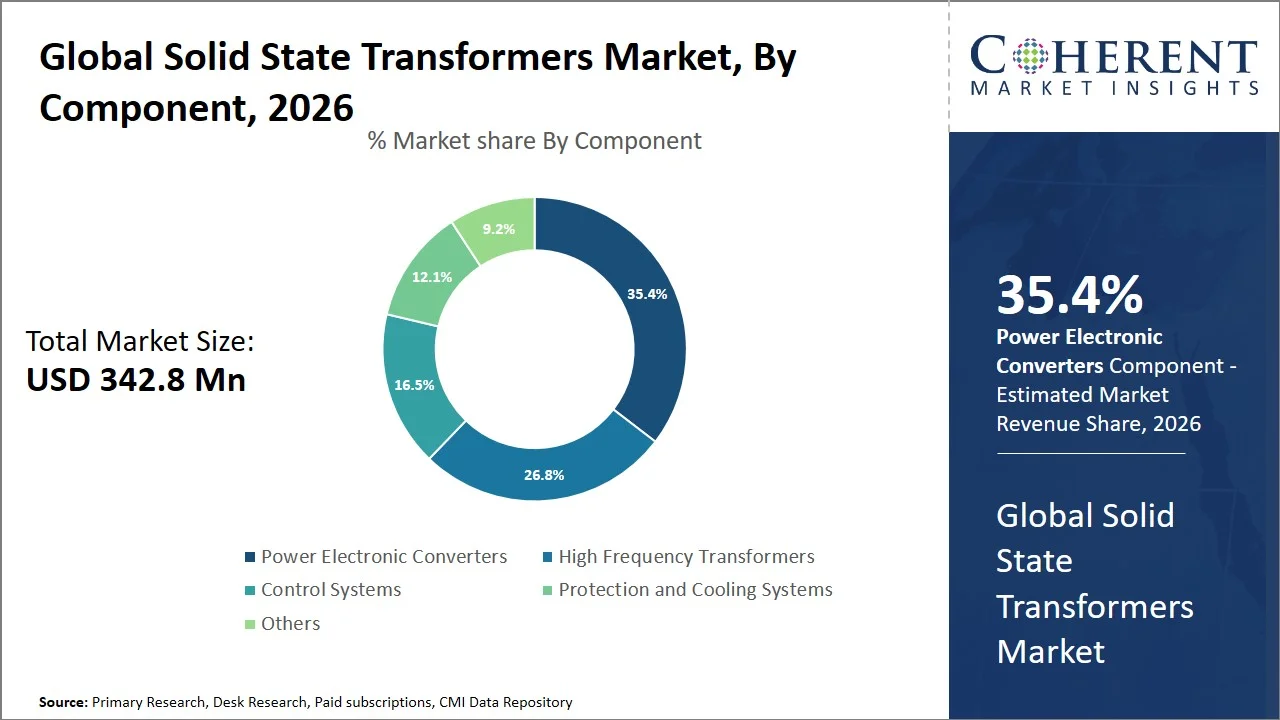
- Power electronic converters are expected to dominate the component segment with 35.4 % of the market share in 2026, as solid state transformer’s architectures rely on high-efficiency semiconductor switching, AC/DC conversion, and bidirectional power flow control. In May 2026, Wolfspeed introduced 3.3 kV SiC power modules designed for solid-state transformer and grid-scale converter applications, supporting compact, high-power infrastructure.
- Distribution solid state transformers are projected to account for 47.6 % of the total market share in 2026 due to their best fit in smart distribution grid, feeder level voltage management and distributed energy integration. In November 2025, the U.S. Department of Energy confirmed the DIRECT project to scale a single-stage solid state transformers into a cascaded multi-module system for field deployment on a load-serving circuit. (Source: U.S. Department of Energy)
- The medium voltage segment is expected to reach 55.60 % of the market share in 2026, with a high level of commercialization expected in the grid-edge power conversion market, AI data centers, EV charging hubs and renewable interconnection. In November 2025, Infineon and SolarEdge announced collaboration on solid state transformers technology enabling direct medium-voltage 13.8–34.5 kV to 800–1,500 V DC conversion for hyperscale power infrastructure. (Source: Infineon Technologies AG)
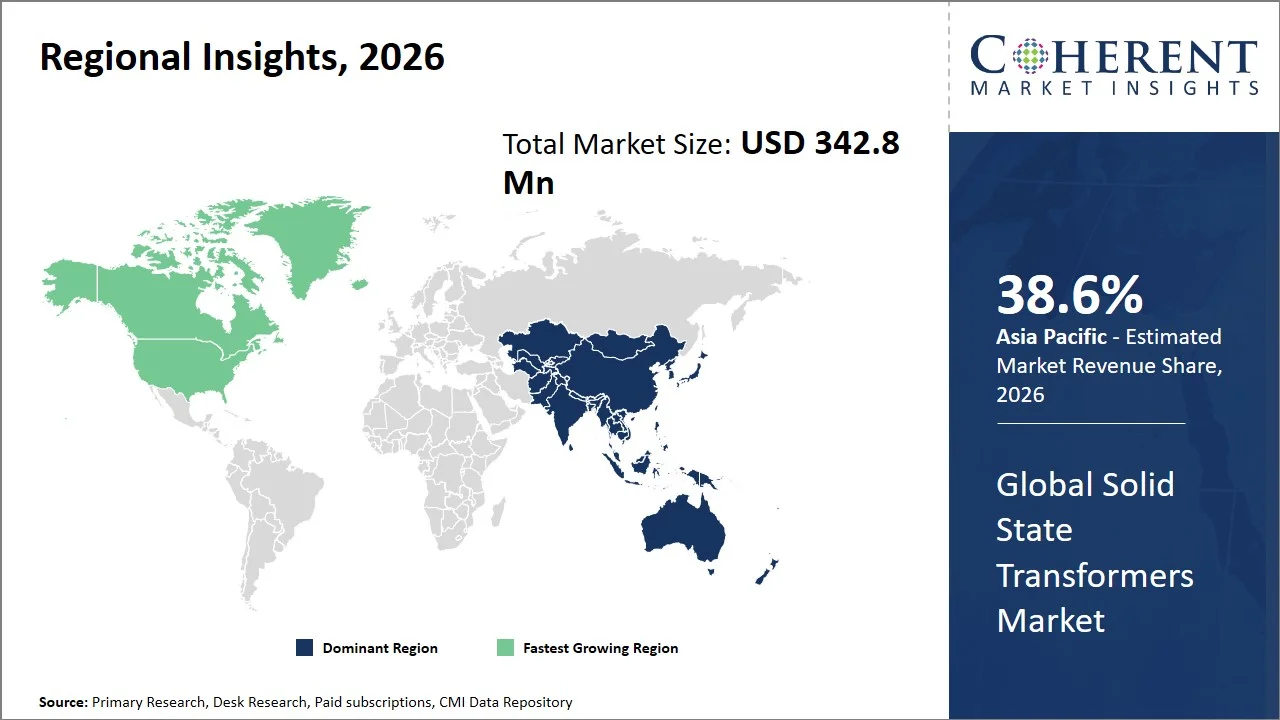
- Asia Pacific is expected to dominate with 38.6 % share in 2026, supported by China-led power electronics manufacturing, large-scale grid modernization, renewable integration, and high-density data-center expansion. In May 2026, Huawei Digital Power unveiled a grid-interactive AIDC strategy in Dongguan, evolving toward an integrated energy router based on solid-state transformer technology.
- North America is expected to be the fastest-growing region with 27.4 % share in 2026, led by AI data-center electrification, utility modernization, and advanced power-conversion ecosystem development. In May 2025, NVIDIA announced its 800 VDC architecture for next-generation AI factories, targeting 1 MW IT racks and involving major power-system partners across the data-center electrical ecosystem.
- Grid-Interactive Power Architecture: Solid state transformers are shifting from niche power devices to intelligent grid-interface platforms. Their strategic value lies in combining voltage transformation, power quality control, renewable integration, and bidirectional energy flow in a single architecture. This positions solid state transformers as enabling assets for utilities seeking more flexible, software-defined distribution networks.
- AI Data Centers and EV Charging Shape Demand Direction: The market is moving toward compact, high-density power infrastructure where conventional transformer-based systems face space, efficiency, and response-time limitations. Solid state transformers adoption is increasingly aligned with AI factories, fast-charging corridors, and distributed energy hubs, creating opportunities for semiconductor suppliers, converter OEMs, and grid equipment manufacturers.
Segmental Insights
Why Do Power Electronic Converters Dominate the Global Solid State Transformers Market?
The global solid state transformers market is expected to be led by power electronic converters, accounting for an estimated 35.4% share in 2026. This dominance is attributed to their role as the active conversion core of SST systems, enabling AC/DC conversion, bidirectional power flow, voltage regulation, and rapid response to dynamic load conditions. The demand is the highest when traditional transformer systems are unable to handle rapidly changing load demands such as AI data centers, grid-connected storage, EV fleet charging and distributed renewable power assets. On the supply side, progress in modular converter architecture, digital control, and wide-bandgap switching is improving efficiency and reducing system footprint. End users adopt these converters where multiple energy inputs and outputs must be controlled through one compact power platform. In May 2026, DG Matrix introduced its Interport Solid State Transformers platform for NVIDIA MGX-based AI factories, highlighting single-stage, multi-port conversion for 800 VDC power delivery.
- Current Industry Events of 2026
- Market Size Estimation
- Regional Breakdown
- Competitive Landscape
- Customer Intelligence
- Segmental Analysis
- Pricing Analysis
- Key Market Drivers, Challenges & Future Trends
- Customized Insights Section
Why Do Distribution Solid State Transformers Represent the Largest Product Type in the Global Solid State Transformers Market?
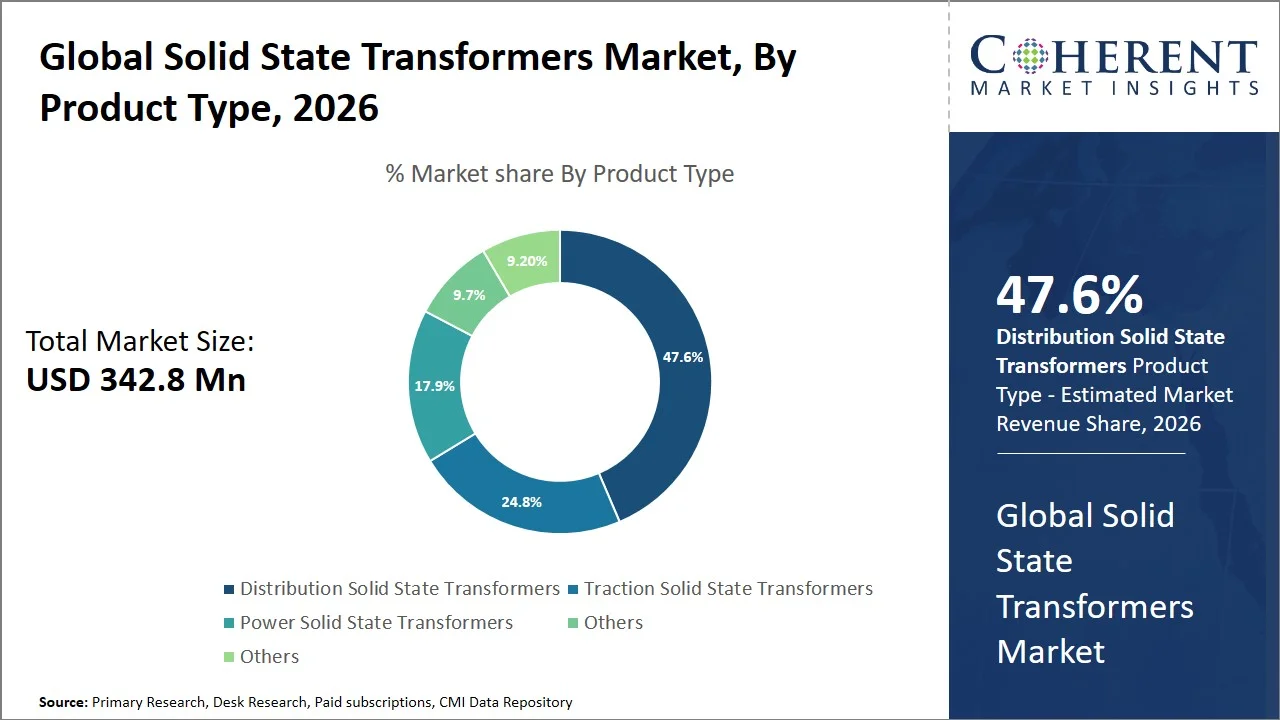
Distribution solid state transformers represent the largest product type with 47.6% of the market share in 2026 as they address the most commercially urgent part of the power network: the distribution edge where utilities, charging operators, buildings, and energy-storage assets connect to end loads. Their dominance comes from the need to replace bulky step-down transformer plus switchgear arrangements with compact, controllable systems that can support DC loads, local storage, and grid-interactive operation. Demand is particularly strong in depots, distributed energy hubs, commercial campuses, and high-power facilities requiring faster grid connection. Supply-side momentum is improving as large electrical OEMs acquire solid state transformers capabilities to scale manufacturing, service, and commercialization. In August 2025, Eaton completed its acquisition of Resilient Power Systems, adding ultra-compact Solid State Transformers technology that connects EV charging depots directly to existing distribution grids.
Why Does Medium Voltage Dominate the Global Solid State Transformers Market?
Medium voltage dominates the global solid state transformers market with an estimated 55.6% share in 2026 because it offers the strongest balance between grid accessibility, power density, and commercial deployability. Solid state transformers at this voltage level are well suited for connecting facilities directly to utility distribution feeders while avoiding extensive low-voltage conversion equipment. Demand is concentrated in megawatt-scale EV charging, renewable interconnection, industrial electrification, port power systems, and high-density digital infrastructure. From a technology standpoint, medium-voltage solid state transformers enable higher-power transfer in smaller footprints while supporting integrated protection, cooling, and controls. End users adopt them where site space, installation timelines, and transformer availability are major constraints. In October 2025, WattEV unveiled a compact medium-voltage SOLID STATE TRANSFORMERS -based power conversion system for megawatt heavy-duty electric truck charging, designed for direct 12 kV–15 kV grid connection. (Source: WattEV)
Global Solid State Transformers Market Dynamics
Key Market Drivers
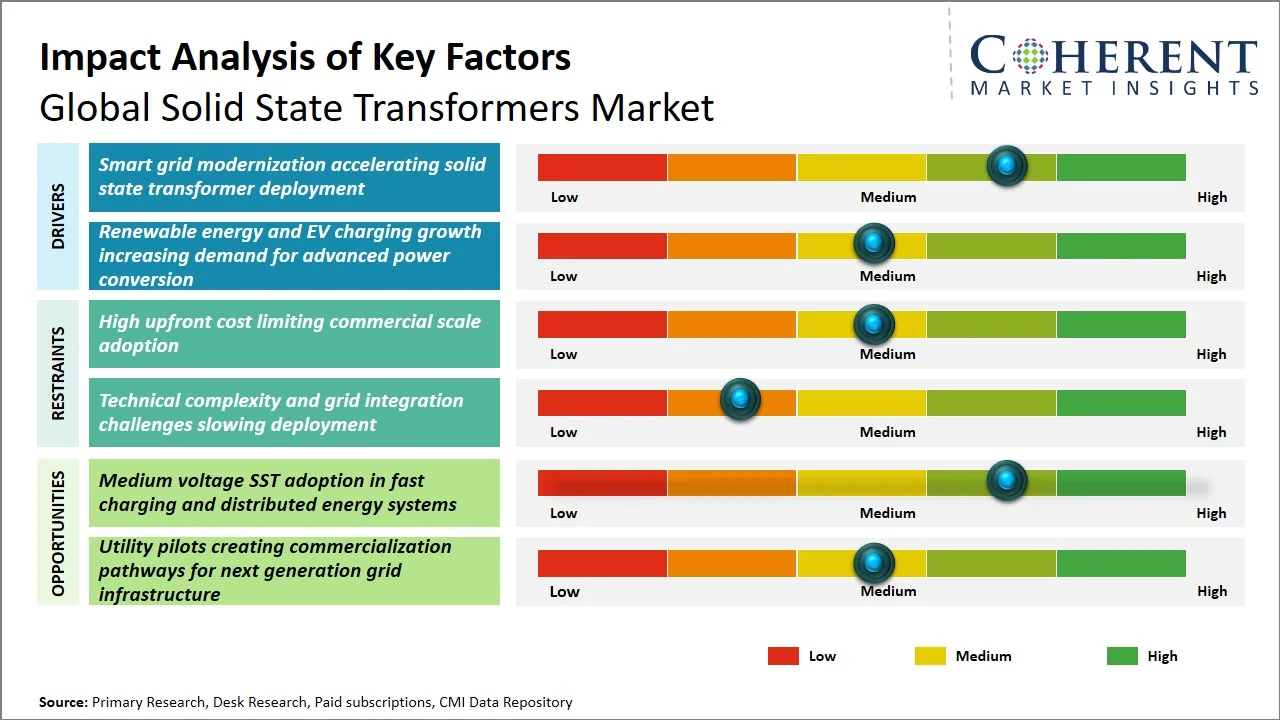
- Smart Grid Modernization Accelerating Solid State Transformer Deployment: Smart grid modernization is a core growth driver for the global Solid State Transformers market because utilities and high-load customers are moving from passive power delivery toward digitally controlled, flexible distribution infrastructure. Solid State Transformers support this shift by combining voltage conversion, power quality management, bidirectional flow, and faster response to grid disturbances in one platform. This is commercially important where utilities must connect distributed energy resources, AI data centers, storage systems, and flexible loads without expanding conventional transformer rooms and switchgear footprints. In June 2026, Alderbuck Energy announced the deployment of its medium-voltage solid state transformers based Nexus Power Unit at the San Diego Supercomputer Center under a California Energy Commission-funded grid-interactive data center project, validating 12 kV AC-to-800 VDC architecture for grid coordination and flexible load planning.
- Renewable Energy and EV Charging Growth Increasing Demand for Advanced Power Conversion: Renewable energy integration and electrified transport are increasing the need for compact, controllable, high-efficiency power conversion systems. Solar, wind, battery storage, EV charging depots, and industrial electrification projects require power equipment that can manage variable generation, DC-linked assets, rapid load changes, and interconnection constraints. Solid State Transformers are gaining relevance because they reduce dependence on multiple conversion stages and enable more integrated AC/DC infrastructure. This improves project economics for developers facing land, interconnection, and commissioning challenges. In June 2026, Heron Power announced a collaboration with LG Energy Solution Vertech to integrate its solid state transformers based Heron Link with U.S.-manufactured battery energy storage systems, creating a validated DC-to-AC platform for utility-scale storage, data centers, and manufacturing applications.
Emerging Market Trends
- Shift Toward Multi-Port, Software-Defined Power Platforms: The market is moving from single-function transformer replacement toward multi-port, software-defined energy routing platforms. This trend is important because future distribution networks must connect multiple power sources and loads, including grid supply, solar PV, battery storage, EV chargers, industrial equipment, and data center loads. Multi-port Solid State Transformers allow operators to manage these assets through a more integrated architecture rather than adding separate transformers, rectifiers, inverters, switchgear, and protection equipment. For manufacturers, this creates opportunities to differentiate through modularity, digital control software, protection intelligence, and grid-service functionality. For end users, the value proposition is not only energy efficiency but also faster deployment, reduced equipment count, improved power quality, and better utilization of constrained grid connections.
- Growing Focus on Medium-Voltage DC Distribution: Medium-voltage DC distribution is emerging as a strategic trend in the Solid State Transformers market as high-density electrical loads become more difficult to serve through conventional low-voltage AC architecture. solid state transformers are positioned at the center of this transition because they can connect medium-voltage utility feeders directly to DC buses used in data centers, storage assets, EV charging hubs, and industrial electrification systems. This trend supports smaller electrical rooms, lower conversion losses, improved equipment integration, and faster scalability for power-dense sites. It also strengthens the role of power semiconductor suppliers, converter designers, and system integrators as electrical infrastructure becomes more electronics-led. Over the forecast period, medium-voltage DC adoption is expected to push Solid State Transformers from pilot projects toward commercial infrastructure planning.
Current Events and their Impact
Current Events | Description and its Impact |
FERC Order No. 1920-A, November 2024 |
|
European Commission Grids Package, December 2025 |
|
India RDSS Smart Metering and Grid Modernization Update, December 2025 |
|
Regional Insights
Why Does Asia Pacific Dominate the Global Solid State Transformers Market?
Asia Pacific is expected to account for the largest share of 38.60% in the global solid state transformers market in 2026 on the back of the high focus on grid modernization initiatives, manufacturing of power electronics, integration of renewable energy, and high-density digital infrastructure in the region. The strong demand base for distribution automation, EV charging, data centers and industrial electrification includes China, India, Japan, South Korea and Taiwan. The area also has a local supply chain of semiconductors, converters, magnetic components and electrical equipment, which helps to lower commercialization barriers for Solid State Transformers platforms. The region's utilities are increasingly seeking flexible, grid distribution systems to respond to a changing load and distributed generation. In April 2026, China’s SASAC reported that State Grid Corporation of China had made major progress in smart grid and green power development, strengthening the regional case for advanced transformer and grid-interface technologies.
Why is North America Emerging as the Fastest-Growing Region in the Global Solid State Transformers Market?
North America is emerging as the fastest-growing region with an estimated 27.40% share in 2026, supported by rising demand from AI data centers, battery energy storage, EV charging corridors, and advanced grid hardware programs. The region has a strong ecosystem of national laboratories, power electronics start-ups, semiconductor suppliers, utilities, and hyperscale customers, creating a favorable environment for early Solid State Transformers commercialization. Demand is also shaped by the need to improve transformer availability, reduce electrical infrastructure footprint, and support medium-voltage DC architectures. In January 2025, the U.S. Department of Energy’s Wide Bandgap Power Electronics Strategic Framework identified Solid State Transformers as an emerging technology that can support DER integration, fault management, reduced power losses, and greater grid flexibility, reinforcing North America’s technology-led growth pathway.
Global Solid State Transformers Market Key Country Outlook
Why is the U.S. a Key Market for the Global Solid State Transformers Market?
The U.S. is a key market for solid state transformers due to rising pressure on its power grid from AI data centers, EV fast-charging corridors, renewable interconnection, and aging distribution infrastructure. Data center load growth is becoming a major grid planning issue, especially in states such as Virginia, Texas, Arizona, and Ohio where hyperscale facilities are expanding rapidly. Solid state transformers are relevant in these conditions because they can support compact medium-voltage power conversion, voltage regulation, bidirectional energy flow, and real-time grid control. For instance, the U.S. Department of Energy has supported hybrid solid-state transformer development through its Transformer Resilience and Advanced Components program, including a 500 kVA hybrid solid-state transformer project led by the University of Texas at Austin. This shows that the U.S. is not only a demand market but also an innovation center for advanced transformer technologies.
Why is India Important in the Global Solid State Transformers Market?
India is important in the solid state transformers market because its distribution grid is being upgraded to handle smart metering, renewable energy, EV charging, metro rail electrification, and rising urban electricity demand. The Revamped Distribution Sector Scheme is strengthening distribution infrastructure through smart consumer meters, feeder metering, and distribution transformer monitoring, creating a stronger base for digitally controlled power equipment. India’s EV charging push under PM E-DRIVE also creates a future use case for medium-voltage solid state transformers in public charging stations, bus depots, logistics hubs, and highway charging corridors. For instance, the government has allocated dedicated support for public EV charging infrastructure under PM E-DRIVE, which can increase the demand for compact and efficient power conversion systems. In India, adoption is expected to begin in high-value applications such as charging hubs, data centers, rail traction, industrial parks, and smart city power networks before wider utility deployment.
Why Does China Support Growth in the Global Solid State Transformers Market?
China supports the solid state transformers market due to its large-scale renewable energy expansion, EV charging infrastructure, advanced electronics manufacturing base, and strong utility-led demonstration ecosystem. The country has one of the world’s largest power equipment supply chains, covering power modules, semiconductor devices, control electronics, magnetic components, thermal systems, and integrated electrical cabinets. China’s renewable-heavy grid and fast-growing EV charging base create strong demand for advanced power conversion and flexible distribution technologies. For instance, China’s Hangzhou Dajiangdong DC Distribution Network Demonstration Project has been associated with a ±10 kV/±375 V, 500 kW solid state transformer application, showing practical use of SST technology in DC distribution networks. With large domestic demand and manufacturing scale, China is likely to be one of the strongest commercialization markets as SSTs move from pilot projects to broader deployment.
Why is Germany a Strategic Country in the Global Solid State Transformers Market?
Germany is strategic for solid state transformers because of its strong electrical engineering base, advanced automation industry, renewable integration needs, and focus on reliable power infrastructure. The country is highly relevant for SST adoption in rail power systems, industrial automation, EV charging, renewable energy integration, and medium-voltage distribution networks. Germany’s power users typically prioritize reliability, safety, energy efficiency, and lifecycle performance, which supports demand for premium power-electronics-based transformer solutions. For instance, Fraunhofer ISE has developed and tested advanced inverter solutions for direct solar feed-in into Deutsche Bahn’s railway power grid, while its medium-voltage laboratory supports testing of converters, transformers, and container-scale power systems on a 20 kV grid. This makes Germany a key engineering and validation hub for next-generation grid power electronics.
Why is Brazil an Important Growth Market for Solid State Transformers?
Brazil is an important growth market for solid state transformers because its power system is facing increasing renewable integration, distributed solar growth, grid reliability needs, and rising industrial electricity demand. The country’s large hydropower base is now being complemented by fast growth in solar and wind capacity, which increases the need for better voltage control, grid flexibility, and power conversion at distribution and industrial sites. For instance, Brazil’s solar capacity has expanded rapidly, and renewable curtailment has become a concern in some areas due to grid absorption limits. Solid state transformers can become relevant in such conditions by supporting renewable integration, storage connection, voltage stabilization, and compact power conversion for industrial and remote-grid applications. Brazil’s role as the largest electricity market in Latin America also makes it a strategic entry point for suppliers targeting regional grid modernization and electrification opportunities.
Technology Adoption Landscape in the Global Solid State Transformers Market
Technology | Adoption Level | Key Application Area | Business Impact |
Silicon Carbide Power Semiconductors | High | Medium-voltage converters and high-frequency switching | Improves efficiency, reduces thermal load, and enables compact solid state transformers designs |
Multi-Port SOLID STATE TRANSFORMERS Architecture | Medium | Data centers, storage, EV charging hubs, renewable integration | Combines multiple conversion stages and supports flexible energy routing |
High-Frequency Transformers | High | Galvanic isolation and compact voltage conversion | Reduces equipment size and improves power density versus conventional transformer cores |
Digital Control and Real-Time Power Management | High | Voltage regulation, load balancing, power quality control | Enables grid-responsive operation and improves reliability for sensitive loads |
Bidirectional AC/DC Conversion | Medium | Battery storage, EV charging, renewable-linked distribution systems | Supports charging, discharging, and grid-support functions from one platform |
Integrated Protection and Thermal Management | Medium | Medium-voltage solid state transformers cabinets and modular converter systems | Improves safety, uptime, equipment life, and acceptance in utility-grade applications |
How are Medium-Voltage DC Architectures and Grid-Interactive Loads Creating New Growth Opportunities in the Global Solid State Transformers Market?
Medium-voltage DC architectures are creating a major growth opportunity for the global solid state transformers market because high-power users increasingly need direct, compact, and digitally managed grid interfaces. AI data centers, EV charging depots, renewable operators, storage developers, and industrial facilities are adding loads that change faster than conventional transformer infrastructure can manage. Solid State Transformers can serve this opportunity by reducing conversion stages, improving power density, enabling bidirectional flow, and supporting real-time control of AC and DC assets. This makes them commercially attractive for projects where interconnection time, electrical room footprint, equipment complexity, and power quality are key constraints. The opportunity is strongest in applications where customers value system-level performance rather than only transformer replacement. Suppliers that can offer modular designs, proven protection systems, thermal reliability, and grid-code-compliant controls will be better positioned to convert early deployments into repeatable commercial platforms.
Market Players, Key Development, and Competitive Intelligence
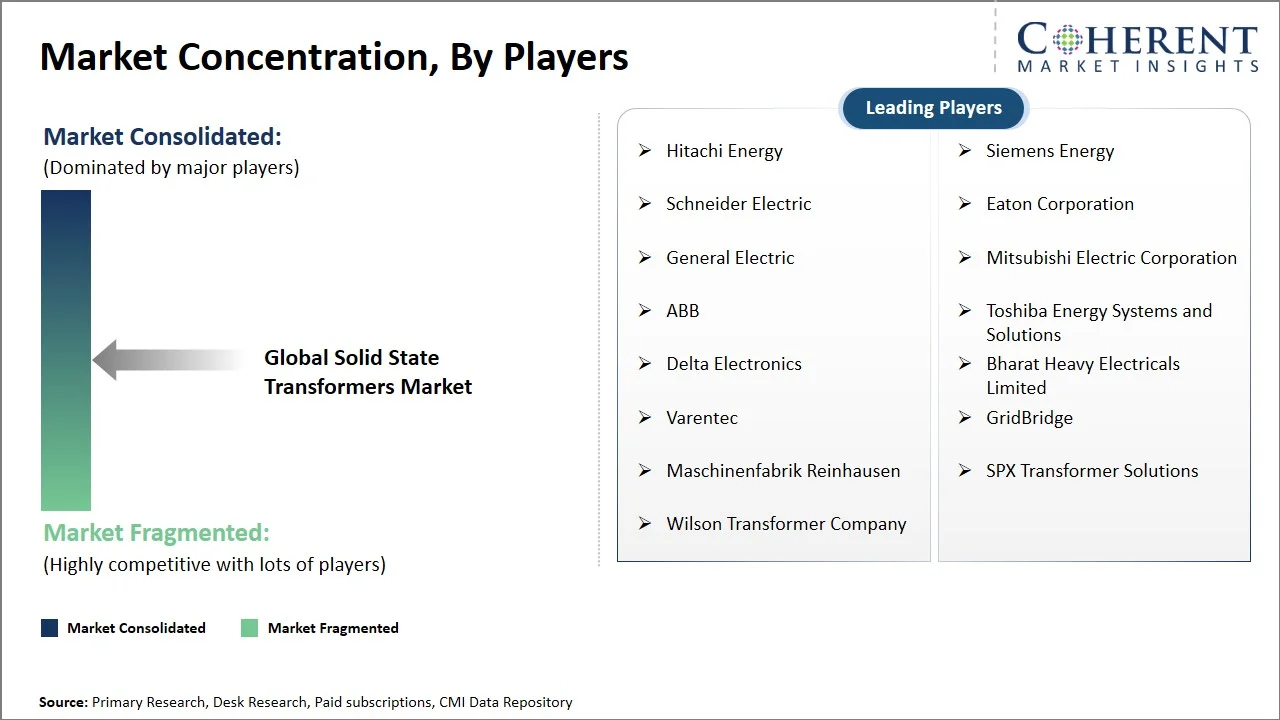
Key Developments
- In June 2026, Alderbuck Energy announced deployment of its 800 VDC solid-state transformer platform at the San Diego Supercomputer Center under a California Energy Commission-funded project. The deployment will validate medium-voltage AC-to-800 VDC power infrastructure for high-density AI data centers, supporting faster energization, improved efficiency, and reduced electrical equipment footprint.
- In June 2026, Heron Power announced a design and engineering collaboration with LG Energy Solution Vertech to integrate Heron’s Solid State Transformers-based Heron Link with U.S.-manufactured battery energy storage systems.
- In April 2026, Enphase Energy announced development of its IQ Solid-State Transformer, a distributed, semiconductor- and software-defined Solid State Transformers platform designed for AI data centers shifting toward high-density DC power architectures. This development strengthens solid state transformers relevance in next-generation data center power delivery, where compact conversion, modularity, and higher rack-density support are becoming critical.
Competitive Landscape
The global solid state transformers market is moderately concentrated at the technology-development level but still emerging at the commercial deployment level. Competition is shaped by power electronics capability, medium-voltage engineering expertise, semiconductor access, system integration, and the ability to validate Solid State Transformers in utility-grade or mission-critical environments.
Key focus areas include
- Product quality and reliability: Companies compete on conversion efficiency, thermal stability, insulation reliability, and protection performance.
- Technology differentiation: Multi-port architecture, SiC-based switching, high-frequency transformer design, and digital controls are key differentiators.
- Cost competitiveness: Suppliers must reduce semiconductor, cooling, and enclosure costs to compete with conventional transformer-plus-power-electronics systems.
- Supply reliability: Access to wide-bandgap devices, magnetic materials, control electronics, and qualified manufacturing partners is becoming critical.
- Certifications and compliance: Grid interconnection standards, electrical safety approvals, cybersecurity readiness, and utility acceptance influence commercialization.
- Application-specific design: Data centers, EV charging, rail traction, renewables, and utilities require different voltage ratings, protection logic, and installation formats.
- Partnership-led commercialization: Collaboration with utilities, storage integrators, charging operators, semiconductor suppliers, and engineering contractors is central to market entry.
- Service and lifecycle support: Remote monitoring, predictive maintenance, spares availability, and commissioning capability will influence customer confidence.
Market Report Scope
Solid State Transformers Market Report Coverage
| Report Coverage | Details | ||
|---|---|---|---|
| Base Year: | 2025 | Market Size in 2026: | USD 342.8 Mn |
| Historical Data for: | 2020 To 2024 | Forecast Period: | 2026 To 2033 |
| Forecast Period 2026 to 2033 CAGR: | 18.9% | 2033 Value Projection: | USD 1,151.6 Mn |
| Geographies covered: |
| ||
| Segments covered: |
| ||
| Companies covered: | Hitachi Energy, Siemens Energy, Schneider Electric, Eaton Corporation, General Electric, Mitsubishi Electric Corporation, ABB, Toshiba Energy Systems and Solutions, Delta Electronics, Bharat Heavy Electricals Limited, Varentec, GridBridge, Maschinenfabrik Reinhausen, SPX Transformer Solutions, and Wilson Transformer Company | ||
| Growth Drivers: |
| ||
| Restraints & Challenges: |
| ||
Analyst Opinion (Expert Opinion)
- The global solid state transformers market is entering a high-growth commercialization phase, supported by the shift toward smart grids, high-density power infrastructure, renewable integration, and electrified mobility.
- The strongest growth pockets are expected in Asia Pacific for distribution modernization and manufacturing scale, and in North America for AI data centers, storage-linked power systems, and EV charging infrastructure. Power electronic converters, distribution solid state transformers, and medium-voltage platforms are likely to remain the most strategically important segments because they directly address power density, grid flexibility, and conversion-efficiency challenges.
- Key barriers include high upfront cost, limited field-proven deployments, utility qualification timelines, semiconductor supply dependence, protection complexity, and the need for specialized installation skills. Market players should focus on modular designs, application-specific reference architectures, utility validation, cost-down engineering, and partnerships with data center, storage, EV charging, and renewable infrastructure developers to gain competitive advantage.
Speak to the analyst
Want personalized insights?
Take the findings above to one of our principal consultants, or have the report rebuilt around the segments, geographies and competitors you actually track.
Market Segmentation
- Component Insights (Revenue, USD Mn, 2021 - 2033)
- Power Electronic Converters
- High Frequency Transformers
- Control Systems
- Protection and Cooling Systems
- Others
- Product Type Insights (Revenue, USD Mn, 2021 - 2033)
- Distribution Solid State Transformers
- Traction Solid State Transformers
- Power Solid State Transformers
- Others
- Voltage Level Insights (Revenue, USD Mn, 2021 - 2033)
- Medium Voltage
- Low Voltage
- High Voltage
- Installation Type Insights (Revenue, USD Mn, 2021 - 2033)
- New Installations
- Retrofit and Replacement
- Utilities
- End-use Industry Insights (Revenue, USD Mn, 2021 - 2033)
- Renewable Energy Operators
- Electric Vehicle Charging Operators
- Railways and Transportation
- Industrial
- Commercial and Data Centers
- Regional Insights (Revenue, USD Mn, 2021 - 2033)
- North America
- U.S.
- Canada
- Latin America
- Brazil
- Argentina
- Mexico
- Rest of Latin America
- Europe
- Germany
- U.K.
- Spain
- France
- Italy
- Russia
- Rest of Europe
- Asia Pacific
- China
- India
- Japan
- Australia
- South Korea
- ASEAN
- Rest of Asia Pacific
- Middle East
- GCC Countries
- Israel
- Rest of Middle East
- Africa
- South Africa
- North Africa
- Central Africa
- North America
- Key Players Insights
- Hitachi Energy
- Siemens Energy
- Schneider Electric
- Eaton Corporation
- General Electric
- Mitsubishi Electric Corporation
- ABB
- Toshiba Energy Systems and Solutions
- Delta Electronics
- Bharat Heavy Electricals Limited
- Varentec
- GridBridge
- Maschinenfabrik Reinhausen
- SPX Transformer Solutions
- Wilson Transformer Company
Sources
Primary Research Interviews
- Utility grid modernization heads and distribution network planning managers
- Power electronics engineers working on solid state transformer architecture
- Renewable energy project developers using advanced grid interconnection systems
- Electric vehicle charging infrastructure operators and charging technology heads
- Data center electrical infrastructure managers and power systems consultants
- Railway electrification engineers and traction power system specialists
- Procurement managers from utilities, industrial facilities, and renewable energy operators
- Product managers and executives from solid state transformer and power conversion companies
- Semiconductor experts working on silicon carbide and gallium nitride power devices
- Regulatory, compliance, and grid code specialists involved in medium voltage electrical equipment
Stakeholders
- Solid state transformer manufacturers and advanced transformer technology companies
- Power electronic converter manufacturers
- High frequency transformer and magnetic component suppliers
- Silicon carbide and gallium nitride semiconductor manufacturers
- Protection, cooling, insulation, and control system suppliers
- Engineering, procurement, and construction companies serving grid and renewable projects
- Utility companies and distribution network operators
- Renewable energy operators and energy storage system developers
- Electric vehicle charging network operators
- Data center operators and industrial electrification customers
- Railway and transportation electrification authorities
End-use Sectors
- Renewable energy operators
- Electric vehicle charging operators
- Utility distribution companies
- Railways and transportation operators
- Industrial manufacturing facilities
- Commercial buildings and data centers
- Microgrid developers and campus energy systems
- Energy storage project developers
- Smart city and urban power infrastructure projects
- Defense and mission-critical power infrastructure users
Regulatory and Grid Authorities
- United States Department of Energy
- Federal Energy Regulatory Commission
- European Commission Energy Department
- Ministry of Power, Government of India
- Central Electricity Authority, India
- National Energy Administration, China
- National Development and Reform Commission, China
- Federal Network Agency, Germany
- National Electric Energy Agency, Brazil
- International Electrotechnical Commission
- Institute of Electrical and Electronics Engineers Standards Association
Databases
- United States Department of Energy Grid Modernization database
- United States Department of Energy Advanced Materials and Manufacturing Technologies Office database
- International Energy Agency electricity grids and renewable integration database
- International Renewable Energy Agency renewable energy statistics database
- European Commission electricity infrastructure database
- Ministry of Power, Government of India Revamped Distribution Sector Scheme portal
- Federal Energy Regulatory Commission transmission planning and grid reliability documents
- World Bank electricity access and power infrastructure indicators
- National Renewable Energy Laboratory medium voltage power electronics resources
- United States Energy Information Administration electricity infrastructure database
Industry News Platforms and Trade Publications
- Power Magazine
- Institute of Electrical and Electronics Engineers Spectrum
- Institute of Electrical and Electronics Engineers Power Electronics Magazine
- Power Electronics News
- Transmission and Distribution World
- Utility Dive
- Smart Energy International
- Renewable Energy World
- Data Center Dynamics
- Power Technology
- Energy Storage News
- Solar Power World
Journals
- Institute of Electrical and Electronics Engineers Transactions on Power Electronics
- Institute of Electrical and Electronics Engineers Transactions on Industry Applications
- Institute of Electrical and Electronics Engineers Transactions on Smart Grid
- Institute of Electrical and Electronics Engineers Journal of Emerging and Selected Topics in Power Electronics
- Institution of Engineering and Technology Power Electronics
- Institution of Engineering and Technology High Voltage
- Electric Power Systems Research
- International Journal of Electrical Power and Energy Systems
- Electronics
- Energies
Newspapers
- The Wall Street Journal
- Financial Times
- The Economic Times
- China Daily
- South China Morning Post
- The Hindu Business Line
Associations and Industry Bodies
- Institute of Electrical and Electronics Engineers Power Electronics Society
- Institute of Electrical and Electronics Engineers Power and Energy Society
- International Electrotechnical Commission
- Power Sources Manufacturers Association
- International Council on Large Electric Systems
- Electric Power Research Institute
- National Electrical Manufacturers Association
- European Network of Transmission System Operators for Electricity
- Smart Electric Power Alliance
- Global Smart Energy Federation
Public Domain Sources
- United States Department of Energy for grid modernization, smart grid, and advanced transformer programs
- United States Department of Energy Advanced Materials and Manufacturing Technologies Office for wide bandgap power electronics
- European Commission for grid modernization policy and European grid infrastructure planning
- Ministry of Power, Government of India for smart metering and distribution strengthening data
- International Energy Agency for electricity grid investment, renewable integration, and energy transition analysis
- International Renewable Energy Agency for renewable integration and grid flexibility publications
- National Renewable Energy Laboratory for medium voltage power electronics and grid validation resources
- Federal Energy Regulatory Commission for transmission planning and grid reliability rules
- World Bank for power infrastructure, electricity access, and energy investment indicators
- United States Energy Information Administration for electricity infrastructure and generation statistics
- World Bank – Healthcare Infrastructure and Health Expenditure Statistics
Proprietary Elements
- CMI Data Analytics Tool, Proprietary CMI Existing Repository of information for last 10 years.
Get access to 250+ pages report
Every segment, forecast, competitor profile and data table behind the analysis above — available for instant download.
- ESOMAR Member
- ISO 9001:2015 Certified
- D-U-N-S Registered
- GDPR & CCPA Compliant
Missing comfort of reading report in your local language? Find your preferred language:
Transform your Strategy with Exclusive Trending Reports
Frequently Asked Questions
The CAGR of the global solid state transformers market is projected to be 18.9% from 2026 to 2033.
The global solid state transformers market is estimated to be valued at USD 342.8 million in 2026 and is expected to reach USD 1,151.6 million by 2033.
In terms of end-use industry, renewable energy operators are expected to dominate the global Solid State Transformers market with share 24.0% in 2026.
In terms of product type, distribution solid state transformers are expected to lead the market with 47.6% share in 2026.
In terms of component, power electronic converters are estimated to dominate the market revenue share in 2026.
Smart grid modernization accelerating solid state transformer deployment and renewable energy and EV charging growth increasing demand for advanced power conversion are the major factors driving the growth of the global solid state transformers market.
High upfront cost limiting commercial scale adoption and technical complexity and grid integration challenges slowing deployment are the major factors hampering the growth of the global solid state transformers market.