

Global Steel Beam Market Size and Forecast – 2026 To 2033
The global steel beam market is expected to grow from USD 106,800 Mn in 2026 to USD 134,000 Mn by 2033, registering a compound annual growth rate (CAGR) of 3.3% from 2026 to 2033. Growing global infrastructure development and urbanization are the primary drivers of the steel beam market, as the expanding construction of buildings, bridges, and transport networks increases the demand for structural steel.
For instance, the development of HS2 has substantially increased the demand for structural steel in the U.K. HS2 is Britain’s new high-speed railway that supports the U.K. government’s mission of growth. When it’s fully operational, the line will connect London and Birmingham in just 49 minutes.
(Source: HS2)
Key Takeaways of the Global Steel Beam Market
- The I-Beam / H-Beam (Universal Beam) segment is expected to account for 41.9 % of the global steel beam market share in 2026. The increasing need for I-beams/H-beams is driven by their high strength-to-weight efficiency, making them essential for supporting modern high-rise buildings, bridges, and large industrial structures. For instance, a new 20-storey hospital tower in the U.S. used large H-shaped steel beams (including heavy W-sections like W14x1000) as primary columns in its braced frame system to achieve high stiffness and load resistance in a high-rise healthcare structure. (Source: ArcelorMittal)
- The hot rolled steel beams segment is estimated to capture 49.6 % of the market share in 2026. Across the Asia Pacific region, the need for hot rolled steel beams rises steadily. Urban expansion accelerates, while new roads and underground transit systems emerge. Industrial sites multiply in developing nations including China and India. On January 5, 2026, China unveiled plans to expand the country’s operational rail network to around 180,000 km (112,000 miles) by 2030 – with high-speed routes totaling 60,000 km and accounting for one-third of the full network – as part of the country’s infrastructure push under the nation’s 2026–2030 five-year plan. (Source: SCMP)
- The carbon steel beams segment is projected to hold 61% of the steel beam market share in 2026. The use of carbon steel beams is increasing due to their high strength, durability, and cost-effectiveness, making them widely preferred in modern construction projects.
- Asia Pacific is expected to dominate the steel beam market in 2026 with a market share of 68.2 % owing to increasing infrastructure projects in the region, which in turn is driving the demand for steel beams. One notable instance involves the planning phase of Malaysia’s East Coast Rail Link (ECRL). (Source: ECRL)
- North America is expected to account for 7.2 % share in 2026 and is projected to record the fastest growth over the forecast period. Growing need from automakers is driving the demand for steel beams in North America. There is a substantial increase in the production of vehicles in the region. For instance, on October 14, 2025, Stellantis announced plans to invest USD 13 billion over the next four years to grow its business in the critical U.S. market and to increase its domestic manufacturing footprint. (Source: Stellantis)
- Infrastructure Development: Both developed and emerging nations need a substantial boost in the quality of construction materials with rising urban population. Among construction materials, metal supports now feature prominently in publicly funded infrastructure designs. As they span long distances without sagging, such beams show up often within transportation projects. Rail transport systems, raised highways, and bridge-like forms make use of these elements regularly. Pressure resistance remains central to their function across expansive developments.
- Commercial and High-Rise Construction: Skyscrapers made for living, workplaces, stores, or factories often rely on steel beams. With more people crowding into cities, building upward has become common, this shift increases the need for structures that go up quickly yet adapt easily to varied layouts. Although materials differ, steel remains a top choice due to its ability to carry heavy loads without adding bulk. Designs that open wide across floors, avoiding columns, work better when supported by these beams.
Segmental Insights
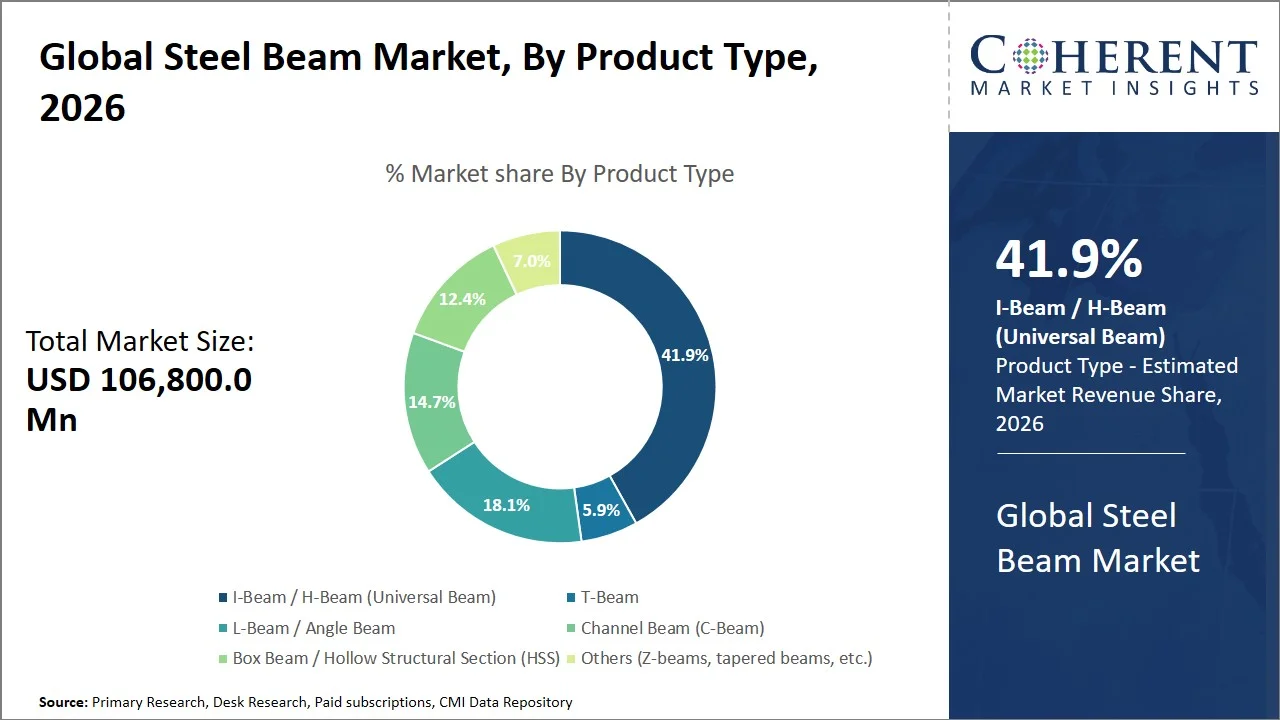
Why Does the I-Beam / H-Beam (Universal Beam) Segment Dominate the Global Steel Beam Market?
The I-Beam / H-Beam (Universal Beam) segment is expected to account for 41.9% of the global steel beam market share in 2026. I-beams along with H-beams hold a central role globally due to broad flanges and carefully shaped profiles that resist bending far better than basic sections. Their design means less steel achieves equal strength, so structures span farther between supports while bearing heavy loads. This efficiency becomes vital when minimizing mass matters, yet rigidity must remain intact. Skyscraper frameworks rely on such performance just as much as large bridges do.
On October 27, 2025, JFE Steel Corporation announced a new, rationalized welding method for built-up H-shaped steel beams (BH beams), developed in collaboration with National University Corporation Utsunomiya University, Nihon Sekkei, Inc., and Yonemori Corporation. This innovative method, named smarTABH, in addition to eliminating the need for conventional scallop back welding and processing of beam end joints, also improves the seismic performance of structures.
(Source: JFE-Steel)
- Current Industry Events of 2026
- Market Size Estimation
- Regional Breakdown
- Competitive Landscape
- Customer Intelligence
- Segmental Analysis
- Pricing Analysis
- Key Market Drivers, Challenges & Future Trends
- Customized Insights Section
Why are Hot Rolled Steel Beams the Most Preferred Manufacturing Type?
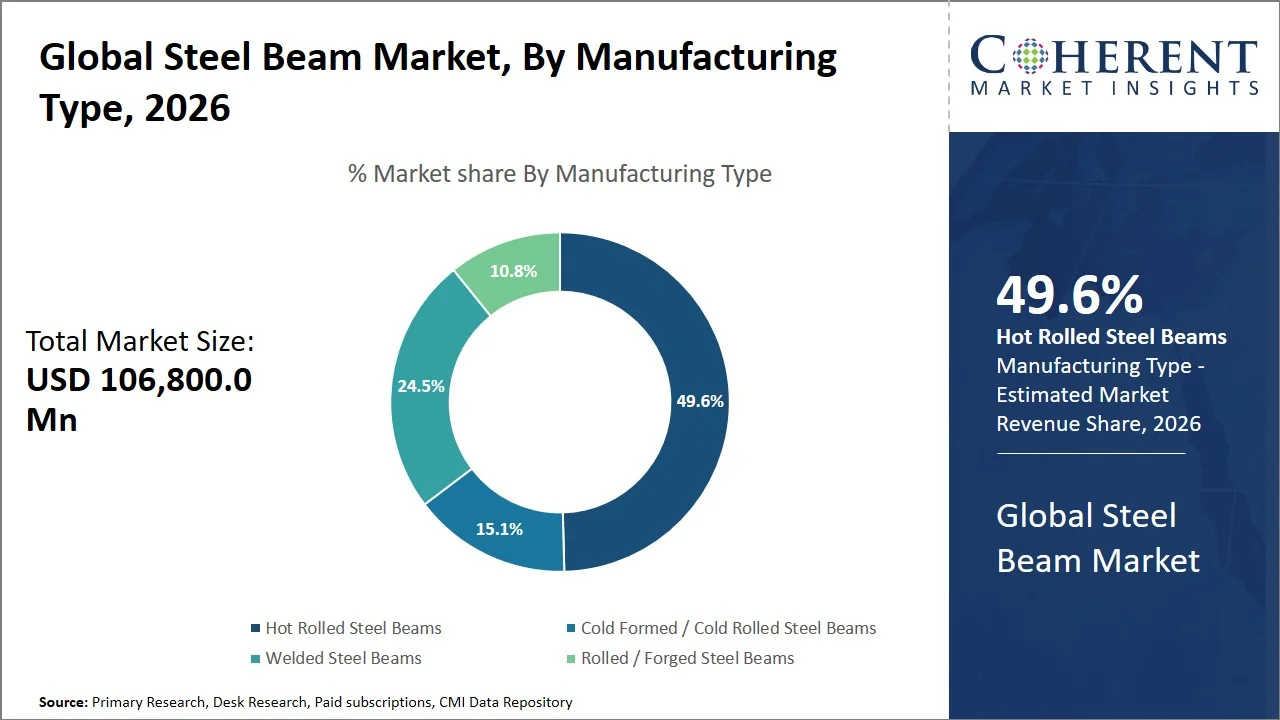
The hot rolled steel beams segment is expected to account for 49.6% of the global steel beam market share in 2026. Although formed at high temperatures, these steel beams gain aligned grain patterns naturally during rolling. As the metal flows under heat, its internal arrangement supports durability across great lengths. As a result, sections like wide-flange profiles hold steady performance without weak spots. With minimal leftover tension inside, they respond well to cutting procedures. Welding becomes less problematic due to stable material behavior.
Moreover, the ongoing development of railway networks is also driving the demand for hot rolled steel beams. In December 2025, India’s South Western Railway (India rail network zone) reported its highest-ever monthly freight loading (5 million tons), with a 15.6% year-on-year rise in finished steel movement, including hot-rolled coils and structural steel used for beams, driven by strong demand from construction and automotive-linked infrastructure projects.
(Source: Indian Railways)
Carbon Steel Beams Segment Dominates the Global Steel Beam Market
The carbon steel beams segment is expected to account for 61% of the global steel beam market share in 2026. Among materials shaping the global steel beam landscape, carbon steel takes precedence due to its prevalence in large-scale construction and infrastructure. Where strength under heavy loads matters most, this variant proves consistently practical. Especially evident in structures such as bridges, factory halls, and vertical edifices relying on uniform frameworks, its standard-grade forms ensure dependable behavior under stress. Fabrication processes adapt well to mass production needs, avoiding expenses tied to specialized alloys.
For instance, in June 2025, the Chenab Rail Bridge construction, part of the Udhampur–Srinagar–Baramulla Rail Link, used around 16,000 tons of carbon steel-based structural components (including beams, plates, and TMT sections supplied by SAIL) for its record-breaking arch structure, demonstrating large-scale reliance on carbon steel in extreme-load bridge construction.
(Source: Times of India)
Currents Events and their Impact
Current Events | Description and its Impact |
EU Carbon Border Adjustment Mechanism (CBAM) |
|
Section 232 Steel Tariffs |
|
(Source: QualityAustria, CBP)
Global Steel Beam Market Dynamics
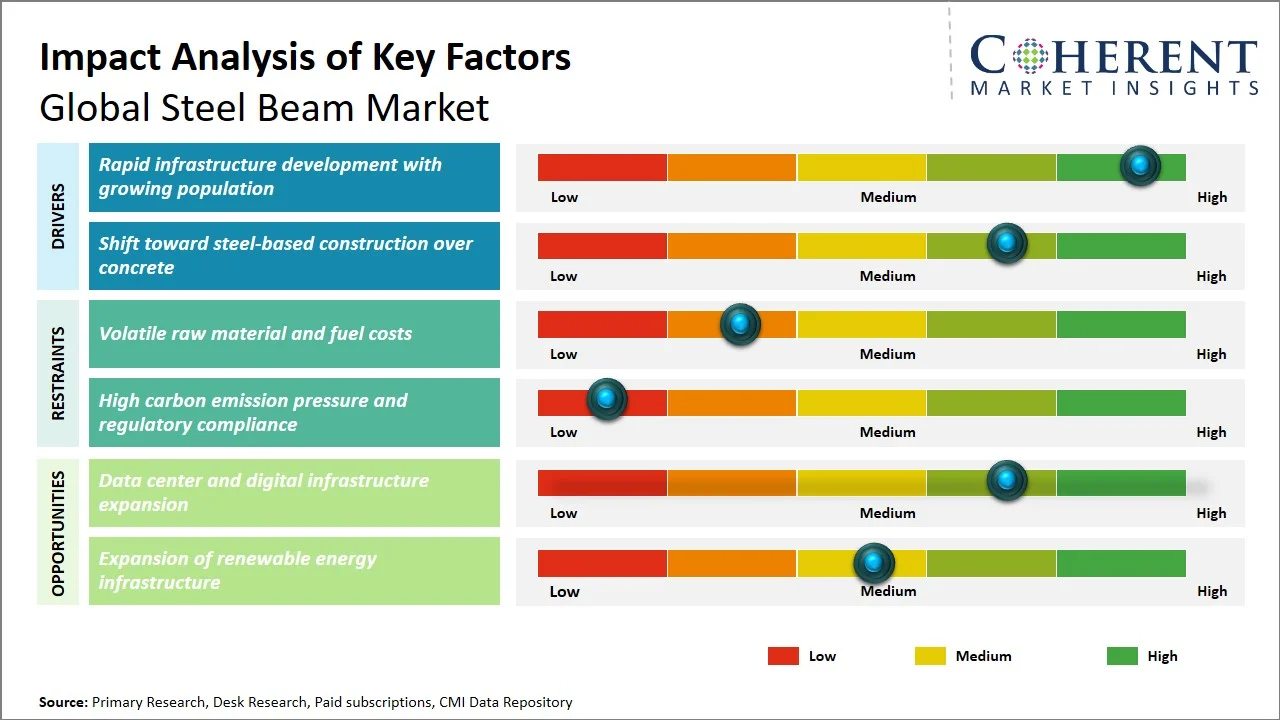
Market Drivers
- Rapid infrastructure development with growing population: Where ground rises and falls, steel beams become essential. India’s construction of the Delhi–Mumbai Expressway shows this demand clearly. Overpasses depend on such materials, especially at intricate interchanges meant for heavy freight movement. Structures gain height when geography complicates travel paths. Industrial necessity shapes bridge forms across difficult areas. Across extended distances, uniform support systems appear wherever land and logistics converge. Movement continues without pause on roads engineered around weight and span. For instance, The Melbourne Metro Tunnel officially opened on November 30, 2025 in Melbourne, Australia, forming part of the city’s metro network expansion. It consists of a 9 km twin tunnel running beneath the Central Business District, connecting the Sunbury line in the west to the Cranbourne and Pakenham lines in the southeast, creating a new high-capacity cross-city rail corridor that bypasses the existing City Loop system. The project includes five new underground stations: Arden, Parkville, State Library, Town Hall, and Anzac. (Source: Big Build)
- Shift toward steel-based construction over concrete: Steel gains favor over concrete in current construction trends. Stuttgart 21 Railway Station illustrates this shift, using wide-span steel elements combined with underground composite methods. Reinforced concrete previously led; however, it struggles with complex layouts due to scheduling setbacks and limited adaptability. Although spans grow more elaborate, timelines shrink when steel becomes part of the structure. Material selection shapes structural flexibility more than established methods. Notable increases in velocity occur when designs diverge from conventional patterns. Plans have been lodged with Toowoomba Regional Council for Queensland’s first new steel mill in more than 30 years. The USD 450 million facility, proposed by Brisbane-based GM Steel, would cover 4.8 hectares of gross floor space and reach heights of 50 meters, operating around the clock. The facility will produce about 350,000 tons of low-carbon steel rebar each year once fully operational. Rebar is a tension device added to concrete to strengthen it as part of building projects. This makes it a vital material in the construction sector. (Source: Construction Resumes)
Emerging Trends
- Shift toward high-strength, low-alloy (HSLA) and engineered beam sections: With shifts underway, conventional carbon steel beams now give way to advanced HSLA along with fabricated H and HSS profiles; these support heavier loads while using less metal. As a result, greater distances between supports become possible. Structures such as tall buildings, factories, and transit systems benefit through leaner material use. Progress here reflects broader trends in structural efficiency.
- Growth of low-carbon and digitally fabricated steel beam production: With tighter emission rules, electric arc furnaces gain favor among steel producers. Rather than relying on conventional processes, operations now draw heavily from recycled scrap material. Automation in fabrication advances through integration with building information modeling systems. These changes cut carbon per ton of beam made. Precision rises alongside environmental performance. For major construction efforts, such advancements meet demands set by rules including CBAM. Compliance becomes easier when processes align with modern code requirements.
Regional Insights
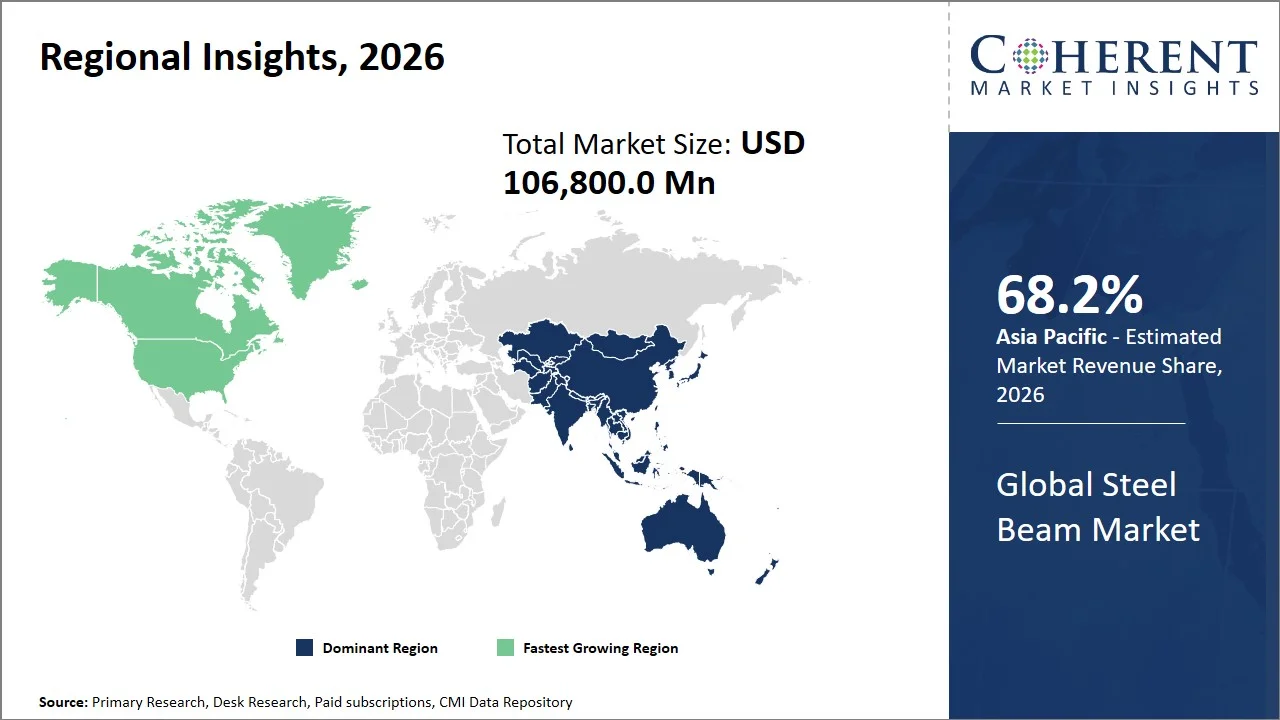
Why is Asia Pacific a Strong Market for Steel Beams?
Asia Pacific is expected to account for a market share of 68.2% in 2026. Across the Asia Pacific region, movement in structural steel buying remains clear. Driven by large domestic initiatives in multiple countries, need stays high. Heavy beam purchases grow steady as China channels funds into fast train systems. At the same time, India advances road corridors, city subways, and transport hubs - pushing material needs upward. Steel frameworks remain essential for overhead pathways and supporting structures in such projects. In different parts of Southeast Asia, expanding industry hubs generate fresh demands. Where manufacturing sites and logistics terminals cluster, longer steel beams are required to handle heavy burdens. Continued progress across linked developments sustains confidence in the area's infrastructure economy.
On February 9, 2026, Indian Railways approved a comprehensive set of rail infrastructure projects aimed at eliminating congestion, enhancing line capacity, improving safety systems, and enabling faster, more reliable passenger and freight movement across the country. These approvals span Southern, Northern and South Eastern Railways, covering line doubling, third and fourth lines, bypass corridors, and advanced electronic interlocking systems.
(Source: PIB)
Why Does the North America Steel Beam Market Exhibit High Growth?
Among recent developments, growth appears evident within North America’s steel beam sector. Industrial activity shifts back across borders, prompting fresh construction of production sites. U.S. companies like Ford and General Motors have demand for steel beams with growing production of electric trucks. Rather than relying on overseas production, there is a move toward domestic facilities. Backing emerges via national programs; money reaches transit systems and shipping hubs. In addition, the Infrastructure Investment and Jobs Act drives construction across regions. As a result, need rises steadily for heavy-duty structural members used in elevated roadways and crossing structures. New distribution nodes also require similar materials. Moreover, increasing customer demand for structural steel is also driving the regional market.
On December 4, 2025, United States Steel Corporation restarted a previously idled blast furnace at its Granite City Works facility due to increased customer demand, adding capacity and rehiring workers to meet projected 2026 steel needs. (Source: USSteel)
Why is China Emerging as a Major Hub in the Steel Beam Market?
Despite common assumptions, size alone does not explain China's central role in the steel beam sector. A vast network of fully integrated plants forms the backbone of output. Because infrastructure initiatives continue expanding, high-speed railways, city subways, industrial zones, and structural steel remain in steady demand. Production strengths emerge not just from scale, but from tight coordination across stages. Rolling technology has evolved quietly, supporting consistent yields of I-beams and H-beams. Efficiency gains stem more from process refinement than headline innovations.
Is the U.S. the Next Growth Engine for the Steel Beam Market?
Despite global uncertainty, fresh momentum appears within the U.S. steel beam sector. Activity moving forward at companies such as Nucor and Steel Dynamics points toward expanded output, continuing past 2024 well into the middle of the decade. Formerly idle sites are restarting operations, prompted by stronger needs from public works and factory building. Behind this shift lies steady capital flow, aided by government support - visible in modernized transit systems, computing hubs, and newly established production zones. The pattern taking shape comes less from guesswork, more from decisions made years earlier.
India Steel Beam Market Analysis and Trends
Growing demand for steel beams defines India's current market landscape, shaped more by infrastructure projects than general construction patterns. In industrial zones, prefabricated methods advance rapidly as modular approaches gradually replace traditional concrete practices. As assembly begins, timing becomes critical; major developments like distribution hubs or tech complexes favor metallic frameworks. Load-bearing behavior influences decisions on factories or warehouses too. Practices formerly uncommon now settle into routine across new projects.
Steel beams in Vietnam find rising use due to targeted transport developments, not general building activity. One key influence emerges from upgrades to the North–South railway line, where structural demands call for durable materials across complex landscapes. Another comes through the USD 7 billion Hanoi–Lao Cai–Haiphong rail route, relying on these components for bridge structures, raised tracks, and terminal buildings serving trade links with China. The railway project is part of a giant spending plan involving 234 infrastructure projects with a combined investment of USD 129.23 billion. Demand gains further strength as industrial zones grow quickly in areas such as Hai Phong and Bac Ninh. There, factories focused on exports now favor steel-framed storage facilities over traditional concrete constructions. Such shifts allow faster assembly while offering better adaptability for large equipment and advanced material handling setups. (Source: Reuters)
Among Japan’s evolving construction priorities, performance under stress guides material choice. Where cities grow denser - Tokyo, Osaka, Nagoya - the need for resilient frameworks rises. Structural demands favor JIS-rated SN-series H-beams, capable of dissipating seismic forces effectively. These beams support tall, multifunctional structures without compromising safety margins. Urban constraints push fabricators toward quicker, more accurate assembly methods. Rather than weld components on-site, pre-rolled solutions gain ground. Nippon Steel Corporation supplies such innovation through its NSHYPER BEAM line. This product serves major developments requiring robust yet streamlined integration. Its production method reduces field labor while enhancing dimensional consistency. High-strength rolling replaces older techniques involving assembled plates. Performance standards now align closely with long-term durability in active zones. (Source: Nippon Steel)
Global Steel Beam Market – Project Pipeline
Region | Project | Stage | Project Value (USD) |
Asia Pacific | China High-Speed Rail Expansion | Ongoing + Expansion | ~USD 1.0–2.3 trillion |
Tokyo Linear Chuo Shinkansen | Under construction | ~USD 64 billion | |
Delhi–Mumbai Industrial Corridor | Ongoing | ~USD 90+ billion | |
North America | Infrastructure Investment and Jobs Act | Ongoing | ~USD 1.2 trillion |
California High-Speed Rail | Under construction | ~USD 128 billion | |
Hudson Tunnel Project | Ongoing | ~USD 16 billion | |
Europe | HS2 high-speed rail | Under construction | ~USD 130+ billion |
Fehmarnbelt Fixed Link | Under construction | ~USD 7.4 billion | |
Grand Paris Express | Ongoing | ~USD 42 billion | |
Middle East & Africa | Etihad Rail | Expansion | ~USD 50 billion |
Lagos–Calabar Coastal Highway | Ongoing | ~USD 11 billion | |
Latin America | Maya Train | Ongoing | ~USD 20 billion |
Sao Paulo Metro Line 6 | Under construction | ~USD 3 billion |
How is Data Center and Digital Infrastructure Expansion Creating New Growth Opportunities in the Steel Beam Market?
Heavy computing hubs now shape steel markets. Where massive buildings rise fast, such as new cloud campuses near Mumbai and Hyderabad - open spaces rule inside. These rooms hold rows of servers, stacked deep. To span vast distances above them, engineers rely on broad steel sections. Such beams carry weight from rooftop gear down through floors below. Projects led by firms including Microsoft or Amazon Web Services push scale higher each year.
Several data centers have been planned in the Konkan region of Maharashtra, India. Fresh allotment data from the Maharashtra Industries Development Corporation (MIDC) points to a cumulative investment commitment of over USD 1,000 Billion, one of the highest in recent years. Several chemical engineering firms and banks have also submitted plans to set up their data storage centers in the region.
(Source: Times of India)
Market Players, Key Development, and Competitive Intelligence
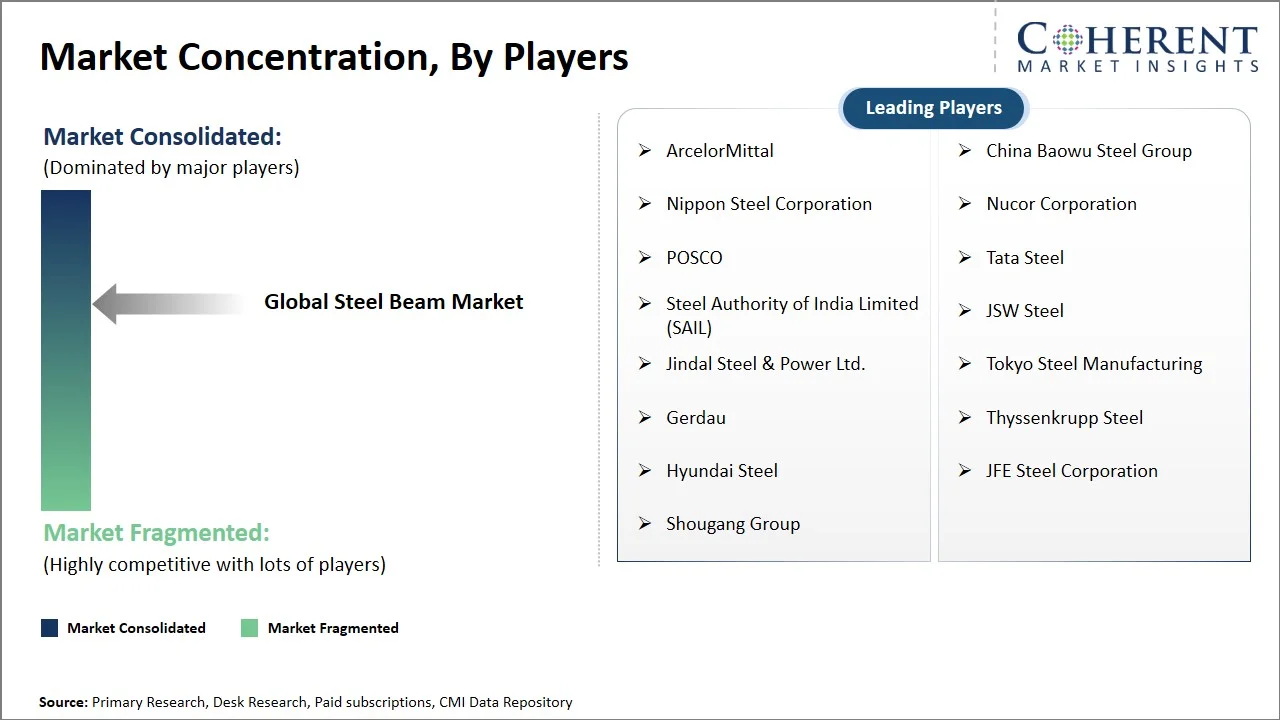
Key Developments
- On February 26, 2026, BlueScope provided a letter to the consortium comprising SGH Limited and Steel Dynamics, Inc. in response to its revised non-binding indicative proposal of USD 8.8 billion takeover received on February 18, 2026.
- On December 1, 2025, Steel Dynamics, Inc. announced its completion of the acquisition of the remaining 55% equity interest in New Process Steel, L.P. New Process Steel, L.P. is a metals solutions and distribution supply-chain management company headquartered in Houston, U.S., with a focus toward growing its value-added manufacturing applications.
Competitive Landscape
Among top suppliers of steel beams worldwide, dominance belongs to major industrial operators who manage extensive regional networks along with sophisticated production systems. While firms like ArcelorMittal, China Baowu Steel Group, and Nippon Steel emphasize volume-driven models, others including POSCO and Nucor place priority on refined engineering outcomes. Competition unfolds across dimensions such as operational size, precision in manufacturing, and incremental design advances. Leading manufacturers hold influence over bulk distribution channels involving I-sections and H-shaped profiles. Output leadership rests largely within Asia Pacific, whereas enterprises based in Europe and North America shift emphasis toward enhanced durability, reduced emissions, and tailored metallurgical performance for buildings and public works.
Market Report Scope
Steel Beam Market Report Coverage
| Report Coverage | Details | ||
|---|---|---|---|
| Base Year: | 2025 | Market Size in 2026: | USD 106,800.0 Mn |
| Historical Data for: | 2020 To 2024 | Forecast Period: | 2026 To 2033 |
| Forecast Period 2026 to 2033 CAGR: | 3.3% | 2033 Value Projection: | USD 134,000.0 Mn |
| Geographies covered: |
| ||
| Segments covered: |
| ||
| Companies covered: | ArcelorMittal, China Baowu Steel Group, Nippon Steel Corporation, Nucor Corporation, POSCO, Tata Steel, Steel Authority of India Limited (SAIL), JSW Steel, Jindal Steel & Power Ltd., Tokyo Steel Manufacturing, Gerdau, Thyssenkrupp Steel, Hyundai Steel, JFE Steel Corporation and Shougang Group | ||
| Growth Drivers: |
| ||
| Restraints & Challenges: |
| ||
Analyst Opinion (Expert Opinion)
- Despite steady structural demand, the worldwide steel beam sector faces tighter supplies because of regulatory pressures. Growth now follows policy shifts rather than economic cycles. Large-scale construction efforts across Asia Pacific and North America support core consumption levels. Yet profitability narrows under fluctuating input prices. Added financial pressure emerges from environmental rules like CBAM. Production limits tied to carbon output also weigh on cost structures.
- Despite market similarities, contrast defines the split between bulk steel makers and specialized fabricators. Chinese and Indian facilities emphasize scale, while their counterparts in Japan, Europe, and America shift toward tailored, resilient, emission-conscious beams. Output leaders rely on mass production; others gain ground through precision engineering. Pricing leverage emerges not from quantity but from performance-focused design. Infrastructure demands evolve - so do supply responses, quietly. Different paths surface under shared global pressure.
- Steady gains appear likely within the sector, supported by ongoing worldwide spending on infrastructure. Data center footprints are widening quickly; at the same time, logistics facilities multiply across regions. In tall buildings and wide-span structures, steel now sees greater favor compared to concrete. Future momentum may hinge less on volume, more on uptake of low-emission steel methods. Efficiency-focused beam configurations also play a growing role. Advancement in these areas shapes distinction among providers. Progress toward lower carbon output becomes a marker of positioning ahead.
Speak to the analyst
Want personalized insights?
Take the findings above to one of our principal consultants, or have the report rebuilt around the segments, geographies and competitors you actually track.
Market Segmentation
- Product Type Insights (Revenue, USD Million, 2021 - 2033)
- I-Beam / H-Beam (Universal Beam)
- T-Beam
- L-Beam / Angle Beam
- Channel Beam (C-Beam)
- Box Beam / Hollow Structural Section (HSS)
- Others (Z-beams, tapered beams, etc.)
- Manufacturing Type Insights (Revenue, USD Million, 2021 - 2033)
- Hot Rolled Steel Beams
- Cold Formed / Cold Rolled Steel Beams
- Welded Steel Beams
- Rolled / Forged Steel Beams
- Material Type Insights (Revenue, USD Million, 2021 - 2033)
- Carbon Steel Beams
- Alloy Steel Beams
- Stainless Steel Beams
- High-Strength Low-Alloy (HSLA) Steel
- End User Insights (Revenue, USD Million, 2021 - 2033)
- Construction & Infrastructure
- Energy & Power
- Automotive & Transportation
- Industrial & Manufacturing
- Others (Marine, Aerospace, etc.)
- Regional Insights (Revenue, USD Million, 2021 - 2033)
- North America
- U.S.
- Canada
- Latin America
- Brazil
- Argentina
- Mexico
- Rest of Latin America
- Europe
- Germany
- U.K.
- Spain
- France
- Italy
- Russia
- Rest of Europe
- Asia Pacific
- China
- India
- Japan
- Australia
- South Korea
- ASEAN
- Rest of Asia Pacific
- Middle East
- GCC Countries
- Israel
- Rest of Middle East
- Africa
- South Africa
- North Africa
- Central Africa
- North America
- Key Players Insights
- ArcelorMittal
- China Baowu Steel Group
- Nippon Steel Corporation
- Nucor Corporation
- POSCO
- Tata Steel
- Steel Authority of India Limited (SAIL)
- JSW Steel
- Jindal Steel & Power Ltd.
- Tokyo Steel Manufacturing
- Gerdau
- Thyssenkrupp Steel
- Hyundai Steel
- JFE Steel Corporation
- Shougang Group
Sources
Primary Research Interviews
- Steel beam manufacturers and suppliers
- Construction industry contractors and builders
- Infrastructure development project managers
- Steel fabrication facility operators
Databases
- Global Trade Atlas Database
- Steel Statistical Yearbook Database
- Construction Industry Database (CID)
Magazines
- Steel Construction Magazine
- Modern Steel Construction
- Construction Week Magazine
- Engineering News-Record (ENR)
Journals
- Journal of Constructional Steel Research
- Steel and Composite Structures Journal
- International Journal of Steel Structures
Associations
- American Institute of Steel Construction (AISC)
- World Steel Association (WSA)
- Steel Construction Institute (SCI)
- International Association for Bridge and Structural Engineering (IABSE)
Public Domain Sources
- U.S. Geological Survey (USGS) Steel Statistics
- World Bank Infrastructure Data
- International Trade Administration Reports
- European Commission Steel Market Reports
Proprietary Elements
- CMI Data Analytics Tool
- Proprietary CMI Existing Repository of information for last 10 years
Get access to 250+ pages report
Every segment, forecast, competitor profile and data table behind the analysis above — available for instant download.
- ESOMAR Member
- ISO 9001:2015 Certified
- D-U-N-S Registered
- GDPR & CCPA Compliant
Missing comfort of reading report in your local language? Find your preferred language:
Transform your Strategy with Exclusive Trending Reports
Frequently Asked Questions
The global steel beam market is expected to stand at USD 106,800 Mn in 2026 and is expected to reach USD 134,000 Mn by 2033.
The CAGR of the global steel beam market is projected to be 3.3% from 2026 to 2033.
Rapid infrastructure development and shift toward steel-based construction over concrete are the major factors driving the growth of the global steel beam market.
Volatile raw material and fuel costs and high carbon emission pressure and regulatory compliance are the major factors hampering the growth of the global steel beam market.
In terms of product type, I-Beam / H-Beam (Universal Beam) is estimated to dominate the market revenue share in 2026.
Rapid urbanization increases the demand for commercial and residential infrastructure requiring structural steel.
Carbon steel is the most commonly used material due to its strength and cost efficiency.