

Global Stick Packaging Market Size and Forecast – 2026 To 203 3
The Global Stick Packaging Market is estimated to be valued at USD 5,420.1 Mn in 2026 and is expected to reach USD 8,933.8 Mn by 2033, exhibiting a compound annual growth rate (CAGR) of 7.4% from 2026 to 2033. This growth is driven by the increasing demand for convenient and sustainable packaging solutions across food and beverages, cosmetics, nutraceuticals, and pharmaceuticals, where brands require lightweight, single-serve, and customizable formats to improve product appeal, portion control, and usability. Technological progress in recyclable films and paper-based high-barrier materials is further supporting adoption.
For instance, in August 2025, Mondi ramped up its FunctionalBarrier Paper Ultimate, a recyclable paper-based high-barrier solution suitable for instant coffee sticks, tea sachets, dried food seasonings, and similar applications, helping brands shift from conventional multilayer packaging toward more sustainable stick pack formats. (Source: Mondi Group)
Key Takeaways of the Global Stick Packaging Market
- Plastic is expected to dominate the global stick packaging market with 48.6 % share in 2026, supported by strong sealability, lightweight handling, and compatibility with high-speed filling lines. A recent instance is Amcor’s 2025 recycled polypropylene stick applicator for Decathlon, using 87% rPP for anti-chafing and sunscreen sticks. (Source: Amcor)
- Flat stick packs are expected to hold 42.4 % of the market share in 2026, owing to their efficient stacking, clean dispensing, and suitability for compact secondary packaging. Theegarten-Pactec’s U1+F1 system demonstrates commercial relevance, offering up to 1,000 wrapped products per minute with flat stick pack secondary packaging capability. (Source: Theegarten-Pactec)
- Food & beverages are projected to account for 38.7 % of the market share in 2026, as brands prioritize portion control, portability, and reduced product wastage across drink powders, sweeteners, and instant mixes. Tipton Mills’ 2025 stick drink powder packaging capability highlights automated multi-lane stick filling and cartooning for powdered beverage products. (Source: Tipton Mills)
- Asia Pacific is expected to lead with 31.2 % of the market share in 2026, supported by strong flexible packaging capacity, FMCG production, and growing single-serve consumption. In 2025, JPFL Films announced the expansion of BOPP, PET, and CPP film lines in Nashik, strengthening India’s flexible packaging supply base. (Source: JPFL Films)
- North America is expected to hold 27.6 % of the market share in 2026, with faster growth supported by premium nutrition, protein, convenience foods, and advanced flexible packaging investments. In November 2025, Amcor announced a major expansion of North American printing, lamination, and converting capacity through early 2026. (Source: Amcor)
- Sustainable Film Redesign: Sustainability is shifting stick packaging procurement toward recyclable mono-material films, downgauged plastics, and lower-carbon laminate structures without compromising barrier performance. A relevant instance is Berry Global and VOID Technologies’ 2024 launch of a high-performance PE film that enables all-PE recyclable packaging while improving toughness and puncture resistance.
- Automation-Led Scale-Up: Multi-lane automation is becoming a decisive trend as converters seek faster output, filling accuracy, lower labor dependency, and consistent seal quality across food, pharma, nutraceutical, and cosmetic stick packs. In March 2025, RichPacking launched a new-generation multi-lane VFFS machine targeting stick pack and sachet packaging applications.
Segmental Insights
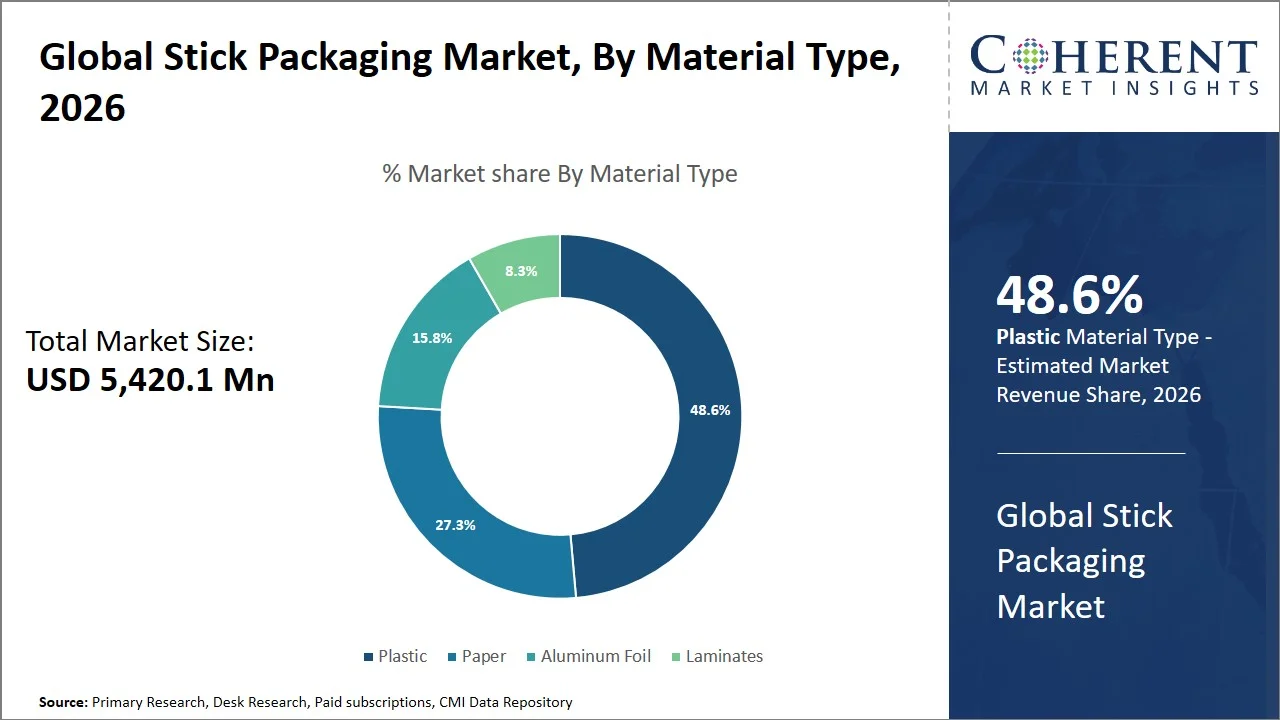
Why Does the Plastic Segment Dominate the Global Stick Packaging Market?
Plastic is expected to dominate the global stick packaging market with 48.6% share in 2026, mainly because stick packs require thin, flexible, heat-sealable, and moisture-resistant materials that can run efficiently on high-speed form-fill-seal lines. Demand is strongest from powdered beverages, instant coffee, nutraceutical powders, oral care samples, and pharmaceutical sachets where lightweight packaging, longer shelf life, and controlled unit dosing are critical. On the supply side, PE and PP films support strong seal integrity, printability, and lower material consumption compared to rigid alternatives. For instance, SÜDPACK’s August 2025 CarbonLite portfolio includes recyclable PP and PE-based high-performance films for food and non-food packaging, offering strong product protection with lower material input. (Source: SÜDPACK)
- Current Industry Events of 2026
- Market Size Estimation
- Regional Breakdown
- Competitive Landscape
- Customer Intelligence
- Segmental Analysis
- Pricing Analysis
- Key Market Drivers, Challenges & Future Trends
- Customized Insights Section
Why Does the Flat Stick Packs Segment Dominate the Global Stick Packaging Market?
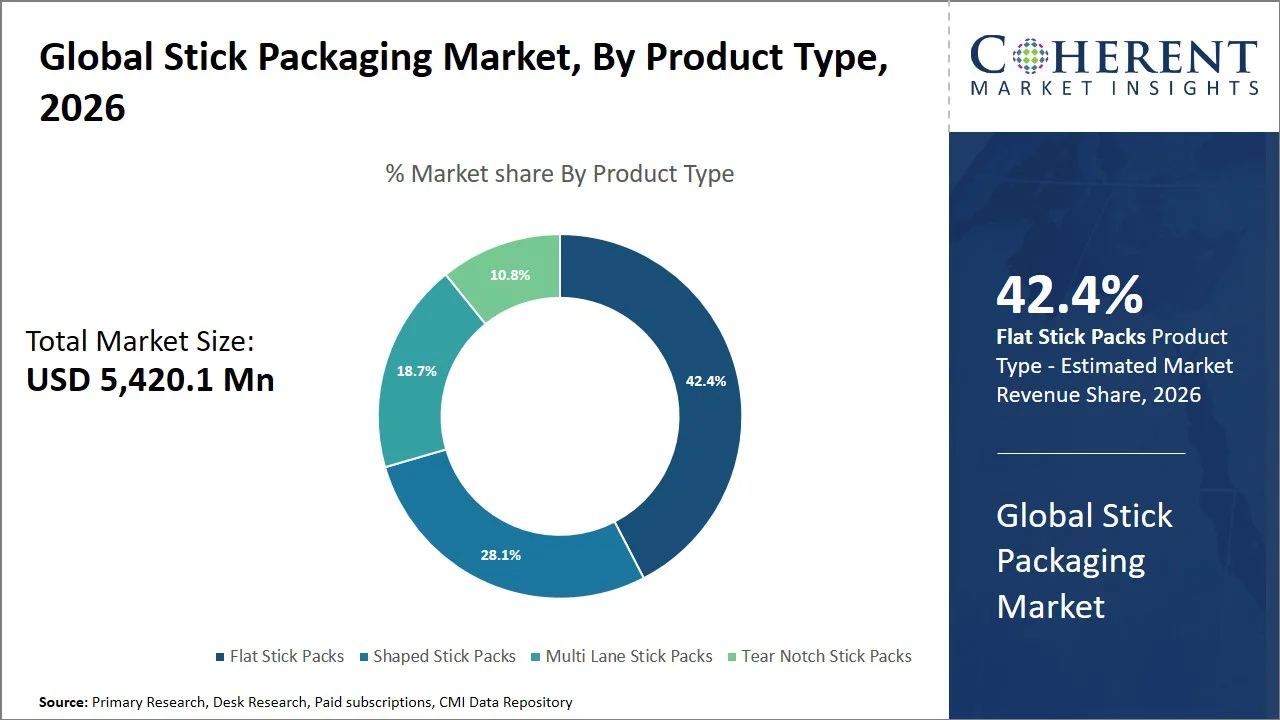
Flat stick packs are expected to dominate with 42.4% of the market share in 2026, owing to their simple rectangular format, efficient filling, easy bundling, and suitability for both primary and secondary packaging. Compared with shaped or specialty packs, flat stick packs reduce film wastage, simplify sealing patterns, and allow faster changeovers across powder, granule, liquid, and gel products. Demand is high from beverage powders, nutraceutical sachets, OTC products, condiments, and cosmetic samples where narrow shelf footprint and single-dose convenience are important. On the technology side, multi-lane VFFS systems improve throughput and dosing consistency, making flat formats easier to scale. A recent instance is RichPacking’s March 2025 launch of a new-generation Multi-Lane VFFS Machine for stick pack and sachet applications. (Source: Guangdong Rich Packing Machinery Co., Ltd)
Why Does the Food & Beverages Segment Represent the Largest Application Segment in the Market?
Food & beverages are expected to account for 38.7% of the market share in 2026, as stick packs are highly suited for single-serve drink mixes, sugar, coffee, tea, dairy powders, sauces, and functional beverage powders. The segment dominates because brands use stick formats to improve portion accuracy, reduce spillage, support on-the-go consumption, and lower secondary packaging weight. Demand-side growth is supported by convenient nutrition, workplace consumption, travel packs, and trial-size launches. From the supply side, powder handling, dosing accuracy, seal inspection, and automated cartooning makes stick packs commercially attractive for high-volume food producers. A recent instance is Tetra Pak’s 2025 Product Development Centre in France, created to help food and beverage powder producers validate products and processes at industrial scale. (Source: Tetra Pak International S.A)
Currents Events and their Impact
Current Events | Description and its Impact |
European Union Packaging and Packaging Waste Regulation Tightens Flexible Packaging Rules (February 2025 onward) |
|
U.S. FDA Removes PFAS Food-Contact Authorizations for Paper Packaging (January 2025 onward) |
|
India Strengthens Plastic Packaging EPR and Circular Economy Implementation (March 2026 update) |
|
(Source: European Commission, Food and Drug Administration)
Global Stick Packaging Market Dynamics
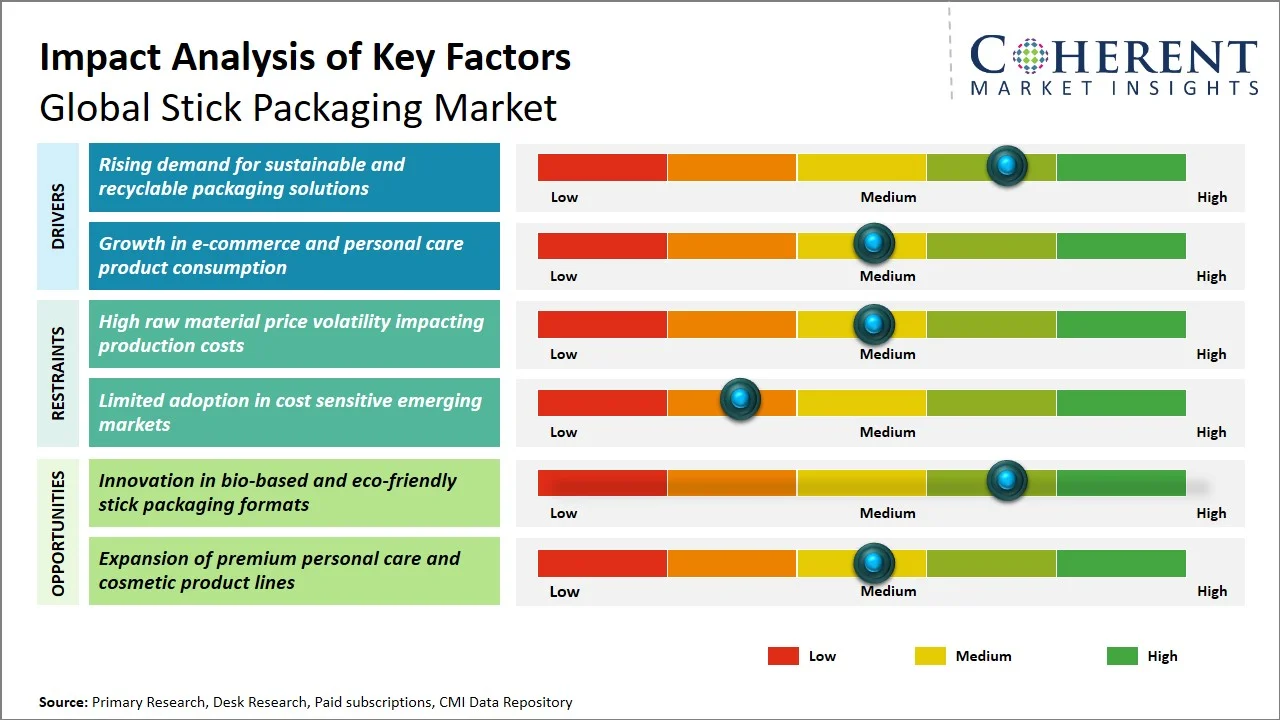
Market Dynamics
- Sustainability-Led Shift Toward Recyclable Stick Packaging: Rising demand for sustainable and recyclable packaging solutions is becoming a core growth driver for the global stick packaging market, especially as food, nutraceutical, pharmaceutical, and personal care brands move away from hard-to-recycle multilayer formats. Stick packs use less material than bottles, jars, and rigid sachet alternatives, but buyers now expect the same portion-control benefit with improved recyclability. This is pushing converters to develop mono-material PE and PP films that can run on existing form-fill-seal lines while maintaining moisture, oxygen, and aroma barriers. In September 2025, Borouge, Siegwerk, and TPN Food Packaging launched a fully recyclable mono-material barrier packaging solution for food applications, showing how flexible packaging suppliers are commercializing recyclable structures for high-barrier formats. This supports stick pack adoption among brands balancing sustainability compliance with packaging efficiency. (Source: Siegwerk Druckfarben AG & Co. KGaA)
- E-Commerce and Personal Care Consumption Expand Compact Pack Demand: Growth in e-commerce and personal care product consumption is strengthening the demand for stick packaging because online and omnichannel brands need compact, lightweight, leak-resistant, and trial-friendly formats. Stick packs and stick-based applicators reduce shipping weight, improve sampling economics, and support premium mini-size launches across deodorants, sun care, lip care, solid skincare, and cosmetic products. Online retail also favors packaging that can withstand parcel movement while offering attractive shelf and unboxing presentation. The U.S. Census Bureau reported that U.S. retail e-commerce sales increased 9.8% year-on-year in Q1 2026, reinforcing the demand for packaging formats optimized for direct-to-consumer distribution. A recent instance is Berry Global’s February 2025 introduction of 15 ml, 20 ml, and 25 ml refillable stick formats for beauty and personal care brands, expanding smaller on-the-go pack options. (Source: U.S. Department of Commerce)
Emerging Trends
- Mono-Material and Recycle-Ready Film Structures: Mono-material stick packaging is emerging as a major trend as brand owners seek recyclable alternatives without losing barrier performance, sealing reliability, or high-speed machine compatibility. The shift is commercially important because stick packs often rely on laminated structures to protect powders, liquids, gels, and sensitive nutraceutical ingredients from moisture and oxygen. As regulations become stricter, converters are redesigning film structures around PE, PP, and paper-based systems that simplify sorting and recycling. The EU Packaging and Packaging Waste Regulation entered into force in February 2025 and requires all packaging to be recyclable by 2030, creating a clear compliance signal for flexible pack redesign. For stick packaging suppliers, this trend supports higher-value material innovation, regulatory readiness, and stronger adoption among multinational FMCG and healthcare customers.
- Automation, Multi-Lane Filling, and Precision Dosing: Automation-led production is becoming a defining trend in the global stick packaging market as manufacturers scale high-volume output while reducing labor dependence, material waste, and dosing variation. Stick packaging is increasingly used for powders, granules, liquid shots, gels, and single-dose formulations, making filling accuracy and seal integrity critical for food, pharma, and nutraceutical applications. Multi-lane VFFS systems allow converters to produce several narrow packs per cycle, improving throughput and cost per unit. PMMI’s 2025 India Packaging Machinery Market report highlights packaging automation trends across FMCG, pharmaceuticals, and co-packing, along with the influence of sustainability policies and retail logistics expansion on machinery selection. This trend will support investment in faster lines, better inspection systems, and contract manufacturing capacity for stick pack formats.
Regional Insights
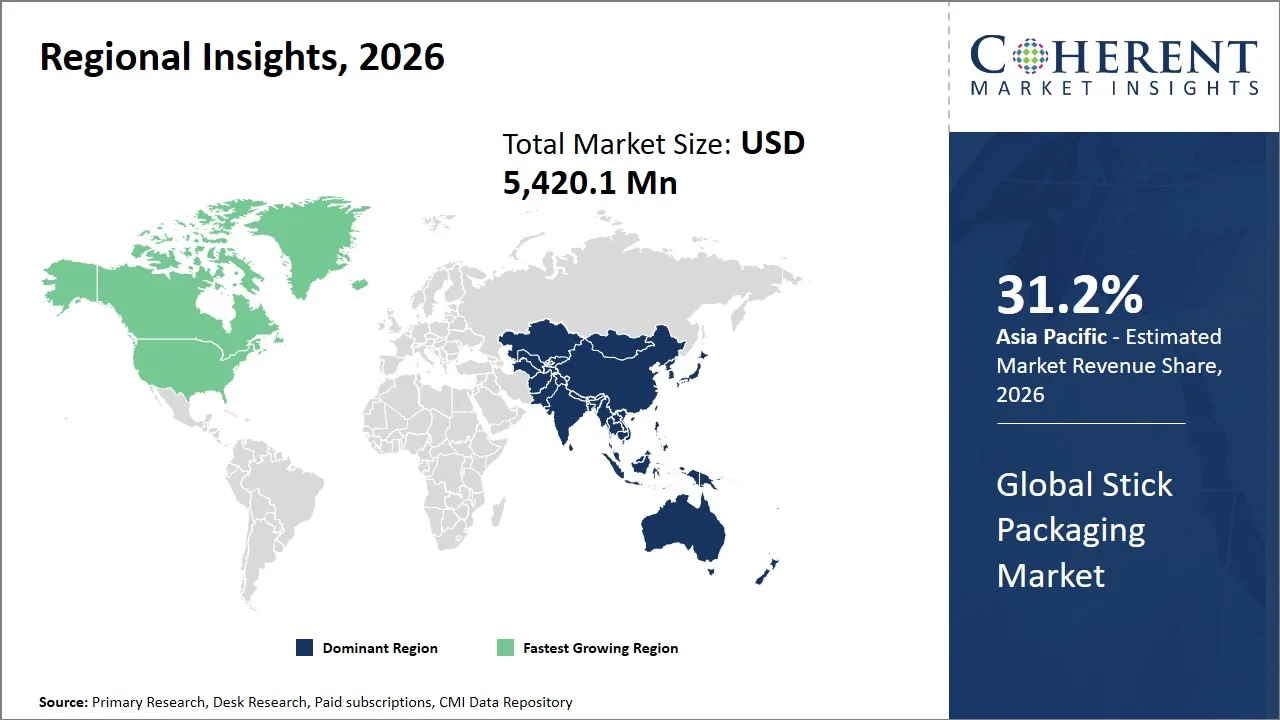
Why Does the Asia Pacific Region Dominate the Global Stick Packaging Market?
Asia Pacific is expected to dominate the global stick packaging market with 31.2% share in 2026, supported by high-volume FMCG manufacturing, expanding food processing capacity, strong flexible film production, and cost-efficient packaging conversion. The region has strong demand for single-serve beverage powders, instant mixes, nutraceutical sachets, condiments, and personal care samples, making stick packs commercially attractive for both mass-market and premium brands. China, India, Japan, Thailand, and Southeast Asian markets also provide a strong machinery and materials ecosystem for laminated films, mono-material films, and form-fill-seal packaging lines. A recent example is Accredo Asia Packaging’s 2025 warehouse project in Binh Duong, Vietnam, which enhanced storage and distribution capacity for its sustainable flexible packaging operations, supporting Southeast Asia’s packaging and logistics ecosystem. (Source: AZB)
Why is North America Emerging as the Fastest-Growing Region in the Global Stick Packaging Market?
North America is expected to emerge as the fastest-growing region with 27.6% share in 2026, supported by strong demand for convenient, portion-controlled, and premium flexible packaging across nutrition, personal care, OTC healthcare, coffee, and functional food products. The region’s growth is reinforced by advanced converting infrastructure, strong private-label penetration, e-commerce-ready packaging demand, and higher adoption of recyclable flexible films. Brand owners in the U.S. and Canada are increasingly using compact packaging formats to reduce logistics cost, improve trial-size sales, and meet sustainability targets. A recent instance is ProAmpac’s March 2026 completion of its acquisition of TC Transcontinental Packaging, strengthening its position in North American flexible packaging and expanding capabilities across rollstock, pouches, labels, shrink films, bags, and advanced coatings. (Source: ProAmpac)
Global Stick Packaging Market Outlook for Key Countries
Why is China a Key Manufacturing and Sustainability Hub in the Global Stick Packaging Market?
China is important in the global stick packaging market because it combines large-scale consumer goods manufacturing with a deep flexible packaging supply chain for films, laminates, inks, adhesives, and packaging machinery. Demand is supported by packaged foods, instant drinks, detergents, cosmetics, nutraceuticals, and e-commerce-driven sample formats. Chinese brands are increasingly shifting from conventional multilayer flexible packaging toward recyclable film structures, which is relevant for stick packs used in food, home care, and personal care applications. The country also benefits from strong local converting capacity and multinational material innovation. A recent instance is Dow’s June 2025 launch of INNATE TF 220 Precision Packaging Resin in China, including collaboration with Liby to scale post-consumer recycled resin use in flexible packaging. This supports China’s role in recyclable film innovation for lightweight formats. (Source: Dow)
Why is the U.S. Leading Premiumization and On-the-Go Stick Pack Adoption?
The U.S. is a key country for stick packaging due to strong demand from functional beverages, dietary supplements, sports nutrition, OTC healthcare, beauty samples, solid personal care, and direct-to-consumer retail. U.S. consumers actively purchase convenient single-dose products, while brands use stick packs and stick-based containers to improve portability, sampling efficiency, and online shipping economics. The country also has advanced co-packing, flexible converting, and packaging design capabilities, allowing fast commercialization of new formats. A recent instance is Berry Global’s February 2025 introduction of 15 ml, 20 ml, and 25 ml refillable stick formats for beauty and personal care brands. This highlights how U.S.-linked packaging innovation is expanding stick formats beyond food powders into premium personal care and refillable applications. (Source: Home & Personal Care)
Why is India Strengthening its Role in Stick Packaging Film Supply?
India is becoming increasingly important in the global stick packaging market due to its strong packaged food, beverage powder, pharmaceutical, nutraceutical, and personal care manufacturing base. The country’s flexible packaging ecosystem supports BOPP, PET, CPP, laminated structures, and printed films used in sachets and stick packs. Demand is also strengthened by price-sensitive consumers, rural retail penetration, and high-volume small-pack consumption, making stick packs attractive for affordability and distribution efficiency. On the supply side, Indian converters are expanding film capacity to meet domestic and export demand. A recent instance is JPFL Films’ 2025 announcement of over USD 7.41 Mn investment in new BOPP, PET, and CPP lines at Nashik, Maharashtra, expected to expand flexible packaging film availability for food, personal care, and pharmaceutical applications. (Source: Labels & Labeling)
Why is Germany Important for High-Speed Stick Packaging Machinery and Automation?
Germany is important in the global stick packaging market because of its strong packaging machinery engineering base, precision automation capability, and leadership in high-speed filling, sealing, and secondary packaging systems. German equipment suppliers support global stick pack producers with reliable dosing, format flexibility, seal consistency, and integrated cartooning technologies used across food, nutraceutical, pharmaceutical, and personal care applications. The country is especially relevant for converters that need faster output, lower labor dependency, and reduced material wastage in multi-format flexible packaging lines. A recent instance is Syntegon’s 2025 FACHPACK showcase in Nuremberg, where the company presented the SVX Agile vertical bagger and Kliklok ACC carton closer, highlighting flexible, energy-efficient, and precision-driven packaging automation for modern production lines. (Source: Syntegon Technology GmbH)
Why is Japan Advancing Recyclable Flexible Packaging for Stick Pack Applications?
Japan is important in the global stick packaging market due to its advanced materials science, high-quality packaging standards, and strong demand for compact, hygienic, and portion-controlled formats across food, beverages, cosmetics, and healthcare. Japanese packaging companies are also active in barrier films, mono-material structures, and recycled flexible packaging, which are directly relevant to future stick pack development. The country’s strength lies in combining premium consumer expectations with technical innovation in film performance, recyclability, and product protection. A recent instance is Dai Nippon Printing’s July 2025 development of a vacuum metalized high-barrier PP film, suitable as a base material for mono-material packaging, offering oxygen, water vapor, and light barrier performance for recyclable flexible packaging structures. (Source: Dai Nippon Printing Co., Ltd)
Technology Adoption Landscape in the Global Stick Packaging Market
Technology | Key Features | Clinical Advantage | Market Relevance |
Multi-lane VFFS stick pack machines | Automated forming, filling, sealing, cutting, and coding across multiple lanes for powders, granules, liquids, gels, and pastes. | Supports accurate single-dose packaging for nutraceutical powders, OTC products, oral rehydration salts, and pharma sachets. | Highly relevant for large-volume production as brands shift toward portion-controlled, high-throughput stick packs. RichPacking launched a new-generation multi-lane VFFS machine in March 2025 for stick pack and sachet applications. |
Mono-material recyclable films | PE, PP, or paper-based structures designed to replace complex multilayer laminates while improving recyclability. | Helps healthcare and nutraceutical brands reduce packaging waste while maintaining product safety and barrier needs. | Adoption is rising due to sustainability rules and retailer packaging targets. EU rules require all packaging to be recyclable by 2030, accelerating mono-material stick pack redesign. |
High-barrier PP and metallized films | Provides oxygen, moisture, and light barrier protection for sensitive powders, granules, and active ingredients. | Protects moisture-sensitive formulations, probiotics, vitamins, and powdered supplements from degradation during storage. | Strong relevance for pharma, nutraceutical, coffee, and functional beverage stick packs. DNP developed a vacuum metalized high-barrier PP film in July 2025 for mono-material packaging applications. |
Smart coding and 2D traceability | Uses QR codes, Data Matrix codes, batch numbers, expiry dates, and serialized product data on flexible packaging. | Improves patient safety, batch traceability, anti-counterfeit protection, and recall management for pharma stick packs. | Important for regulated healthcare, nutraceutical, and premium food products. Domino notes that 2D codes support supply-chain visibility, authentication, waste reduction, and consumer engagement. |
Precision dosing and servo-controlled filling | Uses advanced fillers, servo controls, and weight/volume accuracy systems for powders, liquids, and pastes. | Ensures consistent dosage for oral powders, supplements, nutraceutical sachets, and single-use healthcare products. | Critical for premium stick packs where underfilling, overfilling, or inconsistent dose can affect cost and compliance. Multi-lane systems increasingly integrate automatic feeding, dosing, filling, sealing, and printing. |
Digital and flexographic printing | Enables high-quality graphics, SKU flexibility, variable content, branding, instructions, and short-run customization. | Supports clear dosage instructions, usage directions, batch identification, and compliance messaging on small pack surfaces. | Relevant for trial packs, personalized nutrition, cosmetic samples, and regional SKUs. CL&D highlights digital and flexographic printing for custom stick pack films with high-impact graphics and production-ready performance. |
Aluminum foil and ultra-high barrier laminates | Offers strong moisture, oxygen, aroma, and light protection for sensitive formulations and premium powders. | Extends shelf life of pharmaceutical, probiotic, enzyme, electrolyte, and vitamin-based stick formulations. | Continues to be used where maximum protection is more important than recyclability. Pharma barrier packaging is gaining relevance for moisture-sensitive and oxidation-prone drug products. |
Sustainable paper-based stick packaging | Uses paper or paper-dominant laminate structures with barrier coatings for dry powders and single-serve products. | Provides a lower-plastic option for nutraceutical, wellness, and food-grade stick packs where barrier needs are moderate. | Adoption is supported by brand sustainability commitments and plastic-reduction policies, especially in food, beverage, and personal care sampling. TOPPAN provides mono-material barrier packaging using PP, PE, PET, and paper-based structures. |
How are recyclable and high-barrier stick packs creating new growth opportunities in the global stick packaging market?
Technological advancement in recyclable, paper-based, and high-barrier stick packaging are creating strong growth opportunities in the global stick packaging market Brand owners in food, beverages, nutraceuticals, pharmaceuticals, and personal care are shifting toward compact single-serve formats that reduce material usage while improving portability, dosage control, and shelf-life protection. The opportunity is strongest in mono-material PE/PP films, paper-based stick packs, and barrier-coated structures that can replace complex multilayer laminates without affecting filling speed or product safety. This supports wider adoption among companies targeting sustainability compliance and premium on-the-go consumption. For instance, Huhtamaki’s OmniLock Ultra stickpack for instant coffee is offered in multiple sustainable variants, including paper and recyclable polyolefin-based options, highlighting how stick packaging innovation is moving toward recyclable, high-performance single-serve formats.
Market Players, Key Development, and Competitive Intelligence
Key Developments
- In July 2025, Huhtamaki Oyj advanced sustainable stick packaging through its OmniLock Ultra stickpack for instant coffee applications, offering recyclable and paper-based formats including blueLite, blueloop PO, PE, and paper variants.
- In March 2025, Amcor plc strengthened its sustainable flexible packaging portfolio through its More Sustainable High Shield Pharma Laminates, designed for sachets, stickpacks, and other single-dose formats used in pharmaceutical, consumer health, and nutraceutical applications.
- In October 2024, Constantia Flexibles showcased sustainable flexible packaging innovations at PackExpo 2024, including PERPETUA ALTA Stick Pack, a recycle-ready mono-material polypropylene laminate designed for pharmaceutical applications requiring oxygen, water vapor, and light barrier protection.
Competitive Landscape
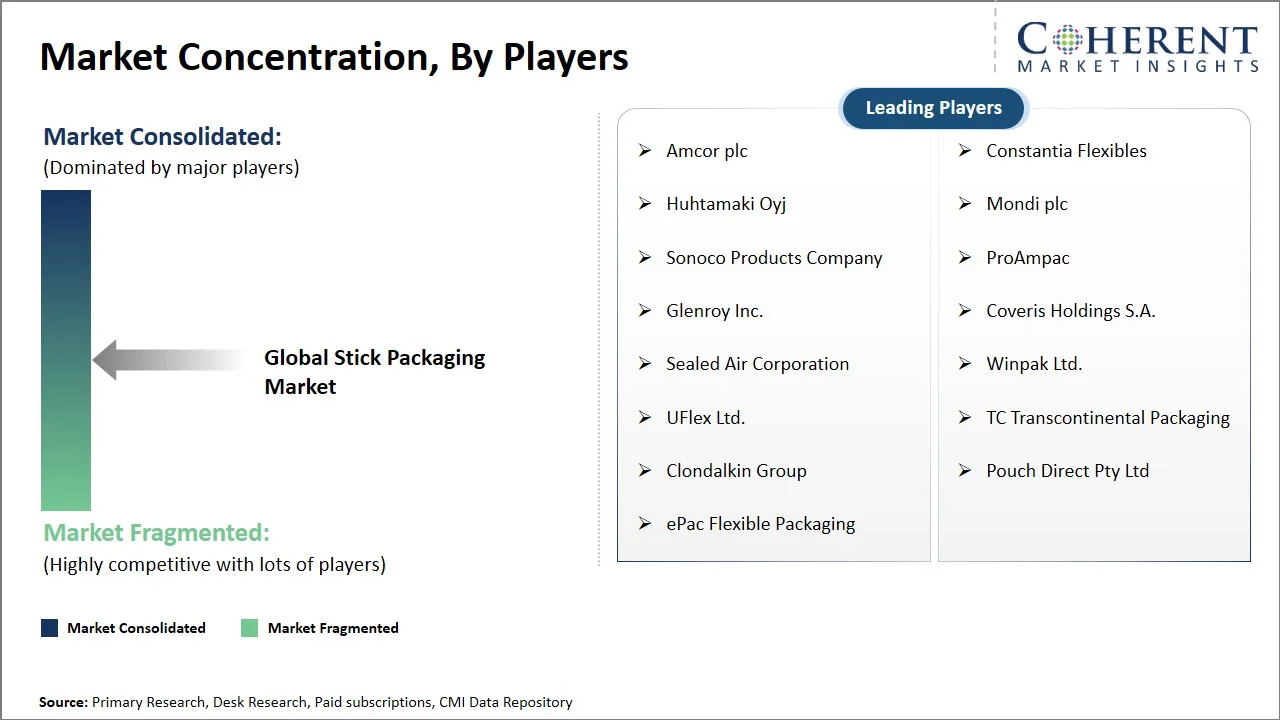
The global stick packaging market is moderately fragmented, with flexible packaging companies, film suppliers, co-packers, and machinery manufacturers competing on sustainability, barrier performance, cost efficiency, and packaging speed. Companies are focusing on recyclable films, paper-based stick packs, and high-speed multi-lane machines to serve food, beverage, nutraceutical, pharma, personal care, and household product brands. Growing demand for single-serve, lightweight, and eco-friendly packaging is pushing players to improve material quality, sealing strength, shelf-life protection, and customization.
Key focus areas include
- Development of recyclable and mono-material stick pack films
- Growth of paper-based and plastic-reduced stick packaging
- Investment in high-speed multi-lane stick pack machines
- Customization for food, pharma, nutraceutical, and personal care products
- Compliance with recyclable packaging and plastic waste regulations
Market Report Scope
Stick Packaging Market Report Coverage
| Report Coverage | Details | ||
|---|---|---|---|
| Base Year: | 2025 | Market Size in 2026: | USD 5,420.1 Mn |
| Historical Data for: | 2020 To 2024 | Forecast Period: | 2026 To 2033 |
| Forecast Period 2026 to 2033 CAGR: | 7.4% | 2033 Value Projection: | USD 8,933.8 Mn |
| Geographies covered: |
| ||
| Segments covered: |
| ||
| Companies covered: | Amcor plc, Constantia Flexibles, Huhtamaki Oyj, Mondi plc, Sonoco Products Company, ProAmpac, Glenroy Inc., Coveris Holdings S.A., Sealed Air Corporation, Winpak Ltd., UFlex Ltd., TC Transcontinental Packaging, Clondalkin Group, Pouch Direct Pty Ltd, and ePac Flexible Packaging | ||
| Growth Drivers: |
| ||
| Restraints & Challenges: |
| ||
Analyst Opinion (Expert Opinion)
- The global stick packaging market is expected to witness steady long-term growth due to rising demand for single-serve, lightweight, and convenient packaging across food & beverages, nutraceuticals, pharmaceuticals, personal care, and household products. Growing preference for portion-controlled packs, easy-to-carry formats, and reduced material usage is expected to support wider adoption of stick packaging among both large brands and private-label manufacturers.
- The strongest opportunities are likely to emerge in food & beverages, where stick packs are widely used for instant coffee, drink mixes, sweeteners, condiments, and powdered products. Asia Pacific is expected to remain the leading region due to strong FMCG production, cost-efficient packaging supply chains, and high consumption of small-pack products, while North America is expected to grow faster with rising demand for premium nutrition, wellness, and personal care formats.
- To gain a competitive advantage, market players should focus on recyclable films, paper-based stick packs, high-barrier materials, and high-speed multi-lane filling technologies. Companies that can offer sustainable packaging, strong product protection, accurate dosing, and customization for different end-use industries will be better positioned to capture demand from food, pharma, nutraceutical, and personal care brands.
Speak to the analyst
Want personalized insights?
Take the findings above to one of our principal consultants, or have the report rebuilt around the segments, geographies and competitors you actually track.
Market Segmentation
- Material Type Insights (Revenue, USD Mn, 2021 - 2033)
- Plastic
- Paper
- Aluminum Foil
- Laminates
- Product Type Insights (Revenue, USD Mn, 2021 - 2033)
- Flat Stick Packs
- Shaped Stick Packs
- Multi Lane Stick Packs
- Tear Notch Stick Packs
- Application Insights (Revenue, USD Mn, 2021 - 2033)
- Food & Beverages
- Pharmaceuticals
- Nutraceuticals
- Personal Care & Cosmetics
- Household Products
- Distribution Channel Insights (Revenue, USD Mn, 2021 - 2033)
- B2B
- B2C
- Regional Insights (Revenue, USD Mn, 2021 - 2033)
- North America
- U.S.
- Canada
- Latin America
- Brazil
- Argentina
- Mexico
- Rest of Latin America
- Europe
- Germany
- U.K.
- Spain
- France
- Italy
- Russia
- Rest of Europe
- Asia Pacific
- China
- India
- Japan
- Australia
- South Korea
- ASEAN
- Rest of Asia Pacific
- Middle East
- GCC Countries
- Israel
- Rest of Middle East
- Africa
- South Africa
- North Africa
- Central Africa
- North America
- Key Players Insights
- Amcor plc
- Constantia Flexibles
- Huhtamaki Oyj
- Mondi plc
- Sonoco Products Company
- ProAmpac
- Glenroy Inc.
- Coveris Holdings S.A.
- Sealed Air Corporation
- Winpak Ltd.
- UFlex Ltd.
- TC Transcontinental Packaging
- Clondalkin Group
- Pouch Direct Pty Ltd
- ePac Flexible Packaging
Sources
Primary Research Interviews
- Stick packaging manufacturers and flexible packaging converters
- Film, laminate, foil, and paper-based packaging material suppliers
- Food and beverage packaging managers and procurement heads
- Nutraceutical, pharmaceutical, and personal care packaging decision-makers
- Packaging machinery manufacturers and multi-lane stick pack equipment suppliers
- Contract packaging and co-packing service providers
Stakeholders
- Stick pack manufacturers
- Flexible packaging converters
- Plastic film, paper, aluminum foil, and laminate suppliers
- Packaging machinery and automation providers
- Printing, labeling, and coding technology providers
- Recycling and sustainable packaging solution providers
End-use Sectors
- Food and beverages
- Pharmaceuticals
- Nutraceuticals
- Personal care and cosmetics
- Household products
- Contract packaging and private-label manufacturing
Regulatory & Industry Bodies
- U.S. Food and Drug Administration (FDA)
- European Food Safety Authority (EFSA)
- European Commission – Packaging and Packaging Waste Regulation
- Food Safety and Standards Authority of India (FSSAI)
- Bureau of Indian Standards (BIS)
- U.S. Environmental Protection Agency (EPA)
- Ministry of Environment, Forest and Climate Change, India
- International Organization for Standardization (ISO)
Databases
- UN Comtrade Database
- World Bank Data
- OECD Statistics
- Eurostat
- U.S. Census Bureau
- India Brand Equity Foundation (IBEF)
- Packaging Gateway Database
- ITC Trade Map
- FAOSTAT
Magazines
- Packaging Europe
- Packaging World
- Flexible Packaging Magazine
- Packaging Digest
- Food Packaging Forum
- Packaging News
- Plastics Today
- Labels & Labeling
Journals
- Journal of Packaging Technology and Research
- Packaging Technology and Science
- Journal of Food Packaging and Shelf Life
- Journal of Cleaner Production
- Sustainable Materials and Technologies
- Polymer Testing
- Food Control
- Materials Today: Proceedings
Newspapers
- Financial Times
- Food Business News
Associations
- Flexible Packaging Association (FPA)
- European Flexible Packaging Association (FPE)
- Association for Packaging and Processing Technologies (PMMI)
- World Packaging Organisation (WPO)
- Indian Institute of Packaging (IIP)
- Plastics Industry Association
- Confederation of European Paper Industries (CEPI)
- Sustainable Packaging Coalition (SPC)
Public Domain Sources
- European Commission – Packaging and Packaging Waste Regulation
- U.S. FDA – Food Contact Substances Database
- U.S. EPA – Sustainable Materials Management and Packaging Waste Data
- Government of India – Plastic Waste Management Rules and EPR Portal
- UN Comtrade – Packaging Material Trade Data
- Eurostat – Packaging Waste Statistics
- U.S. Census Bureau – E-commerce and Retail Data
- World Bank – Manufacturing and Trade Indicators
Proprietary Elements
- CMI Data Analytics Tool, Proprietary CMI Existing Repository of information for last 10 years.
Get access to 250+ pages report
Every segment, forecast, competitor profile and data table behind the analysis above — available for instant download.
- ESOMAR Member
- ISO 9001:2015 Certified
- D-U-N-S Registered
- GDPR & CCPA Compliant
Missing comfort of reading report in your local language? Find your preferred language:
Transform your Strategy with Exclusive Trending Reports
Frequently Asked Questions
The CAGR of the global stick packaging market is projected to be 7.4% from 2026 to 2033.
The global stick packaging market is valued at USD 5,420.1 Mn in 2026 and is expected to reach USD 8,933.8 Mn by 2033.
Flat stick packs dominate the market by product type with 42.4% share in 2026.
Rising demand for sustainable and recyclable packaging solutions and growth in e commerce and personal care product consumption are the major factors driving the growth of the global stick packaging market.
High raw material price volatility impacting production costs and limited adoption in cost sensitive emerging markets are the major factors hampering the growth of the global stick packaging market.
In terms of material type, plastic is estimated to dominate the market revenue share in 2026.
Amcor plc, Constantia Flexibles, Huhtamaki Oyj, Mondi plc, Sonoco Products Company, ProAmpac, Glenroy Inc., Coveris Holdings S.A., Sealed Air Corporation, Winpak Ltd., UFlex Ltd., TC Transcontinental Packaging, Clondalkin Group, Pouch Direct Pty Ltd, and ePac Flexible Packaging are the major players.