

Global Structural Steel Fabrication Market Size and Forecast – 2026 To 2033
The global structural steel fabrication market is expected to grow from USD 183 Bn in 2026 to USD 276 Bn by 2033, registering a compound annual growth rate (CAGR) of 7% from 2026 to 2033. The global structural steel fabrication market is driven by the increasing adoption of prefabricated and modular steel structures. On November 4, 2025, Fabex Steel Structures announced and commissioned its second manufacturing facility near Hyderabad, India, with an investment of USD 1.20 billion to expand the production of pre-engineered steel buildings for factories, logistics parks, and warehouses while increasing automation and throughput.
Key Takeaways of the Global Structural Steel Fabrication Market
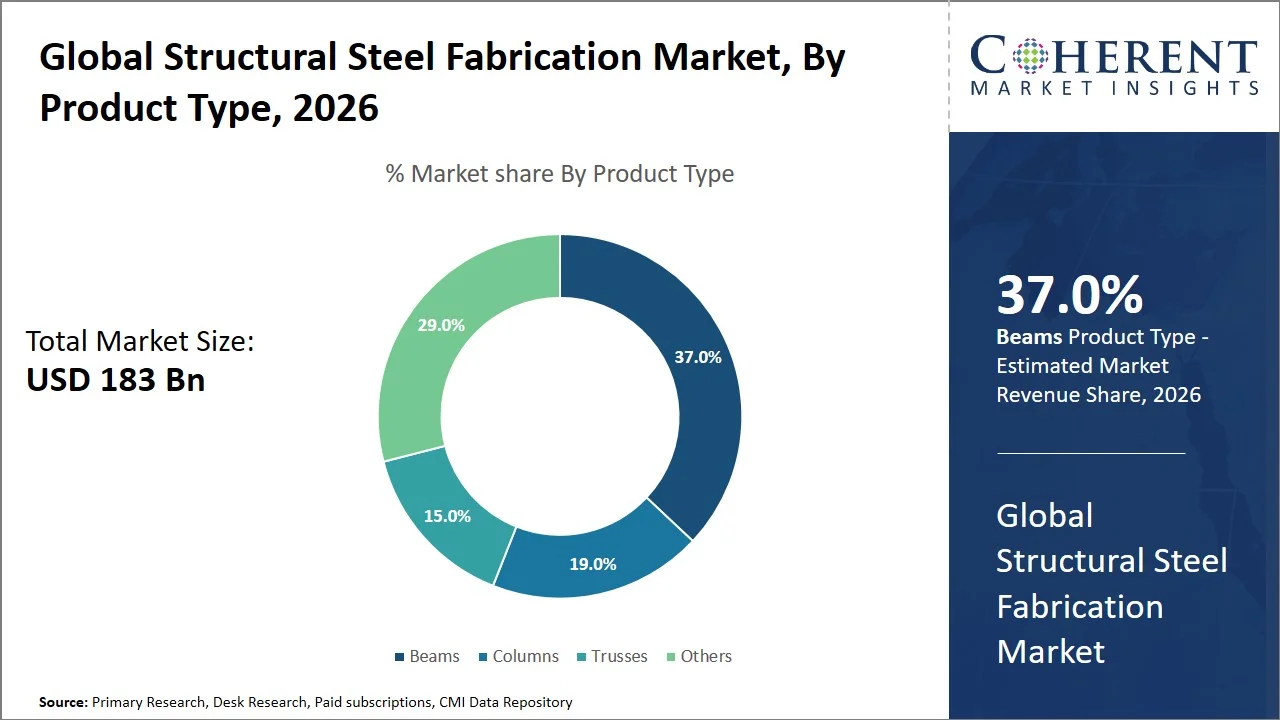
- The beams segment is expected to account for 37.0 % of the global structural steel fabrication market share in 2026. Government spending on transportation and public infrastructure is driving the growth of the segment. On December 22, 2025, U. S. Steel’s Board of Directors approved the funding for the full USD 350 million Gary Works blast furnace reline project.
- The cutting segment is estimated to capture 33.0 % of the market share in 2026. Rising demand for sustainable and recyclable building materials is majorly driving the growth of the segment. On June 19, 2026, Westview Group commenced the development of a low-carbon steel mill in Brisbane using electric arc furnace technology and recycled scrap steel to supply reinforcement steel for sustainable construction projects.
- The commercial construction segment is estimated to capture 47.0 % of the market share in 2026. Growing urbanization and high rise construction projects are driving the growth of the segment. On March 10, 2025, Schuff Steel Company secured fabrication work for multiple large commercial and high-rise developments in the Western U.S., supported by increasing office, mixed-use, and institutional construction activity.
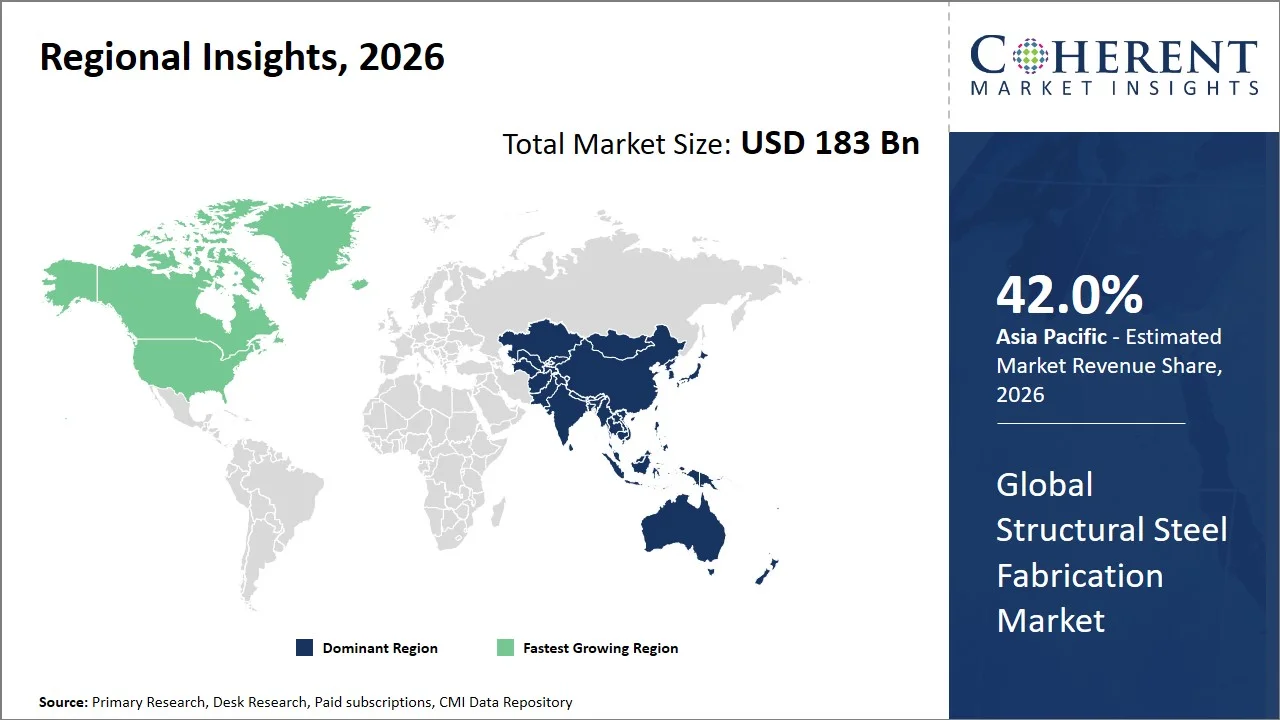
- Asia Pacific is expected to dominate the structural steel fabrication market in 2026 with a market share of 42.0 %. Increasing adoption of BIM integrated digital fabrication technologies in Asia Pacific is driving the growth of the regional market. On April 22, 2025, Trimble Indonesia hosted the technical program “Discover What’s New in Tekla Structures 2025” for Indonesian structural engineers, fabricators and steel contractors. The program highlighted AI-enabled BIM modeling, connected fabrication workflows and cloud-based collaboration for digital steel fabrication projects.
- North America is expected to account for 28.0 % of the market share in 2026 and is projected to record the fastest growth over the forecast period. Rising demand for advanced automated robotic welding systems in North America is driving the growth of the regional market. As of 2025, Wolf Robotics, a Lincoln Electric company, continued expanding the delivery of large-scale robotic welding cells using ABB and FANUC industrial robots for North American transportation, construction equipment, mining equipment, and structural steel fabricators.
- Rapid adoption of robotic welding and automated fabrication systems: Structural steel fabricators are increasingly adopting robotic welding cells, CNC beam processing lines, automated plasma cutting and AI-assisted quality inspection to improve fabrication accuracy, decrease labor reliance and deliver projects more quickly for large infrastructure and industrial projects.
- Growing use of Building Information Modeling and digital fabrication workflows: Fabricators are integrating Building Information Modeling with Tekla Structures, digital twins and cloud-based project management platforms to enable architects, engineers and fabrication facilities to collaborate in real-time, thereby reducing material waste and minimizing mistakes during on-site construction.
Segmental Insights
Why Does the Beams Segment Dominate the Global Structural Steel Fabrication Market?
The beams segment is expected to account for 37.0% of the global structural steel fabrication market share in 2026. The structural steel fabrication market is dominated by beams as they are the key load-bearing components in almost all types of construction and infrastructure projects. Their capacity to effectively transmit vertical and horizontal loads over their full lengths makes them indispensable for commercial buildings, industrial plants, warehouses, bridges, airports, stadiums and high-rise projects. Standardized beam profiles also facilitate production, transportation and on-site installation allowing for speedier project execution while retaining structural strength and compliance with engineering standards. On July 16, 2026, British Steel announced that it has landed a major supply deal to supply structural steel beams from its Teesside Beam Mill for the redevelopment of the Ellison Institute of Technology campus in Oxford that will require thousands of tons of heavy universal beams and columns for research and laboratory buildings
- Current Industry Events of 2026
- Market Size Estimation
- Regional Breakdown
- Competitive Landscape
- Customer Intelligence
- Segmental Analysis
- Pricing Analysis
- Key Market Drivers, Challenges & Future Trends
- Customized Insights Section
Why is Cutting the Most Preferred Fabrication Process?
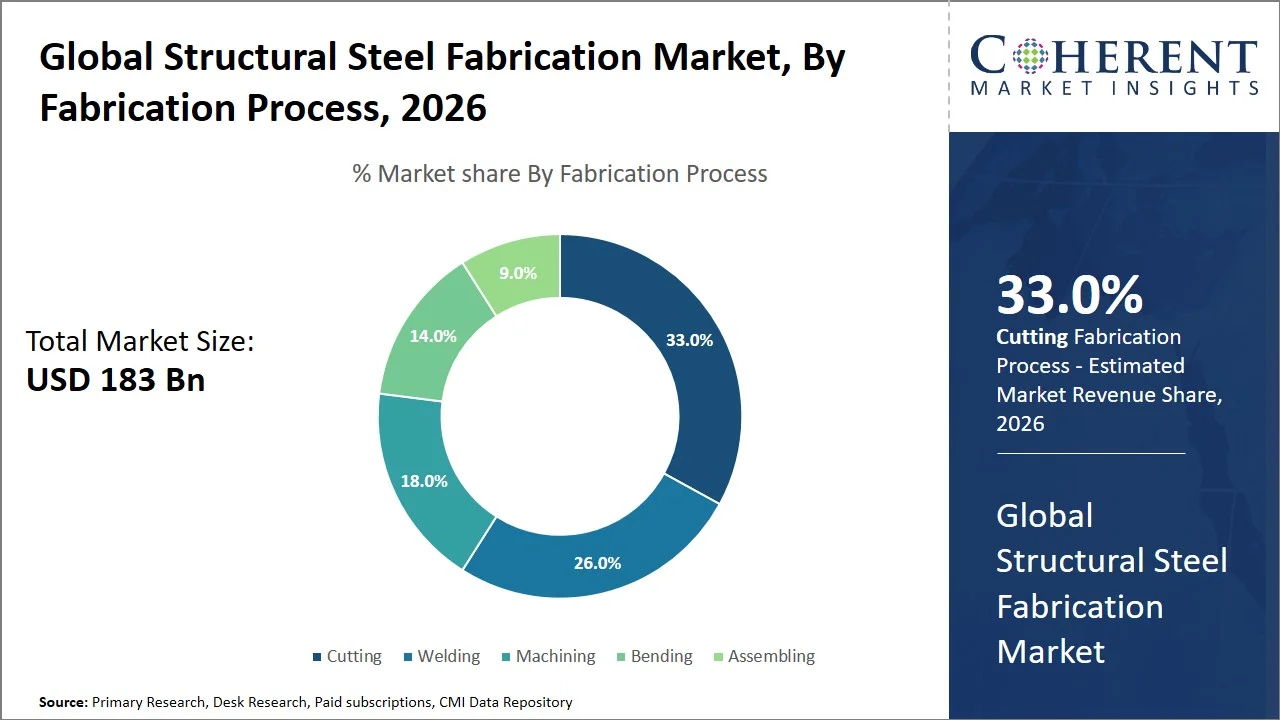
The cutting segment is expected to account for 33.0% of the global structural steel fabrication market share in 2026. The most desired fabrication method is the cutting process because it provides the foundation for all other fabrication processes by creating steel parts with accurate dimensions and smooth edges. High-precision technologies such as CNC laser cutting, plasma cutting, oxy-fuel cutting and waterjet cutting improve material utilization, reduce waste, minimize rework and provide accurate fit-up for welding and assembly, resulting in faster production cycles and consistent structural quality for construction and infrastructure projects. In early 2025, Mazak Optonics Corporation expanded its OPTIPLEX Ez Series across North America by adding higher power level options. Originally designed as an entry-level flat sheet 2D fiber laser, the expanded lineup allows users to pair the system with up to 6kW of power, making it highly capable for thin to medium material.
Commercial Construction Dominates the Global Structural Steel Fabrication Market
The commercial construction segment is expected to account for 47.0% of the global structural steel fabrication market share in 2026. Commercial construction accounts for the largest share of structural steel fabrication because modern commercial buildings require long-span structural systems that provide high strength, design flexibility, and rapid construction. Fabricated steel components are being extensively used in office towers, shopping malls, airports, hospitals, hotels, convention centers and data centers to provide large open spaces, to allow for future building modifications and to reduce overall construction time while satisfying stringent structural and safety requirements. On July 2, 2026, Balfour Beatty announced that it was to construct the 2 Finsbury Avenue commercial tower in the City of London, U.K. The project would use a large structural steel frame to provide flexible office floors, long-span beam systems and fast-track construction programs for one of the U.K.’s flagship commercial developments.
Current Events and their Impact
Current Events | Description and its Impact |
European Union - Construction Products Regulation (Revised CPR, Regulation (EU) 2024/3110) |
|
India - Bureau of Indian Standards Quality Control Orders for Steel Products |
|
Global Structural Steel Fabrication Market Dynamics
Market Drivers
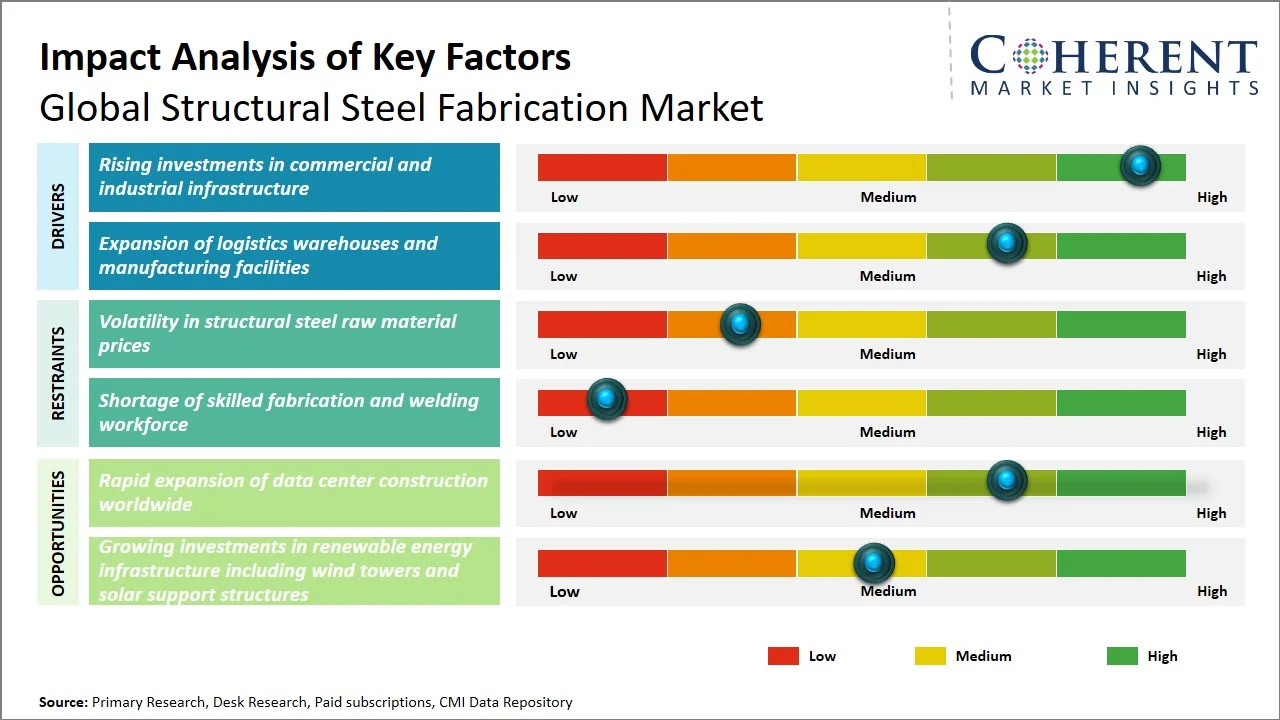
- Rising investments in commercial and industrial infrastructure: The need for structural steel fabrication is growing as governments and private developers are building more office complexes, airports, industrial parks, hospitals, data centers, ports and public transportation networks. Structural steel that is fabricated offers faster construction, better load bearing capacity, and more design freedom and is the material of choice for large infrastructure projects that require durable, standardized, high-strength structural frames. On July 13, 2026, Bhilai Steel Plant announced a major step towards its long-term capacity expansion program by signing a contractual agreement with MECON Limited for Engineering, Procurement, Construction and Management (EPCM) consultancy services for its 3.44 million tons per annum (MTPA) crude steel expansion project. (Source: Press Information Bureau)
- Expansion of logistics warehouses and manufacturing facilities: The rapid expansion of logistics warehouses and manufacturing facilities is increasing the demand for fabricated structural steel as these require long span frameworks, high load capacity and quick project completion. The growth in e-commerce, third-party logistics operations, automotive manufacturing, electronics production and advanced manufacturing facilities is reducing construction time while providing scalable and cost-efficient industrial buildings, leading developers to embrace prefabricated steel structures. On July 16, 2026, DHL Supply Chain Australia announced plans for a 24/7 warehouse and distribution centre at Burrah Park, Western Sydney, Australia as part of a major industrial hub near the new Western Sydney International Airport.
Emerging Trends
- Rising demand for low-carbon and recycled structural steel: Construction companies and project developers are increasingly demanding structural steel produced using electric arc furnace technology and high recycled-content feedstock in order to meet sustainability goals, reduce embodied carbon, and qualify for green building certification standards.
- Expansion of modular and off-site steel construction: The market is seeing a growing trend of using prefabricated structural steel modules for data centers, logistics warehouses, healthcare facilities, commercial buildings, and industrial plants, allowing for quicker installation, enhanced quality control, reduced on-site labor needs, and shorter overall project timelines.
Regional Insights
Why is Asia Pacific a Strong Market for Structural Steel Fabrication?
Asia Pacific is expected to account for a market share of 42.0% in 2026. Asia Pacific dominates the structural steel fabrication market on account of high investments in industrial manufacturing, transportation infrastructure, commercial buildings and energy projects. China continues to churn out structural steel for high-speed railway stations, airport expansion, offshore wind projects and industrial parks, while India is ramping up fabrication capacity to support dedicated freight corridors, metro rail networks, semiconductor facilities and large logistics parks. Japan supports the market with earthquake resistant commercial buildings and industry modernization projects, and South Korea supports the market with manufactured steel that is used in shipyards, semiconductor manufacturing facilities, battery factories, and petrochemical complexes. Southeast Asian countries including Vietnam, Indonesia, and Malaysia are also increasing structural steel consumption through industrial zones, export-oriented manufacturing facilities, ports, and airport development.
Why Does the North America Structural Steel Fabrication Market Exhibit High Growth?
North America is projected to account for 28.0% of the global structural steel fabrication market and is expected to register the fastest growth. North America remains a major market as structural steel fabrication is widely used in data centers, advanced manufacturing plants, logistics warehouses, energy infrastructure, and transportation projects. The U.S. continues to witness fabrication demand from hyperscale data center developments by Microsoft, Amazon Web Services, Google, and Meta, alongside semiconductor projects supported by Intel, TSMC, Samsung Electronics, and Micron Technology. Canada is investing in transit infrastructure, bridge rehabilitation, renewable energy facilities and mining projects that require fabricated structural steel. Domestic steel procurement regulations for federally supported projects in the region also promote local fabrication and supply chain growth.
Global Structural Steel Fabrication Market Outlook for Key Countries
Why is China Emerging as a Major Hub in the Structural Steel Fabrication Market?
China continues to be the world’s largest structural steel fabrication facility with its integrated steel-making capacity and continued investment in infrastructure and industrial construction. Fabricated steel is extensively used in high speed rail stations, airport terminals, urban renewal, offshore wind foundations, petrochemical complexes and major manufacturing campuses. Companies like as China State Construction Engineering Corporation, China Railway Group, China Railway Construction Corporation and China Communications Construction Company continue to take on huge projects involving sophisticated fabricated steel assemblies. The country is also expanding automated fabrication facilities with robotic welding, CNC processing lines and digital production systems to improve efficiency and production quality.
Is the U.S. the Next Growth Engine for the Structural Steel Fabrication Market?
Strong demand for structural steel fabrication in the U.S. is being driven by commercial construction, industrial expansion and modernization of public infrastructure. Major programs include Intel's semiconductor fabrication plants in Ohio, TSMC's in Arizona, Samsung Electronics' in Texas and Micron Technology's in New York, all of which require massive amounts of fabricated steel. Additional demand is driven by hyperscale data centers, airport terminal expansions, highway bridge replacements, electric vehicle manufacturing facilities, battery plants and distribution centers built by major logistics and e-commerce companies. Fabricators in the domestic market are increasingly turning to digital fabrication technologies, robotic welding and Building information modeling integration to increase efficiency and project delivery.
Germany Structural Steel Fabrication Market Analysis and Trends
Germany is still a key market in Europe with a sophisticated industrial base and strong engineering requirements. Its structural steel fabrication serves automotive manufacturing plants operated by Volkswagen, BMW, Mercedes-Benz and Audi, chemical facilities, logistics centers, railway infrastructure and renewable energy projects. The country is also investing in plants that produce hydrogen, offshore wind installations and the renovation of factories that require precisely made steel parts. German manufacturers increasingly rely on automated beam processing systems, robotic welding and digitally integrated fabrication workflows to achieve high accuracy and efficiency in manufacturing.
Japan Structural Steel Fabrication Market Analysis and Trends
The demand for structural steel fabrication in Japan is driven by the strict demands of seismic engineering and continuing redevelopment of commercial and transportation infrastructure. Fabricated steel is used extensively in earthquake resistant office buildings, mixed-use developments, railway stations, airports, industrial facilities and manufacturing plants of companies like Toyota, Honda, Nissan and Mitsubishi Heavy Industries. The country also spurs demand with upgrades to semiconductor production facilities, renewable energy projects and advanced factory automation. Japanese fabricators have highly automated production lines and precision fabrication technologies that deliver superior structural quality and comply with strict building standards.
India Structural Steel Fabrication Market Analysis and Trends
Investments across India in transportation, industrial corridors, commercial real estate and expansion of manufacturing are driving rapid growth in structural steel fabrication. There is a growing demand for fabricated steel structures due to large projects like Bharatmala, Sagarmala, Dedicated Freight Corridors, metro rail, airport modernization and industrial parks. Manufacturing investments from Tata Electronics, Micron Technology, Foxconn and a number of automotive and renewable energy businesses are also supporting fabrication activity. Big logistics parks, data centers, warehousing facilities and steel-intensive commercial expansions in states such as Gujarat, Maharashtra, Tamil Nadu, Karnataka and Uttar Pradesh are adapting to modern manufactured structural steel solutions at a faster pace.
Global Structural Steel Fabrication Market - Structural Steel Production Capacity By Country (2025-2026)
Country | Estimated Structural Steel Production Capacity (Million Metric Tons per Year) |
China | 1,250 |
India | 205 |
Japan | 115 |
U.S. | 110 |
Russia | 95 |
South Korea | 85 |
Germany | 48 |
Turkey | 46 |
Brazil | 45 |
Iran | 40 |
How is the Rapid Expansion of Data Center Construction Worldwide Creating New Growth Opportunities in the Global Structural Steel Fabrication Market?
The boom in hyperscale and colocation data centers is driving huge demand for structural steel fabrication as operators accelerate the construction of high-capacity digital infrastructure. Companies such as Microsoft, Amazon Web Services, Google, Meta, Oracle, Equinix, Digital Realty, CyrusOne, QTS Realty Trust, and NTT Global Data Centers are developing large facilities across the U.S., Europe, India, Southeast Asia, and the Middle East, each requiring thousands of fabricated steel beams, columns, trusses, mezzanine platforms, equipment support structures, and rooftop framing systems. New semiconductor-driven data center clusters in states including Virginia, Texas, Ohio, Arizona, and in countries such as India and Malaysia are further increasing demand for prefabricated structural steel because it enables faster erection, supports heavy mechanical and electrical equipment, and shortens project delivery schedules required by cloud service providers and artificial intelligence infrastructure developers.
On September 23, 2025, OpenAI, Oracle, and SoftBank announced five new U.S. AI data center sites under Stargate, OpenAI’s overarching AI infrastructure platform. The combined capacity from these five new sites brings Stargate to nearly 7 gigawatts of planned capacity and over USD 400 billion in investment over the next three years.
Market Players, Key Development, and Competitive Landscape
Key Developments
- On September 25, 2025, U. S. Steel announced the next phase of capital investment plans, marking another milestone in the strategic partnership between Nippon Steel and U. S. Steel. The cooperative efforts between the two industry leaders have already yielded significant successes. Nippon Steel experts have worked closely with U. S. Steel's integrated mills in the North American Flat-Rolled, Big River Steel Works and Tubular Products segments to enhance operational efficiencies, among other achievements.
- On December 13, 2024, Severfield secured a structural steel contract associated with Ørsted's Hornsea 3 offshore wind farm, expanding its participation in renewable energy infrastructure through fabrication and delivery of major steel components for one of the world's largest offshore wind developments.
Competitive Landscape
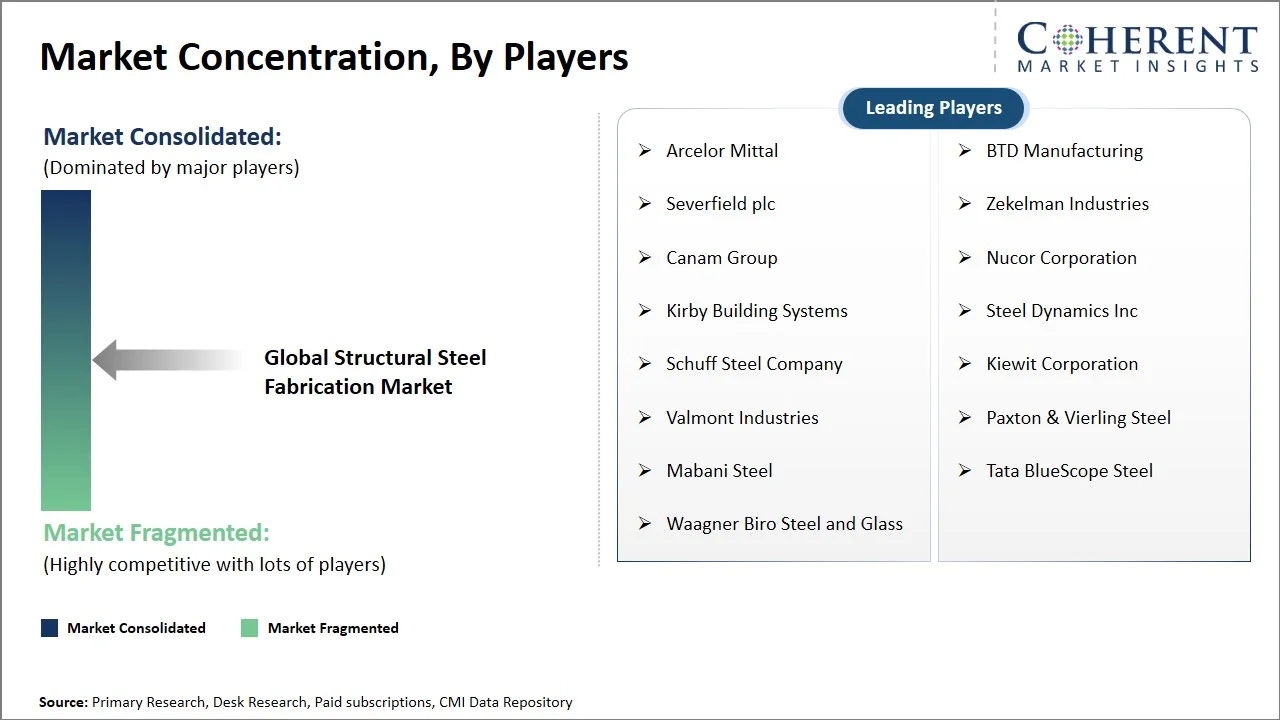
ArcelorMittal Projects, Nucor Corporation, Steel Dynamics Inc, Severfield plc, Canam Group, Schuff Steel Company, Kirby Building Systems and Zekelman Industries are some of the major players in the global structural steel fabrication market. These companies are moving beyond traditional fabrication by investing in automation, digital engineering, and specific project expertise. Severfield is also bolstering its capabilities in complex commercial buildings, sports stadiums and industrial facilities with advanced building information modeling integration and off-site fabrication. Nucor Corporation and Steel Dynamics use vertically integrated steelmaking and wide fabrication networks to reduce lead times for infrastructure and manufacturing projects across North America.
Canam Group specializes in steel bridge components, multi-storey commercial buildings and specialized structural solutions, whereas Schuff Steel concentrates on high-rise developments, airports and large-scale data center construction in the U.S. Kirby Building Systems has extended its pre-engineered steel building portfolio throughout the Middle East, South Asia and Africa, focusing on industrial warehouses and logistics facilities. ArcelorMittal Projects continues to provide engineered steel solutions for ports, renewable energy and major infrastructure developments across the globe.
Market Report Scope
Structural Steel Fabrication Market Report Coverage
| Report Coverage | Details | ||
|---|---|---|---|
| Base Year: | 2025 | Market Size in 2026: | USD 183 Bn |
| Historical Data for: | 2020 To 2024 | Forecast Period: | 2026 To 2033 |
| Forecast Period 2026 to 2033 CAGR: | 7% | 2033 Value Projection: | USD 276 Bn |
| Geographies covered: |
| ||
| Segments covered: |
| ||
| Companies covered: | Arcelor Mittal, BTD Manufacturing, Severfield plc, Zekelman Industries, Canam Group, Nucor Corporation, Kirby Building Systems, Steel Dynamics Inc, Schuff Steel Company, Kiewit Corporation, Valmont Industries, Paxton & Vierling Steel, Mabani Steel, Tata BlueScope Steel, and Waagner Biro Steel and Glass | ||
| Growth Drivers: |
| ||
| Restraints & Challenges: |
| ||
Analyst Opinion (Expert Opinion)
- The industry is expected to experience sustained growth as governments and private developers accelerate investments in digital infrastructure, semiconductor manufacturing, renewable energy, and transportation modernization. Demand is likely to shift toward highly automated fabrication facilities capable of producing complex structural assemblies with shorter production cycles and consistent quality, making digital manufacturing capabilities a key competitive differentiator.
- The greatest opportunities are expected to emerge in fabricated steel solutions for hyperscale data centers, semiconductor fabrication plants, and offshore wind infrastructure, particularly in the U.S., India, and Southeast Asia. Higher-value contracts are likely to go to heavy steel module, long-span beam, equipment support structure and high-precision welded assembly fabricators specializing in these applications rather than to vendors concentrating on traditional commercial buildings.
- Market participants should prioritize investments in robotic welding, CNC beam processing, Building information modeling integration, and automated quality inspection while expanding engineering and design services. Developing low-carbon fabricated steel solutions, strengthening domestic supply chains, and establishing fabrication facilities close to major infrastructure and industrial corridors will provide a competitive advantage in winning complex, schedule-sensitive projects.
Speak to the analyst
Want personalized insights?
Take the findings above to one of our principal consultants, or have the report rebuilt around the segments, geographies and competitors you actually track.
Market Segmentation
- Product Type Insights (Revenue, USD Billion, 2021 - 2033)
- Beams
- Columns
- Trusses
- Others
- Fabrication Process Insights (Revenue, USD Billion, 2021 - 2033)
- Cutting
- Welding
- Machining
- Bending
- Assembling
- End User Insights (Revenue, USD Billion, 2021 - 2033)
- Commercial Construction
- Industrial Construction
- Residential Construction
- Regional Insights (Revenue, USD Billion, 2021 - 2033)
- North America
- U.S.
- Canada
- Latin America
- Brazil
- Argentina
- Mexico
- Rest of Latin America
- Europe
- Germany
- U.K.
- Spain
- France
- Italy
- Russia
- Rest of Europe
- Asia Pacific
- China
- India
- Japan
- Australia
- South Korea
- ASEAN
- Rest of Asia Pacific
- Middle East
- GCC Countries
- Israel
- Rest of Middle East
- Africa
- South Africa
- North Africa
- Central Africa
- North America
- Key Players Insights
- Arcelor Mittal
- BTD Manufacturing
- Severfield plc
- Zekelman Industries
- Canam Group
- Nucor Corporation
- Kirby Building Systems
- Steel Dynamics Inc
- Schuff Steel Company
- Kiewit Corporation
- Valmont Industries
- Paxton & Vierling Steel
- Mabani Steel
- Tata BlueScope Steel
- Waagner Biro Steel and Glass
Sources
Primary Research Interviews
- Structural Steel Fabricators & Manufacturers
- Construction & Infrastructure Project Developers
- Raw Material Suppliers (Steel Mills & Metal Distributors)
- Engineering, Procurement & Construction (EPC) Companies
Magazines
- Modern Steel Construction Magazine
- Steel Times International
- Engineering News-Record (ENR)
- Metal Bulletin Magazine
Journals
- Journal of Constructional Steel Research
- Journal of Structural Engineering (ASCE)
- International Journal of Steel Structures
Associations
- American Institute of Steel Construction (AISC)
- World Steel Association (WSA)
- Steel Construction Institute (SCI)
- National Steel Construction Conference (NSCC)
Public Domain Sources
- U.S. Geological Survey (USGS) – Mineral Resources Data
- World Bank – Infrastructure & Construction Data
- International Energy Agency (IEA) – Industrial Sector Reports
- U.S. Census Bureau – Manufacturing & Construction Statistics
Proprietary Elements
- CMI Data Analytics Tool
- Proprietary CMI Existing Repository of Information for the Last 10 Years
Get access to 250+ pages report
Every segment, forecast, competitor profile and data table behind the analysis above — available for instant download.
- ESOMAR Member
- ISO 9001:2015 Certified
- D-U-N-S Registered
- GDPR & CCPA Compliant
Missing comfort of reading report in your local language? Find your preferred language:
Transform your Strategy with Exclusive Trending Reports
Frequently Asked Questions
The global structural steel fabrication market is expected to stand at USD 183 Bn in 2026 and is expected to reach USD 276 Bn by 2033.
The CAGR of the global structural steel fabrication market is projected to be 7% from 2026 to 2033.
Rising investments in commercial and industrial infrastructure and expansion of logistics warehouses and manufacturing facilities are the major factors driving the growth of the global structural steel fabrication market.
Volatility in structural steel raw material prices and shortage of skilled fabrication and welding workforce are the major factors hampering the growth of the global structural steel fabrication market.
In terms of product type, the beams segment is estimated to dominate the market revenue share in 2026.
Building information modeling improves design coordination, fabrication accuracy, and project execution efficiency.
Robotic welding improves productivity, weld consistency, and manufacturing precision while reducing labor dependence.