

Sulfamic Acid Market Analysis & Forecast: 2026-2033
The Sulfamic Acid Market size is estimated to be valued at USD 190.80 Bn in 2026 and is expected to reach USD 277.61 Bn by 2033, exhibiting a compound annual growth rate (CAGR) of 5.5% from 2026 to 2033.
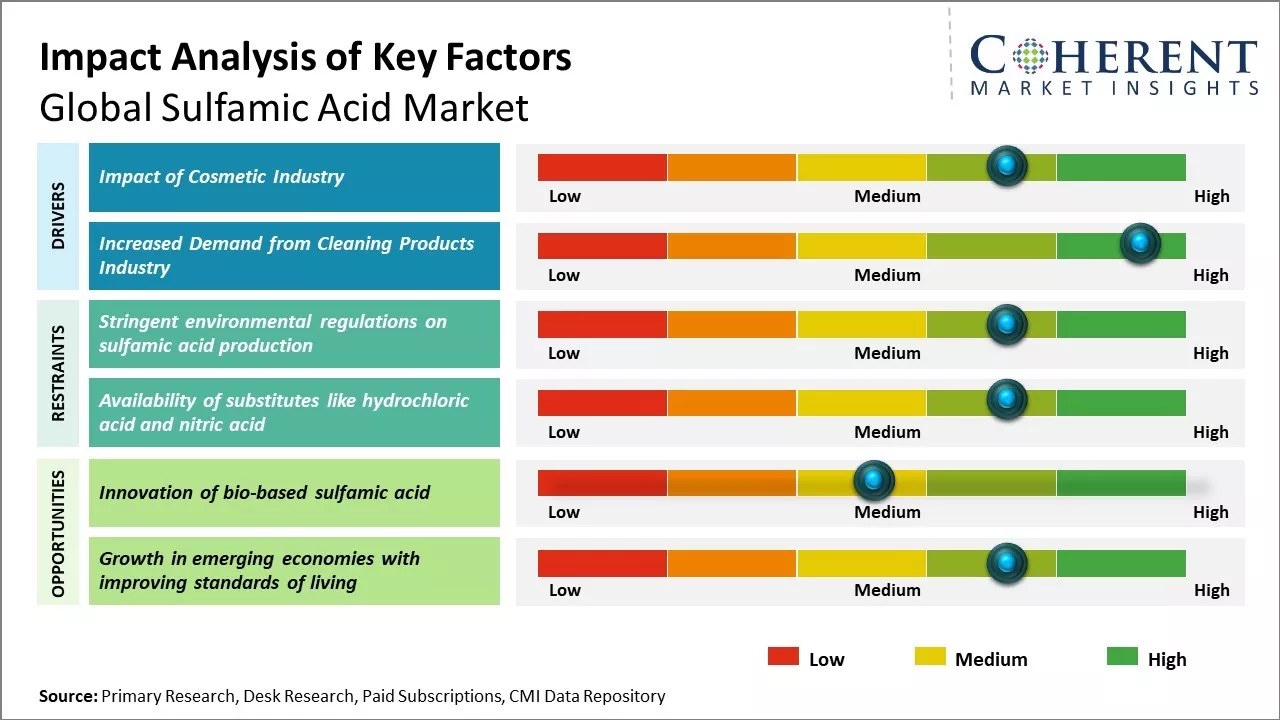
Key Takeaways
- By Application, the Dyes & Pigments Segment is expected to dominate the global sulfamic acid market outlook with a 31.4% share by 2026, driven by its chemical versatility, eco-friendly profile, and booming textile and industrial sectors.
- By Form, the Liquid Segment is projected to lead the market with a 48.2% share in 2026, due to its superior solubility, safer handling, and efficiency in industrial cleaning and water treatment.
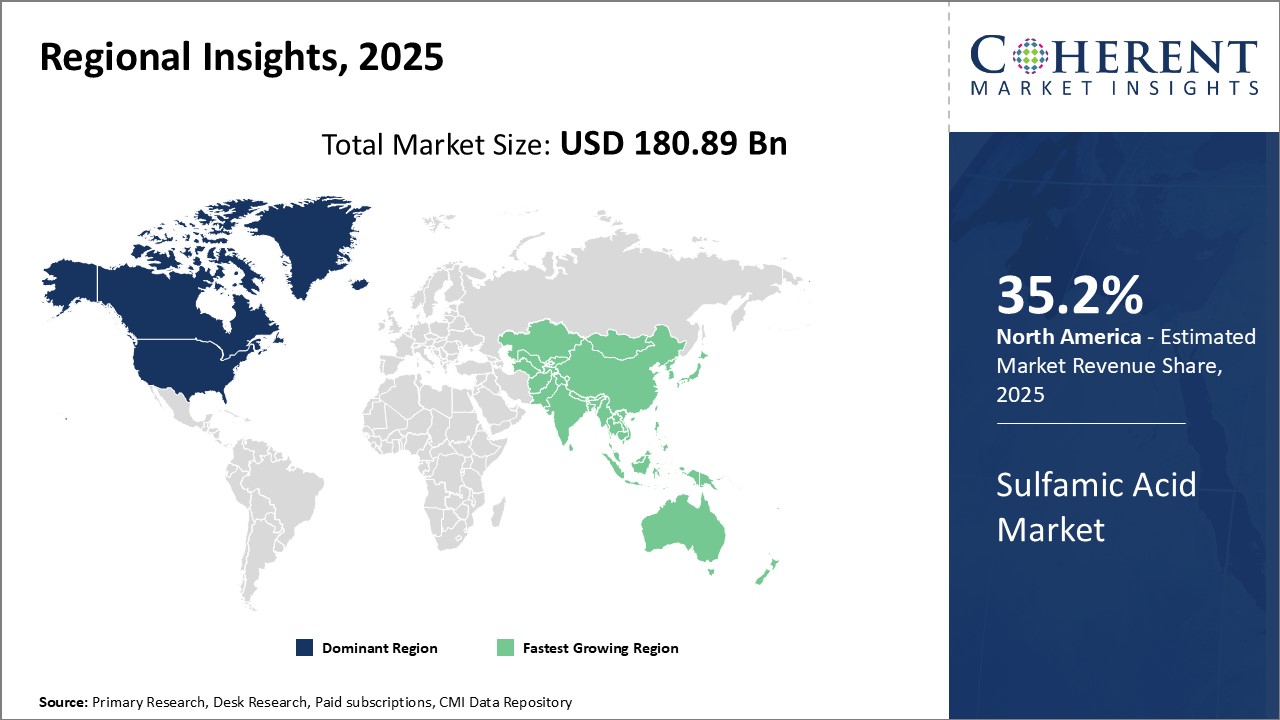
- By Region, North America is anticipated to hold the largest share of 35.2% in the global sulfamic acid market in 2026.
Market Overview
The sulfamic acid market demand is expected to grow on account of increasing applications in the chemicals, pharmaceuticals, and food processing industries. Many businesses use sulfamic acid to clean and control pH levels. In the chemicals industry, the compound is mostly used to make dyes, sulfa drugs, and other chemicals that are used for specific purposes. Also, the growth of the pharmaceuticals and food processing industries is being helped by more people eating processed foods and changing their lifestyles.
Current Events and Its Impact
Event | Description and Impact |
Geopolitical Tensions & Supply Chain Disruptions |
|
Regulatory Shifts & Environmental Policies |
|
Trade Dynamics & Tariff Adjustments |
|
Export Import of Sulfamic Acid
Between June 2024 and May 2025, the world imported 1,277 Sulfamic Acid shipments—a 16% increase from the previous year. These were supplied by 298 exporters to 357 global buyers. In May 2025 alone, there were 105 shipments.
China, Indonesia, and South Korea are the main sources of these imports. The top importers are the United States (810 shipments), Vietnam (769), and Mexico (230).
- Current Industry Events of 2026
- Market Size Estimation
- Regional Breakdown
- Competitive Landscape
- Customer Intelligence
- Segmental Analysis
- Pricing Analysis
- Key Market Drivers, Challenges & Future Trends
- Customized Insights Section
Government Regulation
Sulfamic acid is a dangerous chemical, so it is very tightly controlled in most major markets. The European Union has rules about it through REACH. This means that it needs to be clearly labeled, have rules about how it can be used, and have safety measures in place for moving and handling it. Sulfamic acid is covered by the US Environmental Protection Agency (EPA) under TSCA. This means that manufacturers and importers must follow rules for reporting and evaluating risk.
In India, the Bureau of Indian Standards (BIS) makes sure that both industrial and food-grade products are of good quality. This keeps things safe and the same. The Ministry of Ecology and Environment (MEE) in China makes sure that factories follow strict rules about the environment. To keep things clean and cut down on pollution during production, they check factories on a regular basis.
The UN Recommendations on the Transport of Dangerous Goods and the GHS (Globally Harmonized System) for hazard communication both say how sulfamic acid should be moved around the world. These frameworks change how things are packaged, labeled, and sent around the world.
Overall, new rules about safety and the environment are making producers use cleaner methods and follow international standards. These changes have a direct effect on how much it costs to make things, how easy it is to get to markets, and how supply chains work.
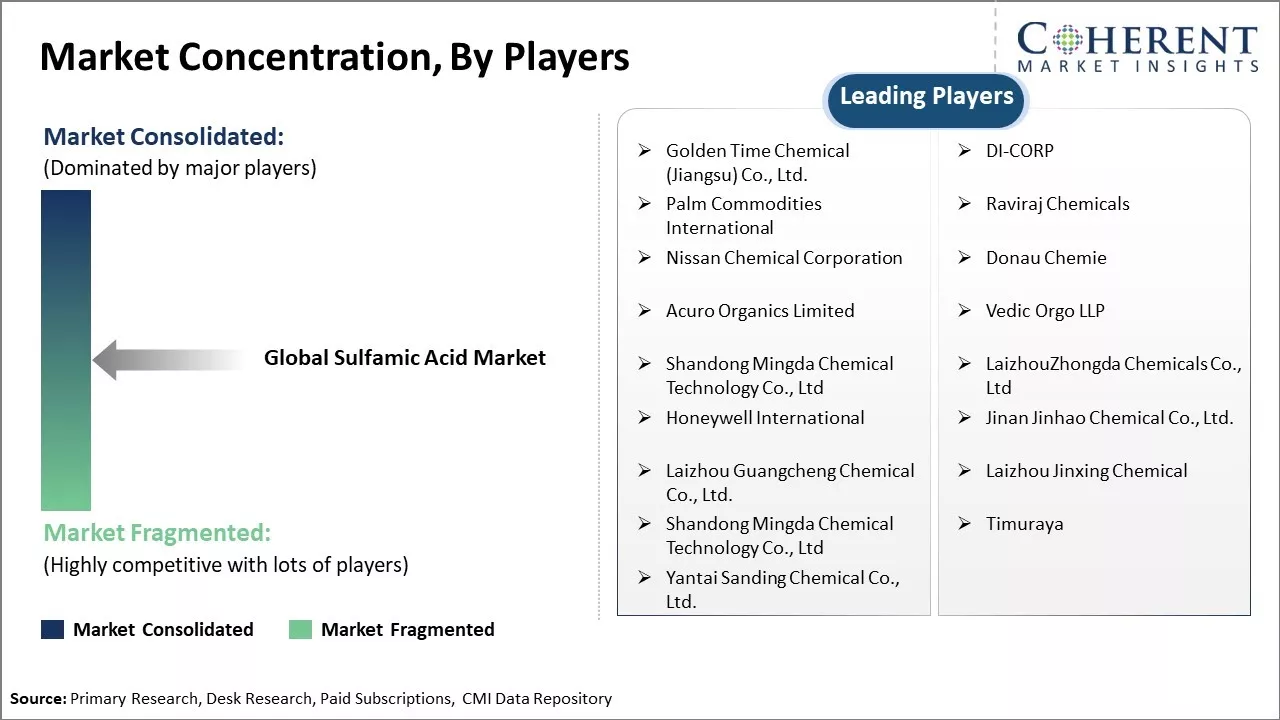
Market Concentration and Competitive Landscape
Segmental Insights
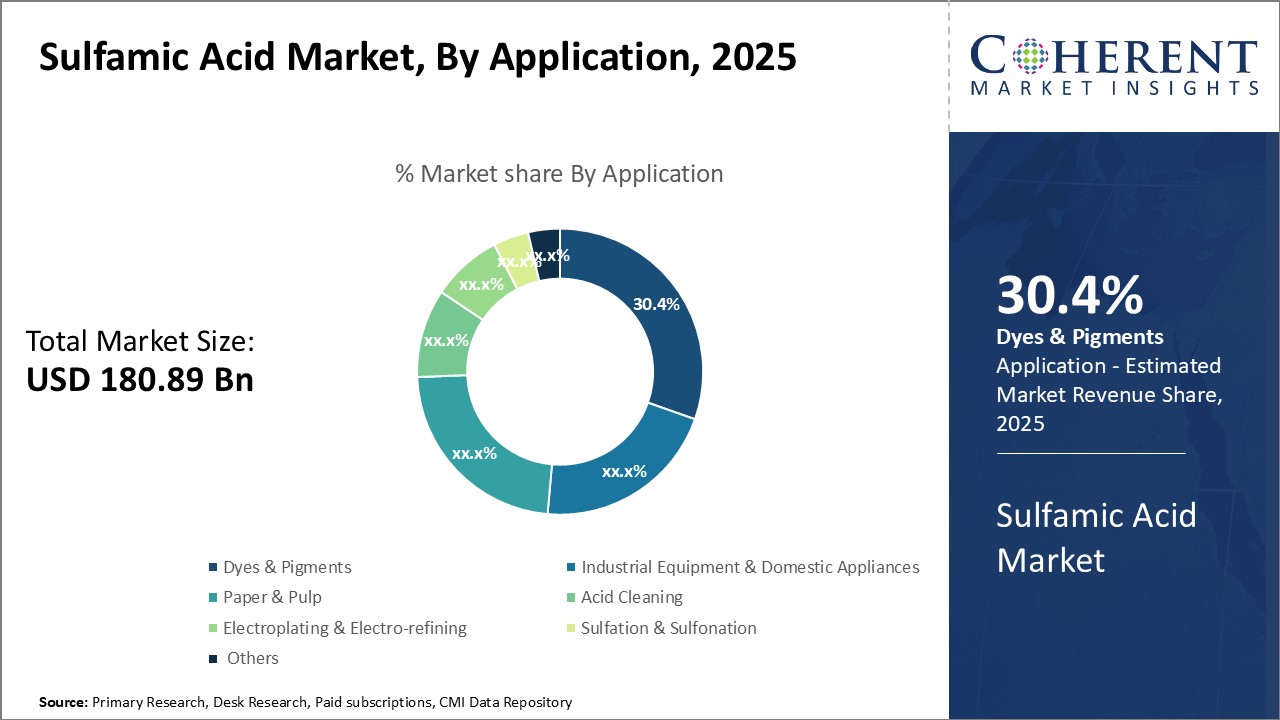
Sulfamic Acid Market Insights, By Application - Dyes & Pigments Has Soaring Demand Driven by Its Chemical Versatility, Eco-Friendly Profile, And Booming Textile and Industrial Sectors
In terms of application, dyes & pigments is expected to contribute 31.4% share of the Sulfamic Acid market value in 2026. This surge in demand is driven by sulfamic acid’s chemical versatility, particularly its role in sulfonation and sulfamation reactions essential for synthesizing complex dye molecules. The expanding textile industry, especially in Asia Pacific has intensified the need for vibrant and durable colorants, where sulfamic acid plays a critical role in formulation and processing. Additionally, its reputation as a safer, biodegradable alternative to harsher acids aligns with growing environmental regulations, prompting manufacturers to adopt it more widely. Beyond textiles, dyes and pigments are integral to plastics, paints, inks, and coatings, all of which are experiencing growth due to urbanization and infrastructure development. Sulfamic acid’s cost-effectiveness further enhances its appeal, making it a preferred choice for large-scale industrial applications in colorant production.
For instance, Sulfamic acid, a versatile cleaning agent, is gaining traction across industries for its low toxicity and effective descaling properties. In the dyes and pigments sector, it plays a crucial role by removing excess nitrides during diazotization, enhancing production efficiency and environmental safety.
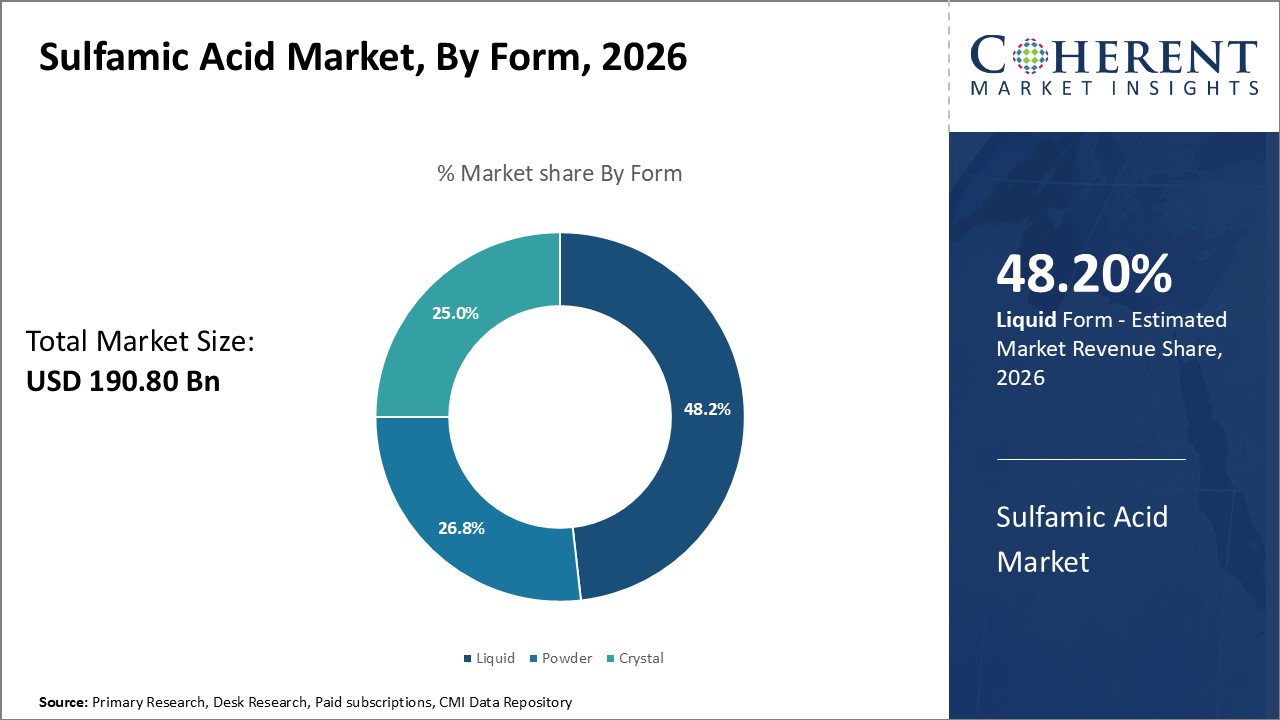
Sulfamic Acid Market Insights, By Form - Liquid Demand Due To Its Superior Solubility, Safer Handling, And Efficiency in Industrial Cleaning and Water Treatment
The liquid segment is expected to account for 48.2% the sulfamic acid market share based on form in 2026 driven by its superior handling, solubility, and versatility across industries. Liquid sulfamic acid is especially favored in cleaning and descaling applications, where it offers faster reaction rates and easier dosing compared to solid forms. Its use in industrial equipment maintenance, water treatment, and household cleaning products is expanding due to growing demand for eco-friendly and efficient solutions. Additionally, liquid formulations reduce dust hazards and simplify storage and transport, making them ideal for large-scale operations.
For instance, Sulfamic acid, widely used in chemical engineering, exhibits powerful cleaning and descaling properties. When mixed with water, it forms a stable, non-volatile solution ideal for industrial applications. Its low toxicity and biodegradability make it a preferred choice in sectors like dyes, pigments, and water treatment, aligning with growing environmental and safety standards.
Regional Insights
North America Sulfamic Acid Market Analysis and Trends
North America is projected to lead the global sulfamic acid market growth with an estimated market share of 35.2% by 2026. The region is supported by a well-established industrial framework which includes textiles, pharmaceuticals, water treatment and metal finishing, all of which are heavy sulfamic acid consumers.
Notably, the region’s most prolific producer and consumer have become the US because of enormous spending by important chemical companies on increasing sulfamic acid production capabilities. North American businesses utilize developed research facilities, skilled workforce, and strict environmental compliance policies to formulate better and environmentally friendly sulfamic acids. These regulations in place have expedited the shift from dangerous acid derivatives towards more benign and biodegradable substitutes, making sulfamic acid the most favorable option across various industries.
For instance, in May 2026, a study on quantifying inorganic carbon in soil using sulfamic acid and gas chromatography was conducted by researchers from Andes Ag, Inc. are using sulfamic acid and gas chromatography to accurately quantify inorganic carbon in soil, offering a safer and more efficient alternative to traditional acids. This method enhances precision in environmental analysis while minimizing hazardous byproducts, marking a significant advancement in soil chemistry and sustainable agricultural research.
Asia Pacific Sulfamic Acid Market Analysis and Trends
Asia Pacific is the fastest growing sulfamic acid market trend due to its rapid industrialization, increasing population, and changing geopolitical trade relations. Countries like China, India, and Japan are active participants in regional growth, fueled by an expanding downstream textile processing industry, metal treatment, and pharmaceuticals.
China is particularly noteworthy, as the country pivots from bulk commodity chemicals to higher-value specialty chemicals, including sulfamic acid. The buildup of the local pharmaceutical industry and maintenance of water treatment facilities also support perpetuated consumption. Their reduced production expenses and plentiful workforce have transformed the region into an appealing area for international producers who want to set up local plants and lower their logistic costs while improving competition in the region.
Sulfamic Acid Market Outlook Country-Wise
United States Sulfamic Acid Market Analysis and Trends
The global sulfamic acid market has the United States as its cornerstone due to the country’s expansive chemical manufacturing ecosystem as well as its progressive regulatory environment. Growing U.S. based producers are increasing their operations to capture both domestic and export opportunities from the pharmaceutical, pulp & paper, and industrial cleaning industries.
The United States is a leader in innovation and production of sulfamic acid as it offers federal incentives towards green chemistry along with ever-increasing requirements for low-toxicity descalers and cleaning agents.
China Sulfamic Acid Market Analysis and Trends
Accompanying the shift in chemical manufacturing from low value to high value in China, the country’s consumption of dyes, textiles, and pharmaceuticals is propelling globally integrated supply systems. Infrastructure development paired with China’s focus on specialty chemical production has enabled the country to rapidly emerge as one of the key markets for sulfamic acid.
Domestic capacity development alongside the importation of premium grades is establishing China as a leading producer and consumer of sulfamic acid.
Market Report Scope
Sulfamic Acid Market Report Coverage
| Report Coverage | Details | ||
|---|---|---|---|
| Base Year: | 2025 | Market Size in 2026: | USD 190.80 Bn |
| Historical Data for: | 2020 To 2024 | Forecast Period: | 2026 To 2033 |
| Forecast Period 2026 to 2033 CAGR: | 5.5% | 2033 Value Projection: | USD 277.61 Bn |
| Geographies covered: |
| ||
| Segments covered: |
| ||
| Companies covered: | Golden Time Chemical (Jiangsu) Co., Ltd., DI-CORP, Palm Commodities International, Raviraj Chemicals, Nissan Chemical Corporation, Donau Chemie, Acuro Organics Limited, Vedic Orgo LLP, Shandong Mingda Chemical Technology Co., Ltd, LaizhouZhongda Chemicals Co., Ltd, Honeywell International , Jinan Jinhao Chemical Co., Ltd., Laizhou Guangcheng Chemical Co., Ltd., Laizhou Jinxing Chemical, Shandong Mingda Chemical Technology Co., Ltd, Timuraya, and Yantai Sanding Chemical Co., Ltd. | ||
| Growth Drivers: |
| ||
| Restraints & Challenges: |
| ||
Sulfamic Acid Market Driver
Increased Demand from Cleaning Products Industry
Sulfamic acid is frequently incorporated as an acid builder or pH adjuster in a wide range of hard surface cleaners and disinfectants. Its water solubility and acidic character make it effective for use in bathroom cleaners, automatic dishwasher detergents, and household cleaners as well as other industrial and household cleaning products. This compound also maintains the acidic pH needed for dissolving dirt, grease, and stains. It also improves cleaning performance through its mineral sequestration capabilities.
The increase in the usage of cleaning products globally has significantly increased the consumption of sulfamic acid. Some of the things that are driving the sales growth of home and commercial cleaning products are people being more aware of personal hygiene, busy lives, higher household incomes, and cities growing quickly.
Impact of Cosmetic Industry
The global cosmetic industry has witnessed significant growth over the past few years. There has been a rising demand for various cosmetic products such as hair colorants, hair straighteners, hair fixers, hair conditioners, shampoos, skincare products, makeup items and others. Sulfamic acid plays a vital role in the formulation of many hair products and skincare items.
It is widely used as a cleansing agent and pH controller in shampoos and conditioners. The acid helps keep the pH of these products in the slightly acidic range that is best for hair health. It also lets the product clean hair well and gets rid of dirt, oil, and other impurities without taking away the hair's natural oils.
The growing cosmetic industry is presenting lucrative opportunities for the sulfamic acid market. Manufacturers are focusing on introducing innovative hair care and skincare products with natural and organic ingredients. This is increasing the demand for multifunctional ingredients like sulfamic acid that can aid in cleaning and conditioning while maintaining the right pH.
Also, sales of different hair and skin care products are going up due to people have more money to spend and are more aware of how they look, especially women. People are changing their lifestyles and are more willing to spend money on personal care, which is another important factor driving the global cosmetics industry. As long as this industry keeps growing, it will cause a big increase in the use of sulfamic acid.
Sulfamic Acid Market Opportunities
- Innovation of bio-based sulfamic acid
Bio-based sulfamic acid has a big chance to grow considering more and more people want chemicals that are good for the environment and last a long time. Sulfamic acid is used in a lot of different fields, such as cleaning, textiles, plastics, and more. Chemical synthesis is the main way that sulfamic acid is made right now. This process uses fossil fuels that is unable to be replaced and releases greenhouse gases.
Switching to a bio-based way of making things possibly help cut down on emissions and make us less reliant on oil prices that change all the time. Several companies are researching the use of renewable biomass sources like agricultural residues as a feedstock for sulfamic acid production. If successful, this may help establish a greener supply chain and improved sustainability credentials for the sulfamic acid market.
Analyst Viewpoint
- The sulfamic acid market value is poised to witness steady growth over the forecast period driven by the increasing demand from several end-use industries such as chemical processing, pharmaceuticals, and personal care.
- Sulfamic acid finds wide application as a pH controller and cleaning agent in these industries which will propel market expansion. Furthermore, its properties such as high water solubility and acid strength compared to other similar organic acids make it a preferred industrial chemical.
- North America currently dominates the global sulfamic acid market owing to the presence of leading chemical producers and sizeable market for cleaners and disinfectants in the region.
- Rising environmental regulations regarding toxic ingredients used in cleaning products provide opportunities for sulfamic acid producers to popularize their green cleaning solutions.
- However, availability of substitutes such as sulfuric acid poses a major challenge to the market growth. Also, sulfamic acid is highly corrosive in nature which necessitates proper handling during transportation and storage, thereby acting as a restraint.
Speak to the analyst
Want personalized insights?
Take the findings above to one of our principal consultants, or have the report rebuilt around the segments, geographies and competitors you actually track.
Sulfamic Acid Market Key Developments
- In February 2024, BASF SE, a global chemical company, announced the initiation of a divestment process for its shares in two joint venture companies located in Korla, China. The companies involved are BASF Markor Chemical Manufacturing (Xinjiang) Co, Ltd and Markor Meiou Chemical (Xinjiang) Co, Ltd.
- In September 2023, Brenntag, a leading global distributor of chemicals and ingredients, announced plans to acquire Colony Gums, Inc., a specialized provider of gum-based ingredients and solutions.
Market Segmentation
- Application Insights (Revenue, USD Bn, 2026 - 2033)
- Industrial Equipment & Domestic Appliances
- Dyes & Pigments
- Paper & Pulp
- Acid Cleaning
- Electroplating & Electro-refining
- Sulfation & Sulfonation
- Others
- Form Insights (Revenue, USD Bn, 2026 - 2033)
- Crystal
- Powder
- Liquid
- Regional Insights (Revenue, USD Bn, 2026 - 2033)
- North America
- U.S.
- Canada
- Latin America
- Brazil
- Argentina
- Mexico
- Rest of Latin America
- Europe
- Germany
- U.K.
- Spain
- France
- Italy
- Russia
- Rest of Europe
- Asia Pacific
- China
- India
- Japan
- Australia
- South Korea
- ASEAN
- Rest of Asia Pacific
- Middle East & Africa
- GCC Countries
- Israel
- Rest of Middle East & Africa
- Key Players Insights (Revenue, USD Bn, 2021 - 2033)
- Golden Time Chemical (Jiangsu) Co., Ltd.
- DI-CORP
- Palm Commodities International
- Raviraj Chemicals
- Nissan Chemical Corporation
- Donau Chemie
- Acuro Organics Limited
- Vedic Orgo LLP
- Shandong Mingda Chemical Technology Co., Ltd
- LaizhouZhongda Chemicals Co., Ltd
- Honeywell International
- Jinan Jinhao Chemical Co., Ltd.
- Laizhou Guangcheng Chemical Co., Ltd.
- Laizhou Jinxing Chemical
- Shandong Mingda Chemical Technology Co., Ltd
- Timuraya
- Yantai Sanding Chemical Co., Ltd.
Sources
Primary Research Interviews
- Key Industry Participants
- Stakeholders Across the Value Chain
- Regulatory Bodies
- Industry Experts
- Others
Databases
- Global Business Information Platforms
- Industry Financial and Market Intelligence Tools
- Chemical Sector Analytics Repositories
- Corporate Intelligence Databases
- Others
Magazines
- Chemical Week
- Industrial Minerals
- Chemical & Engineering News
- Others
Journals
- Journal of Sulfur Chemistry
- Chemical Engineering Journal
- Industrial & Engineering Chemistry Research
- Others
Newspapers
- The Wall Street Journal
- The New York Times
- The Guardian
- Financial Times
- Others
Associations
- Global Chemical Industry Associations
- Regional Chemical Engineering Councils
- Scientific Societies for Industrial Chemistry
- Others
Public Domain Sources
- U.S. Environmental Protection Agency (EPA)
- European Chemicals Agency (ECHA)
- National Center for Biotechnology Information (NCBI)
- United Nations Comtrade Database
- Others
Proprietary Elements
- CMI Data Analytics Tool
- Proprietary CMI Existing Repository of Information (Last 8 Years)
*Definition: The sulfamic acid market involves the manufacturing and sale of sulfamic acid as a chemical commodity. Sulfamic acid, also known as sulfamic acid, is an acidic chemical compound with the formula HSO3NH2. It is a colorless crystalline solid that is highly soluble in water. Sulfamic acid is mainly used in the production of dyes, healthcare products, food additives, and agrochemicals. It acts as a pH adjuster, cleansing agent, or acidulant in these applications. The global sulfamic acid market has seen moderate growth in recent years due to its wide range of industrial uses.
Get access to 250+ pages report
Every segment, forecast, competitor profile and data table behind the analysis above — available for instant download.
- ESOMAR Member
- ISO 9001:2015 Certified
- D-U-N-S Registered
- GDPR & CCPA Compliant
Missing comfort of reading report in your local language? Find your preferred language:
Transform your Strategy with Exclusive Trending Reports
Frequently Asked Questions
The Sulfamic Acid Market size is estimated to be valued at USD 190.80 Bn in 2026, and is expected to reach USD 277.61 Bn by 2033.
The CAGR of the global Market is projected to be 5.5% from 2026 to 2033.
Impact of cosmetic industry and increased demand from cleaning products industry are the major factors driving the growth of the global sulfamic acid industry.
Stringent environmental regulations on sulfamic acid production and availability of substitutes like hydrochloric acid and nitric acid are the major factors hampering the growth of the Global Market.
In terms of application, dyes & pigments is estimated to dominate the market revenue share in 2026.
Golden Time Chemical (Jiangsu) Co., Ltd. , DI-CORP, Palm Commodities International, Raviraj Chemicals, Nissan Chemical Corporation, Donau Chemie, Acuro Organics Limited, Vedic Orgo LLP, Shandong Mingda Chemical Technology Co., Ltd, LaizhouZhongda Chemicals Co., Ltd, Honeywell International , Jinan Jinhao Chemical Co., Ltd., Laizhou Guangcheng Chemical Co., Ltd., Laizhou Jinxing Chemical, Shandong Mingda Chemical Technology Co., Ltd, Timuraya, and Yantai Sanding Chemical Co., Ltd. are the major players.
North America is expected to lead the Global Market.