

Global Syngas Market Size and Forecast – 2026-2033
The Global Syngas Market demand is estimated to be 298.6 Mn Nm³/hr in 2026 and is expected to reach 651.9 Mn Nm³/hr by 2033, exhibiting a compound annual growth rate (CAGR) of 11.8% from 2026 to 2033.
Key Takeaways of the Syngas Market
- The steam reforming segment is expected to capture a 46.6 % of the global syngas market share in 2026.
- The petroleum byproducts segment is projected to hold a 32.7 % of the market share in 2026.
- The fixed bed gasifiers segment is expected to account for 24.7 % share in 2026.
- Asia Pacific is set to lead the global syngas market in 2026 with a 56.2 % share. North America, with an estimated share of 22.5% in 2026, will be the fastest-growing region.
Market Overview
One of the principal trends in the syngas market is the increasing use of green syngas production processes, utilizing biomass and renewable feedstocks to lower carbon emissions. Besides, integration of syngas systems with carbon capture and utilization technologies is also on the rise, improving environmental sustainability. Increasing investments in research and development efforts focused on maximizing syngas yield and improving efficiency are further driving the market growth. The mounting demand for green fuel substitutes and the increasing demand from chemical and power industries are anticipated to keep syngas industry growth positive.
Current Events and Its Impact
Current Events | Description and its Impact |
EPA's Stricter CO₂ Emissions Standards (2025) |
|
Advancements in Sorption Enhanced Water Gas Shift (SEWGS) Technology |
|
Segmental Insights
- Current Industry Events of 2026
- Market Size Estimation
- Regional Breakdown
- Competitive Landscape
- Customer Intelligence
- Segmental Analysis
- Pricing Analysis
- Key Market Drivers, Challenges & Future Trends
- Customized Insights Section
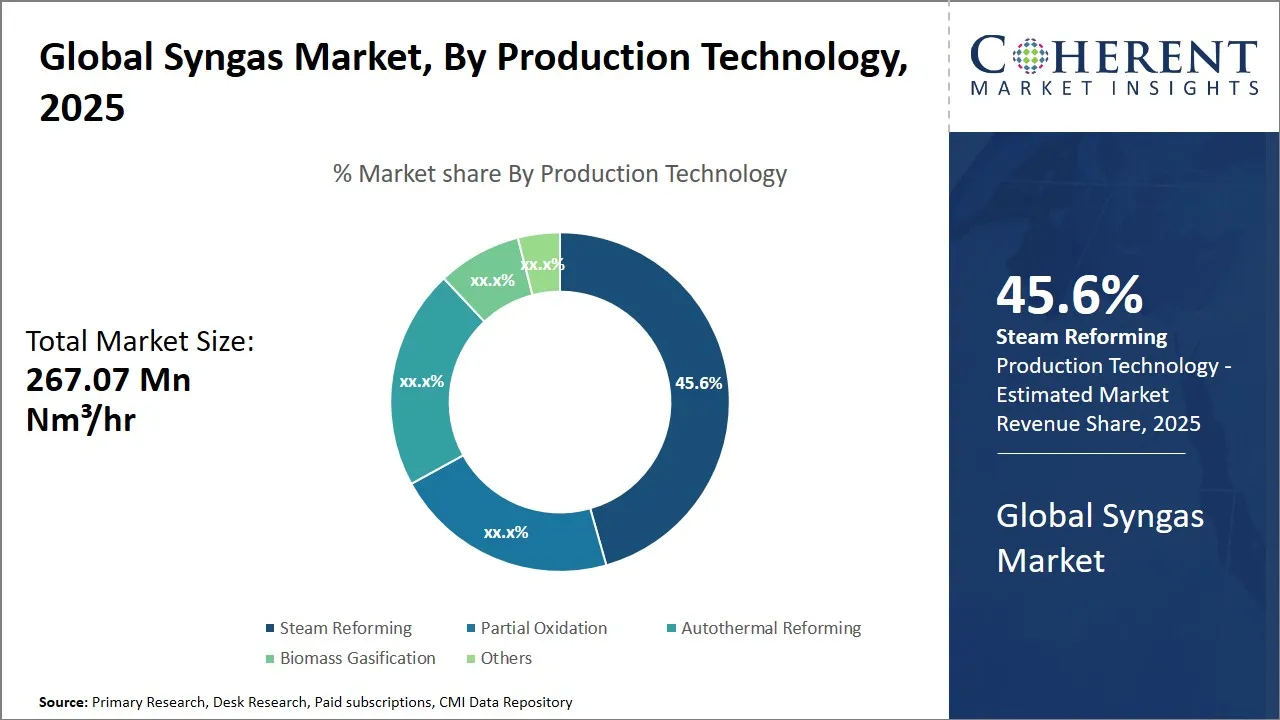
Syngas Market Insights, By Production Technology - Steam Reforming Segment Dominates the Market Due to Process Efficiency and Versatility
The Steam Reforming segment is expected to hold 46.6% share in the global syngas market in 2026, owing to its highly developed process efficiency and flexibility in any industrial application. Steam reforming is a process of reacting hydrocarbons, usually light hydrocarbons or natural gas, with steam to generate syngas that consists mainly of carbon monoxide and hydrogen. Its predominance lies in its technological maturity, extensive commercial application, and capacity for producing highly pure hydrogen-rich syngas, and for this reason it is most appealing for downstream refining and chemical synthesis processes.
A specific example is Shell's hydrogen plant located in Singapore, which is one of the world's largest hydrogen plants. In the operation of this industrial facility, steam reforming is used to convert natural gas to syngas and, subsequently, to high-purity hydrogen for use in their refining operations. This example demonstrates the ability of steam reforming, and industrial gas generation technologies, to add value, improve efficiency, and provide flexible operations in industrial processes across many sectors.
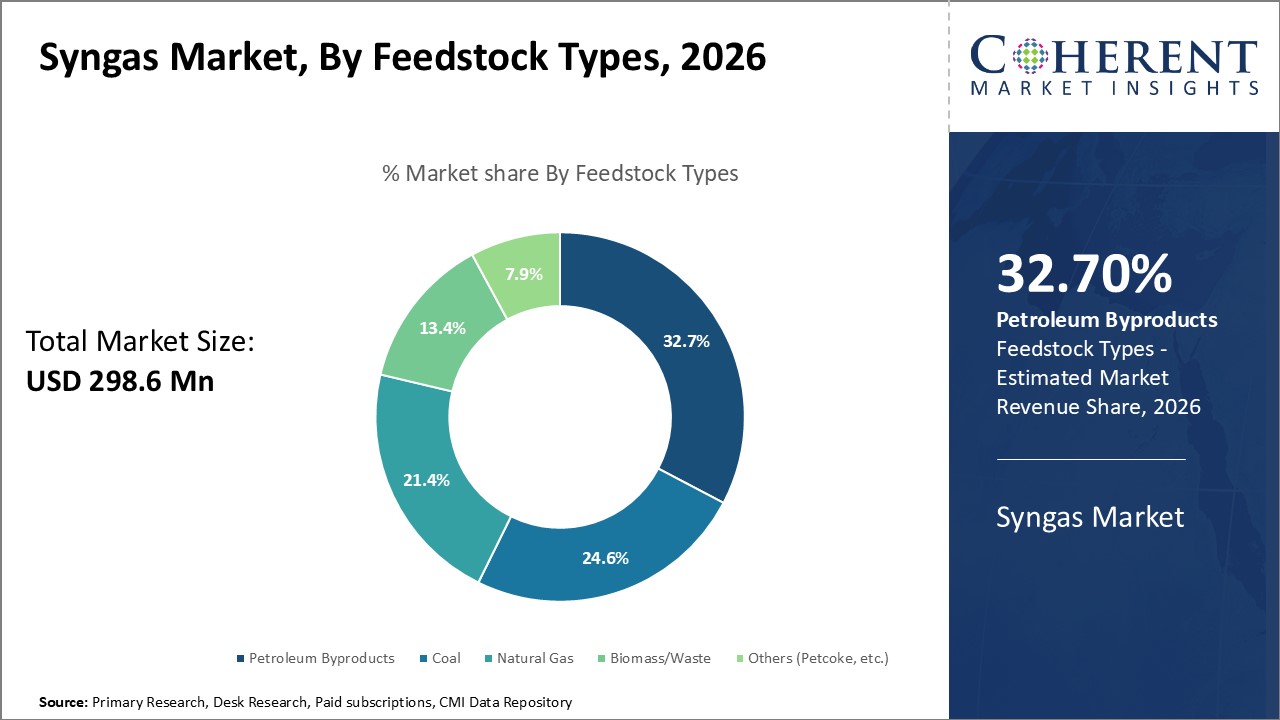
Syngas Market Insights, By Feedstock Types - Petroleum Byproducts Leads the Market Due to Abundance and Refinery Integration
The Petroleum Byproducts segment is expected to capture 32.7% share in 2026. This is mainly because petroleum refining creates various byproducts like refinery off-gases, heavy residues, and other hydrocarbon streams, which are best suited to be converted to syngas. Availability of these feedstocks at ready-made refineries makes it easy for efficient use, reducing transportation and raw material expenses, which further supports their leading role in feedstock consumption.
Petroleum byproducts have high hydrocarbon content and are therefore highly suited to gasification and reforming reactions to yield syngas effectively. Refineries often recycle these byproducts to produce useful syngas, which is in turn utilized as a feedstock for the manufacture of synthetic fuels, chemicals, and hydrogen, maximizing total refinery economics and maximizing use of resources. Besides, being part of refinery complexes, syngas production can be optimized more effectively and wastestreams utilized more efficiently, adhering to economic and environmental considerations.
Syngas Market Insights, By Gasifier Types - Fixed Bed Gasifiers Segment Dominates the Market Due to Simplicity and Flexibility in Feedstock Use
The Fixed bed gasifiers segment is projected to hold 24.7% of the market share in 2026, due mostly to simplicity of operation, feedstock process versatility, and being cost-effective. Fixed bed gasifiers, or moving bed gasifiers, work by passing the feedstock slowly through a fixed bed where it is partially oxidized to produce syngas. They are designed to gasify a broad variety of solid feedstocks, especially biomass and lower rank coals, which tend to be problematic to process with more advanced types of gasifiers.
Among the factors promoting the uptake of fixed bed gasifiers is the technology's reliability across different feedstock conditions. Fixed bed gasifiers can accommodate heterogeneous and variable-quality feed inputs with minimal losses in performance, rendering them ideal in areas where feedstock uniformity cannot be assured. Fixed bed gasifiers are thus widely used in biomass-dense and coal-dense geographies looking to capitalize on local resources into syngas for electricity generation or chemical production.
Regional Insights
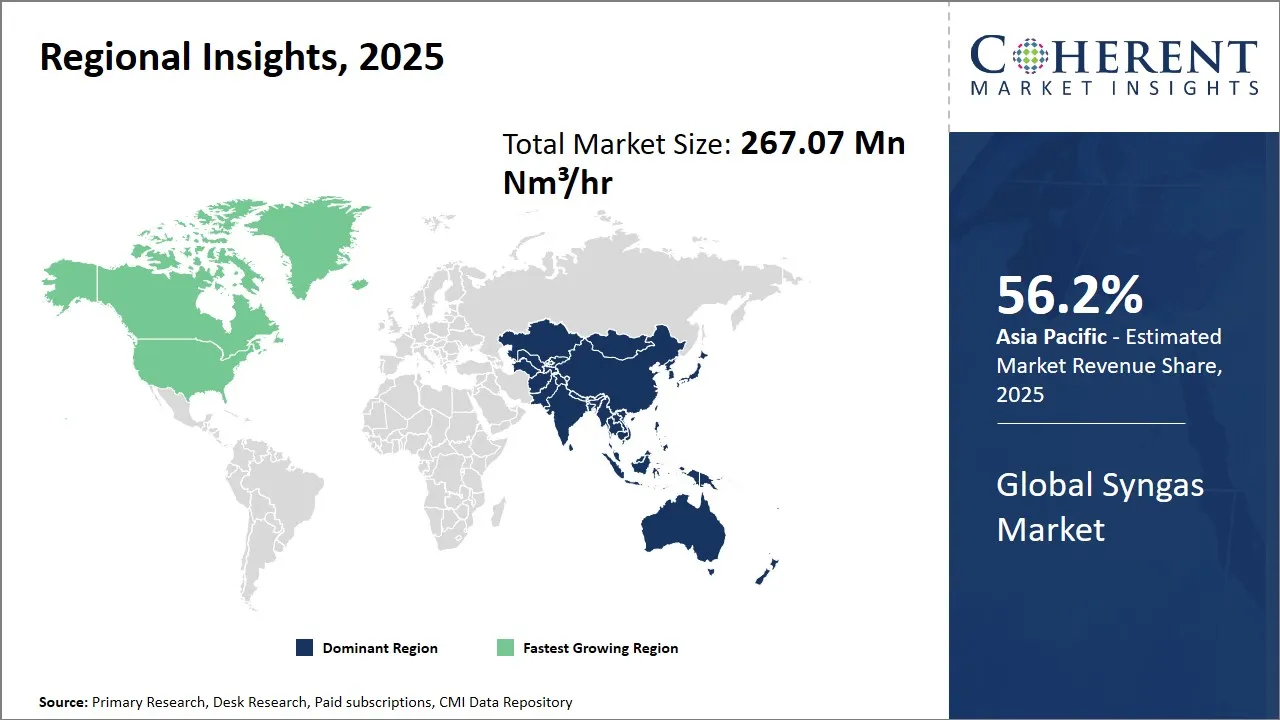
Asia Pacific Syngas Market Analysis and Trends
The Asia Pacific region is projected to lead the market with a 56.2% share in 2026, led by high industrialization growth, rising demand for cleaner fuel substitutes, and government policies for curbing air pollution. Governments and industries in these nations, such as China and India, are rapidly scaling up their chemical production, steel-making, and natural gas treatment industries where syngas is an important intermediate.
Government policies supporting energy shift and investment in gasification projects are fueling adoption. Also, the significant number of indigenous and multinational energy firms, such as Linde Group, Mitsubishi Heavy Industries, and Tata Steel, is driving technology development and capacity expansion, facilitating rapid market penetration.
North America Syngas Market Analysis and Trends
The North America region is expected to exhibit the fastest growth in the market contributing 22.5% share in 2026, on account of the presence of a highly developed industrial infrastructure coupled with superior technological capabilities. The mature chemical, energy, and refining industries in the region form a strong ecosystem that widely uses syngas as a feedstock to manufacture chemicals, fuels, and power. Well-supported by governments through policies that support cleaner energy technologies and carbon management, this market's position is further consolidated. In addition, North America's emphasis on developing sustainable fuel production—particularly through coal gasification and biomass conversion technologies—is driving ongoing innovation. Major players like Air Liquide, Air Products and Chemicals, and Shell are heavily invested in it with considerable R&D and industrial capacity additions that affirm the region's leadership status.
Syngas Market Outlook for Key Countries
U.S. Syngas Market Analysis and Trends
The syngas market in the U.S. is well established, with a well-developed infrastructure for technological advances and active syngas leaders such as Air Products and Chemicals and Air Liquide. The regulatory landscape in the country encourages Carbon Capture and Utilization (CCU) and other cleaner fuel initiatives tailored for syngas-based applications, particularly in chemicals and power generation. Investment is also rolling into innovative projects using renewable feedstock gasification processes that will diversify syngas applications and spark new investment.
China Syngas Market Analysis and Trends
The syngas market in China is growing rapidly as a result of heavy industrial demand and national policies aimed at reducing coal consumption by implementing the syngas technologies in power and chemical production. Key syngas players such as Sinopec and CNPC are currently moving ahead to implement large-scale gasification facilities in order to source new energy types. Continued government support along with urbanization and energy demand is escalating investments in syngas production.
Germany Syngas Market Analysis and Trends
Germany's position as a leader in the Europe syngas market is sustained by a concerted effort to advancement energy-related industrial processes or by supporting the development and implementation of biomass gasification processes. The syngas market in Germany is benefitting from favorable regulations on development, including national efforts and the support of the European Green Deal. Major firms in the syngas space like Linde and Siemens Energy are further growing the syngas market by offering advanced technologies to generate syngas and cleaning solutions in the industrial and power sectors.
India Syngas Market Analysis and Trends
India syngas industry is experiencing rapid growth because of increasing production of chemicals and fertilizers, in addition to increased interest in alternative, cleaner fuel sources. The Indian government continues to promote stronger energy independence and improve pollution reduction efforts through increased adoption of gasification projects. Major corporations such as Tata Steel and Indian Oil Corporation are working to continue technology development that should result in syngas meeting the forecasted increase in demand for industrial fuels in India.
Saudi Arabia Syngas Market Trends Analysis and
The Saudi Arabian syngas market benefits from availability of hydrocarbon-based feedstocks in addition to the Saudi Arabian government’s roadmap to diversify energy away from reliance on crude oil. Significant players in syngas development, such as SABIC and the Saudi Aramco, have advanced syngas based petrochemical development and power generation. Saudi Arabia’s government policies, particularly the focus on modernization of business and partnerships with international businesses, have led to significant growth in syngas incentives and demand and will position the country as a regional leader in the development of syngas technologies.
Macro and Micro Economic Factors Impacting on Syngas Market Growth
Macroeconomic Factors
- Rapidly increasing industrialization, particularly in Asia Pacific, is a macro driver, which is contributing to more demand for chemicals, fuels, and electricity.
- Global Sustainability Commitments - regulatory policies that support carbon reduction and renewable energy integration are increasing investments in cleaner methods to produce.
- Policy changes such as the U.S. Bipartisan Infrastructure Law and Inflation Reduction Act are facilitating decarbonization and expansion in the power sector, increasing syngas’s opportunities for energy and transportation.
- Geopolitical uncertainties – tariffs and trade restrictions – can complicate sourcing feedstocks and transferring technologies for production, impacting costs and supply chain stability.
Microeconomic Factors
- Chemical sector demand for methanol and ammonia remains a primary microeconomic driver influenced by downstream expansions in fertilizers and plastics.
- Syngas's versatility for fuel, power generation, and chemical synthesis allows companies to diversify their product offerings and enter new market segments.
- Technological advancement: Advancements in gasification, carbon capture, and utilization/storage (CCUS) technologies improve energy efficiencies and sustainability metrics which, in turn, improve the return on investment for companies operating in the space.
Market Players, Key Development, and Competitive Intelligence
Key Developments
- In February 2025, HYCO1 Inc. celebrated Break Ground as the Syngas technology provider for UBE Corporation's new EV electrolyte plant in New Orleans.
- In November 2023, Charwood Energy collaborated with Verallia Group to build a greenfield facility to produce syngas using pyrogasification of biomass, helping the firm capture market share in the syngas market.
Top Strategies Followed by Global Syngas Market Players
- Established players in the marketplace generally spend a lot of money on R&D to promote innovation in high-performance syngas products. Their strong R&D efforts allow them to improve product efficiencies, create environmental-friendly solutions, and customize products to address increasingly higher industry standards. To become more global players, established companies also concentrate on building their distribution channels, especially focusing on markets that are emerging and where industrial expansion drives growth in demand for syngas applications.
- For example, Air Products and Chemicals Inc. spend a lot of money on R&D to improve the performance of its syngas products, emphasizing cleaner and more efficient offerings that comply with global environmental standards.
- Mid-tier players in the syngas industry pursue a slightly different strategy, focusing on providing affordable alternatives that balance quality and price. Mid-tier firms are mostly targeted toward price-conscious buyers who need reliable syngas products at prices less than the high-end prices of popular brands. By emphasizing maximizing manufacturing efficiency and raw material expenses, mid-tier players are able to provide competitive prices while still achieving sufficient product performance.
- For example, Praxair (now Linde) provides low-cost syngas technologies to those markets where cost is a major consideration. These firms target mainly price-sensitive customers such as small-scale industrial complexes and utilities that need to obtain reliable but low-cost syngas for their processes.
- Small-scale operators in the international syngas industry fill niche niches by focusing on specialized attributes or novel product designs that establish them apart from major companies. These companies tend to adopt leading-edge technology such as digital monitoring systems, high-performance catalysts, or modular reactor configurations to stay competitive despite financial constraints. By targeting niche applications or delivering highly tailored syngas solutions, small operators serve specialized customer needs that larger companies might not address.
Market Report Scope
Syngas Market Report Coverage
| Report Coverage | Details | ||
|---|---|---|---|
| Base Year: | 2025 | Market Size in 2026: | 298.6 Mn Nm3/hr |
| Historical Data for: | 2020 To 2024 | Forecast Period: | 2026 To 2033 |
| Forecast Period 2026 to 2033 CAGR: | 11.8% | 2033 Value Projection: | 651.9 Mn Nm3/hr |
| Geographies covered: |
| ||
| Segments covered: |
| ||
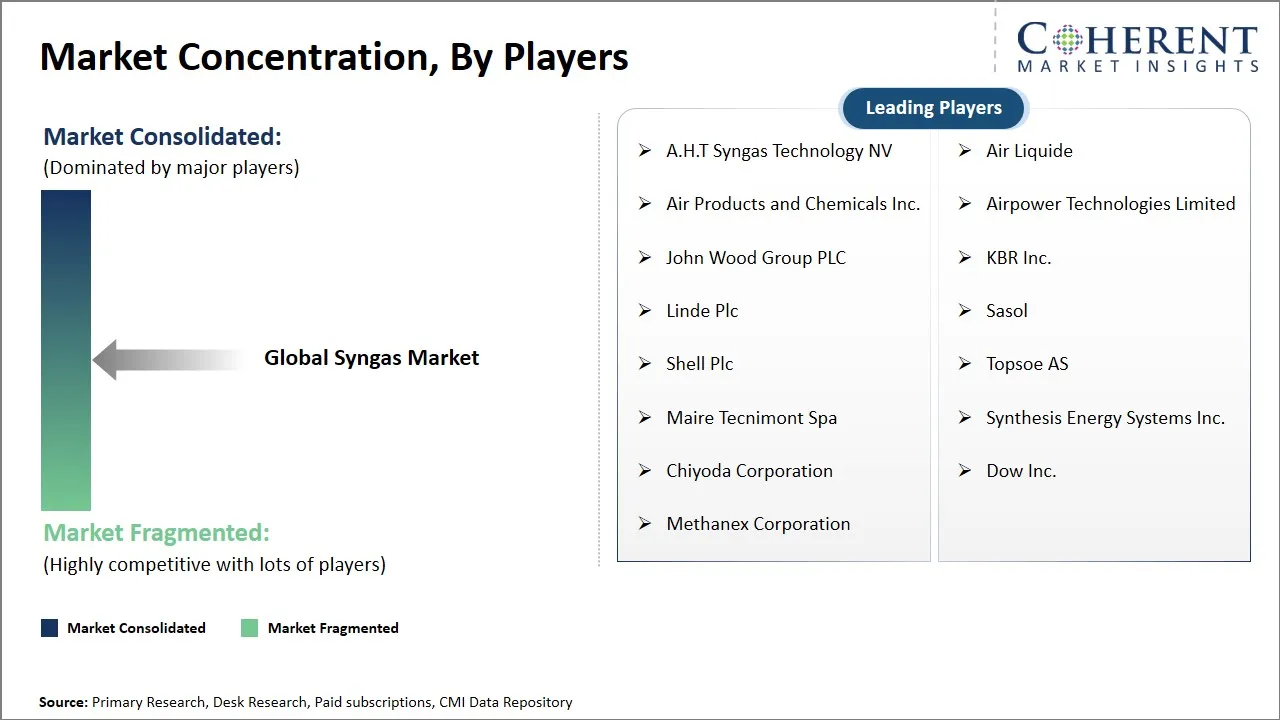
| Companies covered: | A.H.T Syngas Technology NV, Air Liquide, Air Products and Chemicals Inc., Airpower Technologies Limited, John Wood Group PLC, KBR Inc., Linde Plc, Sasol, Shell Plc, Topsoe AS, Maire Tecnimont Spa, Synthesis Energy Systems Inc., Chiyoda Corporation, Dow Inc., and Methanex Corporation | ||
| Growth Drivers: |
| ||
| Restraints & Challenges: |
| ||
Syngas Market Dynamics
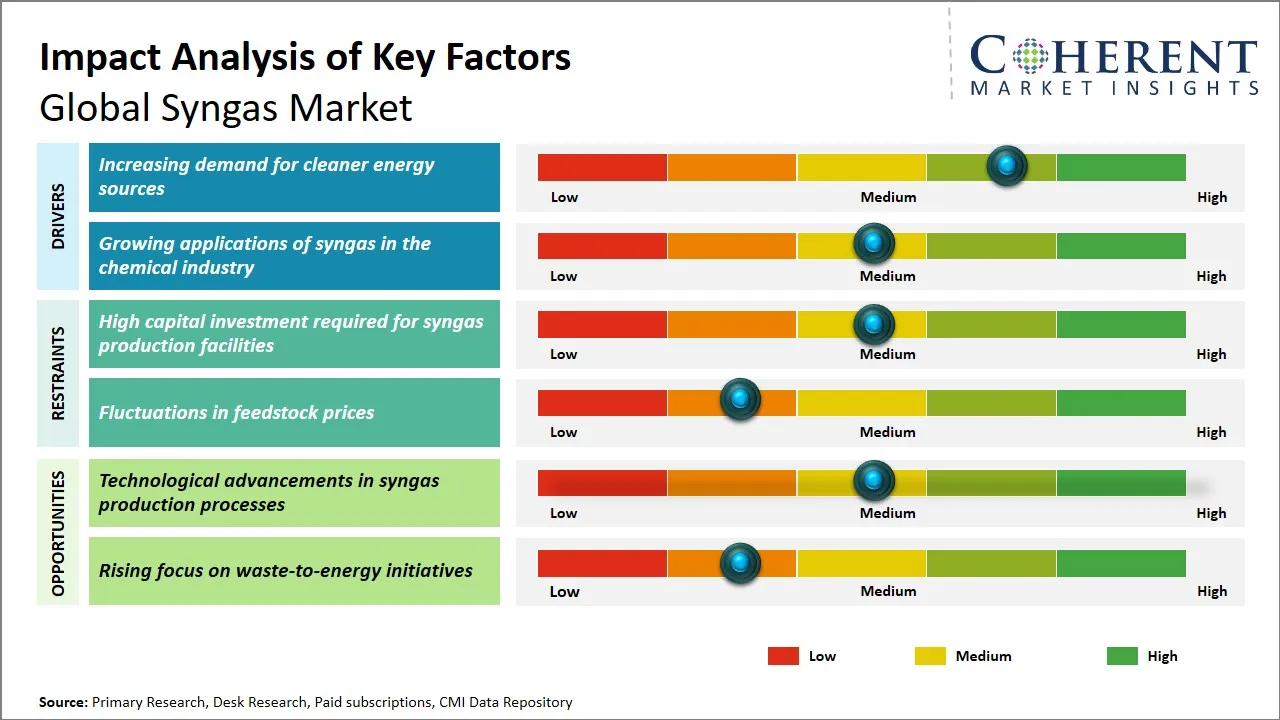
Syngas Market Driver - Increasing Demand for Cleaner Energy Sources
The increasing worldwide focus on lowering carbon footprints and moving towards cleaner energy options has driven the use of syngas as a cleaner fuel source considerably. Syngas, a mixture of hydrogen and carbon monoxide, is a multi-purpose intermediate used to generate electricity, fuels, and lower-emission chemicals compared to conventional fossil fuels. Governments and industries across the globe are increasingly implementing strict environment regulations and making investments in green energy infrastructure, which in turn drives syngas technologies further.
For example, Air Products has joined hands with North American and European partners to develop syngas production through large-scale gasification plants that transform non-recyclable waste into syngas, which is utilized to produce electricity as well as sustainable chemicals.
Syngas Market Opportunity - Technological Advancements in Syngas Production Processes
The global syngas market is poised to gain substantially from continued technological improvements in the production processes for syngas, which are a significant opportunity for growth. Technologies like improved gasification technologies, including plasma gasification and catalytic reforming, are improving the environmental friendliness and efficiency of syngas production. Such technologies are facilitating the processing of a wider variety of feedstocks, such as biomass, coal, renewable natural gas, and wastes, to high-purity syngas with lower carbon footprints and lower operating costs.
For instance, Westinghouse Plasma and Plasma Arc Technology firms have led the development of utilizing high-temperature plasma arcs to transform waste materials, such as municipal solid waste and biomass, to syngas.
Analyst Opinion (Expert Opinion)
- The Global Syngas Technologies Conference (2023) and International Energy Agency Workshop (2022) provided insights that highlighted the importance of syngas as a multiform energy carrier. Firms such as Linde and Air Products are at the forefront in the development of gasification technology, with Linde's recent initiative in gasifying agriculture waste into syngas being an epitome of green energy innovation.
- These conferences featured discussions on the importance of syngas in the production of hydrogen, making it a pillar in upcoming energy systems. The high capital expenditure and requirement of regulatory incentives were among the common challenges identified as impediments towards wider use.
- Companies that focus on collaborations with the government and research to optimize efficiency will be successful. Moreover, carbon capture technologies' integration can make syngas more attractive as a low-carbon option. Finally, the growth of the syngas market will rest on whether it can innovate and meet environmental issues and align with world energy transition targets.
Speak to the analyst
Want personalized insights?
Take the findings above to one of our principal consultants, or have the report rebuilt around the segments, geographies and competitors you actually track.
Market Segmentation
- Production Technology Insights (Revenue, Mn Nm³/hr, 2021 - 2033)
- Steam Reforming
- Partial Oxidation
- Autothermal Reforming
- Biomass Gasification
- Others
- Feedstock Insights (Revenue, Mn Nm³/hr, 2021 - 2033)
- Petroleum Byproducts
- Coal
- Natural Gas
- Biomass/ Waste
- Others (Petcoke, etc.)
- Gasifier Type Insights (Revenue, Mn Nm³/hr, 2021 - 2033)
- Fixed Bed
- Entrained Flow
- Fluidized Bed
- Others (Plasma Arc and Black Liquor)
- Application Insights (Revenue, Mn Nm³/hr, 2021 - 2033)
- Chemicals
- Methanol
- Ammonia
- FT Synthesis Products
- Fuels
- Liquid
- Gaseous
- Power Generation
- Chemicals
- Regional Insights (Revenue, Mn Nm³/hr, 2021 - 2033)
- North America
- U.S.
- Canada
- Latin America
- Brazil
- Argentina
- Mexico
- Rest of Latin America
- Europe
- Germany
- U.K.
- Spain
- France
- Italy
- Russia
- Rest of Europe
- Asia Pacific
- China
- India
- Japan
- Australia
- South Korea
- ASEAN
- Rest of Asia Pacific
- Middle East
- GCC Countries
- Israel
- Rest of Middle East
- Africa
- South Africa
- North Africa
- Central Africa
- North America
- Key Players Insights
- H.T Syngas Technology NV
- Air Liquide
- Air Products and Chemicals Inc.
- Airpower Technologies Limited
- John Wood Group PLC
- KBR Inc.
- Linde Plc
- Sasol
- Shell Plc
- Topsoe AS
- Maire Tecnimont Spa
- Synthesis Energy Systems Inc.
- Chiyoda Corporation
- Dow Inc.
- Methanex Corporation
Sources
Primary Research Interviews
- Plant Manager – Leading Syngas Production Facility
- R&D Head – Global Gasification Technology Developer
- Procurement Director – Major Syngas-Fueled Chemicals Manufacturer
- Energy Projects Manager – Integrated Energy Company (with syngas operations)
- Sustainability Lead – Clean Energy Certification Agency
Stakeholders
- Manufacturers: Syngas producers, technology licensors, EPC firms
- End-use Sectors
- Ammonia & Urea Manufacturers
- Methanol Production Facilities
- Fischer-Tropsch Fuels Producers
- Hydrogen Production Plants
- Power Generation (Gas Turbines, IGCC plants)
- Utility & Energy Majors (gasification-based projects)
- Regulatory & Certification Bodies (environmental and fuel quality)
- EPC Contractors and Project Developers
Databases
- UN Comtrade Database
- IEA (International Energy Agency) Syngas Data & Statistics
- BP Statistical Review of World Energy
- US DOE Energy Information Administration (EIA)
Magazines
- Hydrocarbon Processing – Updates on syngas and reforming projects
- Gasworld – Technology and applications in industrial gases and syngas
- Chemical Engineering Magazine – Global syngas plant news
- Syngas Magazine – Industry trends and innovations
- Fertilizer International – Syngas usage in ammonia/urea sectors
Journals
- International Journal of Hydrogen Energy – Syngas to hydrogen research
- Fuel Processing Technology – Technological advances in syngas production
- Journal of Cleaner Production – Sustainable syngas production
- Energy & Fuels – Gasification processes and syngas valorization
- Biomass & Bioenergy – Syngas from renewable sources
Newspapers
- The Financial Times – Syngas project investments and market growth
- The Wall Street Journal – M&A and financial news in syngas sector
- China Daily – Expansion of syngas in chemicals and power in APAC
- Business Standard (India) – Regional syngas and coal gasification updates
- The Guardian – Environmental impact and policy on syngas projects
Associations
- Gasification and Syngas Technologies Council (GSTC)
- World Biogas Association (for renewable syngas)
- International Energy Agency (IEA) Gas & Clean Energy Program
- American Institute of Chemical Engineers (AIChE) – Syngas Technology Forum
- European Syngas Association
- Clean Energy Council
Public Domain Sources
- US Department of Energy (DOE) – Gasification and syngas technology reviews
- European Commission – Industrial emissions and BAT (Best Available Techniques) for syngas
- World Bank – Reports on clean energy, gasification, and industrial fuel switching
- OECD – Environmental standards and syngas project assessments
- International Syngas Association – Market and technical documentation
Proprietary Elements
- CMI Data Analytics Tool, Proprietary CMI Existing Repository of information for last 8 years.
Get access to 250+ pages report
Every segment, forecast, competitor profile and data table behind the analysis above — available for instant download.
- ESOMAR Member
- ISO 9001:2015 Certified
- D-U-N-S Registered
- GDPR & CCPA Compliant
Missing comfort of reading report in your local language? Find your preferred language:
Transform your Strategy with Exclusive Trending Reports
Frequently Asked Questions
The global syngas market demand is estimated to be at 298.6 Mn Nm3/hr in 2026 and is expected to reach 651.9 Mn Nm3/hr by 2033.
The CAGR of the global syngas market is projected to be 11.8% from 2026 to 2033.
Increasing demand for cleaner energy sources and growing applications of syngas in the chemical industry are the major factors driving the growth of the global syngas market.
High capital investment required for syngas production facilities and fluctuations in feedstock prices are the major factors hampering the growth of the global syngas market.
In terms of production technology, the steam reforming is estimated to dominate the market revenue share in 2026.
A.H.T Syngas Technology NV, Air Liquide, Air Products and Chemicals Inc., Airpower Technologies Limited, John Wood Group PLC, KBR Inc., Linde Plc, Sasol, Shell Plc, Topsoe AS, Maire Tecnimont Spa, Synthesis Energy Systems Inc., Chiyoda Corporation, Dow Inc., and Methanex Corporation are the major players.
Asia Pacific is expected to lead the global syngas market in 2026.