

Global Thermochemical Energy Storage Market Size and Forecast – 2026-2033
According to Coherent Market Insights, the global thermochemical energy storage market is estimated to be valued at USD 5.76 Bn in 2026 and is expected to reach USD 10.07 Bn by 2033, exhibiting a compound annual growth rate (CAGR) of 8.3% from 2026 to 2033.
Key Takeaways of the Thermochemical Energy Storage Market
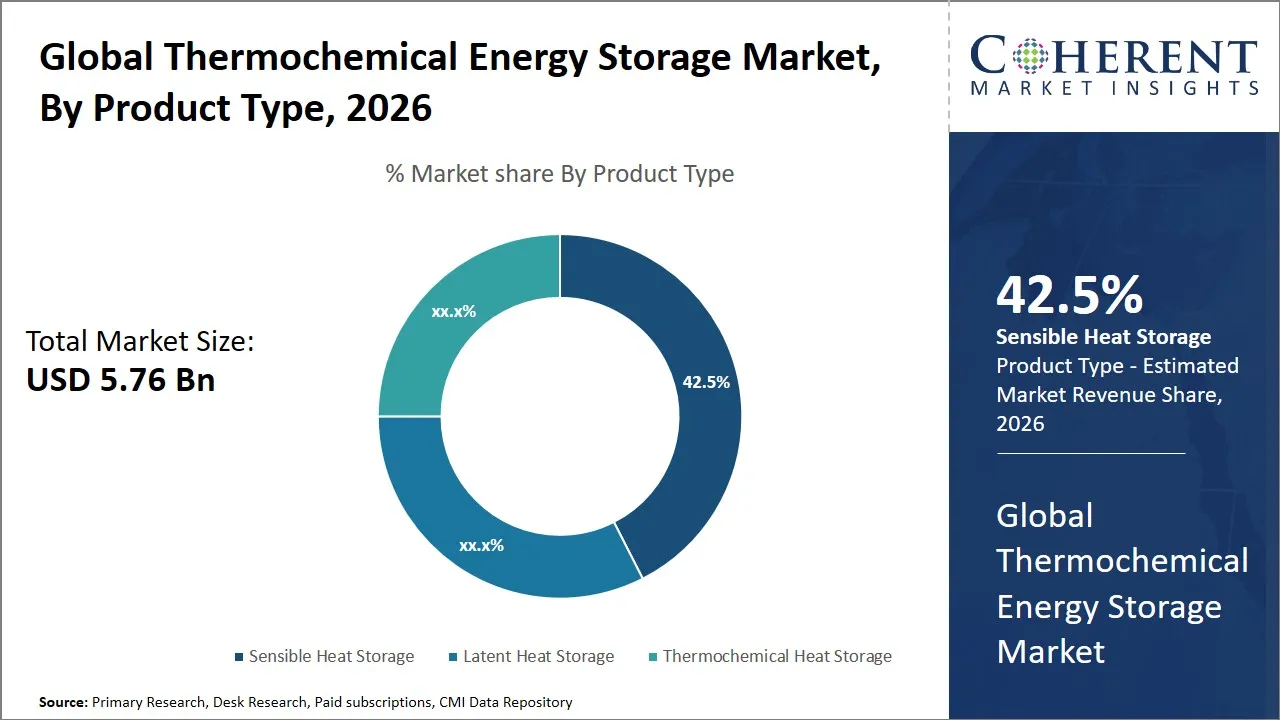
- The sensible heat storage segment is projected to account for 42.5 % of the thermochemical energy storage market share in 2026.
- Molten salt technology segment is expected to capture 37.9 % of the market share in 2026.
- The molten salt segment is projected to hold 42.7 % of the global thermochemical energy storage market share in 2026.
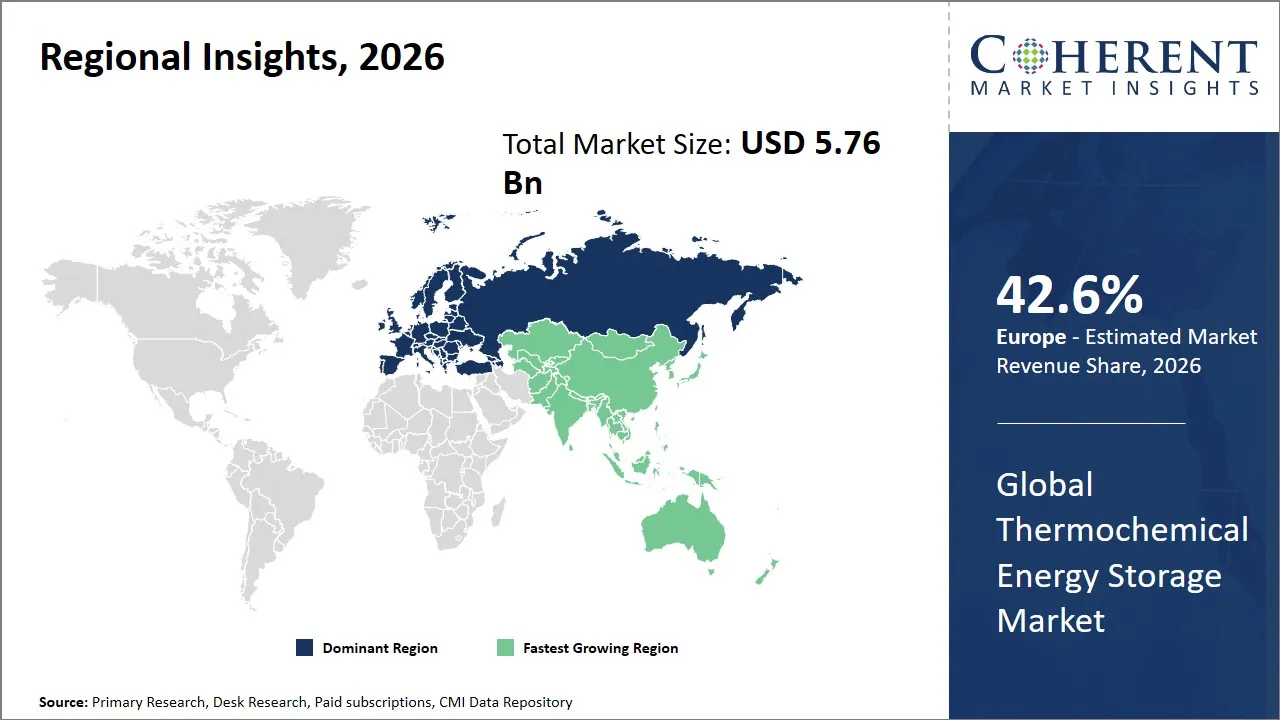
- The Europe region is expected to dominate the market with a 42.6 % share in 2026.
- The Asia Pacific region is anticipated to show the fastest growth in the market, capturing 21.3 % share in 2026.
Market Overview
- A key trend driving the thermochemical energy storage market is the growing focus on long-duration energy storage systems that offer higher energy density and longer discharge times compared to conventional batteries.
- Additionally, advancements in material science and scalable storage reactors are enabling more cost-effective and efficient energy capture and release, making thermochemical energy storage system an attractive option for both industrial and residential applications.
- Increasing governmental incentives and global efforts toward carbon neutrality further bolster market adoption and technology innovation.
Current Events and Its Impact
Current Events | Description and its impact |
Industrial Demonstrator Completion — MGA Thermal in Australia |
|
Broader Thermal Energy Storage Market Expansion |
|
Segmental Insights
- Current Industry Events of 2026
- Market Size Estimation
- Regional Breakdown
- Competitive Landscape
- Customer Intelligence
- Segmental Analysis
- Pricing Analysis
- Key Market Drivers, Challenges & Future Trends
- Customized Insights Section
Why Does the Sensible Heat Storage Segment Dominate the Thermochemical Energy Storage Market in 2026?
Sensible heat storage segment is expected to hold 42.5% of the market share in 2026, due to its cost efficiency and technological maturity. Sensible heat storage The sensible storage of heat is the storage of thermal energy in the form of elevated temperature of a solid or liquid substance, e.g. water, rocks, molten salts. The advantage of this approach is that materials and mechanisms required are simple and, as such, cost less to start-up and can be integrated with existing thermal systems more easily than more complicated ones such as latent or thermochemical heat storage.
For instance, molten salt-based storage systems are commonly used in concentrated solar power (CSP) plants, offering a reliable and low-cost solution for storing solar energy and ensuring energy availability even when sunlight is not available.
Is Molten Salt Technology Revolutionizing the Thermochemical Energy Storage Market?
Molten salt technology is projected to command 37.9% of the thermochemical energy storage market share in 2026. This is heightened by the fact that molten salts are highly thermal stable and have high heat capacity and thus they are the best suited in the capturing and storage of large volumes of the energy at higher temperature. The fact that molten salts are able to work at temperatures between 200C and 600C means that the molten salts can be successfully used in concentrated solar power (Cd) solar plants and energy storage in industries.
The thermal characteristics of molten salts allow it to hold heat over long durations with very little decay, hence overcoming intermittency issues that come with the renewable sources of energy, especially the solar power. Molten salt plants can store excessive thermal energy that is produced during peak generating spells, thus providing a constant energy supply, making the grid more reliable and enabling renewables to be more easily incorporated into the energy mix.
Molten Salt Segment Leads Storage Material Segment Because of Superior Thermal Characteristics and Cost-effectiveness
Molten salt segment is expected to hold 42.7% of global thermochemical energy storage market share in 2026. Molten salt materials are the thermal energy storage and transfer medium which has its benefits in terms of the high heat storage capacity and thermal conductivity. This is because these properties enable the molten salt to take up and give up large quantities of heat efficiently hence it is a great thermal energy storage material both in the short and long term.
The economic benefit of molten salt materials is due to its high availability and relatively inexpensive cost of production as opposed to the use of specialized phase change material (PCM) or other sophisticated compounds. This low cost does not affect performance since molten salts can maintain a cycle of thermal operation without serious loss in form of chemical degradation compared to other materials which are important in ensuring the operational continuity over a period of years.
Regional Insights
Europe Thermochemical Energy Storage Market Analysis and Trends
The Europe region is projected to lead the market with a 42.6% share in 2026, due to the high dedication by the regions toward the integration of renewable energy and the reduction of carbon emission. The strict environmental policies by the European Unions and their favorable government policies, including the European Green Deal and Horizon Europe funding programs have greatly contributed to research and investments in the development of advanced energy storage systems like thermochemical systems.
For example, “SolarTherm" project in Germany integrates thermochemical energy storage systems with solar power plants, allowing for long-duration storage and on-demand electricity generation. This project showcases Europe’s leadership in combining renewable energy technologies with advanced storage solutions, driving the market’s growth.
Asia Pacific Thermochemical Energy Storage Market Analysis and Trends
The Asia Pacific region is expected to exhibit the fastest growth in the market contributing 21.3% share in 2026, due to accelerating industrialization, rapid electrification, and strong government initiatives targeting renewable energy adoption. Some of the countries such as China, Japan and South Korea are already spending a lot on clean energy infrastructure and are also working towards diversification of energy storage facilities other than the usual batteries as a way of resolving grid stability challenges.
Some of the factors of growth may include favorable trade policies, expansion in the number of joint ventures between local start-ups and multinational corporations as well as large scale application in power generating and industrial heating industries.
Moreover, cheap production capacity and the increased environmental issues also contribute to the rapid growth of the regions. The major industry participants, including Toshiba (Japan), Shanghai Electric (China) and Hanwha Energy (South Korea) are leading the way in innovative thermochemical storage technologies and scale-up efforts to satisfy the growing energy needs in a sustainable manner.
Thermochemical Energy Storage Market Outlook for Key Countries
Is Germany Leading the Charge in the Thermochemical Energy Storage Market?
Germany’s thermochemical energy storage market leads due to its early adoption of renewable energy and energy transition policies (Energiewende). German firms such as BASF are on the leading hand in the development of high efficiency thermochemical storage materials and systems to improve their energy density and extend their cycle life. It has a large network of research institutions, Fraunhofer institutes and Helmholtz association, that can unlock technology breakthrough and pilot installations. Powerful state subsidies and established clean technology ecosystems can allow Germany to continue playing a central position in developing thermochemical energy storage to be used in residential, commercial, and industrial applications.
China Thermochemical Energy Storage Market Trends
The development of the thermochemical energy storage market in China is based on the high goals of the Chinese government on the integration of renewables and the intentions of the governments to achieve carbon neutrality by 2060. The nation is interested in implementing the large-scale thermochemical units to power plants and industrial process heat with the assistance of the energy storage-related policies.
Large corporations like Shanghai Electric and State grid corporation are putting their money in research and development and big scale demonstrations. The large production power of Chinas contributes to the reduction of prices and improvement of technological access, thereby becoming one of the main centers of the region in terms of mass commercialization of thermochemical storage.
U.S. Thermochemical Energy Storage Market Trends
The U.S. continues to lead in technological innovation and pilot commercialization of thermochemical energy storage, backed by significant investments from both private and public sectors including the Department of Energy. The American firm 8tree Technologies and NET Power are developing advanced thermochemical cycles and materials that are optimized to stabilize the grids and store industrial heat. The U.S. is enjoying a rich market-ecosystem with dynamic partnership in laboratories, startups, and utilities nationwide and enabling state-level policies supporting energy innovation and decarbonization.
Is Japan Poised for Innovation in the Thermochemical Energy Storage Market?
The market of thermochemical energy storage in Japan is described by a strong emphasis on the system of combining thermochemical storage and the current energy system to enhance its efficiency and reliability with the government supporting this process in its Strategic Energy Plan. Such companies as Toshiba and Mitsubishi Heavy Industries use high-technology materials science and engineering, to construct small, efficient thermochemical storage devices that are able to be installed in residential and commercial buildings. The focus of the Japanese on the principles of the circular economy and energy self-sufficiency also contributes to the growth of innovation and adoption of this sphere.
Netherlands Thermochemical Energy Storage Market Trends
The thermochemical energy storage market is expanding well because of high government policies on the sustainability of energy solutions as well as its strategic location as a center of trade in energy in Europe. The Dutch firms of Climeworks and TNO play a leading role in the development of solutions that integrate thermochemical storage with carbon capture and utilization, developing integrated systems that are more efficient in energy and reduce carbon. The joint industrial environment and good regulatory environment in the country contribute to continuous pilot projects and sharing of knowledge in order to promote quicker market penetration.
Material Degradation & Recyclability Risk
Material | Degradation Risk (%) | Recyclability Risk (%) | Cost per Cycle (USD) |
Sodium Nitrate (NaNO₃) | 20% | 80% | 0.05 |
Magnesium Silicate | 25% | 90% | 0.07 |
Calcium Oxide (CaO) | 18% | 70% | 0.06 |
Market Players, Key Development, and Competitive Intelligence
Key Developments
- In August 2025, SGS launched the first AI-powered automated system for thermal runaway testing designed for energy storage batteries. The solution was developed with Chongqing Energy College (CEC) to help with fire safety concerns with the fast global growth of battery energy storage systems (BESS) at commercial, industrial, and residential levels.
- In July 2025, Echogen Power Systems shared that its strategic partner, Westinghouse Electric Company, officially signed a MoU (Memorandum of Understanding) with Vodohospodárska Výstavba (VVB). Together, they are gearing up toward the development of Europe’s very first grid-scale PTES (pumped thermal energy storage) system in Slovakia.
- In April 2025, MGA Thermal Pty Ltd declared the completion of the world's first industrial steam-heat energy storage demonstration project. The demonstration project, operated by MGA Thermal's ETES, stored 5 MWh of energy at a rated thermal power dispatch of 500 kW, delivering continuous thermal superheated steam for 24 hours.
Top Strategies Followed by Global Thermochemical Energy Storage Market Players
Player Type | Strategic Focus | Example |
Established Market Leaders | Heavy investment in R&D and innovation | Quidnet Energy is a leading player that is involved in utilization of underground reservoirs to store energy as long-duration stores to facilitate high energy density storage solutions. It continuously develops better and more sustainable ways of storing energy using pumped hydro technology in a more cost effective way. |
Mid-Level Players | Cost-effective solutions with balanced quality | Energy Vault has established a special energy storage technology based on the use of gravity to store energy. This system is affordable and easily installation thus appealing to markets that need affordable energy storage systems yet they are also in need of solid performance. |
Small-Scale Players | Niche specialization & innovative variants | SaltX Technology is developing a series of high-technology salt-based thermochemical storage units to the residential and small business market. Their systems are made to store thermal energy in the form of compactness, which is localized and efficient solution to energy storage. |
Market Report Scope
Thermochemical Energy Storage Market Report Coverage
| Report Coverage | Details | ||
|---|---|---|---|
| Base Year: | 2025 | Market Size in 2026: | USD 5.76 Bn |
| Historical Data for: | 2020 To 2024 | Forecast Period: | 2026 To 2033 |
| Forecast Period 2026 to 2033 CAGR: | 8.3% | 2033 Value Projection: | USD 10.07 Bn |
| Geographies covered: |
| ||
| Segments covered: |
| ||
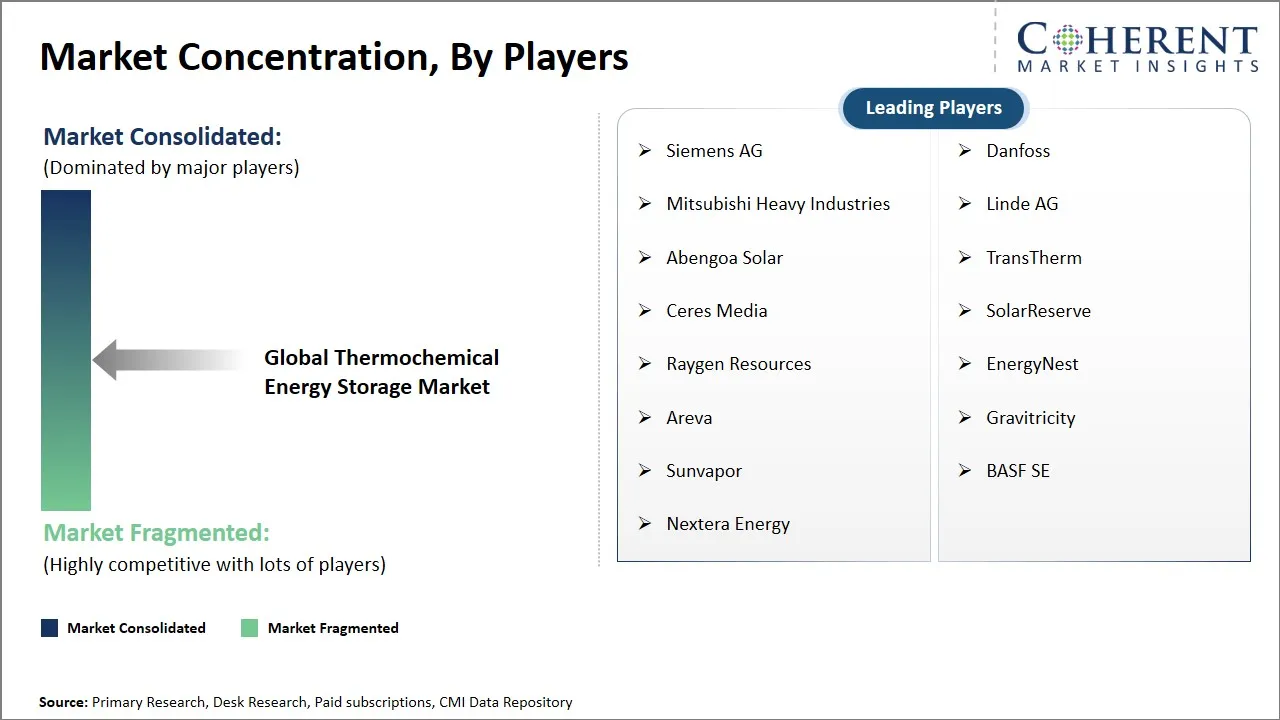
| Companies covered: | Siemens AG, Danfoss, Mitsubishi Heavy Industries, Linde AG, Abengoa Solar, TransTherm, Ceres Media, SolarReserve, Raygen Resources, EnergyNest, Areva, Gravitricity, Sunvapor, BASF SE, and Nextera Energy | ||
| Growth Drivers: |
| ||
| Restraints & Challenges: |
| ||
Thermochemical Energy Storage Market Dynamics
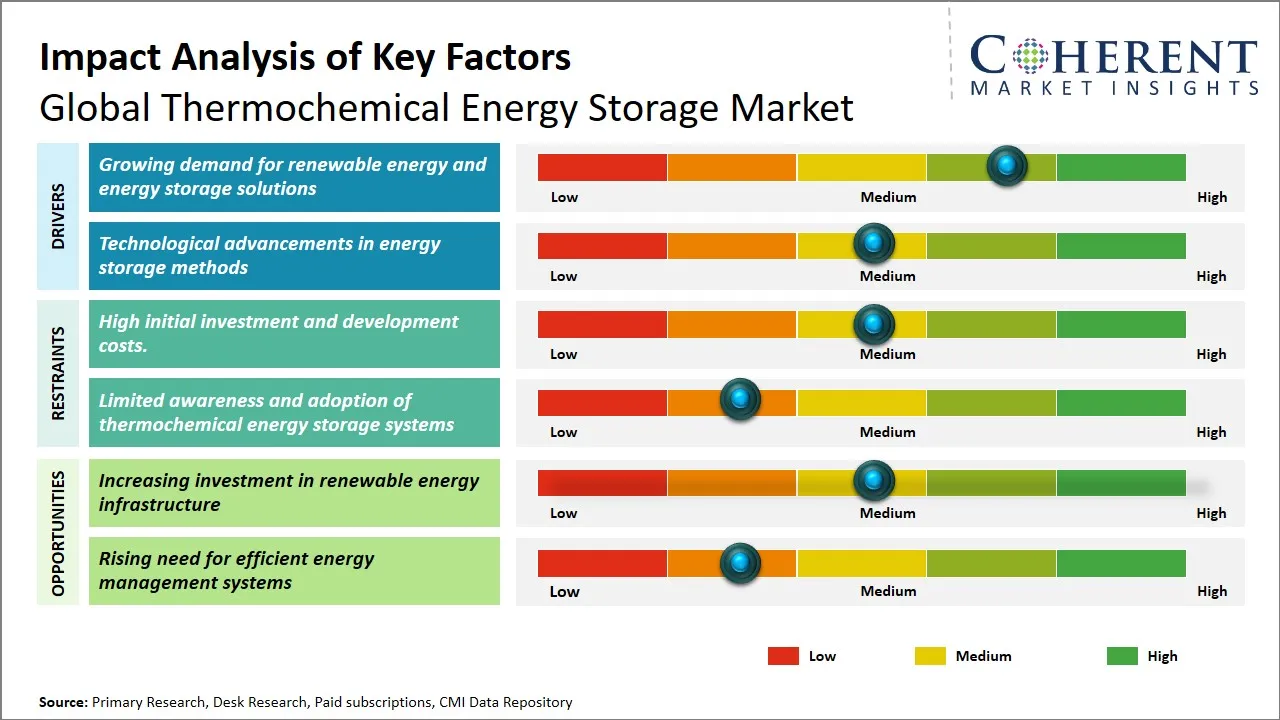
Thermochemical Energy Storage Market Driver - Growing Demand for Renewable Energy and Energy Storage Solutions
The increasing international focus on the need to shift towards the use of sustainable and renewable sources of energy is also strongly fueling the need to go towards the use of thermochemical energy storage systems. Following the increased adoption of solar, wind and other intermittent renewable energy technology, the need to provide efficient and reliable energy storage technologies to balance high and low energy supply, as well as to stabilize the grid, is growing. Another source of energy that has potential competing with the traditional forms of storage is thermochemical energy storage due to its high energy density and capacity to hold heat over prolonged durations without any significant losses. This is increasing pressure driven by the need to lower green gas emissions and attain energy security that is encouraging governments and private enterprise to invest a lot in the energy storage ideas.
In the U.S., the Aurora Solar Project is a clear example of how thermochemical energy storage can be used to complement renewable energy. The project employs the use of solar energy combined with the thermochemical energy storage to store the extra energy produced during the day and can be utilized in the night or during the low solar activity levels. The example of this project shows that thermochemical storage can be a safe way to ensure energy and can be used to strengthen the grid in those areas that are experiencing a quick increase in renewable energy sources.
Thermochemical Energy Storage Market Opportunity - Increasing Investment in Renewable Energy Infrastructure
The international thermochemical energy storage industry will gain a lot through the increased investments in renewable energy infrastructures all over the globe. With governments and individual organizations pushing harder to achieve climate goals and move towards renewable energy with little carbon footprint, bulk integration of intermittent green energy sources like wind and solar is now being given priority. The thermochemical energy storage systems provide a feasible alternative as it provides a long term and efficient storage of energy with negligible energy loss as compared to other battery systems.
This will help solve this crucial problem of balancing the supply and demand of energy particularly when the production of renewable energy is low. Several nations are putting a large sum of money into grid upgrades and implementation of new energy storage systems to improve grid stability and resilience.
The government of Germany has been very active in advancing the work of Power-to-X technologies such as thermochemical energy storage systems, as a part of their Energiewende (energy transition) program. The strategy of Germanys towards a sustainable and low-carbon economy involves significant investments in energy storage of the latest solutions.
Analyst Opinion (Expert Opinion)
- There is a considerable growth in the thermochemical energy storage market, which is supported by the rising demand of effective energy sources that can be used to supplement renewable energy sources. The perspectives of the International Conference on Energy Storage (2023) and the Global Renewable Energy Summit (2022) demonstrate the main achievements, and such companies as SolarReserve and HPC Energy made innovations in the thermochemical systems.
- A case in point is the recent achievement by SolarReserves to develop a high-capacity thermochemical storage technology that improves the level of energy retention to the solar plants. The discussions during these conferences indicated that the importance of thermochemical storage cannot be underrated in dealing with the intermittency of renewable energy sources to allow more stable and reliable energy provision. Nevertheless, the barriers to widespread adoption were often reported to be high operation costs and more technological advancement.
- Firms that are interested in research and development to enhance cost-efficiency and scalability of thermochemical systems will probably gain competitive edge. The end result is that the development of the thermochemical energy storage market will be based on its capacity to become a constant innovator and meet the objectives of energy transitions in the world as well as respond to the increased need of energy solutions that are sustainable.
Speak to the analyst
Want personalized insights?
Take the findings above to one of our principal consultants, or have the report rebuilt around the segments, geographies and competitors you actually track.
Market Segmentation
- Product Type Insights (Revenue, USD Bn, 2021 - 2033)
- Sensible Heat Storage
- Latent Heat Storage
- Thermochemical Heat Storage
- Technology Insights (Revenue, USD Bn, 2021 - 2033)
- Molten Salt Technology
- Electric Thermal Storage Heaters
- Solar Energy Storage
- Ice-based Technology
- Others
- Storage Material Insights (Revenue, USD Bn, 2021 - 2033)
- Molten Salt
- Phase Change Material
- Water
- Application Insights (Revenue, USD Bn, 2021 - 2033)
- Process Heating & Cooling
- District Heating & Cooling
- Power Generation
- Ice storage air-conditioning
- Others
- Regional Insights (Revenue, USD Bn, 2021 - 2033)
- North America
- U.S.
- Canada
- Latin America
- Brazil
- Argentina
- Mexico
- Rest of Latin America
- Europe
- Germany
- U.K.
- Spain
- France
- Italy
- Russia
- Rest of Europe
- Asia Pacific
- China
- India
- Japan
- Australia
- South Korea
- ASEAN
- Rest of Asia Pacific
- Middle East
- GCC Countries
- Israel
- Rest of Middle East
- Africa
- South Africa
- North Africa
- Central Africa
- North America
- Key Players Insights
- Siemens AG
- Danfoss
- Mitsubishi Heavy Industries
- Linde AG
- Abengoa Solar
- TransTherm
- Ceres Media
- SolarReserve
- Raygen Resources
- EnergyNest
- Areva
- Gravitricity
- Sunvapor
- BASF SE
- Nextera Energy
Sources
Primary Research Interviews
- CEO – Leading Thermochemical Storage Developer (e.g., Malta Inc. or EnergyNest AS equivalent)
- Supply Chain Director – Major Thermal Energy Storage Distributor
- Production Lead – Advanced Materials Manufacturer for TCES Systems
- Sustainability Officer – Renewable Thermal Energy Certification Authority
Stakeholders
- Manufacturers
- End-use Sectors
- Concentrated Solar Power (CSP) Plants
- Industrial Process Heat Providers (Chemicals, Steel)
- District Heating and Cooling Networks
- Regulatory & Certification Bodies (e.g., IEA for energy storage standards, EU ETS compliance for thermal systems)
- E-commerce Platforms and Retailers (Alibaba Industrial, Specialized Energy Suppliers)
- Technology Integration Players: CSP and hybrid renewable storage innovators (e.g., Siemens Gamesa, Aalborg CSP)
Databases
- IEA Energy Storage Technology Roadmap Database
- IRENA Renewable Energy Statistics (Thermal Storage)
- NREL Renewable Energy Materials Properties Database
- Eurostat Renewable Energy Trade Statistics
Magazines
- Renewable Energy World – Trends in thermochemical storage innovations
- SolarPACES – TCES in CSP applications
- Power Engineering International – Energy storage market dynamics
- Heat Recovery Magazine – Industrial thermal storage trends
- Energy Storage News – TCES supply chain updates
Journals
- Renewable and Sustainable Energy Reviews – Thermochemical storage systems review
- Applied Energy – TCES materials and performance
- Journal of Energy Storage – Advances in thermochemical processes
- Solar Energy – Integration with renewables
- Energy Conversion and Management – Efficiency modeling
Newspapers
- Reuters – Renewable energy storage investments
- The Guardian – Sustainability in thermal energy tech
- Business Standard (India) – Asia TCES market growth
- Wall Street Journal – Global clean energy demand
- Financial Times – Energy transition and storage volatility
Associations
- Global Energy Storage Alliance
- China Energy Storage Alliance (CNESA)
- Renewable Thermal Collaborative
- Energy Storage Canada (ESC)
- European Association for Storage of Energy (EASE)
- Irish Energy Storage Association (IESA)
Public Domain Sources
- IEA – Thermal Energy Storage Guidelines
- NREL – TCES Technology Assessments
- DOE – Renewable Energy Storage Reports
- European Commission – Renewable Heating and Cooling Strategy
- IPCC – Energy Storage in Climate Mitigation
Proprietary Elements
- CMI Data Analytics Tool, Proprietary CMI Existing Repository of information for last 8 years.
Get access to 250+ pages report
Every segment, forecast, competitor profile and data table behind the analysis above — available for instant download.
- ESOMAR Member
- ISO 9001:2015 Certified
- D-U-N-S Registered
- GDPR & CCPA Compliant
Missing comfort of reading report in your local language? Find your preferred language:
Transform your Strategy with Exclusive Trending Reports
Frequently Asked Questions
The global thermochemical energy storage market is estimated to be valued at USD 5.76 Bn in 2026 and is expected to reach USD 10.07 Bn by 2033.
The CAGR of global thermochemical energy storage market is projected to be 8.3% from 2026 to 2033.
Strong policies in decarbonization and renewable mandates drive TCES adoption.
TCES uses reversible chemical reactions to store and release energy with high energy density.
Growing demand for renewable energy and energy storage solutions and technological advancements in energy storage methods are the major factors driving the growth of the global thermochemical energy storage market.
High initial investment and development costs. and limited awareness and adoption of thermochemical energy storage systems are the major factors hampering the growth of the global thermochemical energy storage market.
In terms of product type, sensible heat storage is estimated to dominate the market revenue share in 2026.