

Global Thermochromic Materials Market Size and Forecast – 2026 To 2033
The global thermochromic materials market is estimated to be valued at USD 1,018.4 Mn in 2026 and is expected to reach USD 1,614.1 Mn by 2033, growing at a compound annual growth rate (CAGR) of 6.8% from 2026 to 2033. This steady growth is supported by increasing use across automotive, packaging, textiles, consumer products, and temperature-monitoring applications, where thermochromic materials provide visible responses to changes in temperature.
Expanding development of smart coatings, flexible sensors, temperature indicators, and responsive surfaces is also broadening their functional role beyond decorative color-changing applications. Research is increasingly focused on improving temperature sensitivity, response accuracy, flexibility, and integration with different substrates. In May 2025, researchers (Prof. Deepak Chopra and his laboratory) from IISER Bhopal reported a flexible thermochromic temperature sensor capable of supporting heat-transfer monitoring, temperature mapping, and hotspot detection through color-based image analysis, highlighting the potential of thermochromic materials in non-invasive thermal monitoring applications.
Key Takeaways of Thermochromic Materials Market
- Leuco Dyebased materials are expected to grow at a CAGR of 6.5% from 2026 to 2033 and hold 58.4 % of the thermochromic materials market in 2026. Their formulation flexibility and suitability for encapsulated color-switching systems support use across packaging, textiles, labels, and consumer goods, giving converters a platform without requiring precision liquid-crystal control. In May 2024, IPB University researchers published a meta-analysis covering 21 studies and 82 treatment sets, confirming temperature-linked color changes in thermochromic leuco dyes.
- Reversible thermochromic materials are expected to grow at a CAGR of 7.2% from 2026 to 2033 and account for 74.8 % of the market share in 2026. Repeated color switching creates greater utility in reusable indicators, interactive surfaces, security features, and smart coatings than single-event temperature marks. In January 2026, ICN2 reported newly developed compounds that reversibly change from colourless to coloured when heated, targeting product labelling, security inks, temperature sensors, and smart-window coatings.
- Powders and pigments are expected to grow at a CAGR of 6.4% from 2026 to 2033 and capture market share 40.7 % in 2026. Their role as adaptable formulation inputs for inks, coatings, polymer compounds, and industrial finishes supports broad application flexibility. This gives manufacturers latitude to tailor activation temperature, color, and application method for different substrates. In June 2025, OliKrom unveiled VisioKrom, a thermochromic pigment designed to make anti-corrosion treatments temporarily visible for industrial quality control.
- Asia Pacific is expected to grow at a CAGR of 7.1% from 2026 to 2033 and account for 34.9 % share of the global thermochromic materials market in 2026. Its leadership reflects a dense manufacturing base across packaging, textiles, consumer products, electronics, and advanced materials, alongside active research commercialization. In April 2024, City University of Hong Kong reported a mask-inspired thermochromic perovskite smart window that improved weather resistance and optical clarity, strengthening the region’s pipeline for energy-efficient smart-surface applications.
- North America is expected to register a CAGR of 7.8% from 2026 to 2033 and represent 28.6 % of the global market share in 2026. As the fastest-growing region, expansion is supported by sophisticated packaging converters, brand-led adoption of interactive inks, specialty-material innovation, and established high-speed printing infrastructure that can shorten commercialization cycles. In September 2024, Colorado-based Chromatic Technologies Inc. reported commercializing hybrid photochromic-thermochromic inks tested on flexographic and gravure presses for high-speed packaging production.
Segmental Insights
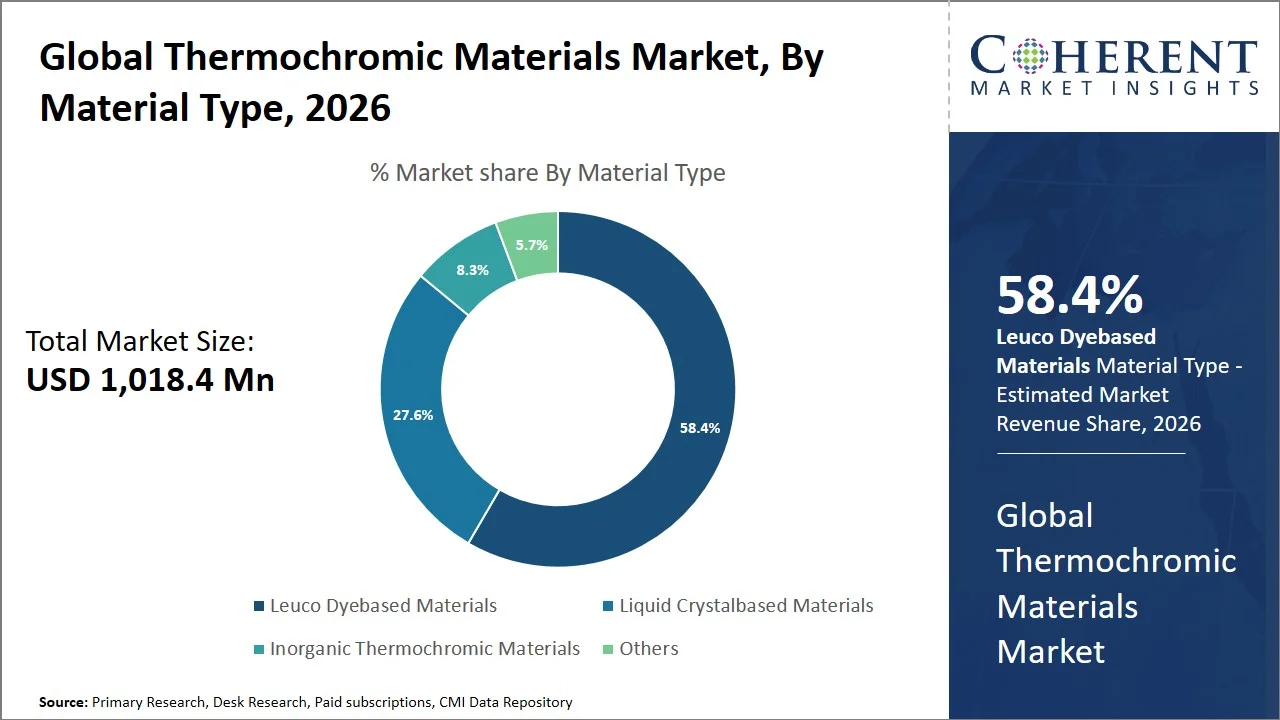
Why Do Leuco Dyebased Materials Dominate the Global Thermochromic Materials Market?
Leuco Dyebased materials are expected to hold 58.4% of the thermochromic materials market in 2026 because they offer a commercially practical balance of color range, activation-temperature tunability, formulation flexibility, and production economics. Their compatibility with microencapsulation allows suppliers to protect the active dye–developer–solvent system while adapting it for printing, coatings, textiles, labels, and consumer products. Buyers also benefit from easier customization than with precision liquid-crystal systems, supporting broader SKU development and converter adoption. For manufacturers, scalable encapsulation and established coating or textile-finishing routes reduce integration barriers and support application-specific product portfolios. This widens addressable demand while preserving formulation control for downstream manufacturers. In June 2025, according to springer nature article researchers reported leuco-Dyebased reversible thermochromic microcapsules incorporated into cotton through pad-dry-cure and exhaustion methods, demonstrating strong thermochromic performance and practical textile-processing compatibility.
- Current Industry Events of 2026
- Market Size Estimation
- Regional Breakdown
- Competitive Landscape
- Customer Intelligence
- Segmental Analysis
- Pricing Analysis
- Key Market Drivers, Challenges & Future Trends
- Customized Insights Section
Why Do Reversible Thermochromic Materials Represent the Largest Temperature Response Segment in the Global Thermochromic Materials Market?
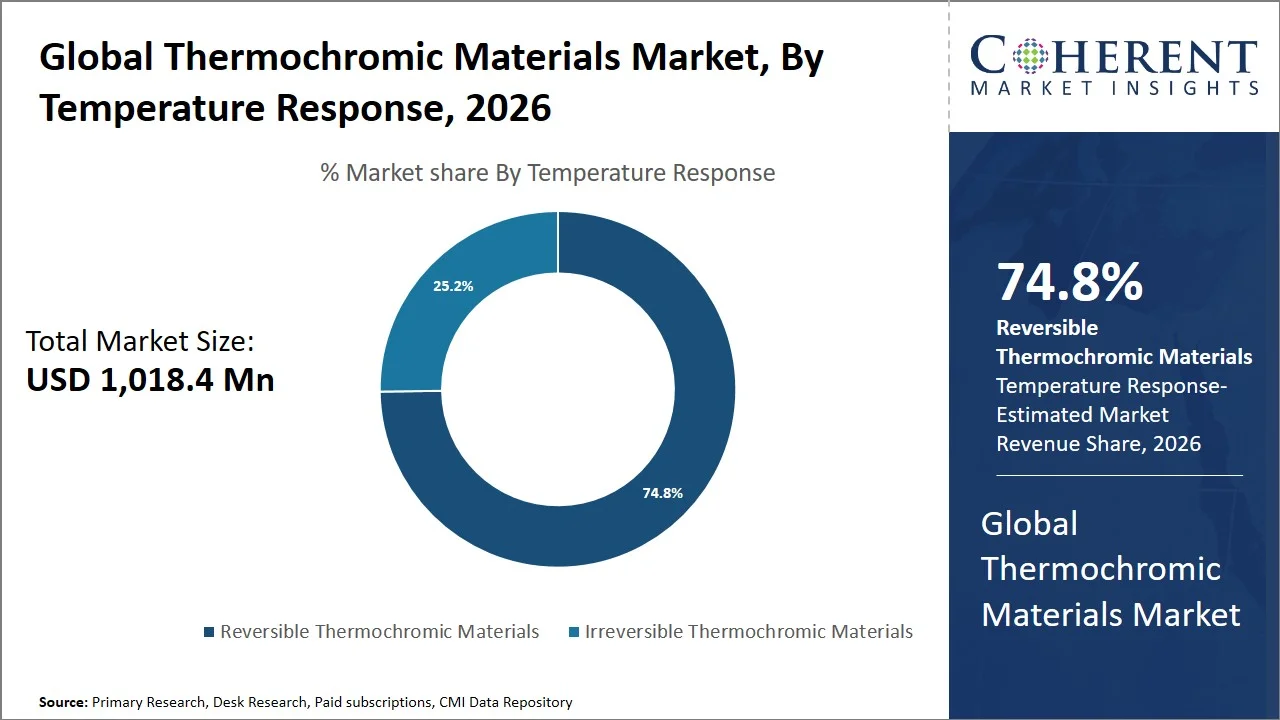
Reversible thermochromic materials are expected to represent 74.8% of the thermochromic materials market in 2026 because repeated switching gives end users continuing functional value rather than a single temperature event. This is important for smart windows, reusable temperature indicators, interactive surfaces, textiles, sensors, and consumer products where the material must respond through multiple heating and cooling cycles. From a supply perspective, improved film formation, encapsulation, and matrix integration are expanding the range of substrates that can host reversible systems without sacrificing usability. Commercially, repeat-use functionality supports higher-value positioning and enables suppliers to sell performance, cycling stability, and application engineering rather than color change alone. In January 2025, Royal Society of Chemistry researchers published a Co-BTC/PVB smart-window film showing reversible thermochromic behavior and measurable solar-control performance, illustrating the segment’s relevance to energy-management applications.
Why Do Powders and Pigments Dominate the Form Segment of the Global Thermochromic Materials Market?
Powders and pigments are expected to account for 40.7% of the thermochromic materials market in 2026 because they give formulators a flexible intermediate that can be dispersed into coatings, inks, polymers, construction materials, and printed systems using existing processing infrastructure. This format allows customers to adjust loading levels, color response, binder chemistry, and substrate compatibility without purchasing a fully finished thermochromic product. That flexibility is particularly valuable to coating producers and converters serving multiple end-use specifications. Suppliers can therefore address a wider customer base through standardized pigment platforms combined with technical formulation support. In November 2025, a peer-reviewed study reported a temperature-adaptive radiative-cooling coating enabled by thermochromic powders and experimentally evaluated its thermal response and building energy-saving potential, demonstrating how powder-format materials can be engineered directly into functional coating systems.
Current Events and their Impact
Current Event | Description and Its Impact |
December 2024 – EU Restricts BPA and Hazardous Bisphenols in Food-Contact Materials |
|
March 2026 – European Commission Advances PPWR Implementation Guidance |
|
Global Thermochromic Materials Market Dynamics
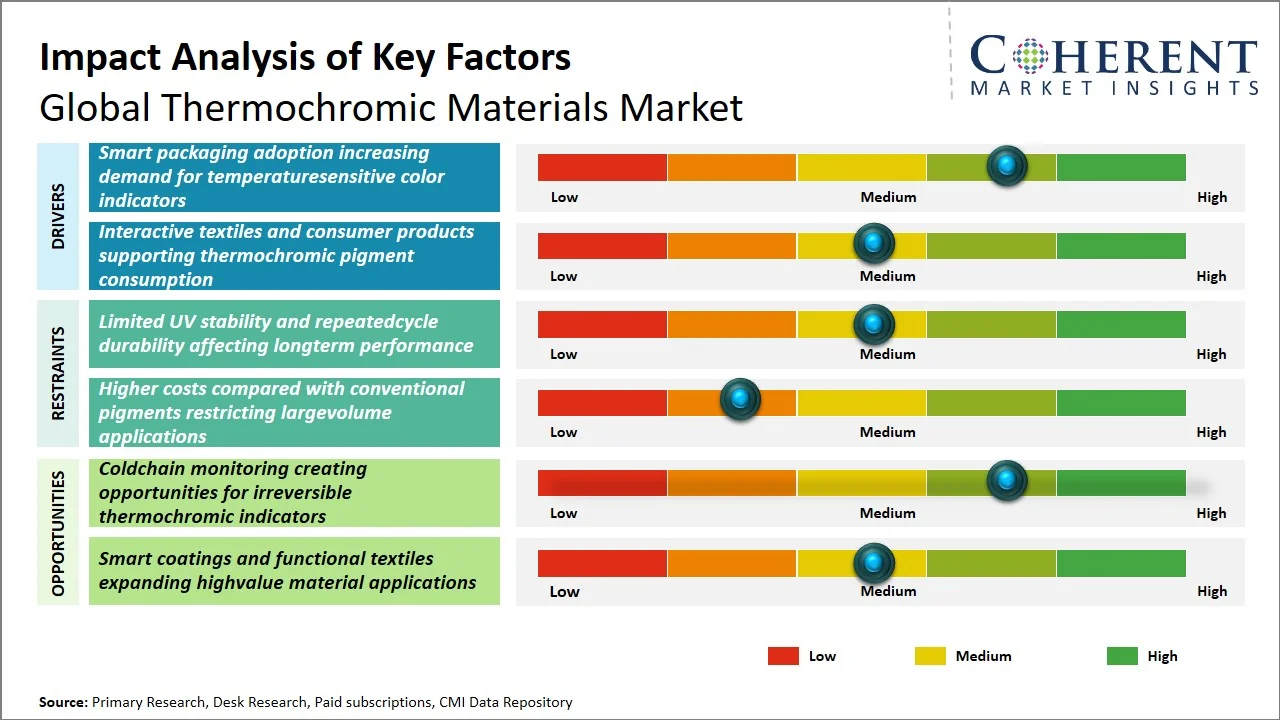
Key Market Drivers
- Smart Packaging Adoption Increasing Demand for Temperature Sensitive Color Indicators: Smart packaging is becoming a practical demand engine for thermochromic materials because brands can convert temperature conditions into an immediate visual message without electronics, batteries, or scanning. In food and beverage packaging, this functionality can indicate serving readiness, improve product interaction, and differentiate otherwise standardized labels or containers at the point of purchase. Ink formulators, label converters, packaging printers, and brand owners benefit because thermochromic features can be integrated through existing decoration and printing workflows while creating a premium communication layer. The commercial value is strongest where temperature directly affects product experience and where brands compete for shelf attention. In April 2026, Aldi UK launched Specially Selected Rouge Clair with a thermochromic label that changes color when the wine reaches its intended chilled serving condition, demonstrating direct retail adoption of temperature-responsive packaging.
- Interactive Textiles and Consumer Products Supporting Thermochromic Pigment Consumption: Interactive textiles and responsive consumer products are expanding the role of thermochromic materials from decorative effects into functional user feedback. When color change is engineered into yarns, printed fabrics, wearables, furnishings, or personal-use products, the material can communicate heat exposure directly on the surface while preserving flexibility and visual appeal. This creates opportunities for pigment suppliers, textile finishers, yarn developers, apparel designers, and healthcare-oriented product manufacturers to develop higher-value offerings differentiated by activation range and visual response. Commercial adoption will depend increasingly on wash durability, skin-contact suitability, color consistency, and integration with standard textile processing. In February 2025, the American Chemical Society highlighted an intelligent heating jacket using thermochromic yarns as visible temperature indicators alongside heating elements and environmental sensing, illustrating how color-changing textiles can support safety-oriented wearable design rather than fashion effects alone.
Emerging Market Trends
- Calibrated Multi-State Temperature Signaling: Thermochromic materials are moving beyond simple color switching toward calibrated multi-state temperature indicators. Healthcare, logistics, industrial safety, and quality-control users increasingly require clear visual differentiation between normal, cautionary, and critical conditions. This is pushing suppliers to improve activation accuracy, color contrast, repeatability, and response stability, creating opportunities for application-specific grades and higher-value functional products.
- Short-Run and Digitally Enabled Thermochromic Production: Thermochromic materials are increasingly being adapted for short-run and digital production across customized packaging, apparel, promotional products, and prototypes. Demand is shifting toward printable coatings, transfer films, and application-ready systems that work with flexible manufacturing processes. This can reduce production barriers for smaller converters while encouraging suppliers to compete through processing support, substrate compatibility, and consistent color-changing performance.
Regional Insights
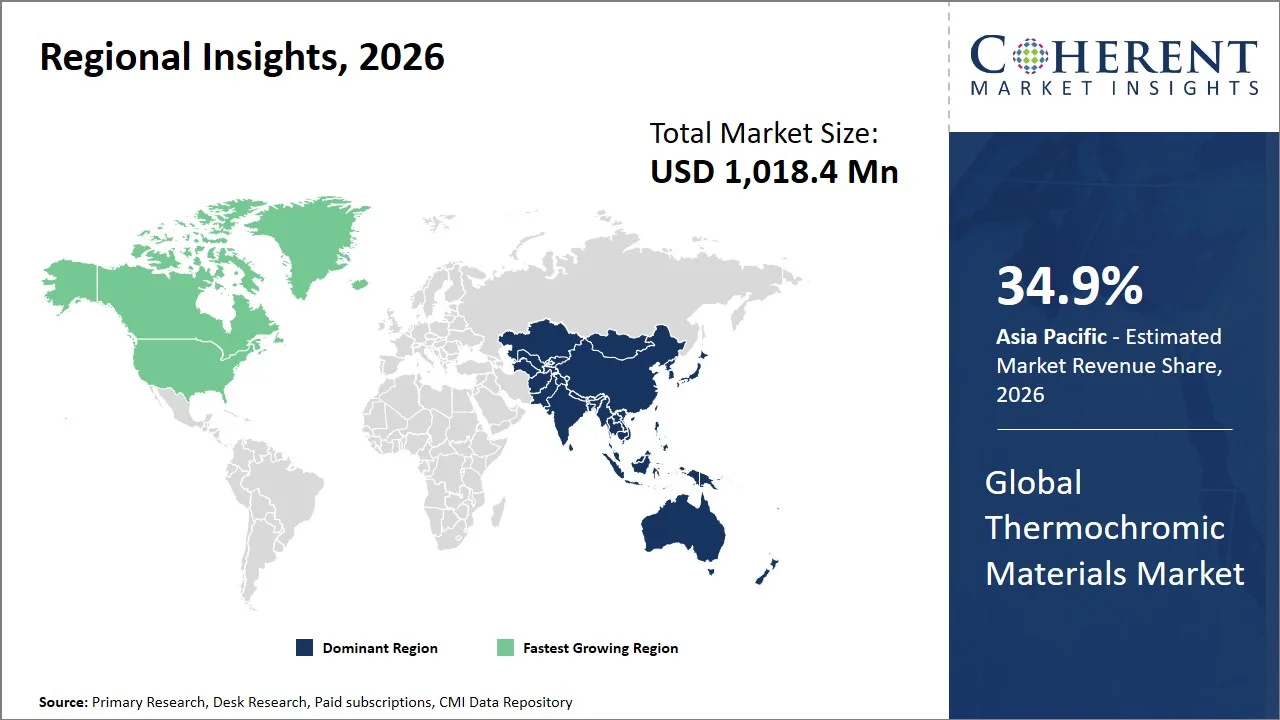
Why Does Asia Pacific Dominate the Global Thermochromic Materials Market?
Asia Pacific is expected to dominate the global thermochromic materials market with a 34.9% share in 2026, supported by its concentrated base of packaging converters, textile processors, consumer-goods manufacturers, electronics producers, and functional-coating suppliers. The region’s scale in printing, plastics, apparel, and specialty chemicals creates broad routes for thermochromic pigments, inks, films, and reversible temperature-responsive systems to move from niche design features into repeat-use commercial applications. Cost-efficient manufacturing and strong materials R&D also improve the feasibility of customized formulations for packaging, smart surfaces, and energy-management products. In October 2024, a China-supported study in Applied Energy demonstrated a multifunctional thermochromic smart window integrating PNIPAm-based hydrogel, MXene nanoparticles, and shape-memory alloy, showing how regional research is extending thermochromic materials toward building-energy applications.
Why Is North America Emerging as the Fastest-Growing Region in the Thermochromic Materials Market?
North America is expected to emerge as the fastest-growing region in the thermochromic materials market, accounting for 28.6% of the global market in 2026. Growth is supported by advanced packaging, specialty printing, smart-building technologies, medical indicators, consumer branding, and a strong ecosystem for functional materials commercialization. Buyers in the region increasingly value thermochromic systems that provide measurable utility, such as temperature indication, product-condition communication, passive solar control, or interactive graphics, rather than purely decorative color change. This encourages suppliers to compete on durability, switching precision, integration, and scale-up capability. In August 2024, Rice University reported a salted polymer thermochromic blend designed for smart windows that improved durability, transparency, and temperature responsiveness, illustrating North America’s emphasis on performance-oriented materials with a practical route toward large-scale use.
Global Thermochromic Materials Market Outlook for Key Countries
Why Is the U.S. a Key Market for the Thermochromic Materials Market?
The U.S. is a key country in the thermochromic materials market because it combines specialty-ink expertise, advanced printing and packaging capabilities, strong university research, consumer-brand experimentation, and demand for functional temperature-responsive materials. Commercial opportunity extends across interactive packaging, medical and food indicators, smart surfaces, specialty textiles, and building applications where visual temperature feedback can add safety, convenience, or energy-management value. The country’s innovation ecosystem also helps move thermochromic concepts from material formulation into manufacturable products through prototyping, digital fabrication, and converter partnerships. In January 2025, MIT CSAIL introduced Thermochromorph, a printing technique using thermochromic inks to create images that transform with heat; MIT identified potential uses including temperature-warning drinkware and packaging for medicines and perishable foods. This development highlights the U.S. pathway from research-led design to commercially relevant thermochromic applications.
Why Does China Support Growth in the Thermochromic Materials Market?
China is important to the thermochromic materials market because its large printing, packaging, textile, plastics, coatings, electronics, and consumer-goods industries provide multiple downstream channels for temperature-responsive pigments and functional color-changing systems. Domestic production scale can support lower-cost formulation, encapsulation, compounding, and application development, while large converter networks make it easier to test thermochromic features across high-volume products. China is also building technical depth in advanced cellulose, optical, coating, and smart-material platforms, which can expand thermochromic use beyond novelty applications into security, sensing, and functional surfaces. In 2024, Tsinghua University researcher Jing Yu’s publication portfolio included a bio-inspired cholesteric cellulose composite combining thermochromic behavior with circularly polarized structural color for multilevel encryption. The work illustrates how Chinese R&D is linking thermochromism with higher-value security and information-protection functions.
Why Is India Important in the Global Thermochromic Materials Market?
India supports growth in the thermochromic materials market through its expanding textile-processing, flexible-packaging, printing-ink, consumer-goods, pharmaceutical, and food supply chains. These industries create practical use cases for heat-sensitive inks, labels, pigments, and coatings that can communicate temperature exposure, enhance product interaction, or add functional differentiation at relatively low material loading. India’s cost-sensitive manufacturing environment also favors scalable formulations that can be integrated into established printing and textile processes without major equipment changes. Policy support for smart and technical textiles strengthens the longer-term development base for responsive materials. In July 2024, India’s Ministry of Textiles approved 19 research projects worth about INR 21 crore under the National Technical Textiles Mission, including projects in smart textiles. This broader R&D push can support commercialization capabilities relevant to thermochromic textile and wearable applications.
Why Is Germany a Strategic Country in the Thermochromic Materials Market?
Germany is a strategic country in the thermochromic materials market because its strengths in advanced coatings, specialty chemicals, glass processing, industrial printing, automotive materials, and energy-efficient building technologies favor high-performance rather than novelty-led thermochromic applications. German buyers and research organizations place strong emphasis on durability, process control, optical performance, and scalable manufacturing, creating opportunities for inorganic thermochromic coatings and engineered films that can meet demanding industrial specifications. The country’s close links between applied research institutes and equipment manufacturers also support pilot-scale validation. In April 2024, researchers including Fraunhofer FEP in Dresden published a roll-to-roll process for high-performance VO₂-based thermochromic coatings on ultrathin flexible glass, demonstrating pilot-scale production and a pathway toward cost-effective large-area smart-window coatings. This reinforces Germany’s role in industrializing advanced thermochromic technologies.
Why Is South Korea an Important Growth Market for the Thermochromic Materials Market?
South Korea is an important growth market for the thermochromic materials market because its electronics, display, digital-fabrication, smart-textile, cosmetics-packaging, and advanced-materials sectors create demand for visually responsive materials with precise functional behavior. The country’s design-intensive manufacturing model is well suited to thermochromic inks and pigments that can add user feedback, interactivity, personalization, or sensor-like functionality without complex electronic interfaces. Strong university-industry links also support experimentation with thermochromic materials in new human-machine and consumer-product formats. In February 2024, KAIST researchers published Thermo-Play, a peer-reviewed study examining thermochromic materials across four interactive design projects and identifying color dynamicity, gradual response, and physical interaction as useful design properties. The work demonstrates South Korea’s capability to translate thermochromic behavior into product-experience concepts that can inform future consumer and interface applications.
Technology Adoption Landscape in the Thermochromic Materials Market
Technology | Adoption Level | Key Application Area | Business Impact |
Microencapsulated Leuco-Dye Systems | High | Packaging inks, textiles, labels, consumer goods | Protects the active thermochromic chemistry and supports scalable incorporation into inks, coatings, and textile finishes while enabling customized activation temperatures. |
Thermochromic Liquid-Crystal Formulations | Medium | Precision temperature indicators and specialty sensing | Provides comparatively defined temperature-response behavior and visual resolution, but formulation sensitivity and processing requirements limit broader commodity adoption. |
VO₂-Based Inorganic Thermochromic Coatings | Medium | Smart glazing and solar-control surfaces | Enables passive modulation of infrared transmission and offers a pathway toward durable building-energy applications, subject to transition-temperature tuning and coating economics. |
Thermochromic Flexographic, Gravure and Screen-Printing Inks | High | Packaging, labels, promotional graphics and process indicators | Uses established commercial printing infrastructure, reducing converter adoption barriers while allowing temperature-sensitive graphics to be integrated into existing production lines. |
Thermochromic Masterbatch Compounding | Medium | Injection-molded and extruded plastic consumer products | Introduces temperature-responsive color functionality directly into polymer components and supports scalable manufacturing through conventional extrusion and molding operations. |
Thermochromic Films and Transfer Layers | Medium | Smart labels, apparel decoration and responsive design surfaces | Separates the active color-changing layer from the final substrate, simplifying customization and allowing converters to add thermochromic functionality with less formulation work. |
How Are Passive Thermal-Condition Indicators Creating New Growth Opportunities in the Global Thermochromic Materials Market?
Industrial condition visualization represents an underdeveloped opportunity for thermochromic materials because many factories still depend on instruments, labels, or manual inspection to identify abnormal surface temperatures. Temperature-responsive coatings, films, or indicator patches can add a passive visual layer to equipment housings, electrical enclosures, piping, tooling, thermal-treatment fixtures, and maintenance checkpoints. The opportunity is strategically attractive where rapid visual recognition can support inspection routines without replacing electronic sensors. Suppliers can capture this space by developing application-specific activation ranges, high-contrast color transitions, chemical-resistant binders, and durable systems suited to repeated heating cycles. Industrial coating companies, maintenance-service providers, equipment OEMs, and specialist material formulators are likely customer groups. Participation will require validation under real operating conditions, documented durability, compatibility with industrial substrates, and channel partnerships with maintenance or coatings specialists. The opportunity should favor technically focused suppliers able to combine thermochromic chemistry with coating engineering and customer-specific qualification rather than firms competing only on pigment price.
Market Players, Key Development, and Competitive Landscape
Key Developments
- In July 2026, Ardagh Metal Packaging collaborated with PepsiCo and Carlsberg Britvic to produce limited-edition Pepsi MAX thermochromic cans using its Thermo Finish technology, with temperature-activated decoration applied at its Wrexham manufacturing facility. This is important for the global thermochromic materials market because it demonstrates that color-changing coatings can be integrated into mainstream beverage-can production and deployed in consumer-facing brand campaigns, strengthening the commercial case for thermochromic inks engineered for high-speed metal packaging lines.
- In August 2025, ZOZO NEXT presented Afterglow, a prototype lampshade incorporating thermochromic material, following its presentation at SaloneSatellite in Milan. This is important for the global thermochromic materials market because it extends heat-responsive surfaces into furniture and interior-product design, where passive changes in color can create ambient interaction without an electronic display. Such concepts broaden co-development opportunities between thermochromic material specialists, product designers, textile developers, and premium consumer-goods manufacturers.
- In November 2024, OCB Company introduced a thermochromic film designed for DTF digital inkjet printing applications. This is important for the global thermochromic materials market because transfer-film formats can make temperature-responsive graphics accessible to apparel decorators, customization businesses, and short-run digital printers without requiring dedicated conventional thermochromic printing infrastructure. The development points toward a more application-ready distribution model in which converters purchase printable or transferable systems rather than formulate thermochromic pigments independently.
Competitive Landscape
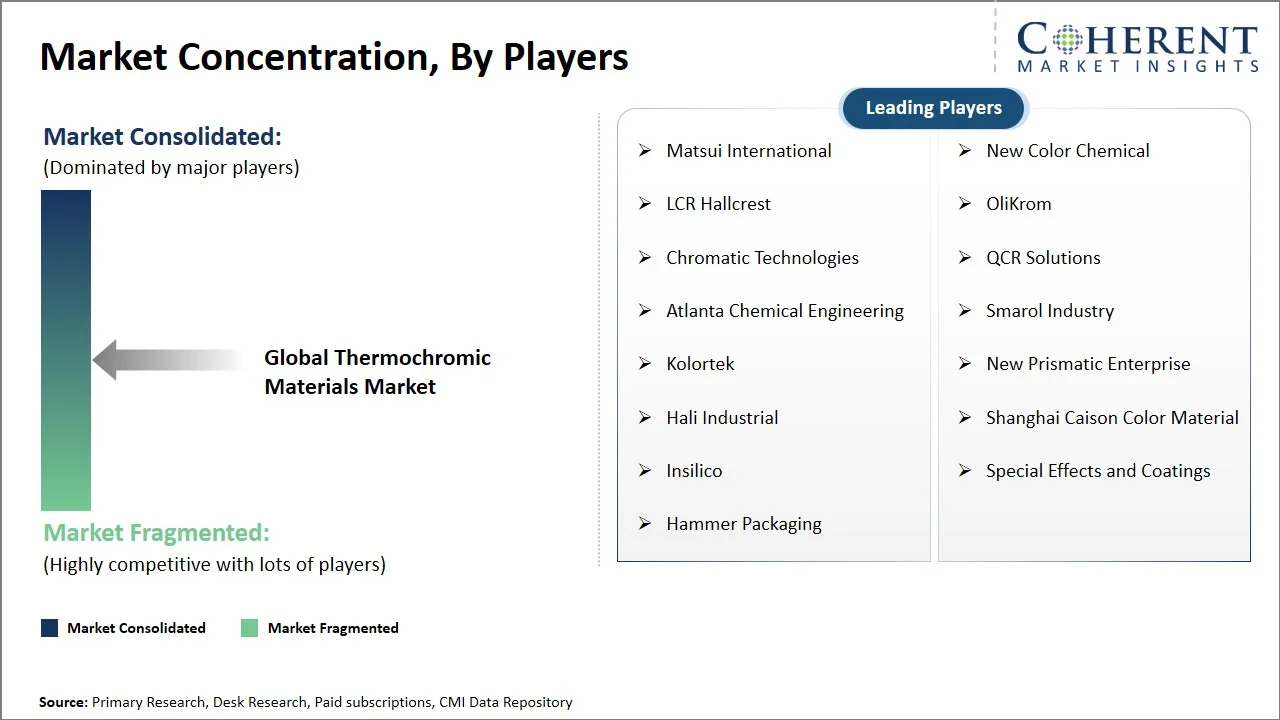
The global thermochromic materials market is fragmented, with specialty pigment producers, ink and coating formulators, smart-material developers, polymer compounders, printing converters, and regional distributors participating at different stages of the value chain. Competition increasingly depends on the ability to deliver a repeatable temperature response under the customer’s actual processing and operating conditions. Specialist suppliers retain an important position because activation temperature, binder compatibility, substrate adhesion, durability, and regulatory requirements frequently require application-specific formulation. Regional companies can compete effectively through shorter lead times, technical service, and customized batches, while technology-oriented suppliers are better positioned in applications where qualification and intellectual property create higher switching barriers. Key focus areas include:
- Activation-temperature precision: Suppliers must offer consistent switching ranges and color contrast across production batches.
- Durability and cycling performance: Resistance to UV exposure, repeated heating, washing, abrasion, and aging increasingly influences qualification for functional applications.
- Formulation customization: Compatibility with inks, polymers, textiles, coatings, adhesives, and customer-specific substrates remains a major differentiation factor.
- Chemical safety and compliance: Documented constituent chemistry, migration performance, and suitability for regulated applications can influence packaging and consumer-product procurement.
- Manufacturing consistency: Batch-to-batch reproducibility and reliable delivery are critical where thermochromic ingredients are incorporated into continuous converting or printing operations.
- Technical support: Suppliers that assist customers with dispersion, curing, loading, processing temperature, and performance testing can reduce commercialization risk.
- Proprietary application know-how: Defensible formulations and application engineering provide stronger margin protection than commodity color-changing pigments alone.
Market Report Scope
Thermochromic Materials Market Report Coverage
| Report Coverage | Details | ||
|---|---|---|---|
| Base Year: | 2025 | Market Size in 2026: | USD 1,018.4 Mn |
| Historical Data for: | 2020 To 2024 | Forecast Period: | 2026 To 2033 |
| Forecast Period 2026 to 2033 CAGR: | 6.8% | 2033 Value Projection: | USD 1,614.1 Mn |
| Geographies covered: |
| ||
| Segments covered: |
| ||
| Companies covered: | Matsui International, New Color Chemical, LCR Hallcrest, OliKrom, Chromatic Technologies, QCR Solutions, Atlanta Chemical Engineering, Smarol Industry, Kolortek, New Prismatic Enterprise, Hali Industrial, Shanghai Caison Color Material, Insilico, Special Effects and Coatings, Hammer Packaging | ||
| Growth Drivers: |
| ||
| Restraints & Challenges: |
| ||
Analyst Opinion (Expert Opinion)
- The global thermochromic materials market leadership is likely to shift from suppliers offering broad color-changing pigment catalogs toward companies providing application-qualified thermochromic platforms. Buyers will increasingly expect defined activation behavior, compatible binders, processing guidance, test protocols, and performance validation as part of the purchase. This transition should reward suppliers that control more of the formulation and application-engineering stack because they can solve manufacturing problems rather than compete primarily on pigment cost.
- Hybrid responsive-material architectures could materially reshape the competitive boundary of the market. Combining thermal response with other optical, mechanical, chemical, or environmental cues may create surfaces that communicate more than temperature alone. Commodity thermochromic pigment suppliers could face pressure if customers move toward integrated responsive layers and multifunctional systems. Expertise in interface chemistry, multilayer structures, controlled response sequencing, and end-use qualification could therefore become more strategically valuable than standalone color-change chemistry.
- Market participants should prioritize safer developer chemistries, improved lightfastness, cycling durability, tightly controlled activation ranges, and qualification support for packaging, industrial, textile, and smart-surface customers. Partnerships with converters and OEMs can shorten application-development cycles and reduce adoption risk. Suppliers should also manage the margin burden created by small customized batches and lengthy customer qualification. Overinvestment in undifferentiated novelty pigments should be avoided, as these products offer weaker switching barriers and greater exposure to price competition.
Speak to the analyst
Want personalized insights?
Take the findings above to one of our principal consultants, or have the report rebuilt around the segments, geographies and competitors you actually track.
Market Segmentation
- Material Type Insights (Revenue, USD Mn, 2021 - 2033)
- Leuco Dyebased Materials
- Liquid Crystalbased Materials
- Inorganic Thermochromic Materials
- Others
- Temperature Response Insights (Revenue, USD Mn, 2021 - 2033)
- Reversible Thermochromic Materials
- Irreversible Thermochromic Materials
- Form Insights (Revenue, USD Mn, 2021 - 2033)
- Powders and Pigments
- Inks and Coatings
- Masterbatches and Compounds
- Films and Sheets
- Others
- Application Insights (Revenue, USD Mn, 2021 - 2033)
- Printing and Packaging
- Textiles and Apparel
- Consumer Goods
- Food and Temperature Indicators
- Automotive
- Medical and Healthcare
- Others
- Regional Insights (Revenue, USD Mn, 2021 - 2033)
- North America
- U.S.
- Canada
- Latin America
- Brazil
- Argentina
- Mexico
- Rest of Latin America
- Europe
- Germany
- U.K.
- Spain
- France
- Italy
- Russia
- Rest of Europe
- Asia Pacific
- China
- India
- Japan
- Australia
- South Korea
- ASEAN
- Rest of Asia Pacific
- Middle East
- GCC Countries
- Israel
- Rest of Middle East
- Africa
- South Africa
- North Africa
- Central Africa
- North America
- Key Players Insights
- Matsui International
- New Color Chemical
- LCR Hallcrest
- OliKrom
- Chromatic Technologies
- QCR Solutions
- Atlanta Chemical Engineering
- Smarol Industry
- Kolortek
- New Prismatic Enterprise
- Hali Industrial
- Shanghai Caison Color Material
- Insilico
- Special Effects and Coatings
- Hammer Packaging
Sources
Primary Research Interviews
- Thermochromic pigment, leuco dye, liquid crystal, inorganic pigment, microcapsule, ink, coating, masterbatch, and film manufacturers
- Smart packaging converters, textile printers, automotive coating suppliers, temperature-indicator producers, smart-glass developers, and consumer-product manufacturers
- Distributors, raw-material suppliers, testing laboratories, regulatory experts, R&D specialists, procurement managers, and technical sales executives
Stakeholders
- Thermochromic material manufacturers, specialty chemical formulators, ink and coating companies, polymer compounders, and printing converters
- Dye developers, solvents, binders, resins, encapsulation materials, additives, substrates, and packaging-material suppliers
- Packaging companies, textile manufacturers, automotive suppliers, healthcare-product companies, consumer-goods manufacturers, and smart-building solution providers
End-use Sectors
- Printing, labels, smart packaging, food and beverage packaging, and temperature indicators
- Textiles, apparel, footwear, promotional products, toys, and consumer goods
- Automotive coatings, medical indicators, healthcare products, smart windows, sensors, security printing, and industrial temperature-monitoring applications
Regulatory and Government Bodies
- U.S. EPA, FDA/CFSAN, OSHA, Consumer Product Safety Commission, and Department of Commerce; U.S. chemical substances can fall under TSCA requirements, while food-contact packaging materials are subject to FDA food-contact requirements depending on intended use.
- European Commission, ECHA, national chemical authorities, and European packaging regulators; REACH applies broadly to chemical substances and mixtures marketed in the EU.
- China MEE and SAMR, Japan METI/MHLW, India BIS/CPCB, South Korea Ministry of Environment, and relevant national chemical-safety authorities
- ISO, ASTM International, AATCC, and accredited chemical, coating, textile, and food-contact testing laboratories
Databases
- ECHA CHEM, REACH restriction databases, U.S. EPA CompTox/ChemView, TSCA Chemical Substance Inventory, and FDA Food Contact Substance databases
- UN Comtrade, ITC Trade Map, Eurostat, USITC DataWeb, World Bank, OECD, and relevant pigment, ink, coating, and specialty-chemical trade records
- WIPO PATENTSCOPE, Espacenet, Google Patents, PubChem, Crossref, Scopus, Web of Science, and scientific-publication databases
- Company annual reports, product catalogues, SDS/TDS documents, patent filings, distributor records, and shipment databases
Magazines and Journals
- Dyes and Pigments, Coloration Technology, Progress in Organic Coatings, and Journal of Coatings Technology and Research
- ACS Applied Materials & Interfaces, Advanced Functional Materials, Smart Materials and Structures, and Journal of Applied Polymer Science
- Textile Research Journal, Packaging Technology and Science, Flexible and Printed Electronics, and Journal of Intelligent Material Systems and Structures
- Coatings World, Ink World, Labels & Labeling, Packaging Europe, and Speciality Chemicals Magazine
Associations
- European Printing Ink Association (EuPIA)
- American Association of Textile Chemists and Colorists (AATCC)
- American Coatings Association and PRINTING United Alliance
- RadTech International, The Society of Plastics Engineers, and The Plastics Industry Association
- European Coatings associations and national printing, packaging, textile, and specialty-chemical industry bodies
Public Domain Sources
- Thermochromic pigment, ink, coating, masterbatch, film, microcapsule, and liquid-crystal product catalogues, technical data sheets, and safety data sheets
- Data on activation temperature, reversible/irreversible response, color transition, particle size, thermal cycling, UV stability, lightfastness, dispersion, adhesion, and chemical resistance
- Application data covering smart packaging, textiles, consumer goods, automotive, medical indicators, smart glazing, sensors, and security printing
- Patent filings, technical papers, regulatory notices, product launches, manufacturing expansions, partnerships, distributor catalogues, pricing information, and import-export records
Key Standards and Regulations
- EU REACH Regulation (EC) No 1907/2006 and applicable REACH substance restrictions for chemicals used in pigments, inks, coatings, and formulated materials.
- U.S. Toxic Substances Control Act (TSCA) for applicable chemical substances and mixtures placed on the U.S. market.
- U.S. FDA Food Contact Substance requirements for thermochromic inks, coatings, colorants, or packaging components where food-contact use is intended.
- EU Packaging and Packaging Waste Regulation (EU) 2025/40 for applicable thermochromic labels, inks, coatings, films, and decorated packaging marketed in the EU.
- OSHA Hazard Communication Standard for applicable chemical classification, labels, and safety data sheets in occupational handling.
- ISO 105 series for relevant textile colorfastness evaluation, including resistance to weathering, laundering, rubbing, and light where thermochromic textiles are assessed.
- Applicable ASTM/ISO methods for coatings, inks, polymer materials, accelerated weathering, thermal cycling, adhesion, migration, and product-specific performance testing
Proprietary Elements
- CMI Data Analytics Tool, Proprietary CMI Existing Repository of information for the last 10 years
Get access to 250+ pages report
Every segment, forecast, competitor profile and data table behind the analysis above — available for instant download.
- ESOMAR Member
- ISO 9001:2015 Certified
- D-U-N-S Registered
- GDPR & CCPA Compliant
Missing comfort of reading report in your local language? Find your preferred language:
Transform your Strategy with Exclusive Trending Reports
Frequently Asked Questions
The CAGR of global thermochromic materials market is projected to be 6.8% from 2026 to 2033.
Thermochromic materials are widely used in smart packaging, textiles and apparel, consumer goods, temperature indicators, automotive components, medical products, printing inks, coatings, and smart surfaces.
Thermochromic materials change color when exposed to a specific temperature range. Depending on the material chemistry, the color change can be reversible after cooling or irreversible for permanent temperature indication.
Key trends include development of durable thermochromic coatings, smart packaging indicators, interactive textiles, temperature-sensitive labels, multifunctional responsive materials, and improved formulations with better UV stability and repeated-cycle performance.
The global thermochromic materials market is estimated to be valued at USD 1,018.4 million in 2026 and is expected to reach USD 1,614.1 million by 2033
Smart packaging adoption increasing demand for temperature sensitive color indicators and Interactive textiles and consumer products supporting thermochromic pigment consumption are the major factor driving the growth of global thermochromic materials market.
Limited UV stability and repeated cycle durability affecting long term performance and Higher costs compared with conventional pigments restricting large volume applications are the major factor hampering the growth of global thermochromic materials market.