

Global Concrete Bonding Agents Market Size and Share Analysis – Growth Trends and Forecasts (2026-2033)
Concrete Bonding Agents Market is estimated to be valued at USD 3,815.4 Mn in 2026 and is expected to reach USD 6,732.0 Mn in 2033, exhibiting a compound annual growth rate (CAGR) of 8.4% from 2026 to 2033.
Key Takeaways
- Based on Application, Repairing segment leads the concrete bonding agents’ market with a 61% share. This is due to its widespread use in small- to medium-scale construction and repair projects.
- Asia Pacific hold market share of 50.3% in terms of value in the global concrete bonding agent’s market. Demand for repairing, flooring, and decorative activities in Asia Pacific is gaining unparalleled traction due to the flourishing building & construction sector.
Market Overview
The market for concrete bonding agents is stimulated by the growing demand for long-lasting infrastructure, growth in construction and the need for strong adhesion between new and old concrete surfaces. The agents enhance structural strength, increase building lifespan, and allow for economic repair and refurbishment, particularly in aged infrastructure. It is also driven by technology advancements in construction, green-oriented building codes, and the increasing application of high-performing bonding products within residential, commercial, and industrial applications. Furthermore, the transition towards green construction methods and the rising use of prefabrication and 3D printing of concrete are driving demand for bonding agents that provide strength coupled with environmental compatibility.
Current Events and Its Impact on Concrete Bonding Agents Market
Current Events | Description and its impact |
Sika Launches Eco Bond Pro Series for Green Infrastructure Developments |
|
DuPont Launches Bio-Based Concrete Bonding Agents to Advance Sustainable Construction |
|
Pricing Analysis
The Concrete Bonding Agents Market price analysis is a mix of raw material prices, region's demand, supply chain, and competitive pressure. Through 2025, prices of concrete bonding agents vary by product type—synthetic latex-based products are costlier than acrylic or epoxy-based products due to their superior bonding strength and longer shelf life.
Raw material volatility, especially on petrochemical-derived inputs such as styrene-butadiene and acrylic polymers, directly impacts pricing. Higher crude oil prices and disruptions in supply chains have contributed to modest price growth over the last year, especially in North America and Europe.
Regional pricing trend shows that Asia-Pacific remains the cheapest market with China and India having massive-scale production and nominally lower labor costs. In contrast, European and North American markets still are more expensive due to strict regulation demands, higher cost of manufacturing, and growing demand for eco-friendly or low-VOC bonding agents.
Market players will tend to adopt value-based pricing, particularly for high-performance or eco-friendly bonding agents sold to infrastructure repair, restoration, and sustainable building construction works. In addition to this, bulk purchases by large construction firms or government tenders lead to volume discounts, which influence average selling prices. Competitive pressure from regional producers in emerging economies is forcing global brands to offer increased localized manufacture and accommodating pricing.
- Current Industry Events of 2026
- Market Size Estimation
- Regional Breakdown
- Competitive Landscape
- Customer Intelligence
- Segmental Analysis
- Pricing Analysis
- Key Market Drivers, Challenges & Future Trends
- Customized Insights Section
Adoption of new technology in Concrete Bonding Agents Market
The introduction of new technologies in the concrete bonding agents’ segment is transforming industry standards by improving performance, sustainability, and efficiency. The biggest breakthrough is the development of low-VOC and sustainable bonding agents with increasing environmental regulation and green building demand.
Firms are introducing bio-based products complying with LEED standards without compromising on strength and durability. Nanotechnology is also coming into its own, with nano-silica and graphene-enhanced formulas being adopted to promote adhesion, hardness, and crack resistance at the microscopic level. They have the advantages of quick curing time and higher structural strength, especially useful in high-performance construction projects.
Epoxy- and polyurethane-formulations continue to be preferred on the basis of their chemical exposure and mechanical longevity, particularly in industrial and marine applications. Technologies are also being researched to develop self-healing technologies based on microcapsules, superabsorbent polymers, and even microbial systems that can seal micro-cracks by themselves, thus enhancing the shelf life of concrete structures.
With growing popularity of 3D printing in construction, bonding agents are also being engineered for additive manufacturing operations—improving layer-to-layer cohesion, workability, and curing rate. Also, manufacturers are now incorporating digital technologies like AI and IoT into production and quality control systems to enable predictive maintenance, consistent product quality, and less material waste.
Use of sustainable and eco-friendly material in Concrete Bonding Agents Market
The use of green and sustainable materials in the concrete bonding agents’ market is expanding at a rapid rate with increasing environmental regulations, green building ratings, and growing awareness of the carbon footprint of the building and construction industry.
The formulators are actively developing products that reduce volatile organic compounds (VOCs), utilize bio-based polymers, and contain recycled or renewable raw material. These developments are particularly vital in reaching global standards of sustainability such as LEED (Leadership in Energy and Environmental Design) and BREEAM (Building Research Establishment Environmental Assessment Method).
Natural products like plant oil, lignin, and starch are also yielding bio-based bonding agents that are performing equally well, yet with reduced greenhouse emissions during production. Waterborne systems in place of solvent-based systems are now gaining traction, as they emit fewer toxic pollutants and are safer for workers.
Recycled product materials, such as industrial wastes and recycled polymers, are also being integrated into bonding agent formulations for stimulating circular economy goals. Some companies are also researching the integration of nanomaterials derived from wastes for enhanced bonding properties as well as minimizing environmental impact. Moreover, the shift to low-energy manufacturing processes and eco-friendly packaging is complementing the industry's overall greener trajectory.
The demand for such sustainable products is particularly robust in countries with strong environmental regulation, such as Europe and North America, but is also increasing in developing nations as urbanization and green construction projects grow. Since sustainability is becoming a key consideration in purchase decisions, the market should have continued innovation and investment in sustainable bonding agent technology.
Market Drivers
Repairing was the largest application segment in the global concrete bonding agents’ market in 2025 and is expected to retain its dominance throughout the forecast period. Currently, there is a significant need for repair and restoration activities for enhancing the quality of roads, bridges, parking areas, and old infrastructure to maintain the strength and integrity of the old constructed surface. This is a key and highly lucrative growth area for manufacturers of concrete bonding agents to capitalize upon and increase revenue gains.
Thus, various players in the market are focusing on R&D activities to deploy various concrete bonding agents for repairing applications. Also, other emerging applications such as flooring and decorative are gaining traction and spurring the growth of the global concrete bonding agent’s market. Concrete bonding agents are highly preferred for flooring applications due to their high bond strength and flexibility. They are also very helpful in increasing the compressive, flexural, and tensile strength of cementitious systems.
In 2025, Kestral Construction Products launched Bonding Bridge 842, a cementitious, polymer-modified bonding agent designed to enhance adhesion on masonry walls and porous concrete surfaces. It simplifies repair and flooring applications, improving mortar bonding and reducing substrate moisture issues.
Segmental Insights
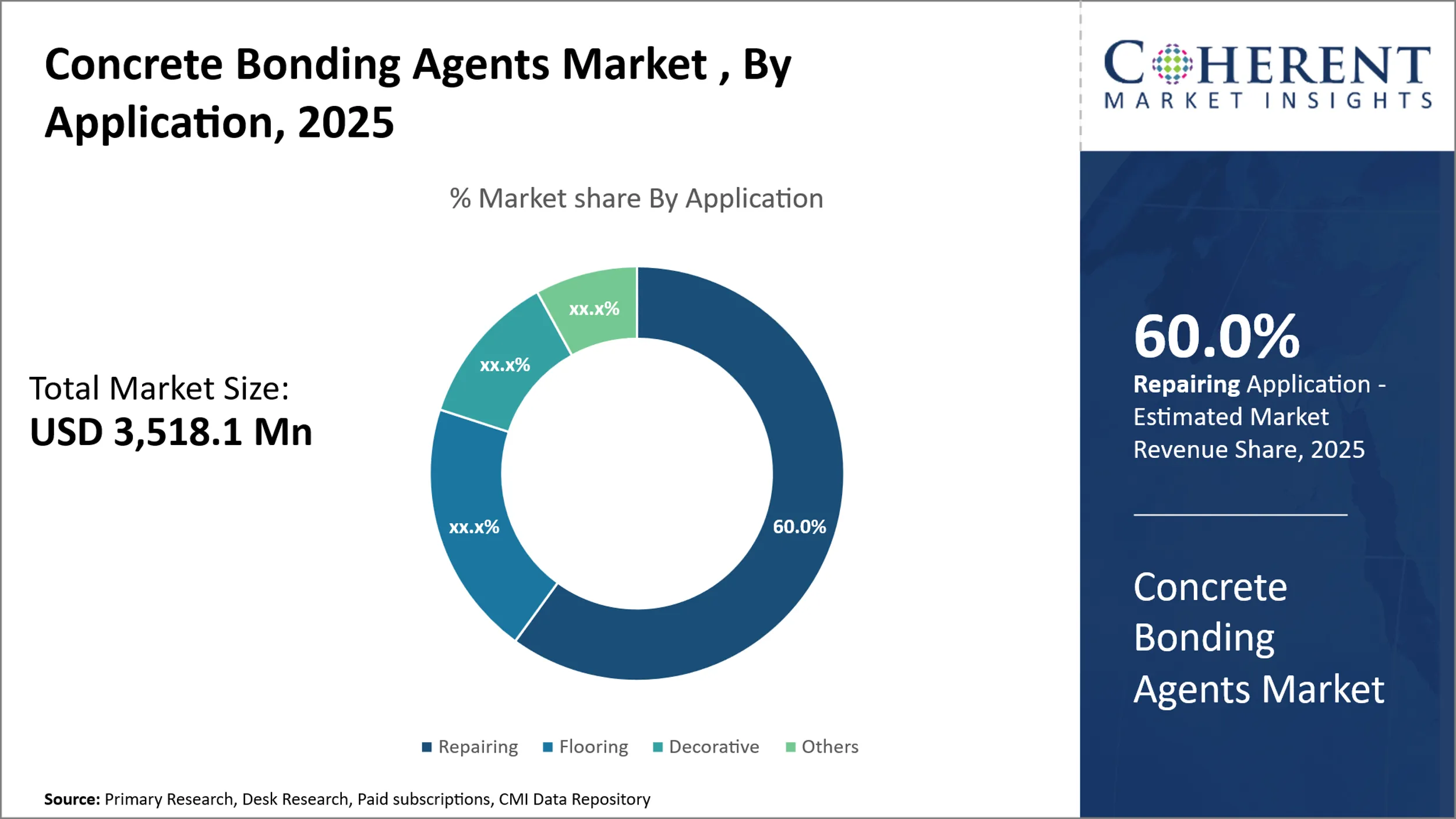
Concrete Bonding Agents Market Insights, By application
Among application, decorative segment is expected to witness the fastest growth in the global concrete bonding agents’ market over the forecast period and is expected to witness the fastest growth over the following decade. Growing urbanization and rising disposable income of people in Asia Pacific and Latin America regions leading to a growing need for well-furnished homes and luxurious residential apartments is one of the major factors driving the growth of the segment in the global concrete bonding agent’s market.
Global Concrete Bonding Agents Market - Regional Insights
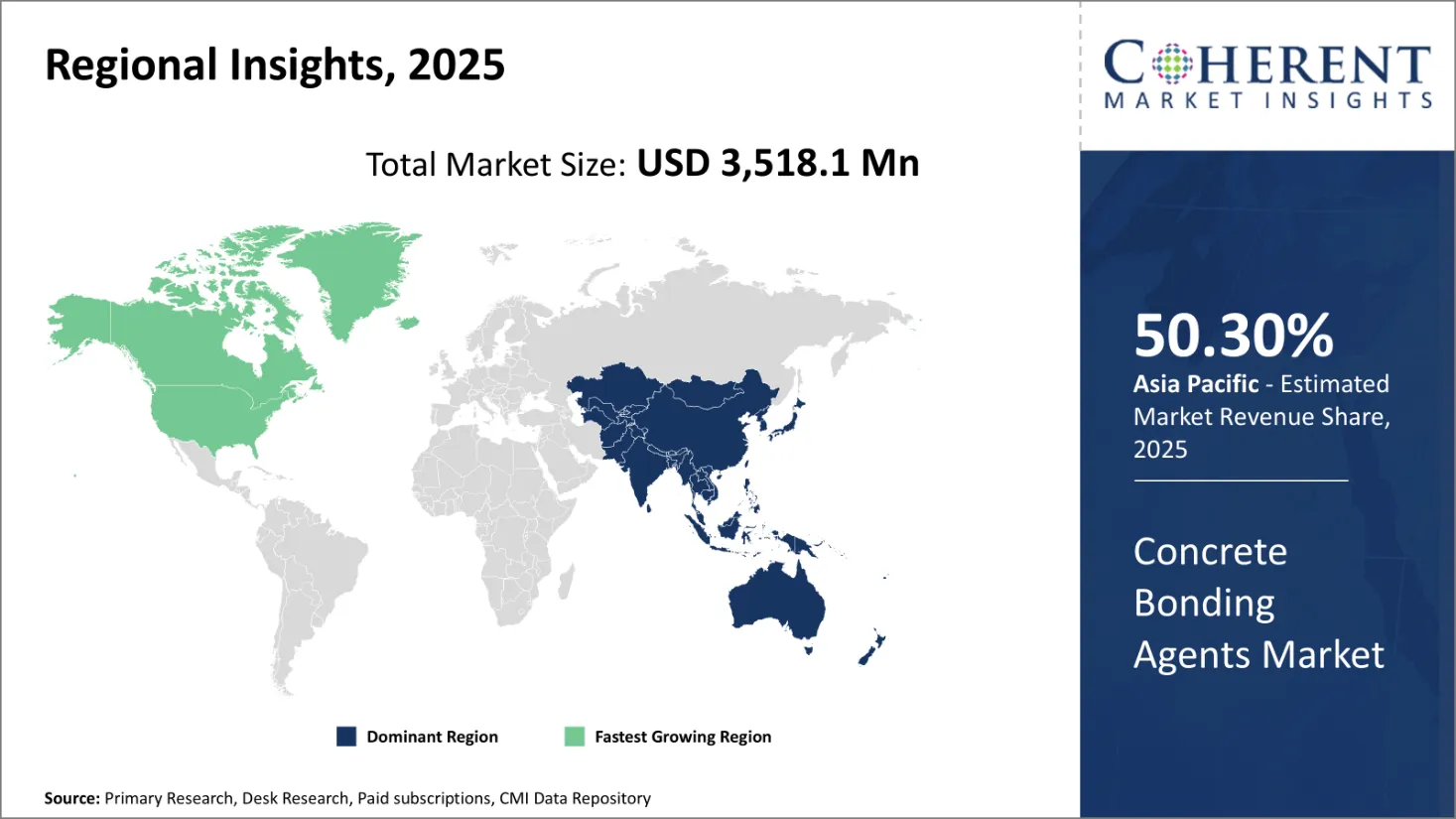
Asia Pacific, followed by North America and Europe, respectively accounted for a major share of the global concrete bonding agents market both in terms of revenue and volume in 2026 and the trend is estimated to remain the same over the forecast period. In 2026, Asia Pacific held a market share of 50.30% in terms of value in the global concrete bonding agent’s market.
Demand for repairing, flooring, and decorative activities in Asia Pacific is gaining unparalleled traction due to the flourishing building & construction sector, and the region emerging as a major economic hub has led to increasing development of commercial and industrial buildings. This, in turn, has positioned Asia Pacific as the growth engine for the global concrete bonding agents market over the forecast period. Growing urbanization and increasing construction activities especially in emerging economies of India and China are major factors fueling demand for effective repairing works, flooring, and decorative activities, subsequently fueling the growth of the global concrete bonding agents’ market in the region.
For instance, as per statistics released in 2022 by India Brand Equity Foundation (IBEF)—a Trust established by the Department of Commerce, Ministry of Commerce and Industry, Government of India—the Indian government plans to invest US$ 376.53 billion in infrastructure development over the following three years.
Concrete Bonding Agents Market Dominating Countries
United States Concrete Bonding Agents Market Analysis and Trend
The U.S. leads the North American market with its massive infrastructure network, increasing repair and reconstruction activity, and rigorous building codes. Drivers here are government spending on sustainable and resilient infrastructure and strong demand for advanced epoxy and acrylic bonding agents.
China Concrete Bonding Agents Market Analysis and Trend
China leads the Asia-Pacific market, fueled by rigorous urbanization, huge infrastructure projects, and a massive construction industry workforce. The country is also a leading producer and consumer of adhesives, supported by local manufacturing capacity and low-cost raw materials.
India Concrete Bonding Agents Market Analysis and Trend
India is emerging as a key market with its booming construction sector, with the help of projects like Smart Cities Mission and huge highway and metro projects. Increasing focus on affordable housing and infrastructure modernization is driving demand for cost-efficient bonding solutions.
Germany Concrete Bonding Agents Market Analysis and Trend
Germany is a European market leader, and stringent green policies coupled with emphasis on sustainable construction. The nation is embracing sophisticated, low-VOC adhesives, with innovation led by local players fueled by green initiatives from the EU.
Japan Concrete Bonding Agents Market Analysis and Trend
Japan's market is driven by its focus on earthquake-resistant building and infrastructure durability. The country invests heavily in high-quality bonding agents for retrofitting and reworking old buildings, with a focus on product quality and durability over time.
Market Report Scope
Concrete Bonding Agents Market Report Coverage
| Report Coverage | Details | ||
|---|---|---|---|
| Base Year: | 2025 | Market Size in 2026: | USD 3,815.4 Mn |
| Historical Data for: | 2020 To 2024 | Forecast Period: | 2026 To 2033 |
| Forecast Period 2026 to 2033 CAGR: | 8.4% | 2033 Value Projection: | USD 6,732.0 Mn |
| Geographies covered: |
| ||
| Segments covered: |
| ||
| Companies covered: | Major players in the global concrete bonding agents market include Sika AG, Fosroc International Ltd., BASF SE, Saint-Gobain Weber S.A., Mapei S.p.A., Dow Construction Chemicals, Lafarge Holcim, The Euclid Chemical Company, GCP Applied Technologies Inc, Dow Corning Corporation, and The Quikrete Companies, Inc. | ||
| Growth Drivers: |
| ||
| Restraints & Challenges: |
| ||
Concrete Bonding Agents Market Recent Development
- In March 2025 saw BASF and Sika launch Baxxodur EC 151, a new low-VOC epoxy hardener for concrete floor applications. The product provides fast curing even at low temperatures, high gloss, color stability, and emissions up to 90% lower than traditional hardeners, allowing for sustainable construction without sacrificing performance.
- In May 2024, Fischer Group launched a next-generation concrete bonding agent intended to be more flexible and stronger, particularly in outdoor conditions with varied temperatures. This new agent addresses increasing demand for long-lasting repair products used in infrastructure and weather-resistant construction ventures.
Analyst View
- The market for concrete bonding agents reflects strong momentum spurred by increasing infrastructure development processes and the increased focus on construction resilience in developed and emerging economies. Growing urbanization and the growing requirement for repair and rehabilitation of old infrastructure, especially in North America and Europe, are driving market demand significantly, particularly in concrete bonding agents market repair work where bonding agents play a vital role in increasing adhesion and durability.
- The growing trend within the construction sector toward green building and the use of new bonding technologies also fortify market opportunities, such as niche solutions for masonry walls of concrete bonding agents that enhance weather resistance and structural strength.
- Nonetheless, the market is subject to significant constraints such as severe environmental protection laws regulating chemical compositions and unstable raw material prices that affect manufacturers' profit margins. Also, complexity of application procedures and required skilled labor pose end-users' operating hurdles that may hamper market penetration in price-sensitive markets.
- Asia-Pacific stands out as the region growing the fastest, fueled by China, India, and Southeast Asia's huge investments in infrastructure, combined with industrialization and urban growth plans at a fast pace. The growth of the construction industry in the region and government efforts in building smart cities offer huge growth prospects.
- Key areas of opportunity include the creation of sustainable, low-VOC bonding agents that conform to green building regulations and sustainable practices. The convergence of nanotechnology and polymer-based offerings brings improved performance attributes, creating new avenues for application. Further, the increasing preference for prefabricated construction and modular building systems brings unexplored potential to specialist bonding solutions, setting the market for continued growth across a range of construction sectors.
Market Segmentation
- Global Concrete Bonding Agents Market, By Agent (Revenue, USD Mn, 2021 - 2033)
- Cementitious Latex Based Agents
- Acrylic
- SBR
- Polyvinylacetate
- Non-Re-emulsifiable
- Re-emulsifiable
- Epoxy Based Agents
- Others
- Cementitious Latex Based Agents
- Global Concrete Bonding Agents Market, By Application (Revenue, USD Mn, 2021 - 2033)
- Repairing
- Flooring
- Decorative
- Others
- Global Concrete Bonding Agents Market, By Region (Revenue, USD Mn, 2021 - 2033)
- North America
- U.S.
- Canada
- Europe
- UK
- Germany
- Italy
- France
- Russia
- Rest of Europe
- Asia-Pacific
- China
- India
- Japan
- ASEAN
- Australia
- South Korea
- Rest of Asia Pacific
- Latin America
- Brazil
- Mexico
- Rest of Latin America
- Middle East
- GCC
- Israel
- Africa
- North Africa
- Central Africa
- South Africa
- North America
- Company Profiles
- Sika AG
- Fosroc International Ltd.
- DOW Corning Corporation
- GCP Applied Technologies, Inc.
- The Euclid Chemical Company
- Saint-Gobain Weber S.A.
- Mapei S.P.A.
- BASF SE
- Lafargeholcim
- The DOW Chemical Company
- The Quikrete Companies
Sources
Primary Research Interviews
- Construction Material Manufacturers
- Concrete Bonding Agent Suppliers
- Construction Industry End users
- Building Contractors and Applicators
- Others
Databases
- Construction Industry Database (CID)
- Global Building Materials Database
- Chemical Industry Database
- Construction Statistics Portal
- Others
Magazines
- Concrete Construction Magazine
- Construction Materials Today
- Building Products Digest
- Chemical Week Magazine
- Others
Journals
- Journal of Construction and Building Materials
- Cement and Concrete Research
- Construction Materials and Structures Journal
- Others
Newspapers
- Construction Dive
- Engineering News Record (ENR)
- Building Design + Construction
- Construction Week
- Others
Associations
- American Concrete Institute (ACI)
- National Ready Mixed Concrete Association (NRMCA)
- International Concrete Repair Institute (ICRI)
- Construction Industry Manufacturers Association (CIMA)
- Others
Public Domain Sources
- Government Construction Statistics
- Building Code Standards and Regulations
- Construction Industry White Papers
- Technical Construction Guidelines
- Others
Proprietary Elements
- CMI Data Analytics Tool
- Proprietary CMI Existing Repository of information for last 8 years
Get access to 250+ pages report
Every segment, forecast, competitor profile and data table behind the analysis above — available for instant download.
- ESOMAR Member
- ISO 9001:2015 Certified
- D-U-N-S Registered
- GDPR & CCPA Compliant
Missing comfort of reading report in your local language? Find your preferred language:
Transform your Strategy with Exclusive Trending Reports
Frequently Asked Questions
The Concrete Bonding Agents Market size is estimated to be valued at USD 3,815.4 Mn in 2026, and is expected to reach USD 6,732.0 Mn by 2033.
Major players in the market include Sika AG, Fosroc International Ltd., BASF SE, Saint-Gobain Weber S.A., Mapei S.p.A., Dow Construction Chemicals, Lafarge Holcim, The Euclid Chemical Company, GCP Applied Technologies Inc, Dow Corning Corporation, and The Quikrete Companies, Inc.
Repairing was the largest application segment and accounted for the highest demand in the market.
The main types of concrete bonding agents include epoxy-based, latex-based (acrylic), and polyvinyl acetate (PVA)-based agents, each offering unique adhesion and durability properties.
Concrete bonding agents help overcome challenges such as cold joints, surface cracking, delamination, and poor adhesion between old and new concrete surfaces.
Essential surface preparation includes cleaning the substrate thoroughly to remove dust, grease, laitance, and loose particles, and ensuring it is sound, slightly damp, and free from contaminants.
The CAGR of the global Market is projected to be 8.4% from 2026 to 2033.