

Trawl Ropes and Nets Market Size and Share Analysis – Growth Trends and Forecasts (2026–2033)
The Trawl Ropes and Nets Market Size is expected to grow at a CAGR of 4.8%, from USD 2.69 Bn in 2026 to USD 3.75 Bn by 2033. The growth of the fishing equipment market is mainly driven by increasing demand for commercial fishing equipment, increasing industrial fishing activities, rising adoption of high strength synthetic ropes and nets, and rising investments in sustainable and durable fishing gear. The market is driven by growing use of trawl nets made of polyethylene, polypropylene and nylon, owing to their enhanced tensile strength, abrasion resistance and operational efficiency. The Food and Agriculture Organization of the United Nations (FAO) reports that global marine capture fisheries production was around 80 million tons in 2024, showing the vast scale of commercial fishing operations worldwide.
Key Takeaways
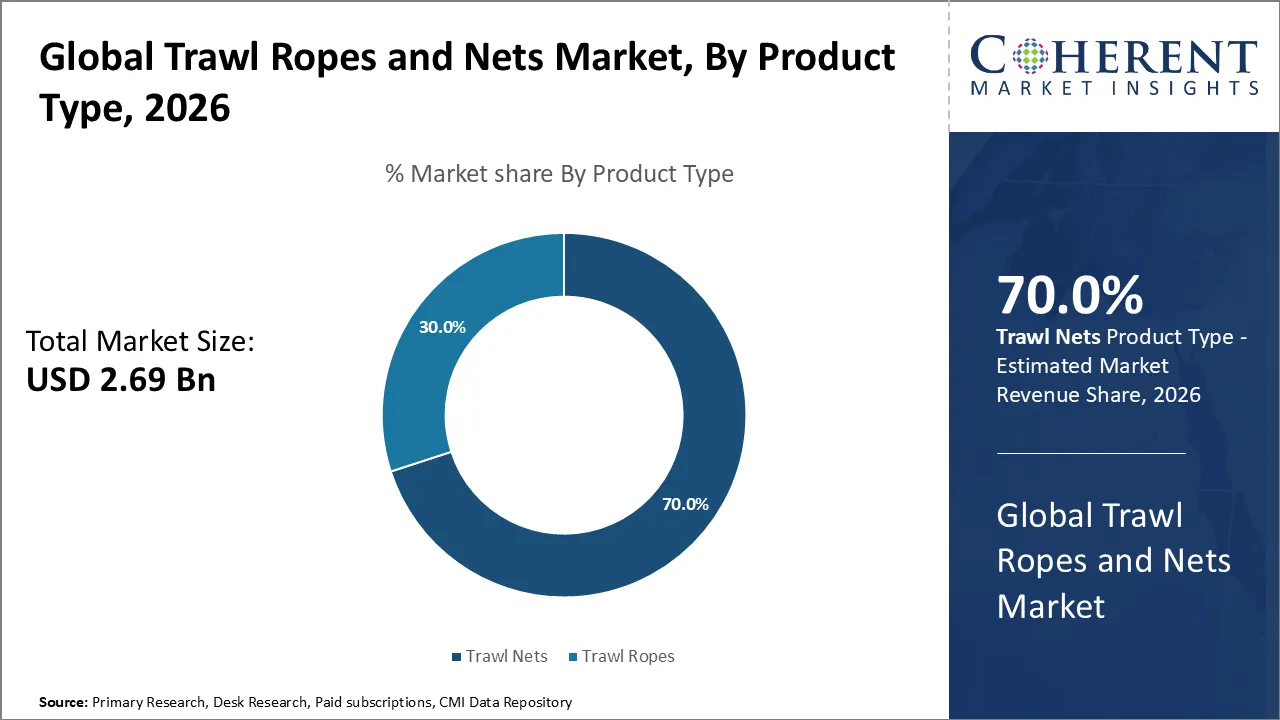
- The Trawl Nets segment is projected to have the largest market share of 70.0% in 2026. The segment’s growth is attributable to increasing commercial fishing activities, demand for high-strength polyethylene and nylon netting and replacement of traditional fishing gear with durable and abrasion resistant materials.
- The Marine segment is projected to lead the market with a market share of 95.0% in 2026. The segment’s growth is driven by extensive offshore fishing activities, rising demand for specialized trawling equipment, and continued investments in commercial fishing operations. According to the North Pacific Fishery Management Council’s 2026 bycatch report, the trawl fisheries in the Bering Sea/Aleutian Islands and Gulf of Alaska took an estimated 1.89 million tons of total catch in 2025, clearly showing the scale of marine trawling operations.
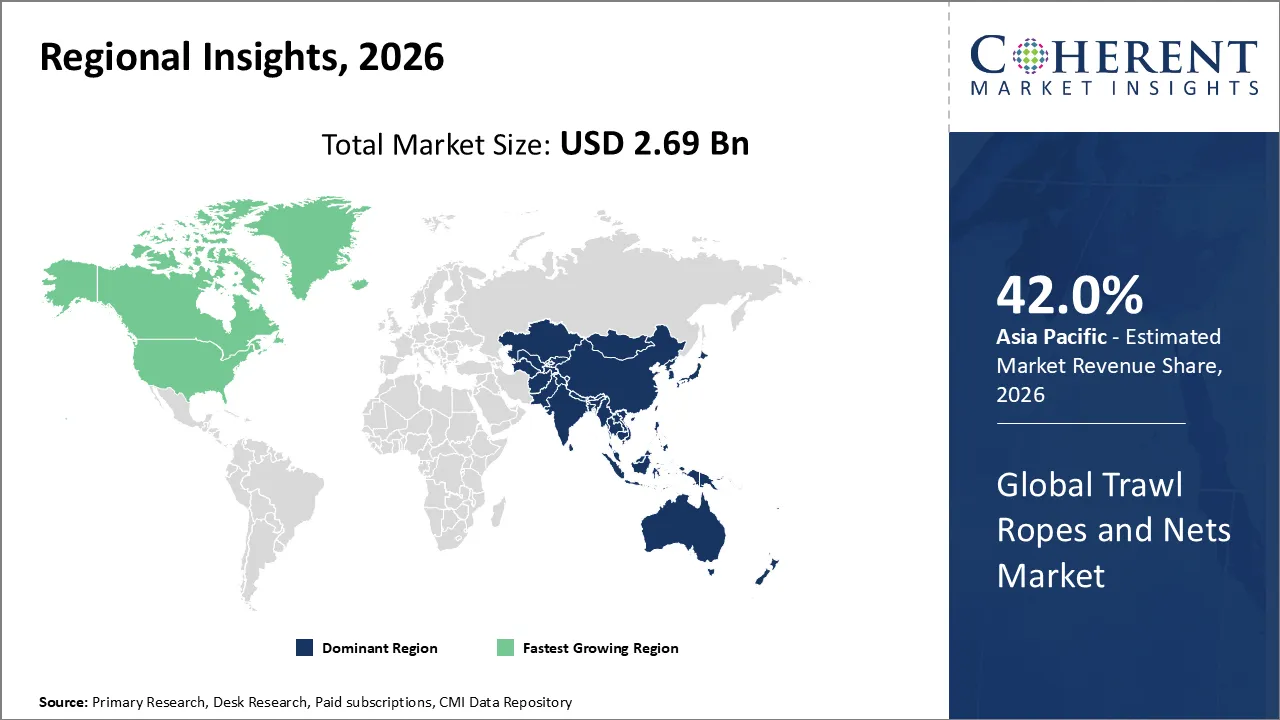
- Asia Pacific is anticipated to dominate the market with 42.0% share in 2026. Growing use of synthetic fishing nets and ropes and established commercial fishing industries in China, Indonesia, India, Japan and Southeast Asia are supporting regional demand. According to the FAO’s June 2026 publication, Asia accounted for about 63% of global marine capture fisheries production in 2024, with China, Indonesia, India, Viet Nam and Japan together contributing 37% of global marine capture production, highlighting the region’s significant commercial fishing operations.
Market Drivers
Increasing Adoption of Advanced and Selective Fishing Gear is Driving the Trawl Ropes and Nets Market
Growth opportunities are present in the Al Trawl Ropes and Nets Market due to rising demand for technologically advanced fishing equipment, enhanced net durability, and increased focus on reducing bycatch in commercial fisheries. Increasingly, fishing operators are concentrating on specialized trawl net configurations, improved mesh designs, and high-strength synthetic ropes to improve operational efficiency and reduce the unintended capture of marine species. The rising demand for sustainable fishing is prompting manufacturers to develop more selective and robust trawling gear.
According to the U.S. National Oceanic and Atmospheric Administration (NOAA) has announced the availability of approximately USD 4.6 million in funding under the 2026 Bycatch Reduction Engineering Program to support collaborative research on new fishing gear technologies and better fishing practices.
In December 2025, the Council of the European Union agreed to keep fishing effort levels for western Mediterranean trawlers the same as in 2026, while continuing incentives for operators who use more selective fishing gear. These developments are creating opportunities for manufacturers of advanced trawl nets, special ropes and fishing equipment with an environmental edge.
Rising Need for Fishing Gear Replacement and Sustainable Net Management is Supporting Market Growth
The global Trawl Ropes and Nets Market is experiencing increasing demand for replacement, maintenance and sustainable management of fishing gear, which has emerged as a key driver. In commercial fishing operations, trawl ropes and nets are constantly subjected to mechanical stress, abrasion, strong ocean currents and harsh marine conditions. These operational conditions create an ongoing demand for durable synthetic ropes, abrasion resistant netting and replacement fishing gear.
According to Fisheries and Oceans Canada, the country’s Ghost Gear Program had recovered some 45,237 units of fishing gear and 976 kilometers of rope, and some 2,543 tons of fishing gear and aquaculture debris, excluding ropes and buoys, as of December 2025. These figures show how much fishing gear is lost at sea and the need for better management of gear and material recovery.
Furthermore, the European Maritime, Fisheries and Aquaculture Fund (EMFAF) of the European Commission has allocated approximately EUR 6.11 billion for 2021–2027 to support sustainable fisheries, coastal communities and the development of aquaculture. While this funding is not explicitly for fishing gear, it creates a broader investment framework for the transition to environmentally responsible fishing practices. Such initiatives are anticipated to spur innovation in recyclable netting, durable synthetic fibers and improved designs of fishing equipment.
Current Events and Their Impact on the Trawl Ropes and Nets Market
Current Event | Description and its Impact |
European Union Introduces 2026 Fishing Opportunities and Incentives for Selective Trawl Gear (December 2025) |
|
European Commission Strengthens Fishing Gear Waste Monitoring and Producer Responsibility (April 2026) |
|
- Current Industry Events of 2026
- Market Size Estimation
- Regional Breakdown
- Competitive Landscape
- Customer Intelligence
- Segmental Analysis
- Pricing Analysis
- Key Market Drivers, Challenges & Future Trends
- Customized Insights Section
Segmental Insights
Why Are Trawl Nets Acquiring the Largest Market Share?
Based on product type, the Trawl Nets segment is projected to dominate the Trawl Ropes and Nets Market share with a maximum of 70.0% in 2026. The segment is growing due to the widespread use of trawl nets in commercial fishing activities, increasing demand for high strength polyethylene and nylon-based netting, and the adoption of advanced mesh configurations to improve fishing efficiency and reduce unintended catches. The increasing focus on selective fishing technologies is also leading to the replacement and upgrading of traditional trawl nets.
In November 2025, the U.S. National Oceanic and Atmospheric Administration (NOAA) reported that properly installed turtle excluder devices (TEDs) were approximately 97% effective in excluding sea turtles from shrimp trawl nets. These devices also reduce unwanted catches and accumulation of marine debris, improving operational efficiency and minimizing net damage.
In November 2025, Faroese fishing gear manufacturer Vónin introduced its new Gannet3000 blue whiting trawl net, designed to improve fishing efficiency, catch performance, and handling in commercial pelagic fisheries.
Why Is the Marine Segment Holding the Largest Market Share?
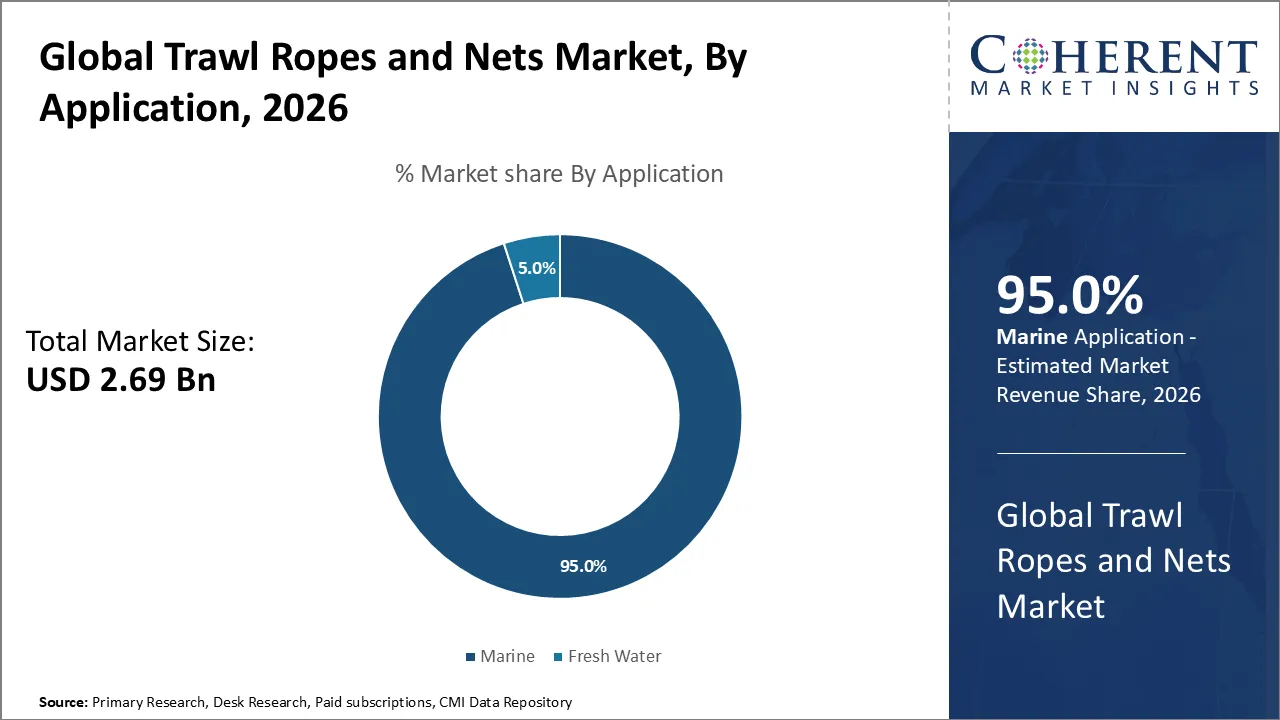
Based on application, the Marine segment is estimated to account for a 95.0% share in the global Trawl Ropes and Nets Market in 2026. The importance of the segment is attributed to large commercial fishing operations in coastal and offshore areas, growing demand for durable fishing equipment, and the widespread use of bottom and midwater trawling systems. Moreover, replacement of worn out fishing nets and ropes and adoption of specialized trawling equipment for different marine species also support the demand.
In December 2025, the Council of the European Union said it will increase fishing opportunities for Norway lobster in the Bay of Biscay (excluding the south) by 54% for 2026, following positive scientific advice and improvements in the condition of fish stocks. Commercial fishing of norway lobster is made with bottom-trawl gear. Expanded fishing opportunities may provide for equipment utilization and replacement demand for participating fleets.
Additionally, the Food and Agriculture Organization of the United Nations (FAO) reported that the global trade of aquatic animal products was valued at around USD 184 billion in June 2026, with more than one-third of the global aquatic production traded globally. “This highlights the economic scale of the global seafood industry and the ongoing need for efficient marine fishing operations, and specialized fishing equipment including high-performance trawl ropes and nets.
Trawl Ropes and Nets Market Trends
- The use of more energy efficient trawl nets and low drag fishing gear will encourage manufacturers to develop optimized net geometries, thinner high strength twines and improved mesh configurations. In September 2026, a study published in Frontiers in Fish Science found that an experimentally optimized bottom trawl reduced hydrodynamic drag by 26.7% and fuel consumption by 15.0% when towed compared to conventional fishing gear. "This promotes innovation in the design of energy efficient trawl nets
- There is an increasing focus on selective fishing nets and bycatch reduction technologies. Specific sorting grids, T90 codends and modified trawl net designs are being developed. A September 2026 study published in Ecological Informatics found that experimental sorting grids and T90 codends reduced juvenile fish catches and some unwanted catches in Mediterranean crustacean trawl fisheries. These advances are encouraging uptake of selective fishing equipment, but the study also highlighted potential trade-offs in terms of revenue.
- Growing interest in biodegradable and eco-friendly fishing materials has driven research into alternatives to traditional polyethylene and nylon fishing nets. Marine Pollution Bulletin, February 2025. In-situ biological degradation of biodegradable PBS/PBAT monofilaments for trawl nets after three years’ aging in seawater at 15 and 25 °C.
Regional Insights
Asia Pacific Dominates Owing to Expanding Commercial Fishing Operations and Government Support for Deep-Sea Fisheries
Asia Pacific is anticipated to hold the largest Trawl Ropes and Nets Market share of 42.0% in 2026. The region’s dominance is fueled by its extensive commercial fishing industry, existing infrastructure for manufacturing fishing gear, and increasing application of high strength synthetic nets and ropes in China, India, Indonesia, Japan, and Southeast Asia. In addition, the demand for durable and efficient trawling equipment is being driven by rising government investments in deep-sea fishing fleets and fisheries modernization.
As of March 5, 2026, the Government of India’s Ministry of Fisheries, Animal Husbandry and Dairying said that 707 fishing vessels have been issued access passes to operate in the country’s Exclusive Economic Zone. This initiative is strengthening the regulatory framework for offshore fishing activities and encouraging opportunities for specialized marine fishing equipment.
In September 2026, the Government of India also announced an outlay of INR 2,500 crore under the Pradhan Mantri Matsya Sampada Yojana (PMMSY) for FY 2026–27. The scheme encourages development, modernization and technology adoption in the fisheries infrastructure which may indirectly boost the demand for advanced trawl nets, synthetic fishing ropes and commercial fishing equipment.
North America Trawl Ropes and Nets Market Trends
North America Trawl Ropes and Nets market is expected to be the fastest growing region in the period 2026-2033. Investments in innovative fishing gear, increased focus on sustainable commercial fishing, and the adoption of advanced trawl nets and synthetic ropes are driving regional growth opportunities. The U.S. and Canada are working to improve fisheries management efforts to reduce bycatch, improve the efficiency of fishing gear and reduce impacts to the seabed. These developments are driving the creation of selective trawl nets, altered rope configurations and sophisticated fishing equipment.
In June 2026, the North Pacific Fishery Management Council approved ongoing research on pelagic trawl gear innovation, including experimental modifications to fishing equipment to reduce seabed contact. The Council also moved forward in its review of gear changes, operational standards and possible restrictions on fishing areas. These developments offer opportunities for manufacturers of more environmentally friendly trawl nets and ropes.
Furthermore, Fisheries and Oceans Canada say the Canadian government is aiming for 40% adoption of electronic reporting for lost fishing gear by March 2027 compared to its current reporting arrangements. This action is part of Canada’s efforts to improve accountability for fishing gear and to reduce abandoned, lost or discarded fishing gear.
Federal Fisheries Research Funding and Advanced Trawl Gear Innovation Are Supporting the U.S. Trawl Ropes and Nets Market
The U.S. Trawl Ropes and Nets Market is witnessing growth opportunities owing to increased investments in fisheries research, adoption of advanced trawling technologies, and greater emphasis on efficient and environmentally responsible commercial fishing operations. Equipment is being modernized in key commercial fishing areas such as Alaska, the Gulf of Maine, and the Pacific Coast, as the use of high-strength synthetic netting, specialty trawl ropes, and optimized fishing gear designs increases.
According to the National Oceanic and Atmospheric Administration (NOAA) said its Cooperative Research Program was funded with USD 8 million for FY 2026 to help research partnerships with the commercial fishing industry. The agency also said it partnered with the Bering Sea Fisheries Research Foundation and Alaska Seafood Cooperative to improve fisheries surveys, reduce impacts from fishing gear and minimize non-target crab bycatch.
In April 2026, NOAA Fisheries and the Virginia Institute of Marine Science began Phase I of an industry-based bottom trawl survey with the F/V Darana R. The project evaluated trawl gear performance at different depths, and sampling efficiency and operations near offshore infrastructure.
China Trawl Ropes and Nets Market Trends
China is anticipated to experience a sustained demand in the Trawl Ropes and Nets Market during the forecast period, due to its massive marine fishing industry, well-established synthetic fishing gear manufacturing industry, and growing attention toward modernizing commercial fishing operations. The country’s large fleet of fishing vessels and growing distant-water fisheries activities are creating opportunities for high-strength trawl nets, synthetic ropes and specialized fishing gear. However, domestic fishing restrictions and sustainability requirements may affect equipment demand in individual fisheries.
In January 2026, Shanghai Ocean University announced the development of an artificial intelligence-based prediction model for trawl net codend hydrodynamic performance. The research team developed and experimentally evaluated 12 trawl codend models with different design parameters, using machine learning algorithms to predict water resistance, oscillation characteristics, and net performance.
Who are the Major Companies in Trawl Ropes and Nets Industry
Some of the major key players in Trawl Ropes and Nets Market are Koninklijke DSM N.V., Jaya Nets Sdn. Bhd., Nitto Seimo Co., Ltd., Hampidjan Group, King Chou Marine Technology, Azuka Synthetics LLP, LFS Inc., and Carlsen Net A/S.
Key News
- In April 2026, Hampiðjan Group announced the successful commercial deployment of its Flow Gear hopper footropes, developed in collaboration with Mørenot. The system replaces conventional rubber rockhopper components with semi-circular heavy-plastic sections to improve bottom-trawl performance and reduce seabed contact.
- In September 2025, Nitto Seimo Co., Ltd., Toray Industries, and Tateura Fisheries Cooperative announced an expansion of their fishing-net-to-fishing-net recycling initiative. Under the collaboration, Toray developed polyester yarn incorporating recycled manufacturing scraps, while Nitto Seimo manufactured fishing nets using the resulting material.
Market Report Scope
Trawl Ropes and Nets Market Report Coverage
Report Coverage | Details | ||
Base Year: | 2025 | Market Size in 2026: | USD 2.69 Bn |
Historical Data for: | 2020 to 2024 | Forecast Period: | 2026 to 2033 |
CAGR: | 4.8% | 2033 Value Projection: | USD 3.75 Bn |
Geographies covered: |
| ||
Segments covered: |
| ||
Companies covered: | Koninklijke DSM N.V., Jaya Nets Sdn. Bhd., Nitto Seimo Co., Ltd., Hampidjan Group, King Chou Marine Technology, Azuka Synthetics LLP, LFS Inc., and Carlsen Net A/S. | ||
Growth Drivers: |
| ||
Restraints & Challenges: |
| ||
Analyst Opinion
- The increasing demand for robust and efficient fishing gear, especially in commercial marine fisheries is expected to benefit the Trawl Ropes and Nets Market. Manufacturers are seeking to improve net strength, abrasion resistance and gear longevity to reduce operational losses and replacement costs. In a June 2026 study in the journal Conservation, 1,864 Vietnamese capture fishers reported annually abandoning, losing or discarding an average of about 82,720 kg of fishing gear, with trawl fisheries losing an average of 8.8 kg of gear per vessel per year.
- Increasing environmental concerns and governmental efforts to reduce marine pollution are pushing for innovation of recyclable fishing nets and sustainable rope materials. In September 2025, the Nordic Council of Ministers report indicates that Nordic countries were estimated to lose about 518–1,035 tons of fishing gear with nets annually, which illustrates the scope of marine fishing gear pollution. The report points to better recycling, recovery and reuse practices, which could lead to opportunities for manufacturers of recyclable synthetic nets, improved gear identification systems and circular material solutions.
- Technological advances in fishing gear materials should offer long-term market opportunities, especially for manufacturers who are designing high-strength synthetic ropes, lightweight netting and environmentally sound fishing equipment. According to the United Nations Conference on Trade and Development (UNCTAD), its 2025 assessment of fishing nets and fishing gear identified polyamide and polyethylene as widely used conventional materials, while highlighting the limited commercial availability of practical substitutes for fossil-based nylon fishing gear.
Speak to the analyst
Want personalized insights?
Take the findings above to one of our principal consultants, or have the report rebuilt around the segments, geographies and competitors you actually track.
Market Segmentation
- By Product Type (Revenue, USD Bn, 2021-2033)
- Trawl Ropes
- Trawl Nets
- Bottom Trawls Net
- Midwater Trawls Net
- By Application (Revenue, USD Bn, 2021-2033)
- Marine
- Fresh Water
- By Region (Revenue, USD Bn, 2021-2033)
- North America
- U.S.
- Canada
- Latin America
- Brazil
- Mexico
- Argentina
- Rest of Latin America
- Europe
- Germany
- U.K.
- France
- Italy
- Spain
- Russia
- Rest of Europe
- Asia Pacific
- China
- India
- Japan
- Australia
- South Korea
- ASEAN
- Rest of Asia Pacific
- Middle East
- GCC
- Israel
- Rest of Middle East
- Africa
- South Africa
- Central Africa
- North Africa
- North America
- Key Players
- Koninklijke DSM N.V.
- Jaya Nets Sdn. Bhd.
- Nitto Seimo Co., Ltd.
- Hampidjan Group
- King Chou Marine Technology
- Azuka Synthetics LLP
- LFS Inc.
- Carlsen Net A/S.
Sources
Primary Research Interviews
- Trawl ropes and fishing nets manufacturers
- Commercial fishing vessel owners and fleet operators
- Fishing gear distributors and suppliers
- Marine fishing equipment procurement managers
- Synthetic fiber, polyethylene, polypropylene, and nylon manufacturers
- Fishing gear design engineers and R&D professionals
- Fisheries scientists and marine technology researchers
- Deep-sea fishing operators and trawling industry experts
- Key opinion leaders (KOLs) in commercial fisheries and sustainable fishing technologies
Databases
- Food and Agriculture Organization of the United Nations (FAO) – FishStat
- UN Comtrade Database
- World Bank – Fisheries and Aquaculture Data
- Organisation for Economic Co-operation and Development (OECD)
- National Oceanic and Atmospheric Administration (NOAA) – Fisheries Statistics
- European Commission – Eurostat Fisheries Statistics
- International Trade Centre (ITC) – Trade Map
- Fisheries and Oceans Canada (DFO) – Fisheries Statistics
Magazines
- National Fisherman
- Fishing News International
- World Fishing & Aquaculture
- The Fishing Daily
- IntraFish
- SeafoodSource
- Commercial Fishing Industry News
Journals
- Fisheries Research
- Marine Policy
- Fish and Fisheries
- Aquaculture
- Ocean & Coastal Management
- Marine Pollution Bulletin
- Journal of Marine Science and Engineering
- ICES Journal of Marine Science
Newspapers
- The Guardian
- Financial Times
- The New York Times
- The Wall Street Journal
- The Economic Times
- South China Morning Post
Associations
- International Council for the Exploration of the Sea (ICES)
- FAO – Committee on Fisheries (COFI)
- Global Ghost Gear Initiative (GGGI)
- National Fisheries Institute (NFI)
- International Seafood Sustainability Foundation (ISSF)
- European Association of Fish Producers Organisations (EAPO)
- Responsible Fishing Vessel Standard (RFVS)
- ICES–FAO Working Group on Fishing Technology and Fish Behaviour (WGFTFB)
Public Domain Sources
- Company Annual Reports and Investor Presentations
- Government Fisheries Statistics and Policy Publications
- FAO Fisheries and Aquaculture Reports
- NOAA Fisheries Research and Commercial Fishing Reports
- European Commission Fisheries Regulations and Policy Documents
- University Research Publications on Fishing Gear Technologies
- Patent Databases such as WIPO, USPTO, and Google Patents
- Publicly Available Fishing Gear Innovation and Sustainability Reports
- Regulatory and Standards Publications Related to Commercial Fishing, Marine Conservation, and Fishing Gear Management
Proprietary Elements
- CMI Data Analytics Tool
- Proprietary CMI Existing Repository of Information for the Last 10 Years
Get access to 250+ pages report
Every segment, forecast, competitor profile and data table behind the analysis above — available for instant download.
- ESOMAR Member
- ISO 9001:2015 Certified
- D-U-N-S Registered
- GDPR & CCPA Compliant
Missing comfort of reading report in your local language? Find your preferred language:
Transform your Strategy with Exclusive Trending Reports
Frequently Asked Questions
The Trawl Ropes and Nets Market is expected to reach USD 3.75 Bn in 2033, increasing from USD 2.69 Bn in 2026.
Major players operating in the global Trawl Ropes and Nets Market include Koninklijke DSM N.V., Jaya Nets Sdn. Bhd., Nitto Seimo Co., Ltd., Hampidjan Group, King Chou Marine Technology, Azuka Synthetics LLP, LFS Inc., and Carlsen Net A/S.
High initial investment and replacement costs, stringent government regulations on trawl fishing, environmental concerns regarding seabed damage, and fluctuating raw material prices are key factors hampering market growth.
Increasing commercial fishing activities, growing adoption of high-strength synthetic ropes and nets, rising demand for durable fishing equipment, and advancements in selective trawling technologies are driving market growth.
The Trawl Ropes and Nets Market is anticipated to grow at a CAGR of 4.8% between 2026 and 2033.
Asia Pacific is estimated to account for the largest market share of 42.0% in 2026, supported by extensive commercial fishing activities in China, India, Japan, Indonesia, and Southeast Asia.
Trawl ropes and nets are specialized fishing equipment used in commercial trawling operations to capture fish and other marine species. They are commonly manufactured using synthetic materials such as polyethylene, polypropylene, and nylon.