

Global Fishing Nets Market Size and Forecast – 2026 To 2033
The Global Fishing Nets Market is estimated to be valued at USD 2.35 Bn in 2026 and is expected to reach USD 3.80 Bn by 2033, exhibiting a compound annual growth rate (CAGR) of 7.1% from 2026 to 2033. Growth is supported by active commercial fishing, expanding aquaculture farms, and recurring replacement of gill nets, trawl nets, seine nets, and cage nets. Demand is also moving toward stronger nylon and polyethylene nets that offer longer service life, better resistance to wear, and lower operating costs.
For instance, the Norwegian Seafood Council’s July 2025 update reported that Norway exported 1.3 million tons of seafood worth USD 8.98 million in the first half of 2025, its best first-half export value. This indicates strong seafood trade activity and supports continued demand for reliable fishing and aquaculture net systems. (Source: Norwegian Seafood Council)
Key Takeaways of the Global Fishing Nets Market
- Commercial fishing is expected to account for 64.7 % of the fishing nets market in 2026, supported by regular net replacement across trawl, seine, gill and lift net operations. Food and Agriculture Organization (FAO) reported in June 2024, that global fisheries and aquaculture production reached a record level in 2022, with capture fisheries remaining a major production base for fishing gear demand. (Source: Food and Agriculture Organization (FAO))
- Nylon is expected to hold 46.8 % share in 2026, reflecting its application in high-tension fishing and aquaculture nets owing to its durability and lifecycle performance. In May 2025, full-size fish farming cages made entirely from recycled nylon were put into use under the Circular Fish Farming Nets project, strengthening nylon’s role in circular net design. (Source: Hampiðjan EN)
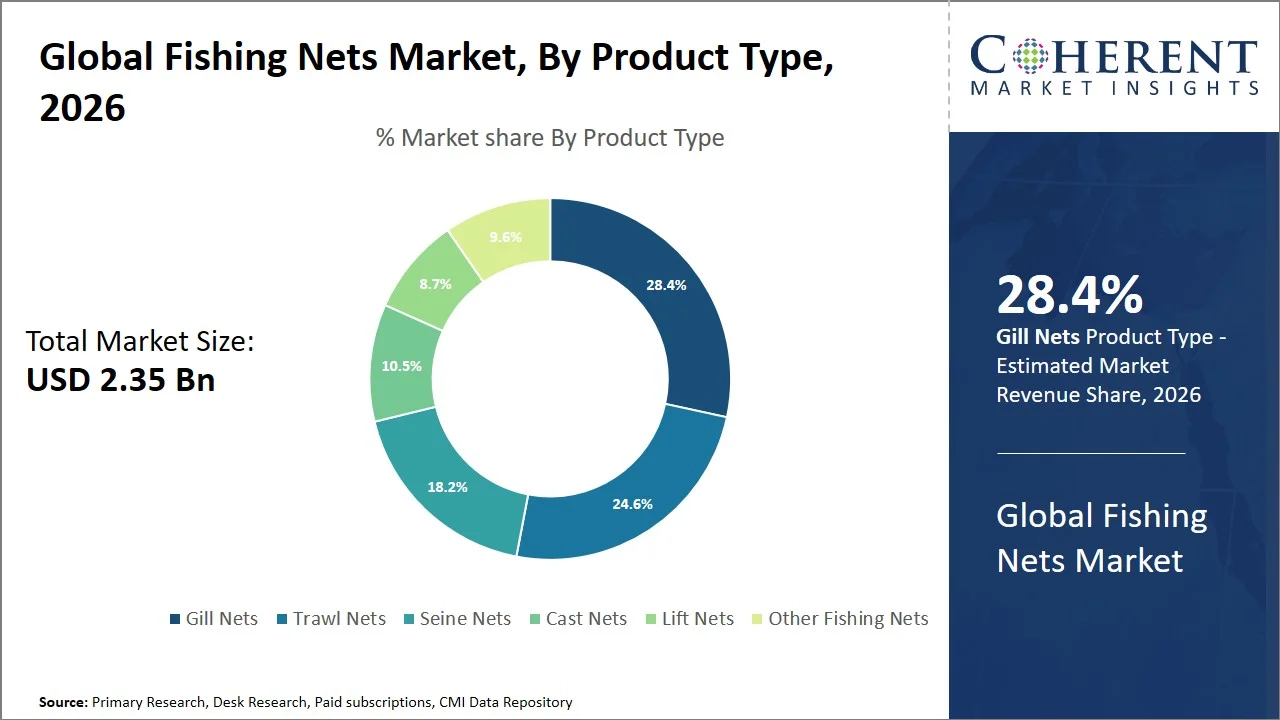
- Gill nets are expected to hold 28.4 % share in 2026, backed by their wide use in small-scale and commercial fisheries due to easy deployment, species selectivity, and suitability for surface, midwater, and bottom fishing. For example, the gillnet gear guidance of January 2026 from NOAA Fisheries highlights mesh-size design, target-species alignment and regulatory control in commercial gillnet operations. (Source: National Oceanic and Atmospheric Administration)
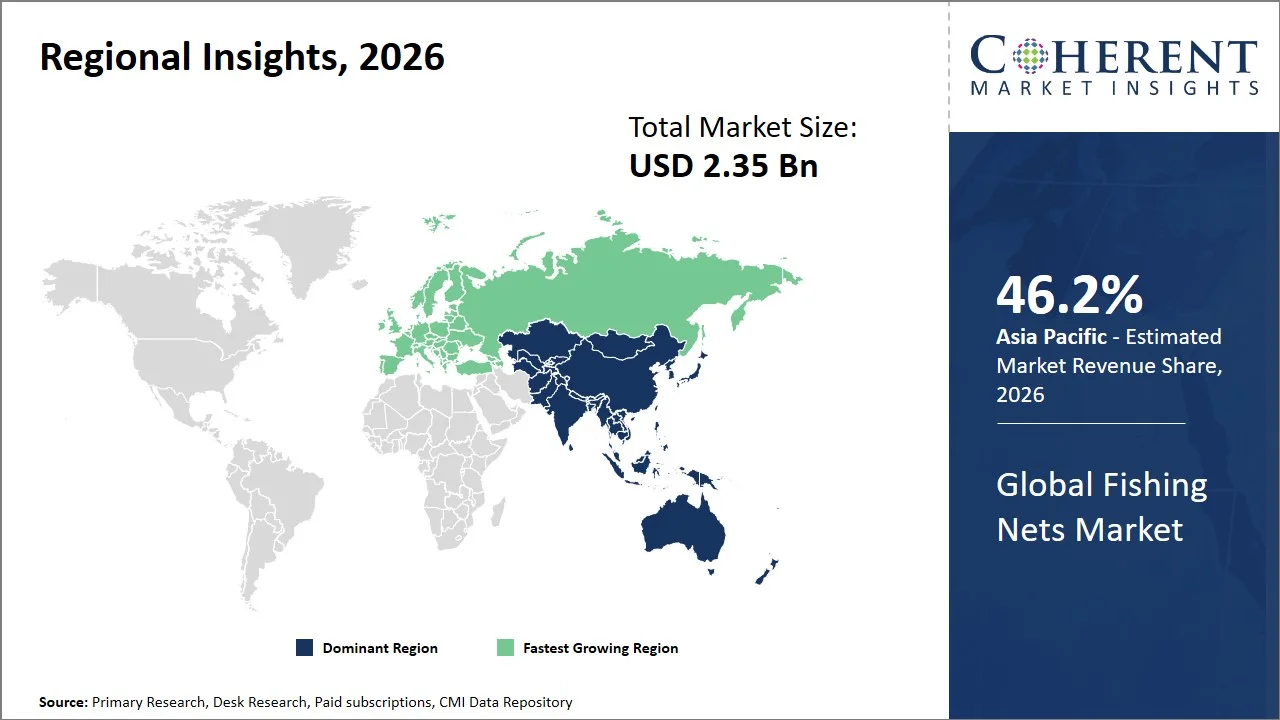
- The Asia Pacific region is anticipated to lead with a 46.2 % share in 2026, driven by large-scale fishing fleets, aquaculture clusters, and cost-competitive net manufacturing. In February 2025, Hampiðjan agreed to acquire 75.1% of India's Kohinoor Ropes, reinforcing the company's regional production capacity for nets and ropes (Source: Hampidjan EN)
- Europe is expected to account for 18.5 % share in 2026 and is positioned as the fastest-growing region due to sustainability-led gear replacement and circular material adoption. In June 2025, the European Commission adopted the European Ocean Pact, including plans to develop a Vision 2040 for fisheries and aquaculture. (Source: European Commission)
- Shift toward sustainable nets: Sustainability is becoming a key purchasing factor as fishing and aquaculture buyers evaluate polymer waste, recyclability and marine leakage risks. The Circular Fish Farming Nets project demonstrated that recycled nylon can be used in full-size aquaculture cages, creating a stronger pathway for commercial-scale reuse of end-of-life fishing nets. (Source: Vónin P/F)
- Premium engineered containment: Suppliers are shifting from commodity mesh toward engineered containment systems that improve fish welfare, predator resistance and operational reliability. AKVA Group highlighted its collaboration with Nofir, Aquafil, Grieg Seafood and Hampiðjan to develop circular farming nets, showing how innovation is moving toward higher-value and sustainability-oriented net systems. (Source: AKVA group)
Segmental Insights
Why Do Gill Nets Dominate the Global Fishing Nets Market?
Gill nets are expected to dominate the product type segment with 28.4% share in 2026, as they are widely used across marine and inland capture fisheries for targeted fish harvesting. Their dominance is linked to simple deployment, lower capital requirement, and suitability for both small-scale and commercial fishing operators. Demand is supported by operators targeting species by mesh size, water depth, and fishing zone, which makes gill nets more adaptable than specialized trawl or seine systems. On the supply side, manufacturers can produce gill nets in multiple mesh sizes, fiber thicknesses, and float-weight configurations, supporting broad replacement demand.
- Current Industry Events of 2026
- Market Size Estimation
- Regional Breakdown
- Competitive Landscape
- Customer Intelligence
- Segmental Analysis
- Pricing Analysis
- Key Market Drivers, Challenges & Future Trends
- Customized Insights Section
Why Does Commercial Fishing Dominate the Application Segment in the Fishing Nets Market?
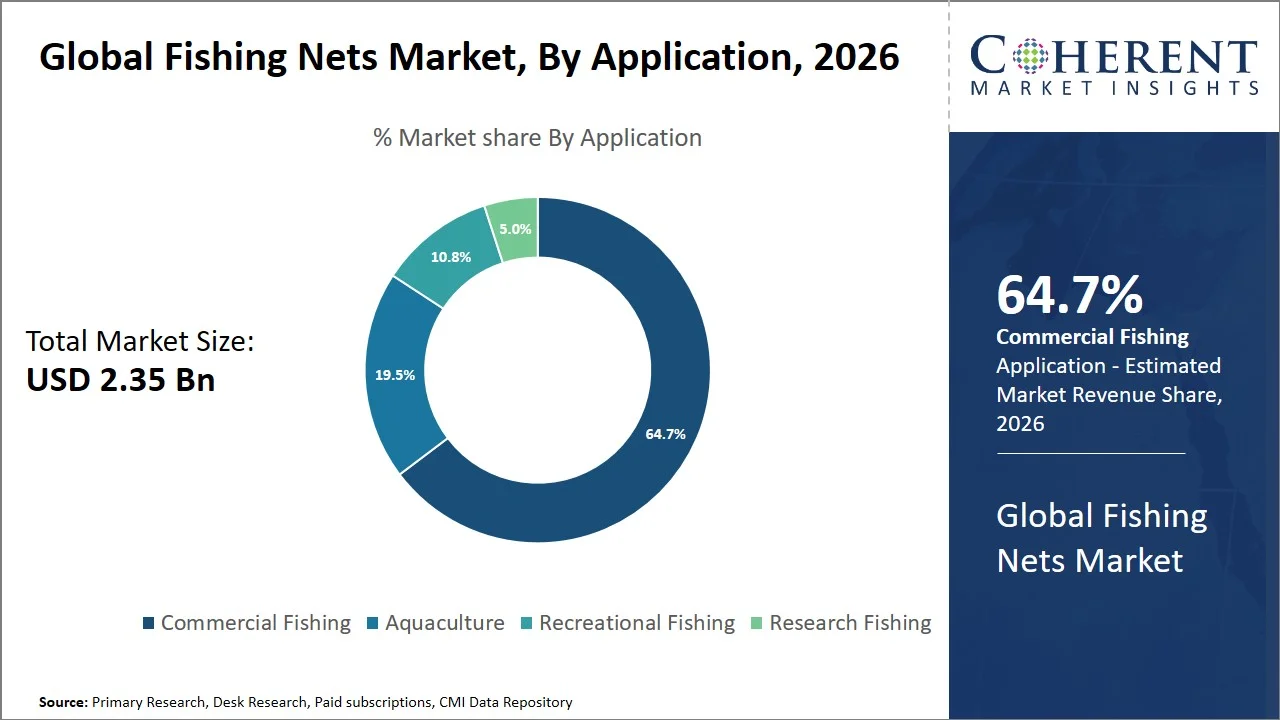
Commercial fishing is expected to dominate the application segment with 64.7% share in 2026, as industrial and organized fishing fleets require regular replacement of gill nets, trawl nets, seine nets, and lift nets due to wear, tearing, biofouling, and regulatory compliance. Demand is stronger in this segment because net usage is continuous, vessel-linked, and volume-oriented compared to recreational or research fishing. The segment also benefits from procurement by fishing operators that require multiple net sets for different target species and fishing grounds. FAO reported that global capture fisheries production reached 92.3 million tons in 2022, including 81 million tons from marine capture, confirming the large operational base that sustains commercial fishing net demand.
Why Does Nylon Represent the Largest Material Segment in the Fishing Nets Market?
Nylon is expected to lead the material type segment with 46.8% share in 2026, owing to its high tensile strength, abrasion resistance, elasticity, and suitability for repeated use in harsh marine conditions. Fishing operators prefer nylon nets where durability, knot strength, and handling performance are critical, especially for gill nets, trawl nets, and aquaculture containment systems. From the supply side, nylon supports advanced net engineering, including recycled and high-tenacity net designs, which improves its fit for sustainability-focused procurement. In May 2025, Hampiðjan reported that two full-size fish farming cages made entirely from recycled nylon were put into use by Grieg Seafood under the Circular Fish Farming Nets project, proving nylon’s relevance in high-performance circular aquaculture equipment.
Currents Events and their Impact
Current Events | Description and its Impact |
European Union enforces extended producer responsibility for fishing gear containing plastic (2025 onward) |
|
European Union strengthens fishing gear marking and lost gear reporting rules (January 2026) |
|
Canada expands government funding for ghost gear prevention and responsible disposal (2026–2029) |
|
(Source: European Commission, Canada. Ca)
Fishing Nets Market Dynamics
Market Drivers
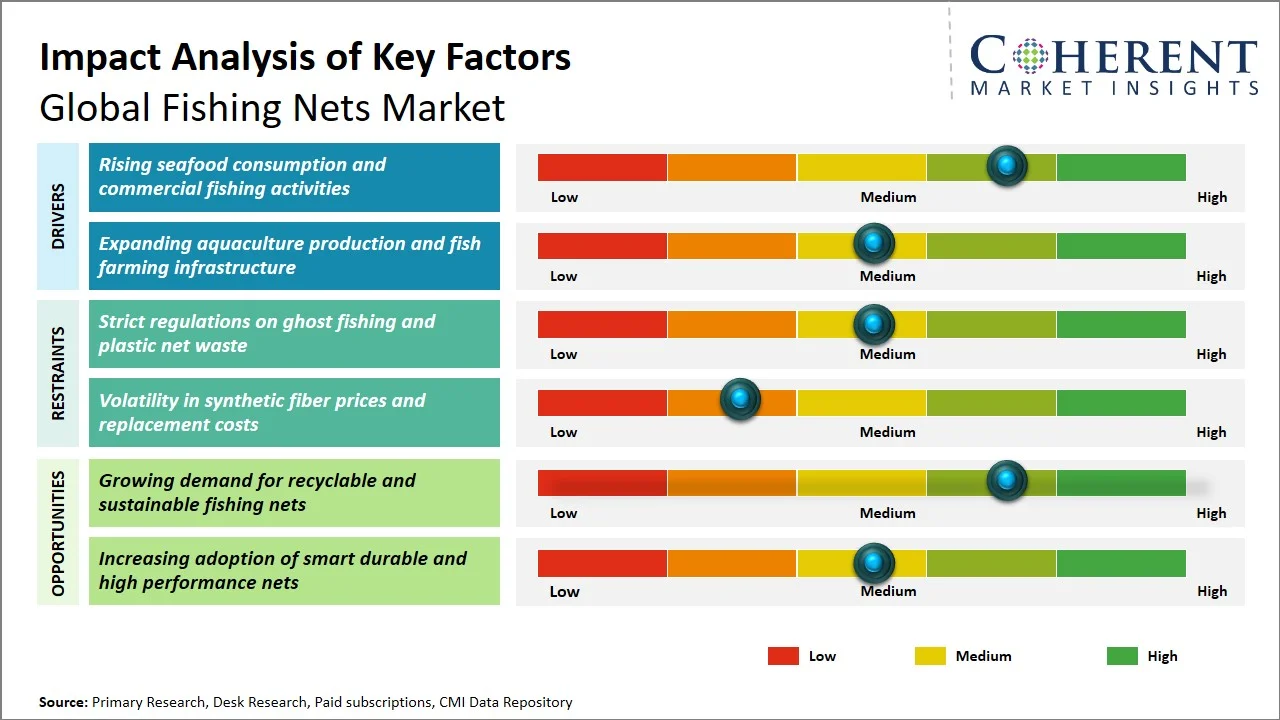
- Seafood consumption keeps commercial fishing net replacement resilient: Commercial fishing activity continues to support the Fishing Nets Market as seafood supply chains depend on stable harvest volumes, vessel productivity, and reliable gear availability. Rising demand from seafood processors, exporters, and coastal fishing economies is encouraging fleet operators to maintain efficient fishing gear inventories. This supports steady procurement of gill nets, trawl nets, seine nets, and other net systems across high-volume fishing regions. For instance is the UK Sea Fisheries Statistics 2024, released in December 2025, which reported U.K. vessel landings valued at US$ 1.55 billion, with quantity up 4% and value up 5% compared with 2023. This indicates that commercial fishing activity remains economically significant, supporting continuous procurement of durable netting systems by vessel operators and fleet owners. (Source: UK Marine Management Organisation)
- Aquaculture infrastructure expansion increases demand for cage and containment nets: Expanding fish farming infrastructure is strengthening the demand for aquaculture nets. Aquaculture farms need cage nets, predator-control nets, hatchery nets, and containment systems that can withstand currents, stocking density, and regular cleaning cycles. A new relevant instance is Norway’s June 2025 offshore aquaculture regulatory proposal, where the Ministry of Trade, Industry and Fisheries proposed changes to enable allocation of larger offshore aquaculture areas and require operators to prepare plans for establishment, development, operation, and closure. This supports industrial-scale offshore fish farming infrastructure and creates future demand for stronger cage-net systems.
Emerging Trends
- Circular and recyclable fishing nets are becoming a procurement priority: Fishing net manufacturers are increasingly shifting toward recyclable polymers, take-back programs, and closed-loop material systems as buyers face stronger pressure to reduce plastic leakage and ghost gear waste. This trend is changing product development from basic net manufacturing to sustainability-led net design, where recyclability, durability, and end-of-life recovery are becoming important purchasing factors. It is also encouraging manufacturers to improve material traceability and develop nets that can be collected, sorted, and reused more efficiently after their service life.
- High-performance aquaculture nets are gaining preference over conventional netting: Aquaculture operators are increasingly adopting engineered nets that offer better strength, anti-fouling performance, predator resistance, and longer replacement cycles. This trend is important because fish farming operations require reliable containment systems that reduce escapes, improve fish welfare, and lower maintenance costs. Manufacturers are responding by developing nets with improved coatings, stronger synthetic fibers, better mesh stability, and designs suitable for offshore and high-density aquaculture environments. This is shifting the market from low-cost net supply toward performance-based net solutions.
Regional Insights
Why Does Asia Pacific Dominate the Global Fishing nets Market?
Asia Pacific is expected to dominate the fishing nets market with 46.2% share in 2026, supported by the world’s largest aquaculture base, extensive marine and inland fishing activity, and a strong net manufacturing ecosystem across China, India, Japan, Taiwan, and Southeast Asia. The region benefits from high seafood consumption, large fishing fleets, lower-cost synthetic fiber conversion, and strong demand for gill nets, trawl nets, seine nets, and aquaculture cage nets. FAO reported that Asia accounted for 91.4% of global aquaculture production in 2022, reinforcing the region’s structural demand for fishing and aquaculture nets. For instance, FAO-led aquaculture events held in Fuzhou, China in March 2026, where global and regional stakeholders focused on sustainable aquaculture advancement, innovation, and scalable solutions supported future demand for advanced aquaculture net systems. (Source: Network of Aquaculture Centres in Asia-Pacific (NACA))
Why is Europe the Fastest-Growing Region in the Fishing nets Market?
Europe is expected to be the fastest-growing region with 18.5% share in 2026, supported by stronger circular-economy rules, stricter gear identification requirements, and rising demand for recyclable and traceable fishing nets. The region’s growth is value-driven, as fishing operators and net suppliers are under increasing pressure to reduce ghost gear, improve end-of-life gear collection, and adopt compliant net systems. For instance, Sweden’s implementation of extended producer responsibility for fishing gear, under which producers of fishing gear are required to engage with or provide a producer responsibility organization from 31 December 2024. This supports formal collection, recycling, and producer accountability for plastic-containing fishing gear, encouraging demand for recyclable and regulation-ready nets across Europe. (Source: Swedish Environmental Protection Agency)
Fishing nets market Outlook for Key Countries
Why is China a Key Market for Fishing Nets?
China is a critical country in the fishing nets market due to its unmatched aquaculture scale, large coastal fishing base, and growing move toward offshore and deep-sea fish farming. Demand is supported by both capture fishing gear and engineered aquaculture systems such as cage nets, anti-fouling nets, and storm-resistant containment solutions. China’s market relevance is increasingly linked to technology upgrades rather than only volume, as producers shift from nearshore farming toward larger offshore platforms that require stronger synthetic nets, floating structures, and mechanized harvesting systems. A relevant instance is China’s deep-sea aquaculture expansion in December 2025, which emphasized integrated offshore farming platforms combining net cages, operating platforms, and barges, along with research into high-strength anti-fouling nets and smart floats designed for challenging marine conditions. (Source: Agroberichten Buitenland)
Why Does Japan Remain Important in the Fishing nets Market?
Japan is important in the fishing nets market because it combines mature coastal fisheries, high-value aquaculture, and advanced domestic net engineering capabilities. The country’s demand is shaped by set nets, purse seine nets, aquaculture nets, trawl nets, and specialized cultivation nets used across coastal and offshore operations. Japan’s market is increasingly focused on performance, precision, and resilience as fishing communities face aging labor, resource variability, typhoons, and warming waters. For instance Japan’s FY2024 White Paper on Fisheries highlighted technology to prevent predation in nori seaweed cultivation, including the development of protective nets against Japanese black bream, along with broader measures to adapt fisheries and aquaculture to marine environmental changes. This supports demand for specialized, application-specific net systems.
Why is India Emerging as a Major Fishing Nets Market?
India is a major country in the fishing nets market due to its large fishing population, long coastline, inland aquaculture expansion, and domestic manufacturing base for synthetic nets and ropes. Demand is supported by marine capture fisheries, inland fish farming, shrimp aquaculture, and continuous replacement of gill nets, cast nets, trawl nets, and aquaculture cage nets. India is also gaining supply-side importance as global manufacturers look to strengthen regional sourcing for netting and rope products. A recent instance is the extension of the Pradhan Mantri Matsya Sampada Yojana up to FY 2025–26. As of July 2025, India had approved fisheries development projects worth US$ 223.67 Mn, supporting infrastructure, productivity, and modernization across the fisheries value chain. (Source: Press Information Bureau India)
Why is Brazil Important for Aquaculture Net Demand?
Brazil is important in the fishing nets market due to its expanding inland aquaculture sector, large freshwater reservoir base, and rising tilapia production. Unlike mature marine fishing markets, Brazil’s demand is strongly linked to cage-based aquaculture systems, where net cages, containment nets, maintenance nets, and replacement mesh are essential operating inputs. The country’s growing focus on traceability and formal aquaculture monitoring also supports higher-quality net procurement. A recent instance is Brazil’s Ministry of Fisheries and Aquaculture launching the 2024 Aquaculture in Union Waters Bulletin in October 2025. The bulletin reported a 20% increase in aquaculture production in Union waters to 148,564.71 tons and introduced traceability of fingerlings grown in net cages, strengthening the commercial case for organized cage aquaculture infrastructure.
Why Does Chile Represent a High-Value Market for Aquaculture Fishing Nets?
Chile is a key country in the fishing nets market because of its large salmon aquaculture industry, where net cages and containment systems are critical for fish welfare, escape prevention, predator control, and biosecurity. The country’s demand is concentrated in high-value marine farming regions such as Los Lagos, Aysén, and Magallanes, where harsh operating conditions require durable nets, antifouling solutions, mooring systems, and routine net replacement. For instance, Sernapesca’s 2025 salmon farming sanitary report, published in 2026, analyzes sanitary behavior, trends, prevention measures, control systems, and inspection actions for Chilean salmon farming. The report also recorded active freshwater farming centers across key salmon regions, reinforcing the operational scale that supports continued demand for aquaculture net systems.
Regulatory Scenario and Sustainability Compliance in the Fishing Nets Market
Region or Geography | Regulation or Compliance Area | Impact on Fishing nets Market |
Europe | Extended producer responsibility for plastic fishing gear | Increases demand for recyclable nets, take-back systems, recycled polymers, and suppliers with end-of-life gear management capabilities. |
Europe | Fishing gear marking and lost gear reporting | Encourages adoption of traceable nets, durable gear labels, identification tags, and compliance-ready net designs. |
International framework | FAO voluntary guidelines on marking fishing gear | Supports wider adoption of marked gill nets, trawl nets, seine nets, and aquaculture nets, especially in regulated and export-oriented fisheries. |
North America | Ghost gear prevention and recovery funding | Strengthens demand for recoverable, recyclable, and lower-loss fishing nets, while supporting recycling and collection infrastructure. |
Europe | National extended producer responsibility for fishing gear | Raises compliance pressure on suppliers and favors recyclable fishing nets with documented material and producer accountability. |
Europe | Producer responsibility for plastic fishing gear | Pushes importers and manufacturers toward formal registration, circular product design, and compliant distribution models. |
Europe, Middle East and Africa | Ghost gear compliance guidance for Mediterranean and Black Sea fisheries | Creates demand for standardized gear identification, responsible net disposal, and traceable products across commercial fishing fleets. |
How are Recyclable and Traceable Nets Creating New Growth Opportunities in the Fishing Nets Market?
Recyclable and traceable fishing nets are creating new opportunities in the global fishing nets market as governments, fishing operators, and aquaculture farms focus on reducing ghost gear, plastic waste, and end-of-life disposal issues. This is encouraging demand for nets made from recyclable nylon and polyethylene, gear marking systems, durable labels, and take-back-ready product designs. Manufacturers that offer longer-lasting and recoverable nets can gain stronger access to regulated fisheries and sustainability-focused seafood supply chains. A relevant instance is Australia’s Ghost Nets Initiative, under which the government committed USD equivalent public funding of AUD 25 million over four years from 2025–26 to remove ghost nets and marine debris. (Source: Parks Australia)
Market Players, Key Development, and Competitive Intelligence
Key Developments
- In December 2025, Garware Technical Fibres Ltd introduced advanced aquaculture net solutions including CFR S CFR Safemax Pro Max and ACE to improve cut resistance recyclability predator protection and durability for fish farming operations
- In May 2025, Hampidjan EN, Nofir AKVA Group, Aquafil and Grieg Seafood put two full size fish farming cages made from recycled nylon into use under the Circular Fish Farming Nets project which supports circular material use in aquaculture.
Competitive Landscape
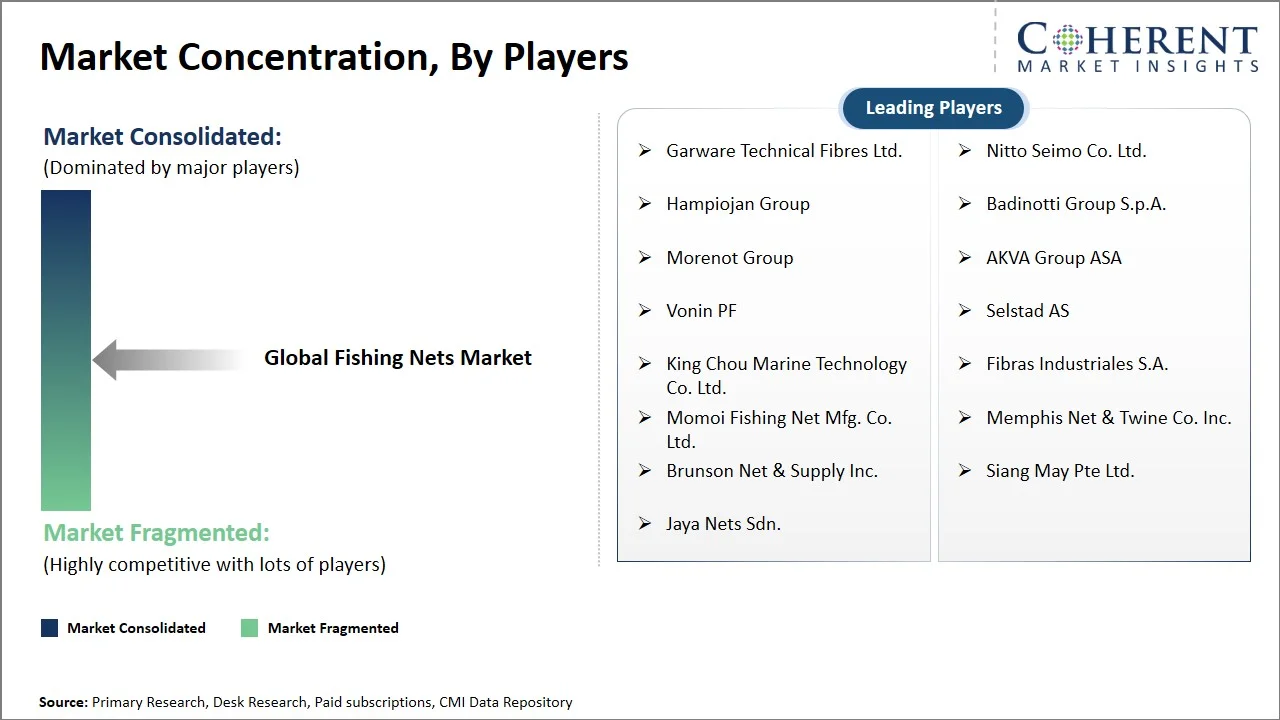
The global fishing nets market is moderately fragmented, with competition spread across established global manufacturers, regional net makers, aquaculture equipment suppliers, and synthetic fiber-based technical textile companies. Key players compete based on net durability, material strength, customization capability, price competitiveness, sustainability compliance, and supply reliability. Large companies are increasingly focusing on high-performance nylon and polyethylene nets, recyclable net solutions, anti-fouling technologies, and aquaculture cage net systems to serve commercial fishing operators and fish farming companies. The competitive landscape is also being shaped by regulatory pressure around ghost gear, plastic waste, and end-of-life net recovery, pushing manufacturers to invest in traceable, recyclable, and longer-lasting products.
Key focus areas include
- Development of durable gill nets, trawl nets, seine nets, and aquaculture cage nets with improved tensile strength and abrasion resistance
- Adoption of recyclable polymers, recycled nylon, and circular net production models to address marine plastic waste and regulatory compliance
- Expansion of anti-fouling, predator-resistant, and high-performance aquaculture nets for offshore and cage-based fish farming operations
- Strengthening of regional manufacturing and distribution networks across Asia Pacific, Europe, and Latin America to support faster delivery and customized net supply
- Partnerships with aquaculture companies, recycling firms, and fisheries organizations to improve net recovery, reuse, and lifecycle management
- Investment in gear marking, traceability features, and compliance-ready net designs to meet emerging sustainability and fisheries control requirements
Market Report Scope
Fishing Nets Market Report Coverage
| Report Coverage | Details | ||
|---|---|---|---|
| Base Year: | 2025 | Market Size in 2026: | USD 2.35 Bn |
| Historical Data for: | 2020 To 2024 | Forecast Period: | 2026 To 2033 |
| Forecast Period 2026 to 2033 CAGR: | 7.1% | 2033 Value Projection: | USD 3.80 Bn |
| Geographies covered: |
| ||
| Segments covered: |
| ||
| Companies covered: | Garware Technical Fibres Ltd., Nitto Seimo Co. Ltd., Hampiojan Group, Badinotti Group S.p.A., Morenot Group, AKVA Group ASA, Vonin PF, Selstad AS, King Chou Marine Technology Co. Ltd., Fibras Industriales S.A., Momoi Fishing Net Mfg. Co. Ltd., Memphis Net & Twine Co. Inc., Brunson Net & Supply Inc., Siang May Pte Ltd., and Jaya Nets Sdn. | ||
| Growth Drivers: |
| ||
| Restraints & Challenges: |
| ||
Analyst Opinion (Expert Opinion)
- The global fishing nets market is expected to witness steady long-term growth, supported by rising seafood consumption, sustained commercial fishing activity, and expanding aquaculture operations. Demand will remain resilient as fishing nets are recurring-use products that require periodic replacement due to wear, tearing, biofouling, and exposure to harsh marine conditions. With commercial fishing accounting for the largest application share and nylon remaining the preferred material, manufacturers are expected to focus on durable, lightweight, and cost-efficient netting solutions.
- The strongest growth opportunities are likely to emerge from Asia Pacific, which dominates the market due to large fishing fleets, high aquaculture output, and strong domestic manufacturing capacity in countries such as China, India, and Japan. Europe is expected to remain a high-growth region, driven by sustainability regulations, ghost gear reduction programs, and rising demand for recyclable and traceable fishing nets. Brazil and Chile also present attractive opportunities due to expanding cage-based aquaculture and salmon farming infrastructure.
- To gain a competitive advantage, market participants should invest in recyclable net materials, high-performance nylon nets, anti-fouling coatings, predator-resistant aquaculture nets, and gear marking solutions. Companies with strong capabilities in product durability, circular economy compliance, and customized net design will be better positioned to serve commercial fishing operators and aquaculture farms. Strategic partnerships with fish farming companies, recycling firms, and regional distributors will also help manufacturers improve market access and strengthen customer retention.
Speak to the analyst
Want personalized insights?
Take the findings above to one of our principal consultants, or have the report rebuilt around the segments, geographies and competitors you actually track.
Market Segmentation
- Product Type Insights (Revenue, USD Bn, 2021 - 2033)
- Gill Nets
- Trawl Nets
- Seine Nets
- Cast Nets
- Lift Nets
- Other Fishing Nets
- Material Type Insights (Revenue, USD Bn, 2021 - 2033)
- Nylon
- Polyethylene
- Polypropylene
- Polyester
- Natural Fiber
- Other Materials
- Application Insights (Revenue, USD Bn, 2021 - 2033)
- Commercial Fishing
- Aquaculture
- Recreational Fishing
- Research Fishing
- End User Insights (Revenue, USD Bn, 2021 - 2033)
- Fishing Operators
- Aquaculture Farms
- Individual Fishers
- Research Institutes
- Distribution Channel Insights (Revenue, USD Bn, 2021 - 2033)
- Direct Sales
- Indirect Sales
- Regional Insights (Revenue, USD Bn, 2021 - 2033)
- North America
- U.S.
- Canada
- Latin America
- Brazil
- Argentina
- Mexico
- Rest of Latin America
- Europe
- Germany
- U.K.
- Spain
- France
- Italy
- Russia
- Rest of Europe
- Asia Pacific
- China
- India
- Japan
- Australia
- South Korea
- ASEAN
- Rest of Asia Pacific
- Middle East
- GCC Countries
- Israel
- Rest of Middle East
- Africa
- South Africa
- North Africa
- Central Africa
- North America
- Key Players Insights
- Garware Technical Fibres Ltd.
- Nitto Seimo Co. Ltd.
- Hampiojan Group
- Badinotti Group S.p.A.
- Morenot Group
- AKVA Group ASA
- Vonin PF
- Selstad AS
- King Chou Marine Technology Co. Ltd.
- Fibras Industriales S.A.
- Momoi Fishing Net Mfg. Co. Ltd.
- Memphis Net & Twine Co. Inc.
- Brunson Net & Supply Inc.
- Siang May Pte Ltd.
- Jaya Nets Sdn.
Sources
Primary Research Interviews
- Fishing net manufacturers producing gill nets, trawl nets, seine nets, cast nets, lift nets, and aquaculture cage nets
- Commercial fishing operators, fleet owners, vessel managers, and fishing cooperatives
- Aquaculture farm owners, cage farming operators, hatchery managers, and fish farm procurement heads
- Synthetic fiber suppliers and technical textile manufacturers supplying nylon, polyethylene, polypropylene, polyester, ropes, twines, and coatings
- Fishing gear distributors, marine equipment dealers, and export-import suppliers
- Net repair, maintenance, recycling, and ghost gear recovery service providers
- Fisheries scientists, marine conservation experts, and sustainable fishing consultants
Stakeholders
- Fishing net manufacturers and technical textile companies
- Raw material suppliers of nylon, polyethylene, polypropylene, polyester, ropes, twines, floats, sinkers, and coatings
- Aquaculture cage system suppliers and fish farming equipment providers
- Commercial fishing companies and fishing vessel operators
- Aquaculture farms and seafood producers
- Small-scale fishers and fishing cooperatives
- Fishing gear distributors, wholesalers, and marine equipment retailers
- Net recycling companies and circular material recovery firms
- Sustainability and marine plastic waste management organizations
End-use Sectors
- Commercial marine fishing
- Inland and freshwater fishing
- Aquaculture and fish farming
- Recreational fishing
- Fisheries research and conservation programs
- Seafood production and processing value chains
- Fishing fleet operators and cooperatives
- Marine equipment and fishing gear service providers
Regulatory and Fisheries Bodies
- Food and Agriculture Organization of the United Nations
- National Oceanic and Atmospheric Administration Fisheries
- Fisheries and Oceans Canada
- European Commission Directorate-General for Maritime Affairs and Fisheries
- European Environment Agency
- General Fisheries Commission for the Mediterranean
- Japan Fisheries Agency
- Ministry of Agriculture, Forestry and Fisheries, Japan
- Department of Fisheries, Government of India
- Ministry of Fisheries and Aquaculture, Brazil
- National Fisheries and Aquaculture Service, Chile
- Ministry of Agriculture and Rural Affairs, China
- United Nations Environment Programme
Databases
- FAO Fisheries and Aquaculture Statistics
- FAO State of World Fisheries and Aquaculture
- OECD-FAO Agricultural Outlook
- UN Comtrade Database
- International Trade Centre Trade Map
- World Bank Data
- Eurostat Fisheries Database
- NOAA Fisheries Commercial Fisheries Landings Database
- Fisheries and Oceans Canada Fisheries Statistics
- India Handbook on Fisheries Statistics
- Japan Fisheries Agency Statistics
- Chile Sernapesca Fisheries and Aquaculture Statistics
- Brazil Fisheries and Aquaculture Statistics
Magazines
- World Fishing & Aquaculture
- International Aquafeed
- Fish Farmer Magazine
- Aquaculture Magazine
- Fish Farming Expert
- Fishing News
- Fishing News International
- Aquaculture North America
- Hatchery International
Journals
- Fisheries Research
- Aquaculture
- Aquaculture Engineering
- Marine Pollution Bulletin
- ICES Journal of Marine Science
- Marine Policy
- Ocean and Coastal Management
- Reviews in Fisheries Science and Aquaculture
- Journal of Cleaner Production
- Waste Management
Newspapers
- The Guardian
- Financial Times
- The New York Times
- The Hindu
- The Economic Times
- The Japan Times
- South China Morning Post
- China Daily
- Valor Econômico
- El Mercurio
- La Tercera
Trade Media
- SeafoodSource
- IntraFish
- The Fish Site
- Undercurrent News
- FiskerForum
- SeafoodNews
- World Fishing & Aquaculture
- Fish Farmer Magazine
Associations
- World Aquaculture Society
- Global Seafood Alliance
- National Fisheries Institute
- Europêche
- European Association of Fish Producers Organisations
- Network of Aquaculture Centres in Asia-Pacific
- International Council for the Exploration of the Sea
- Global Ghost Gear Initiative
- Aquaculture Stewardship Council
- Marine Stewardship Council
Public Domain Sources
- FAO State of World Fisheries and Aquaculture
- FAO Voluntary Guidelines for the Marking of Fishing Gear
- FAO Responsible Fishing Guidelines
- NOAA Fisheries Fishing Gear and Bycatch Resources
- European Commission Single-Use Plastics Directive
- European Commission Fisheries Control Regulation
- Fisheries and Oceans Canada Ghost Gear Program
- UNEP Marine Litter and Plastic Pollution Resources
- Japan Fisheries White Paper
- India Handbook on Fisheries Statistics
- Brazil Aquaculture and Fisheries Bulletins
- Chile Sernapesca Aquaculture and Fisheries Reports
Proprietary Elements
- CMI Data Analytics Tool, Proprietary CMI Existing Repository of information for last 10 years.
Get access to 250+ pages report
Every segment, forecast, competitor profile and data table behind the analysis above — available for instant download.
- ESOMAR Member
- ISO 9001:2015 Certified
- D-U-N-S Registered
- GDPR & CCPA Compliant
Missing comfort of reading report in your local language? Find your preferred language:
Transform your Strategy with Exclusive Trending Reports
Frequently Asked Questions
The CAGR of the global fishing nets market is projected to be 7.1% from 2026 to 2033.
The global fishing nets market is estimated to be valued at USD 2.35 billion in 2026 and is expected to reach USD 3.80 billion by 2033.
China is the largest producer and exporter of global fishing nets market.
Rising seafood consumption and commercial fishing activities and expanding aquaculture production and fish farming infrastructure are the major factors driving the growth of the global fishing nets market.
Strict regulations on ghost fishing and plastic net waste and volatility in synthetic fiber prices and replacement costs are the major factors hampering the growth of the global fishing nets market.
In terms of product type, gill nets are estimated to dominate the market revenue share in 2026.
Garware Technical Fibres Ltd., Nitto Seimo Co. Ltd., Hampiojan Group, Badinotti Group S.p.A., Morenot Group, AKVA Group ASA, Vonin PF, Selstad AS, King Chou Marine Technology Co. Ltd., Fibras Industriales S.A., Momoi Fishing Net Mfg. Co. Ltd., Memphis Net & Twine Co. Inc., Brunson Net & Supply Inc., Siang May Pte Ltd., and Jaya Nets Sdn. are the major players.