

Global Ube Market Size and Forecast – 2026 To 2033
The Global Ube Market is projected to grow from USD 520.3 Mn in 2026 to USD 830.0 Mn by 2033, reflecting a compound annual growth rate (CAGR) of 6.9% over the forecast period 2026-2033. The market is growing due to increasing demand from international food industries and the Philippines’ strong role as a key production and supply base. Over the past several years, Ube (purple yam) native to the Philippines has increasingly appeared in cafes, supermarkets, restaurants and social media content in the U.S. Ube-flavored lattes, cheesecakes, doughnuts, cookies, pancakes, milk teas, cocktails, and ice cream are now sold by both independent Filipino-owned businesses and major American retail chains.
According to PortCalls, citing the Department of Trade and Industry, the Philippines generated USD 3.06 million in ube and ube-based product exports in 2025, supported by growing international demand for authentic Asian flavors, natural food colorants, and diverse food applications. This reflects ube’s shift from a traditional Filipino ingredient to a commercially attractive export product for global food manufacturers and dessert brands. (Source: PortCalls Asia)
Key Takeaways of the Global Ube market
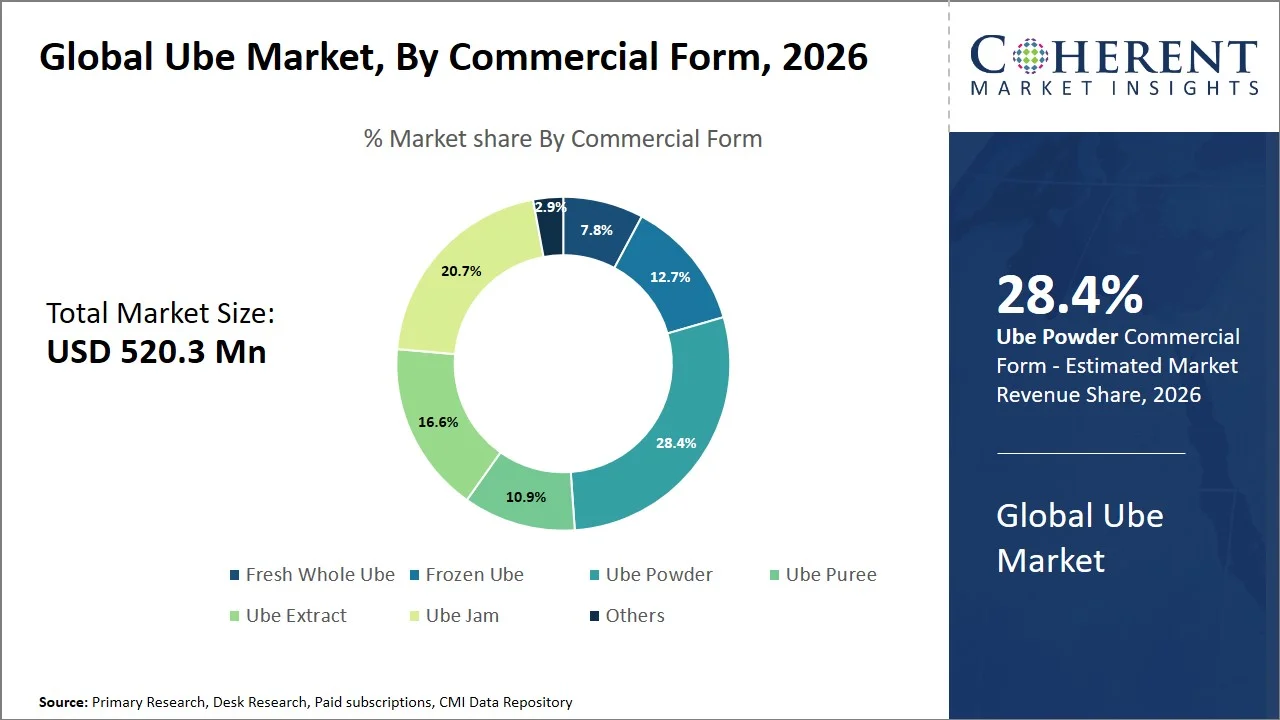
- Ube powder is projected to be the dominant commercial form segment with 28.4% share in 2026. Ube powder leads because it is easier for food companies to store, export, blend, and use in large-scale recipes compared to fresh Ube. It is widely suitable for bakery mixes, beverages, ice cream bases, cookies, cakes, and dessert fillings. The Philippines’ export growth in processed Ube forms, including powder, puree, halaya, and flavor extracts, shows that buyers are moving toward value-added and shelf-stable Ube ingredients. (Source: Vietnam Chamber of Commerce and Industry (VCC))
- The bakery products segment is expected to be the dominant application segment with 29.6% share in 2026. Ube fits bakery products because it gives both flavor and strong purple visual appeal in cakes, rolls, doughnuts, cookies, pastries, and sweet fillings For instance, King’s Hawaiian launched Ube Coconut Sweet Rolls nationwide in 2026 following strong consumer demand, highlighting Ube’s shift from Filipino specialty desserts to mainstream packaged bakery products. (Source: The Shelby Report)
- The direct sales segment is estimated to be the dominant distribution channel with 56.4% market share in 2026. The majority of Ube processors and ingredient suppliers sell directly to the major bakery manufacturers, dessert brands, beverage companies, frozen dessert manufacturers, and foodservice chains that demand a consistent quality, bulk supply and customized forms like Ube powder, Ube paste, puree, Ube extracts and fillings. For instance, the 1.2-ton shipment of Ube powder to Japan in April, 2026 saw Quirino's export packaging, testing and sensory evaluation aligned with the buyer's international requirements, demonstrating direct export from the supplier to the buyer for processed Ube ingredients. (Source: Philippine Information Agency)
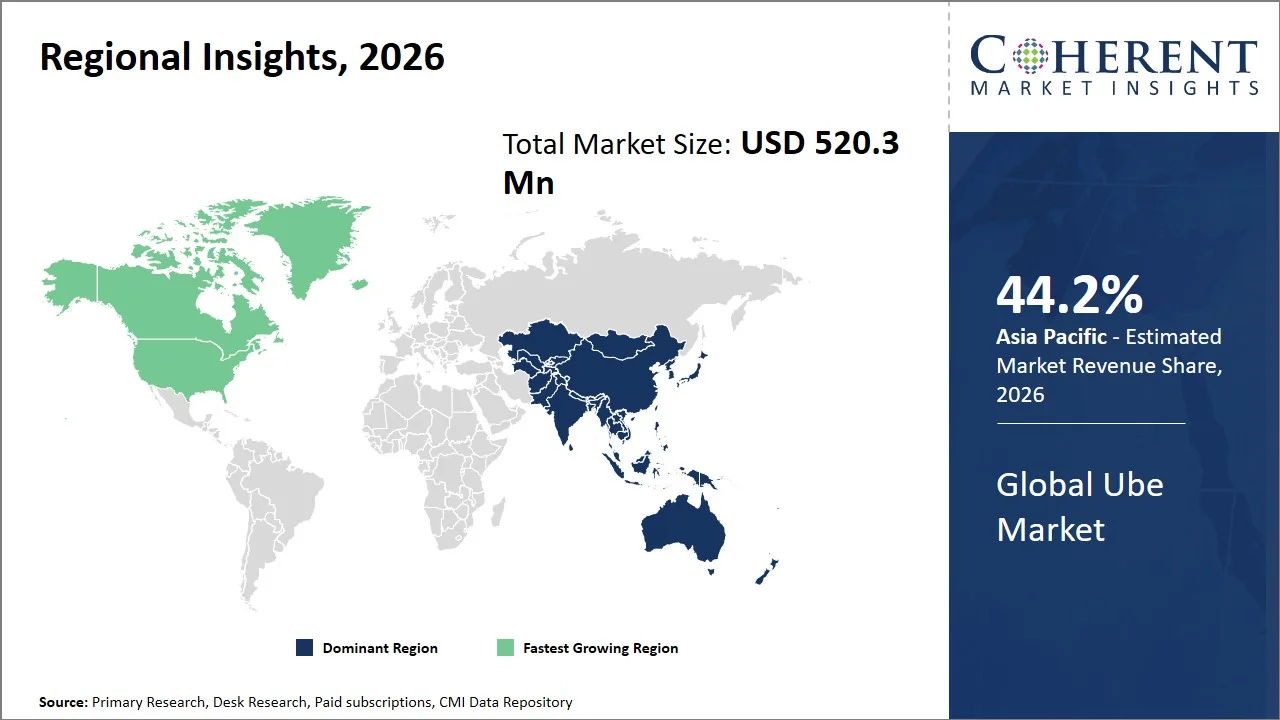
- Asia Pacific will lead the market with a share of 44.2%, followed by other regions in 2026. The region leads as the Philippines is the heartland of Ube production and culture, and the Japanese and Chinese markets, as well as markets in South Korea, Singapore and Australia, are growing markets for Asian desserts and beverage innovation. For instance, in February 2025, groundwork began for the USD 0.81 million Ube Processing Plant in Leyte, Philippines. The facility is expected to strengthen the Ube value chain in Region 8 by supporting farmer linkages, expanding processing capacity, and shifting the market from raw tuber sales toward higher-value Ube products. (Source: Visayas State University)
- North America is expected to be the fastest-growing region with 27.8% market share in 2026. Growth is being supported by mainstream foodservice and bakery adoption, especially in the U.S. In March 2026, Starbucks introduced the Iced Ube Coconut Macchiato in its spring menu, marking Ube’s wider movement into coffeehouse beverages beyond ethnic retail and specialty dessert shops. (Source: Starbucks Coffee Company)
- The rising demand for authentic Asian flavors with natural color appeal: The Ube market is gaining attention because it offers a mild sweet taste, nutty-vanilla notes, and a strong purple color that helps brands create premium, social-media-friendly products. T. Hasegawa, a Japan-based flavor and fragrance company, identified Ube as a major flavor trend, reflecting its growing use across desserts, beverages, and broader food innovation.
- Profitability outlook is stronger in processed and branded Ube formats: Higher margins are likely in Ube powder, puree, extract, syrup, halaya, fillings, frozen desserts, and bakery products because these formats add processing value and reduce dependence on low-margin raw tuber sales. The growing number of global product launches using Ube across ice cream, baked goods, confectionery, beverages, and ready-to-eat desserts shows that value-added formats will drive better commercial returns.
Segmental Insights
Why Does Ube Powder Dominate the Global Ube market?
Ube powder is considered to have the potential to reign the market with an estimated share of 28.4% in 2026 as it is easier to export, store, standardize, and incorporate into industrial recipes than the fresh Ube product. Powder is easier to use than cold chain in bakery mixes, beverages, ice cream bases, cookies, cakes, and desserts, and is a preferred material for food manufacturers to reduce the dependency on the cold chain. A relevant instance is Hamburg Trading Corporation, which offers ube powder made in the Philippines using locally sourced purple yams. Its premium variant is made from 100% real purple yams that are pureed and roll-dried into powder, while its product range also includes intense ube powder and instant ube dessert mix. This shows how ube powder is being commercialized as a flexible processed ingredient for bakery, dessert, and foodservice applications, supporting its leadership over fresh and semi-processed forms.
- Current Industry Events of 2026
- Market Size Estimation
- Regional Breakdown
- Competitive Landscape
- Customer Intelligence
- Segmental Analysis
- Pricing Analysis
- Key Market Drivers, Challenges & Future Trends
- Customized Insights Section
Why Does the Bakery Products Segment Dominate the Application Segment?
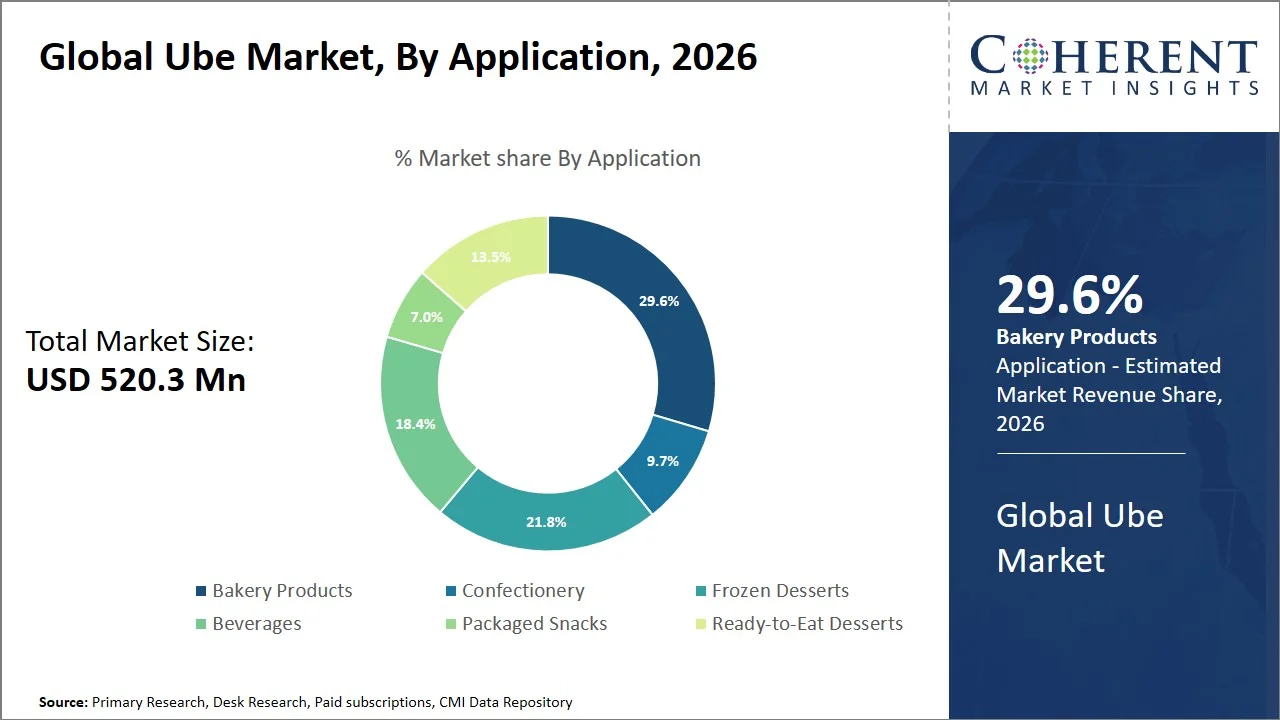
The bakery products segment is projected to hold 29.6% of Ube market share in 2026, because Ube works naturally in sweet products such as cakes, rolls, doughnuts, cookies, pastries, buns, and dessert fillings. The segment gains from Ube’s dual appeal, as it offers a distinct flavor while also delivering a vibrant purple color that helps brands improve product visibility on retail shelves and social media platforms. For Instance, King’s Pastry, which introduced an Ube Jelly Roll as part of its new bakery launches, positioning it as a soft ube-flavored cake with creamy filling and vibrant color for dessert-market differentiation. This shows that ube is gaining traction in commercial bakery product development, especially among suppliers targeting cafés, foodservice operators, and retail dessert buyers. (Source: King’s Pastry)
Why Does Direct Sales Dominate the Distribution Channel Segment?
Direct sales is expected to dominate the Global Ube market with an estimated 56.4% share in 2026. Large bakery companies, frozen dessert manufacturers, beverage brands, café chains, and importers prefer that they purchase Ube powder, puree, paste, extract and fillings directly from processors or farm linked suppliers. They can regulate the product quality, purple color, moisture content, particle size, percentage of real Ube, package size, food safety documents, and the bulk price when buying directly. This channel is more appropriate for Ube than the latter, since processed Ube is an ingredient in formulations, not a retail food. Philippine Ube follows a direct sourcing and wholesale export model, supplying real Philippine ube powder to food manufacturers, bakeries, dessert brands, beverage companies, and importers. Its farm-linked supply approach supports better traceability, consistent quality, and bulk availability for commercial buyers. The company’s key strength is its direct sourcing model, which supports traceability, consistent product quality, and bulk supply for international buyers. This is indicative of the traceability, consistency, and processed Ube value chain margins that can be attained through direct supplier to business procurement. (Source: Philippine Ube)
Currents Events and their Impact
Current Events | Description and Its Impact |
Philippines Ube Supplies Pressure Amid Rising Export Demand |
|
U.S. Menu Penetration and Consumer Awareness Shift Toward Ube |
|
Japan’s Import Compliance Requirements for Food Ingredients |
|
(Source: Convenience, Ministry of Health, Labour and Welfare)
Ube Market Dynamics
Market Drivers
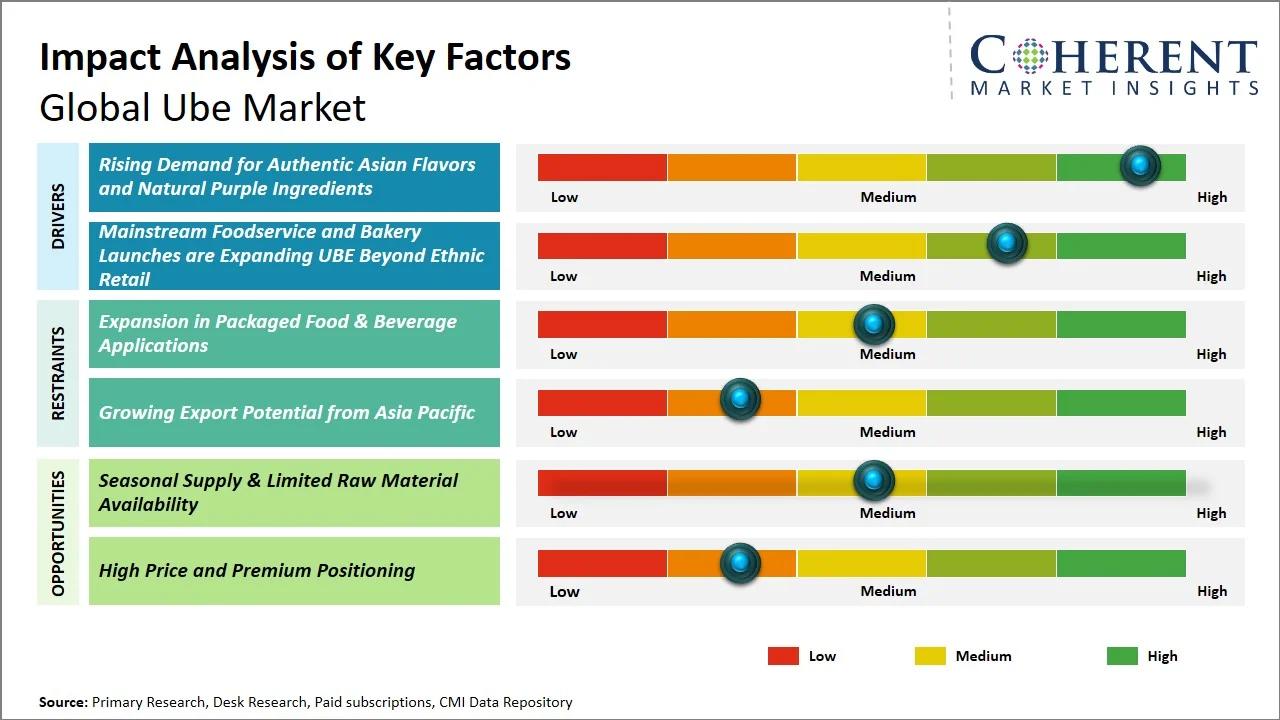
- Rising Demand for Authentic Asian Flavors and Natural Purple Ingredients: The global ube market is expanding as food brands increasingly seek Asian-inspired ingredients that offer both distinctive flavor and strong visual appeal. Ube’s mild sweetness, natural purple color, and nutty vanilla-like taste make it suitable for cakes, cookies, ice creams, beverages, fillings, and ready-to-eat desserts. The growing number of Filipino and Asian-inspired products sold in the U.S., European and Japanese markets, where they are considered as premium offerings, also supports this demand. The value of Philippine Ube and Ube-based exports amounted to USD 3.06 million in 2025, and processed Ube, which included Ube powder, puree, halaya and Ube extracts of flavor, continued to grow indicating that global buyers are moving away from raw Ube to value-added commercial products. (Source: Xinhua / Department of Trade and Industry)
- Mainstream Foodservice and Bakery Launches are Expanding Ube Beyond Ethnic Retail: Ube has gone beyond Filipino grocery stores or traditional desserts and now has its way into the mainstream bakery, café, beverage and QSR outlets. It is very important as large brands can bring Ube into the mass consumers through seasonal menus, bakery product packages, and bakery dessert innovation, which will create a repeat demand. This is important because larger foodservice brands can introduce Ube to mass consumers through limited-time menus, snack items, dessert launches, and online ordering platforms, creating repeat demand. For instance, Jollibee brought back its Ube Pie in the U.S. in April 2024, made with 100% real Ube and positioned as a unique dessert item paired with its chicken sandwich menu. This shows how Ube is being commercialized in a QSR dessert format, helping it reach broader consumers through restaurant outlets, delivery, and repeat snacking occasions.
Emerging Trends
- Shift from Traditional Ube Desserts to Mainstream Bakery and Beverage Innovation: Ube is now evolving from traditional Filipino desserts (halaya, halo-halo, local cakes) to mainstream bakery, coffee and beverage formats. Big foodservice and café companies are turning to Ube for its intense purple hue, subtle sweet flavor and Asian flavor profile. This phenomenon is contributing to the sales of Ube powder, syrup, extract, puree and cold-foam bases.
- Rising Demand for Processed and Export-Ready Ube Ingredients: The Ube market is changing as demand for processed and export ready Ube ingredients (Ube powder, pureed, flavour extract, halaya) has increased as these products are easier to store, export, control, and utilize in processed form in commercial food production. Consistency in color, taste, and supply is critical for bakeries, frozen dessert manufacturers, beverage brands and packaged food companies. These processed Ube products—Ube powder, puree, Ube flavor extracts, and halaya are expected to continue growing, as Ube has evolved from an everyday local staple to a premium ingredient for the global Ube market, according to the DTI.
Regional Analysis
Asia Pacific Leads the Global Ube Market through Strong Production and Consumption Base
Asia Pacific is expected to remain the dominant region with 44.2% share in 2026. The region leads because Ube has a strong consumption base in the Philippines and is increasingly being developed as a commercial food ingredient for bakery, frozen desserts, beverages, and packaged desserts across Asian Ube markets. The Philippines gives Asia Pacific a supply advantage because it has both traditional Ube farming knowledge and a growing processing ecosystem. The facility is important because it supports the shift from low-margin raw tuber sales to higher-value Ube powder, puree, halaya, and other processed products. This improves farmer income, supports export readiness, and strengthens Asia Pacific’s role as the main production and processing hub for the global Ube market. PhilRootcrops also noted that DA RFO8, ATI RTC8, and TESDA RO8 are supporting farmers with organic production and certification efforts, which can further improve product quality and competitiveness (Source: The Philippine Root Crop Research and Training Center (PhilRootcrops))
North America Gains Momentum as a High-Growth Ube Market
The Global Ube market is anticipated to witness the highest growth rate in the North America region with 27.8% share in 2026–2033. Its growth is largely due to Ube being incorporated into main-stream menus in the QSR, frozen dessert and grocery sectors, and in the café sector. With the U.S. and Canada boasting large Filipino and Asian populations, the real growth potential lies with non-Asian consumers experimenting with Ube via a wide array of colorful desserts, premium beverages and menu items that are only available for a limited time. This is making Ube more than just a traditional flavor. An example of this would be Jollibee's Ube Pie in the U.S. which is described as a sweet flaky pie with real Ube. The product demonstrates the commercialization of Ube in a QSR dessert product which has the potential to be sold to a broader consumer base via stores, online and repeat snacking.
Global Ube Market Outlook for Key Countries
Why is the Philippines the Core Supply and Processing Hub for Ube?
The Philippines is the most important country in the global Ube market because it has the strongest cultural connection, production base, and processing potential for Ube-based products. The country is moving from traditional Ube use in halaya, halo-halo, cakes, and ice cream toward commercial value-added formats such as powder, dried Ube, paste, puree, and export-ready ingredients. A relevant instance is the Philippines’ ongoing effort to improve Ube planting materials through propagation techniques, as experts are trying to support quality production amid rising global demand. DOST also highlighted that Bohol is historically the largest Ube-producing province, accounting for around 35% of Philippines production, showing the country’s strong supply-side role. (Source: Republic of the Philippines)
Japan Drives the Demand for Export-Ready Ube Powder and Dessert Applications?
Japan is an important market for Ube due to its strong demand for premium dessert ingredients, bakery innovation, and high-quality imported Asian food products. Ube powder is especially suitable for Japan because it is shelf-stable and can be easily used in cakes, bread, packaged desserts, and premix applications, provided it meets strict quality standards and certification requirements. A relevant instance is BUENAS Purple Yam (Ube) Powder, which will be on display at FOODEX JAPAN from March 10 to March 13, 2026 and will be used in baked goods, cakes, desserts, bread and processed agricultural products. Furthermore, certifications and documents like ISO 22000, HACCP, Halal, and GMP are listed, reflecting Japan's preference for standardized and compliant ingredient formats.
(Source: Foodex Japan 2026)
Why is the U.S. a High-Growth Consumer Market for Ube?
The U.S. is one of the strongest growth markets for Ube because the ingredient is expanding from Filipino communities into mainstream cafés, bakeries, packaged foods, and dessert menus. Ube is gaining traction because it gives brands a strong purple visual identity, a sweet-nutty flavor, and a “new but familiar” Asian flavor story. A useful instance Datassential reported that Ube has grown 231% on U.S. restaurant menus over the past four years, while consumer awareness increased from 15% in 2021 to 27% in 2026. This means more than one in four U.S. consumers are now familiar with Ube, indicating stronger menu penetration and rising consumer acceptance. (Source: Datassential Company)
Why is the U.K. Emerging as a Premium Café and Beverage Ube market?
The U.K. is emerging as a key Ube market because growth is being led by cafés, coffee chains, cocktails, and dessert-led foodservice formats. Ube is being promoted as a colorful alternative to matcha particularly for younger consumers swayed by TikTok and Instagram. A significant example is the introduction of Ube drinks in Starbucks or Costa outlets in U.K. convenience stores, and the fact that Bar Lotus in East London has seen good uptake of Ube cocktails. It indicates that at the moment, the opportunity for the U.K. lies more with the drinks than with the raw ingredients - including at cafés, premium drinks, and Filipino-inspired desserts. (Source: The Guardian)
Why is India an Early-Stage but Promising Market for Ube?
Though India is at the nascent stage of Ube, there is a potential for the sweet in premium cafés, bakery chains, dessert outlets, and social media-inspired beverage innovations. The country already has a robust “café culture” and the acceptance of colorful, indulgent and Instagram-ready drinks, so Ube is ideal for lattes, iced, cheesy, doughnut, pastries and high-end dessert options. A pertinent example is the reporting by Economic Times about the popularity of Ube in the premium beverage segment in India, where Ube is viewed as a good margin opportunity among the already full beverage market. This suggests that India’s near-term Ube supply will likely depend on imports in processed and café-ready formats such as Ube powder, syrups, flavoring, paste, puree, and beverage premixes, rather than fresh Ube tubers. These formats are easier for cafés, bakeries, and dessert outlets to use in lattes, cold beverages, cakes, pastries, and premium dessert. (Source: Economic Times Brand Equity)
Regulatory Landscape for Processed Ube Ingredients
Regions | Regulatory Area | Key Requirement | Impact on Global Ube market |
Philippines | Food product registration and manufacturing compliance | Processed Ube products such as Ube powder, puree, paste, halaya, extracts, and packaged mixes generally require FDA compliance, including License to Operate (LTO) for establishments and Certificate of Product Registration (CPR) for processed food products before local sale or distribution. | This makes formal processing capacity important. Suppliers with FDA-compliant facilities, proper labeling, and registered products are better positioned to supply bakeries, food manufacturers, exporters, and modern retail buyers. |
Philippines Export Market | Phytosanitary and plant-product export clearance | For Ube tubers and relevant plant-based export products, exporters must comply with plant quarantine and importing-country requirements. The Bureau of Plant Industry notes that export applications for plant products must be filed before departure and must meet destination-country import rules. | Export-ready Ube suppliers need stronger documentation, inspection readiness, and product traceability. This supports larger direct sales to Japan, the U.S., and other markets where buyers require consistent quality and regulatory documents. |
U.S. | Imported food safety and supplier verification | Under FDA’s Foreign Supplier Verification Program (FSVP), U.S. importers must verify that imported food meets U.S. safety standards and is not adulterated or misbranded, including allergen-labeling requirements where applicable. | Ube powder, extracts, syrups, puree, and finished Ube products entering the U.S. need reliable supplier documentation, hazard controls, ingredient labeling, and importer verification. These favors established processors over informal suppliers. |
Japan | Imported food notification and inspection | Japan’s Food Sanitation Act requires importers to submit an import notification to the Ministry of Health, Labour and Welfare before imported food can be sold or used for business purposes. | Japanese buyers of Ube powder and processed Ube ingredients will prefer suppliers that can provide test reports, ingredient details, packaging information, and food safety documentation. This raises the entry barrier but supports premium export pricing. |
European Union | Food and feed import controls | The EU applies strict import controls to ensure imported food and feed meet the same safety standards as EU-produced products. For relevant plant products, phytosanitary certification and TRACES-based controls may also apply depending on product form and risk classification. | EU entry requires clear product classification, compliant labeling, traceability, and safety documentation. For Ube powder and processed ingredients, this can support growth through certified distributors and specialty Asian food importers. |
Global / Export-Oriented Processors | Food safety systems and HACCP | Codex General Principles of Food Hygiene provide guidance on Good Hygiene Practices and HACCP-based food safety systems across the food chain. | Processors using HACCP, GMP, ISO 22000, or similar systems are more likely to win export buyers because they can show stronger control over contamination, moisture, color consistency, shelf life, and batch quality. |
Market Players, Key Development, and Competitive Intelligence
Key Developments
- In February 2026: Texture Maker Enterprise Co., Ltd (Chewco made its Expo West) debut with better-for-you ube bakery and beverage solutions, positioning ube as a platform for North American bakery, café, and beverage innovation. This supports demand for processed ube ingredients used in cleaner-label desserts, baked products, and drinks.
- On May 2026: Red Ribbon Bakeshop expanded its ube portfolio with Ube Coconut Cream Cakes under its “New Cake Classics” series, available in bar, square, and dedication cake formats. This shows that ube is being used for product-line expansion in bakery chains, not just single dessert items.
Competitive Landscape
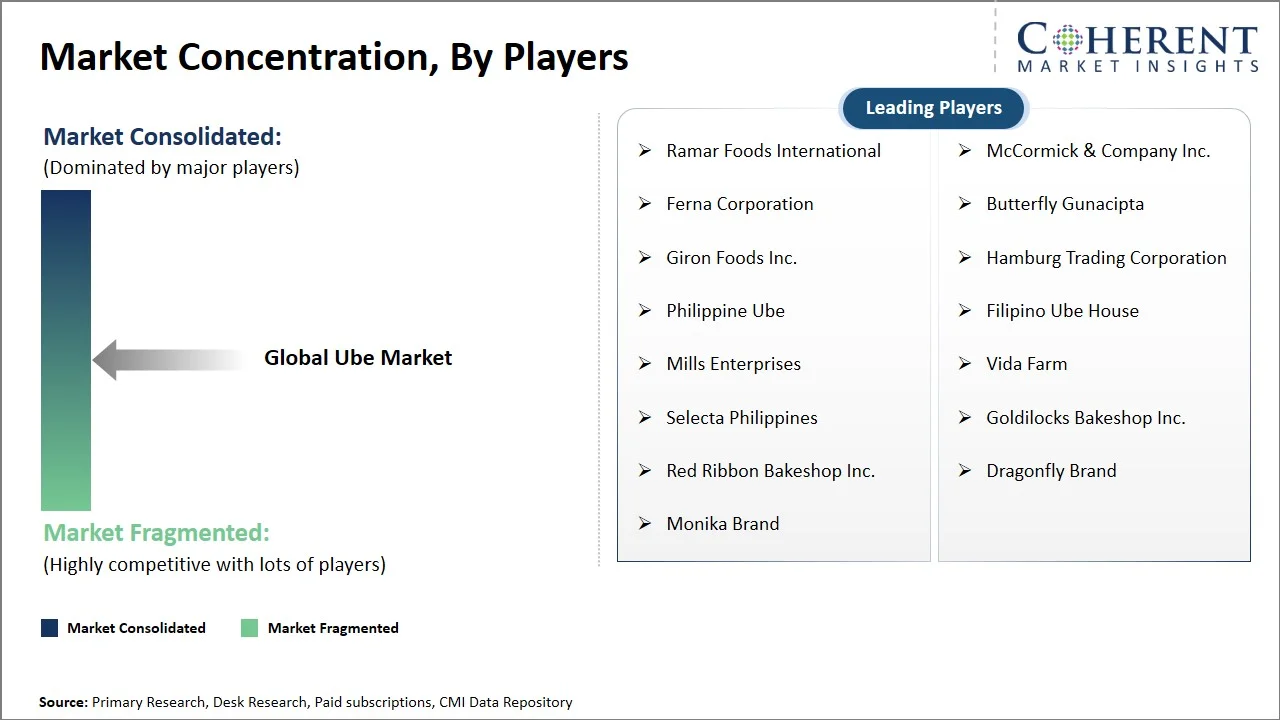
The Global Ube market is moderately competitive with players present in both ingredients and flavors, in frozen desserts, bakery products, and retail-ready format Ube categories. Quality consistency, real Ube content, certifications and bulk availability are the major differentials in Ube powder, paste, extract and flavoring and export-ready ingredient supply which is the main business of the companies (McCormick & Company, Ferna Corporation, Hamburg Trading Corporation, Philippine Ube, Filipino Ube House, Mills Enterprises, and Vida Farm). Consumer-oriented brands like Ramar Foods International, Selecta Philippines, Goldilocks Bakeshop, Red Ribbon Bakeshop, Dragonfly Brand, Monika Brand, Giron Foods, and Butterfly Gunacipta make Ube more visible in the market with their ice cream, cakes, rolls, jam, halaya, and baking products.
Market Report Scope
Ube Market Report Coverage
| Report Coverage | Details | ||
|---|---|---|---|
| Base Year: | 2025 | Market Size in 2026: | USD 520.3 Mn |
| Historical Data for: | 2020 To 2024 | Forecast Period: | 2026 To 2033 |
| Forecast Period 2026 to 2033 CAGR: | 6.9% | 2033 Value Projection: | USD 830.0 Mn |
| Geographies covered: |
| ||
| Segments covered: |
| ||
| Companies covered: | Ramar Foods International, McCormick & Company Inc., Ferna Corporation, Butterfly Gunacipta, Giron Foods Inc., Hamburg Trading Corporation, Philippine Ube, Filipino Ube House, Mills Enterprises, Vida Farm, Selecta Philippines, Goldilocks Bakeshop Inc., Red Ribbon Bakeshop Inc., Dragonfly Brand, and Monika Brand | ||
| Growth Drivers: |
| ||
| Restraints & Challenges: |
| ||
Analyst Opinion (Expert Opinion)
- Ube is moving beyond its traditional use in Filipino desserts and is becoming a global flavor platform across bakery products, frozen desserts, beverages, and ready-to-eat desserts. Brands are using Ube because it provides both taste differentiation and strong purple visual appeal, which helps products stand out in retail and foodservice channels. The nationwide launch of King’s Hawaiian Ube Coconut Sweet Rolls in April 2026 shows that Ube is entering mass bakery retail and is no longer limited to ethnic food stores.
- Processed Ube ingredients are expected to offer better margins than raw Ube because formats such as Ube powder, puree, extract, halaya, and fillings provide longer shelf life, easier export handling, better formulation control, and higher value addition. Direct sales will also remain important as large bakery manufacturers, beverage chains, frozen dessert brands, and importers require stable color, real Ube content, food safety documentation, and consistent bulk supply. While Asia Pacific will continue to support production and processed ingredient exports, North America is expected to drive faster consumer adoption through mainstream café, bakery, and dessert launches.
Speak to the analyst
Want personalized insights?
Take the findings above to one of our principal consultants, or have the report rebuilt around the segments, geographies and competitors you actually track.
Market Segmentation
- Commercial Form Insights (Revenue, USD Mn, 2021 - 2033)
- Fresh Whole Ube
- Frozen Ube
- Ube Powder
- Ube Puree
- Ube Extract
- Ube Jam
- Others
- Application Insights (Revenue, USD Mn, 2021 - 2033)
- Bakery Products
- Confectionery
- Frozen Desserts
- Beverages
- Packaged Snacks
- Ready to Eat Desserts
- Buyer Type Insights (Revenue, USD Mn, 2021 - 2033)
- Food Manufacturers
- Beverage Manufacturers
- Foodservice Operators
- Retail Consumers
- Ingredient Distributors
- Distribution Channel Insights (Revenue, USD Mn, 2021 - 2033)
- Direct Sales
- Indirect (Via Distributor)
- Regional Insights (Revenue, USD Mn, 2021 - 2033)
- North America
- U.S.
- Canada
- Latin America
- Brazil
- Argentina
- Mexico
- Rest of Latin America
- Europe
- Germany
- U.K.
- Spain
- France
- Italy
- Russia
- Rest of Europe
- Asia Pacific
- China
- India
- Japan
- Australia
- South Korea
- ASEAN
- Rest of Asia Pacific
- Middle East
- GCC Countries
- Israel
- Rest of Middle East
- Africa
- South Africa
- North Africa
- Central Africa
- North America
- Key Players Insights
- Ramar Foods International
- McCormick & Company Inc.
- Ferna Corporation
- Butterfly Gunacipta
- Giron Foods Inc.
- Hamburg Trading Corporation
- Philippine Ube
- Filipino Ube House
- Mills Enterprises
- Vida Farm
- Selecta Philippines
- Goldilocks Bakeshop Inc.
- Red Ribbon Bakeshop Inc.
- Dragonfly Brand
- Monika Brand
Sources
Primary Research Interviews
- Ube growers and farmer cooperatives
- Ube powder, puree, paste, halaya, and extract manufacturers
- Bakery product manufacturers and frozen dessert producers
- Beverage brands, café chains, and foodservice operators
- Importers, exporters, and specialty Asian food distributors
- Retail buyers from supermarkets, Asian grocery chains, and online grocery platforms
Magazines / Trade Publications
- Food Business News
- Food Navigator
- Bakery and Snacks
- Prepared Foods Magazine
- QSR Magazine
- Specialty Food Magazine
- Philippine Food and Beverage Industry publications
Journals
- Journal of Food Science and Technology
- Food Chemistry
- International Journal of Food Science
- Journal of Root Crops
- Philippine Journal of Crop Science
- Foods Journal
- Journal of Agriculture and Food Research
Associations
- Philippine Department of Trade and Industry
- Philippine Department of Agriculture
- Philippine Coconut Authority and regional agricultural offices, where relevant
- Philippine Root Crop Research and Training Center
- Specialty Food Association
- International Dairy Foods Association
- American Bakers Association
- International Foodservice Distributors Association
Public Domain Sources
- Philippine Statistics Authority
- Philippine Department of Trade and Industry export updates
- Philippine Information Agency
- Department of Agriculture, Philippines
- Bureau of Plant Industry, Philippines
- UN Comtrade Database
- FAOSTAT
- USDA Foreign Agricultural Service
- Company websites and product portfolios
- Company press releases and newsroom updates
- Retail and foodservice menu listings
Proprietary Elements
- CMI Data Analytics Tool
- Proprietary CMI Existing Repository of information for last 10 years
Get access to 250+ pages report
Every segment, forecast, competitor profile and data table behind the analysis above — available for instant download.
- ESOMAR Member
- ISO 9001:2015 Certified
- D-U-N-S Registered
- GDPR & CCPA Compliant
Missing comfort of reading report in your local language? Find your preferred language:
Transform your Strategy with Exclusive Trending Reports
Frequently Asked Questions
The CAGR of the global Ube market is projected to be 6.9% from 2026 to 2033.
The global Ube market is estimated to be valued at USD 520.3 Mn in 2026 and is expected to reach USD 830.0 Mn by 2033.
In terms of application, bakery products are expected to dominate the global Ube market in 2026, as Ube is widely used in cakes, rolls, buns, pastries, cookies, and other premium bakery items.
North America is expected to grow fastest in the global Ube market due to rising adoption of Ube in cafés, bakery products, frozen desserts, QSR menus, and social-media-led food trends.
Rising popularity of Asian flavors and social media & influencer-led food trends are the major factors driving the growth of the global Ube market.
Expansion in packaged food & beverage applications and growing export potential from Asia Pacific are the major factors hampering the growth of the global Ube market.
In terms of commercial form, Ube powder is estimated to dominate the market revenue share in 2026.