

U.S. Boutique Medicine Market Size and Forecast – 2026 To 2033
The U.S. boutique medicine market is expected to grow from USD 6,430.7 Mn in 2026 to USD 12,435.8 Mn by 2033, registering a compound annual growth rate (CAGR) of 9.9%. The U.S. boutique medicine market is poised for significant expansion, fueled by the growing consumer preference for preventive, personalized, and continuous primary healthcare that emphasizes long-term physician-patient relationships.
According to the U.S. Centers for Disease Control and Prevention (CDC), 85.2% of U.S. adults visited a doctor or other healthcare professional in the past year (2024), reflecting sustained demand for regular primary and preventive healthcare services that supports the adoption of boutique medicine models.
Key Takeaways of the U.S. Boutique Medicine Market
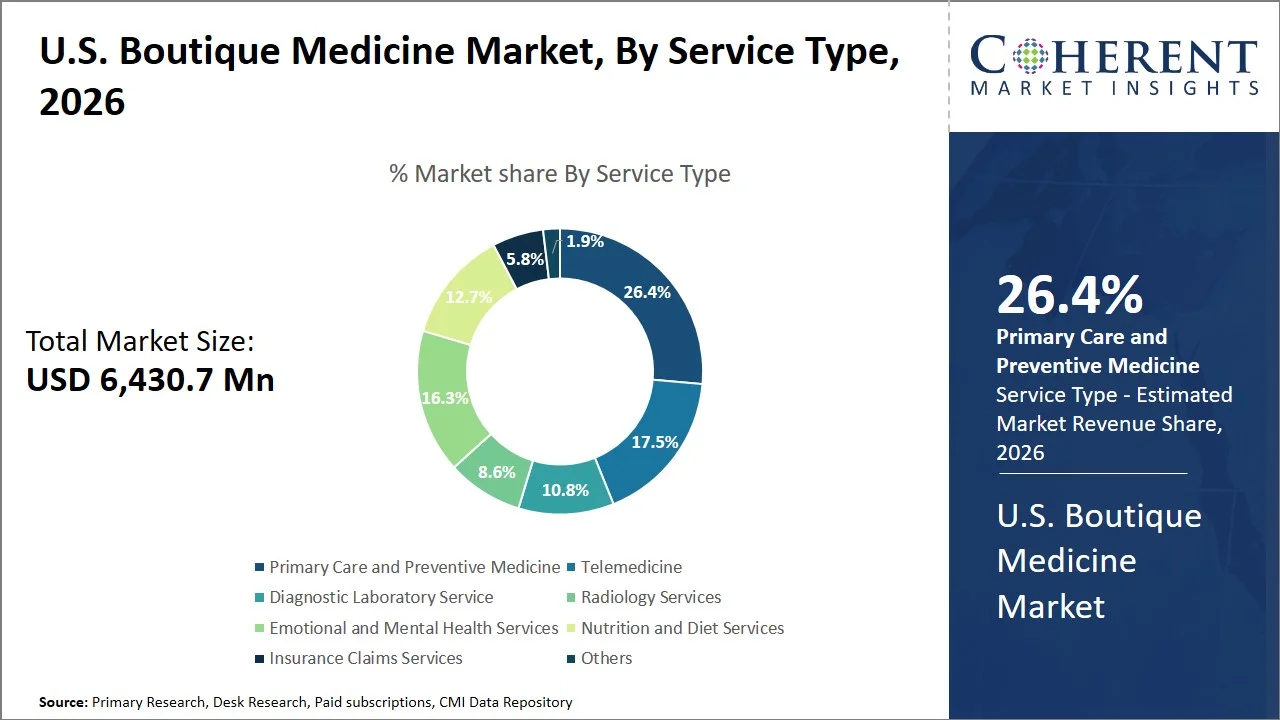
- Primary care and preventive medicine are projected to hold 26.4 % of the U.S. boutique medicine market share in 2026, making it the dominant service type segment, owing to the increasing emphasis on preventive care and long-term health management. For instance, the U.S. Preventive Services Task Force (USPSTF) recommend evidence-based preventive screenings and counseling services across multiple disease areas, reinforcing the growing adoption of preventive care models that underpin boutique medicine practices
- Group is projected to hold 64.9 % of the U.S. boutique medicine market share in 2026, making it the dominant ownership segment, supported by the growing integration of multidisciplinary physicians delivering coordinated and personalized healthcare services. For instance, the U.S. Centers for Medicare & Medicaid Services (CMS) expanded value-based care models through the Medicare Shared Savings Program (MSSP), encouraging physician group practices to deliver coordinated, patient-centered care and improve healthcare outcomes.
- Primary care is projected to hold 24.5 % of the U.S. boutique medicine market share in 2026, making it the dominant specialty segment, driven by the rising demand for continuous physician access and personalized healthcare management. For instance, the U.S. Health Resources and Services Administration (HRSA) prioritize strengthening the primary care workforce through its Primary Care Training and Enhancement (PCTE) Program, supporting high-quality, patient-centered primary care delivery nationwide.
Segmental Insights
Why Do Primary Care and Preventive Medicine Dominate the U.S. Boutique Medicine Market?
Primary care and preventive medicine are projected to hold a market share of 26.4% in 2026, due to growing public interest in preventive medicine and screening, as well as an increasing value on long-term relationship between the doctor and the patient. Membership based practices provide patients with complete wellness planning, chronic disease management, as well as personalized care that enhance patient involvement in the health care. For instance, in September 2024, Julian Javier MD, Leandro Perez MD and Tracey Roth MD partnered with Castle Connolly Private Health Partners, LLC to create Precision Concierge Physicians, a membership-driven primary care practice that provides personalized preventative care, enhanced physician access, and the coordination of patients' lifelong health strategies.
- Current Industry Events of 2026
- Market Size Estimation
- Regional Breakdown
- Competitive Landscape
- Customer Intelligence
- Segmental Analysis
- Pricing Analysis
- Key Market Drivers, Challenges & Future Trends
- Customized Insights Section
Why Does Group Represent the Largest Ownership Segment in the U.S. Boutique Medicine Market?
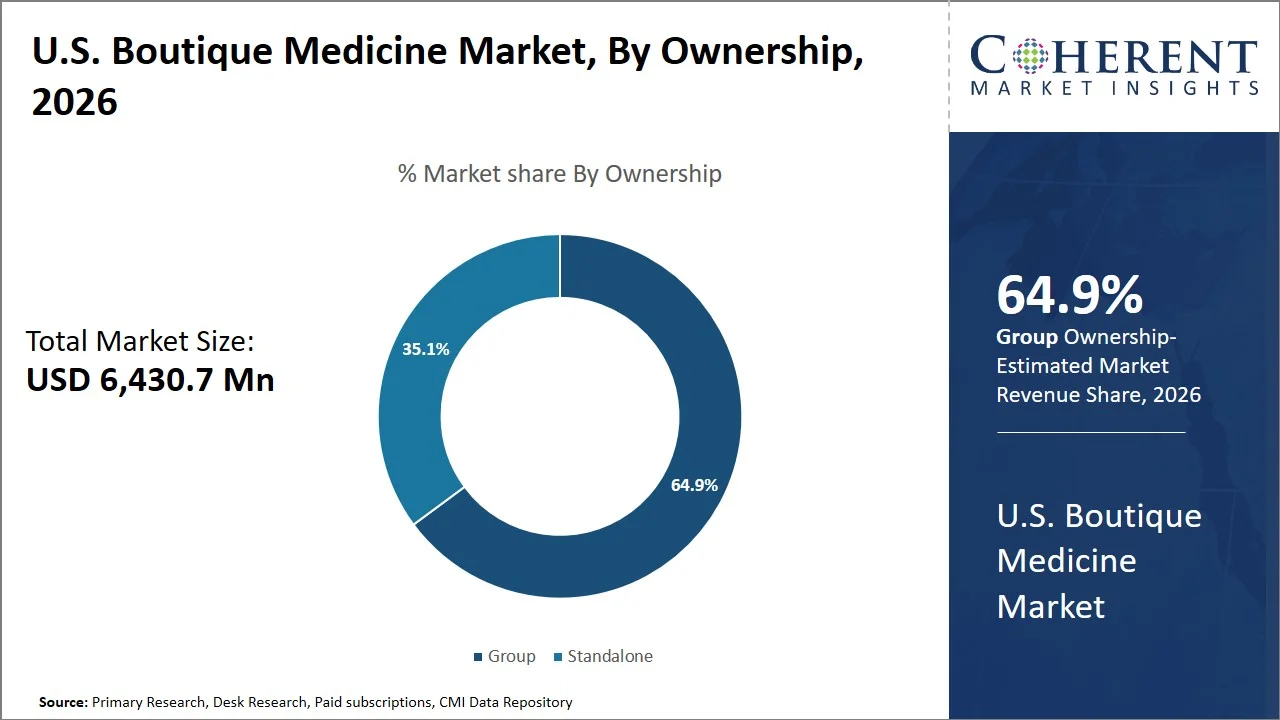
Group is projected to hold 64.9% of the market share in 2026, due to its strengths in providing coordinated, multidisciplinary care, while achieving efficiencies and supporting partnerships among physicians that increase access to health care services. Group practices are best-situated to take on financial, operational and technology risk to fund the development of robust digital capabilities, broaden offerings of specialty services, and provide consistent access to high-value membership care across multiple locations. For instance, in January 2025, Specialdocs Consultants reported that it successfully transitioned a record number of 26 physician clients to independent boutique practices in 2024, reinforcing the growing popularity of formal multi-physician boutiques throughout the US.
Primary Care Segment Dominates the U.S. Boutique Medicine Market
The primary care segment is expected to hold 24.5% of the U.S. boutique medicine market share in 2026, because it focuses on providing relationship-based care and the continuity of medical services while incorporating prevention, chronic care and chronic management. Boutique primary care physicians often utilize smaller patient panels so they have extended consultations, personalized treatment plans, and improved health outcomes. For instance, SignatureMD grew its network to approximately 35+ states adding members to its nationwide chain of concierge-oriented primary care physicians, thereby broadening the availability of personalized, membership-based primary care across the U.S.
Current Events and their Impact
Current Events | Description and its Impact |
Centers for Medicare & Medicaid Services (CMS) Finalizes the Calendar Year 2025 Physician Fee Schedule |
|
Direct Primary Care Receives Federal Policy Support Under H.R.1 (July 2025) |
|
U.S. Boutique Medicine Market Dynamics
Market Drivers
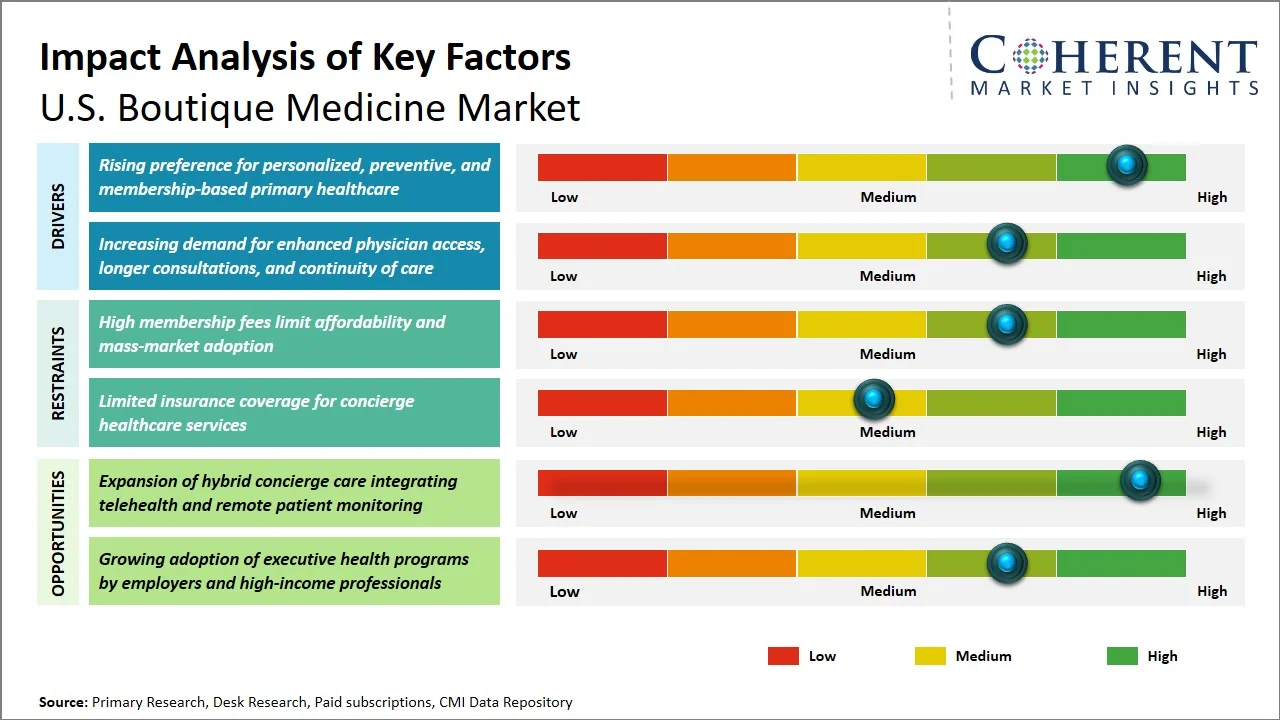
- Rising preference for personalized, preventive, and membership-based primary healthcare: The increasing preference for personalized and preventive healthcare is a key driver of the U.S. boutique medicine market, as patients seek longer physician consultations, individualized wellness planning, and continuous care beyond traditional fee-for-service models. Membership-based practices are increasingly differentiating themselves through comprehensive preventive services and stronger physician-patient relationships, improving patient engagement and long-term health outcomes. For instance, in September 2025, Specialdocs Consultants partnered with Princeton Medicine Physicians to introduce a concierge medicine program, enabling patients to access personalized preventive care, extended appointments, and enhanced physician availability, reflecting the growing adoption of boutique healthcare models in the U.S.
- Increasing demand for enhanced physician access, longer consultations, and continuity of care: The increasing demand for enhanced physician access, longer consultation times, and continuity of care is driving the growth of the U.S. boutique medicine market. Patients are increasingly seeking healthcare models that offer direct communication with physicians, comprehensive health assessments, and ongoing care management, resulting in improved patient satisfaction and stronger long-term physician-patient relationships. For instance, in June 2025, Castle Connolly Private Health Partners expanded its concierge medicine network by partnering with Palm Beach Health Network Physician Group, enabling physicians to provide membership-based care with enhanced accessibility, extended appointments, and personalized preventive services.
- Growing Adoption of Membership-Based Primary Care Models: The increasing acceptance of membership-based primary care is driving the expansion of the U.S. boutique medicine market by providing predictable healthcare costs, improved physician accessibility, and comprehensive preventive care. These models enable physicians to maintain smaller patient panels, allowing for more personalized treatment, timely follow-ups, and stronger long-term patient relationships. For instance, in April 2025, SignatureMD partnered with Legacy Health MD to launch a concierge medicine program in Florida, enabling patients to access membership-based primary care with extended appointments, preventive wellness services, and direct physician communication.
Emerging Trends
- Expansion of Longevity and Precision Wellness Programs: Boutique medicine providers are increasingly incorporating longevity medicine, advanced biomarker testing, genetic risk assessment, and personalized wellness plans into membership offerings. This shift is positioning concierge practices beyond primary care toward proactive health optimization and healthy aging.
- Growth of Employer-Sponsored Concierge Healthcare: Employers are increasingly partnering with boutique medicine providers to offer membership-based primary care and executive health services as part of employee benefits. This trend is helping organizations improve workforce health, reduce absenteeism, and enhance employee retention while expanding the patient base beyond individual subscribers.
- Rising Adoption of Subscription-Based Healthcare Models: Healthcare providers are transitioning from traditional fee-for-service reimbursement toward predictable subscription-based membership models that emphasize preventive care and long-term patient engagement. Flexible membership tiers and customized service packages are making boutique medicine more scalable and financially sustainable across diverse patient segments.
Key Policy and Reimbursement Initiatives Shaping the U.S. Boutique Medicine Market
Policy / Initiative | Implementing Authority | Key Provision | Impact on Market |
Direct Primary Care (DPC) State Laws | State Legislatures | Recognition of membership-based healthcare agreements outside traditional insurance | Encourages expansion of boutique medicine practices |
Medicare Remote Patient Monitoring (RPM) Reimbursement | Centers for Medicare & Medicaid Services | Reimbursement for remote monitoring services | Supports integration of digital care into concierge practices |
Medicare Annual Wellness Visit (AWV) | Centers for Medicare & Medicaid Services | Coverage for preventive health assessments and wellness visits | Increases demand for preventive and personalized care services |
Health Information Interoperability Rules | Office of the National Coordinator for Health Information Technology | Secure exchange of electronic health information across providers | Enhances care coordination and patient engagement |
Telehealth Coverage Policies | Centers for Medicare & Medicaid Services & State Regulators | Coverage for virtual consultations and digital care delivery | Expands access to membership-based healthcare services |
How is the expansion of hybrid concierge care integrating telehealth and remote patient monitoring creating new growth opportunities in the U.S. boutique medicine market?
The growth of hybrid concierge care models that incorporate telehealth and remote patient monitoring in to in-person services offer a major opportunity for growth within the boutique medicine market in the U.S. These models offer continuity of care, better chronic disease management, improved patient convenience and allow physicians to deliver personalized care beyond the clinic settings. For instance, in May 2025, Concierge Choice Physicians joined hands with Medical Clinic of Houston to introduce the Hybrid Choice membership program to offer improved patient access, personalization and connected-care services through the flexibility of a concierge care model.
Market Players, Key Development, and Competitive Landscape
Key Developments
- In February 2026, Hermes Health introduced a Boutique Medicine Program across Chicago and its surrounding suburbs, offering a membership-based care model with a 12-month commitment. The program provides enhanced physician access, extended consultations, house calls, virtual visits, and personalized wellness planning, reflecting the growing demand for premium, relationship-driven healthcare services in the U.S. boutique medicine market.
- In May 2025, the founders of Amazon's PillPack publicly launched General Medicine, a digital healthcare marketplace designed to provide consumers with streamlined access to primary care, specialist consultations, diagnostics, prescriptions, and imaging services through a single platform. The launch highlights the growing shift toward personalized, technology-enabled healthcare models that align with the expanding U.S. boutique medicine landscape.
Competitive Landscape
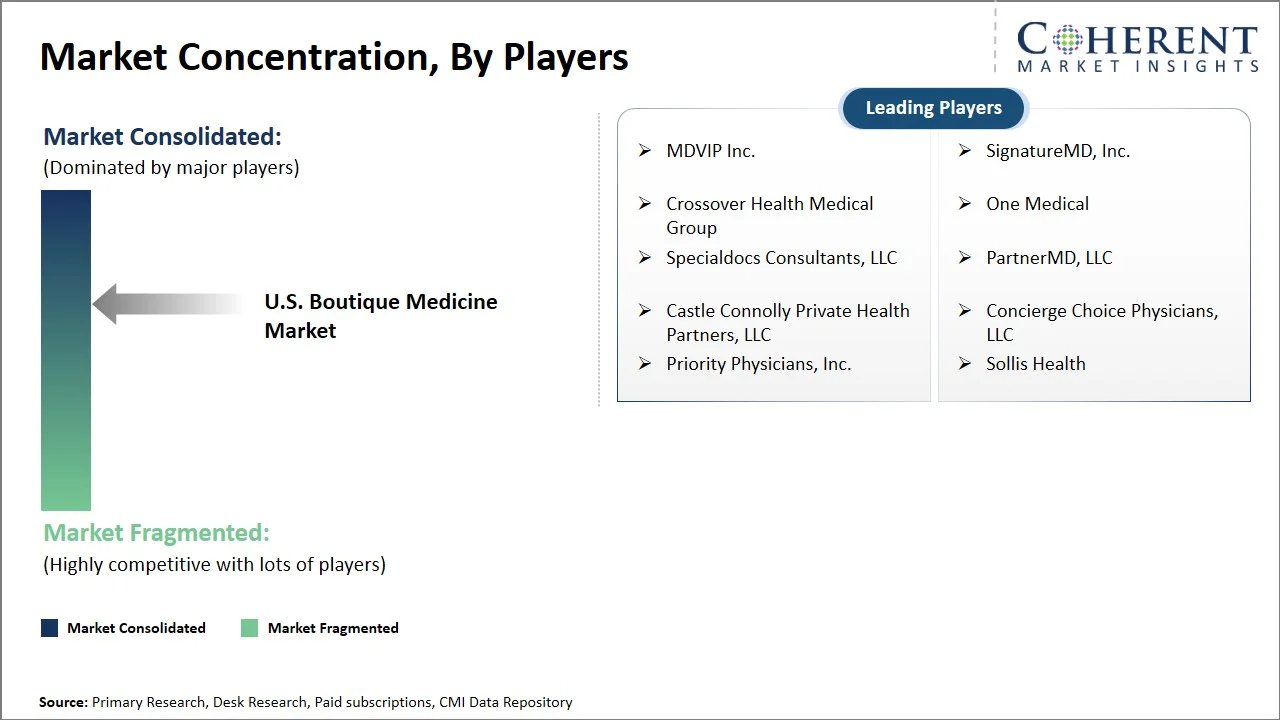
The U.S. boutique medicine market is moderately fragmented, with competition centered on expanding membership-based primary care services, enhancing personalized patient experiences, and integrating digital health technologies into concierge care models. Market participants are strengthening their positions through physician network expansion, strategic partnerships, preventive wellness programs, and technology-enabled care delivery to improve patient retention and service differentiation. Key focus areas include:
- Expansion of concierge and direct primary care physician networks
- Integration of telehealth, remote patient monitoring, and digital health platforms
- Development of personalized preventive care and executive health programs
- Strategic partnerships with employers, insurers, and healthcare technology providers
Market Report Scope
U.S. Boutique Medicine Market Report Coverage
| Report Coverage | Details | ||
|---|---|---|---|
| Base Year: | 2025 | Market Size in 2026: | USD 6,430.7 Mn |
| Historical Data for: | 2020 To 2024 | Forecast Period: | 2026 To 2033 |
| Forecast Period 2026 to 2033 CAGR: | 9.9% | 2033 Value Projection: | USD 12,435.8 Mn |
| Segments covered: |
| ||
| Companies covered: | MDVIP Inc., SignatureMD, Inc., Crossover Health Medical Group, One Medical, Specialdocs Consultants, LLC, PartnerMD, LLC, Castle Connolly Private Health Partners, LLC, Concierge Choice Physicians, LLC, Priority Physicians, Inc., and Sollis Health | ||
| Growth Drivers: |
| ||
| Restraints & Challenges: |
| ||
Analyst Opinion (Expert Opinion)
- The future of the U.S. boutique medicine market will be shaped by the convergence of personalized healthcare, preventive medicine, and digital health technologies. As patients increasingly prioritize continuity of care, wellness management, and convenient physician access, membership-based healthcare models are expected to become an integral component of premium primary care delivery.
- The maximum growth opportunity lies within membership-based primary and preventive care services, particularly for chronic disease management and executive health programs across the U.S. Growing demand from employers, aging populations, and health-conscious consumers seeking long-term physician relationships will continue to support market expansion.
- In order to create an advantage for themselves, the competitors should expand physician networks, integrate telehealth and remote patient monitoring into concierge care models, and leverage data-driven preventive health programs. Strategic collaborations with employers, insurers, and digital health technology providers will further strengthen patient acquisition, retention, and long-term revenue growth.
Speak to the analyst
Want personalized insights?
Take the findings above to one of our principal consultants, or have the report rebuilt around the segments, geographies and competitors you actually track.
Market Segmentation
- Service Type Insights (Revenue, USD Mn, 2021 - 2033)
- Primary Care and Preventive Medicine
- Telemedicine
- Diagnostic Laboratory Service
- Radiology Services
- Emotional and Mental Health Services
- Nutrition and Diet Services
- Insurance Claims Services
- Others
- Ownership Insights (Revenue, USD Mn, 2021 - 2033)
- Group
- Standalone
- Specialty Insights (Revenue, USD Mn, 2021 - 2033)
- Primary Care
- Pediatrics
- Osteopathy
- Internal Medicine
- Cardiology
- Psychiatry
- Others
- Key Players Insights
- MDVIP Inc.
- SignatureMD, Inc.
- Crossover Health Medical Group
- One Medical
- Specialdocs Consultants, LLC
- PartnerMD, LLC
- Castle Connolly Private Health Partners, LLC
- Concierge Choice Physicians, LLC
- Priority Physicians, Inc.
- Sollis Health
Sources
Primary Research Interviews
- Concierge Medicine Physicians and Direct Primary Care (DPC) Practitioners
- Family Medicine and Internal Medicine Physicians
- Executives from Concierge Healthcare Networks and Membership-based Medical Practices
- Hospital and Integrated Health System Primary Care Directors
- Healthcare Strategy, Population Health, and Value-based Care Executives
- Digital Health and Telehealth Platform Executives
- Employer-sponsored Healthcare and Corporate Wellness Program Managers
Stakeholders
- Boutique Medicine Providers (Concierge & Direct Primary Care Practices)
- Independent Primary Care Physician Groups
- Multi-specialty Concierge Healthcare Networks
- Digital Health and Telehealth Solution Providers
- Employer-sponsored Healthcare Benefit Providers
- Health Insurance and Value-based Care Organizations
- End-use Sectors:
- Concierge Medical Clinics
- Direct Primary Care Practices
- Multi-specialty Physician Groups
- Employer Health Clinics
- Executive Health Centers
- Regulatory & Health Bodies
- U.S. Department of Health and Human Services (HHS)
- Centers for Medicare & Medicaid Services (CMS)
- Health Resources and Services Administration (HRSA)
- Centers for Disease Control and Prevention (CDC)
- Agency for Healthcare Research and Quality (AHRQ)
- Office of the National Coordinator for Health Information Technology (ONC)
- U.S. Preventive Services Task Force (USPSTF)
- American Medical Association (AMA)
Databases
- Centers for Medicare & Medicaid Services – Medicare & Physician Payment Data
- Health Resources and Services Administration – Health Workforce Data
- Centers for Disease Control and Prevention – National Center for Health Statistics (NCHS)
- Agency for Healthcare Research and Quality – Medical Expenditure Panel Survey (MEPS)
Magazines
- Concierge Medicine Today
- Healthcare IT News
- Medical Economics
- Modern Healthcare
- Becker's Hospital Review
Journals
- Journal of Primary Care & Community Health
- Annals of Family Medicine
- Journal of General Internal Medicine
- JAMA Internal Medicine
- American Journal of Preventive Medicine
Associations
- American Academy of Family Physicians (AAFP)
- American College of Physicians (ACP)
- American Medical Association (AMA)
- Direct Primary Care Coalition (DPCC)
- American College of Preventive Medicine (ACPM)
Public Domain Sources
- U.S. Department of Health and Human Services (HHS)
- Centers for Medicare & Medicaid Services (CMS)
- Health Resources and Services Administration (HRSA)
- Centers for Disease Control and Prevention (CDC)
- Agency for Healthcare Research and Quality (AHRQ)
- Office of the National Coordinator for Health Information Technology (ONC)
- U.S. Preventive Services Task Force (USPSTF)
- National Center for Health Statistics (NCHS)
Proprietary Elements
CMI Data Analytics Tool, Proprietary CMI Existing Repository of information for last 10 years.
Get access to 250+ pages report
Every segment, forecast, competitor profile and data table behind the analysis above — available for instant download.
- ESOMAR Member
- ISO 9001:2015 Certified
- D-U-N-S Registered
- GDPR & CCPA Compliant
Missing comfort of reading report in your local language? Find your preferred language:
Transform your Strategy with Exclusive Trending Reports
Frequently Asked Questions
The U.S. boutique medicine market is estimated to be valued at USD 6,430.7 Mn in 2026 and is expected to reach USD 12,435.8 Mn by 2033.
Primary care and preventive medicine dominate due to increasing consumer demand for personalized, continuous healthcare, early disease detection, chronic disease management, and long-term physician-patient relationships.
Boutique medicine is a membership-based healthcare model in which patients pay a recurring fee to receive personalized primary care, enhanced physician access, extended consultations, and preventive health services.
The CAGR of the U.S. boutique medicine market is projected to be 9.9% from 2026 to 2033.
The U.S. boutique medicine market is expected to experience steady growth, driven by increasing demand for personalized preventive care, expansion of concierge and direct primary care models, greater integration of digital health technologies, and growing employer adoption of membership-based healthcare services.
Telehealth, remote patient monitoring (RPM), electronic health records (EHRs), AI-enabled clinical decision support, and digital patient engagement platforms are transforming boutique medicine delivery.
Concierge medicine and Direct Primary Care (DPC) are the predominant healthcare models, offering membership-based access to personalized primary care services.