

Sexual Health Market size and share Analysis (2026-2033)
The Global Sexual Health Market is anticipated to grow at a CAGR of 8.9% with USD 45.67 Bn in 2026 and is expected to reach USD 82.94 Bn in 2033. This growth in the market is driven by rising awareness of sexually transmitted infections (STIs), increasing acceptance of wellness products, and expanding access to contraceptives and digital sexual health solutions.
Key Takeaways
- By product type, erectile dysfunction drugs have 39.4% of the market share in 2026. Statistically, demand stays high because erectile dysfunction is very common. The U.S. National Institute of Diabetes and Digestive and Kidney Diseases says that between 30 million and 50 million men in the U.S. have ED. The number of men with ED goes up from about 40% at age 40 to 70% by age 70. (NIDDK)
- The male segment makes up 62.3% of the market in 2026, making it the largest group. This leadership is backed by a higher diagnosed burden in male sexual wellness categories: 30 million to 50 million U.S. men have erectile dysfunction, and gay and bisexual men made up 67% of new HIV diagnoses in the U.S. in 2022. This means that there is still a need for sexual health products and therapies that focus on men.
- In terms of distribution channel, retail pharmacies has the largest market share in 2026, at 38.9%. Their leadership is strengthened by their size and ease of access: NACDS member chains run more than 40,000 pharmacies in the U.S. and fill more than 3 Bn prescriptions each year. The CDC-supported IQVIA report also says that retail pharmacy prescription datasets cover almost all of the activity that happens outside of hospitals.
- In 2026, North America has a 36.8% share of the Sexual Health Market. The region's lead is backed up by a lot of disease and treatment: the CDC says that in 2024, there were more than 2.2 million STIs reported in the U.S., and Canada had 2,288 new HIV diagnoses and an HIV diagnosis rate of 5.5 per 100,000 people.
Segmental Insights
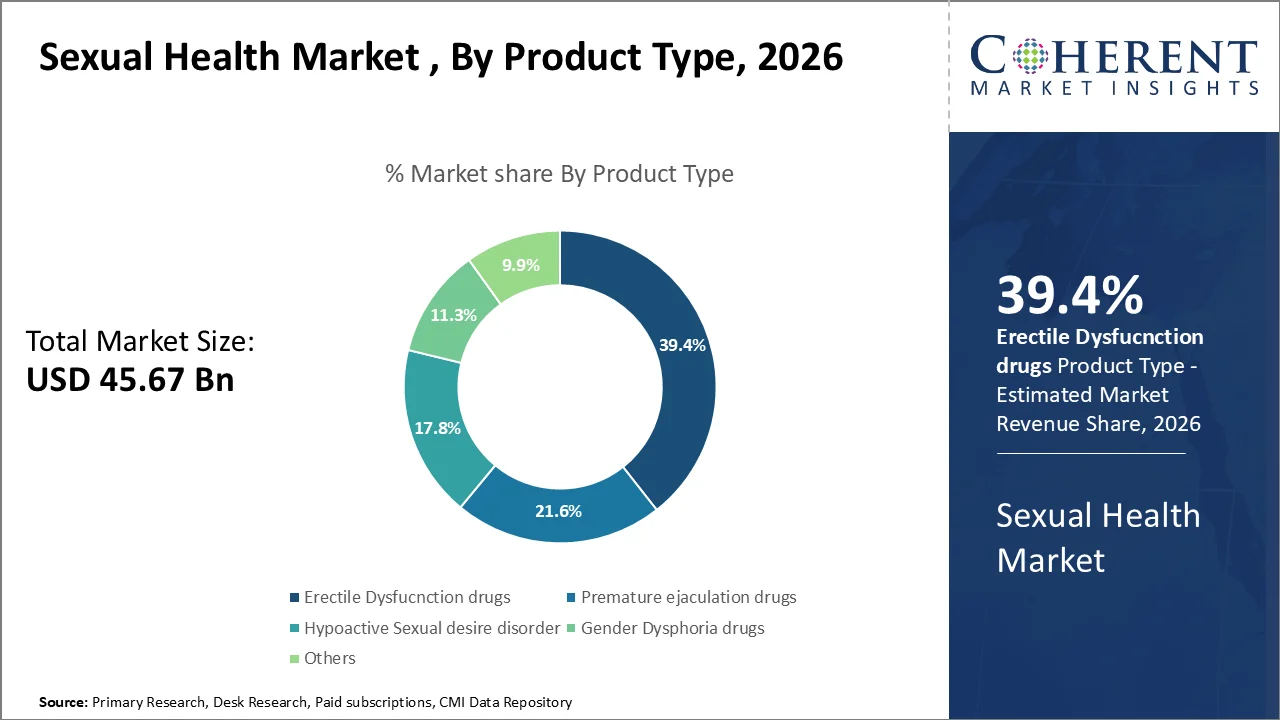
By Product Type: The Erectile Dysfunction Drugs segment dominates with 39.4% of market share in 2026.
The erectile dysfunction drugs segment is the biggest part of the Sexual Health Market with 39.4% share as it deals with one of the most common and well-known male sexual health problems, and there are well-established prescribing patterns and a lot of awareness about treatment. NIDDK says that between 30 million and 50 million men in the U.S. have erectile dysfunction. The number of men with this condition rises from about 40% at age 40 to 70% by age 70, which means that there will always be a need for ED treatments.
The number of men who can be treated is growing because ED is more common as men get older. The number of people with chronic diseases that are linked to ED is going up. The CDC says that in 2023, 40.1 million people in the U.S. had diabetes. The NIDDK says that diabetes, obesity, and cardiovascular disease are some of the most common medical causes of ED.
The FDA gave the go-ahead for ANI Pharmaceuticals' Chewtadzy (tadalafil) chewable tablets for ED on June 28, 2024. They come in 5 mg, 10 mg, and 20 mg strengths. On December 16, 2025, the FDA approved IBSA's Vybrique (sildenafil) oral film for ED. The label said it came in strengths of 25 mg, 50 mg, 75 mg, and 100 mg.
- Current Industry Events of 2026
- Market Size Estimation
- Regional Breakdown
- Competitive Landscape
- Customer Intelligence
- Segmental Analysis
- Pricing Analysis
- Key Market Drivers, Challenges & Future Trends
- Customized Insights Section
By Gender: The Male segment dominates with 62.3% of market share in 2026.
The male segment of the Sexual Health Market has a 62.3% share in 2026. This is mostly because there is a lot of demand for male-specific conditions like erectile dysfunction and HIV prevention and treatment. NIDDK says that 30 million to 50 million men in the U.S. have erectile dysfunction. The CDC says that in 2023, there were 39,201 new HIV cases, 31,846 of which (81%) were in men. This supports the idea that more men use these products. (HIV Data)
Sexual health problems that are linked to age are on the rise. NIDDK says that about 40% of men have erectile dysfunction by age 40 and 70% by age 70. Chronic metabolic disorders are increasing the number of people who need treatment.
The CDC said that after the FDA approved injectable lenacapavir for HIV PrEP on June 18, 2025, the treatment worked 96% of the time in a trial with mostly men over 52 weeks. The CDC's 2025 update also said that 31,846 men made up 81% of HIV diagnoses in 2023, which shows how important this group is. (CDC)
By Distribution Channel: The Retail Pharmacies segment dominates with 38.9% of market share in 2026.
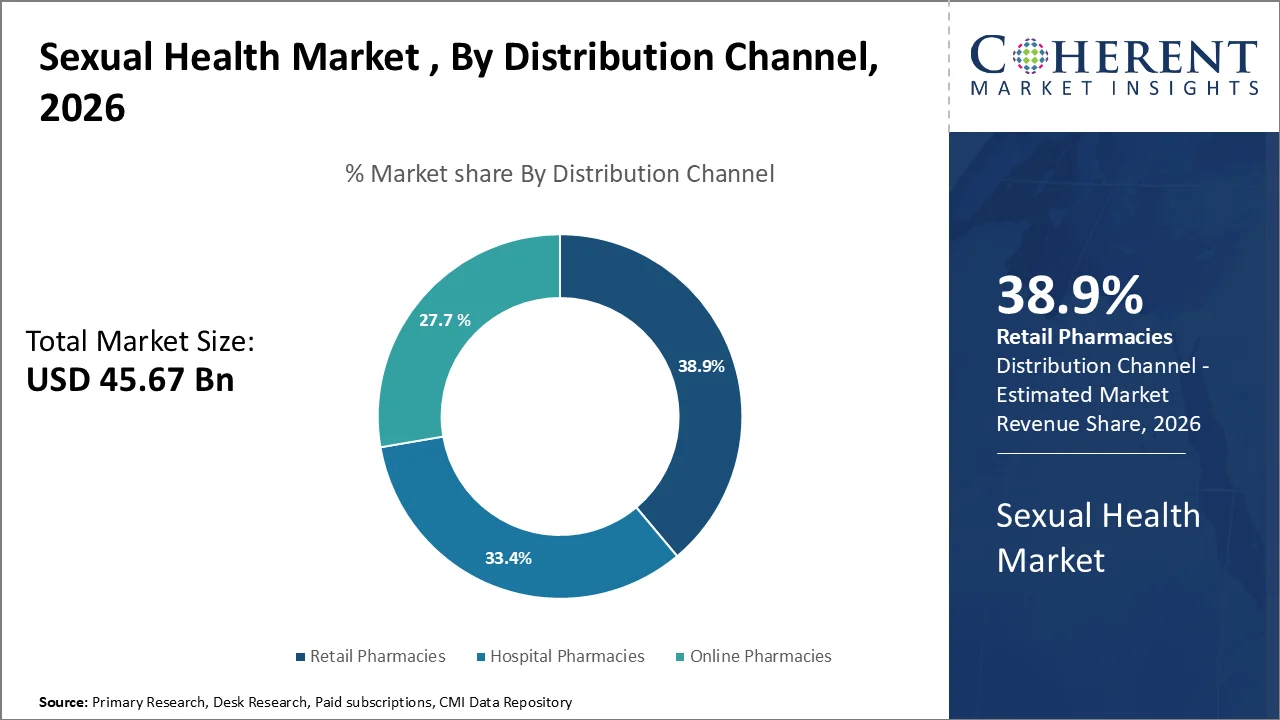
In 2026, the retail pharmacies segment is the dominant Segment and has the largest market share at 38.9%. This is because it offers the widest range of prescription fulfillment, over-the-counter sexual wellness products, pharmacist advice, and easy access in the neighborhood. According to NACDS, chain members run more than 40,000 pharmacies, hire almost 155,000 pharmacists, and fill more than 3 billion prescriptions every year. Walgreens also says that 78% of Americans live within 5 miles of a Walgreens, which shows how far the channel can reach.
Strong local access makes it easy to buy contraceptives, ED treatments, and other related items on a regular basis. Pharmacists are taking on more responsibilities in health care. CVS says that 74% of community pharmacists want to do more than just fill prescriptions, and 64% of customers want local pharmacies to offer a wider range of health services, such as HIV-related and hormonal care support.
CVS started offering hormonal birth control prescribed by pharmacists to eligible adults at almost 400 Massachusetts CVS Pharmacy locations on September 12, 2024. On July 13, 2023, the FDA approved Opill as the first daily oral contraceptive that doesn't need a prescription to buy in drug stores. (CVS Health)
Sexual Health Market Trends: Rising STI Burden, Long-Acting HIV Prevention, and OTC Contraceptive Access
- The rising number of STIs is keeping the demand for products that help with diagnosis, treatment, and prevention. The World Health Organization (WHO) says that more than 1 million curable STIs are spread around the world every day. In 2020, there were 374 million new infections of chlamydia, gonorrhea, syphilis, and trichomoniasis. The CDC said that there were more than 2.2 million cases of chlamydia, gonorrhea, and syphilis in the U.S. in 2024. This shows that testing, treatment, and prevention are still very important for business.
- Long-acting HIV prevention is a big new trend in sexual health. The FDA approved Yeztugo (lenacapavir) for pre-exposure prophylaxis on June 18, 2025. Later, the CDC summarized trial results that showed the drug was 100% effective in women and 96% effective in a mostly male trial population over 52 weeks. This suggests that there is more demand for longer-interval prevention options that can help people stick to their plans better than daily oral regimens. (CDC)
Rising Innovations in the Sexual Health Market (2026)
New ideas and innovations in the sexual health market are increasingly focused on longer-lasting prevention and delivery methods that are easier for patients to use. The FDA's approval of Yeztugo (lenacapavir) for HIV PrEP on June 18, 2025, was a big step forward. The CDC later reported that it was 100% effective in a female trial and 96% effective in a mostly male trial population over 52 weeks, showing that it has a lot of clinical potential. The FDA also approved Chewtadzy (tadalafil) chewable tablets for men's sexual health in June 2024 and Vybrique (sildenafil) oral film in December 2025. This shows a clear shift toward different, more convenient ED treatments. (FDA)
Disease Burden and Treatment Need
A lot of people get sick with sexually transmitted diseases, which helps the sexual health market. WHO says that every day, more than 1 million people around the world get STIs that can be treated. In 2020, there were 374 million new infections of chlamydia, gonorrhea, syphilis, and trichomoniasis. In 2023, the CDC said that more than 39,000 people in the U.S. were diagnosed with HIV, and more than 80% of them were men. The NIDDK says that 30 million to 50 million men in the U.S. have erectile dysfunction. These numbers show that there is a wide and long-lasting clinical demand for sexual health products and treatments. (WHO)
Current Events and Their Impact on Sexual Health Market
Current Events | Description and Its Impact |
FDA approval of Yeztugo (lenacapavir) for HIV prevention |
|
WHO launches consolidated operational handbook for STI response |
|
Regional Insights
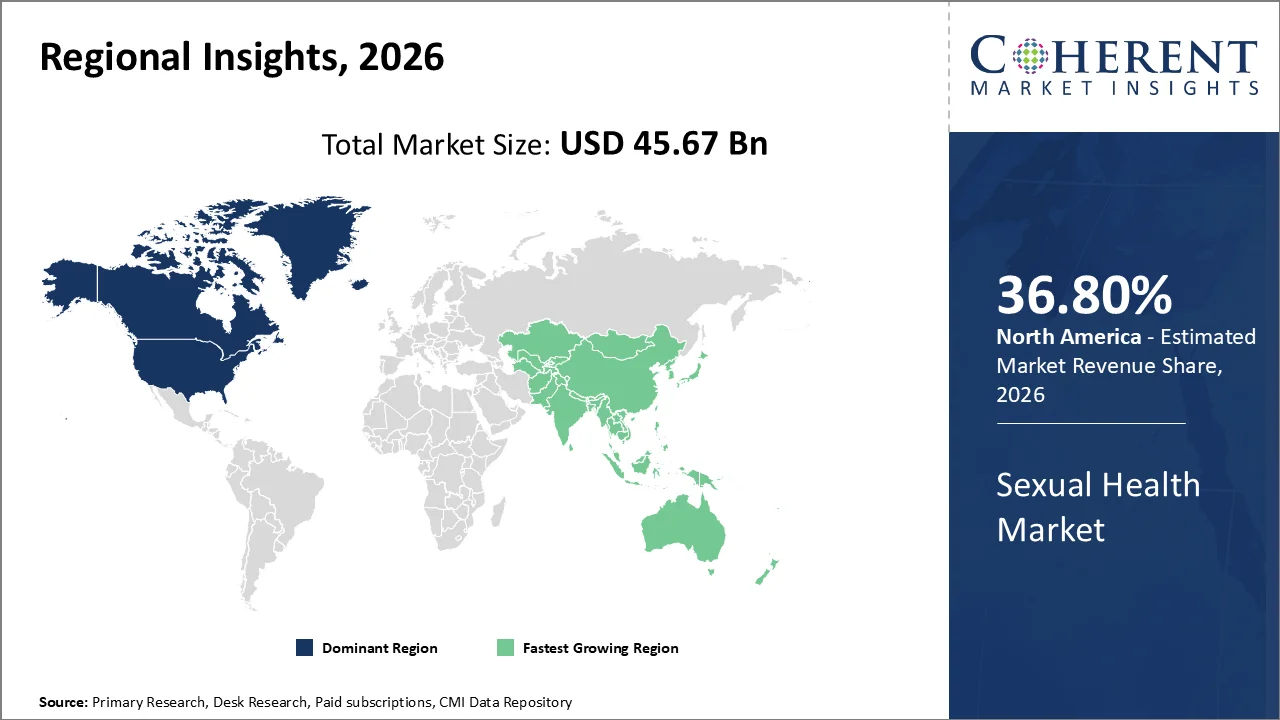
North America Sexual Health Market 2026: High Diagnosis Rates and Advanced Treatment Access Drive Regional Leadership
North America is the biggest regional market with 36.80% of market share in 2026, thanks to high diagnosis rates, easy access to treatment, and a wide range of retail pharmacy options. In 2024, the CDC said that the U.S. still had more than 2.2 million cases of chlamydia, gonorrhea, and syphilis. Canada, on the other hand, had 2,288 new HIV diagnoses. UNAIDS also said that in 2024, 80% of people with HIV in western and central Europe and North America were getting treatment. This shows that the diagnosis-to-therapy system is well-established and keeps demand for sexual health products and services high.
Asia Pacific Sexual Health Market Growth 2026: Rising Family Planning Demand and HIV Prevention Needs Support Rapid Expansion
Asia Pacific is the fastest-growing regional market with 28.5% share in 2026 because it has a lot of people who need help, more people are becoming aware of sexual health issues, and more people can get contraception and HIV prevention services. UNFPA says that 140 million women in Asia and the Pacific need family planning but don't have it. This shows that there is a lot of room for product adoption. UNAIDS also said that in 2024, 6.9 million people in Asia and the Pacific were living with HIV. This region had 23% of all new HIV infections in the world, which shows that there is a strong long-term need for prevention, diagnosis, and treatment products.
Country Analysis
U.S. Sexual Health Market Analysis 2026: STI Burden, HIV Care, and Pharmacy Access Support North America
The U.S. is the best place to buy sexual health products in North America because there are a lot of diagnoses, easy access to prescriptions, and a lot of pharmacies. The CDC said that more than 2.2 million STIs were reported in 2024. In 2023, 39,201 people aged 13 and up were diagnosed with HIV. There is a lot of demand for PrEP, ED drugs, birth control, STI treatments, and sexual wellness products in stores because there are so many people who have been treated.
India Sexual Health Market Analysis 2026: Family Planning Demand and HIV Burden Drive Asia Pacific Growth
India is a major growth engine in Asia Pacific because its sexual and reproductive health needs are supported by both the need for HIV care and the need for more family planning. The Indian government said that NFHS-5 increased the use of birth control to 67% and decreased the need for family planning to 9%. NACO's 2023 estimates also showed that 25.44 lakh people in India have HIV, which means that there will be a long-term need for contraception, testing, prevention, and treatment services. (PIB.GOV)
Market Report Scope
Sexual Health Market Report Coverage
| Report Coverage | Details | ||
|---|---|---|---|
| Base Year: | 2025 | Market Size in 2026: | USD 45.67 Bn |
| Historical Data for: | 2020 To 2024 | Forecast Period: | 2026 To 2033 |
| Forecast Period 2026 to 2033 CAGR: | 8.9% | 2033 Value Projection: | USD 82.94 Bn |
| Geographies covered: |
| ||
| Segments covered: |
| ||
| Companies covered: | Eli Lilly and Company, Viatris, Bayer AG, Organon & Co., Gilead Sciences, ViiV Healthcare, Perrigo Company plc, Reckitt, Church & Dwight Co., Inc., CooperSurgical, LifeStyles Healthcare, Karex Berhad. | ||
Who are the Major Companies in Sexual Health Market?
Major companies in the Sexual Health Market include Eli Lilly and Company, Viatris, Bayer AG, Organon & Co., Gilead Sciences, ViiV Healthcare, Perrigo Company plc, Reckitt, Church & Dwight Co., Inc., CooperSurgical, LifeStyles Healthcare, Karex Berhad.
Key News
In April 2026, Donegal Youth Council launched the SHAM (Sexual Health And More) website, a platform that connects users to sexual health and related services across Donegal.
Analysts Opinion
- The sexual health market is still structurally strong, not cyclical, because the burden of disease is still too high for demand to return to normal. The World Health Organization (WHO) says that more than 1 million curable STIs are spread every day. In 2020, there were 374 million new infections of four major STIs. The Centers for Disease Control and Prevention (CDC) reported more than 2.2 million STI cases in the U.S. in 2024. I think that scale keeps spending on prevention, diagnosis, and treatment from being optional in both public health and retail channels.
- The next big value pool in this market will probably come from innovations that are based on adherence and convenience, not just volume growth. On June 18, 2025, the FDA approved Yeztugo (lenacapavir) for HIV PrEP, which is taken once every six months. On December 16, 2025, the FDA approved Vybrique (sildenafil) oral film for erectile dysfunction. I think that different delivery formats will be in high demand and change the way sexual health companies compete.
Market Segmentation
- Global Sexual Health Market, By Product Type
- Erectile Dysfunction Drugs
- Gender Dysphoria Drugs
- Hypoactive Sexual Desire Disorder Drugs
- Premature Ejaculation Drugs
- Others
- Global Sexual Health Market, By Gender
- Male
- Female
- Global Sexual Health Market, By Distribution Channel
- Hospital Pharmacy
- Retail Pharmacy
- Online Pharmacy
- Global Sexual Health Market, By Region
- North America
- U.S.
- Canada
- Europe
- U.K.
- Germany
- Italy
- France
- Spain
- Russia
- Rest of Europe
- Asia Pacific
- China
- Japan
- India
- ASEAN
- Australia
- South Korea
- Rest of Asia Pacific
- Latin America
- Brazil
- Mexico
- Argentina
- Rest of Latin America
- Middle East
- GCC
- Israel
- Rest of Middle East
- Africa
- North Africa
- Central Africa
- South Africa
- North America
Sources
Primary Research interviews
- Sexual health product manufacturers
- Erectile dysfunction drug manufacturers
- HIV prevention and treatment providers
- Contraceptive product manufacturers
- Retail pharmacy chains
- Hospital pharmacists
- Online pharmacy platforms
- Sexual wellness product distributors
- Gynecologists
- Urologists
- Infectious disease specialists
Databases
- U.S. Food and Drug Administration (FDA) Database
- Centers for Disease Control and Prevention (CDC) Data & Statistics
- World Health Organization (WHO) Global Health Observatory
- UNAIDS Data
- National Institute of Diabetes and Digestive and Kidney Diseases (NIDDK)
- National Institutes of Health (NIH) HIV Data Hub
- World Bank Data
- OECD Health Statistics
- Our World in Data
- Statistics Canada
- National AIDS Control Organisation (NACO) Database
Magazines
- Pharmaceutical Technology
- Drug Store News
- Pharmacy Times
- Managed Healthcare Executive
- The Pharmaceutical Journal
- MedTech Dive
Journals
- The Lancet HIV
- The Lancet Public Health
- BMJ Sexual & Reproductive Health
- Journal of Sexual Medicine
- Sexual Medicine Reviews
- AIDS
- Sexually Transmitted Infections
- American Journal of Public Health
- Contraception
- Journal of Acquired Immune Deficiency Syndromes (JAIDS)
Newspapers
- The New York Times
- The Wall Street Journal
- Financial Times
- The Guardian
- The Hindu
- The Economic Times
Associations
- American Sexual Health Association (ASHA)
- International Planned Parenthood Federation (IPPF)
- National Association of Chain Drug Stores (NACDS)
- HIV Medicine Association (HIVMA)
- American Urological Association (AUA)
- International Society for Sexual Medicine (ISSM)
- Reproductive Health Supplies Coalition (RHSC)
Public Domain sources
- World Health Organization (WHO)
- Centers for Disease Control and Prevention (CDC)
- U.S. Food and Drug Administration (FDA)
- National Institutes of Health (NIH)
- National Institute of Diabetes and Digestive and Kidney Diseases (NIDDK)
- UNAIDS
- United Nations Population Fund (UNFPA)
- World Bank
- OECD
- Statistics Canada
- Public Health Agency of Canada
- Ministry of Health and Family Welfare (India)
- National AIDS Control Organisation (NACO)
- National Health Service (NHS)
- European Centre for Disease Prevention and Control (ECDC)
Get access to 250+ pages report
Every segment, forecast, competitor profile and data table behind the analysis above — available for instant download.
- ESOMAR Member
- ISO 9001:2015 Certified
- D-U-N-S Registered
- GDPR & CCPA Compliant
Missing comfort of reading report in your local language? Find your preferred language:
Transform your Strategy with Exclusive Trending Reports
Frequently Asked Questions
The Global Sexual Health Market is anticipated to to reach USD 82.94 Bn in 2033.
From 2026 to 2033, the Global Sexual Health Market is expected to grow at a rate of 8.9% per year.
The market is mostly driven by more people knowing about sexually transmitted infections (STIs), more people accepting sexual wellness products, easier access to birth control, and the growth of digital sexual health solutions.
The Erectile Dysfunction drugs segment is the biggest part of the market and is expected to have 39.4% of the market share in 2026. This is because erectile dysfunction is very common and people are very aware of how to treat it.
The Male segment has the largest market share in 2026, at 62.3%.