

HPAPIS And Cytotoxic Drugs Manufacturing Market Size and Trends - 2026 to 2033
HPAPIS and cytotoxic drugs manufacturing market is estimated to be valued at USD 37.78 Bn in 2026 and is expected to reach USD 64.81 Bn by 2033, exhibiting a compound annual growth rate (CAGR) of 8% from 2026 to 2033.
Key Takeaways
- By Drug Origin, the Chemical-based HPAPIs segment is expected to lead the market with 60% share in 2026.
- Based on Manufacturing Location, the In-house Manufacturing segment is projected to hold 55% share in 2026.
- Based on Drug Type, the Novel HPAPIs segment is expected to account for 65% share of the market in 2026.
- Based on Type of Pharmacological Molecule, the Small Molecules segment is projected to dominate with 80% share in 2026.
- Based on Application, the Oncology segment is expected to lead with 70% share in 2026, reflecting the high demand for cancer-targeted therapies.
- Based on Region, North America is set to lead the HPAPIS and cytotoxic drugs manufacturing market with 40% share in 2026. While, Asia Pacific is anticipated to be the fastest growing region.
Market Overview
Increase in demand for targeted therapy ingredients and oncology products is fueling the growth of the HPAPIs and cytotoxic drugs manufacturing market. There is a rise in the requirement for high-potency API ingredients used for cancer drugs, biologics, and antibody-drug conjugation. This increases the need for specialized facilities for HPAPIs. Furthermore, the pharmaceutical industry's research efforts, proprietary new drugs developed to treat different diseases, and regulatory support for new therapies are also contributing to the growth of this segment.
Current Events and Its Impacts on the HPAPIS And Cytotoxic Drugs Manufacturing Market
Current Events | Description and its impact |
US-China Trade Relations and Regulatory Tensions
|
|
Global Cancer Drug Pipeline Expansion |
|
How is product innovation driving the growth in HPAPIs and Cytotoxic Drugs Manufacturing?
- Advanced Containment Technologies: Isolator, glovebox, and closed-system manufacturing development to safely handle ultra-potent APIs at safe levels and reduce occupation exposures.
- Continuous Manufacturing Processes: Utilizing the technology of flow chemistry/continuous processing for great efficiency, minimal batch variability, and faster production timelines.
- Targeted Biologics & ADCs: Innovative design of antibody-drug conjugates and biologic HPAPIs to improve specificity of therapies, reducing side effects, and extending options for treatments.
- Current Industry Events of 2026
- Market Size Estimation
- Regional Breakdown
- Competitive Landscape
- Customer Intelligence
- Segmental Analysis
- Pricing Analysis
- Key Market Drivers, Challenges & Future Trends
- Customized Insights Section
Segmental Insights
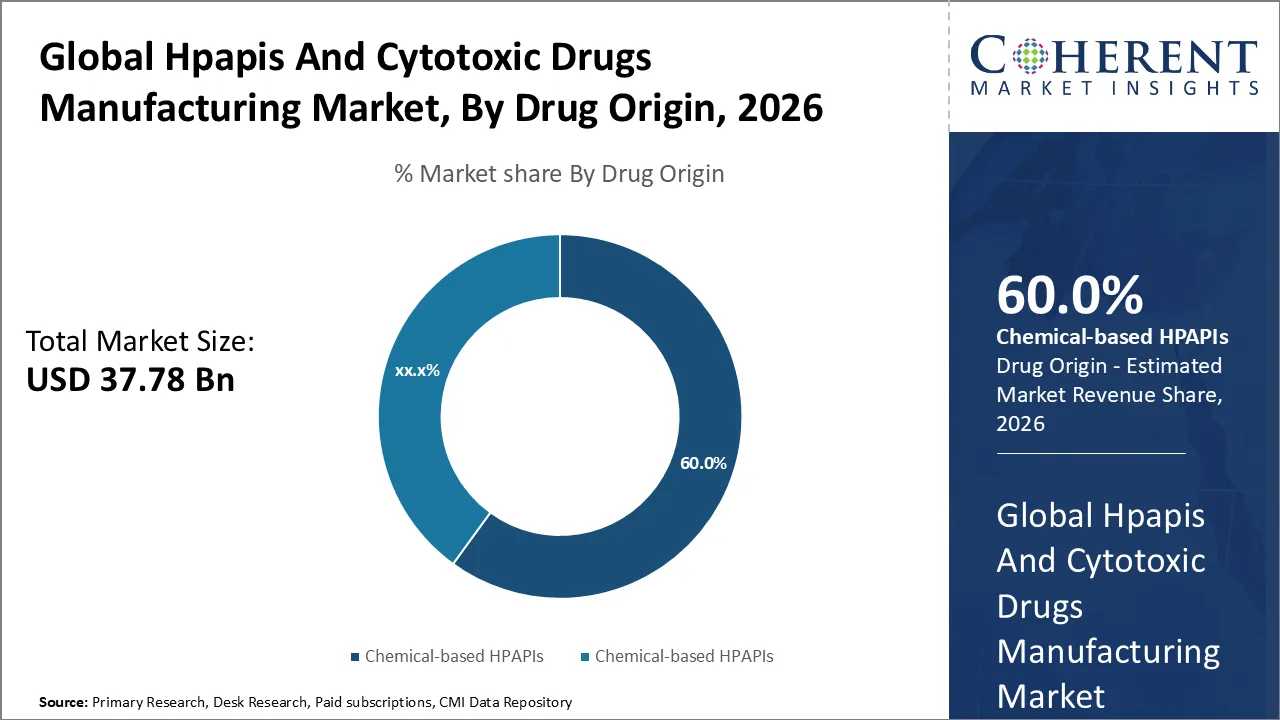
HPAPIs and Cytotoxic Drugs Market Insights, By Drug Origin – Chemical-based HPAPIs dominate due to established production and oncology demand
Based on drug origin, the chemical-based HPAPIs segment is estimated to hold the highest market share of 60% in 2026 due to existing well-established processes and sufficient market need in chemotherapy applications. Chemical-based HPAPIs find a wide range of applications in targeted therapy and chemotherapy formulations.
For instance, in January 2025, AGC Pharma Chemicals announced a major expansion in its HPAPI capabilities in Barcelona, Spain, to allow for seamless scale-up in the range from grams to tons in a single technology ecosystem.
HPAPIs and Cytotoxic Drugs Market Insights, By Manufacturing Location – In-house manufacturing preferred for control over complex production
Based on manufacturing location, the in-house manufacturing segment is projected to hold the highest market share of 55% in 2026. Major pharmaceutical companies interested in the in-house operation of high-potency API production due to the stringency in control, safety, and often proprietary formulations. The approach enables companies to improve compliance with regulatory guidelines on handling cytotoxic and ultra-potent APIs.
For instance, in February 2025, SK pharmteco unveiled a new CGMP‑compliant analytical testing laboratory at its Rancho Cordova, California site dedicated to High Potency Active Pharmaceutical Ingredients (HPAPIs).
HPAPIs and Cytotoxic Drugs Market Insights, By Drug Type – Novel HPAPIs drive market growth with innovative therapies
By drug type, the novel HPAPIs segment is estimated to contribute the highest market share of 65% in 2026, driven by innovative therapies and patent-protected products. The need for next-generation oncology drugs and biologics rests on these novel HPAPIs, namely proprietary cytotoxic molecules and ADC payloads. High value and clinical importance create sustained demand, thus boosting the segment further.
For instance, in July 2025, Bristol‑Myers Squibb announced the launch of a new high potency API product to treat specific cancer types, further extending its commitment to the development of innovative oncology drug offerings and treatment of unmet medical needs in precision therapies.
HPAPIs and Cytotoxic Drugs Market Insights, By Type of Pharmacological Molecule – Small molecules remain dominant for widespread oncology use
Based on type of pharmacological molecule, the small molecules segment is projected to dominate with 80% market share in 2026, owing to their widespread use in cytotoxic and oncology drugs. Small molecules have continued to define high potency drug development, given their efficacy, relative ease of production, and application in targeted therapy.
For instance, in October 2025, Indena S.p.A. showcased improvements made to its GMP Synthetic plant near Milan, Italy, with a focus on the enlargement of its capabilities for the synthesis and production of small molecule HPAPIs, and complex and potent molecules, utilizing its improved technology for reactors and filtration dryers.
HPAPIs and Cytotoxic Drugs Market Insights, By Application – Oncology applications drive largest market share
In terms of application, the oncology segment is anticipated to lead with 70% share in 2026, reflecting high demand for cancer-targeted therapies. HPAPIs and cytotoxic drugs are predominantly used in chemotherapy, ADCs, and other anti-cancer treatments, making oncology the most critical application segment in this market.
For instance, in April 2025, the FDA approved multiple oncology treatments, such as nivolumab (Opdivo) plus ipilimumab (Yervoy) for hepatocellular carcinoma and colorectal cancer.
Regional Insights
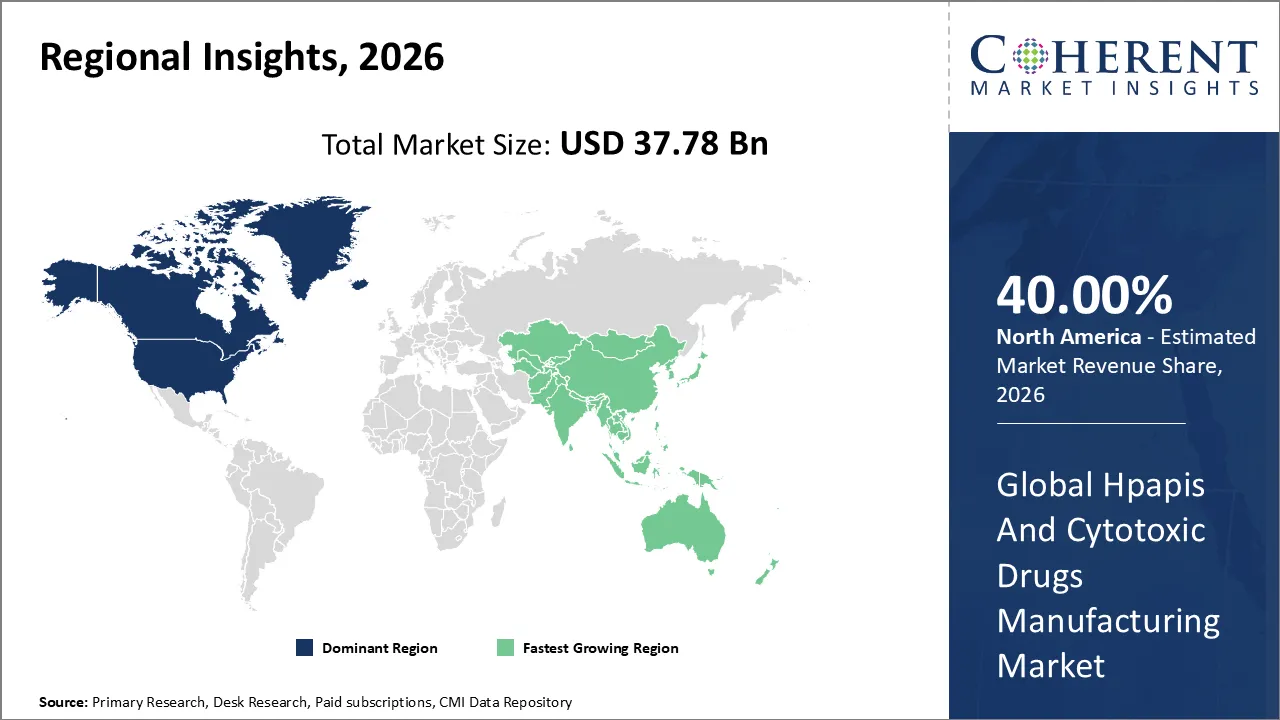
North America HPAPIs and Cytotoxic Drugs Market Analysis & Trends
North America is anticipated to maintain its leading position in the HPAPIs and cytotoxic drugs manufacturing market, accounting for 40% of the market share by 2026. The established base of pharmaceutical and biotechnology companies, advanced high-potency API manufacturing facilities, and high-end R&D capabilities in oncology and targeted therapies drive the leading position of the region.
For instance, in March 2025, Lonza Group expanded its high-potency API manufacturing facility in Portsmouth, New Hampshire, to enhance production capacity for oncology and cytotoxic drugs.
Asia Pacific HPAPIs and Cytotoxic Drugs Market Analysis & Trends
The Asia Pacific is likely to register the fastest market growth due to the rise in pharmaceutical outsourcing, demand for generics in HPAPI, government initiatives to attract investments in biotech, and CDMO capacity in Asia’s growing markets, such as China, India, and Korea.
For instance, in August 2025, WuXi AppTec inaugurated a new HPAPI production unit in Shanghai, China, designed to support both clinical and commercial manufacturing of cytotoxic and oncology APIs.
HPAPIs and Cytotoxic Drugs Manufacturing Market Outlook for Key Countries
Is the U.S. HPAPIs and cytotoxic drugs manufacturing market leading from strong pharma presence and advanced manufacturing?
The U.S. HPAPIs and cytotoxic drugs market is leading globally, driven by the presence of established pharmaceutical giants, advanced manufacturing infrastructure, and a strong pipeline of oncology and targeted therapies. With decades of R&D expertise and state-of-the-art containment technologies, the U.S. continues to dominate high-potency API production.
For instance, in March 2025, Lonza Group expanded its high-potency API manufacturing facility in Portsmouth, New Hampshire. The expansion enhances production capacity for oncology and cytotoxic drugs with advanced process safety measures.
Is Japan’s focus on precision and quality driving niche HPAPI growth?
Japanese pharmaceutical firms have emphasized high-quality and precision manufacturing for cytotoxic and high-potency APIs to appeal to small niche oncology therapies and innovative ADCs. Japan's tough regulatory environment means that partners can be assured of the strictest safety and quality standards.
For instance, in September 2024, CMIC Pharma Science Co., Ltd. expanded its HPAPI production line in Shizuoka to support complex oncology molecules and cytotoxics for clinical trials in Japan. This is reflective of Japan's dedication to precision-based manufacturing in HP APIs.
Market Report Scope
HPAPIs and Cytotoxic Drugs Manufacturing Market Report Coverage
| Report Coverage | Details | ||
|---|---|---|---|
| Base Year: | 2025 | Market Size in 2026: | USD 37.78 Bn |
| Historical Data for: | 2020 To 2024 | Forecast Period: | 2026 To 2033 |
| Forecast Period 2026 to 2033 CAGR: | 8% | 2033 Value Projection: | USD 64.81 Bn |
| Geographies covered: |
| ||
| Segments covered: |
| ||
| Companies covered: | Teva Pharmaceutical Industries Ltd., Pfizer, Inc., Lonza Group, CordenPharma International, Evonik Industries AG, Flamma Group, Merck KGaA, CARBOGEN AMCIS, Catalent, Inc., Piramal Enterprises Ltd., AbbVie Inc., Fareva Group, Cerbios-Pharma SA, Novasep, Ajinomoto Bio-Pharma, PCI Pharma Services, Sterling Pharma Solutions, Heraeus Holding, Polpharma Biologics, Helsinn Healthcare SA, Seqens, Cambrex Corporation | ||
| Growth Drivers: |
| ||
| Restraints & Challenges: |
| ||
Market Dynamics
HPAPIs and Cytotoxic Drugs Market Driver
Rising demand for oncology and targeted therapies
The growing incidence rates of cancer cases across the global population have been a key driver in the demand for high-potency APIs and cytotoxic drugs. APIs are required for the development of drugs such as chemotherapy agents, targeted small molecules, and antibody-drug conjugates. It has been witnessed that the growing focus of pharmaceutical companies on precision medicine and precision oncology drugs has boosted the demand for highly potent APIs requiring low dose amounts. In the same regard, the growing R&D investments and clinical pipeline for oncology drugs are boosting demand for specialized high-potency APIs manufacturing facilities.
HPAPIs and Cytotoxic Drugs Market Opportunity
Expansion of specialized manufacturing and outsourcing to CDMOs
The market is expected to witness strong growth opportunities through the expansion of specialized HPAPI manufacturing infrastructure and increased outsourcing to contract development and manufacturing organizations (CDMOs). Handling high-potency and cytotoxic compounds requires advanced containment technologies, regulatory expertise, and skilled workforce, which many pharmaceutical companies prefer to access through specialized partners.
Analyst Opinion (Expert Opinion)
The volume-driven manufacturing of HPAPIs and cytotoxic drugs has long been irrelevant; execution capability, regulatory maturity, and containment expertise determine the order of things. This market has reached a stage where only manufacturers with deep technical knowhow and proven operational discipline can remain competitive. The shift toward targeted oncology therapies, antibody-drug conjugates, and precision small molecules has fundamentally changed expectations from API manufacturers-basic synthesis competence no longer suffices.
Another feature associated with this market is the process intricacy of novel HPAPIs, particularly cytotoxics, which find application in cancer therapy. In several instances, HPAPIs are associated with difficult reaction conditions, including unstable reactants, narrow reaction windows, as well as process scales that make use of multi-step synthetic pathways.
Regionally, established markets retain influence due to regulatory trust and IP protection, while emerging regions are progressing rapidly by aligning facilities with global compliance standards. However, in my assessment, capability parity does not automatically translate into sponsor confidence. Regulatory inspection history, transparency, and crisis management experience still heavily influence sourcing decisions for HPAPIs.
Speak to the analyst
Want personalized insights?
Take the findings above to one of our principal consultants, or have the report rebuilt around the segments, geographies and competitors you actually track.
Top Strategies Followed by HPAPIs and Cytotoxic Drugs Manufacturing Market Players
- Established players prioritize containment technology and process excellence. Large manufacturers invest significantly in the upgrading of high-containment infrastructure, such as isolators, closed charging systems, and enhanced air-handling units. These companies develop internal processes, perform toxicology assessments, and lifecycle management to support complex cytotoxic and high-potency molecules from early development through commercial scale, with the goal of regulatory compliance and long-term retention of clients.
- Mid-sized manufacturers compete through flexibility and speed-to-market. These operators characterize themselves as flexible partners for clinical and early commercial manufacturing by providing fast scaling capabilities, flexible cleanroom architecture, and flexible batch sizes. They retain competitiveness by enhancing efficiency and investing strategically in high potency suites while satisfying regulatory compliance.
- Smaller players focus on niche capabilities and specialized chemistries. These niche manufacturers serve defined classes of HPAPIs like highly potent kinase inhibitors, ADC payloads, or cytotoxic intermediate molecules. In lieu of their lower scale of operation, they adopt digital batch monitoring techniques, single use containment systems, and strategic partnership options with either formulations or fill-finish services. Local collaborations and regulatory-related consulting partnerships help these businesses expand their market access.
Emerging Startups in the HPAPIs and Cytotoxic Drugs Manufacturing Market
- Startups are driving innovation in next-generation HPAPI manufacturing. Some of the emerging companies are employing innovative advanced process intensification technologies like continuous flow processes and microreactor technologies in the synthesis of HPAs in order to reduce human exposure and better control reaction conditions.
- Containment-first business models are gaining traction. New entrants are building facilities specifically designed for high-potency compounds rather than retrofitting legacy plants. By integrating isolator-based workflows, automated material transfer, and digital environmental monitoring from inception, these startups are positioning themselves as compliant and scalable partners for innovative oncology programs.
- Niche focus and strategic collaborations define early success. Many startups concentrate on narrow therapeutic or chemical segments such as ADC payloads, linker chemistries, or cytotoxic drug conjugation services. Partnerships with biotech firms, academic research centers, and formulation specialists allow them to embed early in development programs and grow alongside their clients’ pipelines.
HPAPIs and Cytotoxic Drugs Manufacturing Industry News
- In March 2025, Cambrex announced a major expansion of its HPAPI manufacturing facility in Iowa, USA, aimed at increasing capacity for oncology APIs to meet rising demand for high-potency compounds.
- In May 2025, Lonza launched its Design2Optimize platform to streamline HPAPI process development and manufacturing workflows.
- In January 2025, Piramal launched a new high-containment HPAPI production line at its Maharashtra, India facility to serve U.S. and EU markets.
- In December 2024, Novasep announced plans to invest €30 million to expand HPAPI capabilities in France, reflecting continued investment in European cytotoxic manufacturing.
Market Segmentation
- Drug Origin Insights (Revenue, USD Bn, 2026 - 2033)
- Chemical-based HPAPIs
- Biologic-based HPAPIs
- Manufacturing Location Insights (Revenue, USD Bn, 2026 - 2033)
- In-house Manufacturing
- Outsourcing
- Drug Type Insights (Revenue, USD Bn, 2026 - 2033)
- Novel HPAPIs
- Generic HPAPIs
- Type of Pharmacological Molecule Insights (Revenue, USD Bn, 2026 - 2033)
- Small Molecules
- Biologics
- Application Insights (Revenue, USD Bn, 2026 - 2033)
- Oncology
- Respiratory
- Ophthalmic Disorders
- Others
- Regional Insights (Revenue, USD Bn, 2026 - 2033)
- North America
- U.S.
- Canada
- Latin America
- Brazil
- Argentina
- Mexico
- Rest of Latin America
- Europe
- Germany
- U.K.
- Spain
- France
- Italy
- Russia
- Rest of Europe
- Asia Pacific
- China
- India
- Japan
- Australia
- South Korea
- ASEAN
- Rest of Asia Pacific
- Middle East
- GCC Countries
- Israel
- Rest of Middle East
- Africa
- South Africa
- North Africa
- Central Africa
- North America
- Key Players Insights
- Teva Pharmaceutical Industries Ltd.
- Pfizer, Inc.
- Lonza Group
- CordenPharma International
- Evonik Industries AG
- Flamma Group
- Merck KGaA
- CARBOGEN AMCIS
- Catalent, Inc.
- Piramal Enterprises Ltd.
- AbbVie Inc.
- Fareva Group
- Cerbios-Pharma SA
- Novasep
- Ajinomoto Bio-Pharma
- PCI Pharma Services
- Sterling Pharma Solutions
- Heraeus Holding
- Polpharma Biologics
- Helsinn Healthcare SA
- Seqens
- Cambrex Corporation
Sources
Primary Research Interviews
- HPAPI & Cytotoxic Drug Manufacturers
- Pharmaceutical API Production Heads
- Oncology Drug Development Scientists
- Contract Development & Manufacturing Organization (CDMO) Executives
- Regulatory Affairs & Quality Assurance Professionals
- Process Development & Chemical Engineering Experts
- Pharmaceutical Supply Chain & Procurement Managers
- Occupational Health & Safety Specialists
- Others
Databases
- Bloomberg Terminal
- Thomson Reuters Eikon
- S&P Global Market Intelligence
- FDA Drug Database
- EMA Medicines Database
- USP–NF (United States Pharmacopeia–National Formulary)
- gov
- Others
Magazines
- Pharmaceutical Technology
- Chemical & Engineering News (C&EN)
- Contract Pharma
- Drug Development & Delivery
- BioPharm International
- Manufacturing Chemist
- Others
Journals
- Journal of Pharmaceutical Sciences
- International Journal of Pharmaceutics
- European Journal of Pharmaceutical Sciences
- Organic Process Research & Development
- Journal of Oncology Pharmacy Practice
- Others
Newspapers
- Financial Times
- The Wall Street Journal
- Reuters
- Bloomberg News
- The Economic Times (Pharmaceuticals Section)
- Nikkei Asia
- Others
Associations
- International Society for Pharmaceutical Engineering (ISPE)
- Parenteral Drug Association (PDA)
- International Federation of Pharmaceutical Manufacturers & Associations (IFPMA)
- American Association of Pharmaceutical Scientists (AAPS)
- European Fine Chemicals Group (EFCG)
- Others
Public Domain Sources
- U.S. Food and Drug Administration (FDA) – Drug Approvals & Manufacturing Guidance
- European Medicines Agency (EMA) – Regulatory Filings & Inspection Reports
- World Health Organization (WHO) – Cancer & Pharmaceutical Manufacturing Data
- ClinicalTrials.gov – Oncology Pipeline Information
- National Cancer Institute (NCI) Publications
- OECD – Pharmaceutical Industry Statistics
- Others
Proprietary Elements
- CMI Data Analytics Tool
- Proprietary CMI Existing Repository of Information for the Last 8 Years
Get access to 250+ pages report
Every segment, forecast, competitor profile and data table behind the analysis above — available for instant download.
- ESOMAR Member
- ISO 9001:2015 Certified
- D-U-N-S Registered
- GDPR & CCPA Compliant
Missing comfort of reading report in your local language? Find your preferred language:
Transform your Strategy with Exclusive Trending Reports
Frequently Asked Questions
The HPAPIs and Cytotoxic Drugs Manufacturing Market is estimated to be valued at USD 37.78 Bn in 2026, and is expected to reach USD 64.81 Bn by 2033.
The CAGR of the HPAPIs and Cytotoxic Drugs Manufacturing Market is projected to be 8% from 2026 to 2033.
Rising demand for oncology and targeted therapies, along with increasing pharmaceutical R&D investments in high-potency drug pipelines, are the major factors driving market growth.
High capital investment requirements for containment infrastructure and stringent regulatory compliance for handling cytotoxic compounds are the major factors hampering market growth.
In terms of drug origin, chemical-based HPAPIs segment is expected to dominate the market in 2026.
Teva Pharmaceutical Industries Ltd., Pfizer, Inc., Lonza Group, CordenPharma International, Evonik Industries AG, Flamma Group, Merck KGaA, CARBOGEN AMCIS, Catalent, Inc., Piramal Enterprises Ltd., AbbVie Inc., Fareva Group, Cerbios-Pharma SA, Novasep, Ajinomoto Bio-Pharma, PCI Pharma Services, Sterling Pharma Solutions, Heraeus Holding, Polpharma Biologics, Helsinn Healthcare SA, Seqens, and Cambrex Corporation are among the major players operating in the market.
North America is expected to lead the market in 2026, supported by strong oncology pipelines, advanced manufacturing infrastructure, and regulatory expertise.