

U.S. Direct to Patient Market Size and Forecast – 2026 To 2033
The U.S. direct to patient market is expected to grow from USD 82,925.8 Mn in 2026 to USD 162,787.1 Mn by 2033, registering a compound annual growth rate (CAGR) of 11.7%. The market is poised for significant expansion fueled by the increasing adoption of digital and home-based care methods.
According to the Centers for Medicare & Medicaid Services, 366 hospitals in 37 states are now authorized to offer care through the Acute Hospital Care at Home program, highlighting a widespread acceptance of decentralized care delivery models across the U.S. (Source: American Medical Association)
Key Takeaways of the U.S. Direct to Patient Market
- Telehealth and remote monitoring segment is projected to hold 44.0 % of the U.S. direct to patient market share in 2026, making it the dominant service type segment, owing to its adoption in reimbursement-driven care delivery models (remote patient monitoring/ chronic patient monitoring (RPM/CCM)), the availability of real-time data for clinical decision-making, and the reduction in hospital re-admissions via continuous monitoring of high-risk patients.
- Pharmaceutical companies are projected to hold 49.6 % of the U.S. direct to patient market share in 2026, making it the dominant service providers segment driven by the direct-to-consumer product launch strategies (Eli Lilly and Company’s launch of Zepbound, supported by extensive direct-to-consumer advertising and digital engagement campaigns to accelerate patient adoption), adoption of digital therapeutics, and patient access programs (Pfizer RxPathways by Pfizer and Novartis Patient Assistance Foundation by Novartis) initiated by manufacturers to enhance adherence and maximize the lifecycle of specialty drugs.
- Healthcare payers are projected to hold 47.4 % of the U.S. direct to patient market share in 2026, making it the dominant end user segment. This is due to their transition towards value-based care delivery, access to claims and patient data that can be leveraged for effective intervention, and launching of home-based care services to manage treatment costs. In the U.S., the transition is clearly illustrated by the Acute Hospital Care at Home Program. This initiative, launched by the Centers for Medicare & Medicaid Services, allows hospitals and insurers to provide acute-level care within patients' homes. As of 2024, more than 300 hospitals have been authorized to take part, underscoring the swift embrace of home-based care models.
- Expansion of At-Home Diagnostic Testing Services: The increased availability of FDA-approved home diagnostic tests makes early diagnosis possible without visiting hospitals. This will enhance the direct-to-patient (DTP) ecosystem by facilitating the integration of diagnostics with telemedicine and treatment.
- Growth of Employer-Sponsored Direct-to-Patient Healthcare Models: Employers are forming direct health care relationships with the intent of lowering their insurance premiums and ensuring better health results for their employees. This represents another emerging and scalable direct-to-patient (DTP) distribution channel.
Segmental Insights
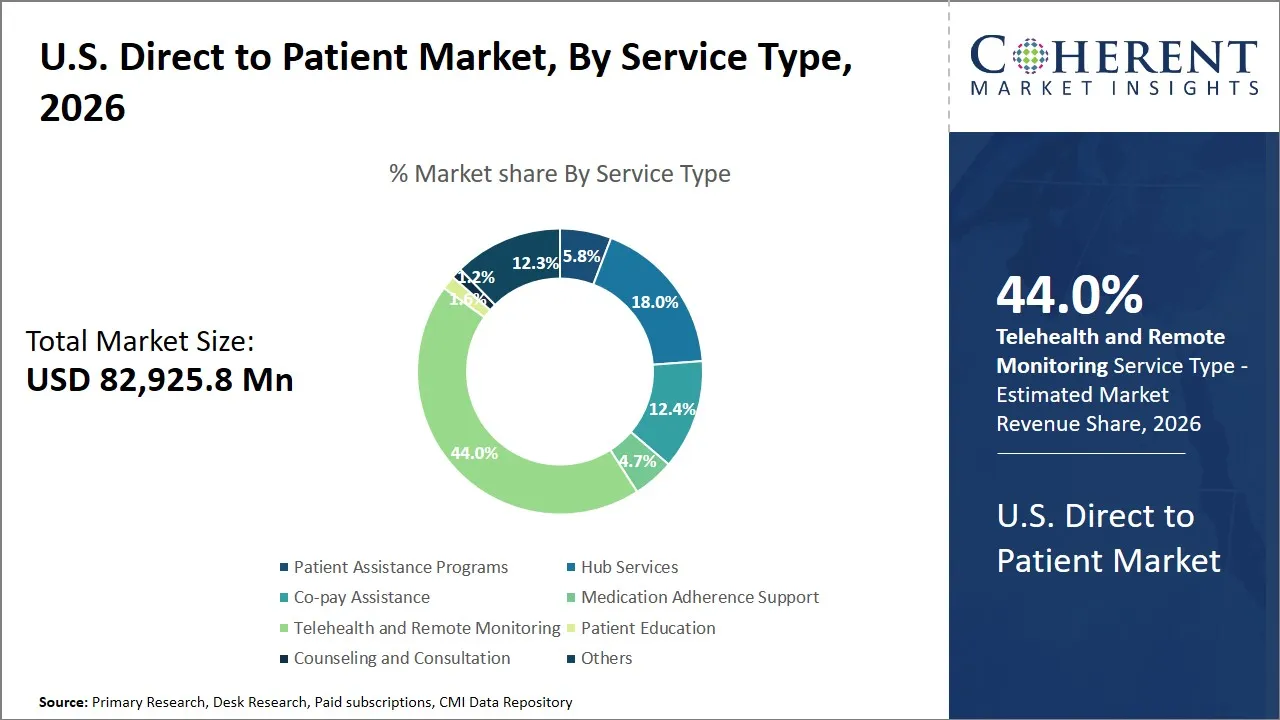
Why Does the Telehealth and Remote Monitoring Segment Dominate the U.S. Direct to Patient Market?
Telehealth and remote monitoring segment is projected to hold a market share of 44.0% in 2026, owing to the ongoing support from regulatory bodies and the widespread use of these services in federal health programs. By 2024, it was estimated that about 25% of the Medicare fee-for-service population utilized telehealth, highlighting an ongoing use of telehealth care (Source: Health Resources and Services Administration). The trend is further emphasized by government-sponsored programs, including the Telehealth Resource Center (TRC) Program from the Health Resources and Services Administration (HRSA), which offers technical assistance, training, and infrastructure support for increasing access to telehealth.
Furthermore, nearly 3 million Medicare patients utilized telehealth during the first quarter of 2024, indicating the consistent quarterly adoption of telehealth (Source: Telehealth Access for America). This continuity has been ensured through continuity in policy from the Center for Medicare & Medicaid Services, which has extended some of its flexibilities regarding telehealth, such as allowing home-based care and eliminating geographical limitations until 2027. Overall, scalability, accessibility, and cost efficiency make telehealth and remote monitoring the major components in the direct-to-patient (DTP) sector.
- Current Industry Events of 2026
- Market Size Estimation
- Regional Breakdown
- Competitive Landscape
- Customer Intelligence
- Segmental Analysis
- Pricing Analysis
- Key Market Drivers, Challenges & Future Trends
- Customized Insights Section
Why are Pharmaceutical Companies the Most Preferred Service Providers in the U.S. Direct to Patient Market?
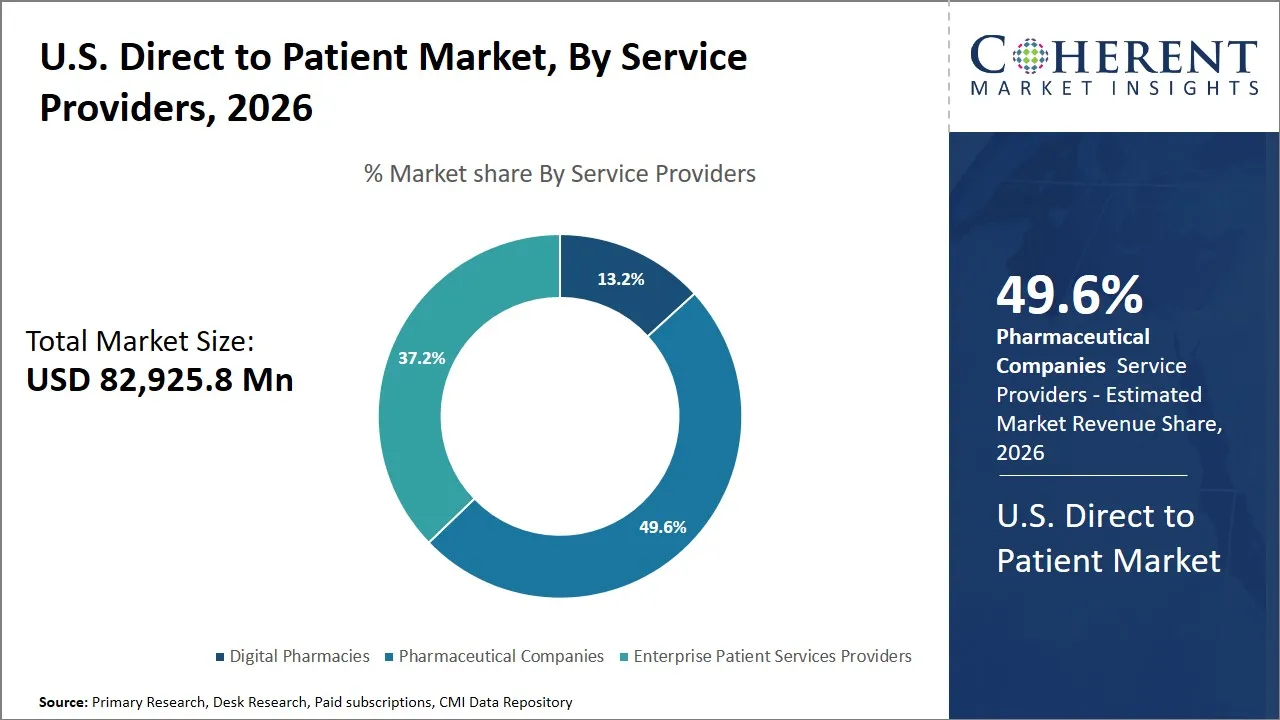
Pharmaceutical companies are projected to hold 49.6% of the market share in 2026, primarily because they integrate drug development, distribution, and patient engagement into a single system. This integration allows for faster and more controlled care delivery. Regulatory support from the U.S. Food and Drug Administration, particularly through rules for direct-to-consumer advertising and digital health programs, has allowed pharmaceutical companies to reach and educate patients directly and on a large scale.
Additionally, the growth of manufacturer-led patient support programs (Pfizer RxPathways, Novartis Patient Assistance Foundation), including financial help and adherence tracking, is strengthening long-term patient relationships and improving treatment results. This vertical integration, combined with regulatory support and the ability to engage patients directly, positions pharmaceutical companies as key and trusted service providers within the direct-to-patient (DTP) ecosystem.
Healthcare Payers Segment Dominates the U.S. Direct to Patient Market
The healthcare payers segment is expected to hold 47.4% of the U.S. direct to patient market share in 2026, primarily because of their extensive control over patient demographics, treatment protocols, and engagement strategies that are contingent on reimbursement. In 2024, Medicare and Medicaid, along with the Children's Health Insurance Program (CHIP), collectively covered 82 million and over 62.7 million individuals, respectively, thereby providing payers with direct access to a substantial portion of the U.S. patient base. (Source: Centers for Medicare & Medicaid Services)
Furthermore, over 54% of Medicare recipients are currently enrolled in Medicare Advantage plans, which are managed by private insurance companies, thus highlighting their increasing significance in the delivery of integrated, patient-centered care models. (Source: KFF)
In conclusion, this wide-ranging coverage, together with the capacity to provide health care management programs, digital health solutions, and home care directly to the beneficiary, positions healthcare payers as the most influential and dominant force within the U.S. direct to patient market.
Currents Events and their Impact
Current Events | Description and its Impact |
Regulatory Shift: Acceleration of Value-Based Care & Accountable Care Models (2024–2025) |
|
Industry Disruption: Rapid Expansion of Accountable Care Organizations (ACOs) & Risk-Based Models |
|
(Source: Centers for Medicare & Medicaid Services, Centers for Medicare & Medicaid Services)
U.S. Direct to Patient Market Dynamics
Market Drivers
- Expansion of Medicare Reimbursement for Remote Patient Monitoring (RPM): The expanding reimbursement support from the Centers for Medicare & Medicaid Services are significant force propelling the market forward. Medicare's broadened coverage of Remote Patient Monitoring (RPM) allows healthcare providers to offer ongoing, home-based care while maintaining financial stability. The U.S. Department of Health and Human Services reported that Medicare's RPM expenditures surpassed USD 500 million in 2024, with almost a million beneficiaries utilizing these services, underscoring the swift uptake of direct-to-patient (DTP) care models. This reimbursement structure is encouraging providers to broaden their patient-focused, at-home care offerings. (Source: U.S. Department of Health and Human Services)
- Rising Burden of Chronic Diseases Driving Continuous Home-Based Care Demand: The increasing prevalence of chronic diseases in the U.S. is a major factor driving the growth of direct-to-patient (DTP) healthcare models. The Centers for Disease Control and Prevention reports that chronic illnesses affect 6 out of 10 American adults, and 4 out of 10 adults have more than one chronic condition. This situation requires the consistent delivery of healthcare services (Source: Centers for Disease Control and Prevention). Furthermore, nearly 80% of Medicare beneficiaries contend with one or more chronic ailments, thereby highlighting the critical need to implement direct-to-patient (DTP) models that prioritize ongoing monitoring and management strategies (Source: National Library of Medicine). Consequently, this trend is fostering the expanded utilization of direct-to-patient (DTP) platforms across diabetes management, cardiology, and respiratory disease treatment.
Emerging Trends
- Integration of AI-Driven Virtual Care and Diagnostics: The market is witnessing rapid implementation of artificial intelligence-enabled RPM solutions, backed by increased insurance coverage from the Centers for Medicare & Medicaid Services. This has enabled healthcare providers to extend their chronic disease management programs (such as diabetes and cardiology), which have proven to reduce costs and improve patient retention rates.
- Expansion of Digital Pharmacies and E-Commerce Prescription Delivery: Growth in direct-to-patient (DTP) companies will continue to be fueled by platforms that cater to certain conditions, such as mental well-being, weight loss, and dermatological problems. For instance, Hims & Hers Health has succeeded in generating regular income streams based on subscriptions for condition-specific treatments.
Regulatory & Reimbursement Landscape Shaping the U.S. Direct to Patient Market
Category
| Regulation | Key Details | Impact on Market |
Telehealth Reimbursement | Centers for Medicare & Medicaid Services – Telehealth Coverage Policies | Expands coverage for virtual consultations, including rural and non-rural access, with defined CPT codes and parity laws in several states | Drives adoption of virtual care platforms and increases patient access to direct care services |
Remote Patient Monitoring (RPM) | Centers for Medicare & Medicaid Services – RPM CPT Codes (99453, 99454, 99457) | Provides structured reimbursement for device setup, data transmission, and clinical monitoring services | Accelerates adoption of continuous monitoring solutions and chronic disease management platforms |
Value-Based Care Models | Centers for Medicare & Medicaid Services – Quality Payment Program (QPP) | Links reimbursement to patient outcomes, quality metrics, and cost efficiency | Encourages integration of analytics, preventive care, and patient engagement in DTP platforms |
Digital Therapeutics (DTx) Coverage | FDA & Private Payers – Emerging reimbursement frameworks | Coverage varies by payer; requires clinical validation and regulatory approval | Creates growth opportunities for AI-based treatment solutions but limits rapid scalability |
Price Transparency & Patient Billing | U.S. Department of Health and Human Services – No Surprises Act | Mandates upfront cost disclosure, patient-friendly billing, and dispute resolution mechanisms | Strengthens demand for transparent pricing tools and patient payment platforms |
Direct-to-Consumer (Self-Pay) Models | Not regulated under traditional reimbursement frameworks | Services offered via subscription or one-time payments without payer involvement | Expands consumer-driven healthcare but reduces dependency on insurance-based revenue |
How is the expansion of direct-to-patient healthcare through government-backed broadband and rural connectivity initiatives creating new growth opportunities in the U.S. direct to patient market?
The expansion of direct-to-patient (DTP) healthcare in the U.S. is being structurally enabled by government-backed broadband and rural connectivity programs, which are directly unlocking access to telehealth and home-based care creating measurable market growth opportunities. According to the Federal Communications Commission (FCC), 22.3% of Americans in rural areas and 27.7% of Americans in Tribal lands lack coverage from fixed terrestrial 25/3 Mbps broadband, as compared to only 1.5% of Americans in urban areas (Source: U.S. Department of Agriculture). Moreover, more than 9.3 million individuals residing in rural communities are without adequate broadband, a situation that significantly limits their ability to access digital healthcare services. (Source: National Library of Medicine)
To help with this, the FCC's Rural Health Care Program and Healthcare Connect Fund offer subsidies, covering up to roughly 65% of the costs, to help providers connect. The goal is to make telehealth and virtual care possible. The regulatory landscape shifted in 2024, expanding the availability of discounted broadband for rural providers. The aim of this shift was to strengthen telehealth, enabling more advanced uses. (Source: American Hospital Association)
As a result, with advancements in connectivity, digital therapeutics platforms (DTPs) are poised to expand their reach, encompassing populations that previously encountered barriers to access. This expansion, in turn, broadens the spectrum of available treatment options for patients, promotes the adoption of digital prescriptions, and streamlines the delivery of continuous remote care.
Market Players, Key Development, and Competitive Intelligence
Key Developments
- In September 2025, AstraZeneca debuted a direct-to-consumer platform in the U.S., aiming to improve patient access to medications, especially for those with long-term health issues. This move underscores the increasing focus on patient-centered healthcare and the rise of digital care. Furthermore, it fuels the need for integrated billing, reimbursement tracking, and revenue integrity solutions to handle direct patient transactions efficiently.
- In September 2025, Novartis revealed its intention to introduce a direct-to-patient platform in the U.S. for Cosentyx. This move aims to enhance patient access and involvement. It's a clear sign of the increasing trend toward decentralized, patient-focused care. Consequently, there's a rising need for sophisticated billing, reimbursement tracking, and revenue integrity solutions to efficiently handle these direct patient transactions.
- In August 2024, Pfizer unveiled PfizerForAll, a digital platform, to streamline how patients directly access healthcare services, encompassing treatment and prescription assistance. This move underscores the increasing trend in the U.S. toward patient-focused, digital healthcare.
Competitive Landscape
The U.S. direct to patient market is highly competitive and evolves at a rapid pace due to the rising use of digital health platforms and patient-centered care approaches. There are specialized firms in the healthcare IT space, virtual care platform, and revenue cycle management (RCM) organizations that help providers to communicate directly with their patients, while ensuring financial success. There is an increasing emphasis among players in this market on automation, artificial intelligence technology, and solutions for patient engagement. Key focus areas include:
- AI-Driven Patient Engagement and Personalized Care Solutions
- End-to-End Direct-to-Patient Platform Integration (Care + Payments + Diagnostics)
- Regulatory Compliance, Data Security, and Billing Transparency Capabilities
Market Report Scope
U.S. Direct to Patient Market Report Coverage
| Report Coverage | Details | ||
|---|---|---|---|
| Base Year: | 2025 | Market Size in 2026: | USD 82,925.8 Mn |
| Historical Data for: | 2020 To 2024 | Forecast Period: | 2026 To 2033 |
| Forecast Period 2026 to 2033 CAGR: | 11.7% | 2033 Value Projection: | USD 162,787.1 Mn |
| Segments covered: |
| ||
| Companies covered: | Teladoc Health, Amwell, Hims & Hers Health, Ro, BetterHelp, Amazon, CVS Health, Walgreens Boots Alliance, Eli Lilly, and Pfizer | ||
| Growth Drivers: |
| ||
| Restraints & Challenges: |
| ||
Analyst Opinion (Expert Opinion)
- The U.S. direct to patient market is currently undergoing an advanced era, where patient care, diagnosis, and payment will be integrated to create a platform-oriented approach centered on consumers' needs. The future of the market will revolve around predictive, preventive, and personalized healthcare approaches, achieved via the use of artificial intelligence and big data analytics. This will replace the traditional episodic approach to care delivery with a more continuous patient engagement approach, offering subscription healthcare services to patients via integrated and transparent pricing.
- The most promising opportunity lies in technologies relating to AI-powered patient engagement and finance optimization technologies in the realm of virtual care and chronic disease management software solutions in the U.S. direct to patient market. The growing trend toward patient responsibility in payment terms makes the need for systems that can provide navigation, real-time pricing, coding, and denial management automation imperative. Moreover, significant growth opportunities are present in areas like behavioral health and remote patient monitoring, where a patient-centered business model could provide substantial benefits.
- For a competitive advantage, companies should give importance to comprehensive platform integration which has clinical, operation, and financial functionalities along with advanced artificial intelligence and automation technologies. They must be focused on investing in interoperability, security, and compliance solutions that enable scalability. The adoption of partnerships and acquisitions, alongside expansion in their ecosystem, would also prove useful for them to improve their service offerings. In addition, following the philosophy of putting patients first, using transparent pricing models, and adopting a hyper-personalized approach toward patients would prove beneficial for them.
Speak to the analyst
Want personalized insights?
Take the findings above to one of our principal consultants, or have the report rebuilt around the segments, geographies and competitors you actually track.
Market Segmentation
- Service Type Insights (Revenue, USD Mn, 2021 - 2033)
- Patient Assistance Programs
- Hub Services
- Co-pay Assistance
- Medication Adherence Support
- Telehealth and Remote Monitoring
- Patient Education
- Counseling and Consultation
- Others
- Service Providers Insights (Revenue, USD Mn, 2021 - 2033)
- Digital Pharmacies
- Pharmaceutical Companies
- Enterprise Patient Services Providers
- End User Insights (Revenue, USD Mn, 2021 - 2033)
- Healthcare Payers
- Healthcare Providers
- Patients
- Others
- Key Players Insights
- Teladoc Health
- Amwell
- Hims & Hers Health
- Ro
- BetterHelp
- Amazon
- CVS Health
- Walgreens Boots Alliance
- Eli Lilly
- Pfizer
Sources
Primary Research Interviews
- Chief Medical Officer / VP – Digital Health / Telehealth Platform (U.S.)
- Director – Remote Patient Monitoring (RPM) Programs (U.S. hospital network)
- Head – Patient Engagement & Digital Front Door Strategy
- VP – Revenue Cycle / Patient Payments (DTP-focused provider)
- Founder / Product Head – Direct-to-Consumer Digital Health Startup
Databases
- Centers for Medicare & Medicaid Services (CMS) – Telehealth utilization, reimbursement, RPM billing data
- FAIR Health – Private insurance claims database (telehealth & DTP service trends)
- IQVIA – Digital health adoption, prescription and DTP therapy insights
- Rock Health Digital Health Funding Database – DTP startup funding and innovation trends
Magazines
- Becker’s Hospital Review – Telehealth, DTP platforms, and digital care trends
- Modern Healthcare – U.S. digital health, virtual care, and payer-provider shifts
- Healthcare IT News (HIMSS Media) – Telehealth technology, interoperability, AI in DTP
- mHealth Intelligence – Remote patient monitoring and mobile health adoption
- Fierce Healthcare – Digital health startups, partnerships, and DTP innovations
Journals
- Journal of Medical Internet Research (JMIR) – Telehealth, digital therapeutics, RPM studies
- NPJ Digital Medicine – AI, remote monitoring, and personalized care models
- Telemedicine and e-Health Journal – Clinical and operational telehealth research
- Health Affairs – U.S. healthcare delivery transformation and virtual care policy
- Journal of Telemedicine and Telecare – Virtual care outcomes and adoption
Newspapers
- The Wall Street Journal – Digital health companies, DTP business models
- Financial Times – Global and U.S. telehealth and digital care investments
- The New York Times – Consumer healthcare and telehealth adoption trends
- The Washington Post – U.S. healthcare access and virtual care expansion
Associations
- American Telemedicine Association – Telehealth adoption, policy, and best practices
- Digital Medicine Society (DiMe) – Digital care models, RPM frameworks
- Healthcare Financial Management Association – Patient payment models & financial experience
- HIMSS – Digital health infrastructure and interoperability
- American Hospital Association – Virtual care adoption and patient engagement strategies
Public Domain Sources
- Centers for Medicare & Medicaid Services (CMS) – Telehealth reimbursement policies, RPM coverage
- U.S. Department of Health and Human Services (HHS) – Digital health regulations and initiatives
- Centers for Disease Control and Prevention (CDC) – Telehealth usage and patient behavior trends
- Office of the National Coordinator for Health IT (ONC) – Interoperability and digital health infrastructure
- Agency for Healthcare Research and Quality (AHRQ) – Care delivery models and patient outcomes
- National Institutes of Health (NIH) – Digital health and remote monitoring research
Proprietary Elements
- CMI Data Analytics Tool, Proprietary CMI Existing Repository of information for last 10 years.
Get access to 250+ pages report
Every segment, forecast, competitor profile and data table behind the analysis above — available for instant download.
- ESOMAR Member
- ISO 9001:2015 Certified
- D-U-N-S Registered
- GDPR & CCPA Compliant
Missing comfort of reading report in your local language? Find your preferred language:
Transform your Strategy with Exclusive Trending Reports
Frequently Asked Questions
The U.S. direct to patient market is estimated to be valued at USD 82,925.8 Mn in 2026 and is expected to reach USD 162,787.1 Mn by 2033.
Telehealth and remote monitoring dominate due to their ability to deliver convenient, real-time, and cost-effective care directly to patients without requiring in-person visits.
The Direct to Patient (DTP) approach to healthcare is one in which medical services, consultation, and products reach the patient without any intermediation of a hospital or clinic.
The CAGR of U.S. direct to patient market is projected to be 11.7% from 2026 to 2033.
Rising adoption of telehealth and virtual care platforms and increasing consumer preference for convenience, home delivery, and personalized healthcare solutions are the major factors driving the growth of the U.S. direct to patient market.
Regulatory complexities around online prescribing, cross-state licensing and data privacy compliance (HIPAA), and limited insurance coverage and reimbursement challenges for direct-to-patient services are the major factors hampering the growth of the U.S. direct to patient market.
In terms of service providers, pharmaceutical companies are estimated to dominate the market revenue share in 2026.