

U.S. Neurology Ultrasonic Aspirators Market Size and Forecast – 2026 To 2033
The U.S. neurology ultrasonic aspirators market is expected to grow from USD 168.3 Mn in 2026 to USD 259.7 Mn by 2033, registering a compound annual growth rate (CAGR) of 6.4% from 2026 to 2033. The U.S. neurology ultrasonic aspirators market is poised for significant expansion fueled by the soaring burden of brain tumors and rising neurosurgical procedure volumes across the U.S.
According to the American Cancer Society, about 24,740 malignant tumors (cancers) of the brain or spinal cord (13,830 in males and 10,910 in females) are diagnosed in the U.S. in 2026, reinforcing the need for advanced tissue resection technologies such as ultrasonic aspirators in neurosurgery.
Key Takeaways of the U.S. Neurology Ultrasonic Aspirators Market
- Standalone is projected to hold 59.7 % of the U.S. neurology ultrasonic aspirators market share in 2026, making it the dominant product type segment, owing to its ease of deployment across neurosurgical operating rooms and compatibility with existing surgical microscopes and navigation systems. For instance, in June 2024, the U.S. Department of Veterans Affairs (VA) renewed national contracts for advanced neurosurgical operating room equipment, including ultrasonic tissue aspiration systems, to support high-complexity neurosurgical procedures across veterans’ affairs (VA) medical centers.
- Instrument/System is projected to hold 36.3 % of the U.S. neurology ultrasonic aspirators market share in 2026, making it the dominant type segment, driven by the increasing adoption of integrated neurosurgical technologies. For instance, in October 2024, the American Association of Neurological Surgeons (AANS) updated its educational recommendations on modern brain tumor surgery, highlighting the importance of advanced intraoperative technologies, including ultrasonic aspiration, neuro navigation, and fluorescence-guided surgery, for maximizing safe resection.
- Brain tumor is projected to hold 66.4 % of the U.S. neurology ultrasonic aspirators market share in 2026, making it the dominant indication segment, driven by the increasing demand for precise tumor resection while preserving healthy brain tissue. For instance, in 2025, the National Cancer Institute (NCI) continued to identify surgical resection as the primary treatment for most newly diagnosed malignant brain tumors, emphasizing maximal safe tumor removal before adjuvant therapy.
- Rising Adoption of Fluorescence-Guided Brain Tumor Surgery: The increasing adoption of fluorescence-guided neurosurgery is creating strong demand for ultrasonic aspirators capable of selective tissue removal while preserving healthy brain structures. As neurosurgeons increasingly combine intraoperative fluorescence imaging with precision aspiration technologies, the need for advanced ultrasonic systems is growing. This trend is particularly evident in high-grade glioma surgeries, where maximizing tumor resection while minimizing neurological deficits is a key clinical objective.
- Integration with Spinal Imaging Technologies: The increasing integration of ultrasonic aspirators with spinal imaging and intraoperative imaging technologies is creating new opportunities in the U.S. neurology ultrasonic aspirators market. Advanced imaging guidance enables surgeons to accurately differentiate pathological from healthy tissue, improving resection precision and reducing neurological complications. As hospitals invest in image-guided neurosurgical suites, the demand for imaging-compatible ultrasonic aspirator systems is expected to rise.
Segmental Insights
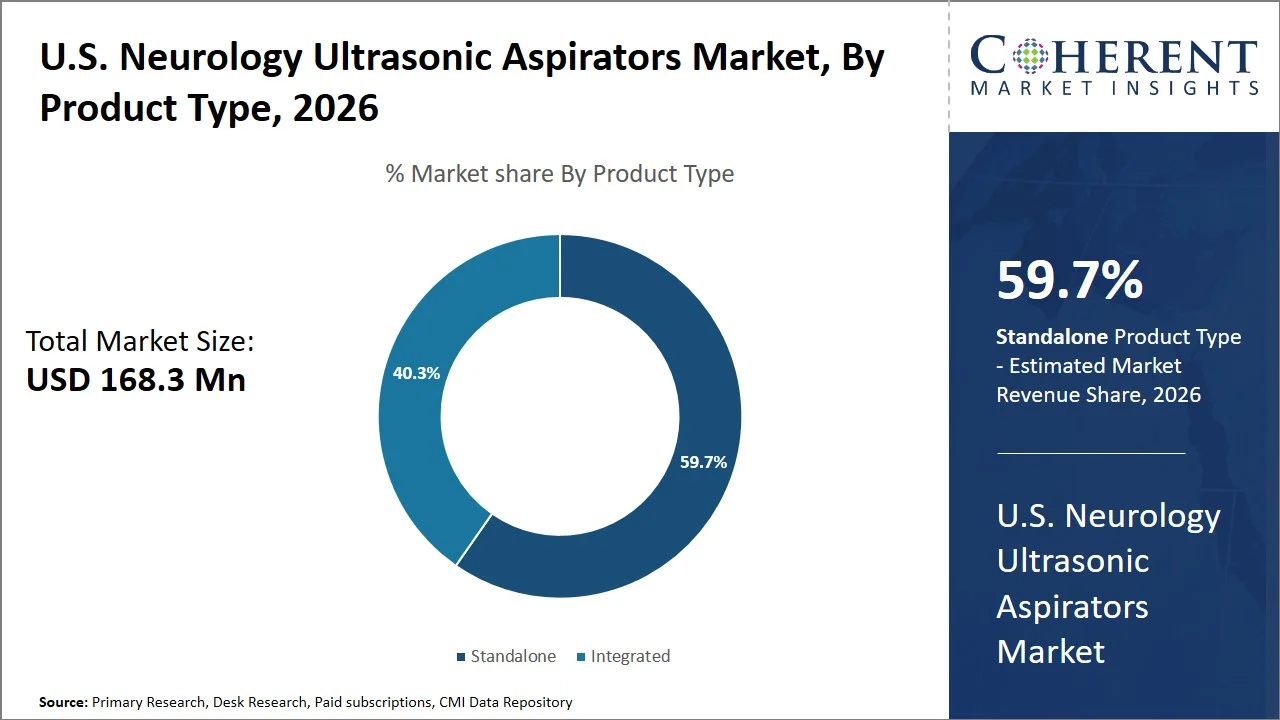
Why Does Standalone Dominate the U.S. Neurology Ultrasonic Aspirators Market?
Standalone is projected to hold a market share of 59.7% in 2026, due to its inherent flexibility, broader compatibility across multiple neurosurgical workflows, and lower infrastructure requirements compared to integrated platforms. In standalone systems, surgeons can select and combine specific components of the device as per the surgical task difficulty, besides having comparatively simple maintenance and relatively lower lifecycle cost, which is beneficial for large tertiary hospital and dedicated neurosurgery clinics. Further, standalone solutions facilitate simple connectivity to existing surgical microscopes and navigation setups in operating rooms, supporting various types of neurosurgical procedure including cranial and spine surgeries.
For instance, in March 2025, the SONOPET iQ Ultrasonic Aspirator System (5500-050-000) from Stryker Instruments received FDA 510(k) clearance (K243930) to add expanded indications for fragmentation, emulsification, and aspiration of soft and hard tissues across multiple surgical specialties, including neurosurgery, reinforcing the increasing adoption of advanced standalone ultrasonic aspirator platforms in the U.S. neurology ultrasonic aspirators market.
- Current Industry Events of 2026
- Market Size Estimation
- Regional Breakdown
- Competitive Landscape
- Customer Intelligence
- Segmental Analysis
- Pricing Analysis
- Key Market Drivers, Challenges & Future Trends
- Customized Insights Section
Why Does Instrument/System Represent the Largest Type Segment in the U.S. Neurology Ultrasonic Aspirators Market?
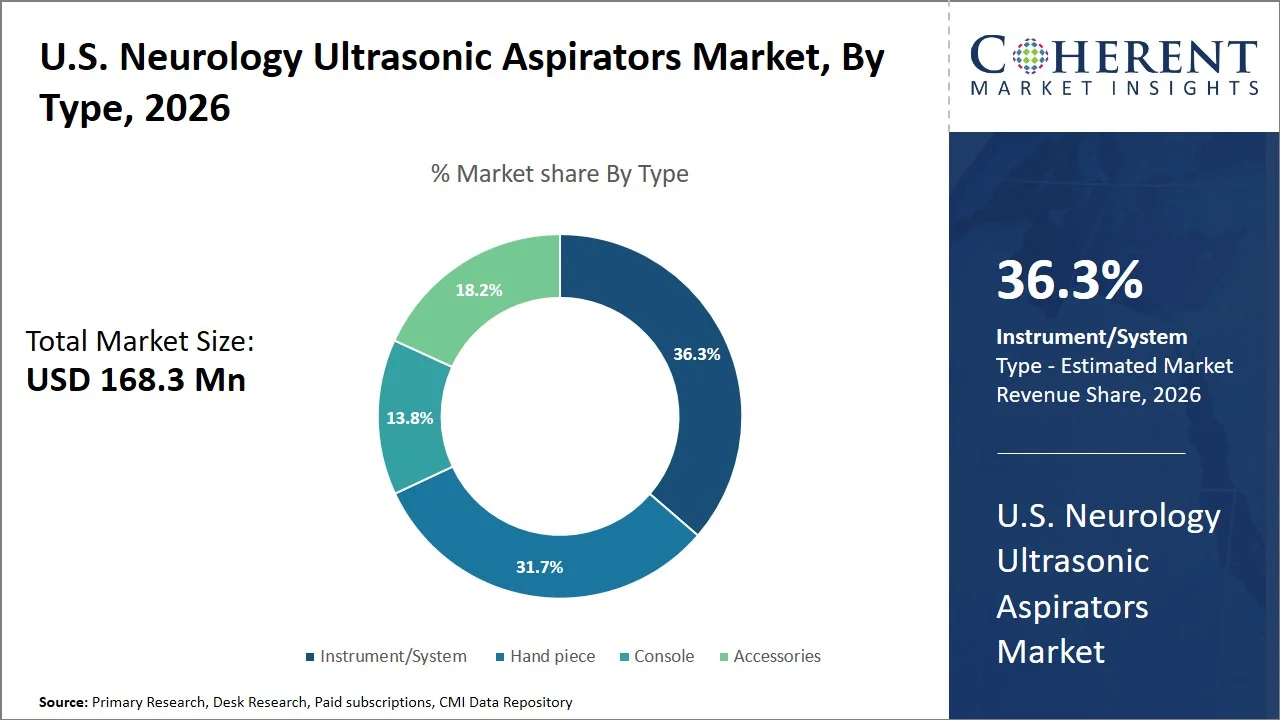
Instrument/System is projected to hold 36.3% of the market share in 2026, due to a comprehensive integrated platform which combines ultrasonic aspiration, irrigation, tissue fragmentation and real time system control that allows surgical accuracy and efficiency to facilitate procedures. Systems provide adjustable style settings, handpiece and system controls to enhance the efficiency in procedures while offering better tissue selectivity and safety to minimize trauma. The system's capability of functioning with other in-house neuro navigation systems, intraoperative microscopy tools and other technologies has further strengthened their adoption across tertiary neurosurgical centers.
For instance, in 2025, Congress of Neurological Surgeons (CNS) and the American Association of Neurological Surgeons (AANS) released the “Systematic Review and Evidence-Based Guidelines Update for the Role of Emerging Therapies in the Management of Patients with Metastatic Brain Tumors.” The guideline reinforces the increased use of advanced intraoperative technologies and evidence-based techniques to refine brain tumor removal and will serve to advance the use of integrated neurosurgical instrument systems to deliver more predictable results for patients.
Brain Tumor Segment Dominates the U.S. Neurology Ultrasonic Aspirators Market
The brain tumor segment is expected to hold 66.4% of the U.S. neurology ultrasonic aspirators market share in 2026, due to the increasing need for exact surgical excision of tumors while safeguarding nearby healthy brain tissue. In addition, ultrasonic aspiration also facilitates accurate targeting of pathological tissue by fragmenting and suctioning it. Advanced microsurgical techniques combined with an effective image-guided approach along with reduced intraoperative trauma with ultrasonic aspirators is a driving factor in handling brain gliomas, meningiomas and metastatic tumors.
For instance, in May 2026, Mayo Clinic News Network researchers announced they had made breakthroughs in brain tumor detection and care-adding molecular profiling, precision imaging, and personalized surgical strategies for treatment planning to make treatment a success. These breakthroughs will help fuel intraoperative technologies-including ultrasonic aspirators that make resecting brain tumors safer and more precise.
Currents Events and their Impact
Current Events | Description and its Impact |
U.S. FDA Issues Draft Guidance on AI-Enabled Medical Device Software Functions (January 2025) |
|
U.S. FDA Reinforces Regulatory Requirements for Neurological Medical Devices Through New 510(k) Clearance (May 2025) |
|
U.S. Neurology Ultrasonic Aspirators Market Dynamics
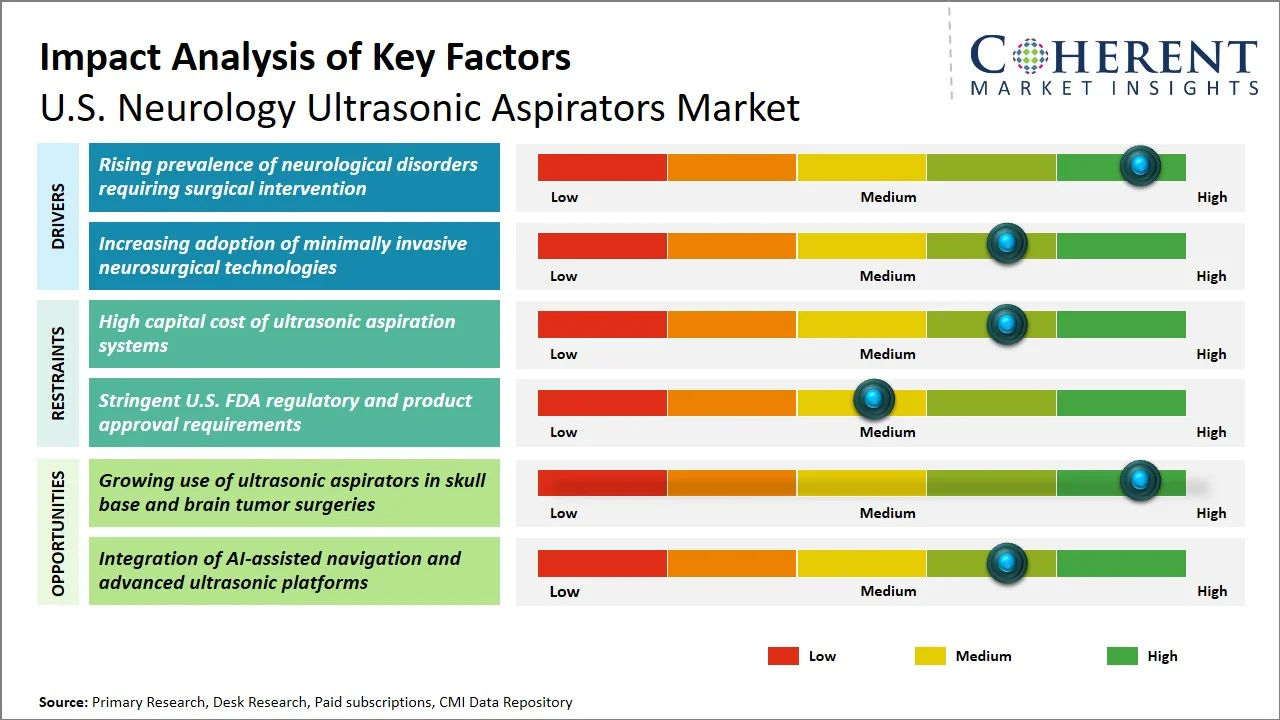
Market Drivers
- Rising prevalence of neurological disorders requiring surgical intervention: The U.S. neurology ultrasonic aspirators market is driven by the growing burden of neurological disorders requiring complex surgical intervention, particularly brain tumors, stroke-related conditions, and epilepsy. Ultrasonic aspirators enable precise tissue resection while preserving critical neural structures, making them indispensable in modern neurosurgery. For instance, according to the U.S. Centers for Disease Control and Prevention (CDC), nearly 795,000 people experience a stroke each year in the U.S, with many patients requiring neurosurgical procedures to manage complications such as intracerebral hemorrhage and other cerebrovascular conditions. The increasing neurosurgical caseload continues to support demand for advanced ultrasonic aspiration technologies.
- Increasing adoption of minimally invasive neurosurgical technologies: The increasing adoption of minimally invasive neurosurgical techniques is driving the demand for ultrasonic aspirators that enable precise tissue removal while minimizing damage to surrounding healthy structures. These systems improve surgical accuracy, reduce blood loss, shorten recovery time, and support better postoperative outcomes in complex cranial and spinal procedures. For instance, in April 2025, the American Association of Neurological Surgeons (AANS) highlighted the growing role of minimally invasive neurosurgery in improving patient outcomes through smaller incisions, reduced tissue disruption, and faster recovery, reinforcing the need for advanced surgical technologies such as ultrasonic aspirators.
Emerging Trends
- Development of Multi-Function Ultrasonic Surgical Platforms: Manufacturers are increasingly developing multi-function ultrasonic aspirator platforms that combine tissue fragmentation, aspiration, coagulation, and irrigation into a single system. These integrated platforms simplify surgical workflows, reduce instrument exchanges, and improve efficiency during complex neurosurgical procedures, driving adoption across advanced neurosurgical centers.
- Growing Adoption of Ergonomic and Disposable Surgical Accessories: There is a growing focus on ergonomic handpieces and single-use/disposable ultrasonic aspirator accessories to improve surgeon comfort, minimize cross-contamination risks, and reduce device turnaround time. This trend is supporting higher procedural efficiency while helping healthcare facilities strengthen infection prevention practices and optimize operating room productivity.
Regulatory Framework Governing the U.S. Neurology Ultrasonic Aspirators Market
Regulatory Authority | Key Regulation / Requirement | Relevance to Ultrasonic Aspirators | Market Impact |
U.S. Food and Drug Administration | 510(k) Premarket Notification | Device clearance for ultrasonic aspirators | Faster commercialization of innovative systems |
U.S. Food and Drug Administration | Quality System Regulation (QMSR) | Manufacturing and quality compliance | Higher compliance costs but improved product quality |
U.S. Centers for Disease Control and Prevention | Hospital reimbursement policies | Reimbursement for neurosurgical procedures | Supports adoption in hospitals |
Joint Commission | Operating room & patient safety standards | Standardization of neurosurgical practices | Encourages investment in advanced surgical devices |
How is the growing use of ultrasonic aspirators in skull base and brain tumor surgeries creating new growth opportunities in the U.S. neurology ultrasonic aspirators market?
The growing adoption of ultrasonic aspirators in skull base and brain tumor surgeries will significantly drive market growth for the U.S. neurology ultrasonic aspirators market. They enable selective fragmentation of tissues to allow surgeons for total resection of tumor without damaging surrounding blood vessels, cranial nerves and surrounding tissues. Ultrasonic aspirators minimize blood loss, promote surgical accuracy, and provide the clearest views during surgery and that has enabled it to be incorporated in cranial surgery. Moreover, increasing tendency toward image-guided as well as minimally invasive neurosurgery procedure will enhance the market growth of ultrasonic aspirators for the neurology segment. For instance, in September 2025, a study published by Frontiers indicated that advanced next-generation intraoperative, ultrasound technologies afforded greater precision, as well as enhanced preservation of the brain’s vascular system in patients undergoing extensive, intraoperative skull base brain tumors, reinforcing the widespread adoption of precision-guided neurosurgical approaches.
Market Players, Key Development, and Competitive Landscape
Key Developments
- In November 2025, Integra LifeSciences received U.S. FDA 510(k) clearance for the CUSA Clarity Ultrasonic Surgical Aspirator System for use in cardiac surgeries, expanding the system's clinical indications beyond its established applications in neurosurgery. The approval broadens the platform's utilization across multiple surgical specialties, reinforcing Integra's product portfolio and supporting continued adoption of advanced ultrasonic aspiration technologies in the U.S. market.
- In July 2025, SonoClear AS received U.S. FDA Breakthrough Device Designation for its SonoClear System, an acoustic coupling fluid designed for intracranial ultrasound procedures during brain tumor surgery. The technology improves intraoperative ultrasound image clarity by reducing acoustic artifacts, enabling more accurate tumor visualization and supporting maximal safe tumor resection. The designation is expected to accelerate the system's clinical development and strengthen innovation in neurosurgical imaging technologies.
Competitive Landscape
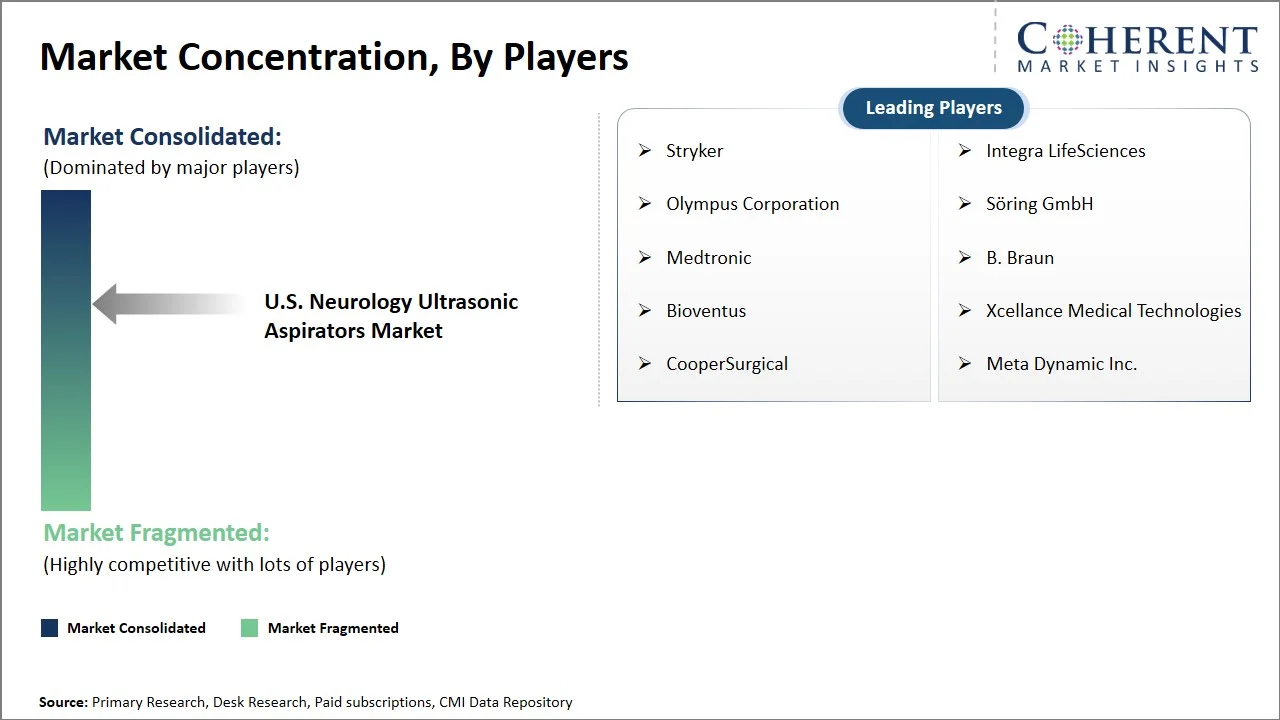
The U.S. neurology ultrasonic aspirators market is moderately competitive, with leading players focusing on technological innovation, regulatory approvals, and expanding clinical applications to strengthen their market position. Companies are investing in next-generation ultrasonic aspiration systems that offer improved tissue selectivity, ergonomic designs, and compatibility with neuro navigation and intraoperative imaging platforms. Strategic collaborations with hospitals, academic medical centers, and neurosurgical institutes, along with continuous product enhancements and clinical evidence generation, remain key competitive strategies. Key focus areas include:
- Development of next-generation ultrasonic aspirators with enhanced tissue selectivity and precision
- Integration with neuro navigation, intraoperative ultrasound, and surgical visualization systems
- Expansion of clinical indications through U.S. FDA clearances and evidence-based validation
- Strategic collaborations with neurosurgical centers and academic hospitals
- Ergonomic handpiece innovations and workflow optimization for complex cranial and spinal surgeries
Market Report Scope
U.S. Neurology Ultrasonic Aspirators Market Report Coverage
| Report Coverage | Details | ||
|---|---|---|---|
| Base Year: | 2025 | Market Size in 2026: | USD 168.3 Mn |
| Historical Data for: | 2020 To 2024 | Forecast Period: | 2026 To 2033 |
| Forecast Period 2026 to 2033 CAGR: | 6.4% | 2033 Value Projection: | USD 259.7 Mn |
| Segments covered: |
| ||
| Companies covered: | Stryker, Integra LifeSciences, Olympus Corporation, Söring GmbH, Medtronic, B. Braun, Bioventus, Xcellance Medical Technologies, Cooper Surgical, and Meta Dynamic Inc. | ||
| Growth Drivers: |
| ||
| Restraints & Challenges: |
| ||
Analyst Opinion (Expert Opinion)
- The future of the U.S. neurology ultrasonic aspirators market will be driven by the convergence of precision neurosurgery, intraoperative imaging, and minimally invasive surgical techniques. As the incidence of brain tumors and other complex neurological disorders continues to rise, ultrasonic aspirators are expected to evolve into integrated surgical platforms offering enhanced tissue selectivity, improved ergonomics, and compatibility with neuro navigation and robotic-assisted systems.
- The maximum growth opportunity lies within Instrument/System products for brain tumor surgery in the U.S, where increasing adoption of advanced neurosurgical technologies and rising procedure volumes are accelerating demand for high-performance ultrasonic aspiration systems. Tertiary care hospitals, comprehensive cancer centers, and academic neurosurgical institutes will remain the primary growth hubs.
- In order to create an advantage for themselves, the competitors must prioritize FDA-compliant product innovation, integration with AI-enabled surgical navigation and intraoperative imaging, and generation of robust clinical evidence demonstrating improved surgical outcomes. Expanding collaborations with leading neurosurgical centers, investing in surgeon training programs, and developing compact, workflow-efficient systems will further strengthen market positioning and support long-term growth.
Speak to the analyst
Want personalized insights?
Take the findings above to one of our principal consultants, or have the report rebuilt around the segments, geographies and competitors you actually track.
Market Segmentation
- Product Type Insights (Revenue, USD Mn, 2021 - 2033)
- Standalone
- Integrated
- Type Insights (Revenue, USD Mn, 2021 - 2033)
- Instrument/System
- Hand piece
- Console
- Accessories
- Indication Insights (Revenue, USD Mn, 2021 - 2033)
- Brain Tumor
- Traumatic Brain Injury
- End User Insights (Revenue, USD Mn, 2021 - 2033)
- Hospitals
- Clinics
- Ambulatory Surgical Centers
- Others
- Key Players Insights
- Stryker
- Integra LifeSciences
- Olympus Corporation
- Söring GmbH
- Medtronic
- Braun
- Bioventus
- Xcellance Medical Technologies
- Cooper Surgical
- Meta Dynamic Inc.
Sources
Primary Research Interviews
- Neurosurgeons specializing in brain tumor, skull base, and cerebrovascular surgeries
- Directors of Neurosurgery Departments at tertiary care hospitals and academic medical centers
- Operating room managers and neurosurgical procurement specialists evaluating surgical capital equipment
- Clinical application specialists for ultrasonic surgical systems and intraoperative imaging platforms
- Biomedical engineers involved in neurosurgical device integration and operating room workflow optimization
Stakeholders
- Neurology ultrasonic aspirator manufacturers and component suppliers
- Hospitals, academic medical centers, and integrated health systems
- Ambulatory Surgery Centers (ASCs) performing neurosurgical procedures
- Neurosurgical specialty clinics and brain tumor treatment centers
- Group Purchasing Organizations (GPOs) and hospital procurement departments
- Neurosurgeons, skull base surgeons, and spine surgeons
- End-use Sectors
- Tertiary care hospitals and academic medical centers
- Neurosurgery departments and neuroscience institutes
- Comprehensive cancer centers (brain tumor treatment centers)
- Ambulatory Surgery Centers (ASCs) performing cranial and spinal procedures
- Specialty neurology and neurosurgery hospitals
- Military and Veterans Health Administration (VA) medical centers
- Regulatory & Health Bodies
- U.S. Food and Drug Administration (FDA)
- Centers for Medicare & Medicaid Services (CMS)
- National Institutes of Health (NIH)
- National Cancer Institute (NCI)
- American Association of Neurological Surgeons (AANS)
Databases
- U.S. FDA 510(k) Premarket Notification Database – Ultrasonic aspirator device clearances and regulatory approvals
- FDA MAUDE (Manufacturer and User Facility Device Experience) Database – Medical device adverse events and post-market surveillance
- ClinicalTrials.gov – Clinical studies involving ultrasonic aspirators, brain tumor surgery, and neurosurgical technologies
- Centers for Medicare & Medicaid Services (CMS) Provider Utilization Database – Neurosurgical procedure utilization and reimbursement trends
- National Cancer Institute (NCI) Surveillance, Epidemiology, and End Results (SEER) Program – Brain tumor incidence and oncology statistics
- American College of Surgeons National Surgical Quality Improvement Program (ACS NSQIP) – Neurosurgical outcomes and quality performance metrics
Magazines
- Medical Device & Diagnostic Industry (MD+DI)
- Neurosurgery Today
- OR Manager Magazine
- BioMedical Instrumentation & Technology Magazine
Journals
- Journal of Neurosurgery
- Neurosurgical Review
- Journal of Medical Devices (ASME),
Newspapers
- The Wall Street Journal (Healthcare Section)
- Modern Healthcare
- Fierce Medical Devices
- MedCity News
Associations
- American Association of Neurological Surgeons (AANS)
- Congress of Neurological Surgeons (CNS)
- Medical Device Manufacturers Association (MDMA)
- American Hospital Association (AHA),
Public Domain Sources
- U.S. Food and Drug Administration (FDA) – Medical Device Approvals & Clearances
- National Institutes of Health (NIH) – Neurology Research Publications
- Centers for Disease Control and Prevention (CDC) – Neurological Disorder Statistics
- U.S. Bureau of Labor Statistics (BLS) – Healthcare Industry Data
Proprietary Elements
- CMI Data Analytics Tool, Proprietary CMI Existing Repository of information for last 10 years.
Get access to 250+ pages report
Every segment, forecast, competitor profile and data table behind the analysis above — available for instant download.
- ESOMAR Member
- ISO 9001:2015 Certified
- D-U-N-S Registered
- GDPR & CCPA Compliant
Missing comfort of reading report in your local language? Find your preferred language:
Transform your Strategy with Exclusive Trending Reports
Frequently Asked Questions
The U.S. neurology ultrasonic aspirators market is estimated to be valued at USD 168.3 Mn in 2026 and is expected to reach USD 259.7 by 2033.
Standalone dominates due to their widespread adoption in high-volume neurosurgical centers, superior surgical flexibility, and ability to deliver high-performance tissue fragmentation and aspiration during complex cranial procedures.
Neurology ultrasonic aspirators are ultrasonic surgical devices that use high-frequency vibrations to selectively fragment, irrigate, and aspirate soft neural tissue during neurosurgical procedures while preserving surrounding critical structures.
The CAGR of the U.S. neurology ultrasonic aspirators market is projected to be 6.4% from 2026 to 2033.
Cavitation generated by ultrasonic vibrations selectively emulsifies soft tissue, enabling precise removal while minimizing injury to adjacent vessels and nerves.
They provide controlled tissue dissection with simultaneous irrigation and aspiration, improving tumor removal accuracy, surgical visibility, and preservation of healthy brain tissue.
Rising prevalence of neurological disorders requiring surgical intervention, and increasing adoption of minimally invasive neurosurgical technologies are the major factors driving the growth of the U.S. neurology ultrasonic aspirators market.