

U.S. Workers Compensation Personal Injury and Preferred Provider Organization (PPO) Market Size and Forecast – 2026 To 2033
The U.S. workers compensation personal injury and preferred provider organization (PPO) market is expected to grow from USD 28,383.6 Mn in 2026 to USD 43,008.0 Mn by 2033, registering a compound annual growth rate (CAGR) of 5.4% from 2026 to 2033. The U.S. workers compensation personal injury and preferred provider organization (PPO) market is poised for significant expansion, fueled by the continued incidence of workplace injuries and the increasing adoption of managed care and PPO networks to optimize medical costs and improve claim outcomes.
According to the U.S. Bureau of Labor Statistics (BLS), private industry employers reported approximately 2.5 million nonfatal workplace injuries and illnesses in 2024, underscoring the sustained demand for workers' compensation medical management and provider network services
Key Takeaways of the U.S. Workers Compensation Personal Injury and Preferred Provider Organization (PPO) Market
- Enterprise is projected to hold 76.4 % of the U.S. workers compensation personal injury and preferred provider organization (PPO) market share in 2026, making it the dominant type segment. The segment benefits from the widespread implementation of employer-sponsored workers' compensation programs and managed care services. For instance, the U.S. Department of Labor's Office of Workers' Compensation Programs (OWCP) administers medical and disability benefits for eligible federal employees through coordinated provider networks, supporting efficient injury management and return-to-work programs.
- Public is projected to hold 57.9 % of the U.S. workers compensation personal injury and preferred provider organization (PPO) market share in 2026, making it the dominant provider segment. Public programs support standardized medical management and provider oversight across workers' compensation systems. For instance, the Texas Department of Insurance, Division of Workers' Compensation (TDI-DWC) oversees certified healthcare networks and evidence-based treatment guidelines to improve care quality and return-to-work outcomes for injured employees
- Occupational diseases are projected to hold 35.6 % of the U.S. workers compensation personal injury and preferred provider organization (PPO) market share in 2026, making it the dominant application segment. Growing emphasis on workplace health monitoring and occupational disease prevention supports demand for specialized compensation services. For instance, the National Institute for Occupational Safety and Health (NIOSH) conducts occupational disease surveillance and research programs focused on preventing work-related respiratory illnesses, hearing loss, and musculoskeletal disorders across U.S. industries.
- Growing Adoption of Value-Based Workers' Compensation Managed Care Programs: Employers and insurers are increasingly adopting value-based workers' compensation programs that emphasize quality outcomes, faster recovery, and reduced total claim costs rather than service volume. PPO networks play a central role by directing injured employees to high-performing providers with proven treatment outcomes. This approach improves return-to-work rates, minimizes unnecessary medical interventions, and strengthens demand for specialized PPO network services.
- Expansion of Behavioral Health and Mental Injury Coverage within Workers' Compensation: Growing recognition of work-related mental health conditions, including post-traumatic stress disorder (PTSD), anxiety, and occupational stress, is creating new opportunities for PPO providers to expand specialized behavioral healthcare networks. As more states broaden coverage for psychological injuries among first responders and other high-risk occupations, demand is increasing for integrated physical and mental health management within workers' compensation programs, opening new avenues for network expansion and care coordination.
Segmental Insights
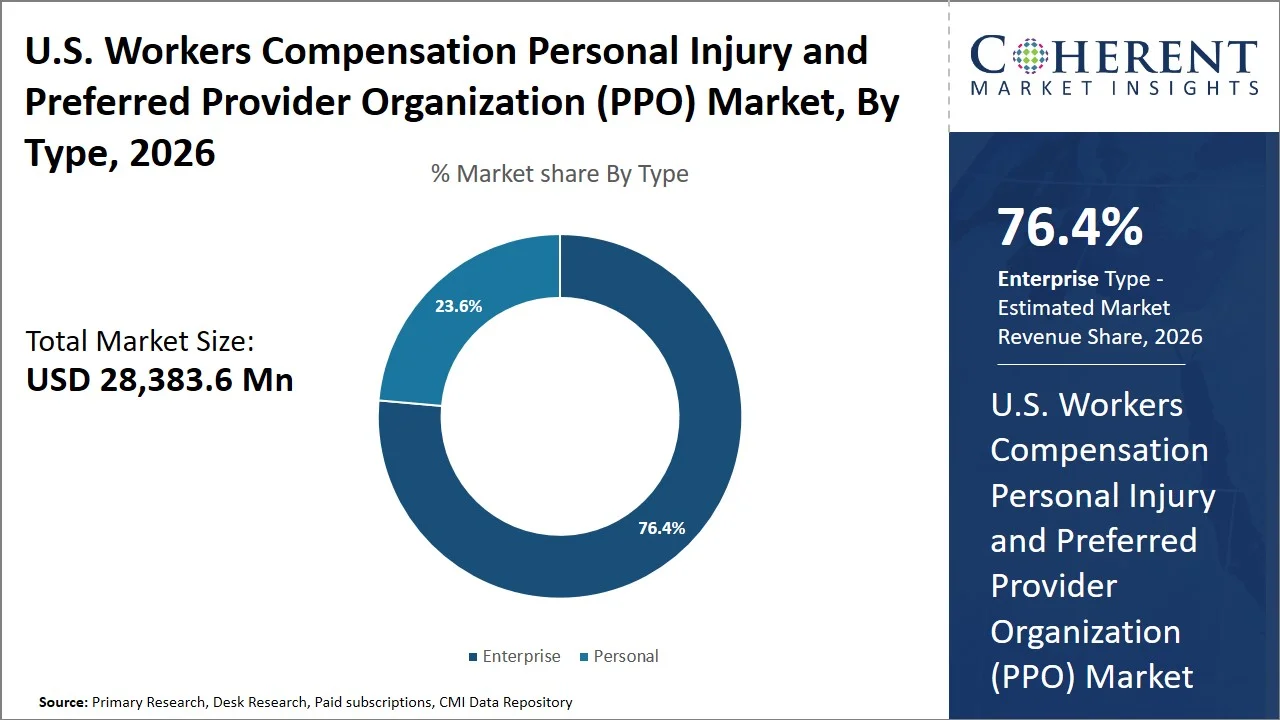
Why Do Enterprise Dominate the U.S. Workers Compensation Personal Injury and Preferred Provider Organization (PPO) Market?
Enterprise is projected to hold a market share of 76.4% in 2026, primarily by their sheer employee volume, high volumes of claims and the desire for large cost control management. Large enterprises are embedding PPOs, bill review, utilization review and case management services into their plan in attempt to drive efficiencies and return to work more effectively. For instance, the Virginia Workers’ Compensation Commission establishes requirements for electronic medical billing (e-billing) for work injury claims to facilitate efficient process and payment of medical billings from the healthcare facility/ provider to and from workers compensation insurance/ payers, aiding the management of an claims by an enterprise employers.
- Current Industry Events of 2026
- Market Size Estimation
- Regional Breakdown
- Competitive Landscape
- Customer Intelligence
- Segmental Analysis
- Pricing Analysis
- Key Market Drivers, Challenges & Future Trends
- Customized Insights Section
Why Does Public Represent the Largest Provider Segment in the U.S. Workers Compensation Personal Injury and Preferred Provider Organization (PPO) Market?
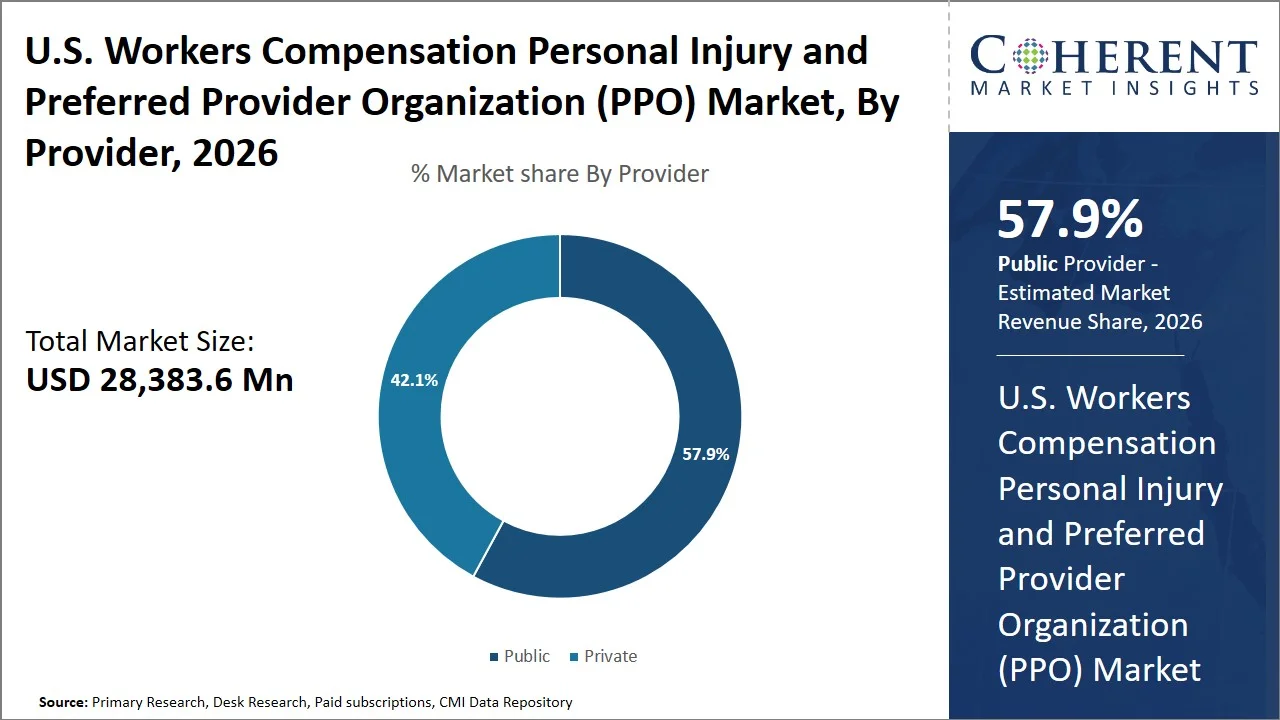
Public is projected to hold 57.9% of the market share in 2026, due to its administration of workers’ compensation programs on behalf of state government employees as well as their establishment of state-funded schemes which aim to expand availability of medical attention as well as claim management solutions. These entities typically offer provider networks that can establish regulatory adherence, enable consistent claims management, as well as guarantee continuation of compensation for injuries. For instance, Washington State Department of Labor & Industries operates a state workers’ compensation system funded by an authorized network of providers for self-insured and state fund employers. This system assists in delivering standardized quality care and coordinated claims administration for these workers.
Occupational Diseases Segment Dominates the U.S. Workers Compensation Personal Injury and Preferred Provider Organization (PPO) Market
The occupational diseases segment is expected to hold 35.6% of the U.S. workers compensation personal injury and preferred provider organization (PPO) market share in 2026, driven by occupational disease claims since many work-related illnesses are a chronic condition requiring extensive medical care, physicians’ and specialists’, along with long-term care of and monitoring and adjudication the individual workers’ claim. A persistent respiratory illness like occupation asthma, work-related hearing loss or even illness due to exposure to chemical and toxins lead to extensive use of medical care and greater payment obligations and much more time that some acute workplace conditions. For instance, U.S. Centers for Disease Control and Prevention’s national institute for occupational safety and health-supported state occupational health surveillance program uses data collected through workers compensation systems to monitor work-related diseases like occupational asthma and pneumoconiosis, and help in the detection and prevention of the same.
Current Events and their Impact
Current Events | Description and its Impact |
National Council on Compensation Insurance (NCCI) Releases 2025 State of the Line Report (May 2025) |
|
Texas Department of Insurance Updates Workers' Compensation Medical Fee Guidelines (January 2025) |
|
U.S. Workers Compensation Personal Injury and Preferred Provider Organization (PPO) Market Dynamics
Market Drivers
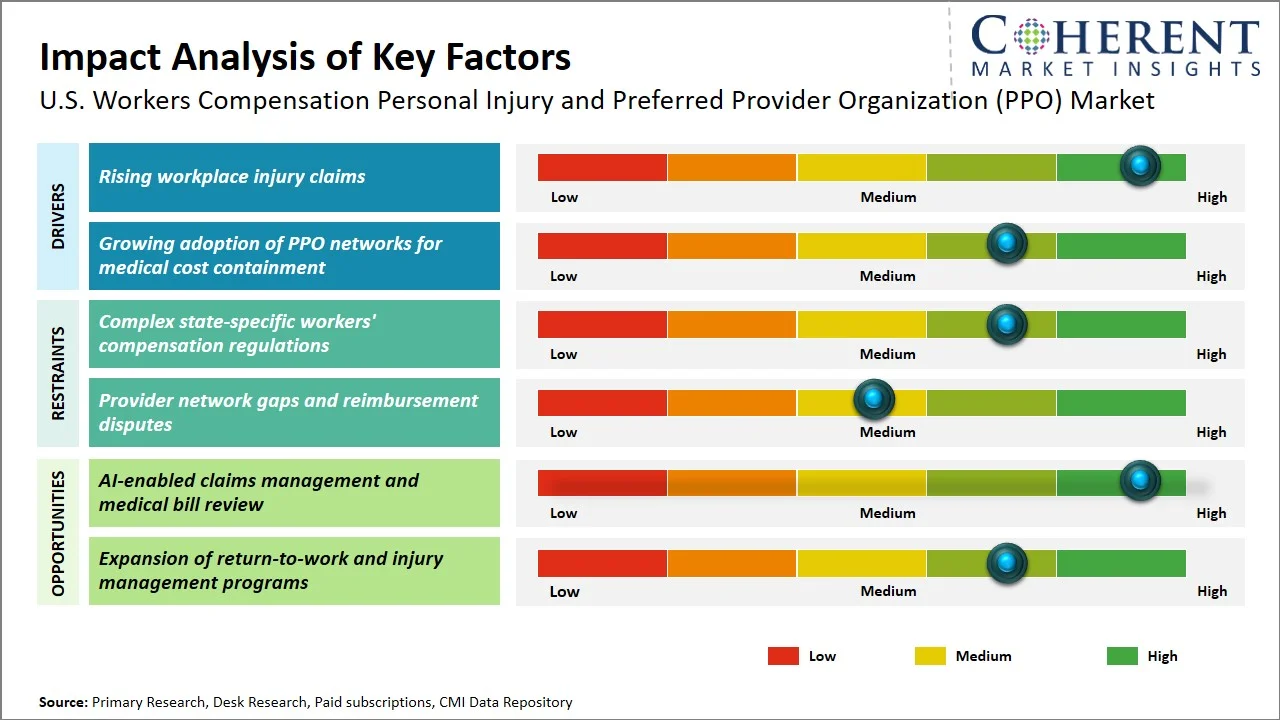
- Rising workplace injury claims: The prevalence of injuries and accidents in high-risk industries such as construction, manufacturing, transportation and health care are fueling the demand for optimal worker’s compensation and PPO management services. Employers and insurers depend on these negotiated provider agreements and preferred provider networks in their efforts to improve turnaround times in the delivery of quality medical care and to maintain an acceptable level of claim costs and re-employment timelines. For instance, Occupational Safety and Health Administration (OSHA) established Severe Injury Reporting program to prompt employers to report inpatient work-related hospitalization, amputations, and loss of vision of an eye as soon as reasonably possible for the speedy resolution and medical care of injury cases.
- Growing adoption of PPO networks for medical cost containment: The increasing focus on controlling medical expenses and improving claim outcomes is driving the adoption of Preferred Provider Organization (PPO) networks across the U.S. workers' compensation system. PPO networks enable employers and insurers to access negotiated provider rates, standardized treatment protocols, and coordinated care, helping reduce unnecessary medical spending while improving recovery outcomes. For instance, the Washington State Department of Labor & Industries (L&I) operates the Medical Provider Network (MPN), which authorizes qualified providers to deliver evidence-based treatment for injured workers while promoting quality care and cost-effective claims management.
Emerging Trends
- Integration of Artificial Intelligence in Claims Triage and Fraud Detection: Workers' compensation insurers are increasingly deploying artificial intelligence (AI) and predictive analytics to automate claims triage, identify potentially fraudulent claims, and prioritize high-risk cases for early intervention. This trend improves claims processing efficiency, reduces administrative costs, and enables preferred provider organization (PPO) networks to deliver more targeted care management.
- Expansion of Virtual Care and Digital Rehabilitation Services: Telehealth consultations, remote physical therapy, and digital rehabilitation platforms are becoming integral to workers' compensation programs, particularly for follow-up care and musculoskeletal injuries. Preferred provider organization (PPO) networks are incorporating these services to improve access to specialists, reduce treatment delays, and support faster recovery while lowering overall healthcare utilization.
Key Workers' Compensation Regulations and Managed Care Frameworks Influencing the U.S. Workers Compensation Personal Injury and Preferred Provider Organization (PPO) Market
Governing Authority | Regulation / Program | Key Focus | Impact on Market |
U.S. Department of Labor (OWCP) | Federal Employees' Compensation Act (FECA) | Medical benefits & claims management | Drives demand for coordinated provider networks and managed care services |
Texas Department of Insurance (TDI-DWC) | Certified Health Care Network Program | Network standards & reimbursement | Expands PPO participation and cost containment |
California Division of Workers' Compensation | Medical Provider Networks (MPNs) | Employer-directed provider networks | Supports wider PPO adoption and standardized treatment |
National Council on Compensation Insurance (NCCI) | Experience Rating & Medical Data Programs | Claims analytics & premium calculation | Encourages efficient medical management and provider performance |
How is the AI-enabled claims management and medical bill review creating new growth opportunities in the U.S. workers compensation personal injury and preferred provider organization (PPO) market?
Artificial intelligence is paving the way to massive new opportunities within the U.S. workers compensation personal injury and preferred provider organization (PPO) market through automating the payment of benefits, medical review, documentation review and fraud detection. Artificial intelligence analytics can be used to unearth suspicious bills, direct the treatment of difficult claims and automate payment approvals, thereby slashing administrative expenses whilst enhancing claims integrity. For instance, the National Council on Compensation Insurance (NCCI), at their 2025 Annual Insights Symposium, specifically mentioned AI claims automation and its role in prediction models to enhance claims and return-to-work accuracy and optimize medical bill review process.
Market Players, Key Development, and Competitive Landscape
Key Developments
- In July 2026, Sompo International Holdings Ltd. announced a definitive agreement to acquire Service Insurance Companies, a U.S. specialist in workers' compensation insurance focused on the SME segment. The acquisition is expected to strengthen Sompo's underwriting capabilities, claims expertise, and distribution network, reinforcing competition in the U.S. workers compensation personal injury and preferred provider organization (PPO) market. The transaction remains subject to customary regulatory approvals and closing conditions.
- In February 2026, MedRisk acquired Horizon Casualty Services' PPO network business to expand its workers' compensation managed care capabilities. The acquisition strengthened MedRisk's national PPO network, enhanced medical cost-containment services, and improved access to high-quality healthcare providers for injured workers across the U.S.
Competitive Landscape
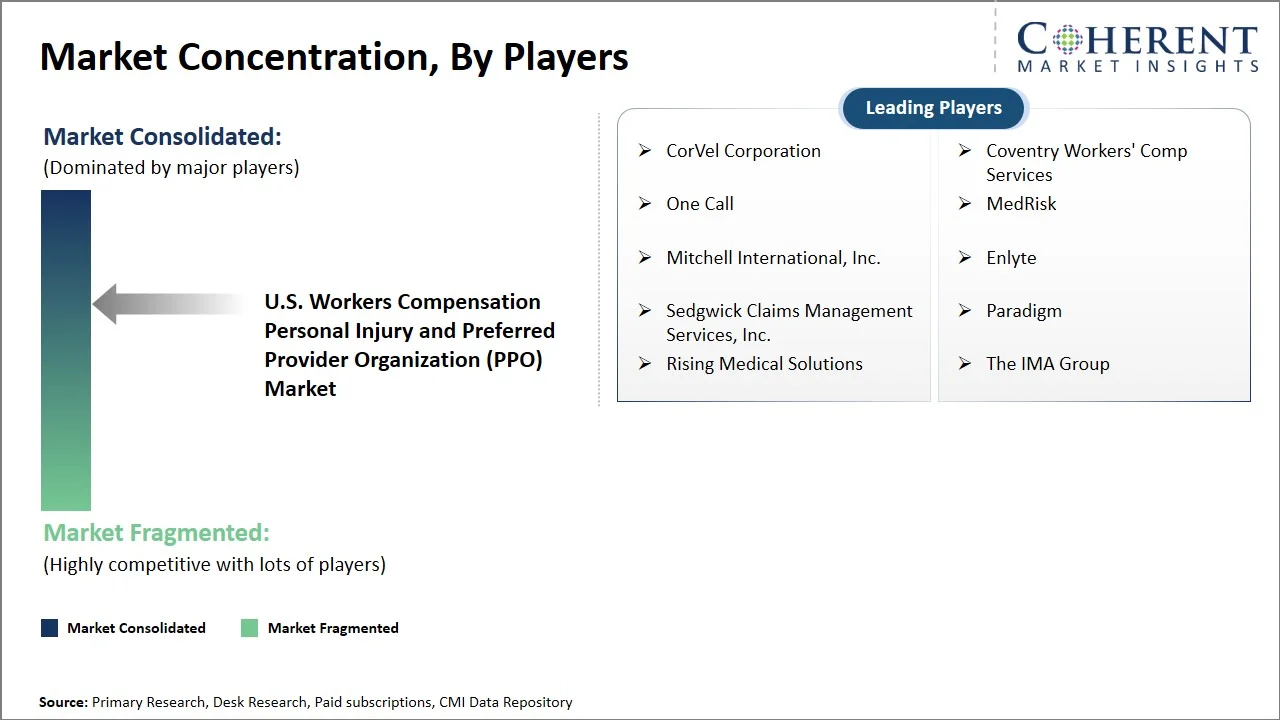
The U.S. workers compensation personal injury and preferred provider organization (PPO) market is moderately consolidated, with leading managed care organizations, third-party administrators (TPAs), and PPO network providers competing through integrated claims management, nationwide provider network expansion, and technology-driven medical cost containment solutions. Companies are strengthening strategic partnerships with employers, insurers, and healthcare providers while investing in digital claims platforms and care coordination services to improve treatment outcomes and reduce claim costs. Key focus areas include:
- Expansion of nationwide Preferred Provider Organization (PPO) and specialty provider networks
- Adoption of AI-enabled claims management, medical bill review, and predictive analytics
- Strengthening return-to-work, case management, and utilization review capabilities
- Strategic acquisitions and partnerships to broaden managed care and workers' compensation service portfolios
Market Report Scope
U.S. Workers Compensation Personal Injury and Preferred Provider Organization (PPO) Market Report Coverage
| Report Coverage | Details | ||
|---|---|---|---|
| Base Year: | 2025 | Market Size in 2026: | USD 28,383.6 Mn |
| Historical Data for: | 2020 To 2024 | Forecast Period: | 2026 To 2033 |
| Forecast Period 2026 to 2033 CAGR: | 5.4% | 2033 Value Projection: | USD 43,008.0 Mn |
| Segments covered: |
| ||
| Companies covered: | CorVel Corporation, Coventry Workers' Comp Services, One Call, MedRisk, Mitchell International, Inc., Enlyte, Sedgwick Claims Management Services, Inc., Paradigm, Rising Medical Solutions, and The IMA Group | ||
| Growth Drivers: |
| ||
| Restraints & Challenges: |
| ||
Analyst Opinion (Expert Opinion)
- The future of the U.S. workers compensation personal injury and preferred provider organization (PPO) market is expected to evolve from a traditional provider network model toward an integrated, technology-enabled managed care ecosystem. Increasing claim complexity, rising medical inflation, and greater emphasis on faster return-to-work outcomes will accelerate the adoption of AI-driven claims management, predictive analytics, and coordinated care solutions. As employers and insurers seek to optimize healthcare spending while maintaining quality of care, PPO providers offering data-driven and outcome-focused services are likely to gain a competitive advantage.
- The maximum growth opportunity lies within enterprise end users, particularly occupational disease and musculoskeletal injury management across the U.S, where employers continue to prioritize long-term cost containment and workforce productivity. The demand for specialized provider networks, utilization review, telehealth-enabled case management, and pharmacy benefit management is expected to increase as organizations adopt more comprehensive managed care strategies.
- In order to create an advantage for themselves, the competitors should expand high-quality provider networks in underserved regions, invest in AI-enabled claims adjudication and medical bill review platforms, and enhance integrated care coordination through strategic partnerships with insurers, employers, and healthcare providers. Companies that demonstrate measurable improvements in claim outcomes, medical cost savings, and return-to-work performance will be better positioned to secure long-term contracts and differentiate themselves in an increasingly value-driven workers' compensation market.
Speak to the analyst
Want personalized insights?
Take the findings above to one of our principal consultants, or have the report rebuilt around the segments, geographies and competitors you actually track.
Market Segmentation
- Type Insights (Revenue, USD Mn, 2021 - 2033)
- Enterprise
- Personal
- Provider Insights (Revenue, USD Mn, 2021 - 2033)
- Public
- Private
- Application Insights (Revenue, USD Mn, 2021 - 2033)
- Occupational Diseases
- Injury caused due to accident during employment
- Partial and permanent disability
- Temporary disability and death
- Others
- Key Players Insights
- CorVel Corporation
- Coventry Workers' Comp Services
- One Call
- MedRisk
- Mitchell International, Inc.
- Enlyte
- Sedgwick Claims Management Services, Inc.
- Paradigm
- Rising Medical Solutions
- The IMA Group
Sources
Primary Research Interviews
- Workers' Compensation Insurance Carriers (Claims, Managed Care, and Medical Management Business Units)
- Preferred Provider Organization (PPO) Network Administrators and Managed Care Organizations (MCOs)
- Third-Party Administrator (TPA) Executives (Claims Administration and Medical Bill Review)
- Occupational Medicine Physicians and Workers' Compensation Case Managers
- Employer Risk Management and Human Resources Executives (Large Enterprises)
- Medical Bill Review, Utilization Review, and Pharmacy Benefit Management (PBM) Solution Providers
Stakeholders
- Workers' Compensation Insurance Carriers (e.g., Travelers, The Hartford, Zurich North America, AmTrust Financial Services, Liberty Mutual)
- Third-Party Administrators (e.g., Sedgwick, CorVel Corporation, Gallagher Bassett, Broadspire)
- Preferred Provider Organization (PPO) and Managed Care Organizations (e.g., Coventry Workers' Comp Services, MedRisk, One Call, Enlyte)
- Occupational Health Clinics and Hospital Networks
- Self-Insured Employers and Employer Associations
- Pharmacy Benefit Management (PBM) Providers and Independent Medical Review Organizations
- End-use Sectors
- Employers (Large Enterprises and Self-Insured Organizations)
- Insurance Companies
- Third-Party Administrators (TPAs)
- Government Workers' Compensation Programs
- Healthcare Providers (Hospitals, Occupational Health Clinics, Physician Practices)
- Rehabilitation and Physical Therapy Centers
- Regulatory & Health Bodies
- U.S. Department of Labor (DOL) – Office of Workers' Compensation Programs (OWCP)
- National Council on Compensation Insurance (NCCI)
- Occupational Safety and Health Administration (OSHA)
- Texas Department of Insurance – Division of Workers' Compensation (TDI-DWC)
- California Department of Industrial Relations – Division of Workers' Compensation (DWC)
- International Association of Industrial Accident Boards and Commissions (IAIABC)
Databases
- U.S. Department of Labor (OWCP) – Federal workers' compensation policies, claims administration, medical benefits, and program statistics.
- National Council on Compensation Insurance (NCCI) – Workers' compensation claim trends, medical cost analysis, premium data, and industry benchmarking.
- Occupational Safety and Health Administration (OSHA) – Workplace injury statistics, severe injury reporting, occupational safety regulations, and compliance data.
- Texas Department of Insurance – Division of Workers' Compensation (TDI-DWC) – Medical fee guidelines, healthcare network regulations, reimbursement policies, and treatment guidelines.
- California Division of Workers' Compensation (DWC) – Medical Provider Network (MPN) regulations, utilization review, evidence-based treatment guidelines, and workers' compensation medical policies.
- International Association of Industrial Accident Boards and Commissions (IAIABC) – State workers' compensation regulatory resources, claims standards, electronic data interchange (EDI), and policy updates.
Magazines
- Risk & Insurance Magazine
- Managed Healthcare Executive
- Business Insurance Magazine
- Workers' Compensation Magazine
Journals
- Journal of Occupational and Environmental Medicine (JOEM)
- American Journal of Industrial Medicine
- Journal of Workers' Compensation
Associations
- National Council on Compensation Insurance (NCCI)
- American Association of State Compensation Insurance Funds (AASCIF)
- Workers' Injury Law & Advocacy Group (WILG)
- Property Casualty Insurers Association of America (PCI)
Public Domain Sources
- U.S. Bureau of Labor Statistics (BLS) – Occupational Injury & Illness Data
- U.S. Department of Labor – Office of Workers' Compensation Programs (OWCP)
- Centers for Disease Control and Prevention (CDC) – Workplace Safety Reports
- State Workers' Compensation Regulatory Agency Reports
Proprietary Elements
- CMI Data Analytics Tool, Proprietary CMI Existing Repository of information for last 10 years.
Get access to 250+ pages report
Every segment, forecast, competitor profile and data table behind the analysis above — available for instant download.
- ESOMAR Member
- ISO 9001:2015 Certified
- D-U-N-S Registered
- GDPR & CCPA Compliant
Missing comfort of reading report in your local language? Find your preferred language:
Transform your Strategy with Exclusive Trending Reports
Frequently Asked Questions
The U.S. workers compensation personal injury and preferred provider organization (PPO) market is estimated to be valued at USD 28,383.6 Mn in 2026 and is expected to reach USD 43,008.0 Mn by 2033.
Enterprise dominates due to the widespread adoption of employer-sponsored workers' compensation programs, high claim volumes managed by large organizations, and the increasing use of PPO networks to control medical costs, streamline claims administration, and improve return-to-work outcomes.
The U.S. workers compensation personal injury and preferred provider organization (PPO) market comprises managed healthcare networks and services that provide medical treatment, claims management, and cost-effective care for employees injured during the course of employment.
The CAGR of the U.S. workers compensation personal injury and preferred provider organization (PPO) market is projected to be 5.4% from 2026 to 2033.
Artificial intelligence, predictive analytics, telehealth, and digital care coordination platforms are expected to improve claims efficiency, treatment outcomes, and medical cost containment.
AI is expected to enhance claims automation, predictive risk assessment, medical bill review, and fraud detection, enabling faster claim resolution and more cost-effective care management.
Medical bill review is the process of evaluating healthcare invoices for coding accuracy, fee schedule compliance, and treatment appropriateness before reimbursement.