

Global Workers Compensation Insurance Market Size and Forecast – 2026 To 2033
The global workers compensation insurance market is expected to grow from USD 55 Bn in 2026 to USD 84 Bn by 2033, registering a compound annual growth rate (CAGR) of 5.5% from 2026 to 2033. The global workers compensation insurance market is driven by rising number of employees in formal workforce globally. On September 8, 2025, Quess Corp reported adding 133,000 formal jobs, with 23% women participation, highlighting strong formal workforce expansion in India’s staffing sector as companies increasingly shift workers from informal to structured payroll employment. (Source: Economic Times)
Key Takeaways of the Global Workers Compensation Insurance Market
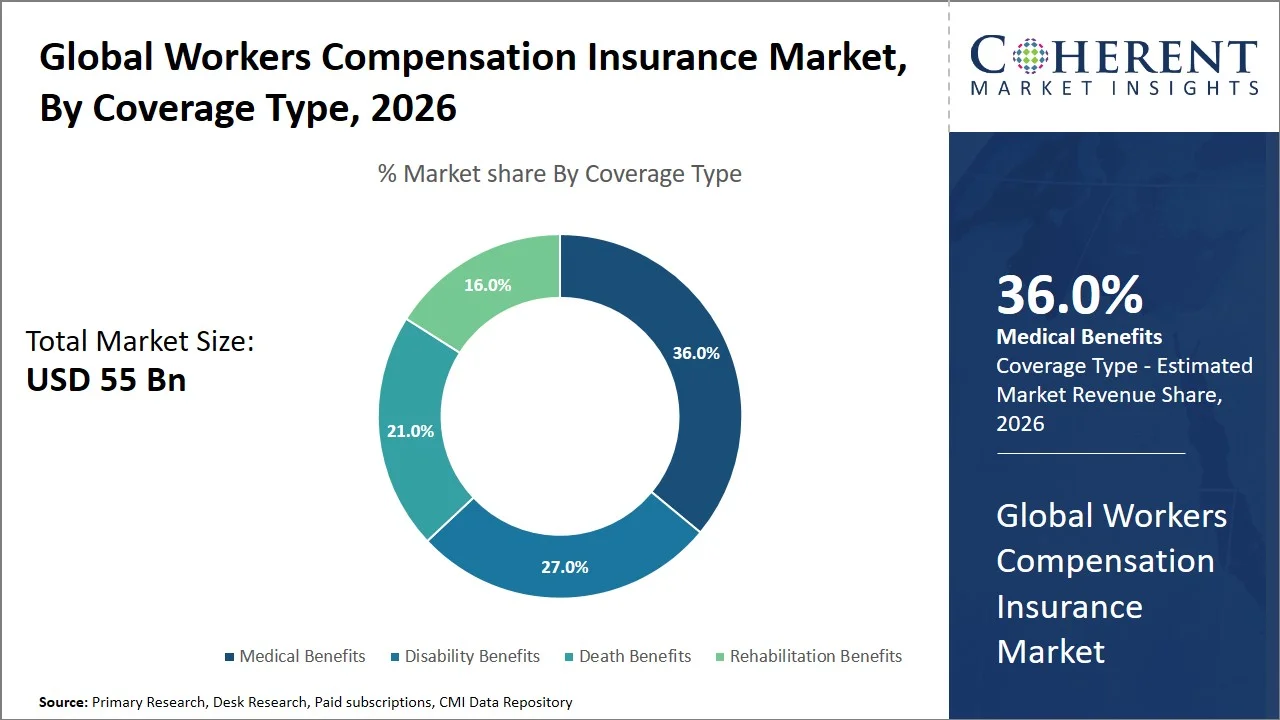
- The medical benefits segment is expected to account for 36.0% of the global workers compensation insurance market share in 2026. Higher awareness of employee welfare & compensation rights is a major factor driving the growth of the segment. On March 26, 2025, Texas Mutual Insurance Company awarded a USD 100,000 grant to Lamar Institute of Technology (LIT) to continue funding the college's Safety Awareness Institute, which provides workplace safety courses for community employers, workers and the general public. (Source: Lamar Institute of Technology)
- The temporary disability claims segment is estimated to capture 38.0% of the market share in 2026. Growing instances of short-term workplace injuries is expected to drive the growth of the segment. On May 4, 2026, The Travelers Companies, Inc. released its 2026 Injury Impact Report, an analysis of more than 1.2 million workers compensation claims received by the company from 2021 through 2025. The report finds that even as workplace injury rates decline, the injuries that do occur are growing more complex and taking longer to heal. (Source: Travelers)
- The construction segment is estimated to capture 26.0% of the market share in 2026. Booming growth in industrial sectors, including construction, is a key factor driving the segmental growth. On May 28, 2026, Cheniere Energy Partners, L.P. announced that its subsidiary, Sabine Pass Liquefaction Stage V, LLC, has entered into a lump sum, turnkey, engineering, procurement and construction contract with Bechtel Energy, Inc. for the first phase of the SPL Expansion Project. (Source: Cheniere Energy Partners, L.P)
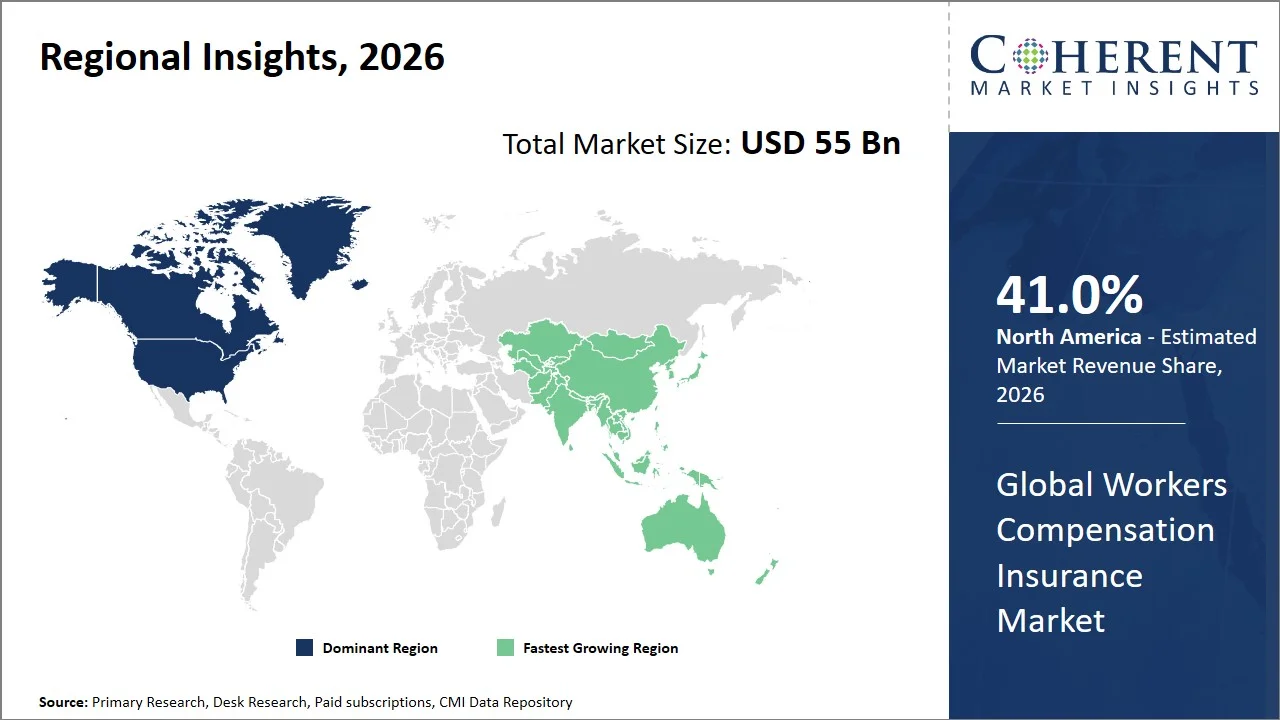
- North America is expected to dominate the workers compensation insurance market in 2026 with a market share of 41.0 %. Increasing introduction of micro-insurance products for SMEs and gig workers is a primary factor driving the regional market. On November 17, 2025, Nine health insurers were approved to sell group health plans to small employers in Washington, U.S. The insurers requested an average premium increase of 9.5%, though a change of 12.8% was approved based on an actuarial review of the companies’ financial projections. (Source: Office of the Insurance Commissioner)
- Asia Pacific is expected to account for 23.0 % share in 2026 and is projected to record the fastest growth over the forecast period. Growing use of data analytics for risk-based premium pricing is expected to drive the growth of the workers compensation insurance market in Asia Pacific. For example, Chinese insurers significantly expanded the use of artificial intelligence and data analytics for fraud detection, claims automation, and customer risk scoring, with the industry managing over USD 6,100 Billion in assets by end-2025. (Source: Insurance Asia)
- Digital Claims Management and Automation: Insurance companies are increasingly using artificial intelligence (AI), machine learning and automated claims-processing platforms to boost efficiency. Digital claims systems cut processing time, minimize fraud, increase accuracy and improve the experience for employers and injured workers.
- Expansion of Coverage for Remote and Hybrid Workforces: The growth of remote and hybrid work arrangements has created new workplace injury and liability risks. Insurers are changing policy structures and underwriting methods to accommodate home office ergonomics, mental health issues and work-related accidents outside of traditional offices.
Segmental Insights
Why Does the Medical Benefits Segment Dominate the Global Workers Compensation Insurance Market?
The medical benefits segment is expected to account for 36.0% of the global workers compensation insurance market share in 2026. Healthcare expenses are high and continue to rise. Insurers must pay for the costs of work-related injuries or illnesses, including emergency treatment, hospitalization, surgery, rehabilitation, prescription drugs and continued medical treatment. Medical benefits make for the greatest share of workers’ compensation claims and as healthcare service costs continue to climb around the world, this will be the largest part of the market. On April 22, 2026, the National Council on Compensation Insurance (NCCI) reported that the Workers’ Compensation Weighted Medical Price Index is rising steadily, confirming persistent medical inflation across hospital care, outpatient treatment, and rehabilitation services, directly increasing workers’ compensation medical benefit claim costs for insurers and employers. (Source: National Council on Compensation Insurance)
- Current Industry Events of 2026
- Market Size Estimation
- Regional Breakdown
- Competitive Landscape
- Customer Intelligence
- Segmental Analysis
- Pricing Analysis
- Key Market Drivers, Challenges & Future Trends
- Customized Insights Section
Why are Temporary Disability Claims the Most Widespread Claim Type?
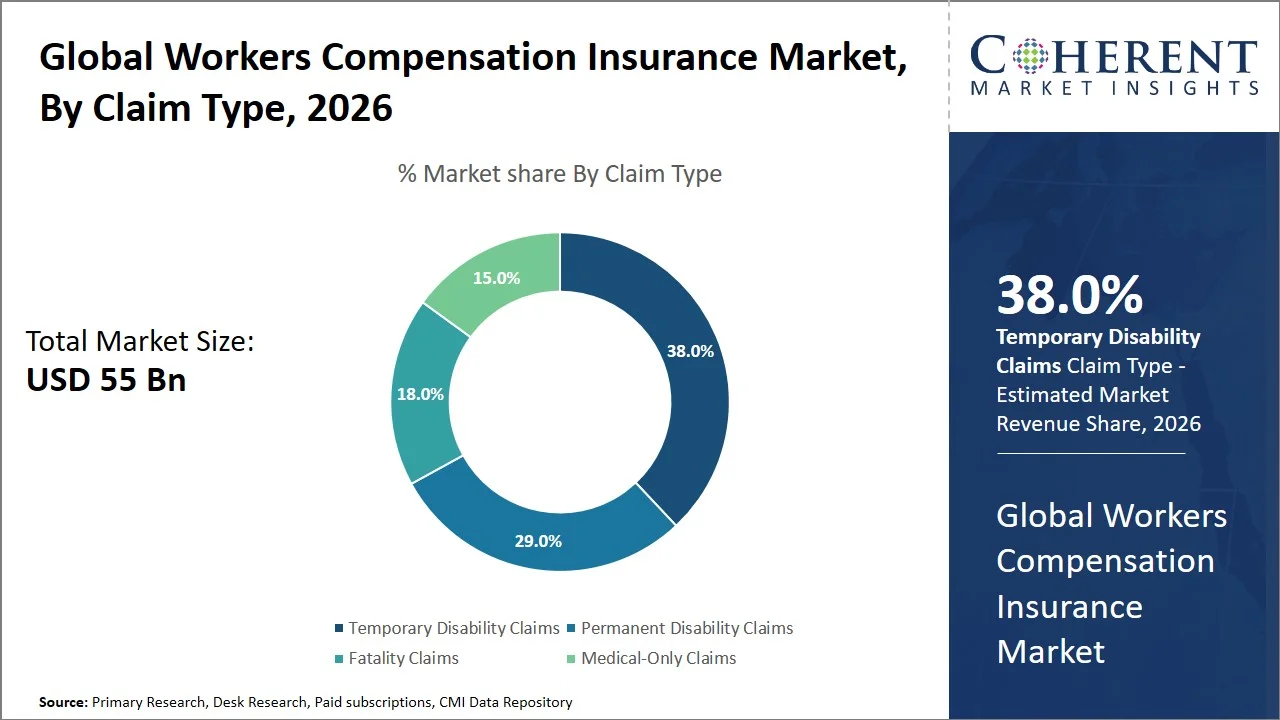
The temporary disability claims segment is expected to account for 38.0% of the global workers compensation insurance market share in 2026. The majority of claims are for temporary disability because to the prevalence of short-term injuries and illnesses on the job. Many occupational injuries including sprains, strains, small fractures and repetitive stress injuries, temporarily hinder people from doing their jobs, but they can return to work once they feel better. The majority of workers’ compensation insurance claims are temporary disability claims, since they are more prevalent than permanent disability or fatal injuries. On November 26, 2025, Washington State Department of Labor & Industries approved a 4.9% increase in workers’ compensation rates, explicitly citing rising medical treatment and injury-related healthcare costs as a key driver of higher benefit payouts required to cover injured workers. (Source: Washington State Department of Labor & Industries)
Construction Dominates the Global Workers Compensation Insurance Market
The construction segment is expected to account for 26.0% of the global workers compensation insurance market share in 2026. The construction industry is the leading sector in the workers compensation insurance market due to the significant risk of injuries and accidents at work. Construction workers face many hazards such as falls from heights, equipment mishaps, electrical hazards and working with heavy gear. With this increased risk of accident, construction companies require a lot of workers’ compensation coverage. As a result, more policies are sought and more claims are filed compared to many other industries. On April 29, 2025, at the Port Arthur LNG construction project managed by Bechtel, a scaffolding collapse led to three worker fatalities and multiple injuries, prompting a full work stoppage and investigation. The incident highlighted high exposure to fall-from-height risks, which are among the most costly workers’ compensation claims in large-scale construction projects. (Source: Bechtel)
Currents Events and their Impact
Current Events | Description and its Impact |
Queensland Workers' Compensation and Rehabilitation Regulation 2025 |
|
Pennsylvania PTSD Benefits Reform for First Responders |
|
(Source: Queensland Government, Commonwealth of Pennsylvania)
Workers Compensation Insurance Market Dynamics
Market Drivers
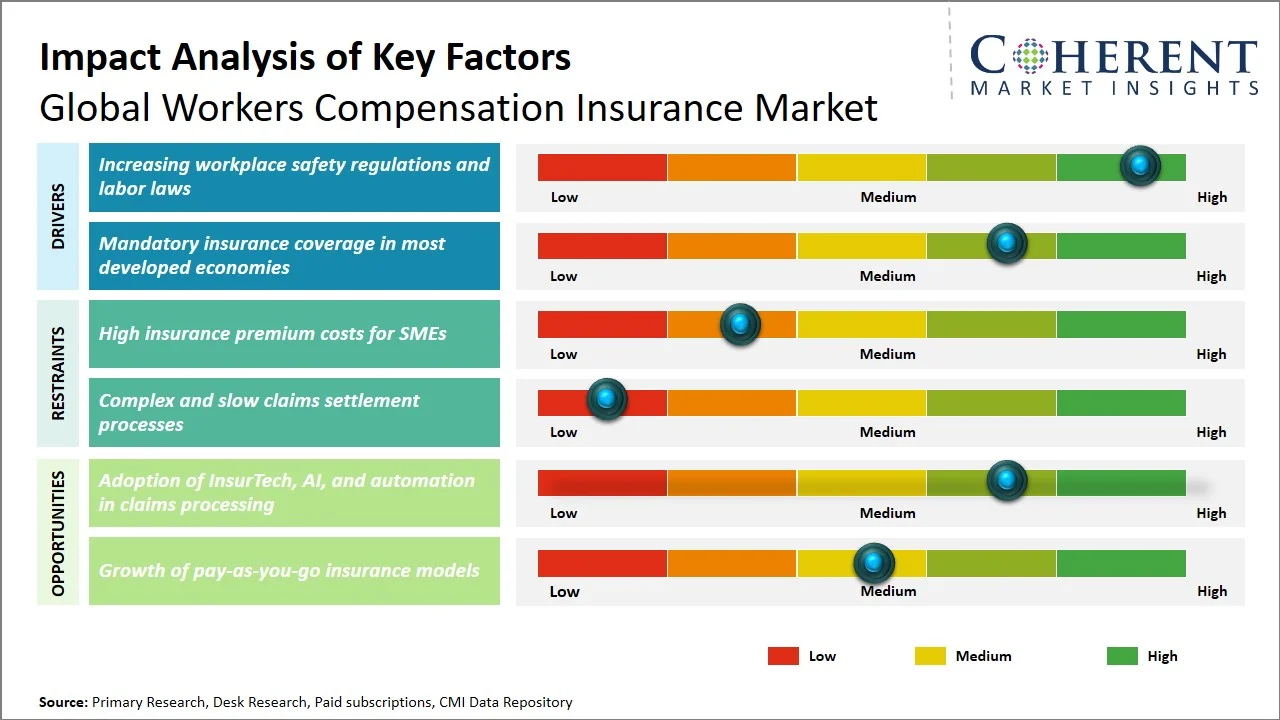
- Increasing workplace safety regulations and labor laws: Growing workplace safety regulations and labor laws are creating demand for the workers compensation insurance market. Governments across the world are strengthening their standards related to employee safety, occupational health, and employer liability. The development of more stringent compliance requirements encourages firms to maintain enough workers’ compensation coverage, improve workplace safety procedures, and offer financial protection to employees in the event of work-related injuries or illnesses. On May 4, 2026, OSHA launched the National Safety Stand-Down to Prevent Falls, reinforcing stricter enforcement of fall protection standards in construction after multiple fatal incidents at worksites, including roofing and elevated platform accidents. The initiative highlights tighter regulatory focus on height-related safety compliance in construction. (Source: OSHA)
- Mandatory insurance coverage in most developed economies: In most developed countries, the workers compensation insurance market is driven by compulsory insurance, as governments oblige employers to provide insurance coverage for work-related injuries and illnesses. These regulatory requirements provide medical and wage-replacement benefits to employees and create a constant demand for workers' compensation insurance across industries and organization sizes. On May 13, 2025, the National Council on Compensation Insurance (NCCI) reiterated that workers’ compensation remains a state-mandated insurance system in nearly all U.S. jurisdictions, with employers legally required to carry coverage or face penalties. (Source: National Council on Compensation Insurance)
Emerging Trends
- Growing Focus on Workplace Safety and Risk Prevention: Insurers are extending beyond claims coverage and are investing in proactive risk management services. Wearable gadgets, IoT sensors, predictive analytics, and real-time monitoring allow firms to identify workplace hazards early, minimize accident rates, and cut compensation expenses.
- Increasing Use of Data Analytics for Personalized Underwriting: Insurers are leveraging advanced analytics and big data to better assess risk and provide customized premium rates. By assessing industry-specific risks, employee demographics, claims history and workplace conditions, insurers may build more specialized workers’ compensation solutions, while increasing profitability and client retention.
Regional Insights
Why is North America a Strong Market for Workers Compensation Insurance?
North America is expected to account for a market share of 41.0% in 2026. The U.S. and Canada have highly developed and mandated state-based compensation systems, making North America the largest workers compensation insurance market. Private workers’ compensation insurers in the U.S. produced high value net written premiums, buoyed by robust demand from the construction, transportation, healthcare and manufacturing sectors. Moreover, increasing adoption of AI-powered claims management and rising medical treatment expenses are also acting as market growth trends across the region. In 2024, OSHA’s severe injury tracking system recorded over 100,000 severe injury cases, including hospitalizations and amputations, but the majority of reported workplace injuries still involve non-fatal incidents such as back injuries, fractures, and fall-related trauma, which typically lead to temporary disability compensation rather than long-term claims (Source: OSHA)
Why Does the Asia Pacific Workers Compensation Insurance Market Exhibit High Growth?
Asia Pacific is projected to account for 23.0% of the global workers compensation insurance market and is expected to register the fastest growth. The Asia Pacific workers compensation insurance market is expected to grow at the fastest rate on account of rapid industrialization, rise of manufacturing hubs and tougher rules on worker protection. Countries like China, India, Vietnam and Indonesia are widening occupational injury coverage to support the burgeoning industrial and platform-based workforce. Government attempts to enhance workplace safety and social security coverage are driving insurance uptake across the area. In 2025, the Singapore Ministry of Manpower’s Workplace Safety and Health report recorded that the manufacturing, construction, and transport sectors accounted for more than half of all major non-fatal injuries, with leading causes including slips, trips, falls, and vehicle-related incidents, most of which result in temporary disability claims rather than permanent impairment. (Source: Ministry of Manpower)
Global Workers Compensation Insurance Market Outlook for Key Countries
Why is the U.S. Emerging as a Major Hub in the Workers Compensation Insurance Market?
The U.S. is the largest market for workers’ compensation insurance in the world, with mandated employer coverage laws in most states and a big labor pool in high-risk industries. Construction continues to be one of the largest claim producing sectors, with Texas having the greatest number of severe occupational injury claims originating from construction operations such as falls, vehicle events, and struck-by accidents. Furthermore, there is a rising adoption of AI in claims processing, underwriting, and fraud detection.
Is China the Next Growth Engine for the Workers Compensation Insurance Market?
The China workers compensation market grows through its occupational injury insurance system, especially among gig-economy and platform workers. In 2025, the government expanded the pilot program for occupational injury insurance to more provinces and significant digital platforms, covering more than 12.3 million delivery drivers, ride-hailing drivers and freight workers. The strategy is projected to be implemented across the country, considerably expanding workers’ compensation coverage and premium levels.
Germany Workers Compensation Insurance Market Analysis and Trends
Germany’s statutory accident insurance system is one of the most comprehensive in the world, under the German Social Accident Insurance (DGUV) structure. The scheme covers more than 80 million covered persons and almost 4 million firms and premiums are paid only by the employers. The German approach is a paradigm for occupational injury protection worldwide because it incorporates accident prevention, medical rehabilitation, vocational recovery, and long-term compensation in a way that many private insurance markets do not.
India Workers Compensation Insurance Market Analysis and Trends
The India workers compensation insurance industry is witnessing growth driven by the Code on Social Security and the increasing formalization of the workforce. The growth is particularly robust in the construction, infrastructure development, logistics, mining and manufacturing sectors supported by large scale government initiatives such as Make in India and developing industrial corridors. Insurers are tailoring workers’ compensation coverage for medium and big companies that want to stay in compliance with shifting workplace safety and labor laws.
Workers Compensation Insurance Market - Workplace Safety Technology Adoption Rates
Safety Technology | Adoption Rate |
IoT-enabled workplace safety systems | ~30%+ of market adoption in advanced industries |
AI-powered wearables (smart helmets, vests, exoskeletons) | ~50–65% adoption in large enterprises; <20% in SMEs |
Wearable sensors / connected worker devices | ~25–40% adoption in high-risk industries |
Big data & predictive analytics in safety management | ~45–55% adoption among large insurers & employers |
Automation & robotics for hazard reduction | ~20–35% adoption (higher in manufacturing than construction) |
Digital Environment, Health & Safety (EHS) platforms | ~60%+ adoption in large enterprises |
Market Players, Key Development, and Competitive Intelligence
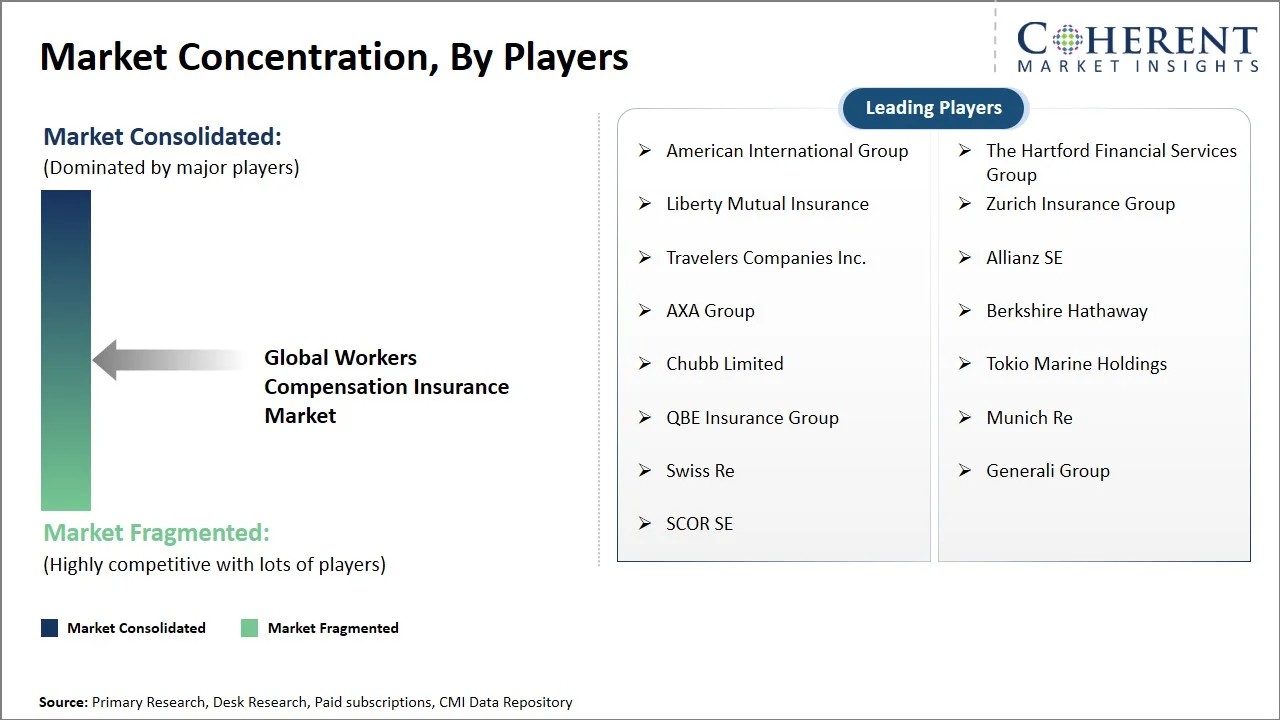
Key Developments
- On June 1, 2026, Coforge launched the Nexa Agentic AI Platform, designed specifically for insurance companies to automate claims management, underwriting, and policy servicing. The platform supports insurers in reducing claims cycle time and improving accuracy in workers’ compensation claim evaluations.
- On December 10, 2025, WTW, a leading global advisory, broking and solutions company, announced it has signed a definitive agreement to acquire Newfront, a San Francisco-based, top 40 U.S. broker combining deep specialty expertise and cutting-edge technology. The agreement provides for upfront and contingent consideration payments totaling USD 1.3 billion.
Competitive Landscape
The workers compensation insurance industry is highly competitive, with giant global insurers, regional carriers and rising InsurTech enterprises, with difference being driven by digital transformation and service innovation. Major firms are concentrating on AI-enabled claims processing, predictive risk analytics and automated underwriting technologies to drive efficiency and minimize loss ratios. There is also a strategic focus on growing value-added services such as workplace safety advice, injury prevention programs and employee wellness solutions. In addition, collaborations and acquisitions of technology providers are being pursued to boost data capabilities and improve customer experience across high-risk industries such as construction, healthcare, and manufacturing.
Market Report Scope
Workers Compensation Insurance Market Report Coverage
| Report Coverage | Details | ||
|---|---|---|---|
| Base Year: | 2025 | Market Size in 2026: | USD 55 Bn |
| Historical Data for: | 2020 To 2024 | Forecast Period: | 2026 To 2033 |
| Forecast Period 2026 to 2033 CAGR: | 5.5% | 2033 Value Projection: | USD 84 Bn |
| Geographies covered: |
| ||
| Segments covered: |
| ||
| Companies covered: | American International Group, The Hartford Financial Services Group, Liberty Mutual Insurance, Zurich Insurance Group, Travelers Companies Inc., Allianz SE, AXA Group, Berkshire Hathaway, Chubb Limited, Tokio Marine Holdings, QBE Insurance Group, Munich Re, Swiss Re, Generali Group, and SCOR SE | ||
| Growth Drivers: |
| ||
| Restraints & Challenges: |
| ||
Analyst Opinion (Expert Opinion)
- Rising workplace safety laws, required insurance requirements and rising healthcare and compensation expenses across major economies are projected to provide continued assistance. The growth is expected to be supported by increasing use of digital platforms and automation technologies that are enhancing claims efficiency and fraud detection. In addition, the expansion of coverage for mental health issues and non-traditional work arrangements are considered as a crucial structural factor. However, increased claim severity and medical inflation are putting pressure on profitability and affecting underwriting techniques globally.
- Advanced analytics, AI-enabled underwriting and completely digital claims ecosystems are projected to increasingly influence the future of the workers compensation insurance market. Emerging economies’ industrialization and the formalization of labor markets should offer plenty of development prospects. As labor market dynamics evolve, insurance coverage is expected to expand to include gig economy workers, remote employees, and mental health-related claims. Other factors expected to increase loss prevention, improve claim outcomes, and enable long-term sustainable market expansion include advancements in predictive risk modeling, telehealth integration, and real-time workplace monitoring.
Speak to the analyst
Want personalized insights?
Take the findings above to one of our principal consultants, or have the report rebuilt around the segments, geographies and competitors you actually track.
Market Segmentation
- Coverage Type Insights (Revenue, USD Billion, 2021 - 2033)
- Medical Benefits
- Disability Benefits
- Death Benefits
- Rehabilitation Benefits
- Claim Type Insights (Revenue, USD Billion, 2021 - 2033)
- Temporary Disability Claims
- Permanent Disability Claims
- Fatality Claims
- Medical-Only Claims
- End User Insights (Revenue, USD Billion, 2021 - 2033)
- Construction
- Manufacturing
- Healthcare
- Transportation and Logistics
- Retail
- Mining and Energy
- Agriculture
- Regional Insights (Revenue, USD Billion, 2021 - 2033)
- North America
- U.S.
- Canada
- Latin America
- Brazil
- Argentina
- Mexico
- Rest of Latin America
- Europe
- Germany
- U.K.
- Spain
- France
- Italy
- Russia
- Rest of Europe
- Asia Pacific
- China
- India
- Japan
- Australia
- South Korea
- ASEAN
- Rest of Asia Pacific
- Middle East
- GCC Countries
- Israel
- Rest of Middle East
- Africa
- South Africa
- North Africa
- Central Africa
- North America
- Key Players Insights
- American International Group
- The Hartford Financial Services Group
- Liberty Mutual Insurance
- Zurich Insurance Group
- Travelers Companies Inc.
- Allianz SE
- AXA Group
- Berkshire Hathaway
- Chubb Limited
- Tokio Marine Holdings
- QBE Insurance Group
- Munich Re
- Swiss Re
- Generali Group
- SCOR SE
Sources
Primary Research Interviews
- Insurance Company Executives and Underwriters
- Risk Management Consultants and Advisors
- Corporate HR Directors and Benefits Managers
- Insurance Brokers and Distribution Partners
Magazines
- Risk & Insurance Magazine
- Business Insurance Magazine
- Insurance Journal Magazine
- Workers' Compensation Report Magazine
Journals
- Journal of Risk and Insurance
- International Journal of Occupational Safety and Health
- Workers' Compensation Law Review
Associations
- National Council on Compensation Insurance (NCCI)
- Workers' Compensation Research Institute (WCRI)
- International Association of Industrial Accident Boards and Commissions (IAIABC)
- Risk and Insurance Management Society (RIMS)
Public Domain Sources
- U.S. Department of Labor Statistics
- Occupational Safety and Health Administration (OSHA) Reports
- State Insurance Commissioner Reports
- Federal Insurance Office Publications
Proprietary Elements
- CMI Data Analytics Tool
- Proprietary CMI Existing Repository of information for last 10 years
Get access to 250+ pages report
Every segment, forecast, competitor profile and data table behind the analysis above — available for instant download.
- ESOMAR Member
- ISO 9001:2015 Certified
- D-U-N-S Registered
- GDPR & CCPA Compliant
Missing comfort of reading report in your local language? Find your preferred language:
Transform your Strategy with Exclusive Trending Reports
Frequently Asked Questions
The global workers compensation Insurance market is expected to stand at USD 55 Bn in 2026 and is expected to reach USD 84 Bn by 2033.
The CAGR of the global workers compensation insurance market is projected to be 5.5% from 2026 to 2033.
Increasing workplace safety regulations and labor laws and mandatory insurance coverage in most developed economies are the major factors driving the growth of the global workers compensation insurance market.
High insurance premium costs for SMEs and complex and slow claims settlement processes are the major factors hampering the growth of the global workers compensation insurance market.
In terms of coverage type, the medical benefits segment is estimated to dominate the market revenue share in 2026.
Automation reduces manual work, speeds up settlements, and improves operational efficiency.
It has expanded coverage considerations to include home-based workplace injuries and mental health issues.