

Global Construction Management Software Market Size and Share Analysis – Growth Trends and Forecasts (2026-2033)
Global construction management software market is estimated to be valued at USD 19.17 Bn in 2026 and is expected to reach USD 38.57 Bn by 2033, exhibiting a compound annual growth rate (CAGR) of 10.5% from 2026 to 2033.
Key Takeaways
- Among Deployment, On-Premise Segment is estimated to contribute the highest market share of 54.2% in 2026. This is due to organizations' continued reliance on legacy systems.
- Among Building Type, Commercial Buildings Segment is estimated to contribute the highest market share of 63.9% in 2026. This is due to the complex requirements of large-scale commercial projects.
- Among End User, Builders & Contractors’ Segment is estimated to contribute the highest market share of 46.2% in 2026. This is due to front-line project management needs.
- North America is the dominant region in the global construction management software market with estimated market share of 47.8% in 2026. This is because the region is home to some of the largest construction companies in the world who have significantly invested in innovative technologies to streamline their operations and project execution.
Market Overview
Rising adoption of cloud-based construction management solutions and increasing investments in infrastructure development especially in developing countries drive the market growth. Extensive usage of construction monitoring mobile apps and growing demand for integrated construction project management software can provide significant growth opportunities for the vendors. Increased adoption of emerging technologies such as artificial intelligence and internet of things in construction software can also contribute to the growth of the market. High implementation and maintenance costs of construction management solutions can, however, restrict market growth.
In July 2024, Hammer Tech, a cloud-based construction management and safety software vendor—raised a US $70 million funding round led by Riverwood Capital to add AI-powered safety monitoring and mobile functionality to its platform.
Current Events and Its Impact on Construction Management Software Market
Current Events | Description and its impact |
India Unveils AI-Based Platform to Simplify Infrastructure Projects |
|
Cross River Rail Project in Australia Deploys Bentley Systems' Digital Twin Software
|
|
Pricing Analysis
Construction management software pricing is highly diverse based on features, deployment type (cloud or on-premise), project size, and capacity of users. Most cloud solutions adopt a subscription-based pricing method, with costs between $30 and $300 per user per month. Entry-level plans provide standard features like scheduling and document management, whereas premium plans offer high-end functionalities like BIM integration, real-time reporting, mobile application access, and API integration.
Enterprise-level Construction Management Software for Contractors and infrastructure companies can be charged on a per-project or quote-by-quote basis, usually costing more than $10,000–$50,000 per year.
On-premise software, although less popular now, needs greater initial investments, such as license fees (which cost tens of thousands of dollars), implementation, hardware, and regular maintenance or upgrade fees.
Providers such as Procore, Autodesk Construction Cloud, Buildertrend, and PlanGrid apply tiered pricing depending on modules and number of users, offering convenience to small and mid-sized businesses. Some software companies also employ freemium approaches to restricted access, inviting upgrades as user requirements grow.
Pricing determinants are:
- Active number of users or seats
- Number of active projects being handled
- Nature of features (e.g., cost control, field reporting, IoT/BIM integration)
- Interoperability with third-party software (ERP, CRM, etc.)
- Mobile access and data storage capability
The move towards Software-as-a-Service (SaaS) pricing makes it more scalable and predictable. Nonetheless, for new markets and small businesses, prohibitive implementation and training expense continues to be a major deterrent. To remain competitive, vendors increasingly provide modular pricing and pay-as-you-go models to cater to varying project requirements and budgets.
- Current Industry Events of 2026
- Market Size Estimation
- Regional Breakdown
- Competitive Landscape
- Customer Intelligence
- Segmental Analysis
- Pricing Analysis
- Key Market Drivers, Challenges & Future Trends
- Customized Insights Section
Adoption of New Technology in the Construction Management Software Market
The construction management software market is in the midst of rapid revolution due to the adoption of innovative technologies including Artificial Intelligence (AI), Building Information Modeling (BIM), Internet of Things (IoT), cloud computing, and mobile-first platforms. These technologies are revolutionizing the way projects are scheduled, tracked, and delivered throughout the construction life cycle.
Artificial intelligence and machine learning are being utilized to improve decision-making through predictive analytics, risk detection, and resource optimization. AI-based systems can analyze huge amounts of data to predict delay in projects, provide cost-cutting recommendations, and detect safety risks in real time. For instance, AI is increasingly being employed for automated progress monitoring through drone imagery and site cameras.
BIM integration with project management software is becoming an essential capability, making it possible to have real-time collaboration between architects, engineers, and contractors using 3D modeling and virtual design coordination. This greatly minimizes rework and improves design accuracy.
IoT integration makes it possible for software to interface with smart sensors and wearables, offering real-time information on equipment usage, worker safety, and site conditions. This facilitates improved field-to-office communication and preventive safety measures.
Cloud-hosted platforms remain the choice, with scalability, single-point access to data, and mobile accessibility. Combined with mobile applications, these platforms enable managers and field workers to make on-the-fly updates to reports, schedules, and inspections—enhancing real-time decision-making.
Further, new technologies like digital twins, AR, and blockchain for contract management are being tested by top vendors. These technologies indicate a future with more data-driven, automated, and collaborative construction management than ever before.
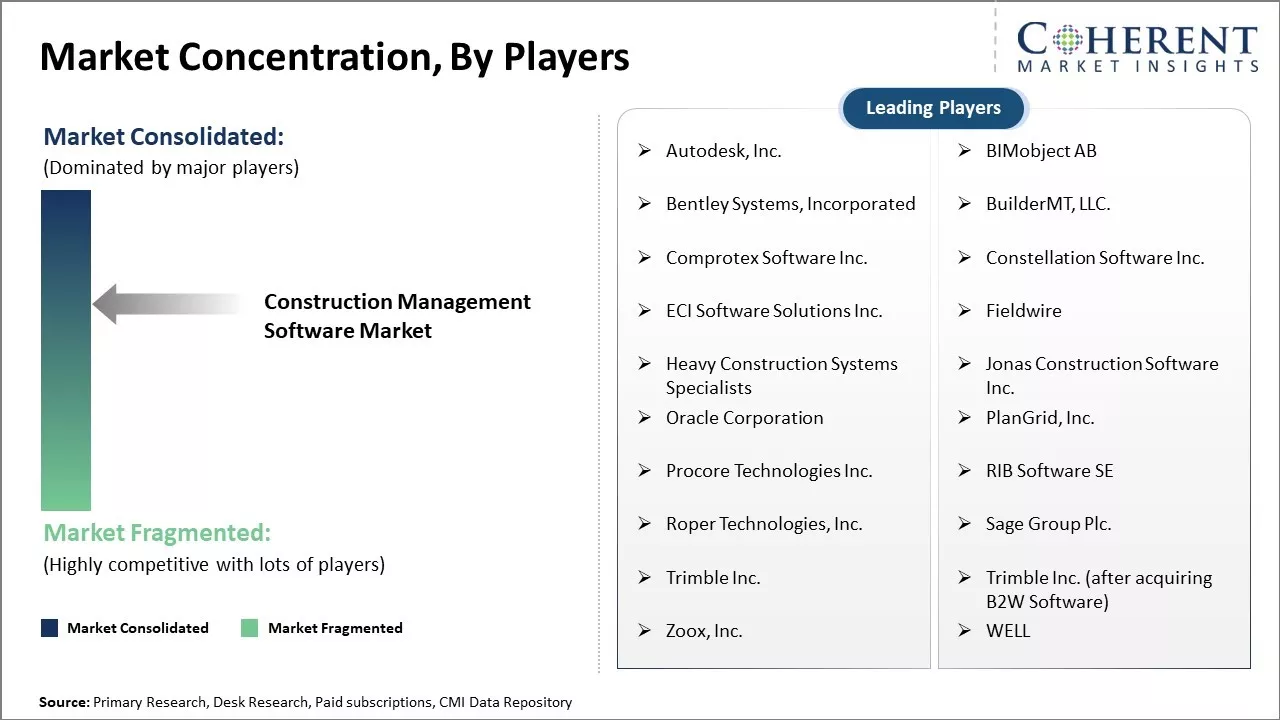
Market Concentration and Competitive Landscape
Market Driver
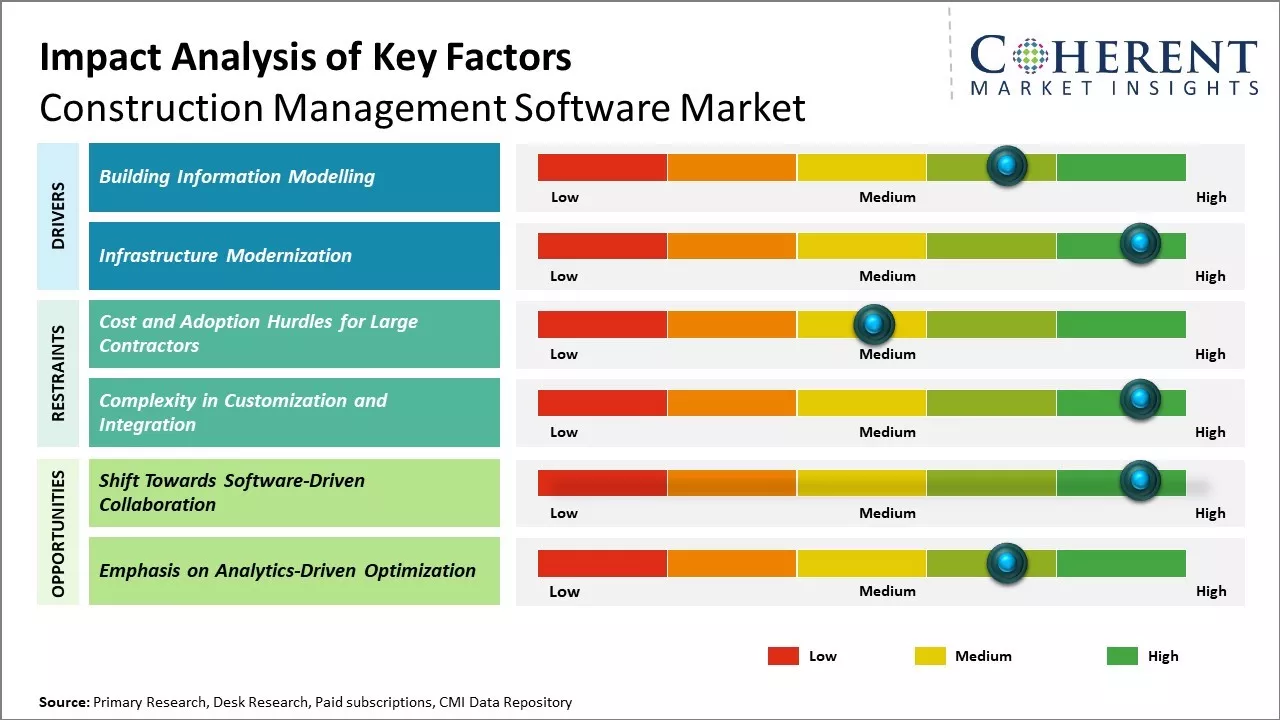
- Building Information Modelling
As construction industry moves towards more integrated processes and data sharing across projects, building information modelling (BIM) has become an important driver for construction management software adoption. BIM is a process involving the generation and management of digital representations of physical and functional characteristics of buildings and civil infrastructure projects. It provides owners, builders, and engineers insights to facilitate decision-making regarding resource and cost planning, schedule management, project coordination and building operation.
Construction management software helps bridge the gap between design conceptualization using BIM tools and execution on the job site. It provides a centralized platform for integrating design data with scheduling, costing, quality and documentation functions during the construction phase. This allows stakeholders to simulate construction sequencing, prefabrication, constructability reviews and identify issues proactively. Construction management solutions with BIM support allow for more effective collaboration and issue resolution, thus, reducing rework and enabling data-driven decision making throughout the project lifecycle.
- Infrastructure Modernization
Ageing infrastructure in developed economies and massive investments for transportation, utilities and social infrastructure projects across regions can drive the global construction management software market growth. Both private and public entities are focused on modernizing critical infrastructure to stimulate economic growth and improve standards of living. Megaprojects involving complex construction schedules, large workforces, interface management and regulatory oversight require sophisticated planning and control systems.
Construction management solutions provide tools for collaboration, resource optimization, procurement management and compliance that help deliver large infrastructure projects on-time and within budgets. Their use enables real-time monitoring of progress, issues tracking, construction management software in document control and analytics for data-driven decisions.
In April 2024, Mytek Innovations introduced a cloud-based, AI-powered infrastructure management platform aimed at helping contractors deliver large-scale projects on time and under budget. Utilizing open AI tools, the system generates automated milestone-wise schedules, enables real-time cost and progress tracking, and simplifies access to funding applications for contractors in India's expansive infrastructure sector.
Market Challenges: Cost and Adoption Hurdles for Large Contractors
Large contractors often hesitate to adopt new technologies due to significant upfront implementation and training expenses. There is resistance to change entrenched paper-based processes, which slows down the adoption of modern software solutions.
Market Opportunities: Shift Towards Software-Driven Collaboration
Industries increasingly rely on software for enhanced collaboration and productivity, and this can offer market growth opportunities. Mobility solutions enable seamless access to project data and remote progress monitoring, fostering efficiency. Modular and affordable offerings, such as SaaS-based solutions, cater to small firms, making these benefits more accessible and scalable.
Segmental Insights
Construction Management Software Market Insights, By Deployment
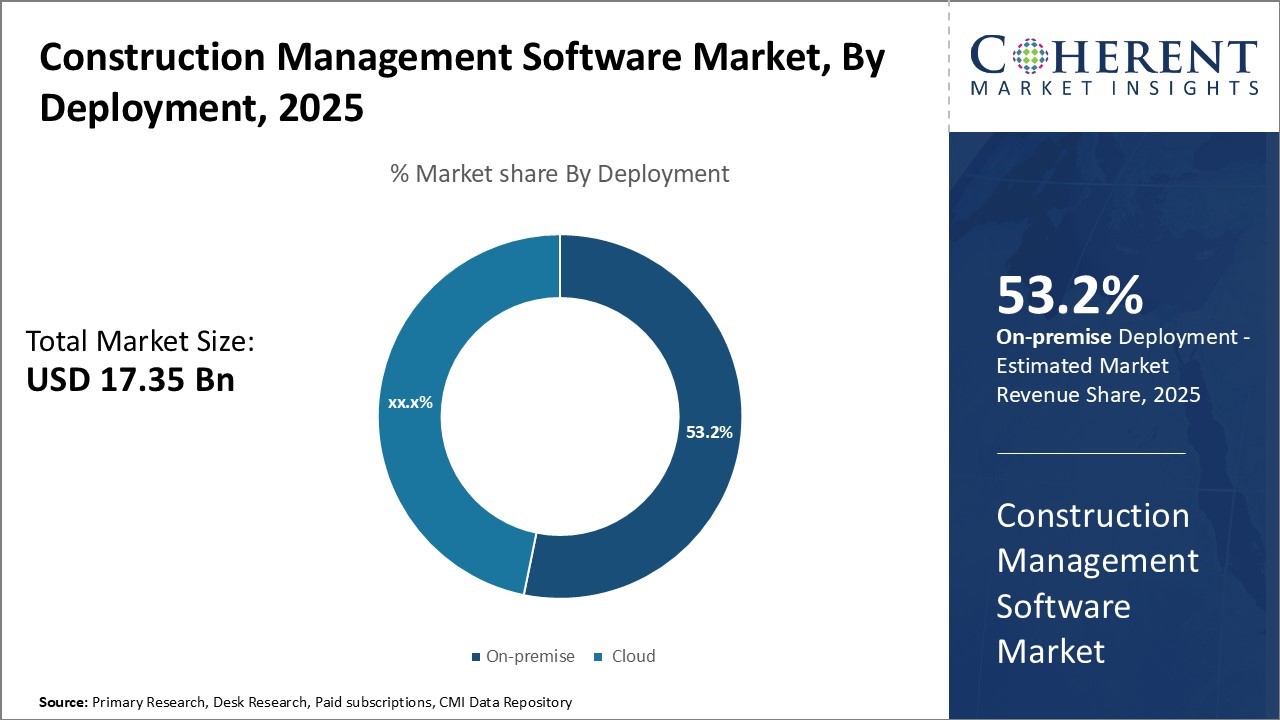
Among deployment, on-premise segment is estimated to contribute the highest market share of 54.2% in 2026 due to organizations' continued reliance on legacy systems. Many construction firms have sophisticated on-premise systems already in place that encompass critical business functions like project management, cost accounting, and document control. Migrating these legacy systems and decades of operational data to the cloud poses technical and security challenges that discourage cloud adoption.
On-premise solutions also allow construction firms more control over sensitive customer and project level information. Proprietary systems tailored specifically to a company's unique business processes are commonly installed on-premise. Reliable internet connectivity can be inconsistent or unavailable at job sites. On-premise solutions ensure constant access to software features regardless of web connectivity. Construction firms value dependable system access especially for field personnel who need up-to-date project details.
Construction Management Software Market Insights, By Building Type
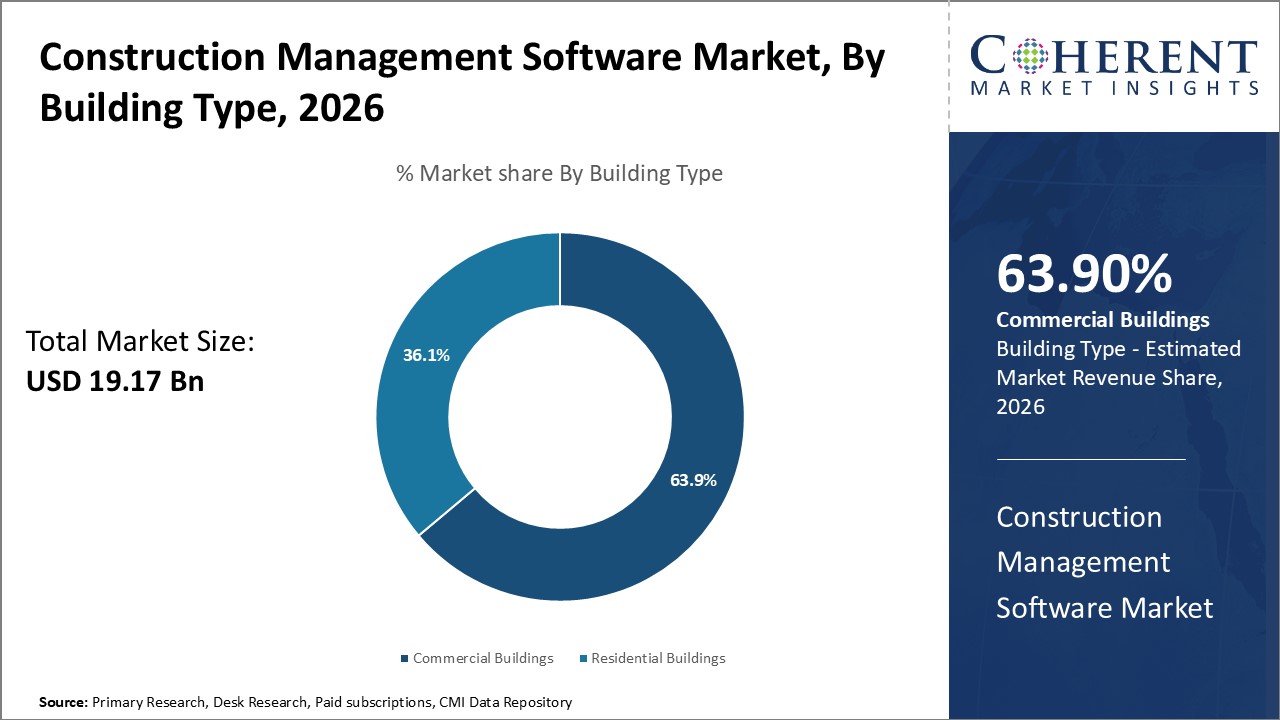
Among building type, commercial buildings segment is estimated to contribute the highest market share of 63.9% in 2026 due to the complex requirements of large-scale commercial projects. Construction of office towers, shopping centers, industrial facilities and other commercial buildings generally involves more multi-disciplinary coordination, stringent permitting and compliance requirements, complex scheduling, budget oversight, and stakeholder engagement as compared to residential development.
Larger construction management software features are valuable for tracking budgets, documentation, communications and validating regulatory compliance across these complex projects. Software solutions streamline processes like submittal reviews, change orders, payments, project closeouts and post-occupancy asset management that are more extensive for commercial ventures.
Construction Management Software Market Insights, By End User
Among End User, builders & contractors’ segment is estimated to contribute the highest market share of 46.2% in 2026 due to front-line project management needs. As the project leaders accountable for schedule, budget and quality compliance, builders and general contractors require robust tools to coordinate field tasks and resources in real-time. Integrated software allowing visibility into RFIs, daily reports, submittals, issues logs, punch lists and closeout documents from any device helps ensure projects stay on track.
Field staff accessibility to critical project data is particularly important for builders and contractors. Mobile apps and offline functionality allow superintendents to update tasks and review revisions independent of internet connectivity. Builders also benefit from automated integration between project management, accounting and contract features to streamline billing and payments. Configurable workflows and templates tailored for repetitively managed tasks like inspections or pay applications improve efficiency.
Global Construction Management Market - Regional Insights
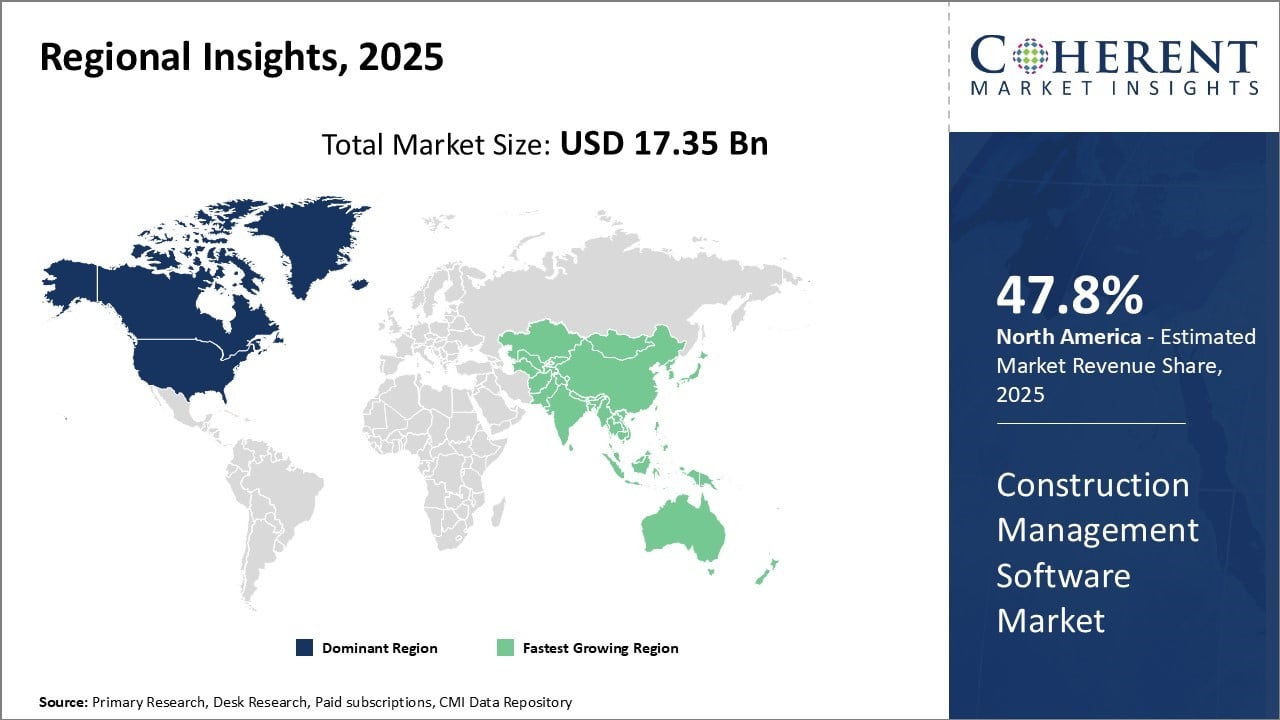
North America Construction Management Software Market Analysis and Trends
North America has established itself as the dominant region in the global construction management software market with estimated market share of 47.8% in 2026. The region is home to some of the largest construction companies in the world who have significantly invested in innovative technologies to streamline their operations and project execution.
Various leading construction management software vendors such as Autodesk, Trimble, and Bentley Systems are headquartered in the U.S. and have a strong customer base within the region. The early adoption of cloud-based services coupled with high digital infrastructure penetration has propelled North American construction firms to embrace digital technologies at a rapid pace.
Asia Pacific Construction Management Software Market Analysis and Trends
Asia Pacific region is poised to be the fastest growing market for construction management software during the forecast period with CAGR of 14.1% in 2026 for the forecast period of 2024-2031. Countries such as China, India, and South Korea offer massive market opportunity due to heavy investments in infrastructure, real estate, and industrial projects.
Governments in the region have envisioned ambitious plans such as Made in China 2026, Smart Cities Mission, and Industrial Clusters to accelerate economic growth through construction and manufacturing. This leads to increase in project deals and the number of project participants involved.
To effectively manage such complex, distributed projects, construction firms are actively piloting and adopting cloud-based collaboration platforms, 4D BIM model coordination software, and lean construction methodologies. The availability of low-cost internet services and a young, digitally-savvy workforce presents a fertile environment for software adoption.
Construction Management Software Market Dominating Countries
United States Construction Management Software Market Analysis and Trend
The U.S. dominates the construction management software market by virtue of its large-scale infrastructure, high rate of adoption of digital construction technologies, and robust presence of software companies such as Procore, Oracle, and Autodesk. Exorbitant labor costs and regulatory compliances also fuel the demand for automated project monitoring, safety compliance, and automation. Governmental spending on smart cities and public infrastructure also fuels market growth.
Germany Construction Management Software Market Analysis and Trend
Germany is a market leader in European construction software, with support from its high-tech engineering industry and focus on accuracy in project delivery. It has been a consistent user of BIM and digital planning tools, with official support from government campaigns for digital construction under its "Construction 4.0" initiative. High demand for sustainable and energy-efficient buildings also drives tech use.
United Kingdom Construction Management Software Market Analysis and Trend
The UK is experiencing strong growth in construction management software resulting from the growing adoption of BIM mandates for public works and expanding infrastructure modernization requirements. Companies are embracing cloud-based platforms to enhance collaboration and cost-effectiveness. Availability of both local and international software providers makes market penetration high.
China Construction Management Software Market Analysis and Trend
China's vast urbanization and infrastructure spending make it a major market for construction software. Smart city development and digital construction focuses by the government are boosting adoption of cloud-based solutions, mobile applications, and IoT-enabled software to coordinate intricate, high-volume projects effectively.
India Construction Management Software Market Analysis and Trend
India is becoming a high-growth market fueled by high-speed urbanization, growing public-private partnerships, and the "Digital India" mission. Growing use of cloud-based technologies and mobile construction applications by mid-size companies and contractors is accelerating project management digital transformation as well as field activities.
Market Report Scope
Construction Management Software Market Report Coverage
| Report Coverage | Details | ||
|---|---|---|---|
| Base Year: | 2025 | Market Size in 2026: | USD 19.17 Bn |
| Historical Data for: | 2020 To 2024 | Forecast Period: | 2026 To 2033 |
| Forecast Period 2026 to 2033 CAGR: | 10.5%2033 Value Projection: | USD 38.57 Bn | |
| Geographies covered: |
| ||
| Segments covered: |
| ||
| Companies covered: | Autodesk, Inc., BIMobject AB, Bentley Systems, Incorporated, BuilderMT, LLC., Comprotex Software Inc., Constellation Software Inc., ECI Software Solutions Inc., Fieldwire, Heavy Construction Systems Specialists, Jonas Construction Software Inc., Oracle Corporation, PlanGrid, Inc., Procore Technologies Inc., RIB Software SE, Roper Technologies, Inc., Sage Group Plc., Trimble Inc., Trimble Inc., Zoox, Inc., WELL | ||
| Growth Drivers: |
| ||
| Restraints & Challenges: |
| ||
Construction Management Software Industry News
- In 2025, The Boston construction giant applied AI-powered safety surveillance to ~150 sites to protect 30,000 workers—monitoring for compliance, falls protection, and equipment use in real time through GPS-enabled systems.
- In 2024, Sumeru Equity Partners invested US $330 million in Job Nimbus, a residential roofing-focused construction management platform, bolstering its capabilities in project, sales, logistics, and back-office workflows.
Key Takeaways from Analyst
- Global construction management software market growth is driven by growing construction projects across commercial and residential sectors globally. Construction firms are increasingly adopting software tools to streamline project management and improve productivity. This includes features like resource allocation, scheduling, cost management and real-time collaboration. The move to digital tools allows collaboration beyond geographical barriers and limits errors resulting from reliance on manual processes.
- Lack of awareness among smaller construction firms and consultants about the benefits of specialized construction management tools can hamper the market growth. Integration challenges with existing project databases can also limit its adoption rates. The advantages of technology penetration outweigh such minor hurdles over the long term.
- North America dominates the market owing to rapid infrastructure development and early technology adoption among major construction contractors. Asia Pacific is expected to be the fastest growing market due to growing construction activity across India, China, and other Southeast Asian countries. Increased foreign construction projects and smart city initiatives in the region can boost demand for collaborative project management solutions in the near future.
Market Segmentation
- Deployment Insights (Revenue, USD Bn, 2021 2033)
- On-premise
- Cloud
- Building Type Insights (Revenue, USD Bn, 2021 2033)
- Commercial Buildings
- Residential Buildings
- End User Insights (Revenue, USD Bn, 2021 2033)
- Builders & Contractors
- Construction Managers
- Engineers & Architects
- Regional Insights (Revenue, USD Bn, 2021 2033)
- North America
- U.S.
- Canada
- Latin America
- Brazil
- Argentina
- Mexico
- Rest of Latin America
- Europe
- Germany
- U.K.
- Spain
- France
- Italy
- Russia
- Rest of Europe
- Asia Pacific
- China
- India
- Japan
- Australia
- South Korea
- ASEAN
- Rest of Asia Pacific
- Middle East & Africa
- South Africa
- GCC Countries
- Israel
- Rest of Middle East & Africa
- Key Players Insights (Revenue, USD Bn, 2021 - 2033)
- Autodesk, Inc.
- BIMobject AB
- Bentley Systems, Incorporated
- BuilderMT, LLC.
- Comprotex Software Inc.
- Constellation Software Inc.
- ECI Software Solutions Inc.
- Fieldwire
- Heavy Construction Systems Specialists
- Jonas Construction Software Inc.
- Oracle Corporation
- PlanGrid, Inc.
- Procore Technologies Inc.
- RIB Software SE
- Roper Technologies, Inc.
- Sage Group Plc.
- Trimble Inc.
- Trimble Inc.
- Zoox, Inc.
- WELL
Sources
Primary Research Interviews
- Construction Project Managers
- Software Development Companies (Construction Tech)
- IT Decision Makers in Construction Firms
- Construction Industry Consultants
- Others
Databases
- IBISWorld Industry Reports
- Others
Magazines
- Construction Executive Magazine
- ENR (Engineering News-Record)
- Construction Technology Magazine
- Building Design + Construction
- Others
Journals
- Journal of Construction Engineering and Management
- Automation in Construction Journal
- Construction Management and Economics
- Others
Newspapers
- Construction Dive
- The Construction Index
- Construction Week
- Building Magazine
- Others
Associations
- Associated General Contractors of America (AGC)
- Construction Financial Management Association (CFMA)
- Construction Industry Institute (CII)
- National Association of Home Builders (NAHB)
- Others
Public Domain Sources
- U.S. Census Bureau Construction Statistics
- Bureau of Labor Statistics Construction Data
- Government Construction Procurement Websites
- Construction Industry Research Reports
- Others
Proprietary Elements
- CMI Data Analytics Tool
- Proprietary CMI Existing Repository of information for last 8 years
*Definition: Construction management software refers to programs and applications that are used to manage various business activities related to construction projects. This type of software enables collaboration between project stakeholders, automated documentation, scheduling and monitoring of tasks, budget management, resource allocation, communication between teams, and documentation of important project details like designs, blueprints, changes, RFIs and issues. It aims to streamline construction processes for improved planning, collaboration and timely completion of projects.
Get access to 250+ pages report
Every segment, forecast, competitor profile and data table behind the analysis above — available for instant download.
- ESOMAR Member
- ISO 9001:2015 Certified
- D-U-N-S Registered
- GDPR & CCPA Compliant
Missing comfort of reading report in your local language? Find your preferred language:
Transform your Strategy with Exclusive Trending Reports
Frequently Asked Questions
The Construction Management Software Market size is estimated to be valued at USD 19.17 Bn in 2026, and is expected to reach USD 38.57 Bn by 2033.
The CAGR of the global Market is projected to be 10.5% from 2026 to 2033.
Building information modelling and infrastructure modernization are the major factors driving the growth of global construction management software industry.
Cost and adoption hurdles for large contractors and complexity in customization and integration are the major factors hampering the growth of global market.
In terms of deployment, on-premise segment is estimated to dominate the market in 2026.
Autodesk, Inc., BIMobject AB, Bentley Systems, Incorporated, BuilderMT, LLC., Comprotex Software Inc., Constellation Software Inc., ECI Software Solutions Inc., Fieldwire, Heavy Construction Systems Specialists, Jonas Construction Software Inc., Oracle Corporation, PlanGrid, Inc., Procore Technologies Inc., RIB Software SE, Roper Technologies, Inc., Sage Group Plc., Trimble Inc., Trimble Inc. (after acquiring B2W Software), Zoox, Inc., WELL are the major players.
North America is expected to lead the global construction management software market in 2026.