

Global Care Management Solutions Market Size and Forecast – 2026 To 2033
The global care management solutions market is expected to grow from USD 19,499.3 Mn in 2026 to USD 48,168.2 Mn by 2033, registering a compound annual growth rate (CAGR) of 13.8% from 2026 to 2033. The market for care management solutions is poised for significant expansion, fueled by the increasing adoption of digitally enabled care coordination and integrated primary care models.
According to the Organisation for Economic Co-operation and Development (OECD), 79% of primary care physicians in countries with available data use Electronic Health Records (EHRs) to facilitate coordinated care, reflecting the growing digitalization of healthcare systems and creating a strong foundation for the adoption of advanced care management solutions.
Key Takeaways of the Global Care Management Solutions Market
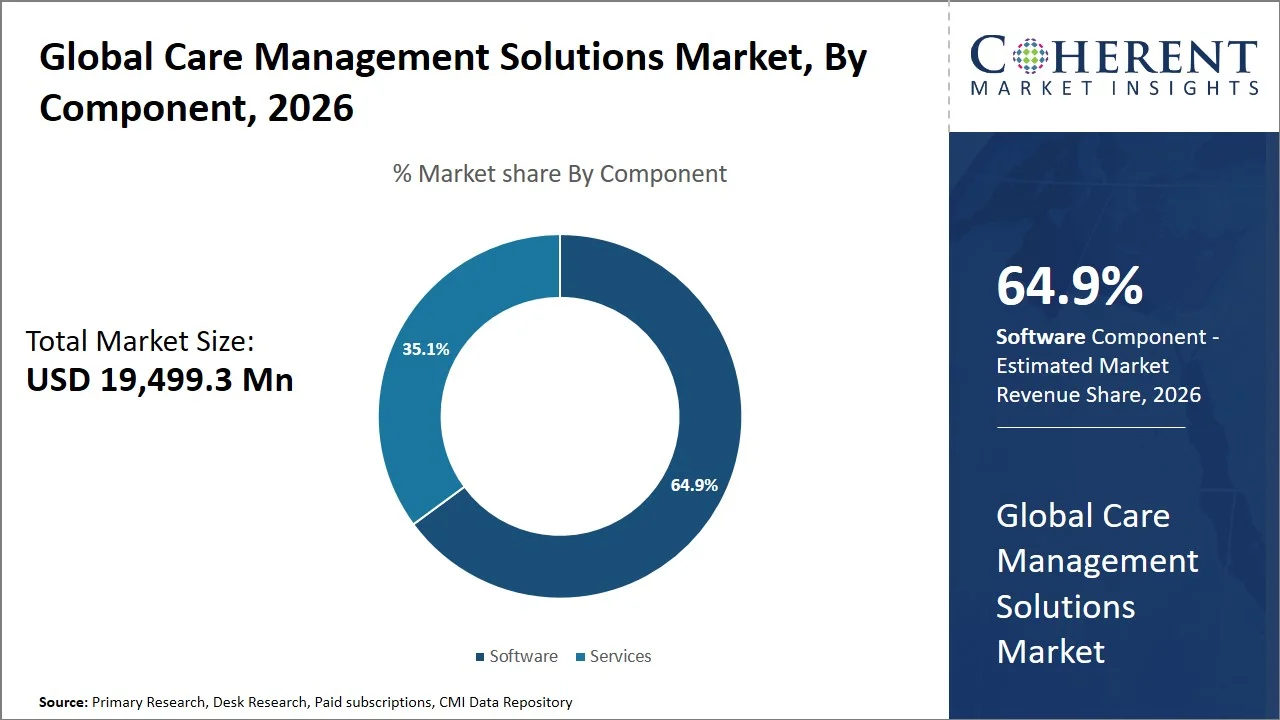
- Software is projected to hold 64.9% of the global care management solutions market share in 2026, making it the dominant component segment across North America due to the rapid adoption of interoperable digital health platforms and value-based care programs. For instance, the U.S. Office of the National Coordinator for Health Information Technology (ONC) enforces the Health IT Certification Program, establishing standardized interoperability and electronic health record (EHR) requirements that facilitate the deployment of advanced care management software across healthcare organizations.
- On-premise is projected to hold 57.2% of the global care management solutions market share in 2026, making it the dominant delivery mode segment across Europe due to stringent healthcare data protection and cybersecurity requirements. For instance, the European Union's General Data Protection Regulation (GDPR) requires healthcare organizations to implement robust safeguards for processing sensitive patient information, encouraging many hospitals to retain on-premise care management systems for greater control over data security and regulatory compliance.
- Chronic care management is projected to hold 38.9% of the global care management solutions market share in 2026, making it the dominant application segment across North America due to expanding reimbursement support for coordinated chronic disease management. For instance, the U.S. Centers for Medicare & Medicaid Services (CMS) reimburses Chronic Care Management (CCM) services for Medicare beneficiaries with two or more chronic conditions, promoting the adoption of digital care management platforms to support continuous monitoring, care planning, and coordinated patient care.
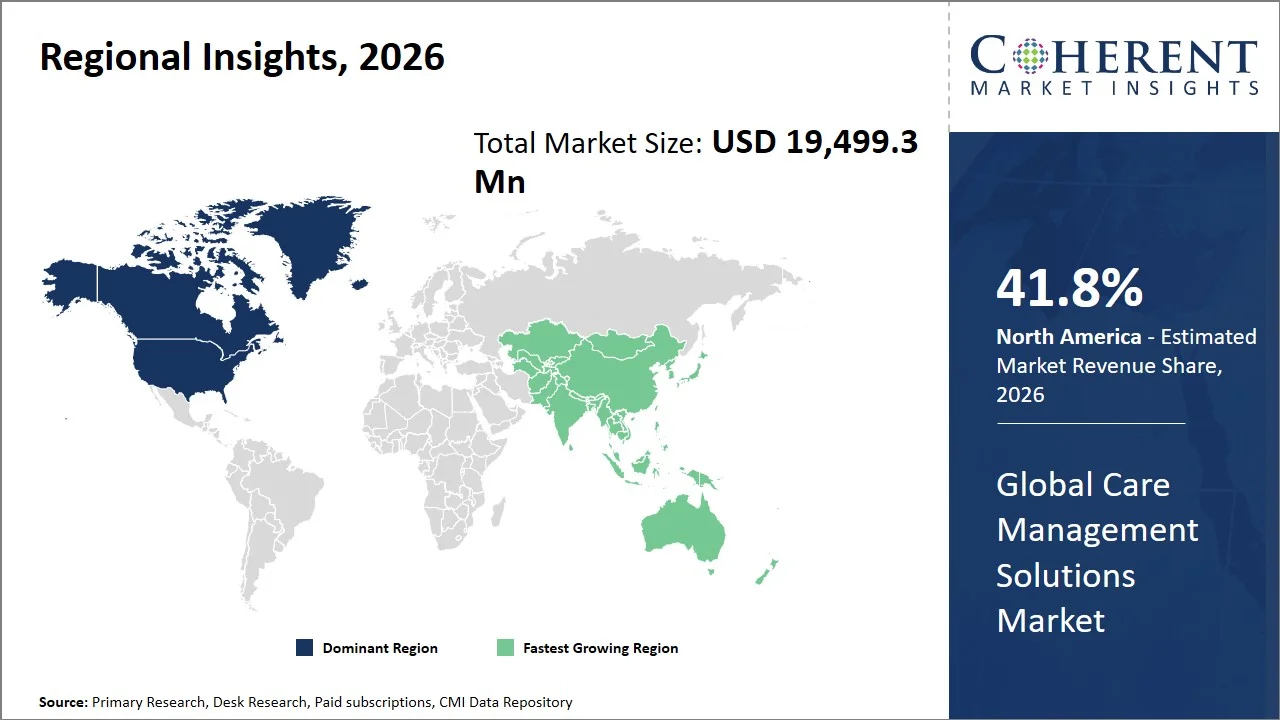
- North America maintains its dominance with an estiamted share of 41.8% in 2026, bolstered by the widespread adoption of value-based healthcare, advanced healthcare IT infrastructure, and supportive digital health regulations. For instance, in December 2024, the U.S. Department of Health and Human Services (HHS) finalized the HTI-1 Rule to strengthen healthcare interoperability, standardized data exchange, and patient access to electronic health information, further accelerating the adoption of care management solutions across healthcare organizations.
- Asia Pacific is expected to exhibit the fastest growth with an estimated contribution of 20.8% share in 2026, propelled by expanding digital health investments, increasing chronic disease burden, and government-led primary care reforms. For instance, in April 2025, Singapore's Ministry of Health expanded the implementation of the Healthier SG programme by onboarding additional primary care providers and strengthening digital care coordination across the healthcare ecosystem, further supporting the adoption of integrated care management platforms.
Segmental Insights
Why Does Software Dominate the Global Care Management Solutions Market?
Software is projected to hold a market share of 64.9% in 2026, driven by integrated platforms used to consolidate patient’s data at a point. Software enables easier workflow automation, population health and facilitates in sharing between health providers. Moreover, incorporating artificial intelligence, machine learning, and electronic health record (EHR), supports clinical decision-making streamlining workflows. For instance, in February 2026, Epic Systems Corporation launched AI Charting together with a comprehensive set of integrated AI features in its electronic health record, enabling clinicians to automatically translate conversations into clinical documentation in the electronic health record (EHR) that can simplify workflows by speeding up documentation.
- Current Industry Events of 2026
- Market Size Estimation
- Regional Breakdown
- Competitive Landscape
- Customer Intelligence
- Segmental Analysis
- Pricing Analysis
- Key Market Drivers, Challenges & Future Trends
- Customized Insights Section
Why Does On-Premise Represent the Largest Delivery Mode Segment in the Global Care Management Solutions Market?
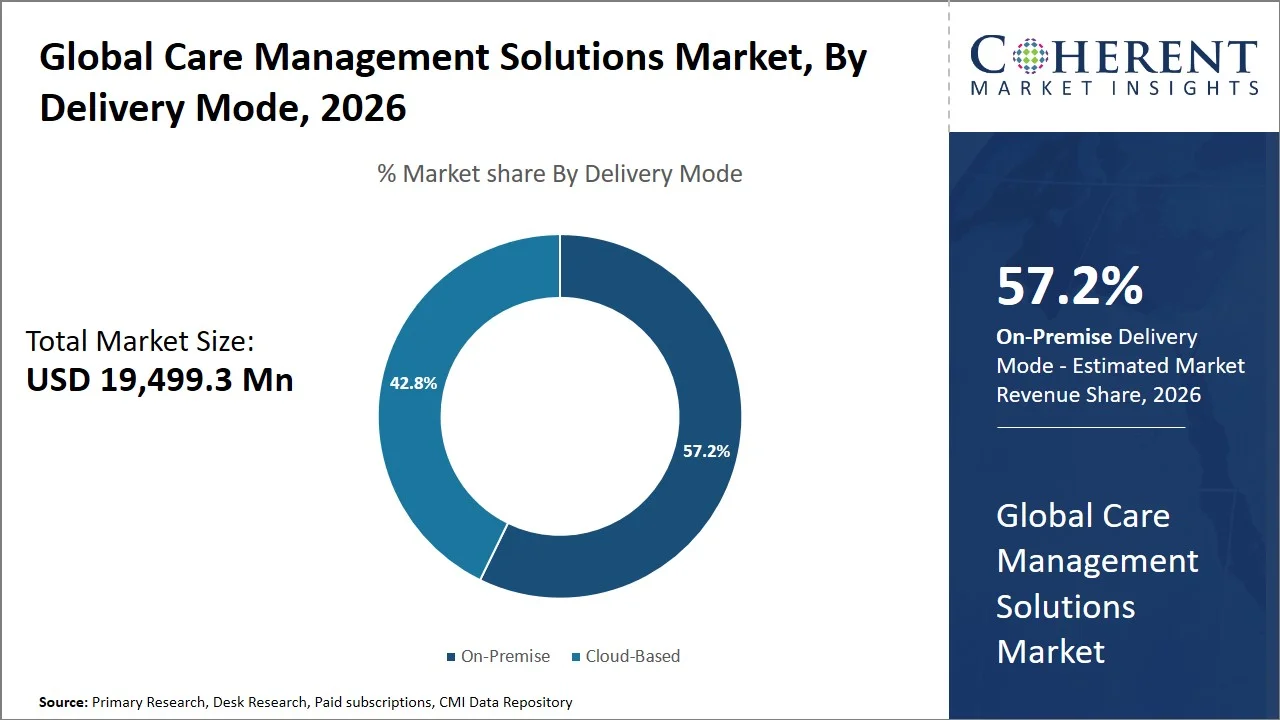
On-premise is projected to hold a market share of 57.2% in 2026, due to its increased control over patients’ sensitive data, scope of customization, and the facility of seamless integration with existing hospital IT Systems. However, healthcare organization prefer on-premise applications on an annual basis to support their high standards for data control, security, and performance under specific requirements and regulatory demands. For instance, in October 2025, Oracle announced OCI Dedicated Region25, allowing customers to put the cloud services and capabilities, including Oracle’s AI, into their own data centers with direct control over where their data resides and how it is protected and compliant.
Chronic Care Management Segment Dominates the Global Care Management Solutions Market
The chronic care management segment is projected to hold a market share of 38.9% in 2026, driven by the high prevalence of long-term chronic diseases that necessitates ongoing treatment, monitoring and management through individualized care plans and collaboration between different care professionals. Care management platforms help ensure proper medication adherence, support remote patient monitoring and improve clinical decision making that results in better patients’ results and less unplanned hospitalizations. For instance, in October 2025, the U.S. Centers for Medicare & Medicaid Services (CMS) published CY 2026 Medicare Physician Fee Schedule Final Rule, which implements provisions intended to improve and support longitudinal care management, advanced primary care, and coordinated chronic disease management under Medicare.
Current Events and their Impact
Current Events | Description and its Impact |
U.S. Centers for Medicare & Medicaid Services (CMS) Expands the Advanced Primary Care Management (APCM) Payment Model (January 2025) |
|
U.S. Centers for Medicare & Medicaid Services (CMS) Finalizes the Transforming Episode Accountability Model (TEAM) (August 2025) |
|
Global Care Management Solutions Market Dynamics
Market Drivers
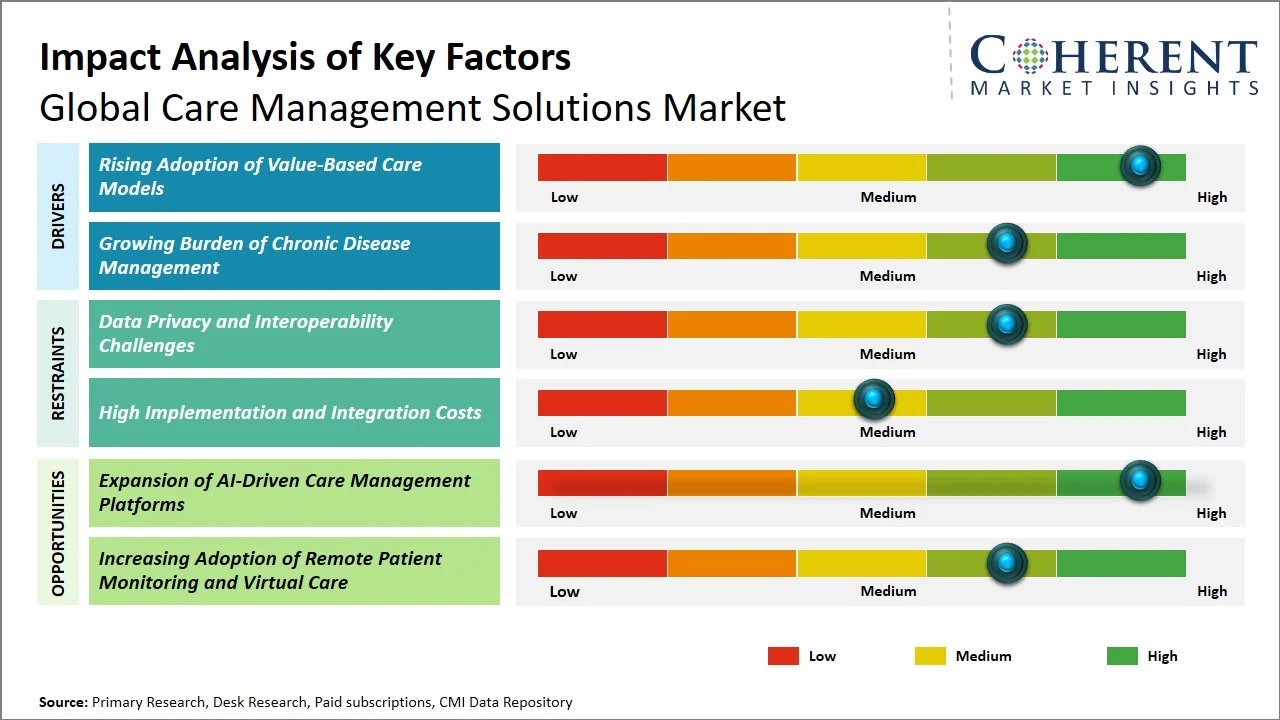
Rising Adoption of Value-Based Care Models
The growing transition toward value-based care is driving the adoption of care management solutions by enabling healthcare providers to improve care coordination, enhance patient outcomes, and meet quality-based reimbursement requirements. These platforms support proactive patient monitoring, risk stratification, and integrated care delivery across the continuum of care. For instance, in November 2025, the U.S. Centers for Medicare & Medicaid Services (CMS) finalized the Making Care Primary (MCP) Model, introducing care management payments and performance-based incentives to strengthen coordinated, patient-centered primary care. The initiative is expected to accelerate the adoption of advanced care management solutions.
Growing Burden of Chronic Disease Management
The growing burden of chronic diseases is driving the adoption of care management solutions by enabling healthcare providers to deliver coordinated, long-term care, improve patient outcomes, and reduce avoidable hospitalizations. For instance, in September 2025, the World Health Organization (WHO) launched the Global Strategy on Integrated Care for Noncommunicable Diseases (2025–2035) to strengthen coordinated, people-centered care and integrated chronic disease management through primary healthcare systems. The initiative is expected to accelerate the adoption of digital care management solutions globally.
Increasing Government Investments in Digital Health Infrastructure
The increasing investment in digital health infrastructure by governments worldwide is accelerating the adoption of care management solutions by enabling integrated care delivery, seamless health information exchange, and improved care coordination. For instance, in January 2025, the European Commission launched the European Virtual Institute for Cancer Research (EVICR) Digital Health Initiative under the EU4Health Programme, supporting interoperable digital health infrastructure and cross-border data sharing to strengthen coordinated patient care across Europe. Such initiatives are expected to drive the adoption of advanced care management platforms.
Emerging Trends
Convergence of Care Management with Home Health and Transitional Care
Care management solutions are increasingly being integrated with home health care and transitional care management programs to ensure seamless care coordination after hospital discharge. This trend enables continuous patient monitoring, reduces avoidable readmissions, and supports better long-term outcomes through coordinated care across multiple healthcare settings.
Expansion of Care Management for Elderly and Chronic Care Populations
Healthcare providers are increasingly deploying specialized care management platforms to address the complex needs of elderly care and patients with multiple chronic conditions. Advanced analytics, personalized care plans, and multidisciplinary care coordination are helping improve medication adherence, enhance patient engagement, and support aging-in-place initiatives.
Increasing Adoption of Risk Stratification and Predictive Population Health Analytics
Healthcare providers and payers are increasingly utilizing advanced risk stratification and predictive population health analytics within care management platforms to identify high-risk patient cohorts before adverse clinical events occur. These capabilities enable targeted interventions, optimized resource allocation, and more effective management of complex patient populations while supporting preventive healthcare strategies.
Regional Insights
Why is North America a Strong Market for Care Management Solutions?
North America leads the global care management solutions market, accounting for an estimated 41.8% share in 2026, attributed to its well-established healthcare IT infrastructure and high integration of care delivery models for efficient functioning along with value-based healthcare standards. The implementation of health and security information regulations and mandates in North America, such as the Health Information Technology for Economic and Clinical Health (HITECH) Act, accelerated the adoption of Electronic Health Record (EHR) and use of care management solutions facilitating value-based and coordinated care.
For instance, in January 2024, the U.S. Department of Health and Human Services (HHS) adopted its Health Data, Technology, and Interoperability (HTI-1) Final Rule. This rule changes standards related to the Health IT Certification Program in order to encourage widespread use and exchange of electronic health information, more EHR certification potential, and innovation in new models of care delivery and management. Furthermore, the region's maturing digital healthcare market also witnessed integrated adoption of population health, clinical workflow and telehealth in care management solutions that contribute for leading market share globally.
Why Does the Asia Pacific Care Management Solutions Market Exhibit High Growth?
The Asia Pacific care management solutions market is expected to exhibit the fastest growth with an estimated contribution of 20.8% share to the global market in 2026, due to growing health expenditures, increasing prevalence of chronic conditions, and greater use of digital health solutions. Government initiatives such as national healthcare reform programs, increased focus on creating smart hospitals, healthcare infrastructure development in nations across this region, and ongoing evolution of telehealth/mobile health sectors collectively boost the adoption of integrated care management solutions. This in turn will facilitate higher patient engagement and operational effectiveness.
For instance, by February 2025, more than 739.8 million (73.98 crore) Ayushman Bharat Health Accounts (ABHAs) were created under India’s Ayushman Bharat Digital Mission (ABDM), over 363,000 (3.63 lakh) health facilities and 564,000 (5.64 lakh) healthcare professionals were registered, and more than 159,000 (1.59 lakh) health facilities were using ABDM-enabled software, strengthening interoperable digital healthcare and supporting the wider adoption of care management solutions. (Source: Press Information Bureau)
Global Care Management Solutions Market Outlook for Key Countries
Why is the U.S. Leading Innovation and Adoption in the Care Management Solutions Market?
The U.S. holds the largest market share for innovation and adoption in care management solutions market due to its integrated care management solutions platforms, which integrates with electronic health records (EHR), payers, and population health management (PHM) systems of large health networks. The country has always been at the cusp of innovation, developing advancements in AI-powered care coordination, predictive analytics, and cloud-based care management, assisted with a developed network of healthcare information technology (HIT) vendors and earlier adopters of interoperable digital health solutions and innovative automated clinical workflows.
Is the U.K. a Favorable Market for Care Management Solutions?
The U.K. care management solutions market presents an opportunity since integrated care provision is central to Integrated Care Systems (ICSs) that mandate coordination between primary, community and secondary care. Providers are embracing digital care management applications that leverage multiple care specialties, enable the management of patients with chronic long-term conditions and enable the sharing of patient data. The wider adoption of cloud-based applications into the healthcare environment, together with digital platforms driven towards interoperability also ensures continued demand for complex care management technologies.
Is China Emerging as a Key Growth Hub for the Care Management Solutions Market?
China care management solutions market is set to observe a rapid expansion due to the increasing digitalization of hospitals, expanding internet healthcare service, and widespread implementation of AI-powered healthcare platforms. Leading hospital and care facilities in China are focusing on adopting the combined care management systems in order to manage the chronic diseases, coordinate care, manage operation processes over a wide span of patient bases. With expanded Chinese health infrastructure, digital health ecosystem in country has create strong demand for advanced care management solutions.
Why Does Germany Top the European Care Management Solutions Market?
Germany leads the Europe care management solutions market due to the wide penetration of hospital information systems, good connectivity digital care pathways to healthcare providers and pervasive implementation of inter-operable electronic health records. Healthcare providers comprising hospitals and sickness funds extensively utilize digital solutions for managing chronic diseases management (CDM), Care coordination (CC) and public health for their population. Investments toward modernizing medical workflows and healthcare IT modernization maintain the demand for digital care management market across the country.
Is the Care Management Solutions Market Developing in Japan?
The care management solutions market in Japan is gradually expanding driven by the widespread adoption of digital care coordination as a core part of primary, acute and long-term care. Primary care practices and organizations are increasingly leveraging AI care management solutions to manage chronic care needs for individuals at risk, medication management and improve multidisciplinary approaches to meet the needs of an aging population. Japan has actively pushed for interoperability within their care ecosystem and connected care to enable rapid adoption of the care management solution.
Evolution of Care Management Solutions Across the Healthcare Continuum
Generation | Core Capabilities | Primary Technologies | Key Value Delivered |
Traditional Care Management | Manual care planning | Standalone software | Basic care coordination |
Integrated Care Management | Electronic Health Records & claims integration | Interoperability | Coordinated patient care |
Intelligent Care Management | AI, predictive analytics | Machine Learning, Natural Language Processing | Risk stratification & intervention |
Connected Care Management | Remote monitoring & virtual care | Remote Patient Monitoring, Telehealth, Cloud | Continuous patient management |
Next-Generation Care Management | Personalized & population health | Generative AI, Digital Twins | Proactive, value-based care |
How is the expansion of AI-driven care management platforms creating new growth opportunities in the global care management solutions market?
The emergence of AI-enabled care management platforms offers substantial potential as various healthcare providers are extensively using AI applications for the purpose of automated clinical workflows, provider assistance, and care coordination. AI-driven automation provides intelligent documentation, prognostic insights, and smoother decision-making, facilitating a more personalized, proactive and predictive patient experience. For instance, in March 2026, Oracle Health unveiled its Clinical AI Agent that leverages generative AI to automate detailed draft clinical notes for inpatient and emergency departments following patient encounters in order to reduce physician and other clinician documentation burden. Additionally, it provides clinicians with more time for patient care.
Market Players, Key Development, and Competitive Intelligence
Key Developments
- In July 2025, Medsien launched its Fully Managed Advanced Primary Care Management (APCM) Solution to support healthcare providers in delivering coordinated, value-based primary care services. The solution combines clinical expertise, technology-enabled care coordination, and reimbursement support to streamline chronic disease management, improve patient engagement, and enhance care outcomes while reducing administrative burden for providers.
- In September 2024, Innovaccer launched Care Management Copilot, an AI-powered solution designed to streamline care management workflows and reduce administrative burden on care managers. The platform leverages generative AI to automate documentation, summarize patient information, and support clinical decision-making, enabling care teams to improve operational efficiency and focus more on delivering personalized patient care.
- In February 2024, Persistent Systems launched an AI-powered Population Health Management (PHM) solution built on Microsoft Azure OpenAI Service. The platform leverages generative AI to automate care coordination, streamline clinical workflows, and deliver actionable patient insights, enabling healthcare providers to improve population health outcomes, optimize care management, and support value-based care initiatives.
Competitive Landscape
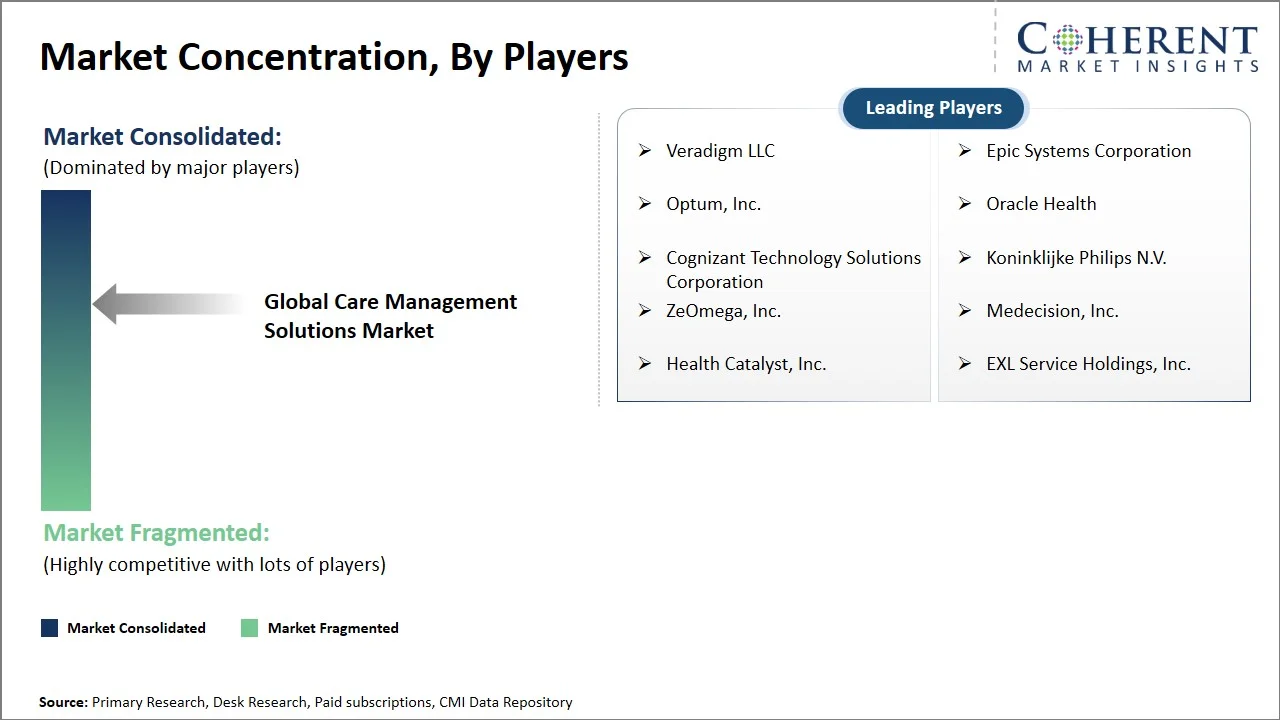
The global care management solutions market is moderately consolidated, with leading players competing through AI-enabled care management platforms, cloud-based deployment, interoperability capabilities, and advanced population health management solutions. Companies are strengthening their market positions through strategic acquisitions, technology partnerships, and continuous product innovation to support value-based care, chronic disease management, and integrated care coordination. Key competitive differentiation increasingly centers on intelligent automation, predictive analytics, and seamless integration with electronic health records (EHRs) and digital health ecosystems. Key focus areas include:
- Development of AI-Driven Care Management and Clinical Decision Support Platforms
- Expansion of Population Health Management and Chronic Care Management Capabilities
- Integration with Electronic Health Records (EHRs), Telehealth, and Remote Patient Monitoring (RPM)
- Strategic Partnerships, Acquisitions, and Value-Based Care Collaborations
- Investment in Cloud-Based, Interoperable, and Predictive Analytics-Enabled Solutions
Market Report Scope
Care Management Solutions Market Report Coverage
| Report Coverage | Details | ||
|---|---|---|---|
| Base Year: | 2025 | Market Size in 2026: | USD 19,499.3 Mn |
| Historical Data for: | 2020 To 2024 | Forecast Period: | 2026 To 2033 |
| Forecast Period 2026 to 2033 CAGR: | 13.8% | 2033 Value Projection: | USD 48,168.2 Mn |
| Geographies covered: |
| ||
| Segments covered: |
| ||
| Companies covered: | Veradigm LLC, Epic Systems Corporation, Optum, Inc., Oracle Health, Cognizant Technology Solutions Corporation, Koninklijke Philips N.V., ZeOmega, Inc., Medecision, Inc., Health Catalyst, Inc., and EXL Service Holdings, Inc. | ||
| Growth Drivers: |
| ||
| Restraints & Challenges: |
| ||
Analyst Opinion (Expert Opinion)
- In the coming years, the global care management solutions market will be driven by the convergence of artificial intelligence (AI), predictive analytics, cloud computing, and interoperable healthcare platforms, transforming care management from a reactive process into a proactive, data-driven model. As healthcare systems increasingly prioritize value-based care, population health management, and personalized care delivery, care management solutions will become integral to improving clinical outcomes, reducing healthcare costs, and enabling continuous patient engagement across the care continuum.
- The maximum opportunities are foreseen within cloud-based care management solutions for chronic care management applications, particularly in the U.S. The country's mature healthcare IT infrastructure, expanding value-based reimbursement programs, growing prevalence of chronic diseases, and favorable reimbursement for coordinated care services are expected to drive sustained demand for scalable, AI-enabled care management platforms.
- In order to gain a competitive advantage market players should focus on developing interoperable, AI-powered platforms that seamlessly integrate with electronic health records (EHRs), telehealth, remote patient monitoring (RPM), and payer systems. Companies should also strengthen strategic partnerships with healthcare providers, payers, and digital health technology firms while investing in predictive analytics, automation, cybersecurity, and regulatory-compliant cloud architectures to deliver differentiated, outcome-driven care management solutions.
Speak to the analyst
Want personalized insights?
Take the findings above to one of our principal consultants, or have the report rebuilt around the segments, geographies and competitors you actually track.
Market Segmentation
- Component Insights (Revenue, USD Mn, 2021 - 2033)
- Software
- Services
- Delivery Mode Insights (Revenue, USD Mn, 2021 - 2033)
- On-Premise
- Cloud-Based
- Application Insights (Revenue, USD Mn, 2021 - 2033)
- Chronic Care Management
- Transitional Care Management
- Advance Care Planning
- Behavioral Health Integration
- End User Insights (Revenue, USD Mn, 2021 - 2033)
- Healthcare Providers
- Healthcare Payers
- Regional Insights (Revenue, USD Mn, 2021 - 2033)
- North America
- U.S.
- Canada
- Latin America
- Brazil
- Argentina
- Mexico
- Rest of Latin America
- Europe
- Germany
- U.K.
- Spain
- France
- Italy
- Russia
- Rest of Europe
- Asia Pacific
- China
- India
- Japan
- Australia
- South Korea
- ASEAN
- Rest of Asia Pacific
- Middle East
- GCC Countries
- Israel
- Rest of Middle East
- Africa
- South Africa
- North Africa
- Central Africa
- North America
Sources
Primary Research Interviews
- Executives from care management software and population health management solution providers
- Hospital Chief Information Officers (CIOs), Chief Medical Information Officers (CMIOs), and digital health leaders
- Primary care physicians, care coordinators, and chronic disease management specialists
- Health plan executives and value-based care program administrators
- Experts from healthcare interoperability, cloud health IT, and AI-enabled care management companies
Stakeholders
- Care management software providers
- Healthcare IT and digital health companies
- Hospitals and integrated delivery networks (IDNs)
- Health insurance companies and managed care organizations
- Accountable Care Organizations (ACOs)
- Government healthcare agencies and public health organizations
- End-use Sectors
- Hospitals
- Physician Practices & Primary Care Clinics
- Ambulatory Care Centers
- Health Insurance Companies (Payers)
- Accountable Care Organizations (ACOs)
- Home Healthcare Agencies
- Regulatory & Health Bodies
- U.S. Centers for Medicare & Medicaid Services (CMS)
- Office of the National Coordinator for Health Information Technology (ONC), U.S.
- U.S. Department of Health and Human Services (HHS)
- European Commission – Directorate-General for Health and Food Safety (DG SANTE)
- National Health Service (NHS) England
- Australian Digital Health Agency (ADHA)
- Ministry of Health, Labour and Welfare (MHLW), Japan
- World Health Organization (WHO)
Databases
- U.S. Centers for Medicare & Medicaid Services (CMS) Data & Research
- HealthIT.gov
- ClinicalTrials.gov
- OECD Health Statistics
- World Bank Open Data
- WHO Global Health Observatory (GHO)
Magazines
- Healthcare IT News
- Healthcare Innovation
- Modern Healthcare
- HealthTech Magazine
- Healthcare Finance News
Journals
- Journal of Medical Internet Research (JMIR)
- International Journal of Medical Informatics
- BMC Health Services Research
- Journal of the American Medical Informatics Association (JAMIA)
- npj Digital Medicine
Newspapers
- Financial Times (Healthcare Section)
- The Wall Street Journal (Health Section)
- The New York Times (Health Section)
Associations
- Healthcare Information and Management Systems Society (HIMSS)
- American Medical Informatics Association (AMIA)
- American Hospital Association (AHA)
- National Association of Accountable Care Organizations (NAACOS)
- Digital Medicine Society (DiMe)
Public Domain Sources
- U.S. Centers for Medicare & Medicaid Services (CMS)
- Office of the National Coordinator for Health Information Technology (HealthIT.gov)
- U.S. Department of Health and Human Services (HHS)
- World Health Organization (WHO)
- Organisation for Economic Co-operation and Development (OECD)
- European Commission (DG SANTE)
Proprietary Elements
- CMI Data Analytics Tool
- Proprietary CMI Existing Repository of information for last 10 years.
Get access to 250+ pages report
Every segment, forecast, competitor profile and data table behind the analysis above — available for instant download.
- ESOMAR Member
- ISO 9001:2015 Certified
- D-U-N-S Registered
- GDPR & CCPA Compliant
Missing comfort of reading report in your local language? Find your preferred language:
Transform your Strategy with Exclusive Trending Reports
Frequently Asked Questions
The global care management solutions market is estimated to be valued at USD 19,499.3 Mn in 2026 and is expected to reach USD 48,168.2 Mn by 2033.
Software dominates due to its ability to streamline care coordination, automate clinical workflows, integrate with electronic health records (EHRs), and support population health management.
Care management solutions are digital platforms that help healthcare organizations coordinate patient care, manage chronic conditions, and improve clinical and operational outcomes.
The CAGR of the global care management solutions market is projected to be 13.8% from 2026 to 2033.
Rising adoption of value-based care models, and growing burden of chronic disease management are the major factors driving the growth of the global care management solutions market.
Data privacy and interoperability challenges, and high implementation and integration costs are the major factors hampering the growth of the global care management solutions market.
In terms of application, chronic care management is estimated to dominate the market revenue share in 2026.