

Biodetection Market Size and Forecast — 2026 - 2033
The Global Biodetection Market size is estimated to be valued at USD 4.72 billion in 2026 and is expected to reach USD 9.15 billion by 2033, exhibiting a compound annual growth rate (CAGR) of 10.3% from 2026 to 2033.
Overview
Biodetection products are analytical systems used to detect biological agents, pathogens, toxins, or biomarkers. These products include biosensors, handheld detectors, laboratory analyzers, and reagent kits. Biodetection technologies are applied in healthcare diagnostics, biodefense, environmental monitoring, and food safety. The products are designed to deliver rapid, sensitive, and specific detection of biological threats or disease indicators. Portability, response time, and detection accuracy are critical product features.
Key Takeaways
The Biosensors subsegment dominates the product type category with a 42% market share, driven by the adoption of highly sensitive and rapid detection technologies in healthcare and defense sectors.
Healthcare remains the leading application segment, accounting for 38% of market revenue, fueled by growing demand for infectious disease monitoring and government health initiatives.
In terms of regional market trends, North America holds the largest industry share owing to robust government funding, advanced infrastructure, and the presence of key market players.
Asia Pacific exhibits the fastest market growth with a double-digit CAGR, benefiting from expanding healthcare infrastructure and increasing biodefense initiatives in countries like China and India.
Biodetection Market Segmentation Analysis
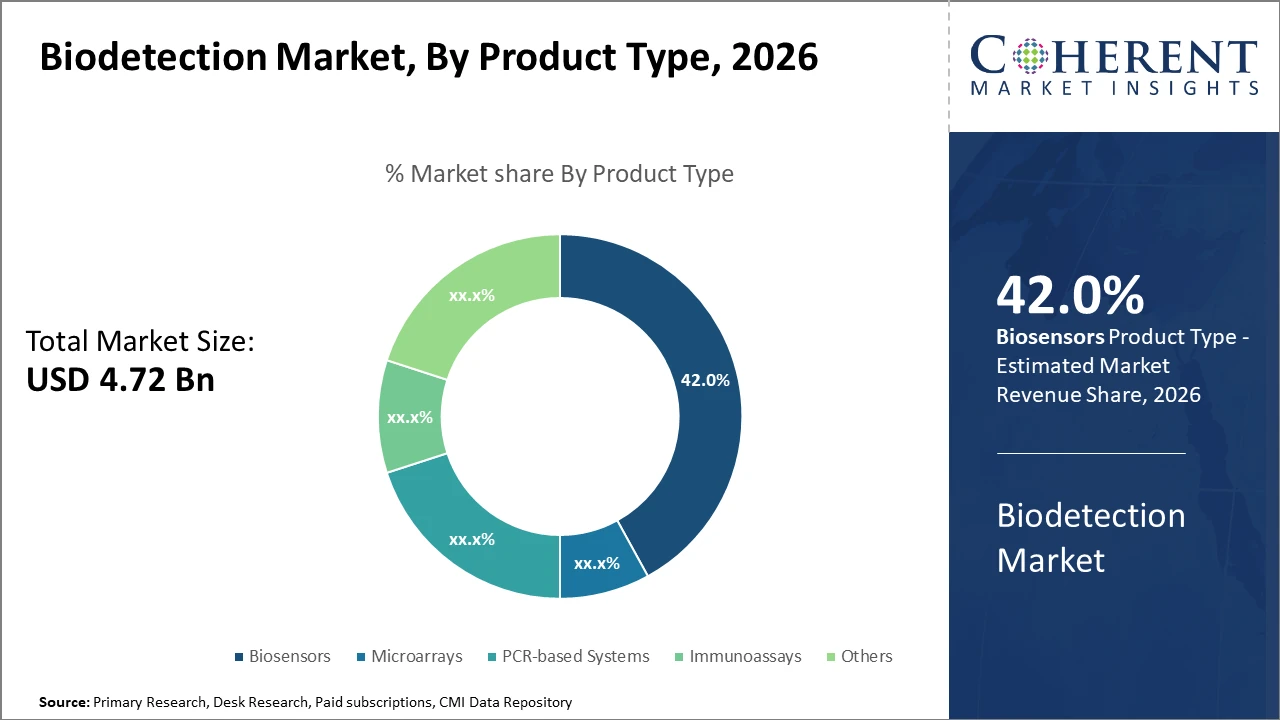
Biodetection Market Insights, By Product Type
Biosensors dominate the market share with 42%. This dominance can be attributed to their unparalleled sensitivity, rapid response time, and versatility across multiple applications from clinical diagnostics to environmental monitoring. Biosensors are increasingly preferred for their capability to deliver real-time data with minimal sample preparation, addressing urgent needs in pandemics and bioterrorism. The fastest-growing subsegment is PCR-based Systems, benefiting from their precision in genetic material amplification, facilitating accurate pathogen detection and genomic surveillance.
Biodetection Market Insights, By Application
Healthcare is holding the lead at 38% market share. Healthcare's dominance stems from urgent needs for rapid diagnostics, effective infection control, and biosurveillance systems critical for hospitals and laboratories worldwide. The fastest-growing application subsegment is Defense & Security, rising due to escalating bio-threat concerns globally and rising expenditures on biodefense by governmental agencies, driving adoption of cutting-edge biodetection solutions. Environmental Monitoring serves as a stable growth segment focused on pollution control and ecosystem health assessments, while Food Safety remains specialized with regulatory compliance driving steady demand.
Biodetection Market Insights, By End-User
Laboratories command a dominant position with 40% market share, attributed to their pivotal role in research, screening, and diagnostic testing. The highly technical nature of laboratory biodetection tools supports robust adoption of sophisticated systems like microarrays and PCR platforms. The fastest-growing subsegment is Government Agencies, driven by intensified biodefense programs, public health emergency preparedness, and surveillance mandates worldwide. Hospitals represent a substantial, steady segment primarily adopting point-of-care biodetection devices to enhance patient outcomes.
Biodetection Market Trends
Current market trends underscore a steady shift toward integrating sophisticated digital technologies with biodetection mechanisms, exemplified by the adoption of AI-driven biosensors in 2024, which proved instrumental in mitigating pandemic impacts through swift pathogen detection.
The rapid miniaturization and deployment of portable devices have reshaped conventional detection paradigms, facilitating point-of-need diagnostics.
Additionally, partnerships between private enterprises and public health bodies continue to foster innovation and quick scalability of biodetection products globally.
Biodetection Market Insights, By Geography
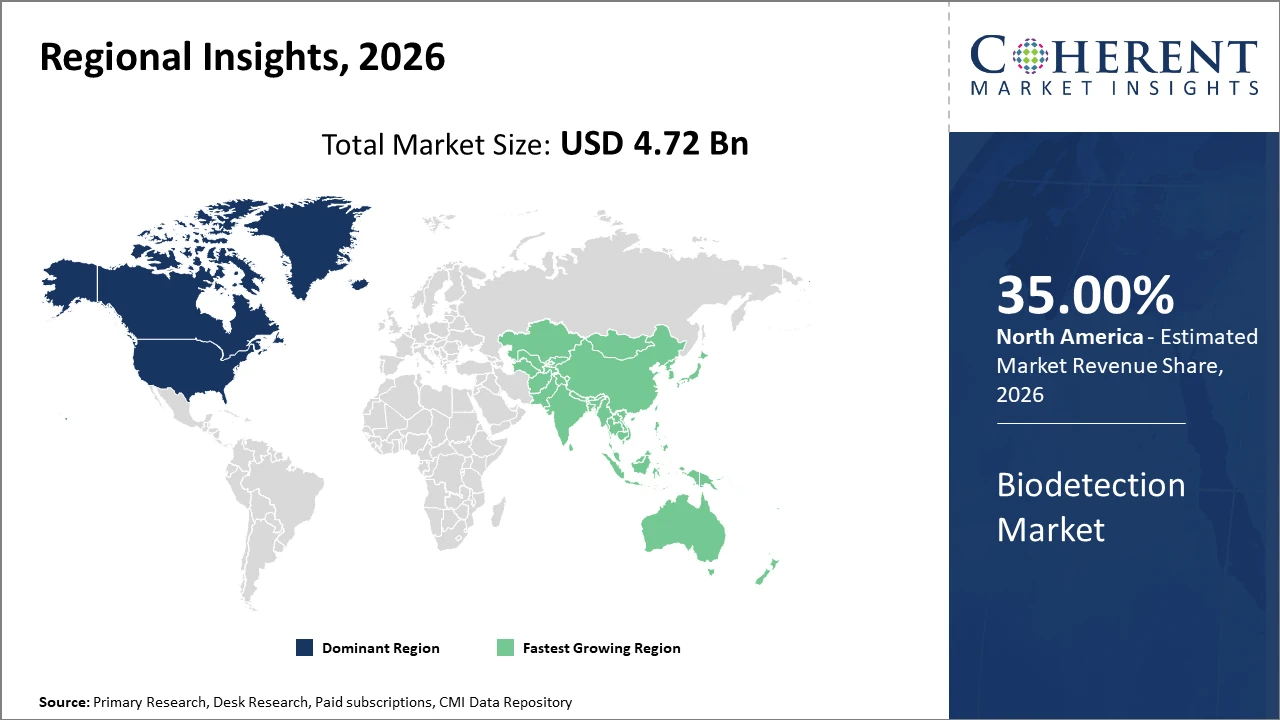
North America Biodetection Market Analysis and Trends
In North America, the dominance in the market is predominantly due to extensive governmental investments in biosecurity and advanced healthcare infrastructure. The region accounted for over 35% of the market share in 2026, boosted by substantial contributions from the U.S. marketplace. Major entities such as Thermo Fisher Scientific and Abbott Laboratories operate here, facilitating cutting-edge technology deployments and exports.
Asia Pacific Biodetection Market Analysis and Trends
Meanwhile, the Asia Pacific territory exhibits the fastest growth, with a CAGR exceeding 12% between 2026 and 2033. This growth is fueled by expanding healthcare infrastructure, increasing biodefense mandates, and surging innovations in electronic biosensors and point-of-care diagnostics, spearheaded by emerging economies like China and India developing extensive R&D capabilities.
Biodetection Market Outlook for Key Countries
USA Biodetection Market Analysis and Trends
The USA's market remains the global frontrunner, driven by large-scale federal funding initiatives targeting biothreat preparedness, such as the continued expansion of programs under the Department of Homeland Security and the CDC. The presence of heavyweights like Danaher and Bio-Rad Laboratories, coupled with increasing exports has propelled domestic production capacity by over 15% during 2024. Adoption of advanced molecular biodetection technologies in hospitals and defense agencies has enhanced the market revenue substantially, supporting a resilient and innovation-centric market environment.
India Biodetection Market Analysis and Trends
China's Biodetection market has evolved rapidly, underpinned by aggressive government policies incentivizing healthcare modernization and biodefense readiness. The government-backed “Health China 2030” plan has bolstered investments in R&D and clinical diagnostics. Leading domestic manufacturers, complemented by international collaborations, have introduced high-throughput PCR-based and AI-assisted biosensing solutions, driving expansive market revenue growth. In 2024, China’s annual import of biodetection components surged by nearly 20%, marking its strategic role in the Asia Pacific market expansion.
Analyst Opinion
One notable insight centers on the surge of demand-side indicators, especially from healthcare applications such as point-of-care (POC) diagnostics. In 2024, deployment of biosensors in clinical settings grew by over 22%, driven by the need for rapid pathogen identification to control infectious diseases. This trend notably supports market size expansion and fuels increased market revenue generation.
Supply-side dynamics reveal rising production capacities for portable biodetection devices, especially in North America and Asia Pacific regions. A 15% increase in manufacturing outputs of handheld biosensors was recorded in 2023 alone, reflecting companies’ commitments to meet swiftly growing government and commercial orders. Such trends directly correlate with higher industry share gains for these advanced devices.
Export volumes of biodetection technologies from countries like the USA rose by 18% in 2024, fueled by growing international concern over biosecurity. These demand and trade dynamics optimize global market growth, especially in regions with fragile healthcare infrastructures seeking efficient biosurveillance solutions.
Nano-scale biodetection technologies, including microfluidic chips used in biodefense, have witnessed rapid adoption. In 2025, this segment’s contribution to the overall market revenue increased by nearly 12%, emphasizing technological sophistication as a key market driver aligned with increasing market insights and trends.
- Current Industry Events of 2026
- Market Size Estimation
- Regional Breakdown
- Competitive Landscape
- Customer Intelligence
- Segmental Analysis
- Pricing Analysis
- Key Market Drivers, Challenges & Future Trends
- Customized Insights Section
Market Scope
| Report Coverage | Details | ||
|---|---|---|---|
| Base Year: | 2025 | Market Size in 2026: | USD 4.72 billion |
| Historical Data for: | 2020 To 2024 | Forecast Period: | 2026 To 2033 |
| Forecast Period 2026 to 2033 CAGR: | 10.3% | 2033 Value Projection: | USD 9.15 billion |
| Geographies covered: |
| ||
| Segments covered: |
| ||
| Companies covered: | MOBIDIAG, Luminex Corporation, GenMark Diagnostics, QIAGEN N.V., Eurofins Scientific, PerkinElmer, Bruker Corporation, BioFire Diagnostics (a part of bioMérieux), Tecan Group, Syntegon Technology. | ||
| Growth Drivers: |
| ||
Biodetection Market Growth Factors
The escalating prevalence of infectious diseases and biosecurity threats remains the foremost growth driver, with pandemics such as COVID-19 highlighting the critical necessity for rapid biodetection solutions globally. Stringent governmental regulations mandating constant biological threat monitoring underpin this demand, supported by increased funding for biodefense programs worldwide. Technological advancements in miniaturization and automation fuel business growth by enabling portable, user-friendly detection devices, evidenced by a 20% annual growth rate in handheld biodetection device sales during 2023-2024. Additionally, rising environmental concerns and food safety regulations stimulate adoption in non-healthcare sectors, broadening the market scope and contributing to sustained CAGR trends observed in the market forecast.
Biodetection Market Development
In April 2025, BD (Becton, Dickinson and Company) received European Union marketing authorization for its BD Max System, capable of detecting both tuberculosis (TB) and respiratory syncytial virus (RSV) from a single patient sample. This milestone made it the first in vitro diagnostic (IVD) system in Europe to achieve CE-IVD marking for dual TB and RSV detection, significantly improving diagnostic efficiency, reducing testing time, and supporting faster clinical decision-making in respiratory and infectious disease management.
In June 2025, the ICAR–Indian Institute of Spices Research (IISR) announced the commercial rollout of a new fungal-based biodetection and pest management tool for cardamom cultivation. The product is designed to enable early detection and biological control of key cardamom pests, reducing dependence on chemical pesticides. This launch supports sustainable spice farming by improving crop protection efficiency while aligning with eco-friendly and integrated pest management (IPM) practices in India’s spice-growing regions.
Key Players
Leading Companies of the Market
MOBIDIAG
Luminex Corporation
GenMark Diagnostics
QIAGEN N.V.
Eurofins Scientific
PerkinElmer
Bruker Corporation
BioFire Diagnostics (a part of bioMérieux)
Tecan Group
Syntegon Technology
Several market companies have adopted aggressive growth strategies such as strategic acquisitions and expanding product portfolios to enhance market share. For example, Thermo Fisher Scientific’s acquisition of a leading molecular diagnostics startup in 2024 expanded its product offerings into rapid biodetection platforms, contributing to a 14% increase in its market revenue that year. Likewise, Danaher Corporation’s investment in AI-powered biosensor technology has resulted in significant operational efficiencies, leading to a notable increase in order volumes from healthcare and defense clients.
Biodetection Market Future Outlook
Future growth will be driven by increasing emphasis on pandemic preparedness, real-time surveillance, and decentralized diagnostics. Integration of artificial intelligence and data analytics will enhance detection accuracy and response speed. Expansion of point-of-care testing and environmental monitoring applications will broaden adoption. Continued government investment and regulatory support will sustain innovation. The market is expected to play a critical role in global health security and public safety infrastructure.
Biodetection Market Historical Analysis
The biodetection market developed primarily in response to public health threats, biodefense initiatives, and environmental safety requirements. Early systems were centralized, laboratory-based solutions designed for government and military use, limiting commercial scalability. Concerns over bioterrorism and infectious disease outbreaks significantly increased demand for faster, more sensitive detection technologies. Advances in biosensors, molecular diagnostics, and microfluidics enabled the development of portable and rapid detection platforms. Over time, biodetection technologies expanded beyond defense into healthcare diagnostics, food safety, and environmental monitoring, creating a diversified market base.
Sources
Primary Research Interviews:
Biosafety officers
defense researchers
laboratory managers
biodefense consultants
Databases:
CDC Surveillance Data
WHO Disease Outbreak Reports
Global Health Security Index
UN Biosecurity Reports
Magazines:
BioTechnique
Homeland Security Today
Defense Technology
Biospectrum
Lab Manager
Journals:
Biosensors & Bioelectronics
Journal of Applied Microbiology
Analytical Chemistry
Sensors Journal
Journal of Biodefense
Newspapers:
Reuters Science
Financial Times (Security)
The New York Times (Science)
Washington Post (Defense)
The Guardian (Global Health)
Associations:
International Biosafety Association
Biological Detection Systems Consortium,
Global Health Security Agenda
American Society for Microbiology
International Society for Biosafety Research
Get access to 250+ pages report
Every segment, forecast, competitor profile and data table behind the analysis above — available for instant download.
- ESOMAR Member
- ISO 9001:2015 Certified
- D-U-N-S Registered
- GDPR & CCPA Compliant
Missing comfort of reading report in your local language? Find your preferred language:
Transform your Strategy with Exclusive Trending Reports
Frequently Asked Questions
Leading companies such as Abbott Laboratories, Danaher Corporation, Thermo Fisher Scientific, and Bio-Rad Laboratories dominate the Biodetection market by continuously innovating and expanding their product portfolios to meet global demand.
The Biodetection market size is projected to grow from USD 4.72 billion in 2026 to USD 9.15 billion by 2033, reflecting a robust CAGR of 10.3% driven by technological advancements and increasing government focus on biodefense.
The healthcare sector remains the largest end-user industry with the highest growth opportunity, driven by rising infectious disease outbreaks and the need for rapid diagnostics.
Key trends include integration of AI with biodetection platforms and a significant shift towards portable devices for real-time monitoring, enhancing detection accuracy and broadening adoption across various sectors.
The market landscape is highly competitive, dominated by technologically advanced players focusing on innovation and strategic acquisitions. Challenges include high development costs and regulatory compliance which could restrict rapid product launches.
Companies primarily adopt acquisition, product portfolio expansion, and partnerships with governmental agencies to increase market penetration and revenue streams.