

Global Vehicle Scanner Market Size and Forecast – 2026-2033
The global vehicle scanner market is expected to grow from USD 2.65 Bn in 2026 to USD 4 Bn by 2033, registering a compound annual growth rate (CAGR) of 5.5% from 2026 to 2033. The global vehicle scanner market is driven by the rapid adoption of AI-powered image analytics for automated threat detection. On September 17, 2025, UVeye expanded its automated inspection technology to support commercial fleets, including Class 6-8 trucks and buses across the U.S. and the U.K. (Source: UVeye)
Key Takeaways of the Global Vehicle Scanner Market
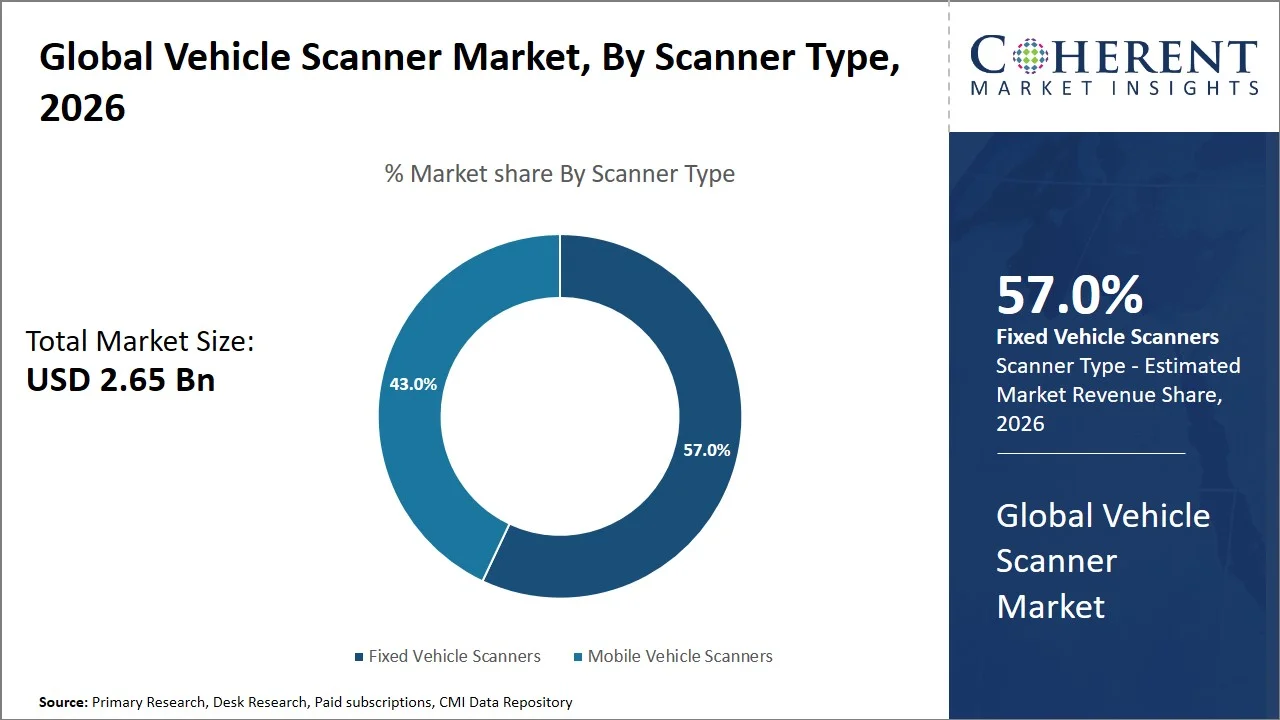
- The fixed vehicle scanners segment is expected to account for 57.0% of the global vehicle scanner market share in 2026. Growing threats from terrorism, smuggling, and vehicle-borne explosives are driving the growth of the segment. On March 18, 2025, Smiths Detection, a global leader in threat detection and security screening signed an agreement with Deepnoid, a South Korean specialized AI software company led by CEO Choi Woo-Sik, to test AI integration within its security screening systems. (Source: Smiths Detection)
- The drive-through scanners segment is estimated to capture 61.0% of the market share in 2026. Ongoing cargo customization and modernization is driving the growth of the segment. In October 2025, Nuctech provided cutting-edge drive-through vehicle and cargo inspection systems for Customs Modernization Projects in Central Asia, enabling automatic identification of concealed contraband, explosives and illegal cargo through AI-assisted picture analysis.
- The X-ray scanning segment is estimated to capture 37.0% of the market share in 2026. The need for non-intrusive, high-throughput vehicle inspection technologies is driving the growth of the segment. On July 10, 2025, OSI Systems, Inc. announced that its Security division was awarded a contract worth approximately USD 34 million by an international customer. The company expects to deploy multiple units of its Z Portal high-throughput inspection system for screening trucks and cargo, as well as its CarView InLane Portal for scanning passenger vehicles. (Source: OSI Systems)
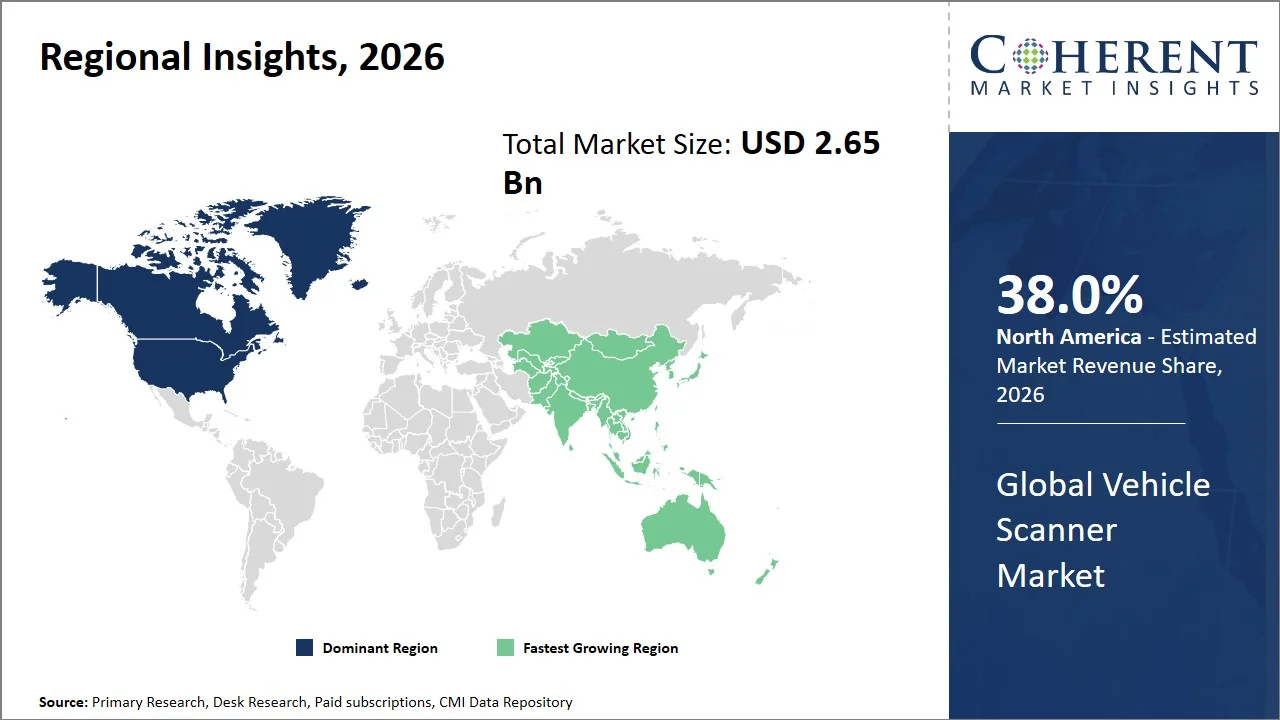
- North America is expected to dominate the vehicle scanner market in 2026 with a market share of 38.0% Smart border management initiatives in countries like the U.S. are driving the growth of the regional market. On June 18, 2026, Leidos secured a USD 270 million contract from the U.S. Customs and Border Protection (CBP) for medium energy mobile systems (MEMS) for non-intrusive inspection procedures.
- Asia Pacific is expected to account for 25.0% of the market share in 2026 and is projected to record the fastest growth over the forecast period. Growth in logistics hubs and international trade corridors across Asia Pacific is driving the growth of the regional market. On January 22, 2026, DP World signed an agreement with the government of Madhya Pradesh, India, to develop the Powarkheda Logistics Composite Hub, an inland logistics gateway designed to strengthen India’s export competitiveness and accelerate inclusive economic growth in Central India. (Source: DP World)
- Increasing Adoption of AI-Powered Automated Threat Detection: Vehicle scanner manufacturers are incorporating artificial intelligence (AI), machine learning (ML), and deep learning algorithms to automatically identify explosives, weapons, contraband, and vehicle modifications at a faster rate and with more accuracy. Image analysis enabled by AI decreases operator labor, reduces false alarms and allows for real time decision making at high security checkpoints.
- Rising Deployment of Contactless Under Vehicle Surveillance Systems (UVSS): Governments, airports, military facilities, data centers, and commercial complexes are increasingly deploying contactless under-vehicle surveillance systems leveraging high-resolution imaging, automatic number plate recognition (ANPR), and vehicle fingerprinting technologies. These devices allow for speedy, non-intrusive inspections with free-flow traffic and increased security.
Segmental Insights
Why Do Fixed Vehicle Scanners Dominate the Global Vehicle Scanner Market?
The fixed vehicle scanners segment is expected to account for 57.0% of the global vehicle scanner market share in 2026. Fixed vehicle scanners are preferred due to their high throughput and continual scanning at permanent security checkpoints. These devices can be installed at border crossings, airports, military bases, ports, government institutions and vital infrastructure locations to scan massive volumes of cars swiftly without slowing down the flow of traffic. They are able to produce high-quality images at all times of day, and can be integrated with other systems that automatically identify vehicles and other security measures (such as entry and exit points). All of this makes them the preferable option for any area that needs reliable vehicle screening over lengthy periods of time. On September 29, 2025, OSI Systems, Inc. announced that its subsidiary, S2 Global, Inc. was awarded a five-year contract from U.S. Customs and Border Protection (CBP) for its Non-Intrusive Inspection (NII) Common Integration Platform (CIP) program.
- Current Industry Events of 2026
- Market Size Estimation
- Regional Breakdown
- Competitive Landscape
- Customer Intelligence
- Segmental Analysis
- Pricing Analysis
- Key Market Drivers, Challenges & Future Trends
- Customized Insights Section
Why are Drive-Through Scanners the Most Preferred Structure Type?
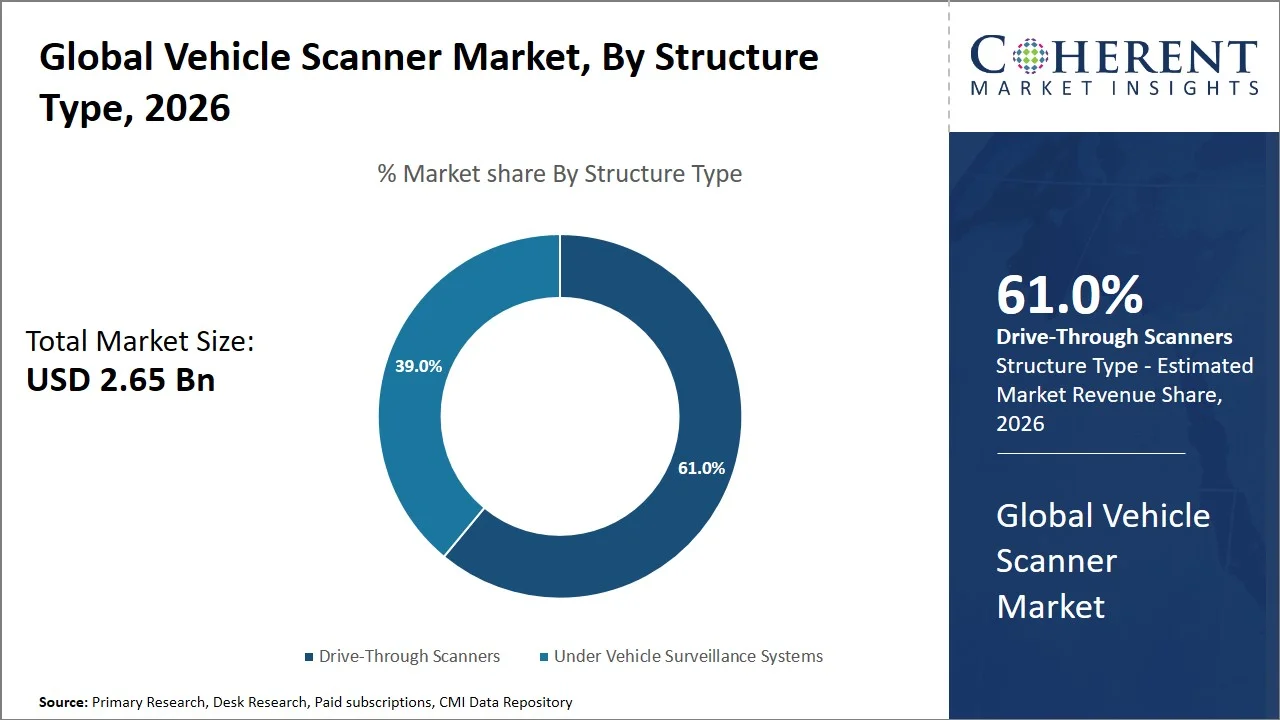
The drive-through scanners segment is expected to account for 61.0% of the global vehicle scanner market share in 2026. Drive-through scanners are the most widely adopted structure type because they enable rapid, non-intrusive vehicle inspection without requiring occupants to exit the vehicle, significantly improving operational efficiency. The systems allow vehicles to go through designated scanning lanes, taking precise photographs of the exterior of the vehicle, the undercarriage, and in some cases, cargo compartments. Their capacity to handle vast quantities of cars with little delay makes them ideal for border crossings, ports, airports, military installations and big commercial sites where security has to be maintained but traffic flow must be unimpeded. In January 2025, Scanlab improved its drive-through car scanning equipment with increased X-ray imaging and AI-assisted picture analysis. The new platform improves the pace of inspections and increases the capacity of the permanent security checkpoints.
X-ray Scanning Dominates the Global Vehicle Scanner Market
The X-ray scanning segment is expected to account for 37.0% of the global vehicle scanner market share in 2026. X-ray scanning is popular as it delivers deep penetration and high quality images, allowing security officers to discover hidden weapons, explosives, narcotics, contraband and hidden compartments without having to open or dismantle the vehicle. Since it can accurately inspect both the vehicle structure and cargo, it is the chosen technology at border checkpoints, customs, ports, airports and high security government facilities where complete, non-intrusive inspection is needed.
Currents Events and their Impact
Current Events | Description and its Impact |
European Union - Regulation (EU) 2024/1356 (Screening Regulation under the Pact on Migration and Asylum) |
|
U.S. - Maritime Transportation Security Act (MTSA) implementation updates (2024–2025) |
|
Vehicle Scanner Market Dynamics
Market Drivers
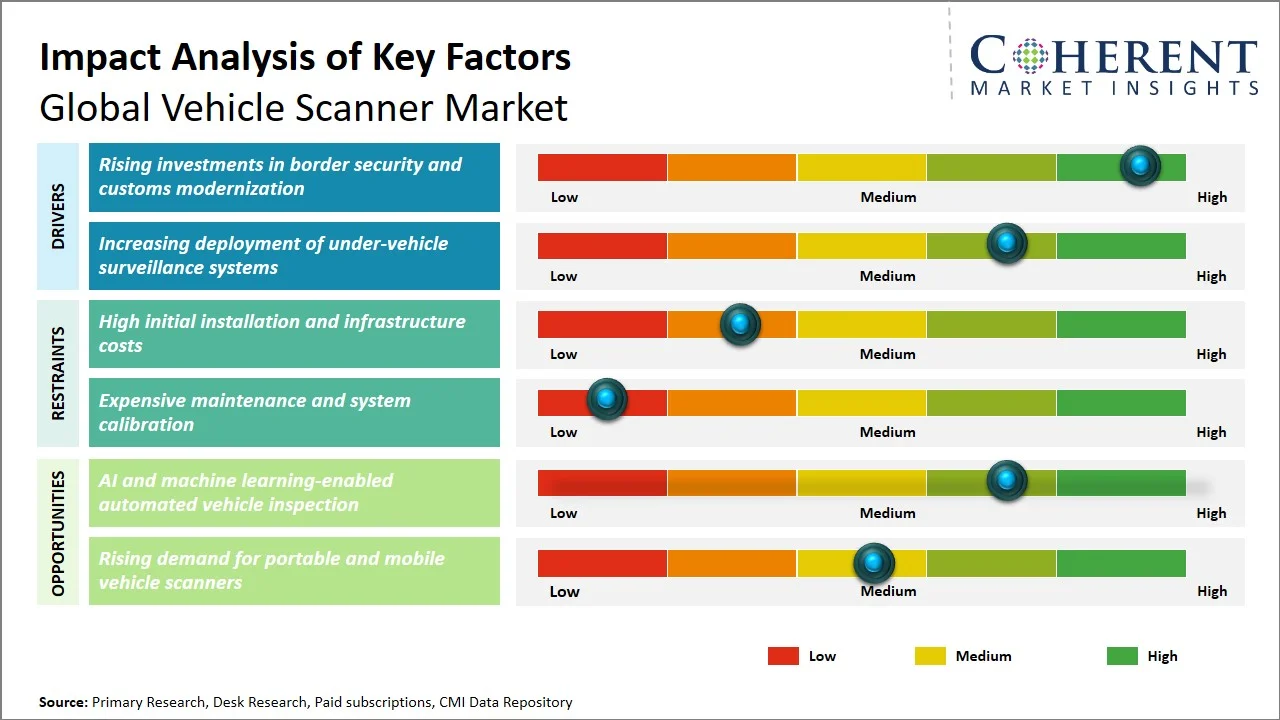
- Rising investments in border security and customs modernization
Governments are investing heavily in border security and customs modernization worldwide to improve national security, curb smuggling and enable the smooth flow of lawful trade. Border agencies are enhancing inspection infrastructure with advanced vehicle scanners, automated drive-through inspection systems, under-vehicle surveillance technologies and AI-enabled threat detection solutions to enable faster, non-intrusive screening of passenger and commercial vehicles. The modernization initiatives help in operating efficiency, reduce the length of inspections and increase the detection rate of hidden weapons, explosives, narcotics and contraband, thereby making border security expenditures a significant growth engine for the global vehicle scanner market. On January 21, 2026, Smiths Detection stated that it has successfully launched an automated International Remote Baggage Screening System (IRBS), creating a new worldwide standard for cross-border airline security and passenger processing between South Korea and the U.S.
- Increasing deployment of under-vehicle surveillance systems
The growing adoption of under-vehicle surveillance systems is driving the demand for advanced vehicle scanning solutions, as governments, military organizations, airports, ports, commercial complexes and critical infrastructure operators seek to strengthen perimeter security. These systems employ high-resolution photography and automated analysis to examine the underside of cars for explosives, weapons, contraband or unlawful changes without physical inspection. In high-risk and high-traffic regions, under-vehicle surveillance systems have become a vital element of the modern security infrastructure, capable of providing fast, non-invasive, and accurate screening with minimal traffic disruption. On March 12, 2024, Vehant Technologies announced that it has added Sovereign Imaging AI to its AI-enabled Under Vehicle Scanning System (UVSS) to automate the detection of suspicious things, vehicle modifications and contraband hidden under vehicles.
Emerging Trends
- Growing Demand for Mobile and Portable Vehicle Scanning Solutions
Security agencies and defense organizations are putting more money into mobile and portable vehicle scanners for ad hoc inspections, border patrol, public events, emergency response and military operations. These tiny systems enable operational flexibility, rapid deployment and effective inspection capabilities in remote or constantly changing locations.
- Integration with Smart Security Ecosystems and Cloud-Based Monitoring
Modern car scanners are being integrated with centralized security management platforms, cloud connection, biometric access control, CCTV surveillance and Internet of Things (IoT) networks. This connection allows smart cities, transportation hubs, and critical infrastructure facilities to monitor remotely, do predictive maintenance, share data in real time, and respond to threats in unison.
Regional Insights
Why is North America a Strong Market for Vehicle Scanners?
North America is expected to account for a market share of 38.0% in 2026. North America is the most technically advanced market for vehicle scanners, due to substantial use at land borders, ports, airports and defense facilities. AI-enabled drive-through X-ray scanners and under-vehicle monitoring systems are quickly modernizing the region’s inspection infrastructure. The Department of Homeland Security and Customs and Border Protection of the U.S. continues to upgrade inspection lanes at major ports (Port of Laredo and Eagle Pass Port of Entry) of entry along the U.S.–Mexico border with non-intrusive inspection technologies to increase contraband identification and minimize screening times. Canada is also increasing the capacity for advanced vehicle inspections at key border crossings under the Beyond the Border cooperation framework with the U.S., helping to boost regional demand for high-performance vehicle scanning systems.
Why Does the Asia Pacific Vehicle Scanner Market Exhibit High Growth?
Asia Pacific is projected to account for 25.0% of the global vehicle scanner market and is expected to register the fastest growth. Asia Pacific is the fastest growing geographical market, with large scale border modernization, expanding transit infrastructure and increasing investments in homeland security. Sophisticated car scanners are being deployed in ports, airports, industrial zones and other key government sites in countries such as China, India, Japan, South Korea and Australia. The region is also developing as a key manufacturing base for AI-enabled car inspection equipment, with local companies like Nuctech and Vehant Technologies, developing combined X-ray and intelligent image recognition systems. Cross-border commerce corridors and the growing need for security screening at logistics hubs throughout the area continue to drive significant demand for fixed and mobile vehicle scanning systems.
Global Vehicle Scanner Market Outlook for Key Countries
Why is the U.S. Emerging as a Major Hub in the Vehicle Scanner Market?
The U.S. continues to lead the world in adoption of cutting-edge vehicle scanning technologies with ongoing expenditures by U.S. Customs and Border Protection in non-intrusive inspection methods at key border crossings such as Laredo, El Paso and San Ysidro. The country is progressively using high-energy X-ray drive-through scanners that check commercial vehicles without unloading goods, considerably increasing throughput and bolstering narcotics and weapons detection. Automatic license plate identification and centralized security management platforms like Motorola Solutions, are also used in major airports, military sites, nuclear plants and seaports, which deploy advanced under-car surveillance systems, boosting the demand for next-generation vehicle scanners.
Is China the Next Growth Engine for the Vehicle Scanner Market?
The vehicle scanner industry in China is booming as customs officials are upgrading inspection facilities at major international ports such as Shanghai, Shenzhen, Ningbo-Zhoushan and Qingdao. Domestic manufacturers such as Nuctech have dramatically increased their deployment of AI-enabled vehicle and cargo inspection systems that can automatically analyze images and do remote monitoring. The country's emphasis on safeguarding Belt and Road Initiative logistics corridors and strengthening customs enforcement has accelerated installations of high-energy drive-through X-ray scanners at border checkpoints, ports and bonded logistics parks, making China one of the largest consumers of advanced non-intrusive inspection technologies.
Germany Vehicle Scanner Market Analysis and Trends
The Germany vehicle scanner market is driven by tight security requirements at international logistics hubs, seaports, and vital industrial sites. Cargo hubs like the Port of Hamburg are adopting cutting-edge technologies for inspecting vehicles and cargo to tighten customs controls without impeding the flow of freight. German airports and government buildings are also increasingly using automated under-vehicle surveillance systems that are integrated with access control infrastructure. In addition, the country’s robust engineering environment guarantees the ongoing advancement of high-resolution imaging technology and intelligent inspection software, thereby strengthening Germany’s status as a key European market for car scanners.
India Vehicle Scanner Market Analysis and Trends
India is witnessing a considerable development in the deployment of vehicle scanners through modernization projects in border check posts, airports, ports, defense establishments and smart city projects. The Land Ports Authority of India has set up integrated check stations with advanced non-intrusive inspection systems at major border points including Attari, Petrapole and Moreh to promote trade facilitation and security screening. Vehant Technologies and other domestic manufacturers are providing AI-enabled under-vehicle surveillance systems and automatic number plate recognition solutions to government agencies, metro infrastructure, and critical facilities, supporting the growing localization of advanced vehicle scanning technologies.
U.K. Vehicle Scanner Market Analysis and Trends
Enhanced border security procedures under the Border Target Operating Model, focusing on risk-based inspections and digital border administration, are boosting the vehicle scanner market in the U.K. Border control facilities at Dover and other major freight gateways are employing high throughput vehicle scanning technologies to efficiently assess commercial trucks and minimize delays. Airports, nuclear facilities and government buildings are continuing to invest in sophisticated under-vehicle surveillance systems that are integrated with biometric access control and CCTV platforms. Meanwhile, security technology vendors are expanding AI-assisted inspection capabilities to meet evolving national security requirements.
Global Vehicle Scanner Market - AI-Based Vehicle Threat Detection Deployments (2026)
Region | Estimated AI-Based Vehicle Threat Detection Deployments (Units) |
North America | 5,250 |
Europe | 3,900 |
Asia Pacific | 3,750 |
Middle East & Africa | 1,350 |
Latin America | 750 |
How is AI and Machine Learning-Enabled Automated Vehicle Inspection Creating New Growth Opportunities in the Vehicle Scanner Market?
The vehicle scanner market is witnessing huge growth opportunities led by artificial intelligence (AI) and machine learning (ML) powered automated vehicle inspection which is revolutionizing traditional screening systems into intelligent and data-driven security platforms. AI algorithms can automatically detect concealed weapons, explosives, narcotics, vehicle modifications and other suspicious abnormalities in X-ray and under-car photos with better speed and accuracy than manual examination alone, decreasing false alarms and operator dependency. Machine learning algorithms that learn from new inspection data increase detection performance continually, and integration with automatic number plate recognition, facial recognition and centralized security systems enable real-time threat assessment and faster decision-making. These capabilities are driving long-term market growth since governments, border agencies, airports, ports, military sites and critical infrastructure operators are investing in next-generation automated vehicle inspection systems.
On February 2, 2026, UVeye and Cox Automotive’s vAuto announced a new partnership to provide AI-powered car inspections and condition intelligence straight into the retail process. The collaboration combines UVeye’s automated inspection technology with vAuto’s appraisal, pricing and inventory systems, allowing dealers real time, objective view into vehicle condition without impeding operations.
Market Players, Key Development, and Competitive Intelligence
Key Developments
- On April 30, 2026, Vehant Technologies announced a partnership with Bihar Police to deploy AI-powered security and surveillance technologies for strengthening public safety infrastructure. The initiative expands Vehant's footprint in intelligent inspection and security solutions, supporting wider adoption of AI-enabled vehicle screening technologies across government agencies.
- On April 1, 2025, OSI Systems, Inc. announced that its Security division has secured orders totaling approximately USD 17 million from a strategic North American customer. The orders include the delivery of Eagle M60 high-energy mobile cargo and vehicle inspection systems, along with comprehensive service and support.
Competitive Landscape
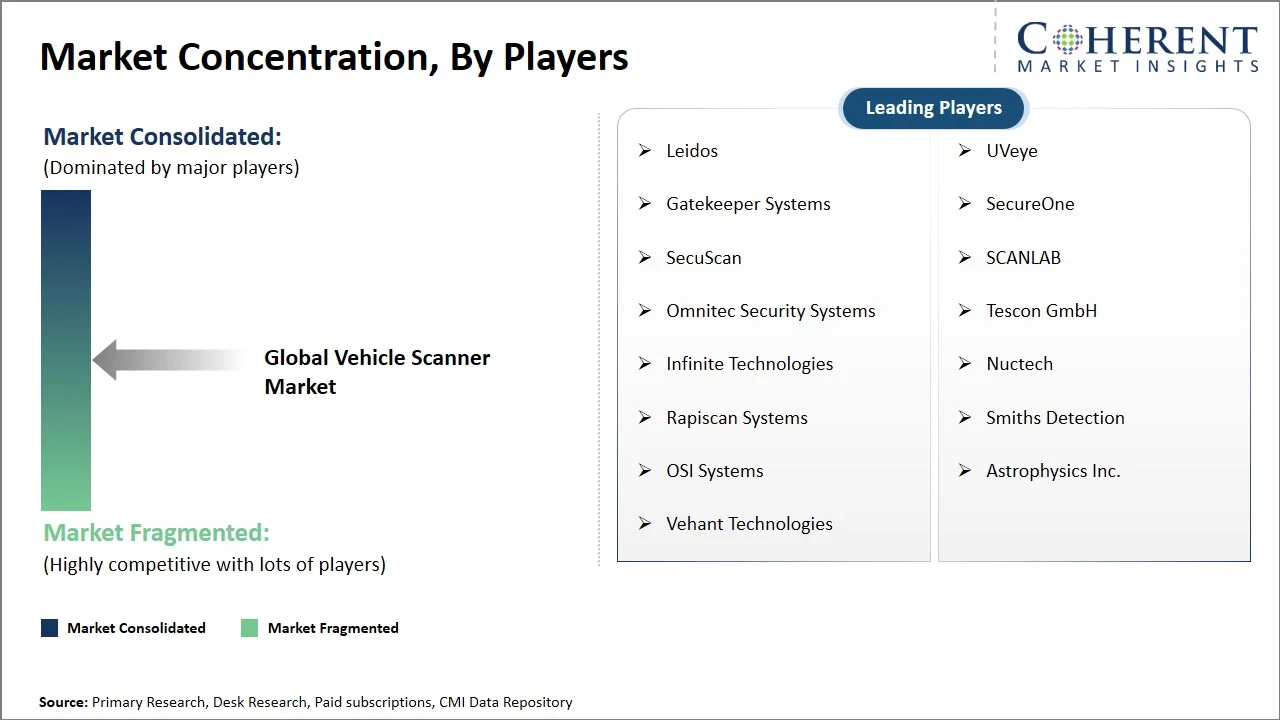
The global vehicle scanner market is marked by the presence of established security technology providers and specialized inspection system manufacturers competing with each other on the basis of technological innovation, product reliability and government contract acquisitions. To stand out, companies are increasingly focused on AI-enabled image analysis, high-energy X-ray scanning, under-vehicle surveillance systems and integrated security platforms. To enhance competitive positioning, companies are forging strategic alliances with border security agencies, airports, ports, and defense groups and investing in software-driven automation, remote monitoring, and predictive maintenance capabilities.
Market Report Scope
Vehicle Scanner Market Report Coverage
| Report Coverage | Details | ||
|---|---|---|---|
| Base Year: | 2025 | Market Size in 2026: | USD 2.65 Bn |
| Historical Data for: | 2020 To 2024 | Forecast Period: | 2026 To 2033 |
| Forecast Period 2026 to 2033 CAGR: | 5.50% | 2033 Value Projection: | USD 4 Bn |
| Geographies covered: |
| ||
| Segments covered: |
| ||
| Companies covered: | Leidos, UVeye, Gatekeeper Systems, SecureOne, SecuScan, SCANLAB, Omnitec Security Systems, Tescon GmbH, Infinite Technologies, Nuctech, Rapiscan Systems, Smiths Detection, OSI Systems, Astrophysics Inc., and Vehant Technologies | ||
| Growth Drivers: |
| ||
| Restraints & Challenges: |
| ||
Analyst Opinion (Expert Opinion)
- The vehicle scanner market is likely to be driven by ongoing expenditures in border security modernization, critical infrastructure protection, and intelligent inspection technologies. There is an increasing focus on automated threat detection, AI-enabled image processing and non-intrusive inspection technologies to increase operational efficiency and security outcomes. The expanding government procurement and infrastructure development projects along with consistent product innovation are projected to enhance market competition and promote greater acceptance across both developed and emerging nations.
- The vehicle scanner market is projected to see next-generation inspection systems incorporating artificial intelligence, machine learning, cloud connectivity, and enhanced imaging technologies. Demand is expected to increase as governments continue to enhance border control, transit security and protection of vital infrastructure against evolving security threats. With the widespread adoption of autonomous inspection capabilities, mobile scanning platforms, digital border ecosystems and real-time data analytics, the application scope of vehicle scanners is expected to expand, while sustained investments in smart infrastructure and international trade corridors are expected to create long-term growth opportunities for market players.
Speak to the analyst
Want personalized insights?
Take the findings above to one of our principal consultants, or have the report rebuilt around the segments, geographies and competitors you actually track.
Market Segmentation
- Scanner Type Insights (Revenue, USD Billion, 2021 - 2033)
- Fixed Vehicle Scanners
- Mobile Vehicle Scanners
- Structure Type Insights (Revenue, USD Billion, 2021 - 2033)
- Drive-Through Scanners
- Under Vehicle Surveillance Systems
- Technology Insights (Revenue, USD Billion, 2021 - 2033)
- X-ray Scanning
- Imaging Systems
- Illumination Systems
- Sensing Technologies
- AI-Based Image Processing
- Application Insights (Revenue, USD Billion, 2021 - 2033)
- Government and Critical Infrastructure
- Border Security and Customs
- Military and Defense
- Airports and Seaports
- Commercial and Industrial Facilities
- Logistics and Warehousing
- Regional Insights (Revenue, USD Billion, 2021 - 2033)
- North America
- U.S.
- Canada
- Latin America
- Brazil
- Argentina
- Mexico
- Rest of Latin America
- Europe
- Germany
- U.K.
- Spain
- France
- Italy
- Russia
- Rest of Europe
- Asia Pacific
- China
- India
- Japan
- Australia
- South Korea
- ASEAN
- Rest of Asia Pacific
- Middle East
- GCC Countries
- Israel
- Rest of Middle East
- Africa
- South Africa
- North Africa
- Central Africa
- North America
Sources
Primary Research Interviews
- Automotive Diagnostics Equipment Manufacturers
- Vehicle Service & Repair Center Professionals
- OEM (Original Equipment Manufacturer) Representatives
- Automotive Aftermarket Parts & Tools Distributors
Magazines
- Motor Age Magazine
- Automotive Body Repair News (ABRN)
- Professional Tool & Equipment News (PTEN)
- Auto Service Professional Magazine
Journals
- International Journal of Automotive Technology
- Journal of Automobile Engineering
- SAE International Journal of Passenger Cars
Associations
- Automotive Service Association (ASA)
- Society of Automotive Engineers (SAE International)
- Motor & Equipment Manufacturers Association (MEMA)
- National Automobile Dealers Association (NADA)
Public Domain Sources
- U.S. Environmental Protection Agency (EPA) – Vehicle Emission Standards & Diagnostics
- European Automobile Manufacturers' Association (ACEA) – Industry Reports
- U.S. Department of Transportation (DOT) – Vehicle Safety & Compliance Data
- International Organization for Standardization (ISO) – OBD Standards Documentation
Proprietary Elements
- CMI Data Analytics Tool
- Proprietary CMI Existing Repository of Information for the Last 10 Years
Get access to 250+ pages report
Every segment, forecast, competitor profile and data table behind the analysis above — available for instant download.
- ESOMAR Member
- ISO 9001:2015 Certified
- D-U-N-S Registered
- GDPR & CCPA Compliant
Missing comfort of reading report in your local language? Find your preferred language:
Transform your Strategy with Exclusive Trending Reports
Frequently Asked Questions
The global vehicle scanner market is expected to stand at USD 2.65 Bn in 2026 and is expected to reach USD 4 Bn by 2033.
The CAGR of the global vehicle scanner market is projected to be 5.5% from 2026 to 2033.
Rising investments in border security and customs modernization and increasing deployment of under-vehicle surveillance systems are the major factors driving the growth of the global vehicle scanner market.
High initial installation and infrastructure costs and expensive maintenance and system calibration are the major factors hampering the growth of the global Vehicle Scanner market.
In terms of scanner type, the fixed vehicle scanners segment is estimated to dominate the market revenue share in 2026.
Yes, high-energy drive-through vehicle scanners are specifically designed to inspect commercial trucks and cargo vehicles efficiently.
Non-intrusive inspection improves security while minimizing delays and eliminating the need for manual vehicle searches.