

Global Viticulture Market Size and Forecast – 2026 To 2033
The Global Viticulture Market is estimated to be valued at USD 84.61 Bn in 2026 and is expected to reach USD 115.92 Bn by 2033, growing at a compound annual growth rate (CAGR) of 4.6% from 2026 to 2033. Market growth is supported by sustained demand for high-quality wine and table grapes, vineyard modernization, improved disease management, precision irrigation, and greater emphasis on climate-resilient cultivation.
Growers are increasingly investing in technologies that improve water-use efficiency, vine health, grape quality, and production consistency under changing climatic conditions. In January 2025, the U.S. Department of Agriculture’s Agricultural Research Service initiated the Sustainable Grape Production Under Emerging Climate Threats project, focusing on drought resilience, soil management, disease detection, vineyard sensing, and improved grape-production practices. The initiative demonstrates continuing institutional investment in technologies that can strengthen long-term vineyard productivity and sustainability.
Key Takeaways of the Global Viticulture Market
- Wine Grapes is projected to register an estimated 15.1% CAGR during 2026–2033 and hold 54.8% of the global viticulture market in 2026. Its lead reflects the large commercial acreage tied to wineries, established contract-growing systems, and higher value capture from varietal differentiation. In April 2025, OIV reported 2024 global wine production of 226 million hectoliters, underscoring the scale of wine-oriented grape cultivation.
- Conventional cultivation is expected to expand at an estimated 13.8% CAGR during 2026–2033 and represent 87.4% of the market in 2026. Its dominance stems from established input protocols, easier disease-control flexibility, predictable yields, and lower certification complexity across large vineyards. In March 2026, France’s agriculture ministry reported that only 21% of French vineyards were organically cultivated in 2024, illustrating the continuing predominance of non-organic production.
- Wine Production is forecast to grow at an estimated 15.0% CAGR during 2026–2033 and account for 52.7% of the market in 2026. This application captures the strongest monetization pathway because wineries require consistent grape quality, varietal specifications, harvest timing, and long-term grower relationships. In July 2025, Wine Australia estimated a 1.57-million-tonne winegrape crush, equivalent to roughly 1.1 billion liters of wine.
- Europe is projected to post an estimated 16.8% CAGR during 2026–2033 and hold 34.8% of the market in 2026, making it the fastest-growing region. Expansion is supported by vineyard restructuring, climate-adaptation investment, export development, and product diversification. In March 2025, the European Commission proposed measures to manage production potential, strengthen resilience, and open new market opportunities for the EU wine sector.
- Asia Pacific is expected to emerge as the fastest-growing region with 5.3% CAGR during 2026-2033 and account for 31.4% of the global viticulture market in 2026. Growth is supported by expanding commercial grape cultivation, increasing wine and fresh-grape consumption, vineyard modernization, and stronger export-oriented production across China, India, and Australia. In July 2025, Wine Australia reported that the country’s winegrape crush reached 1.57 million tons, increasing 11% from 2024 and demonstrating renewed production activity within Asia Pacific’s established viticulture base.
Segmental Insights
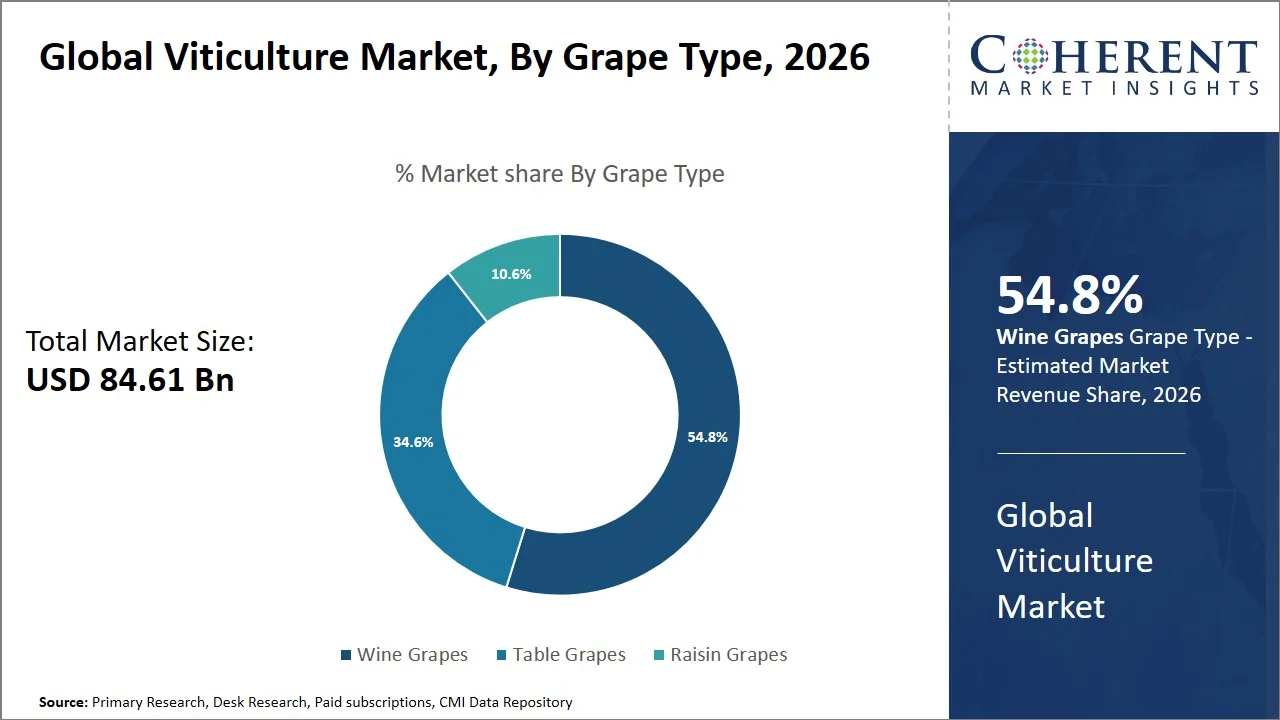
Why Do Wine Grapes Dominate the Global Viticulture Market?
Wine Grapes are expected to hold 54.8% of the global viticulture market in 2026 because they connect vineyard acreage directly with wineries requiring varietal consistency, defined maturity windows, controlled acidity, color, tannin, and predictable crush volumes. Unlike fresh-market grapes, wine grapes can be cultivated around processing specifications rather than retail appearance, allowing growers to optimize vineyard design, canopy management, harvest timing, and long-term winery contracts. The segment also benefits from specialized nurseries, cellar-linked logistics, vineyard advisory services, and established appellation systems that support differentiated pricing. This creates recurring demand across growers, wineries, equipment suppliers, and agronomy providers. In March 2025, South Africa Wine reported that the country’s 2025 wine-grape harvest was progressing with strong fruit quality across major cultivars and wine regions, reinforcing the commercial depth of wine-oriented vineyard production.
- Current Industry Events of 2026
- Market Size Estimation
- Regional Breakdown
- Competitive Landscape
- Customer Intelligence
- Segmental Analysis
- Pricing Analysis
- Key Market Drivers, Challenges & Future Trends
- Customized Insights Section
Why Does Conventional Cultivation Represent the Largest Cultivation Type in the Global Viticulture Market?
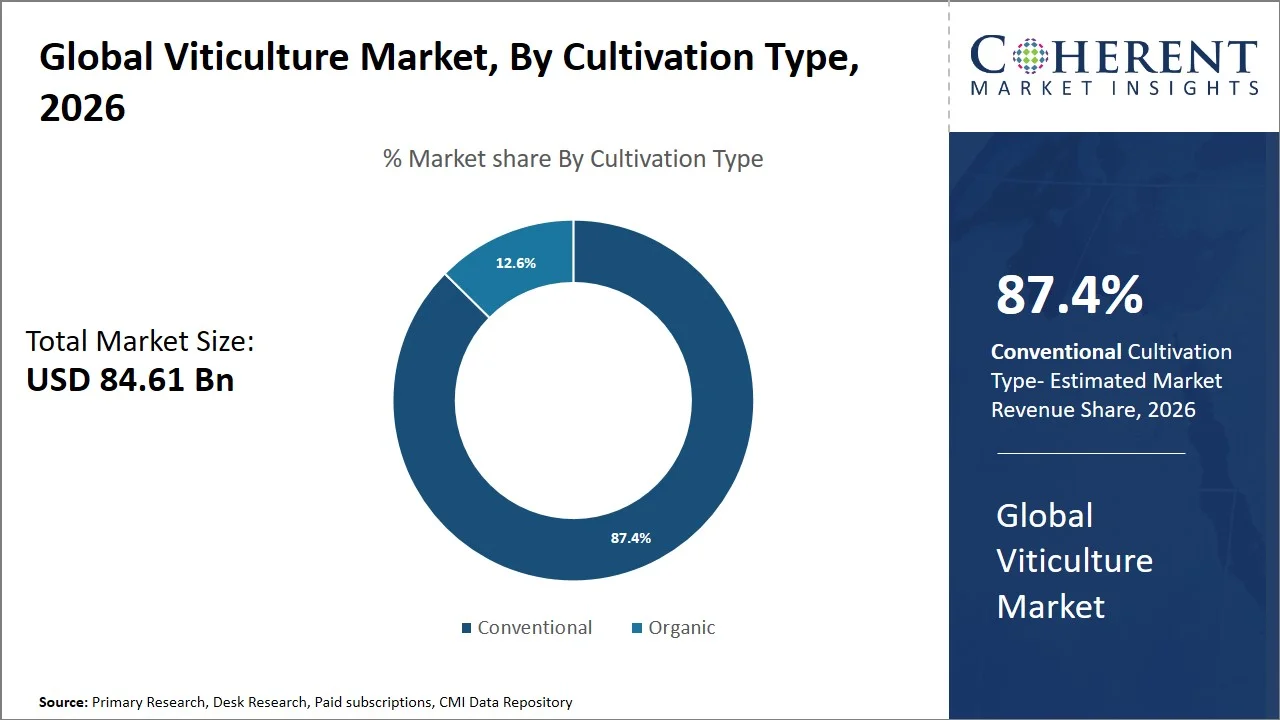
Conventional cultivation is expected to account for 87.4% of the global viticulture market in 2026 because commercial vineyards often require a broad, flexible set of crop-protection, nutrition, weed-control, and disease-management tools to maintain reliable output across large acreages. Conventional systems also integrate readily with mechanized spraying, fertigation, pest monitoring, and established agronomy protocols, reducing transition complexity for growers supplying wineries, processors, and fresh-grape buyers on fixed schedules. The commercial advantage lies in operational predictability: producers can respond quickly to nematodes, fungal pressure, weeds, and weather-linked disease risks while protecting marketable yield and vineyard longevity. In January 2025, Corteva Agriscience launched Salibro CA nematicide for California crops including vineyards after regulatory approval, providing growers with a new mode of action usable pre-plant, at planting, or post-plant through drip irrigation.
Why Does Wine Production Dominate the Application Segment of the Global Viticulture Market?
Wine Production is expected to represent 52.7% of the global viticulture market in 2026 because it converts grapes into a higher-value, storable product supported by wineries, bottling infrastructure, cellars, brands, tourism, export channels, and established grower contracts. Vineyard decisions for this application are closely tied to varietal selection, sugar-acid balance, harvest timing, fermentation suitability, and winery intake capacity, creating tighter integration between cultivation and processing than in other grape applications. This encourages sustained investment in vineyard quality, traceability, grape composition, and processing-linked logistics. Wine production also supports multiple price tiers, from bulk supply to premium origin-led wines, widening commercial outlets for growers and processors. In September 2025, New Zealand Winegrowers reported that industry success had supported investment in 42,000 hectares of vineyards and advanced processing facilities, with 90% of domestically produced wine destined for international markets.
Current Events and their Impact
Current Event | Description and Its Impact |
|
February 2026 – Council of the EU adopts updated wine-sector regulation |
| |
January 2024 – England implements wine reforms including greater freedom for hybrid grape varieties |
| |
March 2024 – China removes anti-dumping and anti-subsidy tariffs on Australian wine |
| |
Global Viticulture Market Dynamics
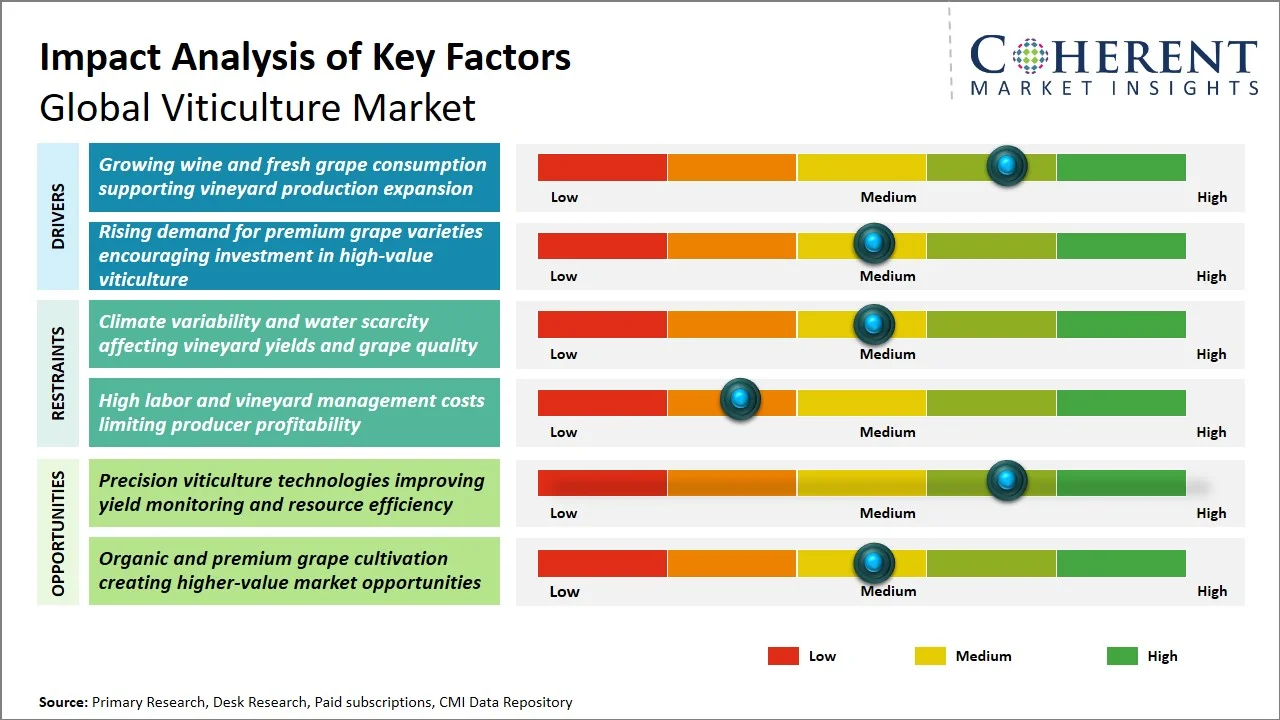
Key Market Drivers
- Growing wine and fresh grape consumption supporting vineyard production expansion: Growing wine and fresh grape consumption supporting vineyard production expansion is strengthening the commercial case for growers to maintain productive acreage, renew vines, and improve post-harvest consistency. Fresh-grape retailers benefit from reliable seasonal supply, while wine-grape growers, nurseries, vineyard contractors, packers, wineries, and input suppliers gain when downstream purchasing supports longer production planning cycles. The mechanism is particularly important because viticulture carries multi-year establishment costs; stronger sell-through improves confidence in replanting, canopy management, irrigation, labor, and crop-protection spending. In October 2025, Lidl GB reported that store-layout upgrades supporting fresh produce helped it become the fastest-growing retailer in fresh-fruit categories including grapes, providing a direct retail signal that grape purchasing remains commercially relevant. This strengthens incentives for suppliers to secure consistent quality, volumes, and delivery windows rather than compete only on spot availability.
- Rising demand for premium grape varieties encouraging investment in high-value viticulture: Rising demand for premium grape varieties encouraging investment in high-value viticulture is shifting grower economics from maximizing tonnage toward protecting flavor, appearance, resilience, harvest timing, and post-harvest performance. Proprietary-variety breeders, licensed nurseries, premium table-grape growers, wineries, exporters, and specialized agronomy providers benefit because differentiated genetics can support stronger buyer loyalty and more defensible pricing. Growers also become more willing to invest in vineyard renewal when improved genetics combine consumer appeal with agronomic advantages such as disease tolerance, yield stability, or better shipping performance. In May 2025, BLOOM FRESH broke ground on a USD 23.33 million Breeding & Technology Center in Blanca, Murcia, including trial fields and research infrastructure for next-generation fruit genetics, with table-grape work covering varieties such as Sweet Globe and Cotton Candy. The investment illustrates how premiumization is increasingly being built into vineyard genetics rather than added only through branding after harvest.
Emerging Market Trends
- Climate-Adaptive Vineyard Design Is Becoming a Long-Term Production Strategy: Climate-adaptive vineyard design is becoming a planned production strategy rather than a short-term response to extreme weather. Growers are reassessing rootstocks, canopy structures, irrigation systems, soil management, elevation, and harvest timing to protect grape quality and vineyard productivity. This is increasing demand for specialized nurseries, irrigation technologies, agronomic services, and vineyard engineering. Over the forecast period, vineyards capable of maintaining grape composition, yield stability, and reliable harvest windows under changing climatic conditions are likely to achieve stronger commercial resilience.
- Vineyard Procurement Is Shifting from Standalone Tools to Integrated Operating Systems: Vineyard technology procurement is shifting toward integrated systems that connect scouting, irrigation, spraying, machinery, labor, and harvest planning. Growers increasingly expect field data to translate directly into lower input use, improved scheduling, and more consistent production decisions. This favors precision-agriculture providers, machinery suppliers, and agronomy firms offering interoperable solutions and technical support. Over the forecast period, competition is likely to center on system integration, operational reliability, data portability, and measurable improvements in vineyard efficiency rather than standalone technology features.
Regional Insights
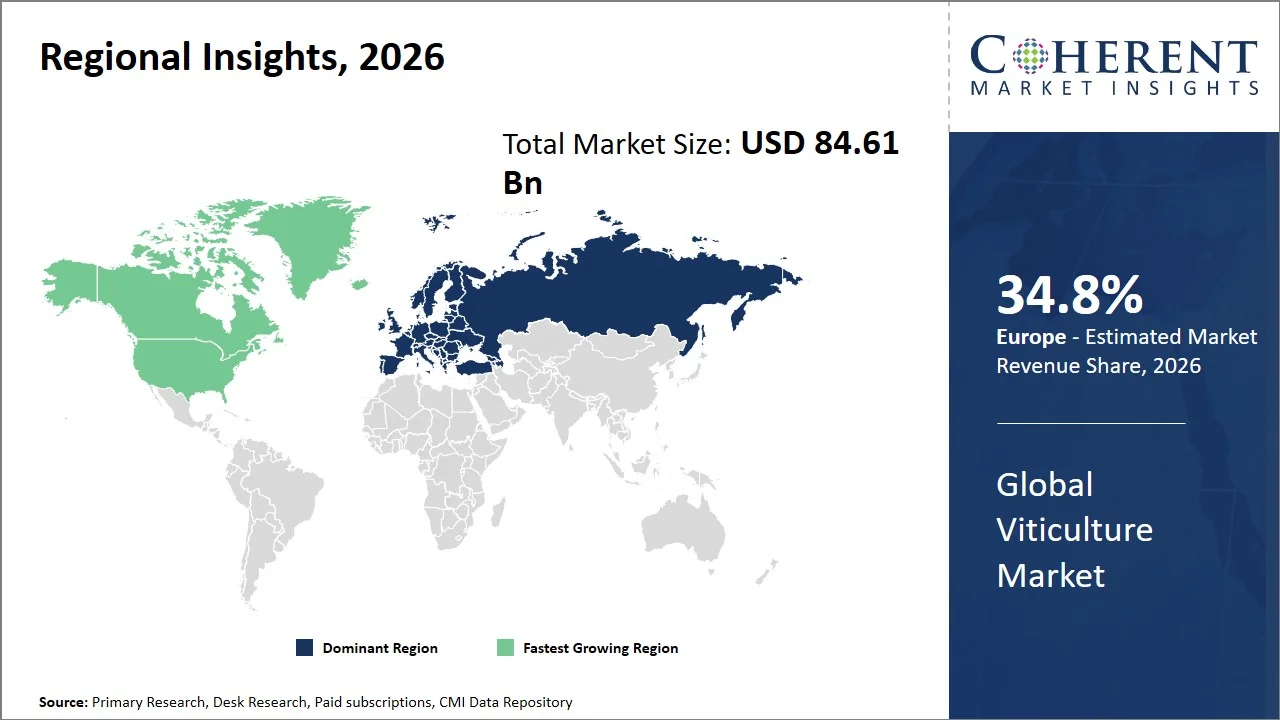
Why Does Europe Dominate the Global Viticulture Market?
Europe is expected to hold 34.8% of the global viticulture market in 2026 and is the dominating region as vineyard economics increasingly shift toward climate adaptation, varietal renewal, precision field management, and higher-value grape and wine positioning. The region combines dense vineyard clusters with research institutions, specialist nurseries, machinery suppliers, cooperatives, and protected-origin wine systems, creating a strong pathway for innovations to move from trials into commercial vineyards. Growth is also supported by the need to manage heat, drought, disease pressure, labor constraints, and evolving consumption patterns without weakening product quality. In July 2025, the EU’s CORDIS platform updated results from the vWISE project, which developed approaches involving grapevine genetic resources, proximal sensing, water-management research, and practical guidance for winegrowers adapting vineyards to climate change. This research-to-field ecosystem strengthens Europe’s capacity to modernize vineyard production while retaining differentiated regional quality.
Why Is Asia Pacific Emerging as the Fastest-Growing Region in the Global Viticulture Market?
Asia Pacific is expected to account for 31.4% of the global viticulture market in 2026 and emerge as the fastest-growing region, supported by expanding commercial grape cultivation, vineyard modernization, higher fresh-grape consumption, and development of premium domestic wine industries across China, India, Australia, and other producing countries. The region benefits from diverse growing climates, improving irrigation and vineyard-management practices, expanding cold-chain and processing infrastructure, and stronger export participation. China’s development of specialized wine-grape clusters further strengthens regional investment in higher-value viticulture. In June 2025, the Ningxia Development and Reform Commission reported that the region had 261 wineries and about 606,000 mu of wine-grape vineyards, with annual wine production reaching around 140 million bottles, demonstrating continued expansion of an important Asia Pacific viticulture cluster.
Global Viticulture Market Outlook for Key Countries
Why Is the U.S. a Key Market for the Global Viticulture Market?
The U.S. is estimated to represent 34.5% of the global viticulture market in 2026, reflecting the commercial weight of California together with established grape production in Washington, Oregon, New York, and other states. Growth is supported by premium wine-grape contracts, sizeable table and raisin grape industries, sophisticated vineyard services, mechanized field operations, and a strong university-extension ecosystem that accelerates adoption of improved production practices. The country also has deep links between vineyards, wineries, packers, distributors, tourism, and export channels, creating multiple revenue streams around grape cultivation. California remains particularly important because its grape sector combines scale with high crop value and technology-intensive production. As of September 2025, California Department of Food and Agriculture statistics valued the state’s 2024 grape crop at USD 5.64 billion, placing grapes among California’s highest-value agricultural commodities and reinforcing the commercial importance of vineyard productivity and quality management.
Why Does China Support Growth in the Global Viticulture Market?
China is estimated to account for 15.9% of the global viticulture market in 2026, supported by a large grape-growing base serving fresh consumption, wine production, processing, and premium domestic channels. Its commercial advantage comes from the coexistence of high-volume table-grape regions and specialized wine-grape clusters such as Ningxia, where dry conditions, irrigation infrastructure, and organized winery development support higher-value viticulture. Investment is increasingly moving toward better cultivars, water efficiency, vineyard tourism, quality control, and branded regional wines rather than acreage expansion alone. This broadens demand for nurseries, irrigation systems, vineyard equipment, agronomy services, and post-harvest infrastructure. In June 2025, official Chinese reporting stated that Ningxia had more than 600,000 mu, or approximately 40,000 hectares, of wine-grape plantations by the end of 2024, alongside an established commercial wine-production ecosystem, demonstrating the scale of China’s specialized vineyard clusters.
Why Is India Important in the Global Viticulture Market?
India is estimated to hold 6.7% of the global viticulture market in 2026, with growth centered on fresh table grapes, export-oriented cultivation, and a smaller but developing wine-grape ecosystem. Maharashtra provides the principal production and export cluster, while Karnataka and other states broaden domestic supply. The country’s competitive position is strengthened by experienced growers, commercial packhouses, residue-monitoring systems, and traceability infrastructure that support access to quality-sensitive overseas markets. Unlike wine-led vineyard economies, Indian viticulture is strongly linked to fresh-fruit realization, making berry quality, cold-chain handling, residue compliance, and export timing critical investment areas. APEDA reports 172.58 thousand hectares under grape cultivation and exports of 224,401.27 metric tons valued at USD 367.99 million during FY2025-26. This export base supports continued investment in vineyard quality management, packhouse efficiency, and internationally compliant production systems.
Why Is France a Strategic Country in the Global Viticulture Market?
France is estimated to account for 8.9% of the global viticulture market in 2026, supported by a mature vineyard economy built around appellation-controlled production, premium wine positioning, specialized grape varieties, technical viticulture services, and a dense network of cooperatives and wineries. Its importance lies less in expanding vineyard area and more in improving the productivity, resilience, and market fit of existing vineyards. Growers are increasingly balancing heritage varieties with restructuring, disease management, climate adaptation, and changing wine-consumption patterns, creating demand for planting material, trellising, vineyard equipment, advisory services, and precision management. In January 2026, FranceAgriMer reported that France had 746,139 hectares of vineyards as of July 2025 and maintained the ceiling for new planting authorizations at 1% of vineyard area, equivalent to 7,461 hectares. The framework illustrates how controlled planting and restructuring shape investment and supply discipline in French viticulture.
Why Is Brazil an Important Growth Market for the Global Viticulture Market?
Brazil is estimated to represent 3.6% of the global viticulture market in 2026, supported by a diversified production model spanning wine grape, table grapes, juice grapes, and tropical or subtropical vineyard systems. Rio Grande do Sul remains the traditional processing center, while Pernambuco, Bahia, Minas Gerais, Goiás, and emerging northeastern areas broaden the country’s production geography. A key growth advantage is the ability of selected irrigated regions to manage multiple vegetative cycles, creating differentiated harvest windows and supporting fresh-grape supply beyond conventional temperate seasons. This raises opportunities for irrigation technology, adapted cultivars, protected cultivation, technical services, and post-harvest logistics. In July 2025, Embrapa Meio-Norte conducted its “Circuito da Uva” in Piauí to demonstrate the state’s viticulture potential and transfer production knowledge to stakeholders. The initiative reflects efforts to expand commercially viable grape cultivation beyond Brazil’s established southern vineyard base.
Technology Adoption Landscape in the Global Viticulture Market
Technology | Adoption Level | Key Application Area | Business Impact |
Mechanical Grape Harvesting with Onboard Sorting | High | Large-scale wine-grape harvesting | Accelerates harvest execution, reduces dependence on seasonal picking crews, and improves throughput where machine harvesting is compatible with vineyard architecture and quality requirements. |
Sensor-Guided Precision Drip Irrigation and Fertigation | High | Root-zone water and nutrient management | Improves water allocation, controls vine vigor, supports grape-quality consistency, and enables growers to manage irrigation more precisely across variable vineyard blocks. |
Multispectral and Hyperspectral Canopy Imaging | Medium | Vine-vigor, stress and maturity assessment | Identifies within-block variability earlier, improving scouting efficiency and enabling more targeted irrigation, nutrition, disease management, and harvest decisions. |
Canopy-Sensing Variable-Rate Spraying | Medium | Crop protection and foliar applications | Adjusts application according to canopy conditions, reducing unnecessary chemical use while improving treatment precision and input-cost control. |
GNSS/RTK-Guided Autonomous Vineyard Machinery | Medium | Weeding, mowing, pruning assistance and spraying | Reduces repetitive manual work, extends available operating hours, and improves task consistency, particularly where labor availability constrains vineyard operations. |
Image-Based Yield and Phenology Forecasting | Medium | Crop-load estimation and harvest planning | Gives vineyard managers earlier visibility into crop development, improving winery intake planning, labor scheduling, harvesting sequences, and buyer communication. |
How Are Shared Precision-Viticulture Services Creating New Growth Opportunities in the Global Viticulture Market?
Shared precision-viticulture services are creating an underdeveloped opportunity by allowing small and mid-sized vineyards to access advanced capabilities without owning every machine, sensor, or software platform. The strongest model is likely to combine contracted vineyard mapping, crop scouting, robotic or precision field operations, irrigation scheduling, disease-risk monitoring, and yield forecasting under a seasonal service agreement. This lowers the capital barrier for growers while giving technology providers recurring revenue and denser equipment utilization across multiple farms. Cooperatives, independent growers, vineyard-management companies, and regions with fragmented holdings are particularly suitable customers. Commercial capture will require local agronomic teams, equipment fleets, dependable field connectivity, data-integration capability, maintenance infrastructure, and pricing models linked to hectares, tasks, or outcomes. The opportunity should favor specialist service operators, machinery dealers, and technology vendors able to build regional networks, while vertically integrated growers may use similar capabilities internally. Success will depend on proving operational reliability and making digital recommendations actionable at field level rather than merely providing dashboards.
Market Players, Key Development, and Competitive Landscape
Key Developments
- In November 2025, New Holland announced and previewed its R4 autonomous robot series concept for specialty crops, including an electric version targeted at narrow vineyards and functions such as inter-row work and spraying. The development remained at concept-preview stage rather than representing an immediate universal commercial rollout. It is important for the global viticulture market because purpose-built vineyard autonomy could reduce dependence on conventional tractor-centered workflows while extending automation into narrow, high-value vineyard configurations.
- In February 2025, Kubota Corporation showcased vineyard-focused smart agricultural technologies including a Smart Robotic Pruner using image analysis to identify grapevine buds, branches, and stems, alongside autonomous spraying technology. This is important for the global viticulture market because pruning and crop-protection operations remain labor-intensive and quality-sensitive; vineyard-specific automation can shift equipment purchasing toward systems capable of executing skilled repetitive tasks with greater operational consistency.
- In February 2025, Orbia Netafim launched its Hybrid Dripline system, combining an integral dripline with a built-in outlet and specifically identifying vineyard applications where fixed dropping points can simplify installation and irrigation management. This is important for the global viticulture market because irrigation infrastructure increasingly needs to address both water-delivery precision and field-labor efficiency, strengthening the value proposition for systems designed around long-lived vineyard layouts rather than generic irrigation configurations.
Competitive Landscape
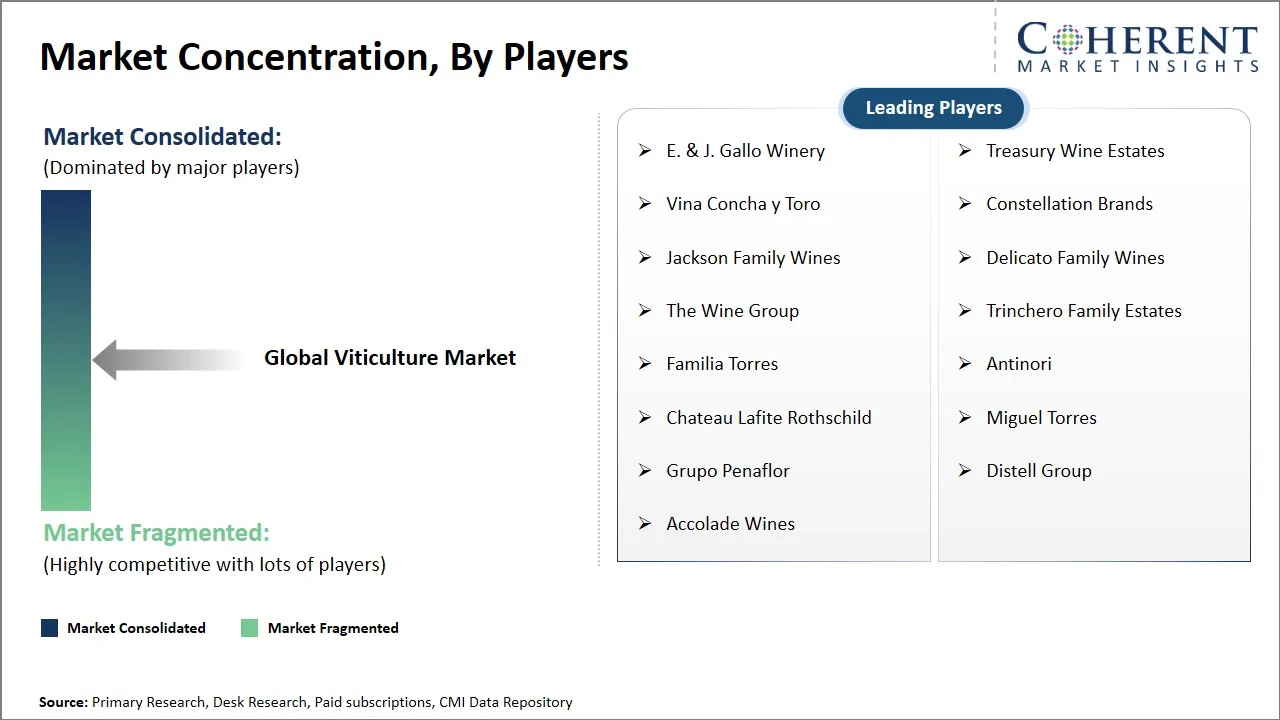
The global viticulture market is fragmented overall, reflecting the large population of independent vineyards, family-owned estates, cooperatives, contract growers, and regional producers operating alongside larger integrated grape and wine businesses. Competitive intensity differs across the value chain: proprietary grape genetics, vineyard machinery, irrigation equipment, crop inputs, and precision-agriculture solutions contain more specialized suppliers, whereas primary grape cultivation remains geographically dispersed. Commercial differentiation increasingly depends on producing grapes to buyer-specific quality, maturity, residue, variety, and delivery requirements while controlling labor, water, and crop-risk exposure. Relationships with wineries, retailers, exporters, nurseries, distributors, and vineyard-management partners therefore remain central to competitive positioning.
Key focus areas include
- Grape quality and specification consistency: Ability to deliver required sugar, acidity, berry size, flavor, color, maturity, and physical condition supports repeat purchasing and contract retention.
- Access to differentiated plant genetics: Proprietary, premium, disease-tolerant, and climate-suitable cultivars can strengthen vineyard economics and reduce direct comparability with commodity supply.
- Harvest-window and supply reliability: Accurate crop planning and dependable execution become critical where wineries and fresh-grape buyers operate tightly scheduled receiving and packing programs.
- Labor and water productivity: Growers with efficient field practices can protect margins when seasonal labor availability or irrigation constraints increase operating complexity.
- Traceability and quality assurance: Documented crop-treatment, origin, residue, and production records strengthen access to demanding export, retail, and premium processing channels.
- Buyer and grower relationships: multi-season contracts, technical collaboration, nursery relationships, and dependable offtake can reduce commercial volatility across the vineyard lifecycle.
- Regional service and distribution capability: Local agronomic support, machinery maintenance, planting-material availability, packing access, and logistics remain important differentiators because viticulture requirements vary significantly by growing area.
Market Report Scope
Viticulture Market Report Coverage
| Report Coverage | Details | ||
|---|---|---|---|
| Base Year: | 2025 | Market Size in 2026: | USD 84.61 Bn |
| Historical Data for: | 2020 To 2024 | Forecast Period: | 2026 To 2033 |
| Forecast Period 2026 to 2033 CAGR: | 4.6% | 2033 Value Projection: | USD 115.92 Bn |
| Geographies covered: |
| ||
| Segments covered: |
| ||
| Companies covered: | E. & J. Gallo Winery, Treasury Wine Estates, Vina Concha y Toro, Constellation Brands, Jackson Family Wines, Delicato Family Wines, The Wine Group, Trinchero Family Estates, Familia Torres, Antinori, Chateau Lafite Rothschild, Miguel Torres, Grupo Penaflor, Distell Group, Accolade Wines | ||
| Growth Drivers: |
| ||
| Restraints & Challenges: |
| ||
Analyst Opinion (Expert Opinion)
- Market leadership is likely to shift from simply controlling vineyard acreage toward managing assured grape supply systems. Stronger participants will connect planting decisions, agronomic protocols, harvest specifications, quality verification, crop data, and buyer commitments. This could make contractual coordination and supply visibility nearly as important as vineyard ownership, particularly for companies seeking reliable multi-region sourcing without concentrating capital in owned agricultural land.
- A deeper disruption may come from risk-sharing commercial models across growers, buyers, financiers, insurers, and service providers. Future contracts could combine guaranteed offtake, quality-linked pricing, production-service agreements, and risk-transfer mechanisms. Participants able to assess crop condition and expected output earlier in the season will be better positioned to reduce uncertainty around working capital, procurement planning, and production risk.
- Market participants should prioritize operational optionality rather than maximum fixed-capacity exposure. Investment should favor vineyards that can accommodate alternative cultivars, flexible irrigation, changing buyer specifications, selective mechanization, and multiple sales channels. Suppliers should strengthen technical support, while companies should avoid excessive dependence on a single export market, cultivar, closed-data platform, or inflexible high-cost vineyard configuration.
Speak to the analyst
Want personalized insights?
Take the findings above to one of our principal consultants, or have the report rebuilt around the segments, geographies and competitors you actually track.
Market Segmentation
- Grape Type Insights (Revenue, USD Bn, 2021 - 2033)
- Wine Grapes
- Table Grapes
- Raisin Grapes
- Cultivation Type Insights (Revenue, USD Bn, 2021 - 2033)
- Conventional
- Organic
- Application Insights (Revenue, USD Bn, 2021 - 2033)
- Wine Production
- Fresh Consumption
- Raisins and Dried Grapes
- Juice and Other Processing
- Distribution Channel Insights (Revenue, USD Bn, 2021 - 2033)
- Direct Sales
- Indirect Sales
- Regional Insights (Revenue, USD Bn, 2021 - 2033)
- North America
- U.S.
- Canada
- Latin America
- Brazil
- Argentina
- Mexico
- Rest of Latin America
- Europe
- Germany
- U.K.
- Spain
- France
- Italy
- Russia
- Rest of Europe
- Asia Pacific
- China
- India
- Japan
- Australia
- South Korea
- ASEAN
- Rest of Asia Pacific
- Middle East
- GCC Countries
- Israel
- Rest of Middle East
- Africa
- South Africa
- North Africa
- Central Africa
- North America
- Key Players Insights
- E. & J. Gallo Winery
- Treasury Wine Estates
- Vina Concha y Toro
- Constellation Brands
- Jackson Family Wines
- Delicato Family Wines
- The Wine Group
- Trinchero Family Estates
- Familia Torres
- Antinori
- Chateau Lafite Rothschild
- Miguel Torres
- Grupo Penaflor
- Distell Group
- Accolade Wines
Sources
Primary Research Interviews
- Vineyard owners, grape growers, wine-grape producers, table-grape growers, raisin-grape producers, wineries, packers, exporters, and cooperatives
- Grapevine nurseries, irrigation-system suppliers, crop-protection companies, fertilizers, vineyard machinery, trellising, and precision-viticulture technology providers
- Grape processors, wineries, retailers, distributors, exporters, fresh-produce buyers, and juice/dried-grape processors
- Vineyard managers, viticulturists, agronomists, procurement, production, quality, sustainability, export, marketing, and sales executives
Stakeholders
- Conventional, organic, wine-grape, table-grape, and raisin-grape growers
- Rootstock and grapevine nurseries; fertilizer, pesticide, biocontrol, irrigation, and vineyard-input suppliers
- Pruning, spraying, harvesting, sensing, precision-irrigation, vineyard-monitoring, and farm-machinery providers
- Wineries, grape processors, packhouses, exporters, distributors, retailers, laboratories, certification bodies, and agricultural cooperatives
End-use Sectors
- Wine Production: wineries, wine cooperatives, estate producers, and contract winemakers
- Fresh Consumption: supermarkets, wholesalers, fresh-produce distributors, exporters, and foodservice
- Raisins & Dried Grapes: dried-fruit processors, ingredient suppliers, bakery, confectionery, and retail
- Juice & Other Processing: grape juice, concentrates, extracts, food ingredients, and other processed grape products
Regulatory and Government Bodies
- International Organisation of Vine and Wine (OIV)
- USDA, USDA-NASS, USDA-ARS, U.S. EPA, and state agriculture departments
- European Commission – DG Agriculture and Rural Development, EFSA, and national EU agriculture authorities
- China Ministry of Agriculture and Rural Affairs and General Administration of Customs
- India Ministry of Agriculture & Farmers Welfare and APEDA
- FranceAgriMer and French Ministry of Agriculture; Brazil MAPA and Embrapa
Databases
- OIV Vine and Wine Statistics and World Vine & Wine Sector databases
- FAOSTAT, UN Comtrade, ITC Trade Map, and Eurostat
- USDA-NASS grape production and grape-crush statistics; USDA-FAS trade databases
- APEDA grape export statistics and GrapeNet traceability/certification system
- National agricultural statistics, customs databases, vineyard registers, company reports, and grower databases
Magazines and Journals
- OENO One
- American Journal of Enology and Viticulture
- Australian Journal of Grape and Wine Research
- Vitis – Journal of Grapevine Research
- Agricultural Water Management
- Scientia Horticulturae
- Precision Agriculture
Associations
- International Organisation of Vine and Wine (OIV)
- Wine sector and grape-grower associations across the U.S., Europe, Australia, South Africa, and Latin America
- National winegrower, table-grape, raisin, and agricultural producer associations
- Regional vineyard cooperatives, appellation bodies, and sustainability organizations
Public Domain Sources
- Vineyard area, grape production, yield, variety, harvest, wine-grape crush, and table-grape statistics
- Grape prices, farm-gate pricing, export/import volumes, acreage changes, and regional production
- Rootstocks, irrigation, pruning, crop protection, mechanization, precision viticulture, and vineyard-management practices
- Winery procurement, fresh-grape distribution, cold-chain, packhouse, raisin, and grape-processing information
- Vineyard investments, planting/replanting programs, technology adoption, sustainability initiatives, and climate-adaptation projects
Key Standards and Regulations
- EU Wine Legislation: vineyard planting/replanting authorizations, vineyard registers, certification, declarations, wine-production rules, and sector-support requirements.
- EU Vine Planting Authorization Scheme: regulates orderly vineyard-area development and planting permissions within EU member states.
- Organic Production Requirements: applicable national and regional organic certification rules for organically managed vineyards
- Plant Protection & Pesticide Regulations: country-specific pesticide registrations, residue limits, application controls, and worker-safety requirements
- Phytosanitary & Export Requirements: pest controls, residue testing, traceability, certification, packing, and customs requirements for internationally traded grapes
- GrapeNet – India: export-grape testing, certification, traceability, laboratory, and quality-assurance requirements administered through APEDA.
Proprietary Elements
- CMI Data Analytics Tool, Proprietary CMI Existing Repository of information for last 10 years.
Get access to 250+ pages report
Every segment, forecast, competitor profile and data table behind the analysis above — available for instant download.
- ESOMAR Member
- ISO 9001:2015 Certified
- D-U-N-S Registered
- GDPR & CCPA Compliant
Missing comfort of reading report in your local language? Find your preferred language:
Transform your Strategy with Exclusive Trending Reports
Frequently Asked Questions
The CAGR of global viticulture market is projected to be 4.6% from 2026 to 2033.
The global viticulture market is estimated to be valued at USD 84.61 billion in 2026 and is expected to reach USD 115.92 billion by 2033.
Precision irrigation, vineyard sensors, remote sensing, variable-rate spraying, automated harvesting, and digital crop monitoring are helping growers improve grape quality, optimize resource use, and increase vineyard operating efficiency.
Climate-adaptive vineyard design, precision irrigation, digital vineyard management, sustainable cultivation practices, and increasing use of data-driven crop monitoring are the key trends shaping the global viticulture market.
Wine production, fresh consumption, raisins and dried grapes, and juice and other processed grape products are the major applications in the global viticulture market.
Major growth opportunities include climate-resilient grape varieties, premium and specialty grapes, sustainable vineyard management, precision viticulture services, improved irrigation systems, and expansion of value-added grape products across emerging markets.
In terms of grape type, wine grapes are estimated to dominate the market revenue share in 2026.