

Global Wall Bed Market Size and Forecast – 2026 To 2033
The Global Wall Bed Market is estimated to be valued at USD 4.25 Bn in 2026 and is expected to reach USD 6.78 Bn by 2033, exhibiting a compound annual growth rate (CAGR) of 6.90% from 2026 to 2033. Market development is supported by urban housing constraints, smaller residential layouts, and growing demand for furniture that allows bedrooms, home offices, and living areas to serve multiple purposes.
Suppliers are also expanding digital sales platforms, customization options, and integrated storage and desk configurations to reach urban homeowners, renters, and commercial accommodation providers. In November 2025, Legacy Handcraft launched a consolidated brand and website combining Urban Legacy and Lancaster Handcraft, creating a unified platform for handcrafted Murphy beds, cabinet beds, and other space-saving furniture products.
Key Takeaways of the Global Wall Bed Market
- Vertical wall beds are expected to hold 47.6% of the global wall bed market in 2026 because their upright footprint suits standard room widths, preserves circulation space, and supports integration with desks, shelves, and sofas. In May 2025, Lori Beds promoted mechanized Murphy beds with dedicated queen and twin vertical configurations for multifunctional rooms.
- The queen size segment is expected to account for 39.8% of the market share in 2026, balancing two-person sleeping comfort with dimensions that remain practical for guest rooms, apartments, and home offices. In March 2025, Saatva launched a Murphy Bed Mattress in Twin, Full, and Queen sizes, validating supplier investment in queen-compatible wall-bed sleep systems.
- Engineered wood is expected to capture 48.7% of the market share in 2026 because it enables consistent panel dimensions, scalable flat-pack production, broad finish selection, and lower cabinet weight and cost than many solid-wood alternatives. In April 2026, Forbes highlighted the Bestar Pur Murphy Bed, constructed from engineered wood and steel, among its evaluated wall-bed options.
- North America is expected to represent 34.8% of the global wall bed market in 2026, supported by mature home-improvement retail, established Murphy-bed manufacturers, high multifamily construction, and widespread use of guest rooms as flexible workspaces. In July 2025, NAHB reported that U.S. multifamily completions reached 608,000 in 2024, the highest level since 1986.
- Europe is expected to hold 30.6% of the market share in 2026, with expansion supported by apartment living, housing affordability pressures, renovation-led furnishing, and demand for adaptable interiors across dense cities. In December 2025, Eurostat reported that 16.9% of EU residents lived in overcrowded households in 2024, reinforcing the commercial relevance of furniture that releases usable floor area.
Segmental Insights
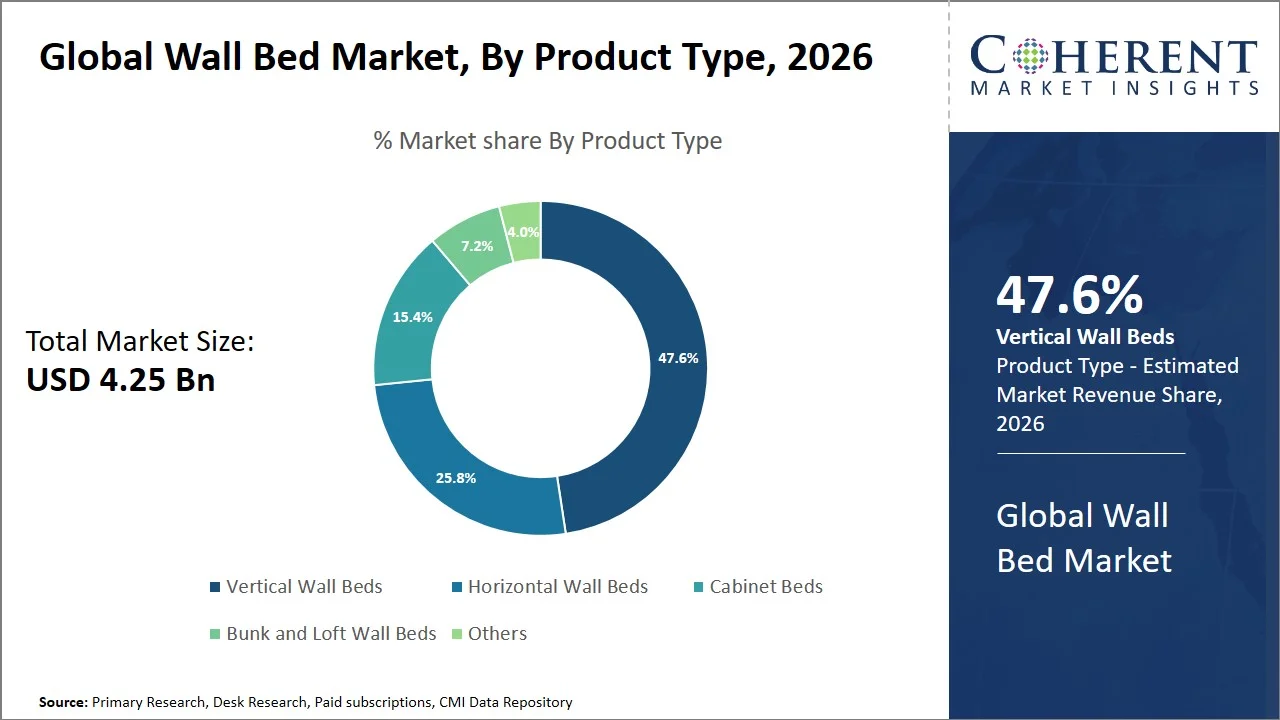
Why Do Vertical Wall Beds Dominate the Global Wall Bed Market?
Vertical wall beds are expected to hold 47.6% of the wall bed market in 2026, as they utilize wall height instead of wide wall frontage. This setup works for normal and larger mattresses in conventional guest rooms, studios, and even home offices, while still allowing wall space to be available for the room to surround a wardrobe, shelving or workstation. Standardized vertical frames also provide a base for the manufacturers to expand on, adding desks, sofas, lighting and storage without having to redesign the lifting mechanism. Dealers enjoy a format that's relevant to a broader spectrum of residential projects and installers will be familiar with the requirements for anchoring and clearance. In October 2024, Hideaway Beds published dedicated guidance distinguishing vertical systems as the traditional option for standard or higher-ceiling rooms and noting their suitability for larger bed sizes, supporting their broader addressable installation base.
- Current Industry Events of 2026
- Market Size Estimation
- Regional Breakdown
- Competitive Landscape
- Customer Intelligence
- Segmental Analysis
- Pricing Analysis
- Key Market Drivers, Challenges & Future Trends
- Customized Insights Section
Why Does Queen Size Represent the Largest Bed Size Segment in the Global Wall Bed Market?
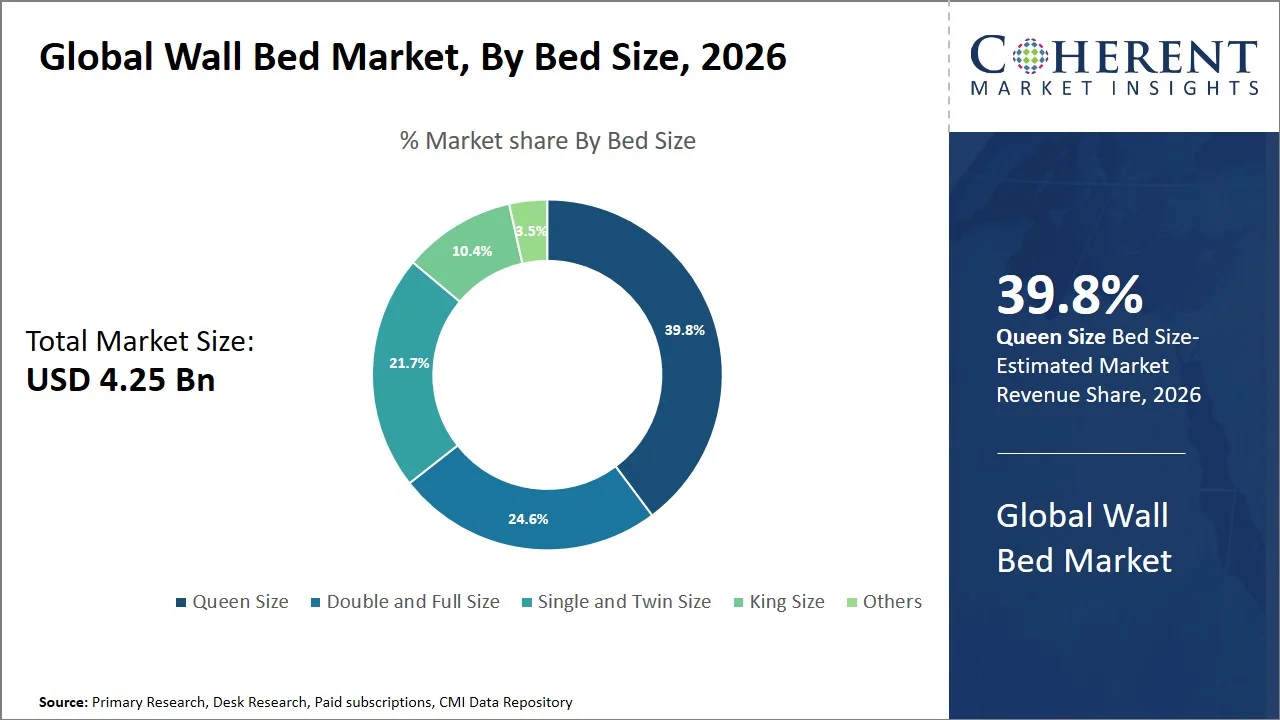
Queen size segment is expected to represent 39.8% of the global wall bed market in 2026 because they offer a commercially attractive middle point between sleeping capacity and cabinet dimensions. The size supports couples, individual premium users, family visitors, and extended-stay guests without requiring the wider structure and heavier mechanism associated with king models. Its standardized mattress dimensions also simplify replacement, merchandising, and compatibility across residential and hospitality channels. Manufacturers can therefore spread mechanism, cabinet, and accessory development costs across a larger buyer base, while hotel operators can add flexible occupancy without permanently sacrificing living or workspace. In June 2025, Hyatt opened The Wildbirch Hotel in Anchorage; Hyatt’s official room inventory identifies an Urban Suite combining two queen beds with a queen Murphy bed and workspace, demonstrating queen-format adoption in a newly opened hospitality property.
Why Does Engineered Wood Dominate the Material Segment of the Global Wall Bed Market?
Engineered wood is expected to account for 48.7% of the global wall bed market in 2026 because it supports precise, repeatable cabinet production at costs suited to both mass-market and mid-premium products. MDF and particleboard provide consistent thickness, stable surfaces, and compatibility with laminates, veneers, edge bands, and painted finishes, allowing brands to offer several visual options from one standardized platform. CNC cutting and nested-panel production further reduce waste and facilitate flat-pack distribution, modular storage additions, and replacement components. These properties are particularly relevant to residential wall beds, where the visible cabinet must coordinate with existing interiors while remaining price-accessible. In April 2025, ANDRITZ announced successful first-fiber production at Metro Decorative’s MDF facility in India, confirming continued investment in scalable panelboard capacity that can support furniture and interior-product manufacturing.
Current Events and their Impact
Current Event | Description and Its Impact |
U.S. TSCA Title VI Laminated-Product Compliance Milestone – March 2024 |
|
EU General Product Safety Regulation Becomes Applicable – December 2024 |
|
Furniture Prioritized Under the EU ESPR Working Plan – April 2025 |
|
Global Wall Bed Market Dynamics
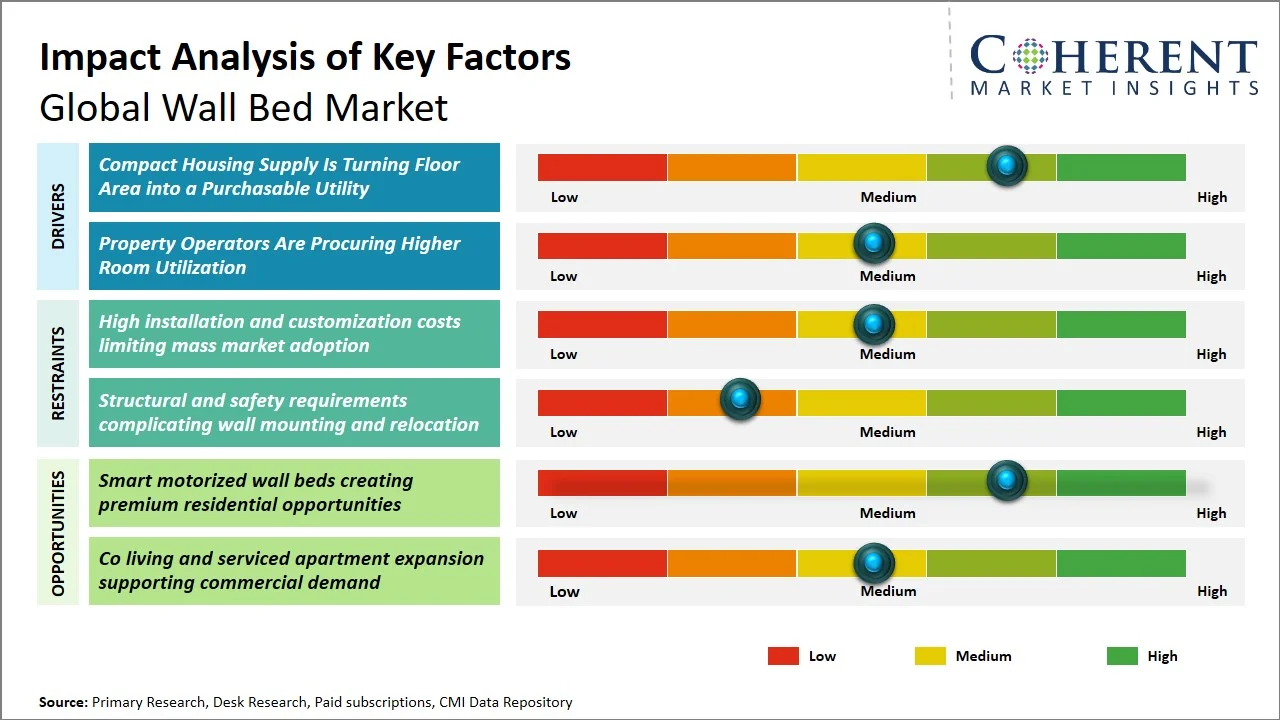
Key Market Drivers
Compact Housing Supply Is Turning Floor Area into a Purchasable Utility
Urban housing constraints convert floor area into a measurable purchasing consideration, strengthening demand for wall beds that return sleeping space to daytime use. Unlike conventional beds, a vertically stored system allows a compact dwelling to accommodate work, dining, exercise, or guest functions without adding another room. This mechanism benefits wall-bed manufacturers, engineered-panel suppliers, counterbalance-hardware producers, installers, residential developers, and furniture retailers offering space-planning services. Commercially, the driver supports higher-value fitted solutions because buyers compare the installed cost with the expense or unavailability of additional floor area rather than with a standard bed alone. In February 2025, Singapore’s Housing & Development Board stated that one in four flats offered in its BTO and SBF exercises were 2-room Flexi units available to singles, illustrating continued institutional supply of compact homes where space-recovery furniture has direct utility.
Property Operators Are Procuring Higher Room Utilization
Multifunctional room planning is shifting wall-bed demand from occasional household purchases toward specification-led residential and hospitality projects. Property operators can use a retractable sleeping platform to change the same room between living, working, meeting, and sleeping modes, improving utilization without altering the building envelope. This creates opportunities for mechanism specialists, contract-furniture manufacturers, architects, hotel procurement teams, co-living operators, and installation partners able to meet repeat-use, warranty, and service requirements. It also raises the value of engineering, controls, acoustic performance, and lifecycle support relative to decorative furniture alone. In February 2024, Ori announced that Marriott would bring its Cloud Bed to selected properties; the company later noted that the collaboration had launched in six U.S. cities. The deployment demonstrates that transformable sleeping systems can form part of an operator’s room-product strategy rather than remain limited to private guest bedrooms.
Emerging Market Trends
Renter-Compatible and Low-Intervention Installation
Wall bed suppliers are developing lighter, modular systems that require minimal wall modification and can be dismantled during relocation. Floor-supported frames, simplified anchoring, reversible finishes, and standardized mounting kits reduce landlord approval barriers and installation concerns. This trend benefits direct-to-consumer brands, modular furniture manufacturers, and installer networks. Transferable warranties and reinstallation services can further convert renter mobility into an after-sales revenue opportunity.
Repairable Mechanisms and Replaceable Surface Architecture
Manufacturers are increasingly separating wall bed frames, lifting mechanisms, cabinet panels, and accessories into serviceable modules. This approach lowers repair costs, simplifies refurbishment, and enables customers to update finishes without replacing the complete system. Hardware specialists and brands with reliable spare-parts networks are positioned to benefit. Repair documentation, replacement components, and maintenance services will become increasingly important, particularly in hotels, student housing, and other contract applications.
Regional Insights
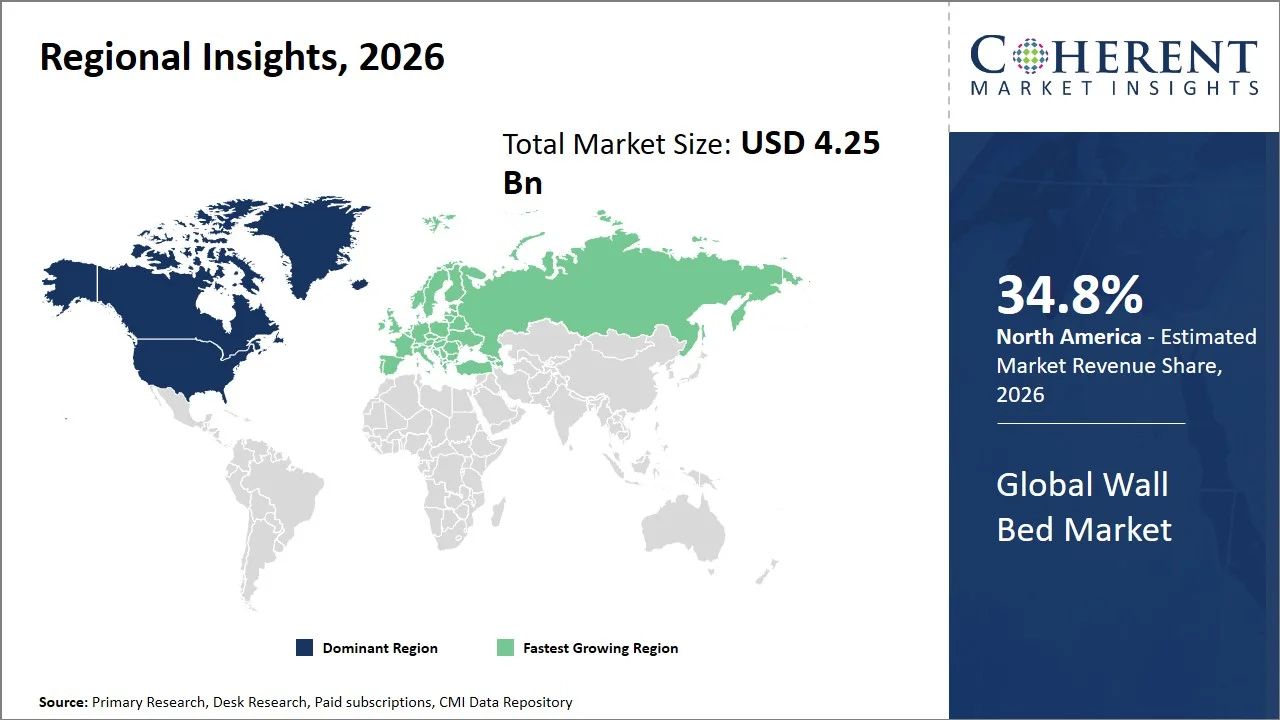
Why Does North America Dominate the Global Wall Bed Market?
North America is expected to dominate the global wall bed market with a 34.8% share in 2026. There is a strong base of expert wall-bed manufacturers, bespoke cabinetry specialists, interior designers, installs and online furniture sellers in the region. Demand is focused on urban apartments, home offices, guest rooms, furnished rentals, co-living projects and senior-friendly complexes where one room needs to serve more than one function in a day. There is also significant interest in paying for counterbalanced mechanisms, integrated sofas, shelving, lighting, and professional installation, enhancing value creation for suppliers. In April 2026, Resource Furniture reported that Park75 in Buffalo had fitted 20 micro-apartments, starting at 290 square feet, with Penelope queen wall beds; these units were the first and among the fastest to lease, demonstrating a direct commercial return from transformable furniture in North American multifamily development.
Why is Europe Emerging as the Fastest-Growing Region in the Global Wall Bed Market?
Europe is expected to emerge as the fastest-growing region in the global wall bed market, accounting for 30.6% of the market share in 2026. Growth is supported by compact urban housing, extensive renovation of older residential stock, premium demand for space-efficient interiors, and strong acceptance of design-led multifunctional furniture. European buyers increasingly evaluate wall beds as long-term fitted-room systems rather than temporary guest beds, encouraging combinations with sofas, desks, storage, and customized finishes. The region also offers established furniture engineering, hardware, panel-processing, and interior-fit-out capabilities that support safer mechanisms and project-specific installation. In April 2026, Italian transformable-furniture manufacturer Clei opened Spazio Clei in Milan, a location dedicated exclusively to contemporary transformable furniture. The investment signals greater retail specialization and consumer education around adaptable living solutions, strengthening the commercial pathway for wall beds across European metropolitan markets.
Global Wall Bed Market Outlook for Key Countries
Why is the U.S. a Key Market for the Global Wall Bed Market?
The U.S. is a key national market for wall beds because it combines a large home-furnishing consumer base with mature remodeling, multifamily development, hospitality, and direct-to-consumer retail channels. Purchases are supported by home offices that must convert into guest rooms, urban rental units requiring higher space productivity, and homeowners seeking built-in storage without adding floor area. The country also has a broad installer and contractor network capable of handling wall anchoring, cabinetry integration, mattress compatibility, and safety requirements, which helps premium products move beyond do-it-yourself buyers. In July 2026, the U.S. Census Bureau published its 2025 Characteristics of New Housing, reporting that 42% of completed multifamily units had one bedroom and the median rental unit measured 1,000 square feet. This concentration of compact rental layouts creates a practical addressable base for vertical and cabinet-style wall-bed systems.
Why is India Important in the Global Wall Bed Market?
India is becoming increasingly relevant to the global wall bed market as apartment-based living expands across major cities and households seek furniture that performs several functions within limited floor areas. Wall beds can address the needs of multigenerational families, working professionals, students, and homeowners using bedrooms as study, work, or guest spaces. Market development will depend on affordable engineered-wood construction, customizable dimensions, reliable installation, and localized after-sales support, since room layouts and wall conditions vary widely. Organized home-furnishing retailers and digital planning tools are also making space-saving concepts easier to visualize and purchase. In April 2025, IKEA opened its first Indian Plan and Order Point in Bengaluru, offering personalized room planning, access to more than 7,000 products, delivery, assembly, and installation services. This service-led format supports wider adoption of planned multifunctional interiors, including integrated sleeping and storage solutions.
Why Does China Support Growth in the Global Wall Bed Market?
China supports growth in the global wall bed market through its extensive furniture manufacturing clusters, engineered-panel capacity, metal hardware supply chain, export infrastructure, and increasingly design-led domestic brands. Manufacturers can combine cabinet production, lifting mechanisms, lighting, storage, and digitally controlled components at scale, supporting both competitively priced products and higher-value customized systems. Domestic demand is reinforced by dense urban housing, younger households, and developers seeking flexible layouts for apartments, serviced residences, and rental projects. Cross-border e-commerce further enables Chinese suppliers to serve international wall-bed brands and private-label buyers. In February 2026, the China International Furniture Fair stated that modular furniture systems were responding to shrinking urban homes and demand for multifunctional living, while highlighting the shift of Chinese companies from order-based manufacturing toward in-house design and research. This transition can strengthen product differentiation, mechanism innovation, and export competitiveness in wall beds.
Why is Germany a Strategic Country in the Global Wall Bed Market?
Germany is a strategic country in the global wall bed market because its furniture sector emphasizes mechanical reliability, precise engineering, product durability, and safe installation. These capabilities are important for wall beds, where hinges, counterbalance systems, load-bearing frames, locking components, and wall fixings directly influence customer confidence. Demand also benefits from renovation activity, single-person living, hybrid work, and preference for furniture that combines practical value with restrained design. German manufacturers and component suppliers are well positioned to serve premium residential projects, hotels, student accommodation, and customized interior fit-outs across Europe. In May 2026, Cologne-based interzum reported that younger and urban buyers were increasingly choosing compact, modular, and multifunctional furniture, while a YouGov survey for Koelnmesse found that Generation Z particularly favored flexible, space-saving solutions. This purchasing pattern closely aligns with integrated wall beds incorporating desks, sofas, and storage.
Why is Brazil an Important Growth Market for the Global Wall Bed Market?
Brazil is an important growth market for wall beds because urban household structures are changing while rental and apartment living are expanding. In metropolitan areas, consumers need furniture that can release floor space during the day, accommodate guests, and add storage without requiring a separate bedroom. Brazil also has a sizeable domestic furniture and wood-panel industry, supporting localized engineered-wood cabinets, finishes, and price points suited to regional purchasing power. Growth opportunities extend beyond owner-occupied homes to furnished rentals, vacation properties, student housing, and compact hospitality rooms. In April 2026, the Brazilian Institute of Geography and Statistics reported that rented homes had increased 54.1% between 2016 and 2025, apartments had expanded 48.7%, and single-person households had risen to 19.7%. These shifts enlarge the customer base for modular, professionally installed wall beds designed for smaller, frequently reconfigured living environments.
Technology Adoption Landscape in the Global Wall Bed Market
Technology | Adoption Level | Key Application Area | Business Impact |
Gas-Piston Counterbalance Systems | High | Assisted opening and closing of vertical and horizontal wall beds | Reduces operating effort, supports controlled movement, and improves usability across residential and hospitality applications. |
Torsion-Spring Balancing Mechanisms | High | Repeated manual operation in residential and contract installations | Provides durable and adjustable lifting force, although precise calibration and professional installation remain important. |
Motorized Linear Actuators with Obstruction Detection | Medium | Premium, accessibility-oriented, and frequently operated wall beds | Supports touch-controlled movement and premium pricing but increases electrical, control-system, maintenance, and after-sales requirements. |
CNC Nested Panel Cutting and Automated Edge-Banding | High | Engineered-wood cabinets, façades, shelving, and integrated storage | Improves dimensional consistency, supports configurable production, reduces panel waste, and lowers assembly errors. |
Digital Room Configurators with Augmented-Reality Placement | Medium | Online measurement, layout planning, finish selection, and customer visualization | Reduces fit uncertainty, improves conversion, enables accessory upselling, and lowers avoidable ordering mistakes. |
Low-Emission Panel Systems and Advanced Surface Finishing | Medium | Indoor cabinetry, residential bedrooms, hotels, and institutional projects | Supports indoor-air-quality positioning, regulatory compliance, finish consistency, and access to specification-led projects. |
How are Contract-Grade Retrofit Programs Creating New Growth Opportunities in the Global Wall Bed Market?
Contract-grade retrofit programs for existing accommodation assets represent a high-potential opportunity beyond conventional household guest rooms. Student residences, co-living properties, extended-stay hotels, workforce housing, and senior-oriented communities often need greater room flexibility but cannot justify structural enlargement or prolonged renovation. Suppliers can address this gap with standardized wall-bed modules supported by site surveys, anchoring specifications, cycle-tested mechanisms, controlled closing, low-emission materials, replacement parts, and service-level commitments. Commercial capture will require dedicated specification teams, installer certification, digital measurement tools, phased pilot projects, and procurement models that combine equipment, installation, inspection, and maintenance. Modular fronts and storage options can preserve property-level design differentiation while a common internal chassis supports manufacturing scale. The opportunity is likely to favor specialist and vertically integrated suppliers that can control hardware quality, documentation, delivery, and after-sales performance. Regional entrants can still compete by pairing certified mechanisms with local panel production and installation capacity. Companies should position the offer around room utilization, lifecycle reliability, and operational continuity rather than selling a retractable bed as an isolated furniture item.
Market Players, Key Development, and Competitive Intelligence
Key Developments
- In August 2025, Hilton opened Motto by Hilton Hong Kong SoHo, whose compact guestrooms include flex beds that stow into the wall and connecting-room configurations for families and groups. This is important for the global wall bed market because it validates retractable beds as a commercially deployable hospitality feature, extending demand beyond residential furnishing into hotel procurement, repeat-use contract furniture, maintenance services, and operator-led space optimization.
- In February 2025, Inovabed launched a dealer program providing authorized retailers with access to its space-saving furniture portfolio, product training, wholesale support, and marketing resources. The announcement also highlighted its Extended Sofa Wall Bed and One Easy Motion mechanism. This is important for the global wall bed market because it expands specialist products through physical retail partners while improving customer education, showroom demonstration, and local sales support.
- In June 2024, BredaBeds partnered with an experienced installer in the Charlotte area and introduced full-service delivery and assembly for qualifying customers. This is important for the global wall bed market because professional installation addresses a major adoption barrier involving cabinet alignment, anchoring, mechanism adjustment, and safe commissioning. The service-led expansion also demonstrates how manufacturers can improve conversion and enter new metropolitan markets without establishing company-owned installation teams.
Competitive Landscape
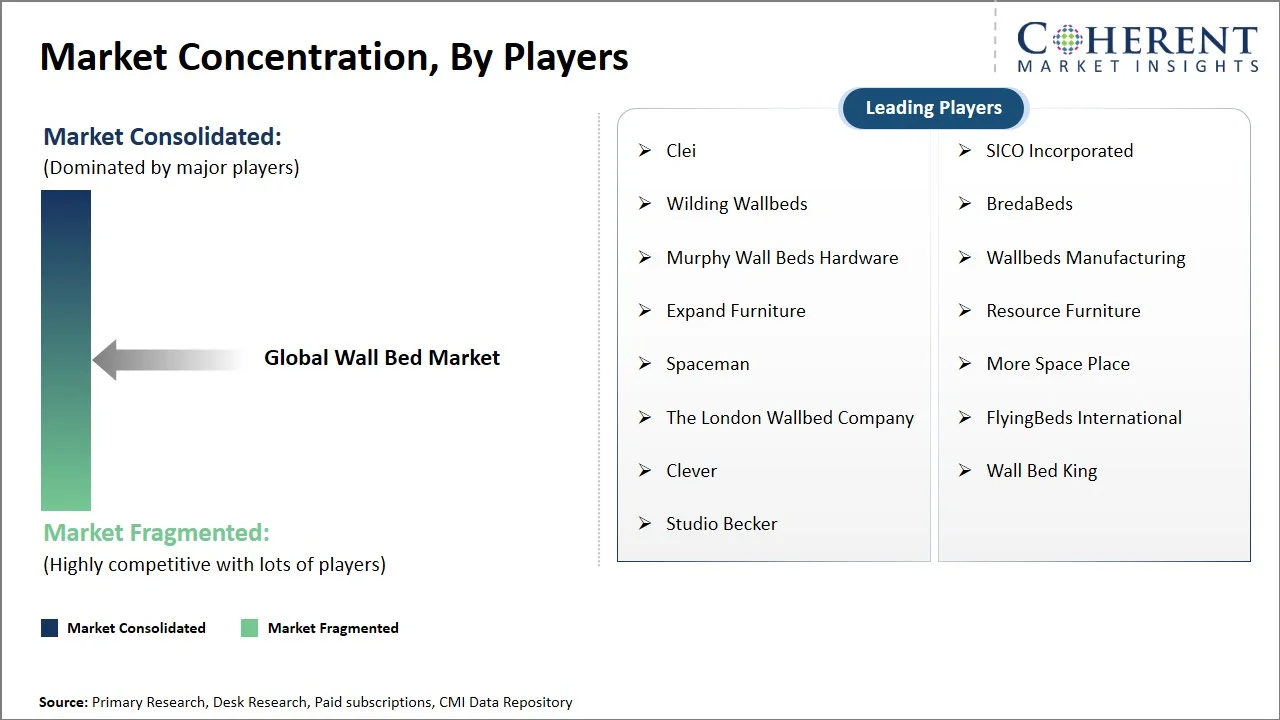
The global wall bed market is fragmented, comprising specialist wall-bed manufacturers, transformable-furniture designers, custom cabinetry businesses, mechanism and hardware suppliers, broad furniture retailers, online sellers, and local installation companies. Competition extends beyond visual design and unit pricing because purchasing decisions also depend on operating safety, mechanism smoothness, dimensional fit, installation competence, material compliance, delivery reliability, warranty coverage, and spare-part availability. Regional specialists retain an advantage in measurement, customization, and site support, while scalable manufacturers benefit from standardized chassis, automated panel processing, digital configuration, and wider dealer networks.
Key focus areas include
- Mechanical safety: Controlled movement, secure locking, anti-tip engineering, and clear anchoring specifications influence buyer confidence.
- Configurable production: Manufacturers must offer finishes, bed sizes, storage, desks, and seating options without creating excessive production complexity.
- Installed ownership cost: Delivery, assembly, wall preparation, maintenance, and repair can be more decisive than the advertised furniture price.
- Material documentation: Traceable panels, adhesives, finishes, and emission compliance support retail access and contract specification.
- Installation coverage: Trained regional installers reduce callbacks, shorten commissioning time, and enable expansion beyond do-it-yourself customers.
- Warranty and spare parts: Accessible replacement hardware and responsive service improve lifecycle value and protect brand reputation.
- Channel capability: Dealer training, digital configuration, architectural specifications, and project-sales support determine access to both residential and institutional buyers.
Market Report Scope
Wall Bed Market Report Coverage
| Report Coverage | Details | ||
|---|---|---|---|
| Base Year: | 2025 | Market Size in 2026: | USD 4.25 Bn |
| Historical Data for: | 2020 To 2024 | Forecast Period: | 2026 To 2033 |
| Forecast Period 2026 to 2033 CAGR: | 6.90% | 2033 Value Projection: | USD 6.78 Bn |
| Geographies covered: |
| ||
| Segments covered: |
| ||
| Companies covered: | Clei, SICO Incorporated, Wilding Wallbeds, BredaBeds, Murphy Wall Beds Hardware, Wallbeds Manufacturing, Expand Furniture, Resource Furniture, Spaceman, More Space Place, The London Wallbed Company, FlyingBeds International, Clever, Wall Bed King, and Studio Becker | ||
| Growth Drivers: |
| ||
| Restraints & Challenges: |
| ||
Analyst Opinion (Expert Opinion)
- The global wall bed market leadership is likely to move from selling cabinets and mechanisms toward delivering complete space-performance solutions. Site assessment, digital configuration, delivery coordination, installation, inspection, warranty management, and refurbishment will increasingly shape purchasing decisions. Suppliers that convert these activities into a consistent service platform should gain stronger customer retention and recurring project access than businesses competing mainly through furniture appearance.
- A modular industry structure could emerge in which safety-critical chassis and balancing mechanisms are produced centrally, while cabinet panels, finishes, storage modules, and installation are completed closer to the customer. This would reduce bulky-product transportation and support faster regional customization. Manufacturers dependent on shipping fully finished bespoke units may face pressure unless they develop standardized interfaces, distributed fabrication partnerships, and stronger quality-control systems.
- Participants should prioritize certified mechanisms, accurate digital measurement, installer training, low-emission materials, spare-parts availability, and clear lifecycle documentation. Repeat-use accommodation and professionally managed rental properties deserve greater attention because service quality can support defensible margins. Companies should control freight damage, installation callbacks, and material-price volatility through local partnerships and modular construction, while avoiding excessive investment in connected features that do not materially improve safety, usability, or maintenance.
Speak to the analyst
Want personalized insights?
Take the findings above to one of our principal consultants, or have the report rebuilt around the segments, geographies and competitors you actually track.
Market Segmentation
- Product Type Insights (Revenue, USD Bn, 2021 - 2033)
- Vertical Wall Beds
- Horizontal Wall Beds
- Cabinet Beds
- Bunk and Loft Wall Beds
- Others
- Bed Size Insights (Revenue, USD Bn, 2021 - 2033)
- Queen Size
- Double and Full Size
- Single and Twin Size
- King Size
- Others
- Material Insights (Revenue, USD Bn, 2021 - 2033)
- Engineered Wood
- Solid Wood
- Metal
- Wood and Metal Combination
- Others
- End User Insights (Revenue, USD Bn, 2021 - 2033)
- Residential
- Hotels and Serviced Apartments
- Student Housing and Hostels
- Offices and Co living Spaces
- Others
- Regional Insights (Revenue, USD Bn, 2021 - 2033)
- North America
- U.S.
- Canada
- Latin America
- Brazil
- Argentina
- Mexico
- Rest of Latin America
- Europe
- Germany
- U.K.
- Spain
- France
- Italy
- Russia
- Rest of Europe
- Asia Pacific
- China
- India
- Japan
- Australia
- South Korea
- ASEAN
- Rest of Asia Pacific
- Middle East
- GCC Countries
- Israel
- Rest of Middle East
- Africa
- South Africa
- North Africa
- Central Africa
- North America
Sources
Primary Research Interviews
- Wall bed, cabinet bed, multifunctional furniture, mechanism, mattress, engineered wood, metal frame, and furniture component manufacturers
- Furniture retailers, e-commerce platforms, distributors, importers, exporters, installers, architects, interior designers, and contractors
- Residential developers, hotels, serviced apartments, student housing, co-living, and rental property operators
- Product development, procurement, production, quality, compliance, logistics, marketing, sustainability, and sales executives
Stakeholders
- Wall bed manufacturers, cabinet makers, contract furniture producers, and custom furniture workshops
- Mechanism, hardware, panel, mattress, adhesive, coating, and fastening suppliers
- Developers, hospitality groups, student housing operators, co-living companies, architects, designers, dealers, and installers
- Testing laboratories, certification bodies, logistics providers, customs brokers, distributors, importers, and exporters
End-Use Sectors
- Apartments, studios, condominiums, houses, guest rooms, home offices, and rental properties
- Hotels, serviced apartments, extended-stay accommodation, vacation rentals, and resorts
- Student housing, hostels, workforce housing, co-living spaces, and senior housing
- Offices, libraries, community facilities, and other multifunctional spaces
Regulatory and Government Bodies
- U.S. Consumer Product Safety Commission, U.S. EPA, U.S. Census Bureau, and USITC
- Health Canada, Statistics Canada, and Canada Border Services Agency
- European Commission, ECHA, Eurostat, and European standardization authorities
- UK Office for Product Safety and Standards, HSE, BSI, and ONS
- China SAMR, China Customs, and the Standardization Administration of China
- Japan Consumer Affairs Agency, METI, MLIT, and JISC
- Bureau of Indian Standards, DGFT, and Ministry of Consumer Affairs
- Brazil INMETRO, ABNT, and Ministry of Development, Industry, Commerce and Services
- ISO, ASTM International, and national furniture testing organizations
Databases
- UN Comtrade, ITC Trade Map, WTO Statistics, Eurostat, USITC DataWeb, World Bank, OECD, and UN-Habitat
- U.S. Census Bureau, Statistics Canada, Destatis, China NBS, Japan Statistics Bureau, India MOSPI, and Brazil IBGE
- China Customs, Japan Trade Statistics, India Export Import Data Bank, and Brazil Comex Stat
- U.S. CPSC recall database, EU Safety Gate, Health Canada recalls, and UK product safety databases
- WIPO PATENTSCOPE, Espacenet, company filings, catalogues, pricing records, and shipment data
- Magazines and Journals
- Furniture Today, Furniture News, Woodworking Network, Hospitality Design, Hotel Business, and Interior Design
- Dezeen, ArchDaily, Sleeper Magazine, Boutique Design, and Designboom
- Forest Products Journal, Applied Ergonomics, Materials & Design, Journal of Cleaner Production, and Journal of Building Engineering
Associations
- American Home Furnishings Alliance
- Business and Institutional Furniture Manufacturers Association
- European Furniture Industries Confederation
- International Sleep Products Association
- Composite Panel Association
- European Panel Federation
- Furniture Industry Research Association
- National Kitchen & Bath Association
- International Interior Design Association
Public Domain Sources
- Product catalogues, installation manuals, mechanism specifications, load limits, anchoring requirements, and safety warnings
- Government data on housing construction, apartment size, rental occupancy, urbanization, and furniture expenditure
- Product recalls, incident reports, safety notices, and corrective action programs
- Material certificates, emission declarations, sustainability certifications, and environmental product declarations
- Annual reports, press releases, project case studies, patents, dealer announcements, retail listings, and warranty policies
Key Standards and Regulations
- ISO 10131 and EN 1129 standards for foldaway bed safety and testing
- ASTM wall bed safety specifications and relevant furniture stability standards
- ISO 9098 and ASTM F1427 for bunk or high-bed configurations
- U.S. Consumer Product Safety Act and applicable furniture safety requirements
- U.S. EPA TSCA Title VI and CARB composite wood emission requirements
- Canadian Consumer Product Safety Act and composite wood formaldehyde regulations
- EU General Product Safety Regulation, REACH, and Ecodesign for Sustainable Products Regulation
- UK product safety and furniture fire safety requirements
- Applicable building codes for anchoring, wall substrates, electrical systems, and fire safety
- ISO 9001, ISO 14001, ISO/IEC 17025, FSC, PEFC, and GREENGUARD standards
Proprietary Elements
- CMI Data Analytics Tool
- Proprietary CMI Existing Repository of information for last 10 years.
Get access to 250+ pages report
Every segment, forecast, competitor profile and data table behind the analysis above — available for instant download.
- ESOMAR Member
- ISO 9001:2015 Certified
- D-U-N-S Registered
- GDPR & CCPA Compliant
Missing comfort of reading report in your local language? Find your preferred language:
Transform your Strategy with Exclusive Trending Reports
Frequently Asked Questions
The CAGR of the global wall bed market is projected to be 6.90% from 2026 to 2033.
The global wall bed market is estimated to be valued at USD 4.25 Bn in 2026 and is expected to reach USD 6.78 Bn by 2033.
Europe is expected to emerge as the fastest-growing region due to compact urban housing, renovation activity, and demand for multifunctional furniture.
Queen-size wall beds lead the market because they balance sleeping comfort, space efficiency, and suitability for residential and hospitality applications.
Engineered wood is the leading material due to its dimensional consistency, design flexibility, cost efficiency, and compatibility with modular cabinet production.
Urban housing constraints increasing demand for space saving furniture and multifunctional room design trends supporting wall bed installations are the major factors driving the growth of the global wall bed market.
High installation and customization costs limiting mass market adoption and structural and safety requirements complicating wall mounting and relocation are the major factors hampering the growth of the global wall bed market.