

Global Home Furnishing Market Size and Forecast – 2026-2033
The Global Home Furnishing Market is estimated to be valued at USD 1.11 Tn in 2026 and is expected to reach USD 2.15 Tn by 2033, exhibiting a compound annual growth rate (CAGR) of 9.9% from 2026 to 2033.
Key Takeaways of the Home Furnishing Market
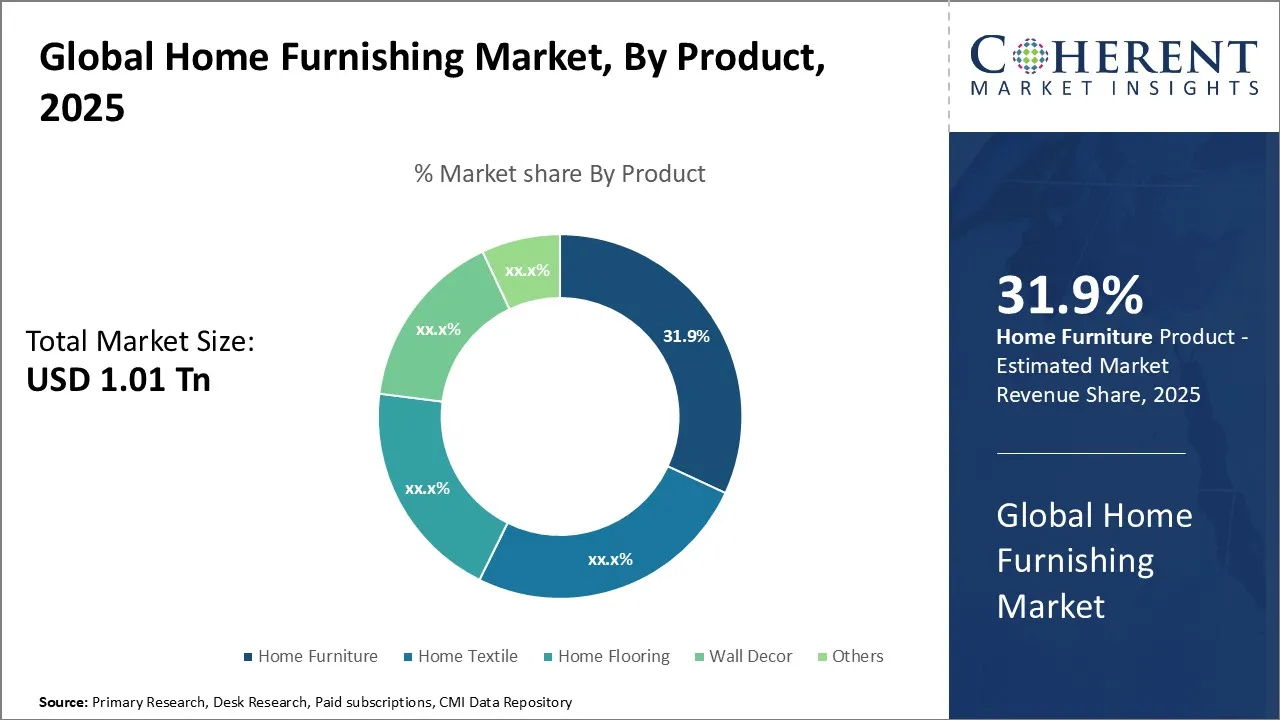
- The home furniture segment is expected to hold a 32.9% market share in 2026.
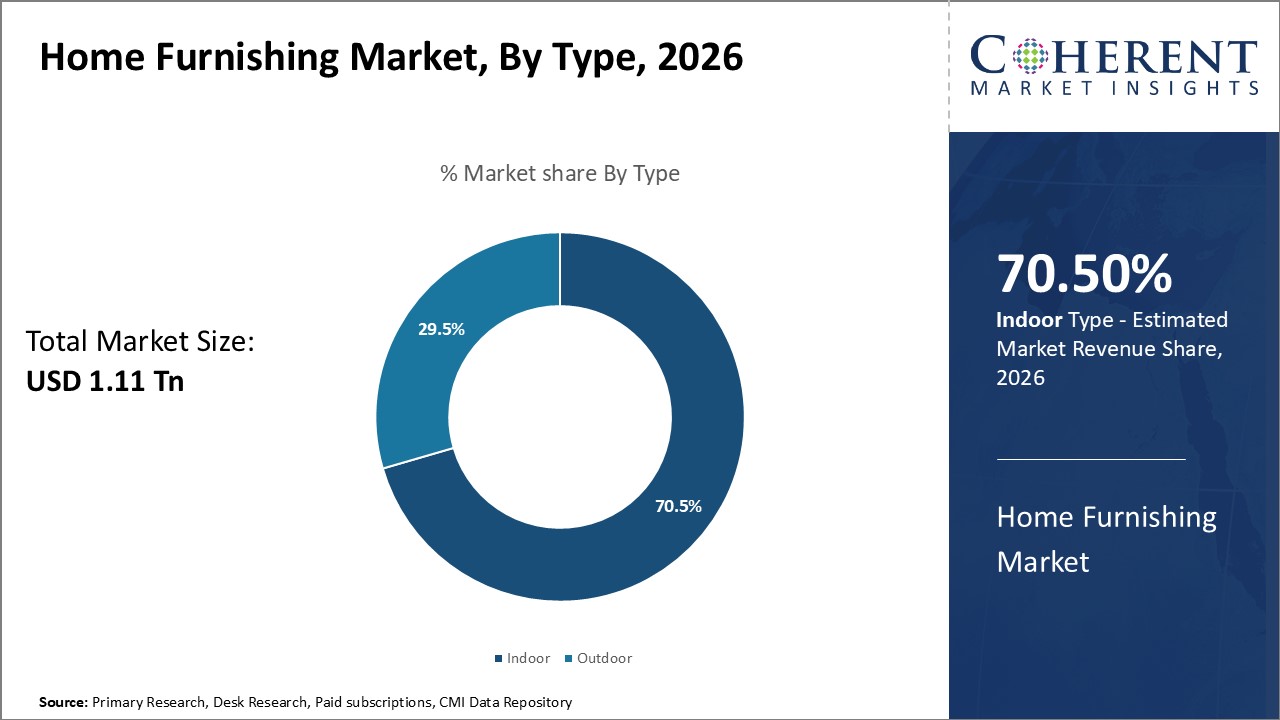
- The indoor segment is projected to account for 70.5 % of the market share in 2026, driven by consumers' focus on comfort, aesthetics, and functionality in indoor spaces.
- Supermarkets & hypermarkets are expected to hold a 33.7 % share of the global home furnishing market in 2026, driven by their unmatched accessibility and convenience for a wide consumer base.
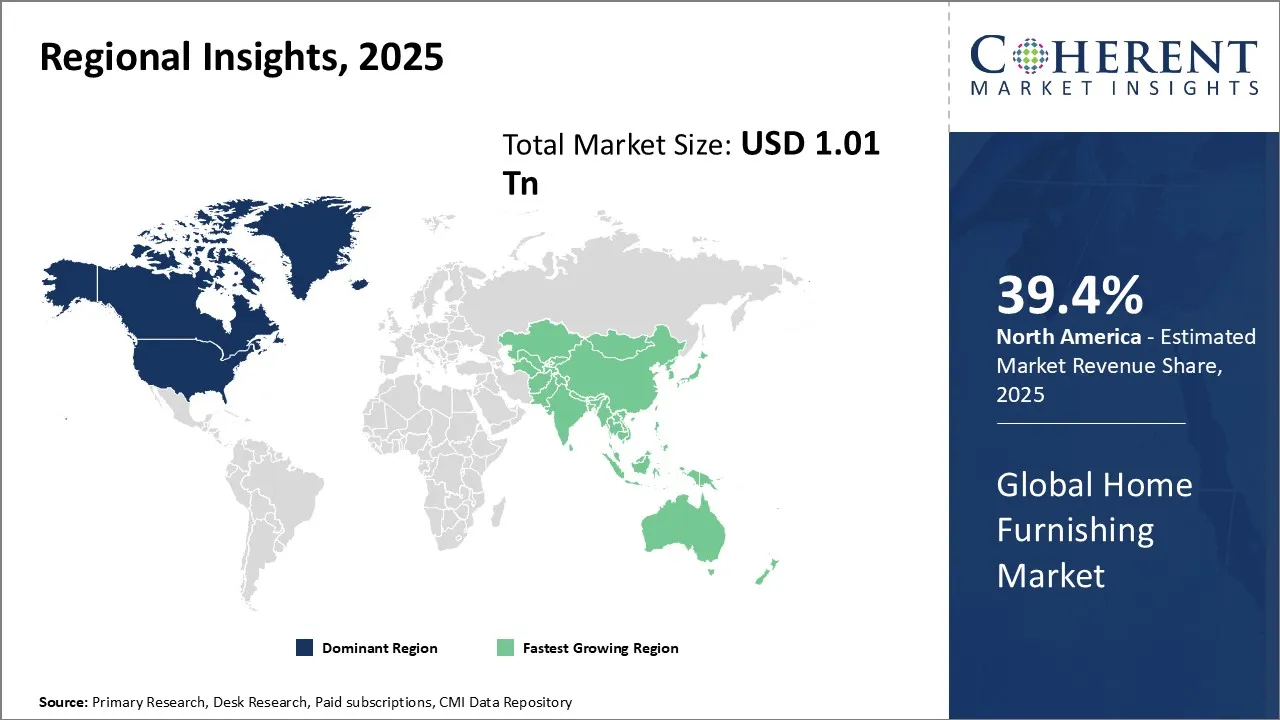
- North America is set to lead the global home furnishing market in 2026 with a 39.4 % share. Asia Pacific, with a 24.5% share, will be the fastest-growing region.
Market Overview
A key market trend in the home furnishing industry is the growing preference for eco-friendly and multifunctional furniture, aligning with consumer awareness about environmental sustainability and space optimization. Additionally, the rise of e-commerce platforms and augmented reality (AR) technologies is transforming the shopping experience, allowing customers to visualize furniture, including office furniture and custom furniture, in their homes before purchasing. These trends are shaping the market landscape, promoting innovation and customization to meet evolving consumer lifestyles and expectations.
Current Events and Its Impact
Current Events | Description and its impact |
Trade Policy Shifts and Rising Tariffs |
|
Surge in Sustainability and Eco-Friendly Demand |
|
Segmental Insights
- Current Industry Events of 2026
- Market Size Estimation
- Regional Breakdown
- Competitive Landscape
- Customer Intelligence
- Segmental Analysis
- Pricing Analysis
- Key Market Drivers, Challenges & Future Trends
- Customized Insights Section
Home Furnishing Market Insights, By Product - Home Furniture Segment Leads Due to Urbanization and Lifestyle Evolution
Home furniture segment is expected to contribute 32.9% share of the market in 2026. This prominence is largely driven by rapid urbanization and evolving consumer lifestyles, which fuel the demand for functional and aesthetically pleasing furniture in residential spaces. As urban populations increase, the need for efficient and space-saving furniture solutions grows, prompting manufacturers to innovate with modular, multi-purpose, and ergonomic designs. These modern furniture options appeal to younger, urban consumers who seek both comfort and style within limited living spaces.
Home Furnishing Market Insights, By Type - Indoor Segment Dominates Due to Comfort and Lifestyle Priorities
Indoor segment is expected to contribute 70.5% share of the market in 2026. This dominance is fundamentally linked to the priority consumers place on comfort, aesthetics, and functionality within their indoor environments. Indoor furnishings encompass a wide range of products, from seating and tables to textiles and decor, all integral to defining personalized and comfortable living spaces.
One of the core factors propelling indoor furnishings is the increasing consumer interest in home décor and interior design trends. Social media platforms and home improvement shows amplify awareness and appreciation for stylish indoor environments, prompting homeowners to invest frequently in updating and enhancing their indoor furnishing. Moreover, interior comfort has gained importance in recent years, with consumers keen to create sanctuaries within their homes that offer relaxation and refuge from the pressures of modern life.
Home Furnishing Market Insights, By Distribution Channel - Supermarkets & Hypermarkets Segment Leads Due to Accessibility and Convenience
Supermarkets & hypermarkets capture an estimated 33.7% share in the global home furnishing market in 2026. This segment’s leadership is predominantly attributed to the unparalleled accessibility and convenience they offer to a large consumer base. These retail formats combine a wide variety of products under one roof, enabling customers to purchase home furnishing items alongside other daily necessities, enhancing the overall shopping experience.
The strategic placement of supermarkets and hypermarkets in both urban and semi-urban areas increases reach and visibility for home furnishing products, especially for middle-income and budget-conscious consumers. These outlets often provide competitive pricing and frequent promotional offers, which further attract cost-sensitive buyers looking to balance quality and affordability.
Regional Insights
North America Home Furnishing Market Analysis and Trends
The North America region is projected to lead the market with a 39.4% share in 2026, driven by a mature and highly developed market ecosystem that includes established retail chains, robust manufacturing capabilities, and a strong consumer base with high purchasing power. The presence of numerous design hubs and innovation centers in the U.S. and Canada further fuels the demand for premium and customized home furnishings. Government policies supportive of domestic manufacturing, coupled with substantial infrastructure investment, create a conducive environment for growth.
As the political and economic landscape shifts in 2026, the newly enacted One Big Beautiful Bill Act (OBBBA) draws close attention from home furnishings retailers nationwide. President Trump signed into law on July 4, 2026, sweeping reforms that aim to stimulate the economy, including tax incentives for manufacturers and retailers, as well as provisions for improving supply chain resilience. These changes are expected to further enhance the competitiveness of North American retailers in the global home furnishing market, ensuring continued growth and expansion.
Asia Pacific Home Furnishing Market Analysis and Trends
The Asia Pacific region is expected to exhibit the fastest growth in the market contributing 24.5% share in 2026, propelled by rapid urbanization, rising disposable incomes, and expanding middle-class populations across countries such as China, India, and Southeast Asian nations. The region’s increasing real estate development, especially in smart cities and luxury residential projects, drives demand for modern and affordable home furnishing solutions.
Government initiatives promoting “Make in India” and China’s manufacturing prowess enhance local production capabilities, reducing reliance on imports and enabling competitive pricing. Furthermore, the evolving e-commerce ecosystem and digital payment platforms facilitate broader market access, attracting both international and local players. Key companies actively shaping this market include Godrej Interio (India), Nitori (Japan), and Kian Furniture (China), all of which focus on blending traditional craftsmanship with contemporary design to meet diverse consumer preferences.
Home Furnishing Market Outlook for Key Countries
U.S. Home Furnishing Market Trends
The U.S. home furnishing market is characterized by innovation and sustainability trends, with a strong focus on smart furniture and eco-friendly materials. Major players such as Ashley Furniture and Herman Miller invest heavily in research and development to align products with evolving consumer lifestyles. Retail giants like Wayfair and IKEA leverage omnichannel sales strategies to enhance customer engagement and experience, contributing to the market’s robust trajectory.
China Home Furnishing Market Trends
China continues to lead the Asia Pacific home furnishing sector owing to its vast manufacturing base and increasing consumer demand for both luxury and affordable furniture. Companies like Kian Furniture and Markor International emphasize product variety and export competitiveness. Government policies supporting domestic production and smart manufacturing innovations further consolidate China’s position as a global hub for home furnishings.
India Home Furnishing Market Trends
India's home furnishing market reflects a blend of traditional and modern home furnishing trends, driven by urban population growth and rising middle-class spending. Government initiatives such as “Atmanirbhar Bharat” encourage local craftsmanship and manufacturing, positioning companies like Godrej Interio and Nilkamal Ltd. at the forefront. Additionally, expanding online marketplaces empower smaller brands to reach wider audiences, enhancing the industry’s overall dynamism.
Germany Home Furnishing Market Trends
Germany's home furnishing market is distinguished by its strong emphasis on high-quality, durable, and design-oriented home furnishing products. Dominated by companies like Hülsta and Rolf Benz, the country benefits from a mature consumer base that values functionality and style. Government regulations promoting sustainability and energy-efficient production reinforce the country’s leadership in environmentally responsible manufacturing practices.
Brazil Home Furnishing Market Trends
Brazil’s home furnishing market is shaped by its diverse cultural influences and growing middle class, which demand affordable yet stylish furniture options. Local manufacturers like Tok&Stok and Etna capitalize on this by providing regionally tailored products. Despite challenges related to import tariffs and economic fluctuations, government efforts to boost domestic industries contribute to steady market development. E-commerce expansion also plays a critical role in reaching consumers beyond urban centers.
Consumer Behavior Analysis of the Home Furnishing Market
Preferences for Online vs Offline Purchasing
- Product Type Matters: Consumers show a clear split depending on the furniture item: lamps, lighting, baby furniture, mattresses, and office furniture are more often purchased online, while recliners, sofas, outdoor furniture, and kitchen tables are frequently bought in-store.
- Motivations for Online: Buyers are drawn to online channels for better prices, free delivery, wider product selection, and shopping convenience. Rich visual content, AR tools, and detailed product information are crucial online, as they compensate for the inability to physically examine products.
- In-Store Motivations: Physical retail is preferred for larger, more tactile items, with consumers valuing the ability to assess comfort, quality, and fit in person.
Influence of Social Media, Influencers, and Design Blogs
- Online Research & Inspiration: Platforms such as Pinterest, Instagram, and design blogs are key sources of inspiration, shaping design preferences and introducing new trends to consumers.
- Influencer Marketing: Influencers play a central role in digital marketing for home furnishing brands, shaping consumer perceptions and boosting the desirability of trending designs, materials, and product ranges.
- Purchasing Decisions: Social media platforms and influencer endorsements contribute significantly to the discovery phase and final purchase choice by offering visual validation, peer reviews, and the latest trends
Market Players, Key Development, and Competitive Intelligence
Key Developments
- In March 2025, Wayfair Inc. unveiled a new standard in home shopping with the launch of Wayfair Verified, a program designed to streamline the shopping experience for customers by highlighting the best products across all styles and price ranges. This trusted seal showcases carefully curated items that have been evaluated and selected by Wayfair's product specialists for their quality and value, making it easier for shoppers to confidently furnish their homes.
- In March 2024, Ashley Home, Inc. and Resident Home, Inc. announced an agreement under which Ashley Home, Inc., an affiliate of Ashley Global Retail, LLC, will acquire Resident Home, Inc. This acquisition, which was unanimously approved by both companies' Boards of Directors, enables Resident—a leading digital retailer and wholesaler of mattresses and bedding accessories—to expand its home furnishings range and global presence. The partnership with Ashley Furniture Industries, LLC will enhance Resident's sourcing and operational efficiencies, driving further growth in both its direct-to-consumer and wholesale businesses.
- In May 2023, Williams-Sonoma, Inc., the world’s largest digital-first, design-led, and sustainable home retailer, launched a new brand, GreenRow, under its portfolio. Designed and developed in-house, GreenRow focuses on creating heirloom-quality, vintage-inspired products using sustainable materials and manufacturing practices. Its debut collection includes a variety of home essentials, such as living, bedroom, and dining furniture, rugs, bedding, bath, baby products, lighting, pillows, throws, curtains, table linens, dinnerware, and décor.
Top Strategies Followed by Global Home Furnishing Market Players
- Established players in the global home furnishing market, such as IKEA, Ashley Furniture, and Steelcase, capitalize on their strong brand recognition and substantial financial resources to focus heavily on research and development (R&D).
- For instance, IKEA has invested in sustainable innovations, like its focus on circular design and using renewable materials in its products, aligning with growing consumer demand for eco-friendly options. These companies innovate high-performance and aesthetically appealing products by leveraging emerging material technologies and customer insights, ensuring their offerings stay in tune with evolving consumer preferences.
- Mid-level players in the home furnishing industry adopt a contrasting but complementary strategy centered around cost-effective solutions. These companies aim to strike a balance between quality and affordability, specifically targeting price-sensitive consumers who seek durable and stylish furnishings without premium price tags. By leveraging collaborations with technology providers, production facilities, or even logistics partners, mid-sized firms boost their operational efficiency and scale production capabilities without compromising on product standards.
- For instance, Wayfair, which operates primarily online, leverages its large-scale supply chain and partnerships with various manufacturers to offer an extensive range of products at various price points, from affordable to high-end options. The online marketplace model allows mid-level players to reach diverse demographics and scale efficiently.
- Small-scale players occupy a unique niche within the global home furnishing market by concentrating on specialized features or innovative product lines that cater to highly specific customer needs. They continuously adopt cutting-edge technologies such as smart home integration, eco-friendly materials, or bespoke design capabilities to differentiate themselves from mainstream competitors. By addressing unmet needs or distinct aesthetic sensibilities, these smaller firms strengthen their competitive edge despite limited resources.
- For example, Tuft & Needle and BenchMade Modern focus on high-quality, customizable products that cater to specific customer needs. Tuft & Needle specializes in affordable, direct-to-consumer mattresses and is known for its simplicity and transparency in product offerings, catering to consumers who prioritize both comfort and value.
Market Report Scope
Home Furnishing Market Report Coverage
| Report Coverage | Details | ||
|---|---|---|---|
| Base Year: | 2025 | Market Size in 2026: | USD 1.11 Tn |
| Historical Data for: | 2020 To 2024 | Forecast Period: | 2026 To 2033 |
| Forecast Period 2026 to 2033 CAGR: | 9.9% | 2033 Value Projection: | USD 2.15 Tn |
| Geographies covered: |
| ||
| Segments covered: |
| ||
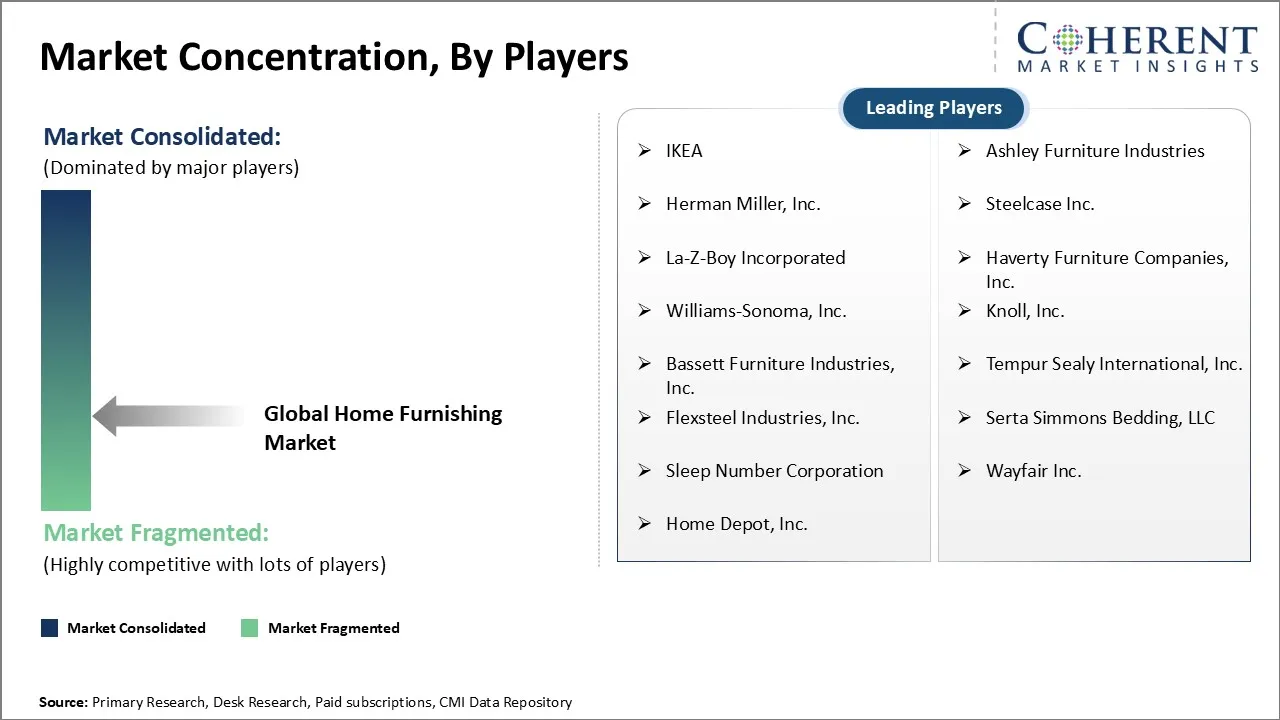
| Companies covered: | IKEA, Ashley Furniture Industries, Herman Miller, Inc., Steelcase Inc., La-Z-Boy Incorporated, Haverty Furniture Companies, Inc., Williams-Sonoma, Inc., Knoll, Inc., Bassett Furniture Industries, Inc., Tempur Sealy International, Inc., Flexsteel Industries, Inc., Serta Simmons Bedding, LLC, Sleep Number Corporation, Wayfair Inc., and Home Depot, Inc. | ||
| Growth Drivers: |
| ||
| Restraints & Challenges: |
| ||
Home Furnishing Market Dynamics
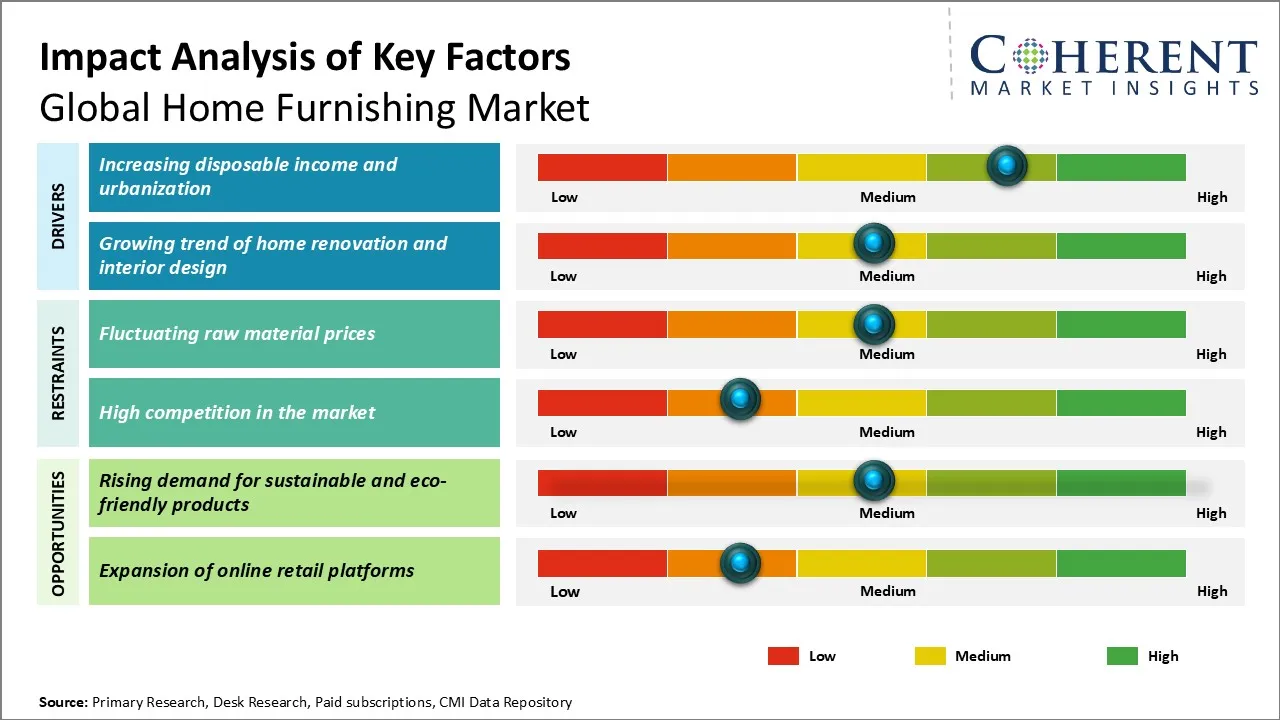
Home Furnishing Market Driver - Increasing Disposable Income and Urbanization
The increasing disposable income and urbanization are driving the home furnishing market, as more consumers in urban areas are opting for stylish, functional furniture and home accessories. For example, in cities like Bangalore and Mumbai in India, the growing middle-class population, coupled with higher income levels, has led to increased demand for premium home furnishings, including modern sofas, smart furniture, and customized decor. Additionally, urbanization has resulted in the rise of compact living spaces, boosting the demand for space-saving, multi-functional furniture like modular sofas and foldable beds.
For example, Home Centre offers a range of space-saving furniture such as the Cosmo 2-Seater Sofa cum Bed and Foldable Dining Tables, ideal for apartments with limited space.
Home Furnishing Market Opportunity - Rising Demand for Sustainable and Eco-Friendly Products
The global home furnishing market is witnessing a significant opportunity driven by the rising demand for sustainable and eco-friendly products. Consumers are becoming increasingly conscious of their environmental impact and are actively seeking products that align with their values of sustainability and responsible consumption. This shift is propelled by growing awareness about climate change, resource depletion, and the harmful effects of non-biodegradable materials. As a result, there is a surge in preference for home furnishings made from natural, renewable, and recycled materials such as bamboo, reclaimed wood, organic cotton, and recycled metals.
For example, West Elm, a leading home furnishing brand, has incorporated eco-friendly materials like reclaimed wood, organic cotton, and recycled materials into its product offerings. The brand also partners with artisans globally to promote sustainable and ethical manufacturing processes.
Analyst Opinion (Expert Opinion)
- The global home furnishing market is navigating a transformative phase, driven by shifts in consumer behavior and an increasing focus on sustainability. Brands like IKEA and Wayfair are leading the charge by integrating eco-friendly materials and innovative designs, as evidenced at the recent International Contemporary Furniture Fair (2023) and the Home Furnishings Conference (2022).
- Presentations highlighted successful case studies where companies adopted circular economy principles, emphasizing recycling and upcycling practices that resonate with environmentally conscious consumers. For instance, IKEA's initiative to source sustainable wood and reduce plastic use was a focal point of discussions, showcasing its commitment to sustainability. Additionally, the rise of remote work has spurred demand for multifunctional furniture, prompting brands to innovate designs that optimize space without compromising style.
- The growing trend of personalization in home decor, facilitated by digital platforms, also emerged as a significant driver in recent market analyses. As consumers increasingly seek unique and sustainable solutions for their living spaces, the home furnishing market is well-positioned for growth, with companies that prioritize innovation and sustainability likely to thrive in this evolving landscape.
Speak to the analyst
Want personalized insights?
Take the findings above to one of our principal consultants, or have the report rebuilt around the segments, geographies and competitors you actually track.
Market Segmentation
- Product Insights (Revenue, USD Tn, 2021 - 2033)
- Home Furniture
- Home Textile
- Home Flooring
- Wall Decor
- Others
- Type Insights (Revenue, USD Tn, 2021 - 2033)
- Indoor
- Outdoor
- Distribution Channel Insights (Revenue, USD Tn, 2021 - 2033)
- Supermarkets & Hypermarkets
- Specialty Stores
- Online
- Others
- Regional Insights (Revenue, USD Tn, 2021 - 2033)
- North America
- U.S.
- Canada
- Latin America
- Brazil
- Argentina
- Mexico
- Rest of Latin America
- Europe
- Germany
- U.K.
- Spain
- France
- Italy
- Russia
- Rest of Europe
- Asia Pacific
- China
- India
- Japan
- Australia
- South Korea
- ASEAN
- Rest of Asia Pacific
- Middle East
- GCC Countries
- Israel
- Rest of Middle East
- Africa
- South Africa
- North Africa
- Central Africa
- North America
- Key Players Insights
- IKEA
- Ashley Furniture Industries
- Herman Miller, Inc.
- Steelcase Inc.
- La-Z-Boy Incorporated
- Haverty Furniture Companies, Inc.
- Williams-Sonoma, Inc.
- Knoll, Inc.
- Bassett Furniture Industries, Inc.
- Tempur Sealy International, Inc.
- Flexsteel Industries, Inc.
- Serta Simmons Bedding, LLC
- Sleep Number Corporation
- Wayfair Inc.
- Home Depot, Inc.
Sources
Primary Research Interviews
- Head of Product Development – Leading Home Furnishing Brand
- Procurement Manager – Major Retailer of Furniture and Home Accessories
- Sustainability Lead – Home Furnishing Certification Body
- Senior Designer – Well-Known Textile and Upholstery Manufacturer
Stakeholders
- Manufacturers
- End-use Sectors:
- Residential
- Commercial (Hotels, Offices, and Restaurants)
- Retailers and Distributors
- E-commerce Platforms – Online Home Furnishing Stores and Marketplaces
- Technology Integration Players – Smart Home Furniture Providers
Databases
- UN Comtrade Database
- India Import Export (EXIM) Database
Magazines
- Home & Design Magazine – Latest Trends in Home Furnishing and Interior Design
- Furniture Today – Innovations in the Furniture Industry and Global Market Trends
- Living & Decor – Market Analysis of Home Accessories and Soft Furnishings
- Interior Design Business – News and Updates on Interior Furnishings and Market Insights
- HomeStyle Magazine – Retail Trends in Home Furnishings and Design
Journals
- Journal of Interior Design – Market Trends and Design Evolution in Home Furnishings
- International Journal of Home & Design – Innovations in Furniture and Soft Furnishings
- Journal of Consumer Research – Trends in Consumer Preferences for Home Furnishings
Newspapers
- The Financial Times – Growth of the Home Furnishing Industry and Market Shifts
- The Guardian – Sustainability in Home Furnishings and Design Preferences
- Asia Home Business Journal – Market Trends and Consumer Behavior in Home Furnishing in Asia
- European Design News – Regulatory Insights and Market Performance in the Home Furnishing Sector
- The New York Times – Emerging Consumer Preferences and Home Furniture Sales Trends
Associations
- American Home Furnishings Alliance (AHFA)
- European Furniture Manufacturers Federation (EFMF)
- International Furnishings and Design Association (IFDA)
- National Home Furnishings Association (NHFA)
- Furniture Industry Research Association (FIRA)
Public Domain Sources
- U.S. Environmental Protection Agency (EPA) – Regulations on Furniture Sustainability and Safety
- European Commission – EU Regulations on Home Furnishing Products
- World Trade Organization (WTO) – Trade Guidelines and Tariff Information for Furniture and Home Furnishing Products
Proprietary Elements
- CMI Data Analytics Tool, Proprietary CMI Existing Repository of information for last 8 years.
Get access to 250+ pages report
Every segment, forecast, competitor profile and data table behind the analysis above — available for instant download.
- ESOMAR Member
- ISO 9001:2015 Certified
- D-U-N-S Registered
- GDPR & CCPA Compliant
Missing comfort of reading report in your local language? Find your preferred language:
Transform your Strategy with Exclusive Trending Reports
Frequently Asked Questions
The global home furnishing market is estimated to be valued at USD 1.11 Tn in 2026 and is expected to reach USD 2.15 Tn by 2033.
The CAGR of the global home furnishing market is projected to be 9.9% from 2026 to 2033.
Home decor refers to the aesthetic elements and style of a space, while home furnishings include functional items like furniture, curtains, and rugs.
Smart homes are influencing furnishing styles by integrating technology into furniture, enhancing convenience, comfort, and functionality with features like voice control and automation.
Increasing disposable income and urbanization and growing trend of home renovation and interior design are the major factors driving the growth of the global home furnishing market.
Fluctuating raw material prices and high competition in the market are the major factors hampering the growth of the global home furnishing market.
In terms of product, home furniture is estimated to dominate the market revenue share in 2026.