

Door Handles Market Size and Share Analysis - Growth Trends and Forecasts (2026 - 2033)
The door handles market is anticipated to grow at a CAGR of 5.73% with USD 9.22 Bn in 2026 and is expected to reach USD 12.90 Bn in 2033. Attributing factors such as increasing residential and commercial properties (There is 8,975,232 Global Commercial Real Estate businesses as of 2025) or complexes are fueling growth of the door handles market. Increasing manufacturing of doors and windows promotes the growth for the door handles because they are not only used as a mechanical tool to open and close the door but they also contribute towards the aesthetic appearance of the door. These factors are anticipated to propel the demand for door handles over the forecast period.
Key Takeaways
- Metal type is expected to account the largest share of 60% in 2026, metal handles (aluminum, stainless steel, brass, zinc alloys) are preferred for durability, aesthetics, and a premium feel in construction activities. Global construction activity is forecast to fall 2.4% over 2025 to USD9.4 trillion and then grow 3.4% in 2026 to USD9.8 trillion.
- Residential will dominate with 55% in 2026, homebuilders increasingly favor stylish and durable handles for apartments, houses, and gated communities. Global construction costs are were expected to rise by 3.4 per cent in 2025.
- Asia Pacific is expected to acquire the dominant share of 45% in 2026, escalating urbanization, large-scale residential as well as commercial construction in China, India, Southeast Asia, etc. India alone has five megacities, and China has four. Five of the world's megacities in 2025.
Segmental Insights
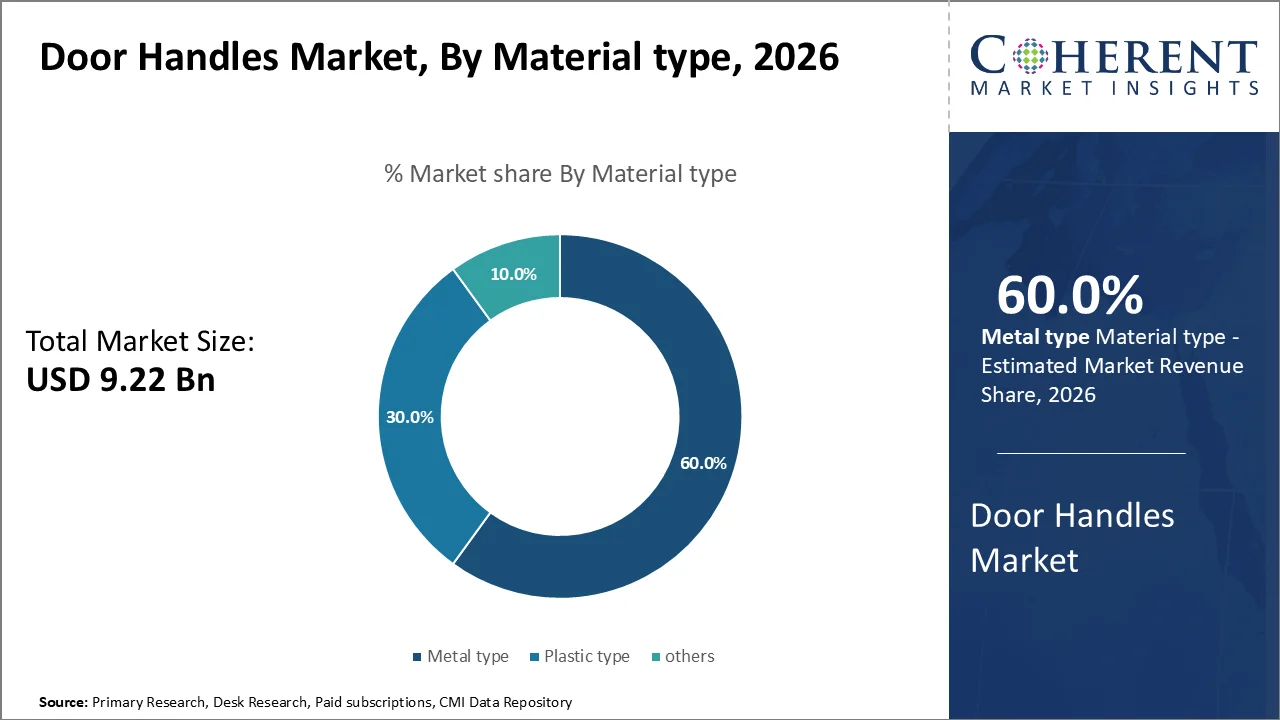
Why is Metal type Acquiring the Largest Market Share?
Metal type is projected to account for the largest share of material type in 2026, representing approximately 60% of the total volume. The superior durability, aesthetic appeal, as well as established manufacturing infrastructure that has been refined over decades of industrial production which is propelling the market growth. According International Monetary Fund, global factories remained busy in October, with global industrial output rising by 0.2 percent in October 2025.
Metal door handles, particularly those manufactured from stainless steel, brass, as well as aluminum alloys, have maintained their dominance owing to their inherent strength characteristics that can resist repeated use in high-traffic environments such as commercial buildings, hospitals, educational institutions, etc.
- Current Industry Events of 2026
- Market Size Estimation
- Regional Breakdown
- Competitive Landscape
- Customer Intelligence
- Segmental Analysis
- Pricing Analysis
- Key Market Drivers, Challenges & Future Trends
- Customized Insights Section
Residential holds the Largest Market Share
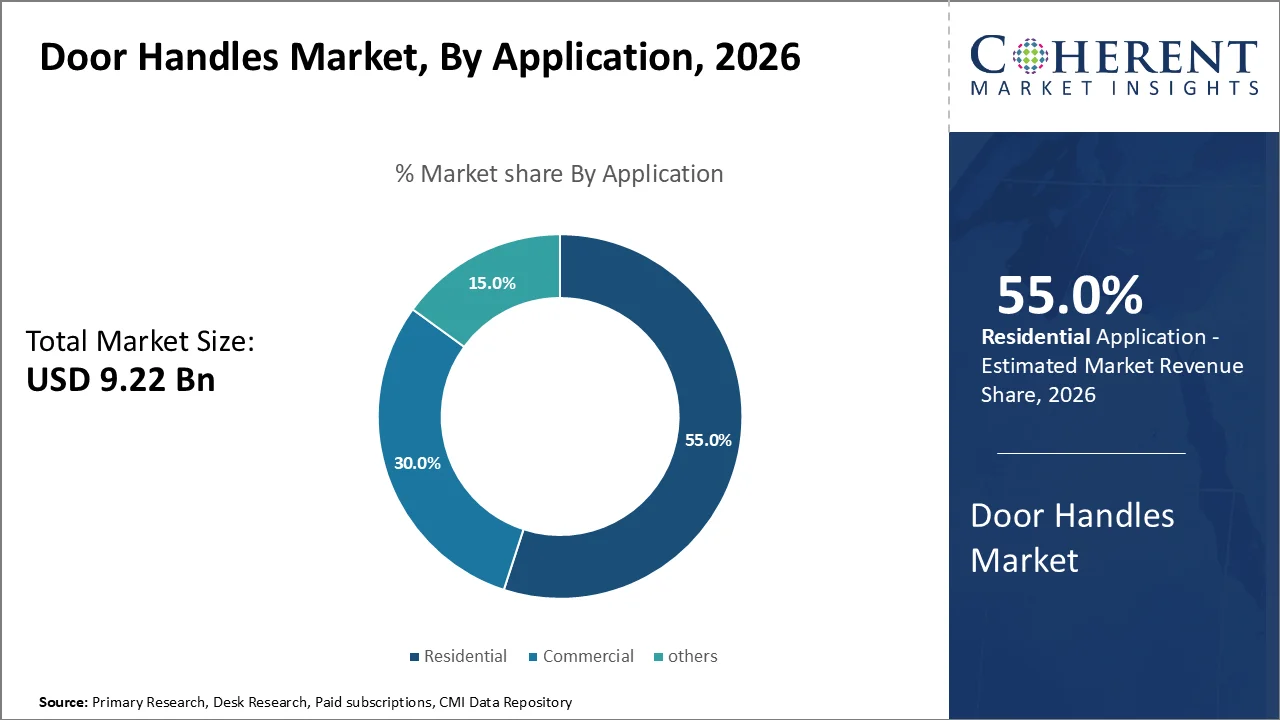
Based on application, residential dominates the market, accounting for a significant 55% share in 2026, the substantial global housing stock as well as continuous residential construction activities worldwide are the factors responsible for the growth of the market. The residential segment's dominance stems from the fundamental need for door handles in every dwelling unit, whether single-family homes, apartments, condominiums, or townhouses. After increasing 2.7% last year we expect global construction output growth to slow down to 1.4% this year, followed by 2.1% in 2026.
According to the United Nations Human Settlements Programme (UN-Habitat), approximately 1.6 billion people worldwide lack adequate housing, driving massive residential construction initiatives globally. This housing deficit, along with urbanization trends, makes sustained demand for door handles across new residential developments.
Market Drivers
Smart Lock Technology is transforming the Door Handles Industry
Smart lock technology leverages core innovations such as Bluetooth Low Energy (BLE) for proximity unlocking, Wi-Fi integration for remote access, Z-Wave/Zigbee mesh networking for smart home connectivity, and NFC for touch-to-unlock functionality. Leading adopters include August Home (Assa Abloy) with its retrofit Smart Lock Pro, Yale’s Nest Connect locks integrated with Google, Schlage Encode Plus with built-in Wi-Fi, and Kwikset Halo series offering seamless Wi-Fi connectivity.
The adoption of smart locks is driving market growth at a 15–20% CAGR, enhancing security through real-time monitoring, access logs, and remote control capabilities. These systems also improve user convenience with keyless entry and temporary access codes, while simplifying property management for rental properties and Airbnb hosts, making smart locks an increasingly essential component of modern homes and commercial spaces.
Biometric Authentication Systems: A major breakthrough in Door Handles
Biometric authentication systems utilize advanced technologies such as fingerprint recognition with capacitive and optical sensors, AI-powered 3D facial recognition, iris scanning for high-security applications, and voice recognition for audio-based authentication. Key adopters include Ultraloq with its U-Bolt Pro smart locks, Samsung’s SHP series offering fingerprint and PIN access, Gateman’s popular fingerprint door locks in Asia, and Anviz’s commercial-grade biometric access control systems.
The adoption of biometric systems significantly enhances security by eliminating major duplication as well as unauthorized access, while enabling contactless operation. These systems are highly applied in offices, hospitals, secure facilities, etc., reducing the need for traditional key management and lowering operational costs, making them a vital component of modern access control solutions.
Current Events and Their Impact on the Door Handles Market
Current Event | Description and its Impact |
Rising Green Building Regulations in Europe |
|
U.S. Tariffs on Imported Aluminum and Metals |
|
Door Handles Market Trends
- Integration of IoT as well as smart home systems is creating demand for digital and biometric door handles, providing utmost security along with convenience.
- More people care about the environment, so they are choosing eco-friendly materials like recycled metal and sustainable wood. In April 2025, Verum, a premium Italian brand behind architectural door hardware, kicked off 2025 with a brand new, sustainable door lever collection called Verum Snapp. Made of old fishing nets, Snapp turns one of many ocean plastic waste products into a useful, beautiful product.
- High preference for customized as well as designer door handles to complement interiors in residential as well as commercial spaces. For instance, in April 2026, WOXTO Introduced Premium Brass Door Handles Inspired by Italian Design, made with Precision in India.
- Consumers want door handles that do not rust and are comfortable to use, lasting a long time.
Regional Insights

Asia Pacific dominates owing to the rapid urbanization
Asia Pacific account 45% market share in 2026, rapid urbanization and a booming construction industry are primary drivers. Countries like China, India, and Southeast Asian nations are witnessing a surge in residential, commercial, and hospitality infrastructure projects, which directly feeds into the rising demand for door handles tailored to varied architectural aesthetics and functional requirements. Singapore’s construction sector is forecasted for solid growth of 6.5 percent in 2025, driven both by large projects, such as Changi Airport Terminal 5, major hotel expansions as well as 150 concurrently built Built-To-Order (BTO) projects by the Housing Development Board (HDB).
The increasing local manufacturing capacities and technological upgradation facilitated by regional governments through “Make in India” and China’s “Made in China 2025” initiatives, is stimulating the market which emphasize pushing supply chains toward higher quality standards and smart product diversification.
North America Door Handles Market Trends
The North America region is poised to be the fastest-growing region through 2026-2033, expanding at a CAGR of approximately 7.5%. The highly developed infrastructure, stringent building codes, as well as escalating construction activities in both residential as well as commercial sectors. There are 65,658 businesses in the Commercial Building Construction industry in the United States.
The rising emphasis on safety, security, as well as aesthetic appeal of building components, including door handles that meet modern design and functional requirements is stimulating the market.
For example, the U.S. General Services Administration (GSA) has recently emphasized the use of touchless and antimicrobial door handles to curb the spread of infections in public buildings, contributing to increased demand for innovative door handle solutions in the public and corporate segments.
Expansive Residential and Commercial Construction Activities is Accelerating the Door Handles Market Demand in United States
The U.S. contributes the highest share in the door handles market in North America owing to its expansive residential and commercial construction activities as well as ongoing investments in infrastructure renovations.
The country’s diverse architectural landscape, spanning from ultra-modern smart homes to vast commercial complexes drives demand for a wide variety of door handle styles, ranging from traditional mechanical handles to innovative smart locking solutions.
For instance, federal initiatives such as the U.S. Department of Energy’s push towards energy-efficient as well as smart buildings indirectly bolster the adoption of advanced door hardware equipped with IoT functionalities, including touchless and biometric door handles.
Moreover, urban development projects in metropolitan hubs such as New York, Los Angeles, and Chicago continue to prioritize security and ease of access, further necessitating high-quality, durable door fittings.
China Door Handles Market Trends
China subsegment contributes the highest share in the door handles market within APAC owing to its massive urbanization, construction, and industrial growth. China’s ongoing infrastructure expansion, driven by government initiatives such as the Belt and Road Initiative (BRI) and the emphasis on smart city projects, significantly propels the demand for advanced and aesthetically appealing door hardware, including door handles.
For example, the Chinese Ministry of Housing and Urban-Rural Development recently reported a surge in urban housing projects and redevelopment efforts in second- and third-tier cities, which require high volumes of door hardware products.
Who are the Major Companies in Door Handles Industry
Some of the major key players in door handles market include, Seleco Hardware decoration Products Co., Galbusera G. & G., Daya, Kuriki Manufacture Co., Bangpai, Ltd, Assa Abloy Group, Hafele, Sobinco, Allegion plc, Hooply, Ltd., Enrico cassina, HEmtek products Inc., D- Line and WEST inx.
Key News
- In December 2025, China tightens door handle rules, mandating mechanical opening after crashes and EV battery incidents.
- In July 2025, Godrej Enterprises Group's Locks & Architectural Solutions division launched HDH Wave 5, a premium collection of 100% brass decorative door handles.
Market Report Scope
Door Handles Market Report Coverage
| Report Coverage | Details | ||
|---|---|---|---|
| Base Year: | 2025 | Market Size in 2026: | USD 9.22 Bn |
| Historical Data for: | 2020 To 2024 | Forecast Period: | 2026 To 2033 |
| Forecast Period 2026 to 2033 CAGR: | 5.73% | 2033 Value Projection: | USD 12.90 Bn |
| Geographies covered: |
| ||
| Segments covered: |
| ||
| Companies covered: | Seleco Hardware decoration Products Co., Galbusera G. & G., Daya, Kuriki Manufacture Co., Bangpai, Ltd, Assa Abloy Group, Hafele, Sobinco, Allegion plc, Hooply, Ltd., Enrico cassina, HEmtek products Inc., D- Line and WEST inx. | ||
| Growth Drivers: |
| ||
| Restraints & Challenges: |
| ||
Analyst Opinion
- The door handles market demonstrates robust momentum driven by accelerating construction activities across residential and commercial sectors globally. Construction input prices have risen at a 9.7% annualized rate through the first quarter of 2025.
- Rising urbanization and infrastructure development initiatives are creating substantial demand for diverse door handle solutions, ranging from traditional mechanical designs to advanced electronic as well as smart variants. Smart locks from Schlage, TCL, TP Link, etc., were released alongside newcomers from Nuki or luxury models from Lockly.
- Smart home integration holds the most significant opportunity, with IoT-enabled door handles having keyless entry, biometric authentication, as well as remote monitoring capabilities are gaining high adoption among tech-savvy consumers.
- Businesses like offices, hotels, and hospitals are using touchless and voice-activated door handles to stay clean and safe. Antimicrobial coatings help meet new safety needs after the pandemic.
- Companies are focusing on custom designs and looks to stand out, while using eco-friendly materials and methods because customers care about the environment, changing how the market competes.
Speak to the analyst
Want personalized insights?
Take the findings above to one of our principal consultants, or have the report rebuilt around the segments, geographies and competitors you actually track.
Market Segmentation
- By Material Type (Revenue, USD Bn, 2021-2033)
- Metal type
- Plastic type
- Others
- By Application (Revenue, USD Bn, 2021-2033)
- Residential
- Commercial
- By Region (Revenue, USD Bn, 2021-2033)
- North America
- U.S.
- Canada
- Latin America
- Brazil
- Mexico
- Argentina
- Rest of Latin America
- Europe
- Germany
- U.K.
- France
- Italy
- Spain
- Russia
- Rest of Europe
- Asia Pacific
- China
- India
- Japan
- Australia
- South Korea
- ASEAN
- Rest of Asia Pacific
- Middle East
- GCC
- Israel
- Rest of Middle East
- Africa
- South Africa
- Central Africa
- North Africa
- North America
Sources
Primary Research Interviews
- Door Handle Manufacturers and Suppliers
- Hardware Retailers and Distributors
- Construction Industry Professionals
- Interior Designers and Architects
- Others
Databases
- Euromonitor International Database
- Others
Magazines
- Hardware Retailing Magazine
- Door & Window Market Magazine
- Building Products Digest
- Construction Specifier Magazine
- Others
Journals
- International Journal of Construction Management
- Journal of Building Engineering
- Materials & Design Journal
- Others
Newspapers
- Construction Dive
- Building Design + Construction
- Hardware + Building Supply Dealer
- Remodeling Magazine News
- Others
Associations
- Door and Hardware Institute (DHI)
- Builders Hardware Manufacturers Association (BHMA)
- National Association of Home Builders (NAHB)
- American Institute of Architects (AIA)
- Others
Public Domain Sources
- U.S. Census Bureau Construction Statistics
- Federal Trade Commission Industry Reports
- European Commission Construction Market Data
- World Bank Construction Industry Statistics
- Others
Proprietary Elements
- CMI Data Analytics Tool
- Proprietary CMI Existing Repository of information for last 10 years
Get access to 250+ pages report
Every segment, forecast, competitor profile and data table behind the analysis above — available for instant download.
- ESOMAR Member
- ISO 9001:2015 Certified
- D-U-N-S Registered
- GDPR & CCPA Compliant
Missing comfort of reading report in your local language? Find your preferred language:
Transform your Strategy with Exclusive Trending Reports
Frequently Asked Questions
The door handles market is expected to reach USD 12.90 Bn in 2033.
Major players operating in the global door handles market include Seleco Hardware decoration Products Co., Galbusera G. & G., Daya, Kuriki Manufacture Co., Bangpai, Ltd, Assa Abloy Group, Hafele, Sobinco, Allegion plc, Hooply, Ltd., Enrico cassina, HEmtek products Inc., D- Line and WEST inx.
Manual revolving door mechanism and high cost of door handles is expected to restrain the door handles market growth over the forecast period.
Increasing residential and commercial properties are driving growth of the global door handles market.
The door handles market is anticipated to grow at a CAGR of 5.73% between 2026 and 2033.
Among regions, North America is expected to account for a largest market share in the global Door Handles market over the forecast period.
The trend of knurled, reeded, and etched textures gives handles a crafted, almost artisanal quality. The tactile grip not only enhances comfort and prevents slippage but also creates micro-shadows that add visual depth.