

Global Wheat Grass Powder Market Size and Forecast – 2026 To 2033
The Global Wheat Grass Powder Market is estimated to be valued at USD 249.8 Mn in 2026 and is expected to reach USD 380.6 Mn by 2033, exhibiting a compound annual growth rate (CAGR) of 6.2% from 2026 to 2033. Growth is supported by the integration of plant-based greens into dietary supplements, smoothie mixes, functional beverages, and clean-label food formulations. Manufacturers are also developing powders with improved dispersibility, controlled particle size, organic certification, and better blending compatibility.
In May 2025, the journal of future foods published a peer-reviewed overview examining wheatgrass as a nutrient-dense microgreen and its potential relevance across functional-food and nutraceutical applications. This scientific attention supports ingredient innovation and product positioning, while emphasizing the need for reliable quality testing and responsible health claims.
Key Takeaways of the Global Wheat Grass Powder Market
- Whole leaf wheatgrass powder is expected to hold 64.8 % of the global wheat grass powder market in 2026 because it retains plant fiber, supports broad smoothie and supplement use, and requires fewer processing stages than juice powder, improving cost and yield economics. In August 2026, Amazing Grass continued offering U.S.-grown, organic whole-leaf wheatgrass powder positioned around fiber retention and convenient daily mixing.
- Organic segment is expected to account for 72.4 % of the market share in 2026 as certification, traceable cultivation, and pesticide-free positioning strengthen buyer confidence and support premium pricing across nutraceutical and functional-food channels. In April 2026, Evolutionary Health renewed its AsureQuality organic certification, supporting continued supply of certified organic wheatgrass powder from New Zealand to international ingredient and supplement buyers.
- Dietary supplements are expected to represent 47.6 % of the market share in 2026 because powder formats enable measured daily servings, longer shelf life, easy blending, and incorporation into multi-ingredient wellness formulations. In August 2024, Hiya launched Kids Daily Greens + Superfoods in the U.S., a powdered nutritional supplement containing wheatgrass among its organic greens and designed for convenient recurring consumption.
- Asia Pacific is expected to account for 35.6 % of the market share in 2026, supported by established herbal-wellness traditions, regional wheat cultivation, expanding domestic processing, and export-oriented ingredient manufacturers in India, Australia, and New Zealand. In January 2025, India-based Girme’s Wheatgrass launched the Girme’s Organic Farms brand, extending its plant-based wellness portfolio around its established wheatgrass-powder manufacturing and export base.
- North America is expected to hold 29.4 % of the market share in 2026 and remain the fastest-growing region as direct-to-consumer subscriptions, transparent ingredient communication, cGMP manufacturing, and convenient greens routines widen adoption beyond specialist wellness buyers. In June 2025, U.S.-based Native Greens upgraded its digital storefront for an organic superfood powder containing wheatgrass, adding clearer sourcing, usage, testing, and direct-order information.
Segmental Insights
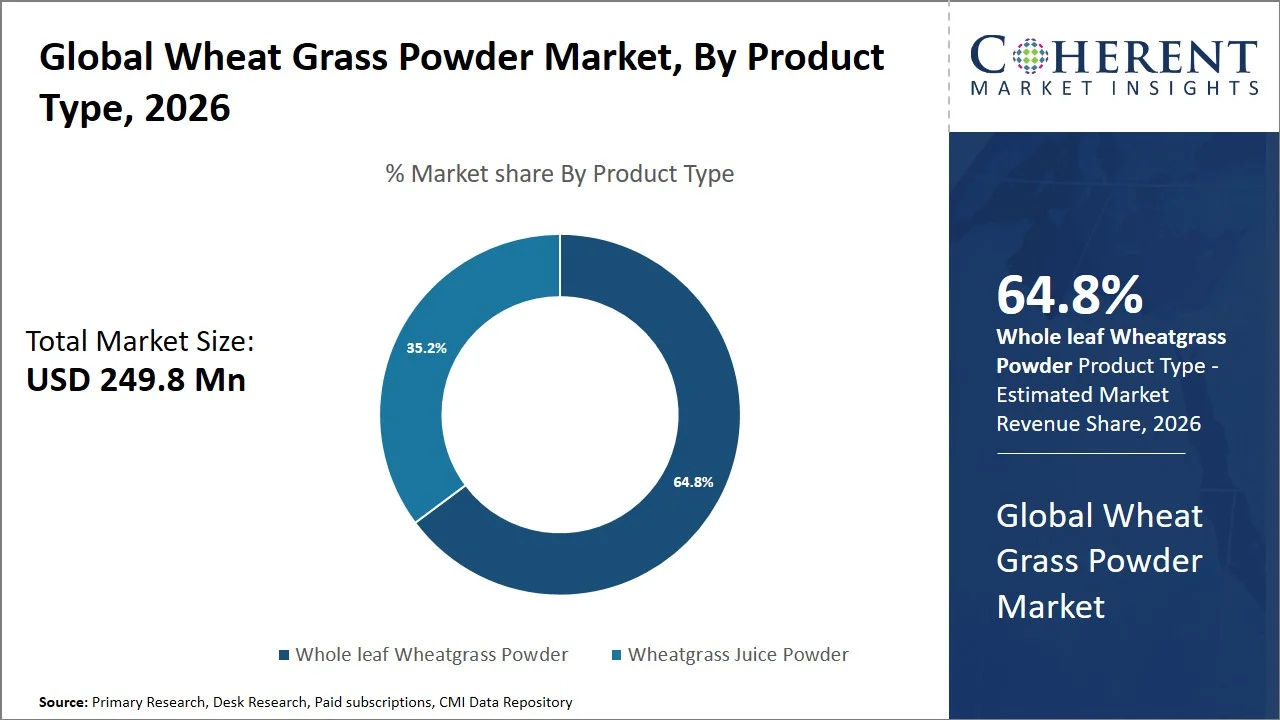
Why Does Whole Leaf Wheatgrass Powder Dominate the Global Wheat Grass Powder Market?
Whole leaf wheatgrass powder is expected to account for 64.8% of the global wheat grass powder market in 2026. Its leading position is supported by its broad formulation compatibility, allowing manufacturers to incorporate the whole milled leaf into beverage mixes, capsules, tablets, nutrition bars, and private-label superfood formulations without the need for juice extraction or carrier-based drying. The retained plant matrix provides fiber and formulation body, while different mesh specifications allow suppliers to serve retail and industrial buyers from the same raw-material stream. This improves inventory utilization and supports competitive pricing for high-volume wellness products. In April 2026, Tata 1mg updated listing for Organic India Wheat Grass Powder identified whole-leaf wheatgrass powder as the principal ingredient and offered it as a mixable daily supplement, confirming continued commercial availability through a major digital pharmacy channel.
- Current Industry Events of 2026
- Market Size Estimation
- Regional Breakdown
- Competitive Landscape
- Customer Intelligence
- Segmental Analysis
- Pricing Analysis
- Key Market Drivers, Challenges & Future Trends
- Customized Insights Section
Why Does Organic Represent the Largest Nature Segment in the Global Wheat Grass Powder Market?
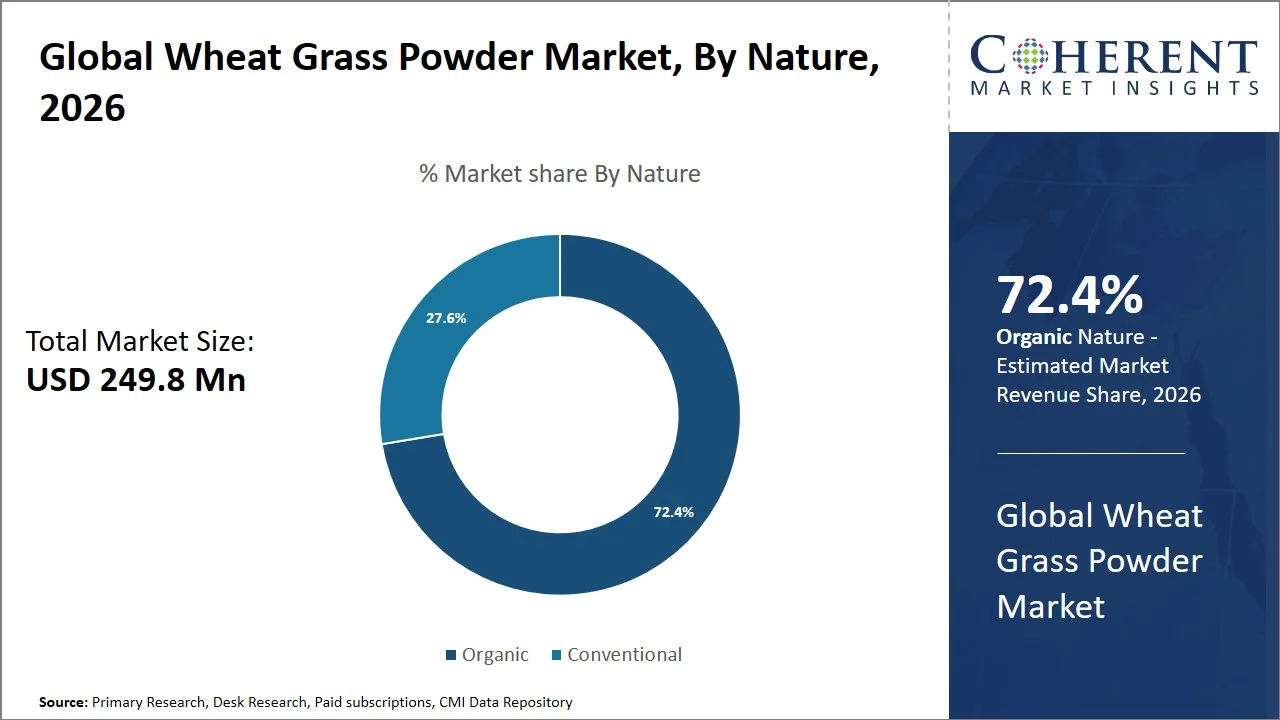
Organic segment is projected to represent 72.4% of the global wheat grass powder market in 2026. The segment benefits from the close association between wheatgrass and clean-label nutrition, making certified cultivation especially important to health-store buyers, practitioner brands, and premium online consumers. Organic status provides a recognizable procurement filter for pesticide management, farm traceability, and ingredient positioning, allowing manufacturers to differentiate products without relying on complex formulations. It also supports higher-value private-label programs where certification documents must accompany finished-product claims. In June 2025, Designs for Health launched its reformulated EssentiaGreens and Reds range using organic ingredient blends; the company’s product specification identifies organic wheat grass juice in selected formulations. The launch demonstrates how certified wheatgrass ingredients are being incorporated into practitioner-oriented supplements emphasizing formulation quality, ingredient integrity, and documented sourcing.
Why Do Dietary Supplements Dominate the Application Segment of the Global Wheat Grass Powder Market?
Dietary supplements are expected to hold 47.6% of the global wheat grass powder market in 2026 because this application converts wheatgrass into measured, repeat-purchase formats with clear usage instructions and extended shelf life. Powder tubs, sachets, capsules, tablets, and effervescent products allow brands to address daily nutrition, digestive wellness, energy, and general wellbeing through differentiated propositions. Supplement channels also provide greater scope for subscriptions, bundled regimens, practitioner recommendations, and direct-to-consumer education than conventional food applications. This increases the commercial value of consistent testing, controlled serving sizes, and contract manufacturing. In March 2025, Grove Collaborative announced its acquisition of 8Greens, whose supplement portfolio uses wheatgrass among eight core greens, and planned to distribute the products through its online marketplace. The transaction demonstrates investment and channel interest in scalable wheatgrass-containing supplement platforms.
Current Events and their Impact
Current Event | Description and Its Impact |
March 2024 – USDA Strengthening Organic Enforcement Rule Became Fully Applicable |
|
March 2024 – European Commission Recommended Expanded Nickel Monitoring in Foods and Supplements |
|
January 2026 – Canada’s Supplemented-Food Framework Became Fully Applicable |
|
Global Wheat Grass Powder Market Dynamics
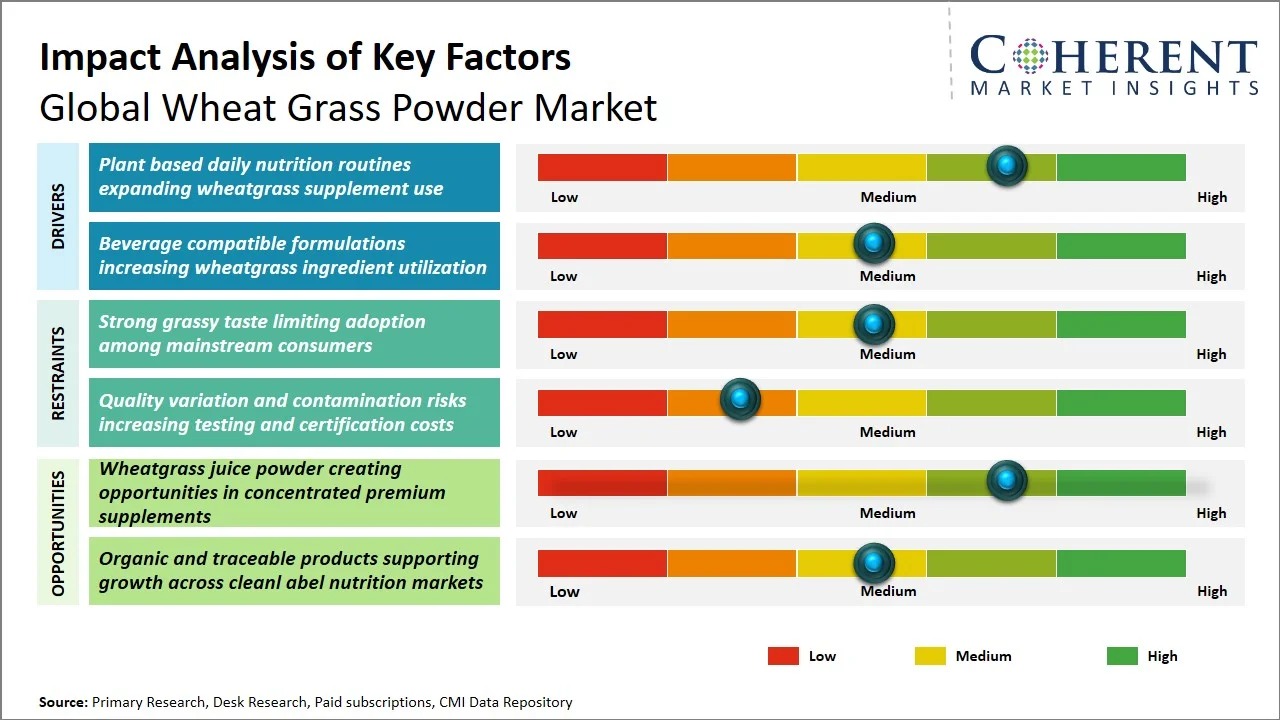
Key Market Drivers
- Plant based daily nutrition routines expanding wheatgrass supplement use: Consumer use of powdered plant nutrition is moving wheatgrass from specialist detox programs into repeatable daily supplement routines. The format offers brands a shelf-stable ingredient that can be sold alone or incorporated into greens blends, tablets, capsules, and subscription packs. This broadens purchasing across wellness consumers, sports-nutrition users, and buyers seeking plant-based alternatives to conventional multivitamin formats. Ingredient processors, organic growers, contract manufacturers, and private-label suppliers benefit because recurring use supports predictable reorder cycles and multiple product architectures. Commercially, suppliers that provide consistent colour, mesh size, microbial specifications, and certification documentation can command stronger B2B relationships than sellers competing only on bulk price. In March 2024, Go Superfoods presented an Organic Super Green Blend containing organic wheatgrass alongside customizable single-ingredient options, illustrating how suppliers are enabling both standardized and bespoke supplement development.
- Beverage compatible formulations increasing wheatgrass ingredient utilization: Wheatgrass powder gains more commercial value when it performs reliably in water, smoothies, meal-replacement shakes, and other beverage-led routines. Beverage compatibility raises consumption frequency because buyers can add a measured serving without handling fresh grass, juicing equipment, or refrigerated inventory. It also encourages formulators to improve dispersibility, sediment control, flavor balance, and single-serve packaging, creating demand for finer-milled or agglomerated grades. Functional beverage brands, cafés, sports-nutrition companies, and contract blenders benefit from the ability to extend wheatgrass into convenience-oriented occasions. Suppliers that solve solubility and sensory constraints can move beyond commodity sales toward co-development agreements. In June 2024, KOS announced Mango, Apple, and Berry variants of its Organic Superfood Greens Blend; the wheatgrass-containing powder is designed for mixing into water, juice, or smoothies, demonstrating how flavor and format adaptation can broaden routine beverage use.
Emerging Market Trends
- Wheatgrass Powder Grades Tailored to Specific Applications: Buyers increasingly select wheatgrass powder based on application performance rather than accepting a standard botanical grade. Supplement producers require batch uniformity and capsule flow, while beverage brands prioritize dispersibility, low sediment, and color stability. Food and personal-care formulators may seek controlled particle size, milder flavor, or formulation compatibility. This shift favors suppliers with flexible milling, agglomeration, testing, and formulation capabilities, while generic bulk traders may face margin pressure. Technical documentation and co-development support will become increasingly important purchasing criteria.
- Private-Label Platforms Transforming Distribution Channels: Retailers, wellness platforms, gyms, and nutrition clinics can launch wheatgrass products through contract manufacturers without investing in cultivation or processing facilities. Manufacturers provide formulation, certification, packaging, and fulfilment, reducing market-entry barriers for companies with established customer access. This increases demand for lower minimum-order quantities, customized blends, exclusive packaging, and faster product development. Suppliers with modular production, regulatory expertise, and reliable delivery systems can secure recurring private-label contracts, while standalone brands and inflexible manufacturers may face stronger pricing and channel pressure.
Regional Insights
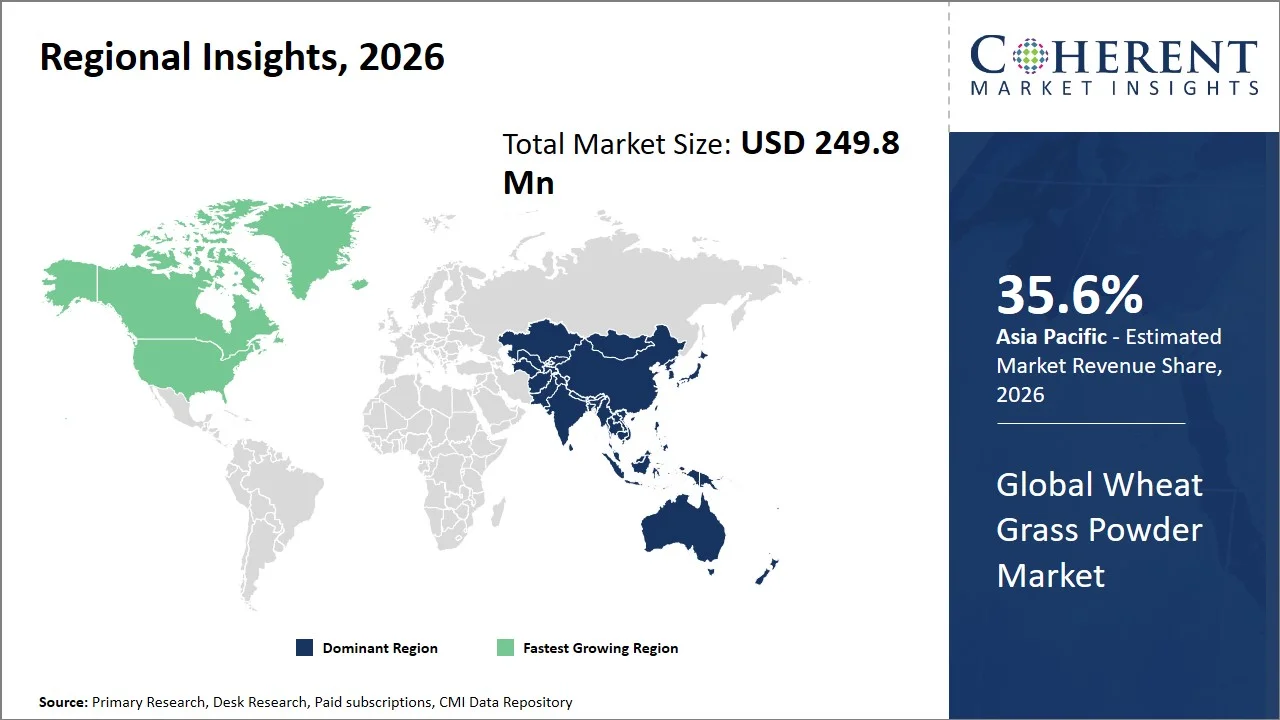
Why Does Asia Pacific Dominate the Global Wheat Grass Powder Market?
Asia Pacific is expected to lead the global wheat grass powder market with a 35.6% share in 2026. The region combines extensive cereal cultivation, established herbal-wellness consumption, competitive drying and milling costs, and a large base of nutraceutical and functional-food manufacturers. India, China, Australia, and New Zealand also support multiple supply models, ranging from organic whole-leaf powders to concentrated juice powders and private-label blends. Regional e-commerce platforms help smaller brands reach consumers without building extensive store networks, while export-oriented processors can serve North America, Europe, and the Middle East. In August 2025, India’s Ministry of Food Processing Industries highlighted the country’s abundant agricultural raw-material base, processed-food export activity, expanding nutraceutical capabilities, and public support for processing infrastructure. This strengthens Asia Pacific’s position as both a production center and a high-volume consumption market for wheatgrass-based powders.
Why is North America Emerging as the Fastest-Growing Region in the Global Wheat Grass Powder Market?
North America is projected to be the fastest-growing region in the global wheat grass powder market, accounting for 29.4% of the market share in 2026. Expansion is supported by frequent supplement use, premium spending on plant-based wellness products, subscription purchasing, and the rapid commercialization of multi-ingredient greens powders. Buyers increasingly expect convenient servings, transparent labels, third-party testing, and formulations that combine wheatgrass with probiotics, minerals, adaptogens, or other botanicals. These requirements create opportunities for certified ingredient suppliers, contract manufacturers, and digitally native brands rather than only bulk-powder vendors. In January 2025, AG1 introduced a research-backed formula update for its daily green’s product, while its official ingredient information continued to identify organic wheatgrass leaf powder within the formulation. The update illustrates how North American brands are converting wheatgrass from a standalone superfood into a recurring, higher-value daily nutrition platform.
Global Wheat Grass Powder Market Outlook for Key Countries
Why is the U.S. a Key Market for the Global Wheat Grass Powder Market?
The U.S. is a key country in the global wheat grass powder market because it combines a large dietary-supplement consumer base with advanced product formulation, influencer-led customer acquisition, and extensive online and specialty-retail distribution. Wheatgrass powder is increasingly commercialized as part of broader greens, digestive-wellness, sports-nutrition, and everyday nutrition products rather than only as a single botanical. This creates demand for suppliers that can provide consistent flavor, color, microbial specifications, organic documentation, and flexible pack sizes. The country’s contract-manufacturing ecosystem also enables emerging brands to launch without owning processing assets, accelerating product turnover and category experimentation. In January 2025, Proper launched “The Greens,” a U.S. superfood powder formulated with organic wheatgrass, barley grass, spirulina, kale, spinach, and other ingredients. The launch demonstrates the commercial role of wheatgrass in differentiated, lifestyle-oriented supplement platforms targeted through modern consumer channels.
Why is India Important in the Global Wheat Grass Powder Market?
India is important in the global wheat grass powder market because it offers agricultural familiarity with wheat, competitive cultivation and processing economics, a large herbal-nutrition consumer base, and established capabilities in powders, extracts, and private-label supplements. Domestic manufacturers can source young wheat plants, dry and mill the leaves, and serve pharmacies, health stores, online marketplaces, and export buyers. Ayurveda-oriented purchasing also makes green plant powders understandable to consumers, although successful brands must still manage microbial safety, pesticide residues, and unsupported health claims. India’s scale creates room for both low-priced whole-leaf powder and certified organic products aimed at premium customers. For the 2024–2025 crop year, the Agricultural and Processed Food Products Export Development Authority estimated Indian wheat production at 117.94 million tons. This figure does not represent wheatgrass output, but it indicates a deep seed, farming, and agricultural-services ecosystem that can support specialized wheatgrass cultivation.
Why Does China Support Growth in the Global Wheat Grass Powder Market?
China supports growth in the global wheat grass powder market through its large-scale dietary-supplement manufacturing base, established fruit-and-vegetable powder processing, export-oriented contract production, and strong capability in customized formulations. Chinese suppliers can integrate wheatgrass with barley grass, spirulina, chlorella, probiotics, enzymes, and flavor systems for private-label customers. This allows overseas brands to source complete formulations, sachets, jars, tablets, or capsules rather than purchase raw powder alone. Domestic digital commerce also provides a route for imported premium products and locally produced wellness blends, although regulatory classification and product claims require careful management. In 2026, Qingdao-based Nutrifirst Biotech’s online catalogue listed a customizable Super Greens Blend Powder containing wheatgrass and offered formula and flavor customization. The company also identifies manufacturing operations in Hebei and broad export activity, illustrating China’s role as an OEM and finished-product supply base for wheatgrass-containing supplements.
Why is Germany a Strategic Country in the Global Wheat Grass Powder Market?
Germany is a strategic country in the global wheat grass powder market because buyers place strong emphasis on organic certification, ingredient origin, contaminant testing, accurate labelling, and environmentally responsible packaging. Wheatgrass powder is sold through organic retailers, pharmacies, specialist nutrition outlets, and e-commerce platforms, with demand concentrated among vegan, raw-food, smoothie, and natural-wellness consumers. German distributors can also serve neighboring European markets, making supplier documentation and multilingual compliance commercially important. The market therefore rewards producers able to prove microbiological control, pesticide management, traceability, and consistent processing rather than compete only on price. In September 2025, Germany’s Consumer Advice Centre specifically noted that wheatgrass, barley-grass, and leaf-powder supplements may carry pathogen-contamination risks and emphasized manufacturer responsibility for product safety. This scrutiny increases qualification requirements but creates a premium opportunity for suppliers with validated testing, audited organic chains, and transparent batch documentation.
Why is Brazil an Important Growth Market for the Global Wheat Grass Powder Market?
Brazil is an important growth market for the global wheat grass powder market because its large urban consumer base, active sports-nutrition sector, expanding online supplement trade, and familiarity with powdered botanical ingredients support category development. Wheatgrass remains less established than locally recognized superfoods, so suppliers must compete through accessible pricing, Portuguese-language education, palatable blends, and dependable domestic distribution. Local processing could reduce reliance on imported finished products and improve freshness, freight economics, and formulation flexibility for beverage, supplement, and functional-food companies. Brazil also offers scope to position wheatgrass alongside domestic plant powders rather than as a direct substitute for them. In 2025, researchers at the Federal University of Uberlândia examined spray drying of wheatgrass and evaluated processing variables affecting powder production. The work provides locally generated technical knowledge that may support future Brazilian manufacturing, pilot-scale formulation, and application development.
Technology Adoption Landscape in the Global Wheat Grass Powder Market
Technology | Adoption Level | Key Application Area | Business Impact |
Controlled-Environment and Hydroponic Cultivation | Medium | Year-round production of young wheatgrass biomass | Improves control over water, growing conditions, harvest timing, and crop uniformity while reducing seasonal variability; however, controlled facilities require higher capital and operating expenditure. |
Continuous Juice Extraction and Membrane Clarification | Medium | Preparation of concentrated feed for wheatgrass juice powder | Separates insoluble fiber, standardizes solids, and creates a more uniform feed stream for drying, supporting consistent color, texture, and batch performance. |
Spray Drying with Carrier Optimization | Medium | Commercial production of wheatgrass juice powder | Enables scalable dehydration and improved powder flow, but processors must carefully manage carrier selection and thermal exposure to protect color, aroma, and formulation quality. |
Precision Milling and Air Classification | High | Particle-size control for whole-leaf wheatgrass powder | Improves capsule filling, blending uniformity, mouthfeel, and specification consistency, allowing processors to offer application-specific mesh sizes and differentiated product grades. |
Fluid-Bed Agglomeration and Instantization | Medium | Sachets, beverage mixes, and ready-to-blend formulations | Enhances wetting, reduces dust, limits floating particles, and improves beverage convenience, although the additional processing stage increases production cost. |
ICP-MS and Rapid Microbiological Testing | High | Heavy-metal, pathogen, identity, and batch-release testing | Supports importer qualification, regulatory compliance, faster batch disposition, and recall-risk reduction while providing the documentation required by major retailers and B2B buyers. |
How are Standardized Wheatgrass Ingredients Creating New Growth Opportunities in Companion-Animal Nutrition?
Companion-animal nutrition offers an underdeveloped route for wheatgrass powder beyond human wellness products. Pet-food, treat, and veterinary-support brands can use carefully specified wheatgrass as a botanical inclusion in powders, chews, toppers, and functional snack formats, provided palatability, dosage control, and safety documentation are addressed. The opportunity is strategically attractive because it creates a separate B2B customer base and can absorb grades designed for blending rather than premium consumer color. Commercial capture will require species-appropriate formulation work, contaminant and microbiological testing, stable ingredient supply, and disciplined avoidance of unsupported therapeutic claims. Producers should develop application samples, feeding-format guidance, and technical dossiers for contract manufacturers and pet-nutrition formulators. Granulated or encapsulated formats may improve handling and taste management, while regional packaging partners can support smaller launches. The opportunity is likely to favor vertically integrated processors and specialist ingredient suppliers that can combine agricultural control with formulation support; generic bulk traders may struggle to satisfy the documentation and consistency expected by established pet-care brands.
Market Players, Key Development, and Competitive Landscape
Key Developments
- In May 2026, Mía launched its Fiber-First Shake, combining plant protein and prebiotic fibre with a super greens system that includes organic wheatgrass powder. This is important for the global wheat grass powder market because it demonstrates movement toward multi-benefit formulations in which wheatgrass supports a broader nutrition platform rather than functioning as the sole product proposition. Such launches create opportunities for suppliers capable of meeting complex blending, sensory, and specification requirements.
- In October 2025, Bloom Nutrition expanded into Canada by launching its Greens & Superfoods Powder across more than 300 Walmart Canada stores in multiple flavours. This is important for the global wheat grass powder market because the entry of a wheatgrass-containing greens formulation into a major national retail network expands mainstream product visibility and raises volume, packaging, bilingual-labeling, and replenishment expectations for ingredient and contract-manufacturing partners.
- In March 2024, Garden of Life launched Sport Organic Greens in two flavors through online channels and major U.S. retailers. This is important for the global wheat grass powder market because an established wheatgrass juice powder participant extended its greens portfolio toward sports and active-lifestyle buyers, increasing competitive emphasis on mixability, certified-organic positioning, flavor development, and access through mainstream nutrition retail rather than specialist wellness outlets alone.
Competitive Landscape
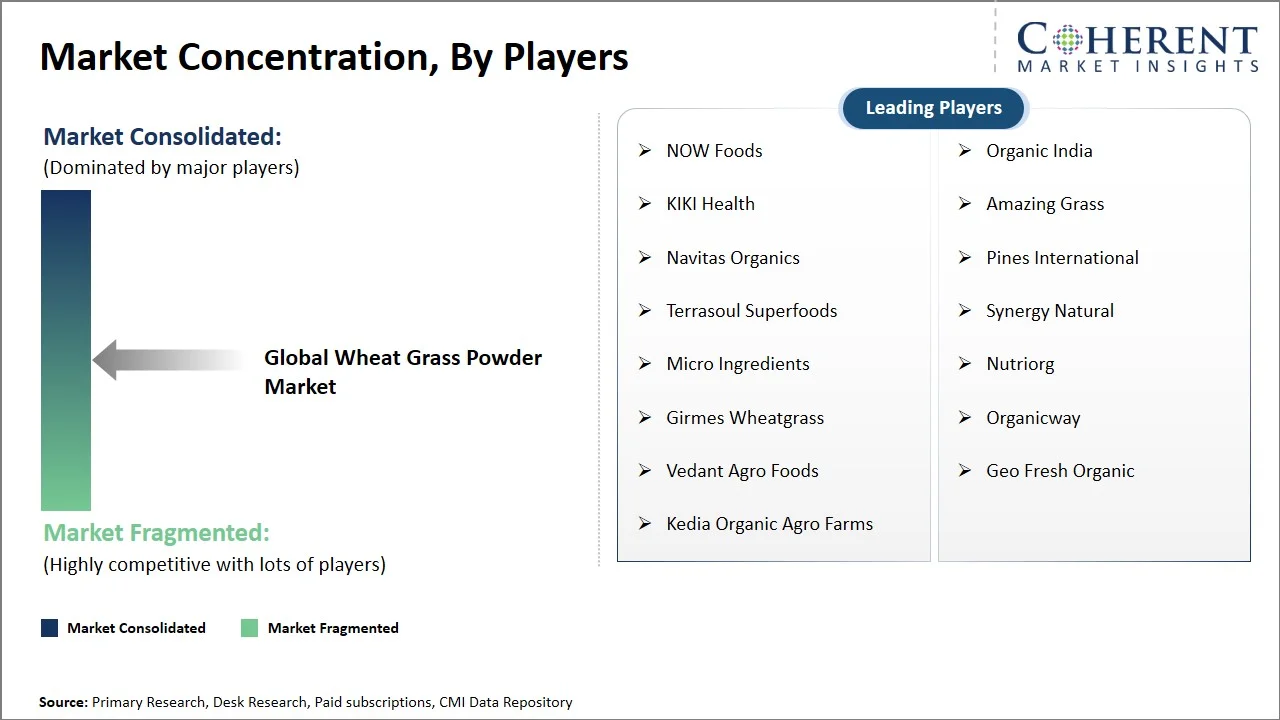
The global wheat grass powder market remains fragmented, comprising vertically integrated growers, organic ingredient processors, consumer supplement brands, contract manufacturers, export traders, and regional health-food suppliers. Scale alone does not secure leadership because buyers evaluate crop origin, organic status, color, flavor, microbial and heavy-metal results, batch consistency, minimum-order quantities, and delivery reliability. Specialist firms can defend premium positions through cultivation control and application support, while regional suppliers compete on responsiveness and landed cost. As retail and B2B channels mature, documentation quality and supply assurance will increasingly determine which vendors gain repeat contracts.
Key focus areas include
- Raw-material control: Captive cultivation and closely managed contract farms improve harvest consistency, input traceability, and supply continuity.
- Product-grade differentiation: Suppliers compete through whole-leaf and juice-powder formats, particle size, dispersibility, color, flavor, and application suitability.
- Certification and compliance: Organic certification, non-GMO verification, allergen controls, and destination-specific documentation influence access to premium accounts.
- Quality assurance: Validated pathogen, pesticide-residue, and heavy-metal testing reduces customer qualification risk and protects retailer relationships.
- Private-label flexibility: Low minimum-order quantities, custom blends, packaging options, and formulation confidentiality support recurring B2B contracts.
- Channel reach: Competitors are expanding through online marketplaces, health stores, pharmacy channels, grocery retail, and specialist ingredient distributors.
- Pricing and supply reliability: Process yield, crop diversification, freight management, and inventory planning are essential for protecting margins without compromising delivery performance.
Market Report Scope
Wheat Grass Powder Market Report Coverage
| Report Coverage | Details | ||
|---|---|---|---|
| Base Year: | 2025 | Market Size in 2026: | USD 249.8 Mn |
| Historical Data for: | 2020 To 2024 | Forecast Period: | 2026 To 2033 |
| Forecast Period 2026 to 2033 CAGR: | 6.2% | 2033 Value Projection: | USD 380.6 Mn |
| Geographies covered: |
| ||
| Segments covered: |
| ||
| Companies covered: | NOW Foods, Organic India, KIKI Health, Amazing Grass, Navitas Organics, Pines International, Terrasoul Superfoods, Synergy Natural, Micro Ingredients, Nutriorg, Girmes Wheatgrass, Organicway, Vedant Agro Foods, Geo Fresh Organic, and Kedia Organic Agro Farms | ||
| Growth Drivers: |
| ||
| Restraints & Challenges: |
| ||
Analyst Opinion (Expert Opinion)
- The global wheat grass powder market leadership is likely to shift from consumer-brand visibility toward supply-chain orchestration. Firms able to coordinate growers, processing capacity, certificates, laboratory testing, and regional fulfillment can offer dependable landed specifications across markets. This favors vertically connected ingredient platforms and disciplined contract manufacturers, while standalone brands may increasingly outsource production and concentrate resources on audience ownership, product positioning, and customer retention.
- Retailer and marketplace quality protocols could become more influential than statutory minimum requirements. A major safety incident or inconsistent contaminant result may prompt large chains and digital platforms to tighten vendor testing across the wider greens category, rapidly excluding suppliers without validated controls. Integrated processors and manufacturers with auditable batch-release systems would be positioned to benefit, while trading-led models could face substantial qualification pressure.
- The wheat grass powder manufactures should prioritize validated decontamination processes, diversified crop sourcing, destination-specific regulatory dossiers, and application laboratories before expanding consumer SKU counts. Margin risk will arise from organic raw-material volatility, laboratory costs, promotional dependence, and price competition. Partnerships with regional packers and established formulators can improve market access and supply flexibility, whereas excessive investment in undifferentiated retail wheatgrass powders should be avoided.
Speak to the analyst
Want personalized insights?
Take the findings above to one of our principal consultants, or have the report rebuilt around the segments, geographies and competitors you actually track.
Market Segmentation
- Product Type Insights (Revenue USD Mn, 2021 - 2033)
- Whole leaf Wheatgrass Powder
- Wheatgrass Juice Powder
- Nature Insights (Revenue USD Mn, 2021 - 2033)
- Organic
- Conventional
- Application Insights (Revenue USD Mn, 2021 - 2033)
- Dietary Supplements
- Functional Foods and Beverages
- Animal Nutrition
- Cosmetics and Personal Care
- Others
- Distribution Channel Insights (Revenue USD Mn, 2021 - 2033)
- Online Retail
- Specialty Health Stores
- Supermarkets and Hypermarkets
- Direct B2B Sales
- Pharmacies and Drugstores
- Others
- Regional Insights (Revenue USD Mn, 2021 - 2033)
- North America
- U.S.
- Canada
- Latin America
- Brazil
- Argentina
- Mexico
- Rest of Latin America
- Europe
- Germany
- U.K.
- Spain
- France
- Italy
- Russia
- Rest of Europe
- Asia Pacific
- China
- India
- Japan
- Australia
- South Korea
- ASEAN
- Rest of Asia Pacific
- Middle East
- GCC Countries
- Israel
- Rest of Middle East
- Africa
- South Africa
- North Africa
- Central Africa
- North America
- Key Players Insights
- NOW Foods
- Organic India
- KIKI Health
- Amazing Grass
- Navitas Organics
- Pines International
- Terrasoul Superfoods
- Synergy Natural
- Micro Ingredients
- Nutriorg
- Girmes Wheatgrass
- Organicway
- Vedant Agro Foods
- Geo Fresh Organic
- Kedia Organic Agro Farms
Sources
Primary Research Interviews
- Wheatgrass growers, organic farms, hydroponic producers, wheatgrass powder processors, botanical ingredient manufacturers, and private-label supplement companies
- Drying, extraction, milling, blending, agglomeration, packaging, and inspection-equipment providers
- Dietary supplement, functional food, beverage, animal nutrition, cosmetics, and personal-care manufacturers
- Distributors, retailers, importers, exporters, laboratories, organic certifiers, and logistics providers
- Agronomy, procurement, production, quality, regulatory, sustainability, marketing, e-commerce, and sales executives
Stakeholders
- Whole-leaf and wheatgrass juice powder manufacturers, contract processors, organic ingredient specialists, and agricultural cooperatives
- Wheat seed, farming input, carrier, flavor, sweetener, capsule, pouch, bottle, and label suppliers
- Dietary supplement brands, smoothie producers, sports-nutrition companies, pet-food manufacturers, and skincare formulators
- E-commerce platforms, supermarkets, health stores, pharmacies, distributors, private-label suppliers, and testing laboratories
End-use Sectors
- Greens powders, capsules, tablets, sachets, effervescent products, and superfood supplements
- Smoothies, juices, functional beverages, protein shakes, nutrition bars, cereals, and bakery products
- Sports nutrition, digestive wellness, vegan, organic, and general-health products
- Animal nutrition, pet-food toppers, functional treats, cosmetics, cleansers, masks, soaps, and shampoos
Regulatory and Government Bodies
- U.S. FDA, USDA AMS and National Organic Program, FTC, USDA NASS, U.S. Census Bureau, and USITC
- Health Canada, Canadian Food Inspection Agency, Statistics Canada, and CBSA
- European Commission, EFSA, Eurostat, EU organic authorities, and national food-safety agencies
- UK FSA, DEFRA, ASA, MHRA, and ONS
- China SAMR, National Health Commission, China Customs, NBS, and SAC
- Japan Consumer Affairs Agency, MHLW, MAFF, Japan Customs, and JAS authorities
- FSSAI, APEDA, Ministry of Food Processing Industries, DGFT, Ministry of Agriculture, and Ministry of AYUSH
- Brazil ANVISA, Ministry of Agriculture, INMETRO, MDIC, Receita Federal, and IBGE
- FSANZ, Australian Department of Agriculture, TGA, ACCC, and ABS
- Codex Alimentarius, ISO, AOAC International, USP, NSF, and accredited laboratories
Databases
- UN Comtrade, ITC Trade Map, WTO Statistics, Eurostat, USITC DataWeb, World Bank, OECD, UNIDO, and FAOSTAT
- USDA NASS, Economic Research Service, FoodData Central, and organic certification databases
- NIH Dietary Supplement Label Database, PubMed, ClinicalTrials.gov, and National Agricultural Library
- EFSA opinions, EU RASFF, FDA warning letters, import alerts, recalls, and enforcement databases
- Health Canada product and recall databases, China Customs, Japan Trade Statistics, and India Export Import Data Bank
- APEDA Agri Exchange, FSSAI databases, Brazil Comex Stat, ANVISA records, and IBGE
- WIPO PATENTSCOPE, Espacenet, company filings, shipment records, retail prices, certificates of analysis, and product catalogues
Magazines and Journals
- Nutraceuticals World, Nutritional Outlook, Natural Products Insider, WholeFoods Magazine, and Nutrition Business Journal
- Food Business News, FoodNavigator, Beverage Industry, Prepared Foods, and Food Processing
- Journal of Functional Foods, Food Chemistry, Nutrients, Foods, and Journal of Food Science
- Journal of Dietary Supplements, Phytotherapy Research, Journal of Herbal Medicine, and Plant Foods for Human Nutrition
- Drying Technology, Powder Technology, Journal of Food Engineering, Food Control, and International Journal of Food Microbiology
Associations
- American Herbal Products Association
- Council for Responsible Nutrition
- International Alliance of Dietary/Food Supplement Associations
- Food Supplements Europe
- Natural Products Association
- Organic Trade Association
- IFOAM–Organics International
- AOAC International
- Institute of Food Technologists
- Global Food Safety Initiative
- International Society of Sports Nutrition
- Pet Food Institute and European Pet Food Industry Federation
Public Domain Sources
- Product catalogues, technical sheets, certificates of analysis, nutrition labels, ingredient declarations, and organic certificates
- Data on cultivation, harvest stage, drying yield, moisture, particle size, bulk density, solubility, colour, chlorophyll, fiber, and protein
- Microbiological, pesticide-residue, heavy-metal, mycotoxin, allergen, and foreign-matter test results
- Application data for supplements, beverages, functional foods, animal nutrition, and personal care
- Import-export records, tariffs, shipment data, retail prices, contract-manufacturing costs, and distributor margins
- Regulatory notices, recalls, warning letters, scientific studies, patents, annual reports, product launches, and capacity expansions
Key Standards and Regulations
- Codex General Principles of Food Hygiene and General Standard for Contaminants and Toxins
- ISO 22000 for food-safety management and ISO 22005 for food-chain traceability
- ISO/IEC 17025 for testing-laboratory competence
- ISO methods for microbiological testing, including Salmonella, E. coli, yeasts, and moulds
- AOAC and USP methods for moisture, nutrients, identity, purity, microbial quality, and elemental contaminants
- NSF/ANSI 173 for dietary supplements
- U.S. FD&C Act, DSHEA, 21 CFR Parts 101, 111, and 117, FSMA, and USDA Organic requirements
- EU food supplement, food information, health claim, contaminant, pesticide, microbiological, novel food, and organic regulations
- Canadian Food and Drugs Act, Natural Health Products Regulations, and Safe Food for Canadians Regulations
- UK food-safety, supplement, labelling, health-claim, and organic requirements
- China food-safety, health-food registration, labelling, and import requirements
- Japan Food Sanitation Act, Food Labeling Act, Foods with Function Claims, and JAS Organic requirements
- FSSAI nutraceutical, organic food, labelling, and food-safety regulations
- Brazil ANVISA supplement, ingredient, labelling, contaminant, and manufacturing requirements
- FSANZ Food Standards Code and Australian therapeutic-product classification requirements
- HACCP, GMP, BRCGS, FSSC 22000, SQF, non-GMO, gluten-free, halal, kosher, and vegan certifications
Proprietary Elements
- CMI Data Analytics Tool, Proprietary CMI Existing Repository of information for last 10 years.
Get access to 250+ pages report
Every segment, forecast, competitor profile and data table behind the analysis above — available for instant download.
- ESOMAR Member
- ISO 9001:2015 Certified
- D-U-N-S Registered
- GDPR & CCPA Compliant
Missing comfort of reading report in your local language? Find your preferred language:
Transform your Strategy with Exclusive Trending Reports
Frequently Asked Questions
The CAGR of the global wheat grass powder market is projected to be 6.2% from 2026 to 2033.
The global wheat grass powder market is estimated to be valued at USD 249.8 million in 2026 and is expected to reach USD 380.6 million by 2033.
In terms of nature, organic wheatgrass powder is expected to lead the global wheat grass powder market, supported by consumer preference for clean-label, pesticide-controlled, and certified plant-based supplements.
Dietary supplements represent the leading application, owing to the widespread use of wheatgrass powder in greens blends, capsules, tablets, sachets, and daily wellness formulations.
Online retail is a prominent distribution channel due to broad product availability, direct-to-consumer purchasing, subscription models, product comparisons, and convenient access to domestic and international wheatgrass powder brands.
Growing consumption of plant based superfood supplements supporting wheatgrass powder demand and expansion of functional beverages and smoothie products increasing ingredient utilization are the major factors driving the growth of the global wheat grass powder market.
Strong grassy taste limiting adoption among mainstream consumers and quality variation and contamination risks increasing testing and certification costs are the major factors hampering the growth of the global wheat grass powder market.