

Global Krill Oil Market Size & Analysis
Global krill oil market size is expected to reach USD 1,126.0 Mn by 2033, from USD 577.8 Mn in 2026, exhibiting a compound annual growth rate (CAGR) of 10.0% during the forecast period.
Key Takeaways
- Based on Form, the Tablet segment is expected to account for the largest share of the market in 2026, due to their convenience, stability, and consumer familiarity.
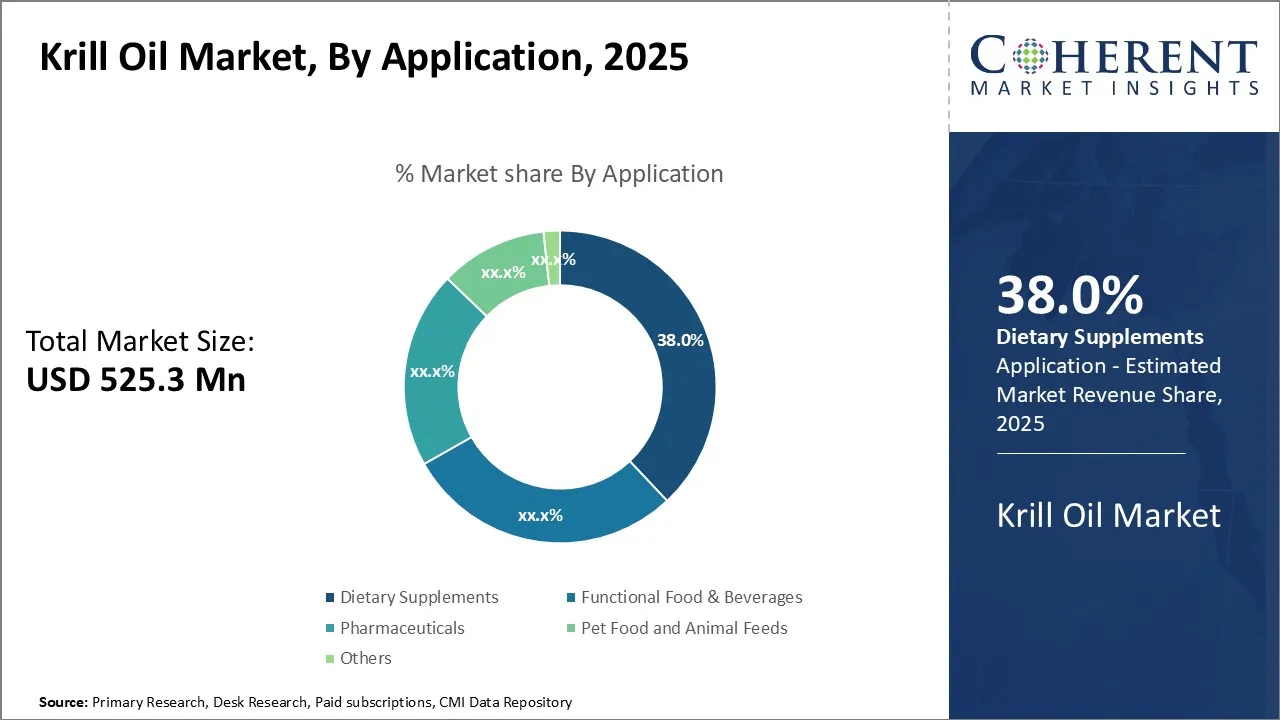
- Based on Application, the Dietary Supplement segment is projected to capture 39% share of the market in 2026, as health-conscious consumers prioritize krill oil for preventive wellness.
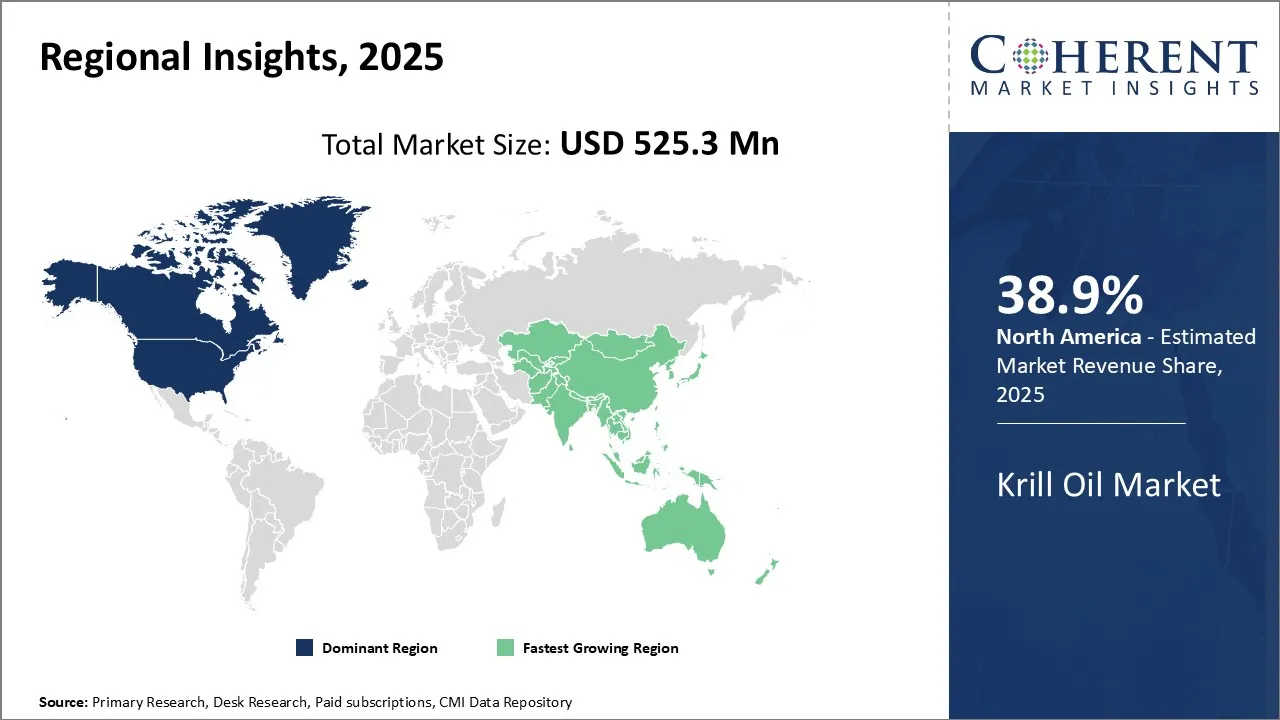
- Based on Region, North America is set to lead the global krill oil market with 38.9% share in 2026. While, Asia Pacific is projected to be the fastest growing region with 10.5% CAGR.
Market Overview
Krill is a supplement that is gaining high demand in the market as an alternative to fish oil. It is a rich source of eicosapentaenoic acid (EPA) and docosahexaenoic acid (DHA), is a type of omega fats that are mainly found in marine species. Krill oil has numerous health benefits as it has anti-inflammatory properties and also helps in reducing arthritis and joint pain. The fats present in the krill oil is easier for the body to absorb in the bloodstream. The consumption of krill oil can also enhance the blood flow and reduce the risk of heart disease.
Current Events and their Impact on the Krill Oil Market
Current Event | Description and its Impact |
Antarctic Krill Fishery Crisis & Resource Scarcity (2024-2025) |
|
Antarctic Ecosystem Collapse Risks from Climate Change |
|
Segmental Insights
- Current Industry Events of 2026
- Market Size Estimation
- Regional Breakdown
- Competitive Landscape
- Customer Intelligence
- Segmental Analysis
- Pricing Analysis
- Key Market Drivers, Challenges & Future Trends
- Customized Insights Section
Krill Oil Market Insights, By Application: Dietary supplements Dominate as Health-Conscious Consumers Prioritize Krill Oil for Preventive Wellness
In terms of application, the dietary supplement segment is expected to hold 39% share of the market in 2026. This growth is driven by increasing consumer awareness of the health benefits of omega-3 fatty acids, particularly for heart, brain, joint, and metabolic health. As non-communicable diseases rise globally, more people are turning to preventive healthcare solutions, with krill oil supplements becoming a key part of wellness routines. The supplement segment benefits from strong retail and e-commerce distribution, targeted marketing, and product innovations like age-specific formulations and enhanced absorption technologies. Other applications, such as functional foods, pharmaceuticals, and pet nutrition are growing but remain secondary to the robust demand in the supplement space.
For instance, in March 2025, Nordmann announced a strategic partnership with Aker BioMarine to enhance its portfolio of marine-based dietary supplements. The collaboration aims to deliver high-quality krill oil ingredients, supporting growing consumer demand for omega-3-rich, sustainable health products. This move strengthens Nordmann’s position in the global nutraceutical and wellness market.
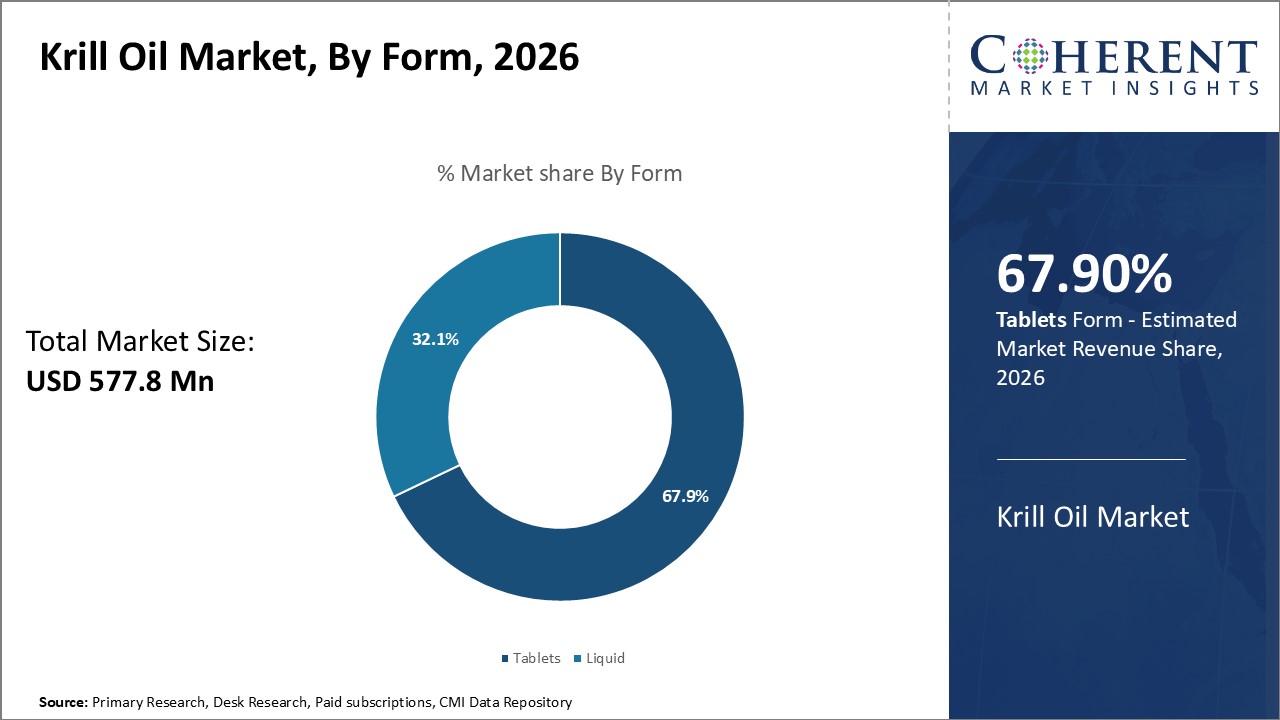
Krill Oil Market Insights, By Form: Tablets Leads Due To Their Convenience, Stability, And Consumer Familiarity
In terms of form, the tablet segment is expected to contribute the largest share of the market in 2026, due to their convenience, precise dosage, and extended shelf life. Consumers are familiar with capsules as a standard supplement form, making them a trusted choice for daily health routines. Additionally, advancements in encapsulation technology have improved the stability and bioavailability of krill oil in tablet form, further enhancing their appeal. While liquid krill oil is gaining popularity, especially among children and those with difficulty swallowing pills, it remains a niche segment compared to the widespread adoption of capsules.
For instance, in May 2025, NYO3, the world’s top online krill oil brand, made a notable debut at Vitafoods Europe 2024, spotlighting its premium krill oil capsules. Known for high bioavailability and purity, the capsules cater to growing global demand for sustainable omega-3 supplements. Each capsule contains krill oil up to 1300mg. NYO3’s presence underscores innovation in marine-based nutrition and clean-label wellness solutions.
Regional Insights
North America Krill Oil Market Analysis & Trends
North America region is projected to lead the market with a 38.9% share in 2026. Some of the key application sectors in the region include pharmaceuticals, infant formula, and supplemental & functional foods. Product demand for functional food and beverage applications is anticipated to be driven by rising consumer fitness preferences in the U.S., Canada, Mexico, and Canada. The demand for krill oil supplements in North America is also anticipated to increase in the near future as a result of expanding health benefits and the launch of various dietary supplement product forms.
For instance, in September 2026, Aker BioMarine launched its second annual Krill Oil Week to promote consumer education on the health benefits of krill oil. The initiative featured expert insights, digital campaigns, and interactive content aimed at raising awareness about omega-3 nutrition, sustainability, and krill oil’s role in supporting heart, brain, and joint health.
Asia Pacific Krill Oil Market Analysis & Trends
Asia Pacific is expected to exhibit the fastest growth in the market contributing 10.5% of CAGR. Krill oils as dietary supplements are increasingly popular among middle-aged consumers in China for eye and immune benefits. Rising demand for supplements in countries like India, China, Singapore, South Korea, Japan, and Australia has fueled the growth of omega-3 in the Asia Pacific region.
For instance, in May 2026, Norwegian krill oil leader NYO3 launched in Hong Kong, partnering with Watsons, Asia’s top health and beauty chain. This strategic move marks NYO3’s entry into the region’s booming wellness market, aiming to meet rising consumer demand for premium omega-3 supplements.
Krill Oil Market Outlook Country-Wise
The U.S. Krill Oil Market Trends
Krill oil demand in the U.S. is rising due to growing health awareness and preference for high-quality omega-3 supplements. Consumers seek its benefits for heart, brain, and joint health, with krill oil offering superior absorption and antioxidant content compared to fish oil. The market is projected to grow at over 10% CAGR through 2033.
For instance, in September 2026, the ROOT Brands launched KO3, a new Antarctic krill oil supplement designed to support heart, brain, and joint health. Marketed as a breakthrough in cellular wellness, KO3 aims to deliver high bioavailability and potent antioxidant benefits, expanding the brand’s reach in the global health supplement market.
China Krill Oil Market Trends
China’s krill oil market is booming due to rising health awareness and demand for premium supplements. Consumers are increasingly seeking omega-3-rich products for heart, brain, and joint health. Krill oil’s superior bioavailability and antioxidant content make it a preferred choice over fish oil, especially among urban, health-conscious adults and aging populations.
For instance, in September 2026, China launched its first home-built krill catcher-processor vessel, backed by a ¥650 million ($89 million) investment. The ship, developed by CNFC Overseas Fishery, marks a major step in China’s push to expand its Antarctic krill harvesting capabilities and reduce reliance on foreign-built fleets.
Market Report Scope
Krill Oil Market Report Coverage
| Report Coverage | Details | ||
|---|---|---|---|
| Base Year: | 2025 | Market Size in 2026: | USD 577.8 Mn |
| Historical Data for: | 2020 To 2024 | Forecast Period: | 2026 To 2033 |
| Forecast Period 2026 to 2033 CAGR: | 10.0% | 2033 Value Projection: | USD 1,126.0 Mn |
| Geographies covered: |
| ||
| Segments covered: |
| ||
| Companies covered: | Neptune Biotech Pvt. Ltd., Aker BioMarine AS, Enzymotec Ltd, Fuji Chemicals, Krill Canada, Rimfrost, Norwegian Fish Oil, Darduck Frd, and Quingdao Kangjing Marine Biotechnology Co. Ltd. | ||
| Growth Drivers: |
| ||
| Restraints & Challenges: |
| ||
Krill Oil Market Drivers
Rising Health Consciousness Among Consumers
Krill oil is good for the brain and heart as it is high in omega-3 fatty acids and antioxidants. Krill Oil Market demand is rising as people seek natural ways to stay healthy. Growth is being driven by rising disposable incomes and awareness of non-communicable diseases, which cause more than 70% of deaths worldwide. Companies that make food, drinks, and supplements are adding more products that contain krill oil for heart, brain, eye, and joint health. This boom is good for both the retail and business-to-business (B2B) sectors. With increased longevity and investment in wellness, krill oil supplements are becoming essential, driving consistent market expansion and innovation in health nutrition products worldwide.
Increasing Demand for Omega-3 Fatty Acids Supplements
The global demand for omega-3 fatty acids has been rising steadily in the recent years due to increasing health consciousness. Omega-3 fatty acids are known to provide numerous health benefits such as reducing inflammation, lowering the risk of heart diseases, boosting brain function, and improving eye health. Krill oil has emerged as a popular source of meeting this rising omega-3 requirement as it contains phospholipid-bound omega-3 fatty acids which are considered better than triglyceride forms present in fish oils.
The awareness about the superior absorption of phospholipid omega-3s from krill oil compared to fish oil capsules has been a major driver for the krill oil market. Various scientific studies conducted on krill oil have validated its anti-inflammatory properties and other health advantages.
For instance, in July 2023, a new study from RTI International suggests omega-3 fatty acids may help maintain lung health. Researchers found that higher levels of omega-3s were linked to better lung function and slower decline over time. These findings highlight the potential of omega-3s as a preventive tool against respiratory issues.
Surging adoption in nutraceutical applications
Growing awareness of omega-3 health benefits is driving global krill oil market growth. Krill oil, a popular nutraceutical, offers highly absorbable fatty acids in a form similar to human cells, making it more effective than fish oil. It’s also lower in mercury and sustainably sourced. Its properties support cognitive function, heart health, joint care, and metabolic wellness. With rising lifestyle-related diseases, preventive healthcare is gaining traction, and consumers are proactively using supplements. Krill oil’s versatility makes it suitable for all age groups, fueling demand across dietary supplements, functional foods, and infant formulas, and contributing to strong market momentum worldwide.
For instance, in June 2025, A recent study published by News Medical reveals that omega-3 fatty acids, commonly praised for their anti-inflammatory benefits, may also be associated with increased levels of certain inflammation markers. Researchers caution that while omega-3s offer health advantages, their effects on inflammation may be more complex than previously understood.
Krill Oil Market Opportunities
Untapped Growth Potential in Emerging Markets
The Krill Oil Market forecast suggests that places like Asia Pacific and Latin America have a lot of room to grow. People are becoming more aware of their health and want superfoods. Therefore they are interested in the omega-3 and antioxidant benefits of krill oil. India, China, Brazil, and Mexico are just a few of the countries with huge untapped consumer markets. These markets can now buy high-quality nutrition products because their economies are getting better and people have more money to spend. As heart disease and diabetes become more common caused by changes in how people live, krill oil is ready to help people stay healthy. These markets change quickly, which gives suppliers a great chance to grow their distribution and get more people to know about their brands.
New product launches with innovative formulations and delivery formats
The Krill Oil Market value is worth more now as companies are coming up with new ways to make and deliver the oil. Krill oil used to only come in softgel capsules, but now it also comes in nanoemulsions and microemulsions, which are easier for the body to absorb and cause less stomach pain. Brands are making specific products with omega-3s, vitamin D, K, and astaxanthin to help with bone, heart, and brain health. More and more people are using age-specific solutions for kids, adults, and seniors. Liquid forms that are easy to use, like juices, elixirs, edible films, and gums, make them more appealing, especially to kids. This expanded portfolio shows that more and more people want personalized wellness, which is driving major expansion in the global krill oil market.
Krill Oil Market Trends
Surging demand for clean label and natural ingredients-based products
The Krill Oil market research shows that increasingly more people want products with natural ingredients and clean labels. People who care about their health now prefer supplements that have not been too processed and have ingredients they can recognize. Krill oil is a sustainable alternative to fish oil that provides omega-3s like EPA and DHA without any mercury. Its environmentally friendly sourcing and nutrient profile have made it more popular. In response, manufacturers are making krill oil pills and softgels with clear formulas that use food-grade krill meal as the main ingredient. Natural alternatives are taking the place of artificial additives. This change fits with the clean label trend, which is pushing the global krill oil market to grow and come up with new ideas.
Rising Prominence of E-Commerce as Sales Channel
E-commerce is quickly changing the Krill Oil Market by giving people a large and easy way to buy things. As more people use digital devices, they now prefer to buy health supplements online, like krill oil products. Online platforms help brands reach more people, show off the benefits of their products, and make personalized suggestions. The fact that it's easy to compare formulations, read reviews, and find subscription models makes customers more likely to buy again. E-commerce also helps launch niche products like krill oil nanoemulsions and supplements for specific age groups. As digital health trends grow, online shopping is expected to be a key factor in the growth of the krill oil market and its availability around the world.
Analyst Opinion (Expert Opinion)
The krill oil market is currently at a pivotal stage, shaped by consumer perceptions, environmental concerns, and regulatory factors. Its appeal stems from claims of superior bioavailability of omega-3 fatty acids, particularly EPA and DHA, compared to fish oil. However, these claims remain contentious; a 2023 meta-analysis indicated that krill oil’s impact on cardiovascular health is not significantly superior to fish oil, raising questions about its premium pricing.
Environmental sustainability represents a major challenge. Krill are essential to the Antarctic ecosystem, supporting species from whales to penguins while aiding carbon sequestration. Industrial-scale krill harvesting has surged, leading to early fishery closures and raising concerns over overfishing and bycatch, including marine mammals. While some companies promote sustainable practices, the lack of a comprehensive global management framework undermines these efforts. Countries such as India have recently entered krill fishing without established quotas or adherence to conservation agreements, intensifying ecological risks.
Regulatory oversight remains limited. The Commission for the Conservation of Antarctic Marine Living Resources (CCAMLR) struggles with geopolitical disputes, allowing unsustainable practices that threaten both ecosystems and market viability.
In conclusion, the krill oil market faces tension between potential health benefits and environmental risks. Long-term sustainability will depend on genuine adherence to conservation practices and robust regulatory frameworks; otherwise, ecological pressures may constrain market growth despite strong consumer demand.
Speak to the analyst
Want personalized insights?
Take the findings above to one of our principal consultants, or have the report rebuilt around the segments, geographies and competitors you actually track.
Recent Developments
- In July 2025, Aker BioMarine, in collaboration with the University of Glasgow’s School of Medicine, Dentistry and Nursing, found that krill oil may help preserve muscle strength and mass during weight loss. The research highlights krill oil’s potential to support metabolic health and physical performance, offering new insights into sustainable fat loss strategies.
- In April 2025, Sirio Europe launched a new shelf-ready range of skin and sports hydration concepts, including formulations enhanced with krill oil. The initiative targets growing consumer demand for functional supplements, combining marine-sourced omega-3s with beauty and performance benefits in convenient, ready-to-market formats.
- In September 2023, Aker BioMarine and Swisse collaborated to launch a ground-breaking product under Australia’s listed assessed medicine category. The product, Swisse Ultiboost High Strength Krill Oil, utilizes Aker BioMarine’s Superba Boost Krill oil and has been included on the Australia Register of Therapeutic Goods (ARTG) with an AUST L(A) 417392. The specific indications for the product are to decrease/reduce/relieve knee pain and stiffness in mild to moderate osteoarthritis and to increase knee physical function in mild to moderate osteoarthritis.
Market Segmentation
- By Form (Revenue, USD Mn, 2021 - 2033)
- Liquid
- Tablets
- By Application (Revenue, USD Mn, 2021 - 2033)
- Dietary Supplements
- Functional Food & Beverages
- Pharmaceuticals
- Pet Food and Animal Feeds
- Others (Infant Formula)
- By Region (Revenue, USD Mn, 2021 - 2033)
- North America
- U.S.
- Canada
- Latin America
- Brazil
- Argentina
- Mexico
- Rest of Latin America
- Europe
- Germany
- U.K.
- Spain
- France
- Italy
- Russia
- Rest of Europe
- Asia Pacific
- China
- India
- Japan
- Australia
- South Korea
- ASEAN
- Rest of Asia Pacific
- Middle East
- GCC Countries
- Israel
- Rest of Middle East
- Africa
- South Africa
- North Africa
- Central Africa
- North America
- Krill Oil Market Companies
- Neptune Biotech Pvt. Ltd.
- Aker BioMarine AS
- Enzymotec Ltd
- Fuji Chemicals
- Krill Canada
- Rimfrost
- Norwegian Fish Oil
- Darduck Frd
- Quingdao Kangjing Marine Biotechnology Co. Ltd.
Sources
Primary Research Interviews from the following stakeholders
- Interviews with commercial krill harvesters, processing plant managers, omega-3 supplement manufacturers, nutraceutical R&D leads, formulation scientists, clinical researchers, QC/food-safety managers, regulatory affairs heads, bulk ingredient traders, procurement heads at retail and e-commerce chains, and logistics/cold-chain operators across leading global markets.
Specific stakeholders
- Corporate/strategic procurement and product development leads at large supplement and CPG companies (e.g., firms sourcing marine omega-3s).
- Fleet managers and operations lead at Antarctic krill harvesting companies and vessel operators.
- Processing and extraction plant managers (cold-press, solvent extraction, supercritical CO₂) and QA/QC heads.
- R&D and clinical trial investigators at universities and contract research organizations working on EPA/DHA and phospholipid bioavailability.
- Regulatory affairs and compliance heads at firms registering nutraceuticals and novel foods in major markets (EU, US, Japan, India, South Korea).
- Nutrition formulators and product managers at dietary supplement brands and private-label manufacturers.
- Category managers and buying heads at pharmacy chains, health-food retailers, supermarkets, and e-commerce marketplaces.
- Sustainability and traceability lead at seafood certification bodies and NGOs.
- Logistics, cold-chain and import/export managers handling marine oil shipments and bulk ingredients.
- Analytical labs and metabolomics teams performing fatty-acid profiling and contaminant testing.
- Insurance and risk managers for marine harvest operations (safety, environmental risk).
- Trade association representatives and commodity traders active in marine oils.
Databases
- UN Comtrade Database
- World Trade Organization (WTO) Trade Statistics
- Food and Agriculture Organization (FAO) Fishery and Aquaculture Statistics
- U.S. International Trade Commission (USITC) / U.S. Census trade data
- Eurostat trade and agriculture datasets
- China Customs Statistics
- Korea Customs Service Data Portal
- Japan External Trade Organization (JETRO) trade statistics
- Directorate General of Commercial Intelligence & Statistics (DGCIS), India / Indian Department of Fisheries trade stats
- National dietary supplement registries and customs portals (e.g., EU TRACES, U.S. FDA import database)
Magazines & Industry Websites
- NutraIngredients / NutraIngredients-Global
- Nutraceuticals World
- SeafoodSource
- NutritionInsight
- Natural Products Insider
- New Hope Network (Nutrition & Supplements coverage)
- FoodNavigator / FoodNavigator-Asia (marine oils coverage)
- Omega-3 Bulletin / industry newsletters
Peer-Reviewed Journals
- Marine Drugs
- Journal of Lipid Research
- Food Chemistry
- Journal of Nutritional Biochemistry
- Prostaglandins, Leukotrienes and Essential Fatty Acids (PLEFA)
- Nutrients
- Journal of Agricultural and Food Chemistry
- Journal of Functional Foods
Newspapers & Business Press
- The Wall Street Journal — Food, Health & Biotech sections
- Financial Times — Food & Agribusiness / Supply Chain
- The Economist — Food & Commodities features
- Nikkei Asia — Marine, Supply Chain & Ingredients
- The Hindu Business Line — Food Processing & Exports
- South China Morning Post — Seafood and supply-chain reporting
Associations & Industry Bodies
- International Fishmeal and Fish Oil Organisation (IFFO)
- Global Organization for EPA and DHA Omega-3s (GOED)
- Marine Stewardship Council (MSC)
- Antarctic and Southern Ocean Coalition (ASOC) / relevant environmental NGOs
- Codex Alimentarius (relevant standards committees)
- National fisheries ministries and seafood councils (e.g., Norwegian Seafood Council)
- Association of Indian Fishery Industries / national seafood associations
- European Federation of Associations in the Marine Ingredients sector
Public-Domain Government & Regulatory Sources
- Food and Agriculture Organization (FAO) reports and fishery status papers
- Commission for the Conservation of Antarctic Marine Living Resources (CCAMLR) reports and catch limits
- U.S. FDA (dietary supplement guidance, import alerts, adverse event reporting)
- European Food Safety Authority (EFSA) scientific opinions on omega-3s and novel foods
- Department/Ministry of Fisheries (national portals: Norway, Chile, India, Korea, Japan)
- NOAA Fisheries (U.S.) and other national marine agencies
- National standards bodies (e.g., India BIS standards for oils, Japan METI/MAFF guidance)
- Customs tariff and HS code documentation for marine oils
Proprietary Elements
- CMI Data Analytics Tool
- Proprietary CMI Existing Repository of information for last 8 years
Definition: Global krill oil market refers to the industry that encompasses the production, distribution, and sale of krill oil, which is an extract that is prepared from a species of Antarctic krill. Krill oil is rich in omega-3 fatty acids and phospholipid-derived fatty acids, thereby making it a popular dietary supplement known for its potential health benefits. The market includes various product forms such as liquid krill oil and krill oil tablets, and it finds applications in dietary supplements, functional food and beverages, pharmaceuticals, pet food and animal feed, and other areas.
Get access to 250+ pages report
Every segment, forecast, competitor profile and data table behind the analysis above — available for instant download.
- ESOMAR Member
- ISO 9001:2015 Certified
- D-U-N-S Registered
- GDPR & CCPA Compliant
Missing comfort of reading report in your local language? Find your preferred language:
Transform your Strategy with Exclusive Trending Reports
Frequently Asked Questions
The Krill Oil Market is estimated to be valued at USD 577.8 Mn in 2026, and is expected to reach USD 1,126.0 Mn by 2033.
High cost of krill oil products and sustainable harvesting of Antarctic krill are the key factors hampering the growth of the global krill oil market.
Rising health consciousness among consumers, increasing demand for omega-3 fatty acids supplements and surging adoption in nutraceutical applications are the major factors driving the global krill oil market growth.
The dietary supplements are the leading application segment in the global krill oil market.
The major players operating in the global krill oil market are Neptune Biotech Pvt. Ltd., Aker BioMarine AS, Enzymotec Ltd, Fuji Chemicals, Krill Canada, Rimfrost, Norwegian Fish Oil, Darduck Frd, and Quingdao Kangjing Marine Biotechnology Co. Ltd.
North America leads the global krill oil market.
The CAGR of the Krill Oil Market is projected to be 10.0% from 2026 to 2033.