

Global Wind Blade Recycling Market Size and Forecast – 2026-2033
The global wind blade recycling market is estimated to be valued at USD 68,125.1 Th in 2026 and is expected to reach USD 636,262.3 Th by 2033, exhibiting a compound annual growth rate (CAGR) of 37.8% from 2026 to 2033.
Key Takeaways of the Wind Blade Recycling Market
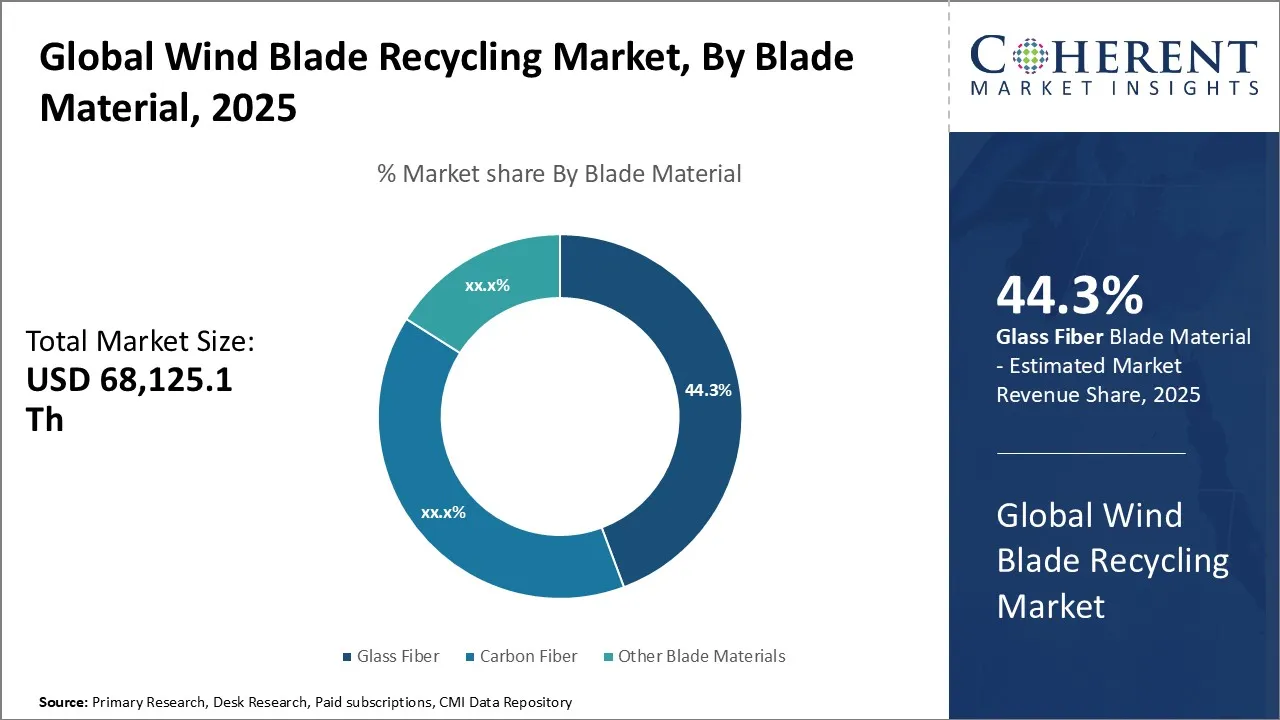
- The glass fiber segment is projected to account for 45.3 % of the market share in 2026.
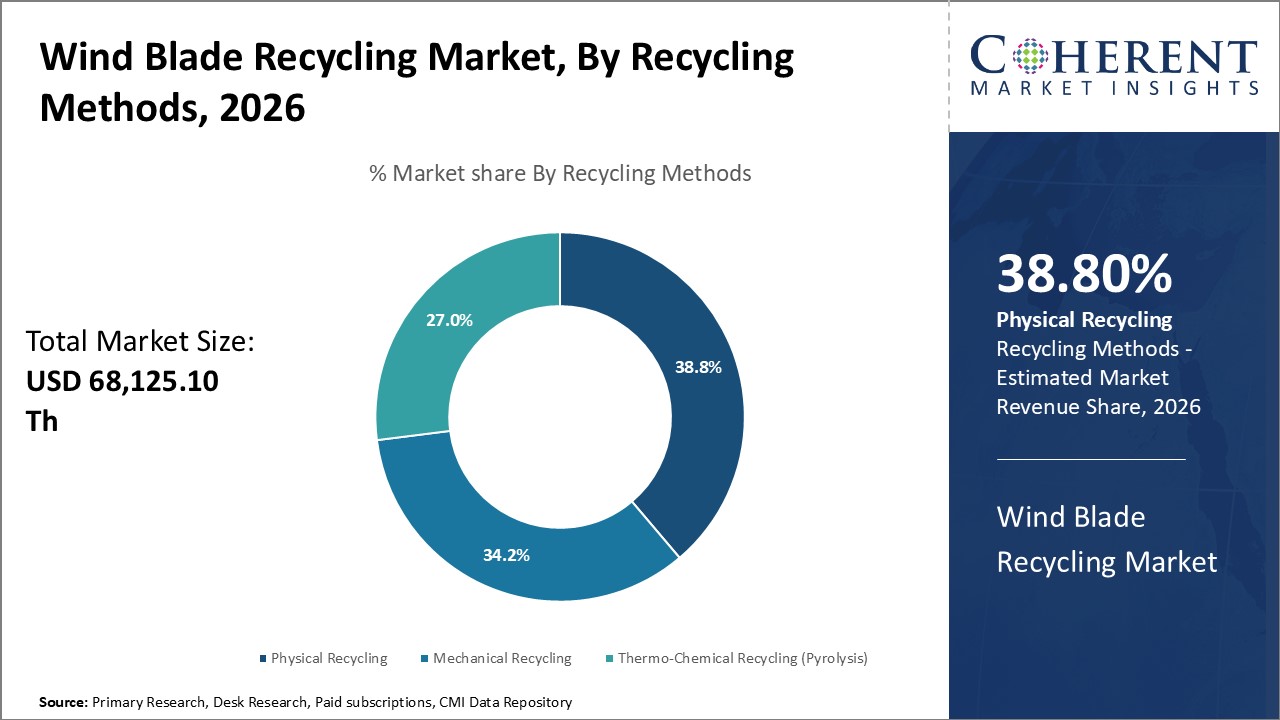
- Physical recycling is expected to capture 38.8 % of the global wind blade recycling market in 2026.
- The construction materials segment is projected to hold a 29.7 % share of the market in 2026.
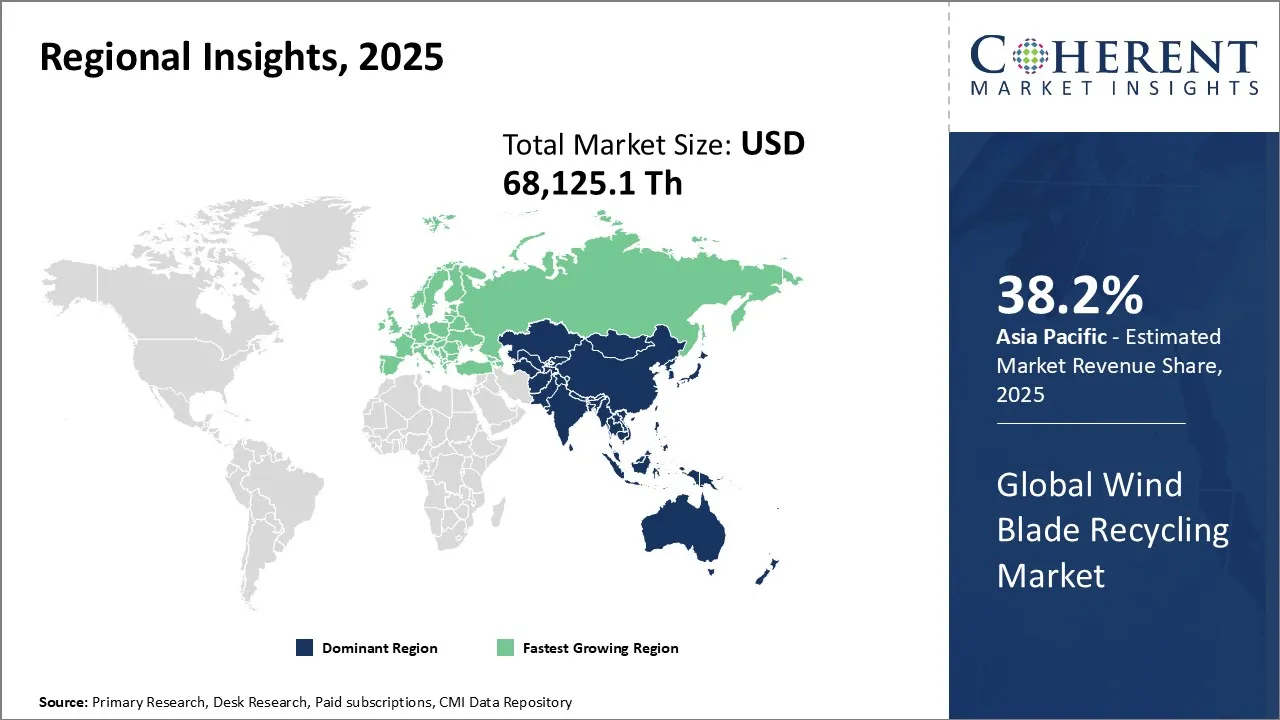
- Asia Pacific is set to lead the global wind blade recycling market in 2026 with a 38.2 % share. Europe, with a 24.5% share, will be the fastest-growing region.
Market Overview
Market trends indicate a rising emphasis on the development of advanced recycling technologies to manage the growing volume of decommissioned wind blades, particularly from offshore wind projects. Innovations such as chemical recycling and thermal treatment methods are gaining traction to efficiently process composite materials.
Additionally, collaborations between manufacturers, recyclers, and governments are fostering circular economy models, promoting cost-effective and environmentally friendly wind blade disposal, which is expected to propel the market expansion over the forecast period. Moreover, the integration of recycling initiatives into wind turbine operations and maintenance strategies ensures sustainable lifecycle management, reducing long-term environmental impact while enhancing overall project efficiency.
Current Events and Its Impact
Current Events | Description and its impact |
U.S. DOE announces USD 20M for wind recycling & notes 90% mass recyclability (U.S.) — January 2025 |
|
ZEBRA consortium demonstrates closed-loop recycling for thermoplastic blades (EU) — October 2024 |
|
Segmental Insights
- Current Industry Events of 2026
- Market Size Estimation
- Regional Breakdown
- Competitive Landscape
- Customer Intelligence
- Segmental Analysis
- Pricing Analysis
- Key Market Drivers, Challenges & Future Trends
- Customized Insights Section
Wind Blade Recycling Market Insights, by Blade Material - Glass Fiber Leads Owing to High Volume of Retired Glass Fiber Blades
Glass fiber segment is projected to hold 45.3% share of the market in 2026, primarily due to its widespread use in wind turbine blade manufacturing. Glass fiber has been the staple composite material due to its cost-effectiveness, mechanical robustness, and availability, making it the material of choice for most manufacturers worldwide. Consequently, the extensive deployment of glass fiber blades leads to a higher volume of end-of-life blades composed predominantly of glass fiber, making this segment the largest contributor in this market.
For example, Denmark-based wind turbine manufacturer Vestas has announced initiatives to develop circular recycling solutions specifically for glass fiber blades, as a significant share of its retired onshore and offshore turbine blades are composed of glass fiber. This has prompted collaborations with partners like Olin and Stena Recycling to scale glass fiber blade recycling technologies.
Wind Blade Recycling Market Insights, by Recycling Methods - Physical Recycling Leads Due to Cost-Effectiveness and Material Integrity Preservation
Physical recycling is expected to hold 38.8% share in the global wind blade recycling market in 2026, largely because it represents the most straightforward and cost-effective approach to reclaiming blade materials. Physical recycling encompasses processes such as mechanical shredding, grinding, and milling to break down composite blades into reusable fragments or fibers without employing complex chemical treatments or high-temperature processes.
The driving factor behind this segment’s growth is primarily its operational simplicity and relatively low capital investment compared to thermo-chemical or chemical recycling methods like pyrolysis. For many recyclers and waste management companies, physical recycling provides a pragmatic option to quickly process large volumes of decommissioned blades while maintaining reasonable margins. This method’s scalability and adaptability to existing waste handling infrastructure make it particularly attractive in regions where investment in advanced recycling technologies may be limited.
Wind Blade Recycling Market Insights, by Application - Construction Materials Segment Dominates Due to Versatility and Sustainability Demand
The construction materials segment is projected to account for 29.7% share of the market in 2026, due to their highly complementary nature of recycled blade materials with construction industry requirements. Recycled composites from wind blades—primarily comprising glass fibers and resin matrices—demonstrate properties such as high strength, dimensional stability, and good durability, making them suitable for use as filler materials, aggregates, and reinforcement components in various construction applications.
The construction sector’s expansive scale and ongoing demand for sustainable building materials contribute significantly to this segment’s growth. Using recycled wind blade materials in concrete, asphalt, and prefabricated building panels helps reduce reliance on natural aggregates and virgin construction materials, addressing both environmental concerns and resource depletion challenges. Additionally, these recycled materials often improve the mechanical properties of construction products while reducing overall material costs, offering a compelling value proposition for builders and developers.
Regional Insights
Asia Pacific Wind Blade Recycling Market Analysis and Trends
The Asia Pacific region is projected to lead the market with a 38.2% share in 2026, due to rapid expansion of the renewable energy sector in countries like China, India, and Japan. The increasing installation of wind turbines in coastal and inland regions generates a larger volume of decommissioned blades requiring recycling. Government initiatives aimed at reducing environmental pollution and promoting green manufacturing encourage investment in recycling infrastructure and technology development.
The nascent but quickly evolving supply chain for blade recycling in Asia Pacific is witnessing increasing participation from global players such as Goldwind, Sinovel, and Suzlon alongside emerging local recycling firms. These companies focus on adapting recycling methods to regional material compositions and cost structures. Trade barriers and regulatory gaps remain challenges, but progressive policies and industrial cooperation accelerate the creation of an effective market ecosystem.
Europe Wind Blade Recycling Market Analysis and Trends
The Europe region is expected to exhibit the fastest growth in the market contributing 24.5% share in 2026, driven by the region’s advanced wind energy infrastructure, stringent environmental regulations, and strong government policies promoting circular economy practices. European countries, notably Germany, Denmark, and the Netherlands, have established robust frameworks encouraging the recycling and repurposing of wind turbine blades to mitigate landfill use and address sustainability targets. The presence of a mature wind energy sector fosters innovation in recycling technologies, supported by collaboration among manufacturers, research institutions, and waste management companies.
Leading European companies such as Veolia, Ragn-Sells, and LM Wind Power have been instrumental in pioneering blade recycling solutions, including mechanical recycling and blade disassembly techniques, making Europe a hub for sustainable wind blade waste management. Trade dynamics within the EU, promoting cross-border movement of recyclable materials, further enhance operational efficiencies and reduce costs within the market.
Global Wind Blade Recycling Market Outlook for Key Countries
Germany Wind Blade Recycling Market Analysis and Trends
Germany's wind blade recycling market is characterized by its proactive environmental legislation and leadership in renewable energy deployment. The country's strict recycling targets and landfill bans compel turbine manufacturers and operators to prioritize blade recycling solutions. German companies like RKW and Veolia actively collaborate with wind turbine OEMs to design blades for easier recyclability and develop advanced composite recycling techniques. Germany's well-established recycling infrastructure and strong governmental subsidies support continuous innovation and operational scalability in the market.
U.S. Wind Blade Recycling Market Analysis and Trends
The U.S. remains a major contributor to the market due to its large wind power capacity distributed across states like Texas, Iowa, and California. Federal and state-level incentives increasingly support recycling infrastructure and R&D in composite materials recycling. Companies such as TPI Composites and Global Fiberglass Solutions are advancing blade recycling by integrating thermal, mechanical, and chemical processes to recover valuable materials. While policy fragmentation across states poses challenges, growing public awareness and industry commitment drive momentum for sustainable wind blade end-of-life management.
China Wind Blade Recycling Market Analysis and Trends
China's rapidly expanding wind energy market underpins its rising prominence in the wind blade recycling sector. The country's focus on carbon neutrality and pollution control fosters supportive regulatory frameworks aimed at sustainable waste management. Major players like Goldwind and China National Bluestar leverage economies of scale to develop blade recycling facilities tailored to domestic turbine designs. Government funding and partnerships with research institutions expedite technology adoption, though balancing cost-effectiveness with efficiency remains a key market dynamic in China.
India Wind Blade Recycling Market Analysis and Trends
India's wind blade recycling market reflects the emerging status of wind blade recycling supported by increasing turbine installation and nascent environmental policies. The government’s emphasis on renewable energy capacity growth is gradually complemented by regulations targeting circular economy practices. Companies such as Suzlon actively explore composite recycling techniques and blade repurposing approaches. Although infrastructure and technology are still developing, collaborative efforts between public agencies and private firms are building a foundation for sustainable recycling growth.
Denmark Wind Blade Recycling Market Analysis and Trends
Denmark continues to lead in wind energy innovation and sustainability initiatives, which extend into the blade recycling market. Danish companies like LM Wind Power play critical roles in advancing recyclable blade designs and lifecycle management solutions. National environmental policies encourage reuse and recycling practices, integrated within broader climate objectives. Denmark’s established wind industry ecosystem and research collaborations sustain the country’s impact on refining recycling technologies and setting global industry standards.
Macro and Micro Economic Factors Impacting Wind Blade Recycling Market Growth
Macroeconomic Factors
- Increasing global renewable energy investments: The rapid expansion of wind farms worldwide leads to a growing volume of decommissioned wind turbine blades needing recycling.
- Government regulations and policies: Strong regulations promoting sustainability, circular economy principles, and landfill reduction encourage recycling efforts. For example, the EU Renewable Energy Directive and other regional mandates drive recycling market growth.
- Environmental awareness and sustainability mandates: Growing public and corporate pressure for environmentally responsible waste management and corporate social responsibility incentivize recycling adoption.
- Technological advancements: Innovations in recycling technologies such as mechanical grinding, pyrolysis, chemical treatment, and thermochemical processes are making recycling more viable and cost-effective.
Microeconomic Factors
- High costs and technological complexity: Recycling composite materials like fiberglass and carbon fiber is challenging and costly due to blade durability and complex material composition.
- Market demand for recycled materials: Fiberglass and carbon fiber extracted from blades have growing demand in industries like construction, automotive, electronics, and consumer goods.
- End-use industry adoption: Construction is a major consumer of recycled blade materials, using them for building materials, insulation, and concrete reinforcement.
- Collaborations and partnerships: Increasing collaboration among wind energy operators, recyclers, and material scientists drives innovation and scaling of recycling solutions.
- Market competition and players: Leading companies like SUEZ, Veolia, Siemens Gamesa, and innovative startups are advancing recycling infrastructure and technology.
Market Players, Key Development, and Competitive Intelligence
Key Development
- In March 2022, Hitachi, Ltd. launched the Blade Total Service, an advanced solution aimed at reducing risks associated with wind power facilities. The service leverages artificial intelligence, digital technologies, and state-of-the-art drone systems to address challenges such as blade deterioration from wear and tear, structural stress from typhoons, and lightning-related damage.
Top Strategies Followed by Global Wind Blade Recycling Market Players
- Established companies in the sector are at the forefront of innovation, investing heavily in research and development to create high-performance recycling technologies that increase efficiency and minimize environmental impact. Furthermore, established players aggressively pursue global expansion by broadening their distribution networks. This enables them to penetrate emerging markets where wind energy adoption is rapidly growing, positioning themselves as key enablers of sustainable blade recycling solutions worldwide.
- For example, Veolia has partnered with General Electric (GE) to recycle decommissioned wind turbine blades in the U.S., converting them into raw material for cement production.
- Mid-level firms within the wind blade recycling market typically focus on balancing cost and quality to appeal to price-sensitive customers. Their strategy revolves around offering cost-effective recycling solutions that do not compromise on performance or environmental standards, allowing them to target smaller wind farm operators and regional players who require affordable options. To strengthen their competitiveness, these players often form strategic collaborations with technology providers and other market participants to enhance their production capabilities and adopt novel recycling methods.
- For instance, Global Fiberglass Solutions (GFS), a U.S.-based company, has developed a cost-effective process that transforms retired blades into pellets and panels used for construction and industrial applications.
- Small-scale enterprises in the wind blade recycling segment adopt a more specialized approach, focusing on niche market segments where innovation and unique features can provide a competitive edge. By developing tailored solutions that address specific recycling challenges or regional regulatory requirements, these smaller players differentiate themselves from larger, more generalized manufacturers.
- For example, Carbon Rivers LLC, a U.S. start-up, focuses on advanced pyrolysis-based recycling to recover high-quality glass fibers from decommissioned blades. This allows them to serve specific industries such as automotive and aerospace that demand premium recycled composites.
Market Report Scope
Wind Blade Recycling Market Report Coverage
| Report Coverage | Details | ||
|---|---|---|---|
| Base Year: | 2025 | Market Size in 2026: | USD 68,125.1 Th |
| Historical Data for: | 2020 To 2024 | Forecast Period: | 2026 To 2033 |
| Forecast Period 2026 to 2033 CAGR: | 37.8% | 2033 Value Projection: | USD 636,262.3 Th |
| Geographies covered: |
| ||
| Segments covered: |
| ||
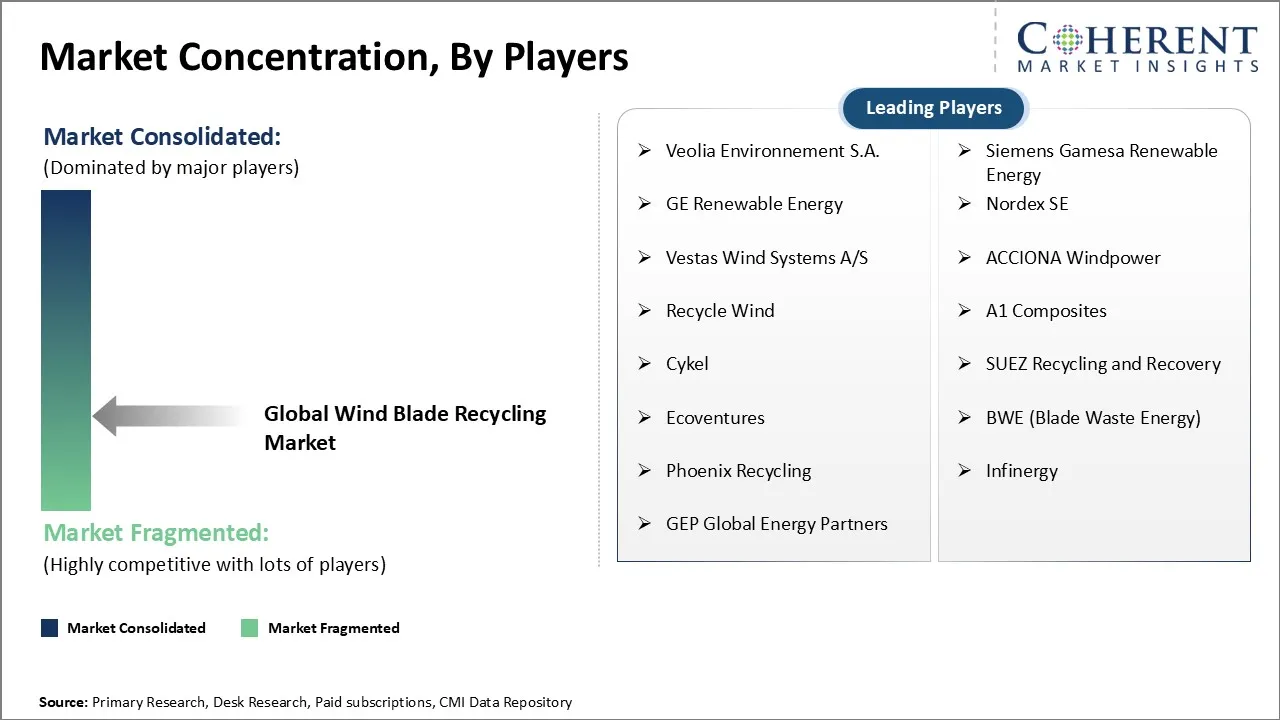
| Companies covered: | Veolia Environnement S.A., Siemens Gamesa Renewable Energy, GE Renewable Energy, Nordex SE, Vestas Wind Systems A/S, ACCIONA Windpower, Recycle Wind, A1 Composites, Cykel, SUEZ Recycling and Recovery, Ecoventures, BWE (Blade Waste Energy), Phoenix Recycling, Infinergy, and GEP Global Energy Partners | ||
| Growth Drivers: |
| ||
| Restraints & Challenges: |
| ||
Wind Blade Recycling Market Dynamics
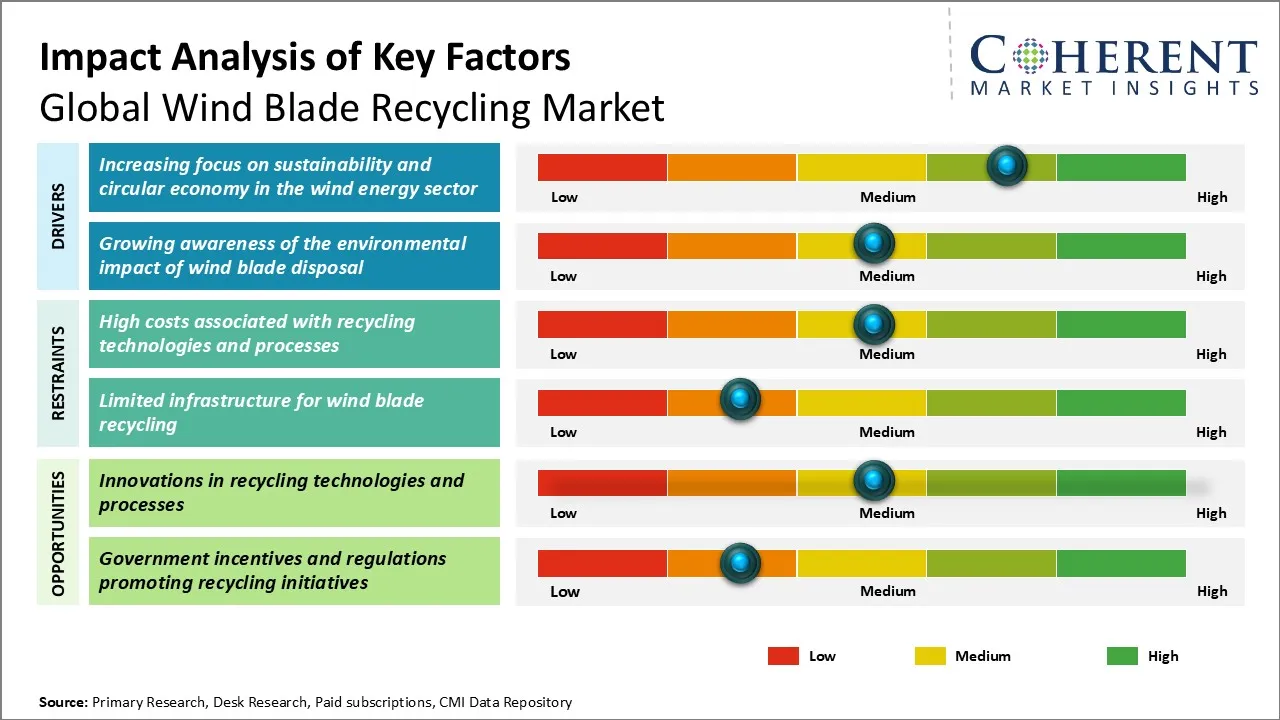
Wind Blade Recycling Market Driver - Increasing Focus on Sustainability and Circular Economy in the Wind Energy Sector
The wind energy industry’s growing commitment to sustainability and circular economy principles is a significant driver propelling the wind blade recycling market forward. As environmental regulations tighten and stakeholders demand greener practices, original equipment manufacturers (OEMs), operators, and policymakers are increasingly prioritizing end-of-life management for wind turbine components.
In 2025, the European wind industry reaffirmed its pledge that all decommissioned wind turbine blades will be reused, recycled, or recovered—demonstrating a steadfast commitment to circularity and sustainable end-of-life solutions.
Wind Blade Recycling Market Opportunity - Innovations in Recycling Technologies and Processes
The global wind blade recycling market stands at the cusp of transformative growth led by continuous innovations in recycling technologies and processes. As wind energy installations expand rapidly worldwide, the volume of decommissioned wind blades is expected to surge significantly, creating an urgent need for efficient recycling solutions. Recent advancements in materials recovery techniques, such as enhanced mechanical grinding, chemical solvolysis, and pyrolysis, allow for higher recovery rates of valuable composite materials like fiberglass and carbon fiber.
For example, Companies like Vestas have pioneered chemical recycling solutions that dissolve epoxy resins to separate fibers, while innovative startups are developing mechanical shredding processes that convert blade materials into construction aggregates and cement additives. The European Union's Circular Economy Action Plan and similar initiatives globally are driving regulatory frameworks that mandate recycling quotas, creating a compelling business case for these technological innovations.
Analyst Opinion (Expert Opinion)
- The global wind blade recycling market is gaining momentum, driven by increasing environmental awareness and regulatory pressures for sustainable practices in the wind energy sector. Insights from the International Renewable Energy Conference (2023) and the Global Wind Energy Summit (2022) highlighted the urgent need for effective recycling solutions, as the lifespan of wind turbine blades approaches its end.
- Companies like Vestas and Siemens Gamesa are at the forefront, spearheading initiatives to develop innovative recycling technologies that can repurpose composite materials from blades. For instance, Vestas' collaboration with recycling firms aims to transform decommissioned blades into new products, showcasing a commitment to a circular economy. Additionally, discussions at these conferences emphasized the importance of establishing standardized recycling processes and regulatory frameworks to facilitate market growth.
- As the number of decommissioned blades increases, the demand for efficient recycling solutions will become critical. Companies that invest in research and partnerships to enhance recycling capabilities will likely lead the way. Ultimately, the future of the wind blade recycling market hinges on its ability to innovate and align with broader sustainability goals in the renewable energy landscape.
Speak to the analyst
Want personalized insights?
Take the findings above to one of our principal consultants, or have the report rebuilt around the segments, geographies and competitors you actually track.
Market Segmentation
- Blade Material Insights (Revenue, USD Th, 2021 - 2033)
- Glass Fiber
- Carbon Fiber
- Other Blade Materials
- Recycling Method Insights (Revenue, USD Th, 2021 - 2033)
- Physical Recycling
- Mechanical Recycling
- Thermo-Chemical Recycling (Pyrolysis)
- Application Insights (Revenue, USD Th, 2021 - 2033)
- Construction Materials
- Road Infrastructure
- New Wind Blades
- Composites Manufacturing
- Others
- Regional Insights (Revenue, USD Th, 2021 - 2033)
- North America
- U.S.
- Canada
- Latin America
- Brazil
- Argentina
- Mexico
- Rest of Latin America
- Europe
- Germany
- U.K.
- Spain
- France
- Italy
- Russia
- Rest of Europe
- Asia Pacific
- China
- India
- Japan
- Australia
- South Korea
- ASEAN
- Rest of Asia Pacific
- Middle East
- GCC Countries
- Israel
- Rest of Middle East
- Africa
- South Africa
- North Africa
- Central Africa
- North America
- Key Players Insights
- Veolia Environnement S.A.
- Siemens Gamesa Renewable Energy
- GE Renewable Energy
- Nordex SE
- Vestas Wind Systems A/S
- ACCIONA Windpower
- Recycle Wind
- A1 Composites
- Cykel
- SUEZ Recycling and Recovery
- Ecoventures
- BWE (Blade Waste Energy)
- Phoenix Recycling
- Infinergy
- GEP Global Energy Partners
Sources
Primary Research Interviews
- Head of Innovation – Leading Wind Turbine Blade Manufacturer
- Sustainability Manager – Major Wind Farm Operator
- Procurement Lead – Global Renewable Energy Developer
- Technology Strategist – Wind Blade Recycling Start-up
Stakeholders
- Wind Blade Manufacturers
- End-use Sectors:
- Wind Farms (developers, operators, owners)
- Renewable Energy Project Financiers
- Regulatory & Certification Authorities
- Waste Management and Recycling Companies
- Technology Solution Providers: Composite processing, chemical recycling, thermal processes
- Academic and Research Institutions
Databases
- UN Comtrade Database
- International Energy Agency (IEA) Data Portal
- US EPA Materials and Waste Database
Magazines
- Windpower Monthly – Industry updates and recycling innovations
- Renewable Energy World – Technology trends in wind blade recycling
- CompositesWorld – Trends in composite recycling for wind blades
- Global Wind Energy Update – Market growth and regulatory news
Journals
- Resources, Conservation & Recycling – Recycling research and case studies
- Journal of Cleaner Production – Sustainable manufacturing and recycling
- Renewable and Sustainable Energy Reviews – Market trends and lifecycle analysis
- Waste Management – Recycling methodologies for composite materials
Newspapers
- The Financial Times – Market developments in wind energy and recycling
- The Guardian – Policy news on renewable energy waste
- Asia Wind Energy Journal – Regional developments in wind blade recycling
- European Renewables News – Regulatory changes and recycling strategies
- The New York Times – Global trends and challenges in wind blade disposal
Associations
- Global Wind Energy Council (GWEC)
- American Wind Energy Association (AWEA)
- European Wind Energy Association (WindEurope)
- International Renewable Energy Agency (IRENA)
- Composites Recycling Association
- Clean Energy Council
Public Domain Sources
- US EPA – Guidelines and case studies on wind blade recycling
- European Commission – Waste framework directives and recycling guidelines
- IEA – Reports on decommissioning and repowering wind farms
- OECD – Analysis of circular economy initiatives in renewables
Proprietary Elements
- CMI Data Analytics Tool, Proprietary CMI Existing Repository of information for last 8 years.
Get access to 250+ pages report
Every segment, forecast, competitor profile and data table behind the analysis above — available for instant download.
- ESOMAR Member
- ISO 9001:2015 Certified
- D-U-N-S Registered
- GDPR & CCPA Compliant
Missing comfort of reading report in your local language? Find your preferred language:
Transform your Strategy with Exclusive Trending Reports
Frequently Asked Questions
The global wind blade recycling market is estimated to be valued at USD 68,125.1 Th in 2026 and is expected to reach USD 636,262.3 Th by 2033.
The CAGR of global wind blade recycling market is projected to be 37.8% from 2026 to 2033.
Increasing focus on sustainability and circular economy in the wind energy sector and growing awareness of the environmental impact of wind blade disposal are the major factors driving the growth of global wind blade recycling market.
High costs associated with recycling technologies and processes and limited infrastructure for wind blade recycling are the major factors hampering the growth of global wind blade recycling market.
In terms of blade material, glass fiber segment is estimated to dominate the market revenue share in 2026.
Veolia Environnement S.A., Siemens Gamesa Renewable Energy, GE Renewable Energy, Nordex SE, Vestas Wind Systems A/S, ACCIONA Windpower, Recycle Wind, A1 Composites, Cykel, SUEZ Recycling and Recovery, Ecoventures, BWE (Blade Waste Energy), Phoenix Recycling, Infinergy, and GEP Global Energy Partners are the major players.
Asia Pacific is expected to lead the global wind blade recycling market in 2026.