

Global Windshield Wiper Blades Market Size and Forecast – 2026 To 2033
The global windshield wiper blades market is estimated to be valued at USD 7.34 Bn in 2026 and is expected to reach USD 10.81 Bn by 2033, growing at a compound annual growth rate (CAGR) of 5.7% from 2026 to 2033. This growth is supported by expanding vehicle fleets, increasing replacement requirements, and continuous improvements in blade design, material performance, and durability.
Demand is further strengthened by emerging automotive markets where passenger vehicle ownership and component servicing networks are expanding. In April 2026, the International Organization of Motor Vehicle Manufacturers (OICA) reported that global vehicle production increased to 96.4 million units in 2025 from 92.7 million units in 2024, highlighting continued expansion of the automotive ecosystem that supports long-term demand for essential components such as windshield wiper blades.
Key Takeaways of the Global Windshield Wiper Blades Market
- Beam or Boneless Wiper Blades, with an estimated CAGR of 6.1 %, are expected to account for 48.6% of the global windshield wiper blades market in 2026, supported by increasing adoption in premium passenger vehicles due to aerodynamic efficiency, uniform windshield contact, and lower wear characteristics. In May 2025, Bosch expanded its Aerotwin wiper technology with the AeroClip adapter, improving high-speed wiping stability and aftermarket applicability for modern vehicles.
- Passenger Cars, with an estimated CAGR of 5.8 %, are projected to represent 62.8% of the global windshield wiper blades market in 2026, as passenger vehicle owners increasingly prioritize visibility, replacement reliability, and compatibility with advanced windshield systems. In January 2025, the International Organization of Motor Vehicle Manufacturers (OICA) reported continued global vehicle production activity, reinforcing the importance of passenger vehicle fleets for component suppliers.
- Natural and Synthetic Rubber, with an estimated CAGR of 5.5 %, are anticipated to capture 56.7% of the global windshield wiper blades market in 2026, owing to established processing capabilities, cost competitiveness, and suitability across varied operating climates. In March 2025, Continental highlighted its focus on sustainable rubber sourcing and material innovation within automotive supply chains, supporting long-term development of performance-oriented rubber components.
- Asia Pacific, with an estimated CAGR of 6.2 %, is expected to hold 34.6% of the global windshield wiper blades market in 2026, driven by its integrated automotive manufacturing ecosystem, expanding vehicle parc, and strong aftermarket replacement networks. In February 2025, the China Association of Automobile Manufacturers reported continued strength in new energy vehicle and automobile production, supporting regional demand for automotive components and replacement systems.
- North America, with an estimated CAGR of 5.9 %, is forecast to contribute 27.8% of the global windshield wiper blades market in 2026, supported by a large installed vehicle base, high replacement frequency, and established automotive aftermarket channels. In June 2025, the Automotive Aftermarket Suppliers Association (AASA) emphasized continued investment in aftermarket supply-chain resilience, highlighting opportunities for component suppliers serving vehicle maintenance requirements.
Segmental Insights
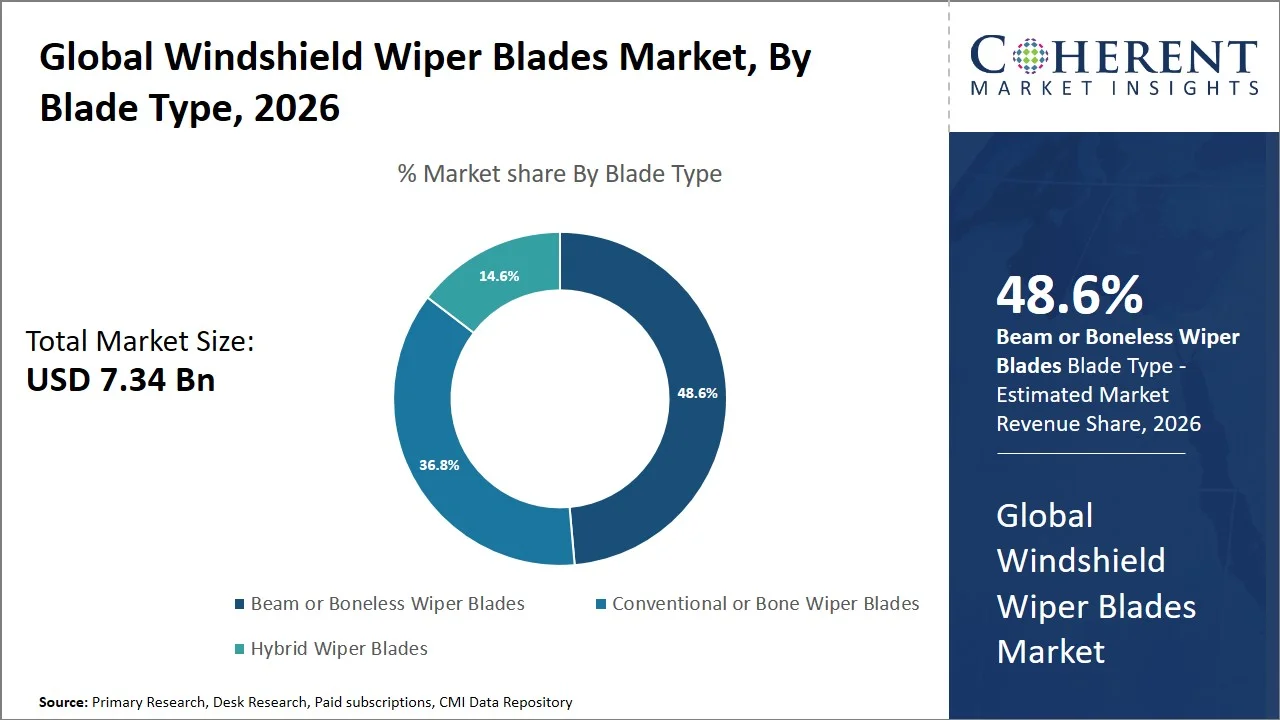
Why Does Beam or Boneless Wiper Blades Dominate the Global Windshield Wiper Blades Market?
Beam or Boneless Wiper Blades are expected to account for 48.6% share of the global windshield wiper blades market in 2026, supported by their superior pressure distribution, aerodynamic structure, and compatibility with modern curved windshields. Unlike conventional framed blades, beam designs use a flexible spring structure that maintains consistent windshield contact, improving wiping performance at higher vehicle speeds. OEM adoption in premium and mid-range passenger vehicles, along with increasing aftermarket replacement preference, strengthens their commercial position. Manufacturers benefit from higher-value product positioning through advanced rubber formulations, low-profile designs, and vehicle-specific fitment solutions. In February 2025, Bosch Aftermarket India highlighted Aerotwin flat blade technology featuring improved wiping performance, long service life, and aerodynamic design advantages for modern vehicles.
- Current Industry Events of 2026
- Market Size Estimation
- Regional Breakdown
- Competitive Landscape
- Customer Intelligence
- Segmental Analysis
- Pricing Analysis
- Key Market Drivers, Challenges & Future Trends
- Customized Insights Section
Why Does Passenger Cars Represent the Largest Vehicle Category in the Global Windshield Wiper Blades Market?
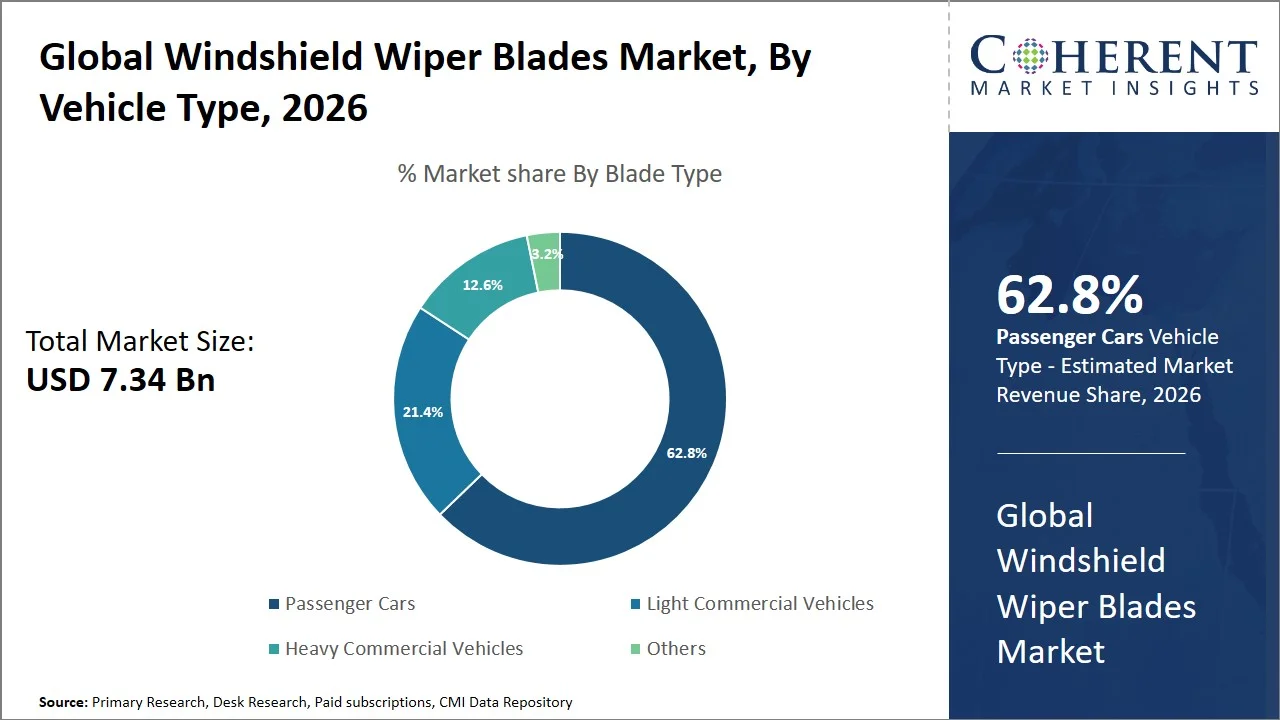
Passenger Cars are expected to represent 62.8% share of the global windshield wiper blades market in 2026, supported by the large global passenger vehicle fleet, frequent replacement requirements, and wider adoption of advanced visibility features in personal vehicles. Passenger cars generate consistent demand through both OEM installation and aftermarket replacement channels because owners prioritize driving safety, convenience, and product reliability. The segment also provides opportunities for suppliers offering premium blades compatible with automatic rain sensors, electric vehicles, and advanced driver-assistance systems. Automotive manufacturers increasingly require suppliers to deliver components meeting durability and performance expectations across diverse weather conditions. In March 2025, the International Organization of Motor Vehicle Manufacturers (OICA) released global vehicle production statistics, reflecting continued importance of passenger vehicle manufacturing volumes for automotive component demand.
Why Does Natural and Synthetic Rubber Dominate the Material Category of the Global Windshield Wiper Blades Market?
Natural and Synthetic Rubber are expected to hold 56.7% share of the global windshield wiper blades market in 2026, due to their established manufacturing ecosystem, cost efficiency, and balanced performance characteristics across different vehicle applications. rubber-based wiping elements remain widely preferred because they provide flexibility, abrasion resistance, and effective water removal while supporting large-scale automotive production requirements. Suppliers benefit from mature processing capabilities, broad raw material availability, and compatibility with conventional, beam, and hybrid blade structures. The material category remains commercially important for both OEM suppliers and aftermarket manufacturers seeking scalable production with reliable performance. In September 2024, the International Rubber Study Group (IRSG) highlighted continued focus on natural rubber supply-chain stability and sustainable production practices, supporting long-term availability of rubber-based automotive components.
Current Events and their Impact
Current Event | Description and Its Impact |
March 2025 – European Union Vehicle Safety Regulation Implementation Supporting Advanced Visibility Systems |
|
January 2025 – U.S. National Highway Traffic Safety Administration (NHTSA) Vehicle Safety Technology Priorities |
|
July 2024 – India Automotive Safety and Testing Framework Expansion |
|
Global Windshield Wiper Blades Market Dynamics
Key Market Drivers
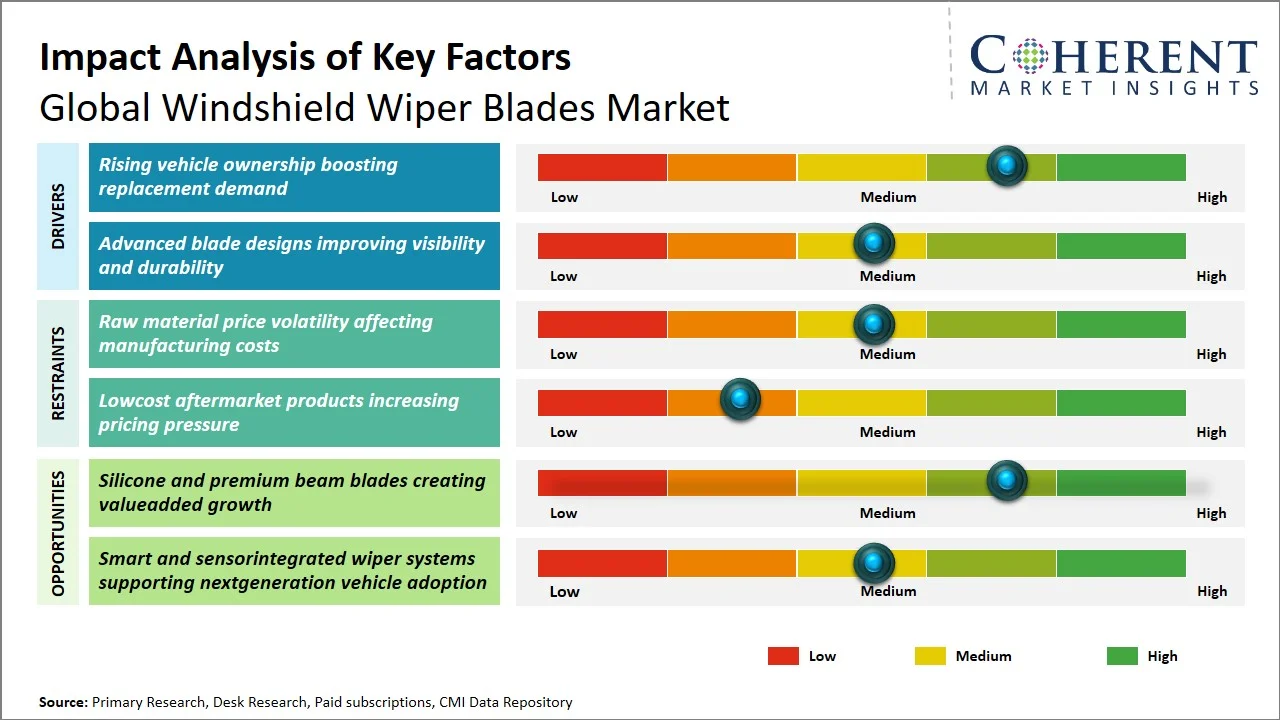
- Rising vehicle ownership boosting replacement demand: The expanding global vehicle parc is strengthening replacement demand for windshield wiper blades, as ageing vehicles require periodic maintenance of safety-critical visibility components. Passenger vehicle owners, fleet operators, automotive workshops, and aftermarket distributors benefit from predictable replacement cycles created by rubber degradation, weather exposure, and mileage accumulation. This driver is particularly important for aftermarket suppliers because replacement demand is less dependent on new vehicle production cycles and provides recurring revenue opportunities across mature and emerging automotive markets. In April 2025, the European Automobile Manufacturers’ Association (ACEA) reported continued growth in the EU vehicle fleet, reinforcing long-term aftermarket requirements for essential maintenance components.
- Advanced blade designs improving visibility and durability: Advanced blade engineering is reshaping product competition as manufacturers move beyond conventional metal-frame designs toward aerodynamic structures, optimized rubber compounds, and vehicle-specific solutions. Beam and hybrid blade suppliers benefit from higher-value positioning because these designs improve windshield contact consistency, reduce operational noise, and support performance under extreme weather conditions. OEM suppliers and aftermarket brands are increasingly investing in differentiated blade technologies to improve customer retention and reduce replacement dissatisfaction. In January 2026, Valeo highlighted its focus on visibility systems and innovative wiping solutions within its automotive technology portfolio, strengthening the role of advanced wiping systems in vehicle safety applications.
Emerging Market Trends
- Integration of windshield wiping systems with vehicle sensing architecture: Windshield wiper systems are evolving from basic mechanical components into integrated visibility solutions connected with cameras, rain sensors, and driver-assistance technologies. Suppliers combining blade engineering with electronic compatibility can capture higher-value opportunities, while traditional manufacturers may need to upgrade capabilities to meet evolving vehicle requirements.
- Sustainability-focused material transition in wiper blade manufacturing: Manufacturers are increasingly exploring durable, lower-impact materials, alternative rubber formulations, and recyclable components to align with OEM sustainability expectations. Companies with advanced material capabilities may gain competitive advantages, while conventional suppliers could face pressure as environmental considerations become more important in automotive procurement decisions.
Regional Insights
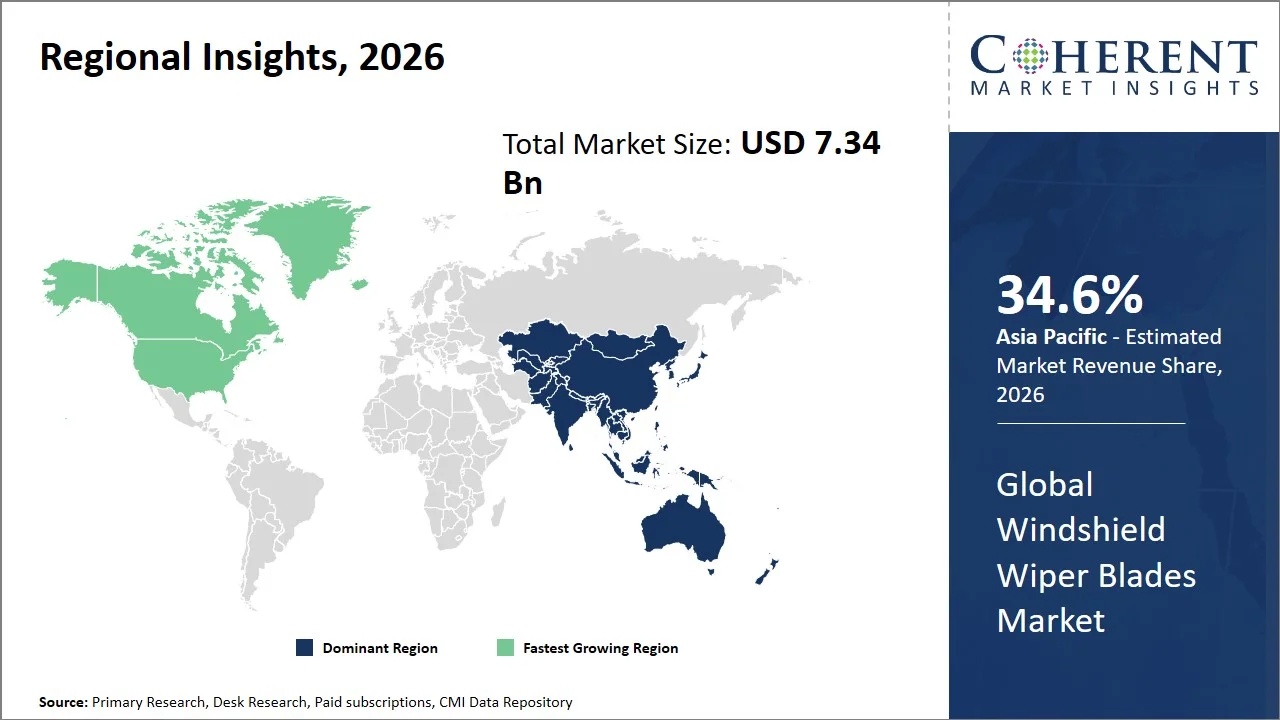
Why Does Asia Pacific Dominate the Global Windshield Wiper Blades Market?
Asia Pacific is expected to account for 34.6% share of the global windshield wiper blades market in 2026, supported by its extensive automotive manufacturing base, strong vehicle production ecosystem, and expanding aftermarket replacement network. The region benefits from large passenger vehicle fleets in China and India, growing commercial transportation activity, and established component manufacturing capabilities that enable cost-efficient production. Local suppliers benefit from mature rubber processing industries, automotive supply chains, and export-oriented manufacturing clusters. Increasing adoption of premium vehicles and advanced safety systems is also supporting demand for higher-performance beam and hybrid wiper blades. In February 2026, India’s Ministry of Heavy Industries reported that the country’s automobile sector maintained strong production activity, with passenger vehicle production reaching 53.8 lakh units and exports continuing to support the domestic automotive value chain, strengthening regional demand for automotive components.
Why Is North America Emerging as the Fastest-Growing Region in the Global Windshield Wiper Blades Market?
North America is expected to represent 27.8% share of the global windshield wiper blades market in 2026, with growth supported by a large installed vehicle base, high replacement frequency, and strong consumer preference for premium aftermarket components. The region’s aging vehicle fleet creates consistent replacement opportunities, while advanced safety systems and increasing adoption of SUVs and pickup trucks are encouraging demand for durable and high-performance wiping solutions. The presence of established automotive aftermarket distributors further strengthens product accessibility. In January 2025, the Automotive Aftermarket Suppliers Association (AASA) highlighted continued aftermarket industry focus on supply-chain resilience and service availability, supporting replacement-component opportunities across North America.
Global Windshield Wiper Blades Market Outlook for Key Countries
Why Is the U.S. a Key Market for the Global Windshield Wiper Blades Market?
The U.S. is expected to account for 18.9% share of the global windshield wiper blades market in 2026, supported by one of the world’s largest vehicle populations, high annual vehicle miles traveled, and a mature automotive aftermarket ecosystem. Demand is strengthened by frequent replacement requirements caused by seasonal weather conditions, including snow, heavy rainfall, and temperature fluctuations. The country also represents a major market for premium beam blades and advanced rubber formulations due to consumer preference for convenience and improved vehicle performance. Automotive service chains, retailers, and online aftermarket platforms provide broad access for replacement products. In February 2025, the U.S. Bureau of Transportation Statistics reported continued growth in registered vehicle availability, supporting long-term maintenance demand for automotive components.
Why Is India Important in the Global Windshield Wiper Blades Market?
India is expected to contribute 8.7% share of the global windshield wiper blades market in 2026, driven by increasing passenger vehicle ownership, expanding two- and four-wheeler mobility ecosystems, and rising demand for replacement automotive components. The country’s growing vehicle manufacturing base supports domestic sourcing opportunities for wiper blade producers, while diverse climatic conditions create demand for durable products suitable for monsoon, dust, and high-temperature environments. Domestic aftermarket channels, independent workshops, and online automotive platforms are improving product availability beyond major urban centers. In January 2025, the Society of Indian Automobile Manufacturers (SIAM) reported continued momentum in India’s automobile production and sales environment, supporting component demand across passenger and commercial vehicle segments.
Why Does China Support Growth in the Global Windshield Wiper Blades Market?
China is expected to hold 14.6% share of the global windshield wiper blades market in 2026, supported by its extensive vehicle production capacity, strong automotive supply chain network, and position as a major manufacturing base for global component suppliers. The country’s large passenger vehicle market, rapid electric vehicle adoption, and concentration of automotive manufacturing clusters create demand for both OEM-installed and replacement wiper systems. Chinese manufacturers also benefit from established rubber processing, precision component production, and export capabilities. The increasing integration of advanced vehicle technologies is encouraging suppliers to develop higher-performance wiping solutions compatible with modern vehicle architectures. In April 2025, China’s Ministry of Industry and Information Technology continued promoting automotive industry upgrading initiatives, supporting technology-oriented vehicle component development.
Why Is Germany a Strategic Country in the Global Windshield Wiper Blades Market?
Germany is expected to account for 6.4% share of the global windshield wiper blades market in 2026, supported by its advanced automotive manufacturing ecosystem, premium vehicle production base, and strong engineering capabilities. The country’s automotive industry places significant emphasis on component reliability, safety performance, and precision manufacturing, creating opportunities for suppliers offering advanced beam, hybrid, and sensor-compatible wiping systems. Germany’s export-oriented vehicle industry also influences demand for high-quality automotive components across European supply chains. Sustainability requirements and vehicle electrification trends are encouraging manufacturers to optimize component efficiency and lifecycle performance. In March 2025, the German Association of the Automotive Industry (VDA) emphasized continued transformation of the automotive sector toward advanced vehicle technologies and supplier innovation.
Why Is Brazil an Important Growth Market for the Global Windshield Wiper Blades Market?
Brazil is expected to represent 4.1% share of the global windshield wiper blades market in 2026, supported by its large vehicle fleet, regional automotive manufacturing presence, and demand for replacement components across diverse climatic conditions. The country’s tropical environment, including heavy rainfall in several regions, creates recurring requirements for reliable windshield visibility solutions. Brazil’s aftermarket sector remains important due to vehicle age distribution and consumer preference for cost-effective maintenance solutions. Local distributors and automotive service networks play a key role in ensuring availability of replacement blades across urban and regional markets. In February 2025, the National Association of Motor Vehicle Manufacturers (ANFAVEA) reported continued activity in Brazil’s automotive production sector, supporting domestic demand for automotive component suppliers.
Market Players, Key Development, and Competitive Landscape
Key Developments
- In May 2025, Valeo expanded its aftermarket wiper blade portfolio with additional references under its Valeo First range, improving vehicle coverage across replacement applications. This supports Valeo’s strategy of strengthening aftermarket penetration through broader product availability and fitment capability.
- In February 2025, DENSO expanded its automotive aftermarket product portfolio, including additional replacement components supporting vehicle maintenance requirements. This reinforces DENSO’s position as a full-range automotive supplier by improving access to replacement customers and distributors.
- In November 2024, Bosch introduced the XpressFIT PRO windshield wiper blade range, designed with simplified installation features and enhanced aftermarket compatibility. This development strengthens Bosch’s replacement-market position by improving installer convenience and expanding coverage across vehicle applications.
Competitive Landscape
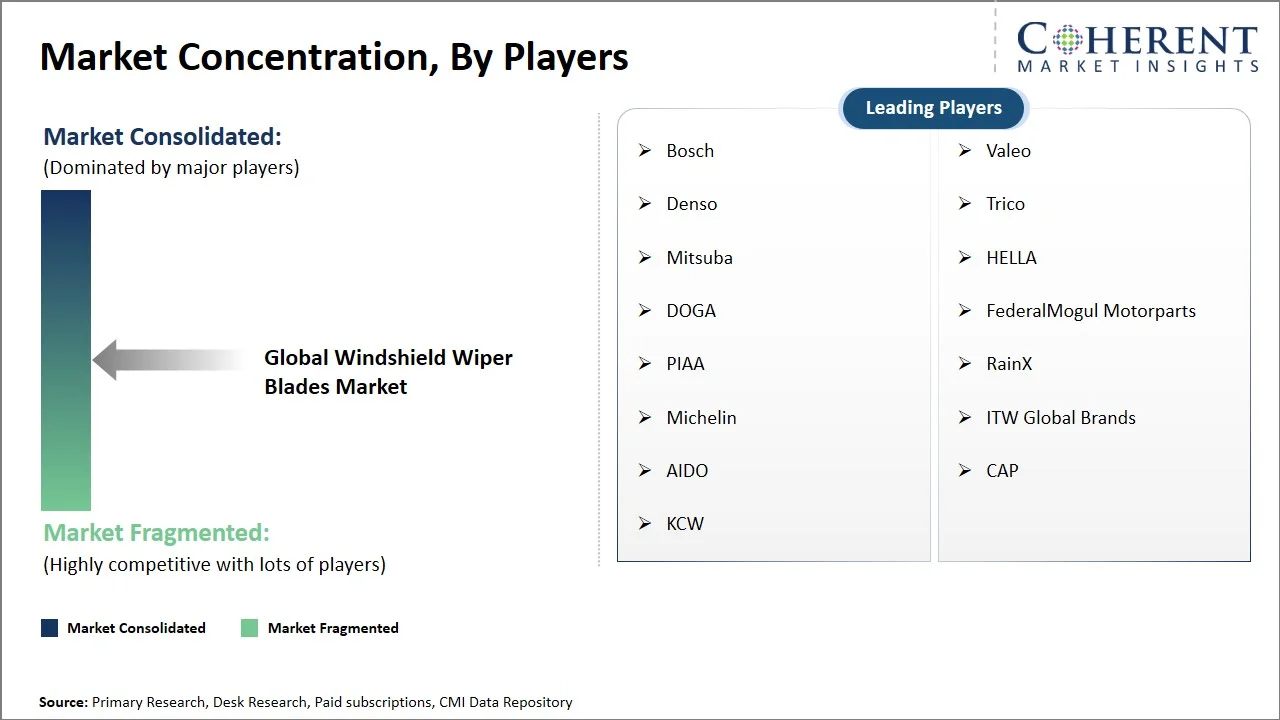
The global windshield wiper blades market is moderately consolidated, with global automotive suppliers competing alongside specialized aftermarket manufacturers. Competition is primarily based on blade performance, material engineering, vehicle compatibility, pricing, distribution reach, and OEM relationships. Tier-1 suppliers maintain advantages through automotive validation capabilities, while regional manufacturers compete through cost efficiency, customization, and replacement-market accessibility.
Key Focus Areas include
- Product durability and wiping performance under different climatic conditions.
- Advanced blade design capabilities, particularly beam and hybrid technologies.
- Material innovation involving rubber compounds, silicone formulations, and coatings.
- OEM supply agreements and vehicle-platform compatibility.
- Aftermarket distribution networks and replacement availability.
- Manufacturing scale and supply-chain reliability.
- Compliance with automotive quality standards and testing requirements.
- Premium positioning through longer service life and enhanced user experience.
Market Report Scope
Windshield Wiper Blades Market Report Coverage
| Report Coverage | Details | ||
|---|---|---|---|
| Base Year: | 2025 | Market Size in 2026: | USD 7.34 Bn |
| Historical Data for: | 2020 To 2024 | Forecast Period: | 2026 To 2033 |
| Forecast Period 2026 to 2033 CAGR: | 5.7% | 2033 Value Projection: | USD 10.81 Bn |
| Geographies covered: |
| ||
| Segments covered: |
| ||
| Companies covered: | Bosch, Valeo, Denso, Trico, Mitsuba, HELLA, DOGA, FederalMogul Motorparts, PIAA, RainX, Michelin, ITW Global Brands, AIDO, CAP, KCW | ||
| Growth Drivers: |
| ||
| Restraints & Challenges: |
| ||
Analyst Opinion (Expert Opinion)
- The global windshield wiper blades market is likely to shift from a replacement-volume business toward a performance-driven component market. Future competitive advantage will depend less on basic blade availability and more on supplier capability to deliver vehicle-specific engineering, material optimization, and integration with broader visibility systems.
- The strongest disruption potential will come from the convergence of wiper blade technology with autonomous and assisted-driving systems. Suppliers that can support sensor reliability, automated cleaning requirements, and intelligent vehicle architectures may redefine market leadership, while conventional replacement-focused manufacturers could face margin pressure.
- Companies should prioritize advanced material development, OEM collaboration, aftermarket channel strength, and localized manufacturing capabilities. Key risks include raw material volatility, increasing competition from low-cost suppliers, and changing vehicle architectures. Strategic investments should focus on premium solutions rather than competing only through price-based positioning.
Speak to the analyst
Want personalized insights?
Take the findings above to one of our principal consultants, or have the report rebuilt around the segments, geographies and competitors you actually track.
Market Segmentation
- Blade Type Insights (Revenue, USD Bn, 2021 - 2033)
- Beam or Boneless Wiper Blades
- Conventional or Bone Wiper Blades
- Hybrid Wiper Blades
- Vehicle Type Insights (Revenue, USD Bn, 2021 - 2033)
- Passenger Cars
- Light Commercial Vehicles
- Heavy Commercial Vehicles
- Others
- Material Insights (Revenue, USD Bn, 2021 - 2033)
- Natural and Synthetic Rubber
- Silicone
- Composite Materials
- Distribution Channel Insights (Revenue, USD Bn, 2021 - 2033)
- Direct Sales
- Indirect Sales
- Regional Insights (Revenue, USD Bn, 2021 - 2033)
- North America
- U.S.
- Canada
- Latin America
- Brazil
- Argentina
- Mexico
- Rest of Latin America
- Europe
- Germany
- U.K.
- Spain
- France
- Italy
- Russia
- Rest of Europe
- Asia Pacific
- China
- India
- Japan
- Australia
- South Korea
- ASEAN
- Rest of Asia Pacific
- Middle East
- GCC Countries
- Israel
- Rest of Middle East
- Africa
- South Africa
- North Africa
- Central Africa
- North America
- Key Players Insights
- Bosch
- Valeo
- Denso
- Trico
- Mitsuba
- HELLA
- DOGA
- FederalMogul Motorparts
- PIAA
- RainX
- Michelin
- ITW Global Brands
- AIDO
- CAP
- KCW
Sources
Primary Research Interviews
- Windshield wiper blade manufacturers, automotive component suppliers, OEM procurement teams, aftermarket distributors, automotive service providers, and replacement-part retailers
- Automotive engineers, product development specialists, material experts, aftermarket professionals, and vehicle maintenance industry consultants
Stakeholders
- Automotive OEMs, Tier-1 suppliers, wiper blade manufacturers, rubber compound producers, component manufacturers, and automotive technology providers
- Automotive aftermarket retailers, online automotive platforms, repair networks, distributors, and fleet maintenance operators
End-use Sectors
- Passenger vehicles and commercial vehicles
- Automotive aftermarket and vehicle maintenance services
- Fleet management and transportation operations
- Electric vehicles and advanced driver-assistance system (ADAS) applications
Regulatory and Industry Bodies
- Automotive safety authorities and vehicle regulatory agencies
- Automotive testing and certification organizations
- Vehicle standards and compliance organizations
- Environmental and material sustainability authorities
Databases
- UN Comtrade and ITC Trade Map – Automotive components, vehicle parts, and wiper system trade analysis
- Government automotive production, registration, and import-export databases
- Company annual reports, investor presentations, product catalogues, and corporate disclosures
- Automotive industry databases, aftermarket intelligence platforms, and vehicle registration datasets
Magazines and Journals
- Automotive News
- SAE International Publications
- Automotive World
- MotorTrend
- Aftermarket News
Associations
- International Organization of Motor Vehicle Manufacturers (OICA)
- Automotive Aftermarket Suppliers Association (AASA)
- Original Equipment Suppliers Association (OESA)
- Society of Automotive Engineers (SAE International)
- Automotive component and aftermarket industry organizations
Public Domain Sources
- Automotive production trends, vehicle fleet developments, and aftermarket reports
- Windshield wiper technology developments, material innovations, and product introductions
- Vehicle safety regulations, testing requirements, and compliance updates
- Trade statistics and automotive component industry publications
Key Standards and Regulations
- Automotive safety and visibility system standards
- Vehicle component quality and performance requirements
- Material quality, rubber compound, and durability standards
- Environmental compliance and sustainable material regulations
- Automotive quality management standards (IATF 16949) Top of Form
Proprietary Elements
- CMI Data Analytics Tool, Proprietary CMI Existing Repository of information for the last 10 years
Get access to 250+ pages report
Every segment, forecast, competitor profile and data table behind the analysis above — available for instant download.
- ESOMAR Member
- ISO 9001:2015 Certified
- D-U-N-S Registered
- GDPR & CCPA Compliant
Missing comfort of reading report in your local language? Find your preferred language:
Transform your Strategy with Exclusive Trending Reports
Frequently Asked Questions
The global windshield wiper blades market is estimated to be valued at USD 7.34 billion in 2026 and is expected to reach USD 10.81 billion by 2033
The global windshield wiper blades market includes beam or boneless blades, conventional or bone blades, and hybrid blades, each designed for different vehicle requirements and performance expectations.
The CAGR of global windshield wiper blades market is projected to be 5.7% from 2026 to 2033.
Consumers typically consider vehicle compatibility, blade durability, weather performance, installation convenience, brand reliability, and replacement cost when selecting windshield wiper blades.
Windshield wiper blades are primarily used in passenger vehicles, light commercial vehicles, heavy commercial vehicles, and other automotive applications requiring reliable visibility solutions.
Key trends include integration with advanced vehicle visibility systems, development of durable material formulations, premium aftermarket solutions, and sustainability-focused manufacturing approaches.
Rising vehicle ownership boosting replacement demand and advanced blade designs improving visibility and durability are the major factors driving the growth of global windshield wiper blades market.