

Herbal Beauty Products Market Analysis & Forecast: 2026-2033
Herbal Beauty Products Market is estimated to be valued at USD 111.95 Bn in 2026 and is expected to reach USD 163.93 Bn in 2033, exhibiting a compound annual growth rate (CAGR) of 5.6% from 2026 to 2033.
Key Takeaways
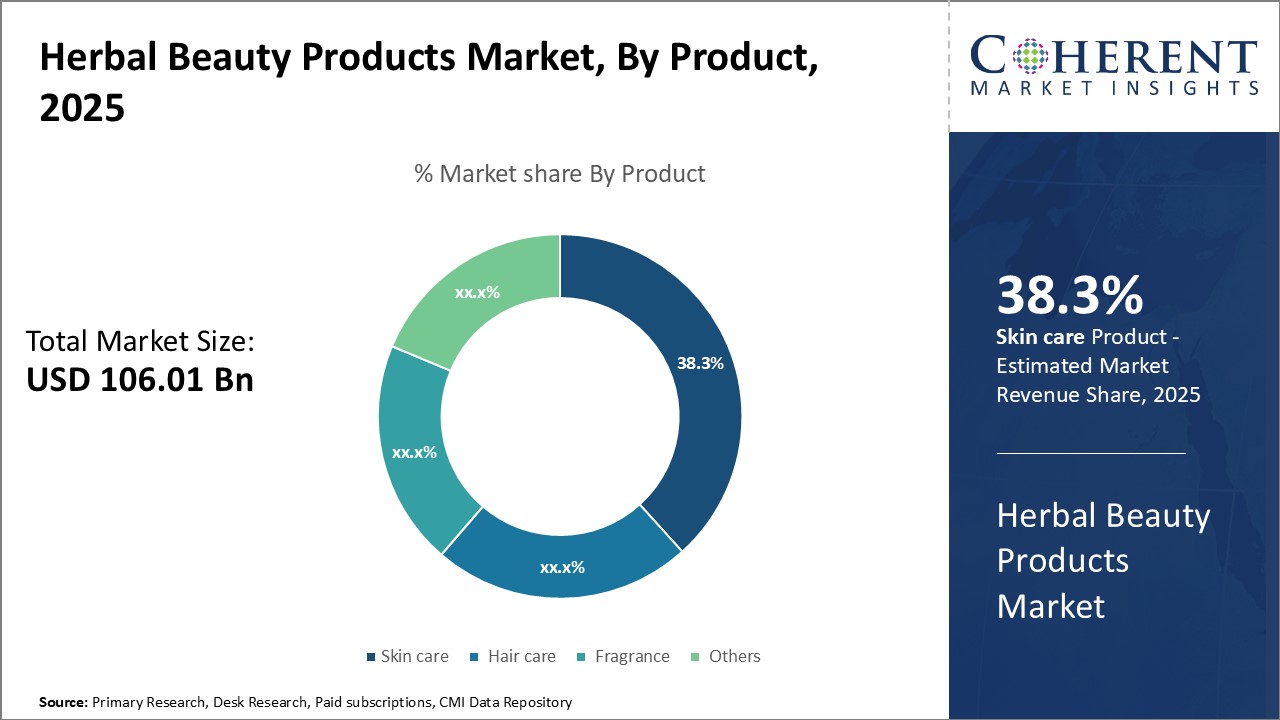
- According to Product, The Skin Care Category is anticipated to account for the largest share of 39.3% for the Herbal Beauty Products market in 2026.
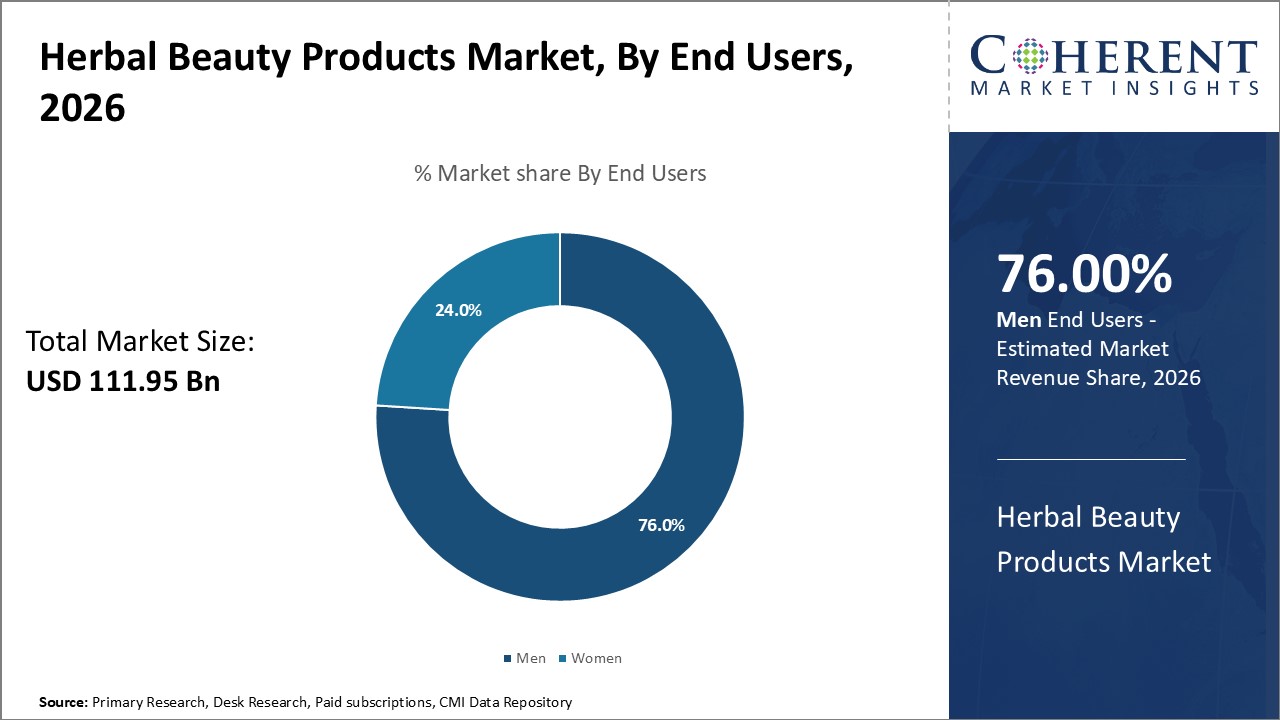
- According to End-User, The Men’s Segment is anticipated to hold major share of 76% for the Herbal Beauty Products market in 2026.
- According to Distribution Channel, Hypermarkets hold largest share of 37.1% for Herbal Beauty Products Market.
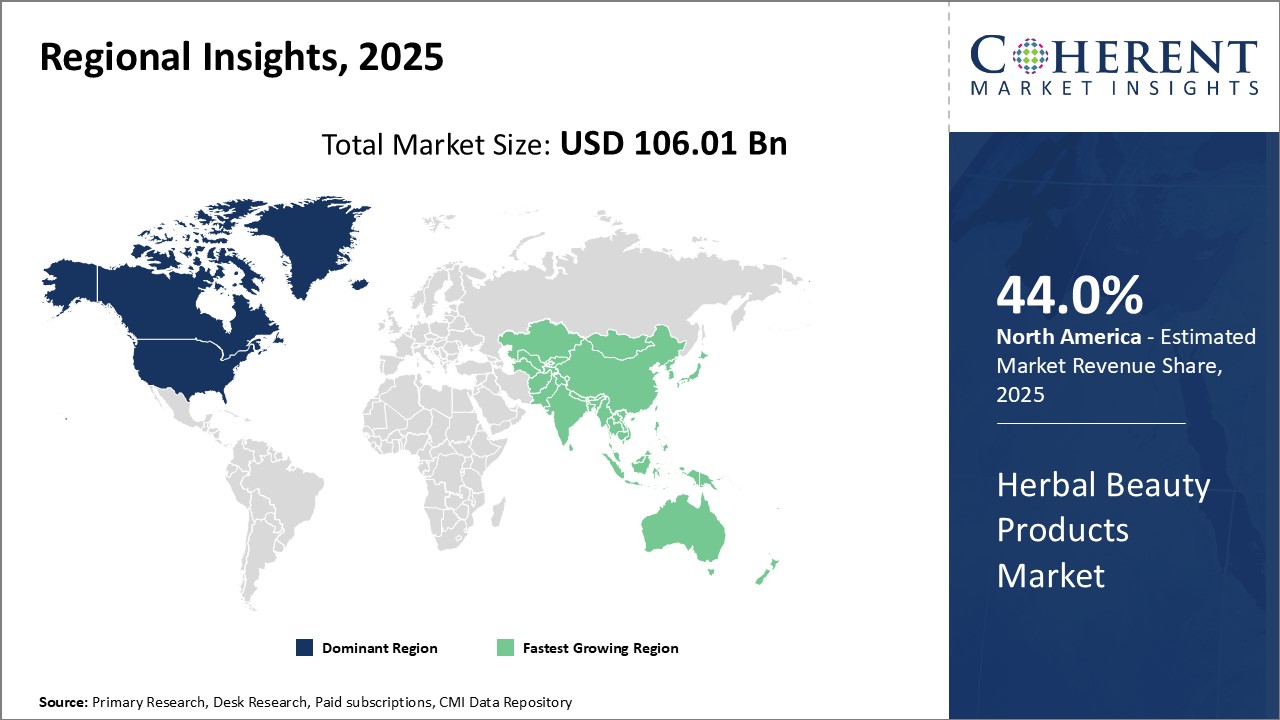
- North America holds the largest market share of 44.0% for Herbal Beauty Products market growth by 2026.
Market Overview
The Herbal Beauty Products Market Size is experiencing robust growth which is driven by increasing consumer awareness of the potential health risks associated with synthetic chemicals in conventional cosmetics and rising preference for natural, organic alternatives. The herbal beauty products market has been witnessing significant growth over the past few years. Factors such as increasing consumer preference for organic and natural personal care products owing to rising health and wellness concerns.
For instance, in September 2024, Indus Valley, a pioneer in organic and natural beauty products, is thrilled to unveil its luxurious range of ready-to-use Pastes, meticulously crafted to offer effortless and effective solutions for hair care.
Current Events and Its Impact on the Herbal Beauty Products Market
Event | Description and Impact |
EU Green Deal & Sustainability Initiatives |
|
Surge in Online Channels & Influencer Marketing |
|
Pricing Analysis
Herbal beauty products are generally more expensive than conventional cosmetics due to the high costs of sourcing natural ingredients, organic certification, eco-friendly packaging, and sustainable manufacturing practices. These factors significantly raise the final retail price.
Herbal beauty products are often positioned as premium items in the market. This premium pricing can make them less accessible to budget-conscious consumers and limits widespread adoption, especially in regions with lower purchasing power.
Herbal beauty products typically cost 30–100% more than their synthetic counterparts, depending on the brand, certification, and ingredient sourcing. For example, a conventional moisturizer may retail for €10–€20, whereas a comparable herbal product could be €25–€60.
- Current Industry Events of 2026
- Market Size Estimation
- Regional Breakdown
- Competitive Landscape
- Customer Intelligence
- Segmental Analysis
- Pricing Analysis
- Key Market Drivers, Challenges & Future Trends
- Customized Insights Section
Role of AI
- AI-powered platforms analyze individual skin types, concerns, and preferences to recommend personalized herbal beauty routines. Advanced algorithms assess skin texture, hydration, and biological age, enabling ultra-precise product suggestions and enhancing consumer satisfaction and loyalty.
- For instance, in April 2025, Personal care formulators can swiftly and simply search Nouryon's extensive library of inventive and imaginative hair and skin care formulations with BeautyCreationsTM, a cutting-edge digital platform. The BeautyCreationsTM formulation discovery tool, powered by Albert Invent, uses artificial intelligence (AI) to help formulators accelerate the development of beauty formulations. Formulators can communicate their formulation needs and desired consumer product claims to the BeautyCreationsTM tool, which is specifically educated for personal care formulation chemistry, using natural language.
Consumer Feedback and Unmet Demand
European consumers consistently express a strong preference for herbal and plant-based beautyproducts, valuing their perceived benefits such as healthier skin, reduced aging signs, and fewer side effects compared to synthetic alternatives. There is growing demand for personalized herbal beauty solutions tailored to individual skin types, concerns, and local environmental conditions. Many consumers feel current offerings are too generic.
Segmentation Analysis
Herbal Beauty Products Market Insights, by Product -
In terms of Product, Skin care contributes the 39.3% share of the market in 2026, owing to the increasing focus on natural ingredients. Customers are increasingly opting for skin care products with natural plant and herbal extracts rather than synthetic or chemical ingredients due to growing health and wellness concerns. Many customers view herbal ingredients as gentler and better suited for sensitive skin. Brands in the skin care segment strategically promote the natural credentials of their products to attract such customers.
Within the skin care segment, face care remains the largest category. Products for anti-aging and improving skin texture are highly popular. Herbal ingredients with antioxidant properties help fight the signs of aging. Face oils containing plant oils like argon and jojoba are gaining traction. Customers also seek natural solutions for issues like acne, pigmentation and dark circles. Brands offer targeted formulations containing ingredients like Aloe Vera, turmeric and green tea.
The natural position of herbal extracts helps skin care brands command a premium. Customers are ready to pay higher prices for efficacious formulations with short and simple natural ingredients lists. Regional herbs specific to markets also boost the customized approach of brands. Strict regulations around synthetic ingredients further validate the natural image of herbal skin care products. The skin care segment thus leads the herbal beauty products market driven by health-oriented customers and supportive regulations.
Herbal Beauty Products Market Insights, by End Users
In terms of end-users, the men's segment contributes the 76% share to the market in 2026, due to rising acceptance of personal care among men. Traditionally under-penetrated, the male grooming category is expanding steadily. Growing exposure through social media and celebrity endorsements influences male customers. They are increasingly experimenting with different personal care types beyond basic bathing products.
Within the men's segment, face care enjoys high demand growth. Facial scrubs and masks containing activated charcoal and other herbal extracts are popular choices for male skincare newbies. Hair care too captures the youth through herbal shampoos and conditioners for different hair types. Younger men drive trends and encourage peers to adopt basic daily grooming rituals. Working men also seek convenient natural options fitting their schedules.
The herbal positioning fits the need for mild formulations. Men hesitate using store brands perceiving them as too feminine or strong. Natural brands hence gain their trust with gentle herbal products. Customers associate plants with traditional remedies their ancestors relied on. The perception of natural = safe brings more men into the herbal beauty domain. This growing acceptance from the erstwhile untapped male segment boosts market potential.
Herbal Beauty Products Market Insights, by Distribution Channel
In terms of distribution channels, hypermarkets contribute the 37.1% share to the market in 2026, owing to the immersive shopping experience they enable. Herbal beauty brands leverage large shelf and display spaces in hypermarkets to showcase diverse product collections. Customers appreciate browsing through numerous new stocks keeping units across categories under one roof.
Brand showrooms inside hypermarkets create product discoverability through demo stations and trained staff. Customers interact with product textures, scents and benefits before deciding. Staff recommendations aid consideration along with big brand promotions near checkouts. The hypermarket format helps customers replace several daily use items in one shopping trip. Affordable price points further boost larger basket sizes than other channels.
Digitally native customers also access hypermarket mobile apps and websites to research new collections and read reviews. They skip lines at payment counters using self-checkout options. Convenient hypermarket loyalty programs give bonus rewards motivating repeat visits. Home delivery services extend access beyond physical store trips. This holistic hypermarket retail experience tops other channels in driving sales and new customer trials within the herbal beauty domain.
Regional Insights
North America Herbal Beauty Products Market
North America has been dominating the global herbal beauty products market for a long time with 44.0% share in 2026. The region has strong presence of major players who have established their brands well in the market. Also, the awareness and demand for natural and organic products is historically high among consumers in USA and Canada.
North American companies are continuously investing in R&D and new product development to cater to shifting consumer preferences. They also focus on innovative packaging and compelling marketing strategies to promote herbal ingredients. Furthermore, North America has emerged as a price leader in this category. Companies offer premium pricing for products with organic certifications and ethically sourced ingredients.
Asia Pacific Herbal Beauty Products Market
The Asia Pacific region has shown most impressive growth in recent years and is emerging as the fastest growing market for herbal beauty products. Countries like India, China, Indonesia and Vietnam showcase enormous potential due to rising disposable incomes, growing health consciousness and expanding middle class consumers.
There is also a deep-rooted tradition of using herbal remedies for personal care needs. Local companies have strong roots in domestic markets while international brands are also looking at this region as the future.
Herbal Beauty Products Market In Europe
European consumers are increasingly seeking products with transparent ingredient lists, organic certifications, and clear environmental commitments. There is a notable preference for holistic beauty solutions that address wellness, anti-aging, hydration, and sensitive skin needs
Herbal Beauty Products Market Dominating Countries
U.S Herbal Beauty Products Market
The U.S. herbal beauty products market is experiencing robust growth, driven by increasing consumer awareness of the potential health risks associated with synthetic chemicals in cosmetics and a strong preference for natural, plant-based alternatives.
India Herbal Beauty Products Market
India stands out as a global leader in the herbal beauty products market, leveraging its deep-rooted traditions in Ayurveda and natural wellness. The country’s vast biodiversity and centuries-old knowledge of herbal remedies have fostered a dynamic industry that caters to both domestic and international markets.
Herbal Beauty Products Market In China
China is a dominant force in the herbal beauty products market, propelled by a combination of traditional Chinese medicine, rising disposable incomes, and a growing middle-class population seeking premium, natural beauty solutions.
Market Report Scope
Herbal Beauty Products Market Report Coverage
| Report Coverage | Details | ||
|---|---|---|---|
| Base Year: | 2025 | Market Size in 2026: | USD 111.95 Bn |
| Historical Data for: | 2020 To 2024 | Forecast Period: | 2026 To 2033 |
| Forecast Period 2026 to 2033 CAGR: | 5.6% | 2033 Value Projection: | USD 163.93 Bn |
| Geographies covered: |
| ||
| Segments covered: |
| ||
| Companies covered: | Weleda AG, Bio Veda Action Research Co., Arbonne International, LLC, Vasa Global Cosmetics, Klienz Herbal Pvt. Ltd., The Himalaya Drug Company, Shahnaz Ayurveda Pvt. Ltd, Lotus Herbals Limited, Marc Anthony Cosmetics, Inc., Hemas Holdings PLC., Khadi Natural, Biotique, Dabur, Shahnaz Husain, Kama Ayurveda, VCos Cosmetics Pvt Ltd, Forest Essentials, North India Life Sciences Pvt Ltd, Herrco Cosmetics Ltd, Natural Skincare Solutions Ltd. | ||
| Growth Drivers: |
| ||
| Restraints & Challenges: |
| ||
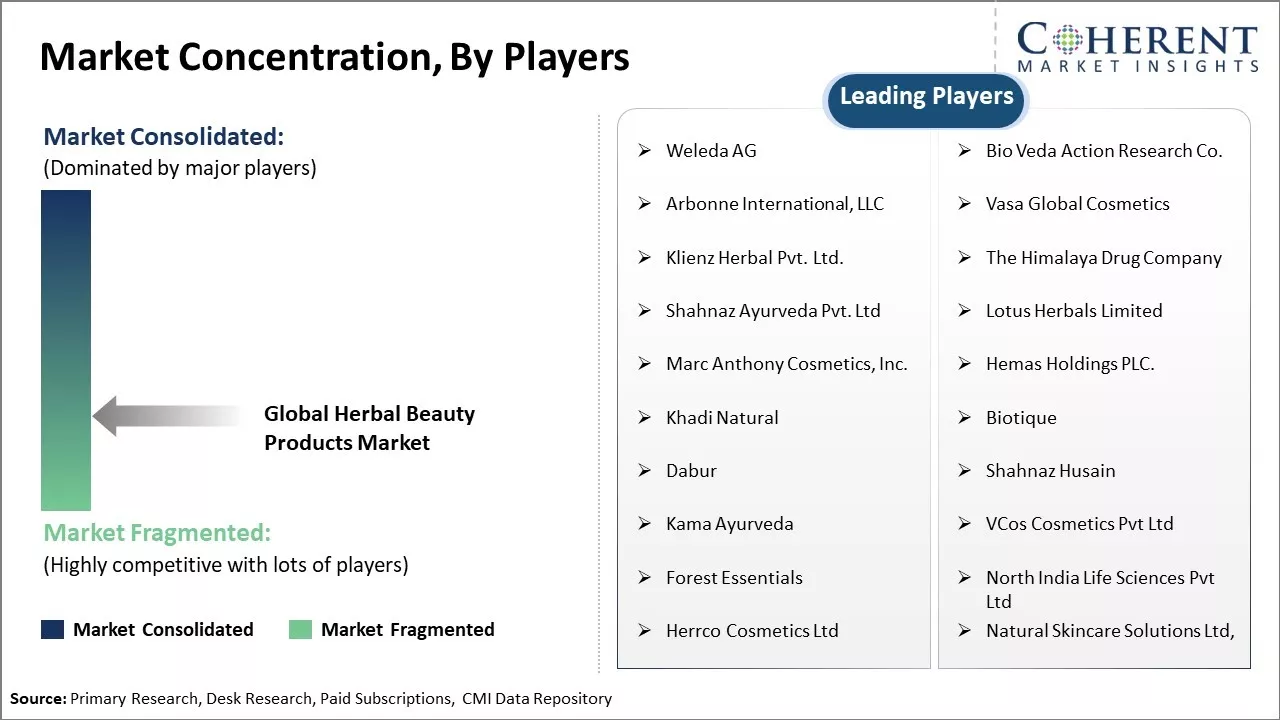
Market Concentration and Competitive Landscape
Herbal Beauty Products Market: Growth Drivers
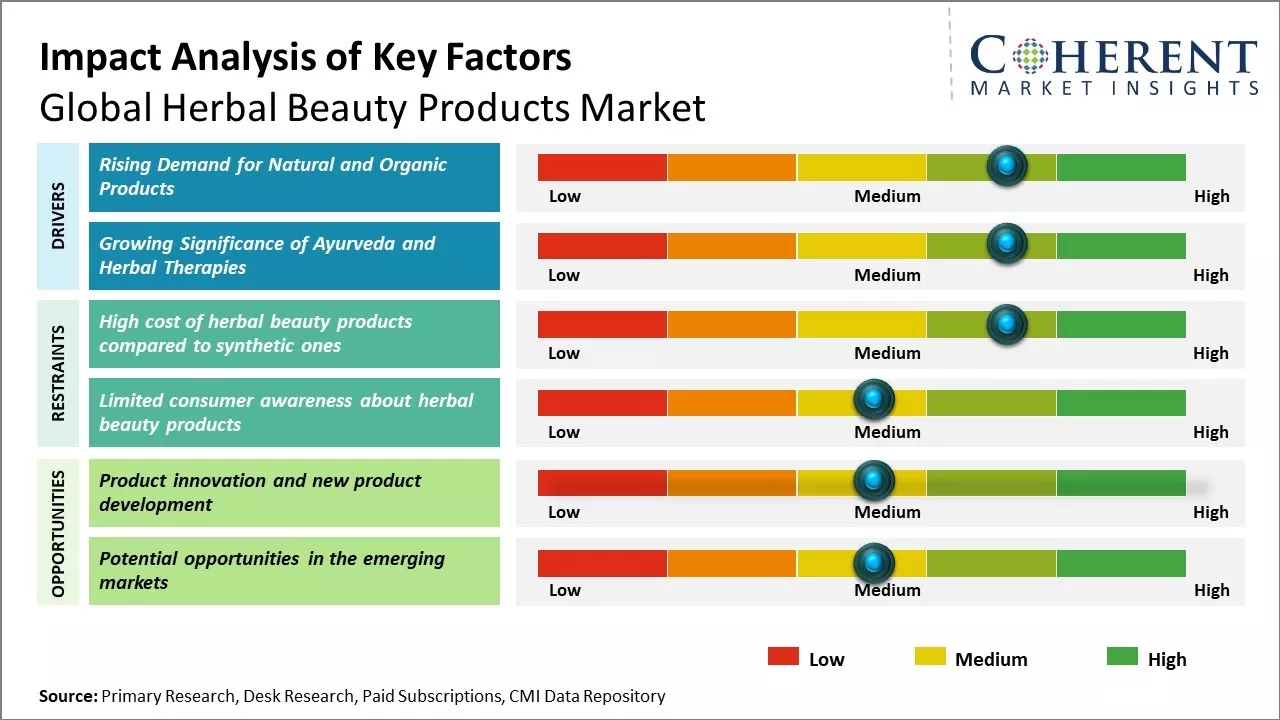
- Rising Demand for Natural and Organic Products
The demand for herbal and natural beauty products is growing significantly as more consumers are becoming conscious of the ingredients used in the cosmetic products. People are increasingly embracing the natural way of taking care of their skin and body. With growing health and environmental concerns related to the use of chemical ingredients, consumers are shifting towards natural and herbal alternatives.
The awareness about the potential side-effects of chemicals used in cosmetics such as parabens, sodium lauryl calcium sulphate, and mineral oil is compelling people to switch to organic products. Consumers want products that nourish their skin without harming it in any way. The clean and organic label is becoming more important while purchasing skincare or haircare products. Various studies have linked chemical-based cosmetics with problems like skin irritation, hormonal imbalance, and even cancer.
Women, in particular, are cautious about applying products on their face and take time to read labels to ensure the product meets their definition of natural. The demand is propelling companies to innovate with natural ingredients and remove chemicals from their formulations. This herbal revolution has positively impacted the growth of natural beauty product market. Organic personal care witnessed a CAGR of over 10% in the last 5 years globally.
- Growing Significance of Ayurveda and Herbal Therapies
The global popularity of ancient medicinal practices like Ayurveda and herbalism is contributing to the rise of herbal beauty market. People have started embracing traditional remedies and natural therapies for healthier skin, hair, and overall well-being.
Ayurveda, which originated in India 5000 years ago, promotes the use of indigenous herbs for treatment, prevention, and health maintenance. It views beauty as a manifestation of inner wellness. Many plants and herbal formulations prescribed by Ayurvedic texts for Skin disorders are finding new applications in natural cosmetic products. Growth in wellness tourism has concurrently boosted the ayurvedic beauty business.
Herbal beauty rituals are becoming mainstream as people experience the deep healing, nourishing, and rejuvenating effects of herbs. Consumers want multi-purpose products incorporating Ayurvedic principles that also act as preventive anti-aging solutions. This stems from a holistic approach where inner and outer beauty are balanced.
Herbal Beauty Products Market: Trends
- Rising Demand for Hair Care
Herbal hair care, especially oils enriched with ingredients like argan, jojoba, rosemary, and lavender, is gaining traction across Europe. Consumers are seeking certified organic, additive-free solutions, and are willing to pay a premium for products that are both effective and environmentally friendly. Social media and influencer marketing are accelerating this trend
Herbal Beauty Products Market: Opportunities
- Product innovation and new product development
Herbal beauty products have huge potential for innovation and new product development in the global market. With increasing awareness about side effects of chemical-based cosmetics, people are becoming more inclined towards natural and organic personal care offerings. Herbal ingredients such as aloe vera, neem, turmeric, ginger etc. provide several skin and hair benefits due to their antioxidant and anti-inflammatory properties.
Product developers can explore various herbal formulations and combinations to address multiple concerns like aging, tanning, acne, and hair fall through innovative delivery systems. Sustainable and eco-friendly packaging is also an area that needs attention. Many consumers look for cruelty-free products packaged in recyclable materials. Developing herbal beauty items in organic terracing bottles, cornstarch-based compacts or seeds-embedded lip balms could capture the imagination of these ethically-conscious buyers.
Furthermore, customization plays a vital role. Allowing customers to select personalized oil blends for facial massages or letting them choose natural dyes for henna hair colors increases participation and brand loyalty. Product lines targeted for men are another avenue, as self-care gains prominence among the male population too.
Herbal Beauty Products Market: Key Developments
- February 2025, The Indian beauty company started off the year announcing the launch of its premium lip balm range. This new launch is a major move in the company’s new product strategy according to the chairman and managing director of Lotus Herbals.
- August 2024, Denzour Nutrition, a leading Indian brand renowned for its commitment to natural and effective sports supplements, is excited to announce its expansion into the exciting world of organic nutraceuticals. This new product line caters not only to athletes but to the broader population seeking to elevate their health and fitness through the power of nature's finest ingredients.
- September 2024, Total Pet Solutions has launched Herbal Paws, a new brand that comprises a range of premium grooming and all-natural supplements. The grooming range features shampoos and conditioners in a choice of three fragrances – Baby Fresh, Coconut Milk & Honey, and Lavender Leaf.
Analyst Opinion
- The herbal beauty products market is expected to witness steady growth in the coming years. Rising consumer preference for natural and chemical-free products will drive demand. However, high prices of natural ingredients may restrain volume growth to some extent.
- The market is currently dominated by North America and Western Europe due to higher health awareness. However, Asia Pacific is likely to emerge as the fastest growing regional market. With growing incomes and influence of Western beauty trends, Asian consumers are increasingly open to spending on premium natural brands.
- Ingredients sourced from local biodiversity like coconut, neem and turmeric put Asian brands at an advantage over international players. Their in-depth understanding of regional climatic conditions and cultural nuances of Asian consumers gives them an edge.
- Online shopping is opening new revenue streams for brands by making eco-friendly beauty more accessible. However, online buyers give more importance to product reviews and brand trust than offline shoppers. Successful brands will have to work on building strong loyalty through consistent quality and communication of health benefits.
Herbal Beauty Products Market: Key Companies
Some of the key players in the global Herbal Beauty Products market are Weleda AG, Bio Veda Action Research Co., Arbonne International, LLC, Vasa Global Cosmetics, Klienz Herbal Pvt. Ltd., The Himalaya Drug Company, Shahnaz Ayurveda Pvt. Ltd, Lotus Herbals Limited, Marc Anthony Cosmetics, Inc., Hemas Holdings PLC., Khadi Natural, Biotique, Dabur, Shahnaz Husain, Kama Ayurveda, VCos Cosmetics Pvt Ltd, Forest Essentials, North India Life Sciences Pvt Ltd, Herrco Cosmetics Ltd, Natural Skincare Solutions Ltd.
Speak to the analyst
Want personalized insights?
Take the findings above to one of our principal consultants, or have the report rebuilt around the segments, geographies and competitors you actually track.
Market Segmentation
- By Product (Revenue, USD Bn, 2021 - 2033)
- Skin care
- Hair care
- Fragrance
- Others
- By End-user (Revenue, USD Bn, 2021 - 2033)
- Men
- Women
- By Distribution Channel (Revenue, USD Bn, 2021 - 2033)
- Hypermarkets
- Pharmacy & Drug stores
- E-commerce
- Others
- Regional Insights (Revenue, USD Bn, 2021 - 2033)
- North America
- U.S.
- Canada
- Latin America
- Brazil
- Argentina
- Mexico
- Rest of Latin America
- Europe
- Germany
- U.K.
- Spain
- France
- Italy
- Russia
- Rest of Europe
- Asia Pacific
- China
- India
- Japan
- Australia
- South Korea
- ASEAN
- Rest of Asia Pacific
- Middle East
- GCC Countries
- Israel
- Rest of Middle East
- Africa
- South Africa
- North Africa
- Central Africa
- North America
- Company Profiles
- Weleda AG
- Bio Veda Action Research Co.
- Arbonne International, LLC
- Vasa Global Cosmetics
- Klienz Herbal Pvt. Ltd.
- The Himalaya Drug Company
- Shahnaz Ayurveda Pvt. Ltd
- Lotus Herbals Limited
- Marc Anthony Cosmetics, Inc.
- Hemas Holdings PLC.
- Khadi Natural
- Biotique
- Dabur
- Shahnaz Husain
- Kama Ayurveda
- VCos Cosmetics Pvt Ltd
- Forest Essentials
- North India Life Sciences Pvt Ltd
- Herrco Cosmetics Ltd
- Natural Skincare Solutions Ltd,
Sources
Primary Research interviews:
- Product managers at Himalaya Wellness, Biotique, Forest Essentials, and Kama Ayurveda
- Retail category heads at Nykaa, Shoppers Stop, and Amazon Beauty
- Herbal cosmetologists or dermatologists from leading skincare clinics
- Procurement managers from hotel spas and wellness resorts
- Ayurvedic practitioners from Patanjali Ayurved or Kerala Ayurvedic centers
Databases:
- Ministry of AYUSH (India)
- UN Comtrade
- Statista (limited free access)
- APEDA (Agricultural and Processed Food Products Export Development Authority)
- WHO Global Traditional Medicine Database
- Euromonitor (data access via institutions)
Magazines:
- Cosmetics Business
- Global Cosmetics News
- Natural Products Insider
- Happi Magazine (Household and Personal Products Industry)
- Beauty Packaging
- Vogue Business – Beauty Section
Journals:
- International Journal of Herbal Medicine
- Journal of Ethnopharmacology
- International Journal of Cosmetic Science
- Phytotherapy Research
- Journal of Ayurveda and Integrative Medicine
- Industrial Crops and Products
Newspapers:
- The Economic Times (India) – Beauty and FMCG sections
- Business Standard – Lifestyle and Retail
- The Hindu BusinessLine
- Bloomberg – Beauty and wellness industry features
- Financial Times – Global consumer goods and wellness market trends
Associations:
- Ayurvedic Drug Manufacturers Association (ADMA)
- Confederation of Indian Industry (CII) – Ayurveda & Wellness vertical
- Indian Beauty & Hygiene Association (IBHA)
- The Personal Care Products Council (USA)
- Cosmetic, Toiletry and Perfumery Association (CTPA – UK)
- Natural Products Association (NPA – USA)
Proprietary Elements:
- CMI Data Analytics Tool, Proprietary CMI Existing Repository of information for last 8 years
*Definition: The Herbal Beauty Products Market consists of beauty care products that are made using natural plant and herbal ingredients. This includes items such as facial cleansers, toners, moisturizers, face masks, serums, shampoos, conditioners, hair masks and other hair care products which are formulated using herbs, plant extracts, essential oils and other natural ingredients.
Get access to 250+ pages report
Every segment, forecast, competitor profile and data table behind the analysis above — available for instant download.
- ESOMAR Member
- ISO 9001:2015 Certified
- D-U-N-S Registered
- GDPR & CCPA Compliant
Missing comfort of reading report in your local language? Find your preferred language:
Transform your Strategy with Exclusive Trending Reports
Frequently Asked Questions
The Herbal Beauty Products Market size is estimated to be valued at USD 111.95 Bn in 2026, and is expected to reach USD 163.93 Bn by 2033.
The CAGR of the global Market is projected to be 5.6% from 2026 to 2033.
Boost in female employment rate and incorporation of natural and organic ingredients are the major factors driving the growth of the global market.
High cost of premium/professional products and presence of counterfeit products are the major factors hampering the growth of the global market.
In terms of product type, shampoo is estimated to dominate the market revenue share in 2026.
L’Oréal S.A., Beiersdorf AG, Procter & Gamble (P&G), Unilever, Johnson & Johnson Services, Inc., Amorepacific, The Estée Lauder Companies Inc., Kanebo Cosmetics Inc., Himalaya Global Holdings Ltd., Shiseido Co., Ltd., Lotus Herbals Pvt. Ltd., Natura & Co., Moroccanoil, The Estee Lauder Companies Inc., Perse Beauty Inc., John Master’s Organic, Vogue International LLC (OGX), Real Purity Inc., Essential Care (Organics) Ltd., Rahua Classics, Natulique, and Art Naturals are the major players.
North America is expected to lead the global hair care products industry.