

Blade Market Size and Share Analysis - 2026 To 2033
The Blade Market is anticipated to grow at a CAGR of 4.9% with USD 6,665.2 Mn in 2026 and is expected to reach USD 9,171.1 Mn in 2033. Increasing number of ophthalmic surgeries, growing prevalence of cataracts and corneal disorders, rising ageing population (1.4 billion people expected to be aged 60+ by 2030), and greater adoption of precision microsurgical procedures drive growth in the blade market, supported by advancements in disposable blade design, sharper microsurgical instruments, and improving access to specialized ophthalmic care.
Key Takeaways
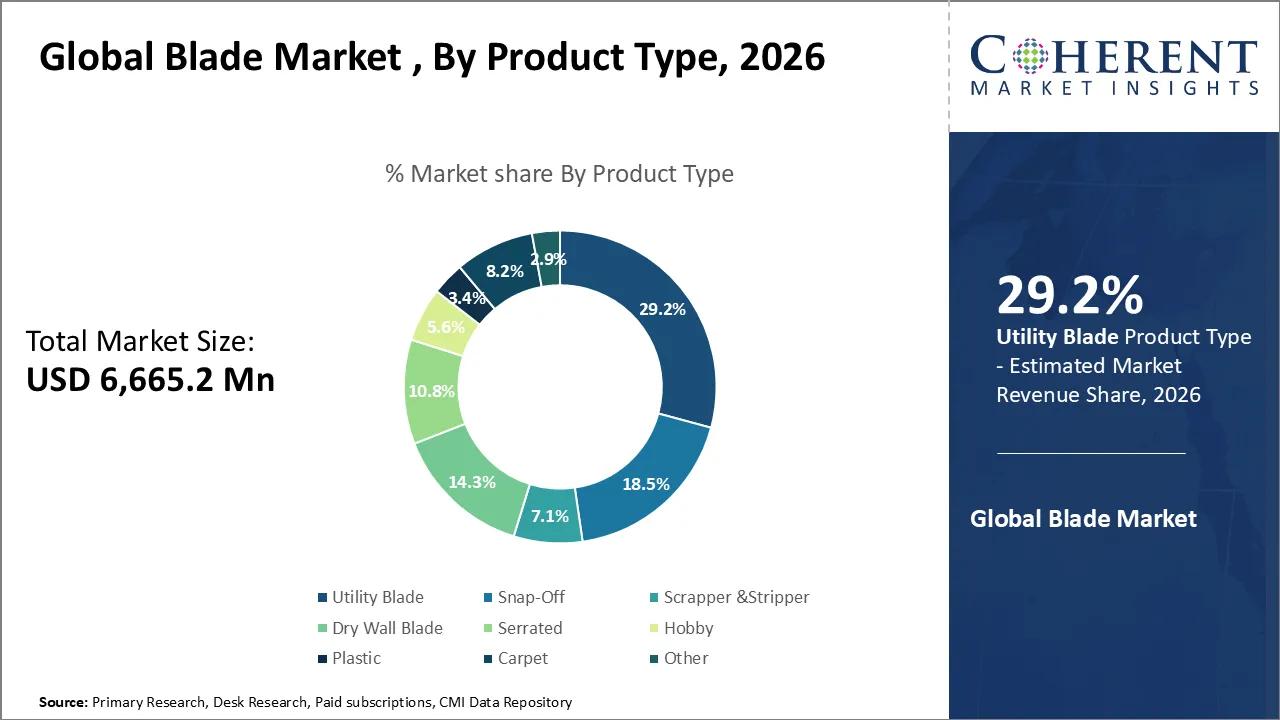
- Utility blade expected to account the largest share of 29.2% in 2026, driven by the high-frequency application across construction, warehousing, packaging, and home improvement activities. For instance, in January 2026, according to the data published by the Harvard Joint Center for Housing Studies projects homeowner improvement spending to reach USD 522 billion in 2026; AF&PA reported that packaging papers and specialty packaging shipments increased 4% year over year in February 2026; and U.S. construction spending was an annualized USD 2.19 trillion in January 2026, with highway construction alone accounting for USD 148.5 billion.
- Based on Distribution Channel, Home center & hardware will dominate with 39.0% in 2026, supported by the wide product availability at one place and strong demand from construction & industrial users. For instance, in February 2026, the Lowe's Companies, Inc., a premier American home improvement retailer operated 1,759 stores in 2026, Ace Hardware had over 5,800 stores worldwide in 2025, and Home Depot generated USD 159.5 billion in fiscal 2025 sales, highlighting the strength of organized hardware retail. Simultaneously, it is anticipated that home repair and renovation expenditures would reach USD 522 billion by Q4 2026, supporting a consistent uptake of blades through these outlets.
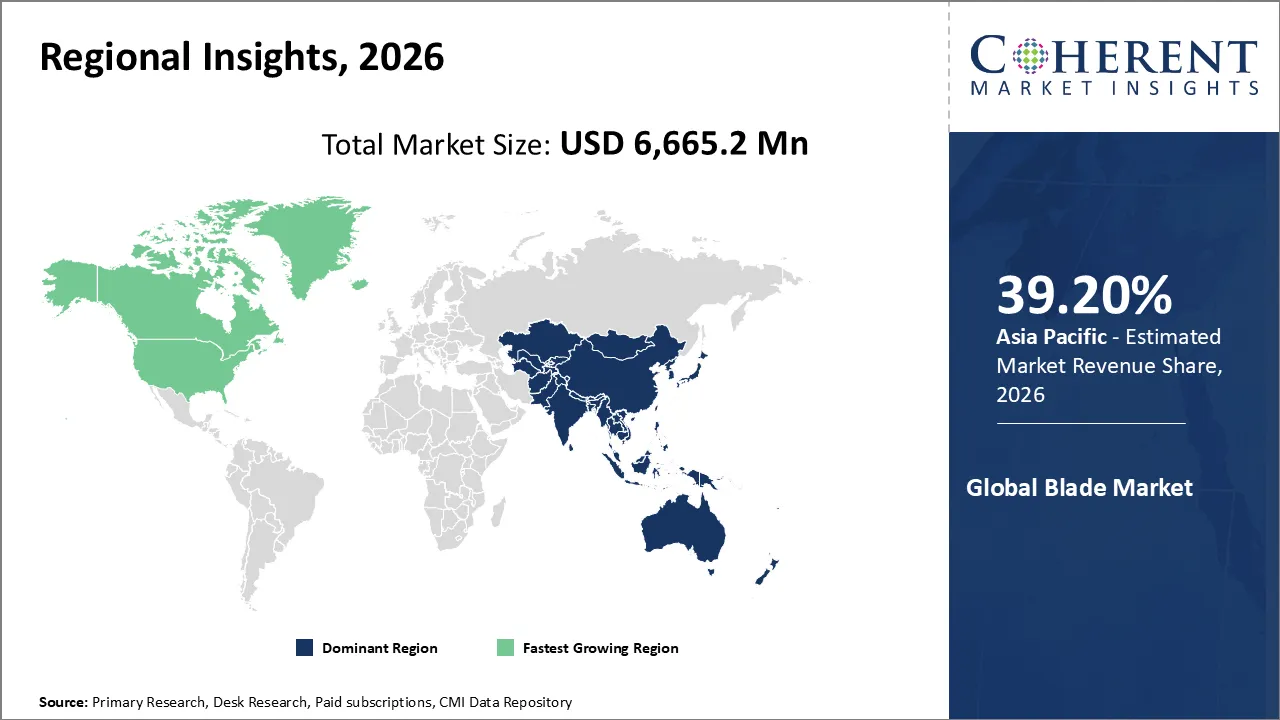
- Asia Pacific is expected to acquire the dominant share of 36.2% in 2026, attributed to rapid urbanization & population growth, growing personal grooming industry and increasing disposable income. For instance, in January 2026, according to the data published by the Small Business and Entrepreneurship Council, India’s GDP growth of around 6-7%, along with projected middle-class population of nearly 580 Mn by 2026 and increasing per capita income over USD 2,500 has significantly boosted consumer purchasing power. At the regional level, ADB expects developing Asia and the Pacific to grow 4.6% in 2026, with domestic demand remaining a key support factor
Segmental Insights
Why is Utility Blade Acquiring the Largest Market Share?
Utility blade is projected to account for the largest share of global blade market in 2026, representing approximately 29.2% of the total volume. Utility blade is extensively used in packaging, construction, carpentry, and DIY/home repairs which means suitable for both household and professional use. Utility blade can cut materials like plastic, thin metals, rubber and cardboard. One tool serves multiple purpose which increases its adoption globally. Utility blades are consumable items which requires regular replacement due to wear and tear and ensures continuous repeat purchases. Utility blade has relatively low-cost compared to specialized blades and easily available in hardware stores, home centers and e-commerce platforms. For instance, utility blades are widely available across both e-commerce and hardware retail channels, which supports high-volume sales. In March 2026, the U.S. Census Bureau reported that retail e-commerce sales reached USD 1,233.7 billion in 2025, growing by 5.4% annually. In Q4 2025, online sales contributed about 16.6% of total retail sales, showing increasing consumer preference for e-commerce. Companies like The Home Depot also generated over USD 164 billion in revenue, supporting growth in the retail and hardware sector.
- Current Industry Events of 2026
- Market Size Estimation
- Regional Breakdown
- Competitive Landscape
- Customer Intelligence
- Segmental Analysis
- Pricing Analysis
- Key Market Drivers, Challenges & Future Trends
- Customized Insights Section
Home Center & Hardware holds the Largest Market Share
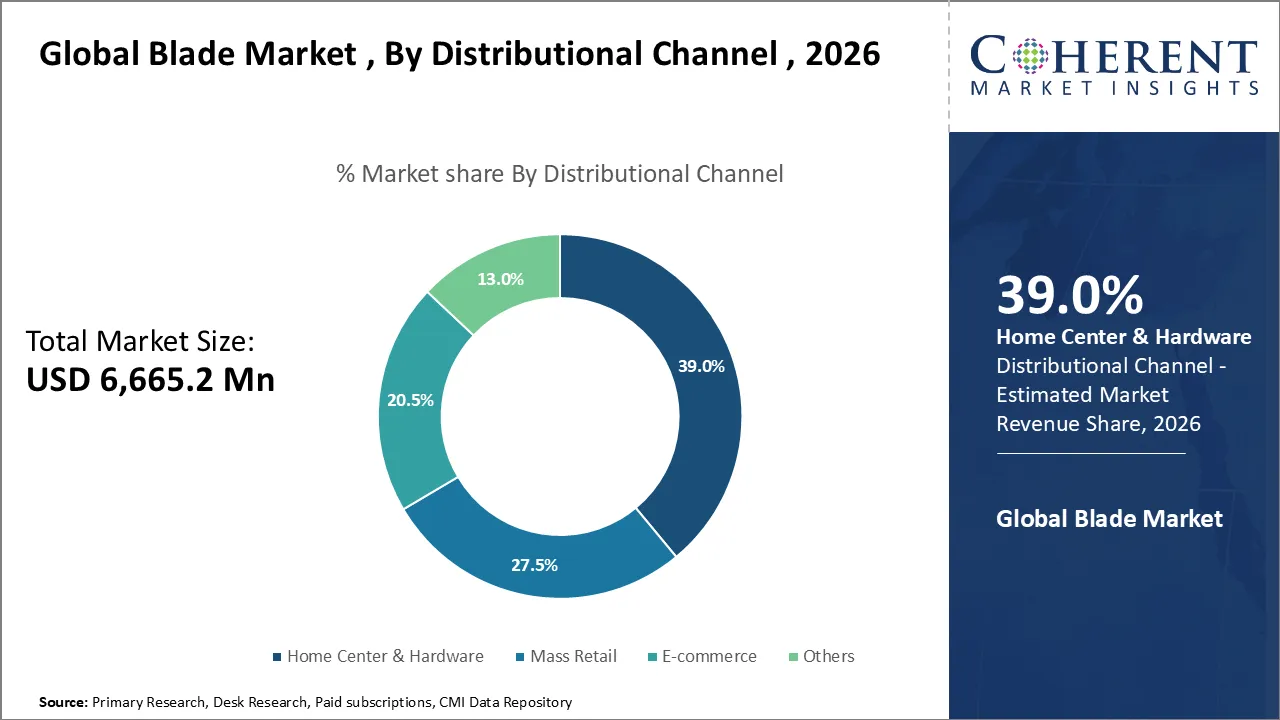
Based on Distribution Channel, home center & hardware dominate the market, accounting for a significant 39.0% share in 2026, owing to direct procurement and competitive pricing. Balde is widely preferred by carpenters, contractors and industrial workers which increases demand and bulk purchasing increases sales volume. Home center has wide product availability and offers a complete range of blades in one place which is convenient for both DIY and professional users. Blades are consumables and requires regular replacement nearby hardware stores make repeat buying easy. Staff present in home centers and hardware provide guidance and product recommendations which builds long-term customer relationships. Large number of hardware stores and home centers globally allows easy accessibility to blade and boosts sales.
For instance, in March 2026, the Home Depot, Inc., largest home improvement specialty retailer, with 12 new locations and more than 1.6 million square feet of retail space spread across eight states in 2026, The Home Depot is growing its presence in the United States. From the Florida peninsula to the coast of Southern California, this expansion will bolster local economies and generate thousands of job opportunities as the country struggles to maintain its aging housing stock.
Blade Market Trends
- Shift toward precision-engineered and longer-lasting blades across grooming industry is a key market trend as end users increasingly prefer products with better edge retention, improved safety, and cleaner cutting performance. This is encouraging manufacturers to focus on coated blades, sharper edge geometry, and more durable materials. For instance, in June 2025, Andis Company, hair tool company, revealed the launch of the GTX-EXO II Trimmer with M-Force blade technology, highlighting consistent magnetic blade tension, reduced wear, sharper cutting performance, and longer tool life.
- The surge in renovation and construction projects has been a boon for blade manufacturers, fueling substantial market expansion. Blades are indispensable tools, used for everything from cutting and trimming to flooring, drywall installation, roofing, insulation, and general repairs. For instance, in March 2026, according to the data published by the U.S. Department of Commerce, it has been estimated that the anticipated seasonally adjusted annual rate of public construction spending in January, 2026 was USD 529.2 Bn, which was 0.6 percent (±1.0 percent) higher than the updated estimate of USD 526.0 Bn from December, 2025. The revised December, 2025, estimate of USD 114.4 Bn was 0.2 percent (±1.5 percent) higher than the seasonally adjusted annual rate of USD 114.1 Bn for educational building. The seasonally adjusted annual rate for highway building was USD 148.5 Bn, which was 3.3 percent (±2.6 percent) higher than the updated December estimate of USD 143.8 Bn.
- Expansion of industrial applications such as packaging, food processing, textile and metal industries etc. shows broad application of blade which supports market growth. For instance, in January 2026, Columbia River Knife & Tool, Inc., an American knife company, will launch a comprehensive new collection. The company takes use of this occasion each year to introduce new designs, improve current models, and increase partnerships with renowned knifemakers. The 2026 launch demonstrates once more how extensive the CRKT line is, ranging from small tools and sturdy fixed-blade knives to ultra-light pocket knives and quality EDC. The Counterpart and the Sero are the launch's two most striking features.
- Growth of e-commerce channels has increased the sales of the blades. Rising online sales through platforms has fuel the market demand. Consumers prefer convenience and discounts which expands market reach globally. For instance, in March 2026, Retail e-commerce sales in the United States hit USD 1.2337 trillion in 2025, up 5.4% from the previous year and making up 16.4% of all retail sales.
Blade Market Drivers
Increasing Demand for Personal Grooming
Rising demand for personal grooming has driven the blade market growth in the near future. Increasing use of razors and grooming blades among both women and men has risen the market demand. Growing awareness about hygiene and appearance has significantly driven the blade market growth over the forecast period. Strong demand in countries like China and India for rimming, finishing, assembly, warehousing, cutting, and maintenance. In other countries the demand is driven by the home improvement, construction, and packaging/logistics activity.
For instance, in 2026, the global grooming market expanded in the mid-single digits in FY2024, adding over USD 1 Bn in retail sales. In FY2025, the company emphasized a significant Venus razor improvement and new shelf design aimed at boosting category consumption. While MOSPI's 2026 consumption-classification update separately tracks "shaving blades, shaving stick and razor" and "shaving cream, shaving foam, aftershave lotion and aftershave balm," indicating grooming-related blade purchases are a regular consumer spending category, IBEF reported that the men's grooming market in India was approximately USD 2.20 Bn (₹20,500 crore) in 2024 and is projected to reach USD 4.12 Bn (₹38,300 crore) by 2033.
Rising Disposable and Middle-Class Income Drives Market Growth Over the Forecast Period
Increasing disposable and middle-class income has estimated to create significant opportunity for the growth of the blade market over the forecast period. Due to higher disposable income, there is higher spending on grooming and household tools. Expanding middle-class population supports the blade market growth
- For instance, in February 2026, according to estimates from the U.S. Bureau of Economic Analysis, U.S. government agency that provides official macroeconomic and industry statistics, personal income rose by USD 113.8 Bn (0.4 percent on a monthly basis) in January, 2026. Personal consumption expenditures (PCE) climbed USD81.1 Bn (0.4 percent), while disposable personal income (DPI), or personal income less personal current taxes, increased USD219.9 Bn (0.9 percent). In January, 2026, there was a rise of USD 85.8 Bn in personal outlays, including PCE, personal interest payments, and personal current transfer payments. In January, personal savings were USD1.05 trillion, with a personal saving rate of 4.5% of DPI. Increases in compensation, personal dividend income, and personal current transfer receipts were the main causes of the January increase in current-dollar personal income. In January, current-dollar PCE increased by USD81.1 Bn due to a rise in services spending of USD 105.7 Bn, which was somewhat offset by a decline in goods spending of USD 24.6 Bn.
Current Events and Their Impact on the Blade Market
Current Event | Description and its Impact |
Increasing Support from Government Policies and Government Initiatives |
|
Supportive Regulatory Shift is Reshaping Blade Packaging |
|
Regional Insights
Asia Pacific dominates owing to Rapid Urbanization & Industrial Activities
Asia Pacific account 39.20% market share in 2026, due to rapid urbanization, expansion of construction & industrial activities, and growing awareness of personal grooming. In China, the urbanization rate reached 67.89% by the end of 2025, and online retail sales rose to USD 2.33 trillion in 2025, with physical-goods online retail accounting for 26.1% of total retail sales. In India, the e-commerce market is projected to reach about USD 211.6 Bn in 2025, with major platforms such as Flipkart and Amazon helping widen product access, while India Brand Equity Foundation (IBEF) states India’s men’s grooming market was valued at about USD 2.3 Bn (₹20,500 crore) in 2024. These trends are supporting higher blade demand across construction, packaging, industrial use, and personal grooming applications in the region.
North America Blade Market Trends
The North America region is poised to be as the fastest-growing region through 2026-2033 in the global blade market, supported by rising middle class population, high disposable income and strong industry presence. North America has well-established construction & industrial sector. Blade is extensively used in packaging, construction, manufacturing and continuously in infrastructure and renovation activities. For instance, in March 2026, according to the data published by the U.S. Census Bureau, in January 2026, the United States' overall construction investment reached a seasonally adjusted annual pace of USD 2.19 trillion, while the number of privately owned housing starts increased by 9.5% to 1.487 million units. In January 2026, Canada invested CAD 23.4 Bn in building construction, an increase of 7.8% from the previous year. Simultaneously, U.S. retail e-commerce sales reached USD 1.2337 trillion in 2025, supporting a high level of packing and warehouse activity, where blades are frequently employed for box-opening, cutting, and trimming.
Advanced Retail & Distribution Network is accelerating the Blade Market Demand in the U.S.
The U.S. blade market is undergoing a period of robust expansion. Many leading blade manufacturers are headquartered in the U.S. due to strong research & development and product innovation. U.S. has well-developed channels such as home centers & hardware stores, supermarkets & hypermarkets and e-commerce platforms, hence easy product accessibility boosts sales. High popularity of DIY activities in U.S. increases demand for utility and cutting blades. For instance, the Home Depot, Inc., a leading home improvement specialty retailer, stated that with USD 164.7 Bn in net sales and USD14.2 Bn in earnings for the fiscal year 2025, the Home Depot, Inc. company is estimated to be largest home improvement specialty retailer in the world. In the United States (including Puerto Rico, the U.S. Virgin Islands, and the territory of Guam), Canada, and Mexico, The Home Depot Inc. company has over 2,300 retail locations.
Source: HomeDepot
China Blade Market Trends
The China blade market projected to grow significantly during the upcoming years. China has one of the largest populations in the world with higher number of consumers which increases blade market demand. China is a global manufacturing hub which provide large-scale production of blades at low cost due to easy availability of raw materials and labor. Rapid development in buildings, roads and industrial projects has generated high demand for utility and industrial blades. Rising disposable income in China has significantly driven the China blade market. For instance, the National Bureau of Statistics of China estimates that as at the end of 2025, there were 1.40489 Bn people living in China. Furthermore, online retail sales increased to 15.97 trillion yuan in 2025, showing the size of China's consumer market and the widespread availability of various items through digital channels, while per capita disposable income reached 43,377 yuan. These elements contribute to the growing use of blades in general-purpose cutting, grooming, and daily use applications.
Who are the Major Companies in Blade Market
Some of the major key players in Blade Market are Olfa Corporation, Stanley Black & Decker, Inc., U.S. Blade Manufacturing Co. Inc., Irwin Industrial Tools, DeWalt, Pacific Handy Cutter Inc., Lenox, Craftsman, Better Tools LLC, and Warner Manufacturing Company.
Key News
- In January 2026, Outdoor Edge, a company focused on designing and manufacturing of knives and tools, unveiled Razor VX7 and Razor VX8. Both razor blades have superior handle materials, stainless steel liners, fast-opening pivot systems, and Outdoor Edge's unique RazorSafe blade and blade holder technology. In a contemporary knife intended for daily use, the push-button blade changing system provides consistent cutting performance without the need for honing.
- In January 2025, DORCO, a company manufacturing shaving equipment, revealed the introduction of the premium razor range, SLEEK, encapsulating decades of expertise in razor technology. SLEEK is the outcome of DORCO's unrelenting R&D efforts, fusing precision-engineered blades with the cutting-edge Thin Edge Blade technology. The product, marketed under the name Shaving to Perfection, offers a perfect shaving experience that minimizes skin irritation and guarantees a close shave.
- In September 2025, Laifen, lifestyle-tech brand company, added electric shavers to its lineup. Laifen's cutting-edge personal care equipment have empowered more than 20 million consumers globally since its founding in 2019. Laifen will debut two models for the first time at IFA 2025 in Berlin: the powerful P3 Pro Electric Razor for demanding beard care and the small T1 Pro Electric Razor for accurate shaving.
Market Report Scope
Blade Market Report Coverage
| Report Coverage | Details | ||
|---|---|---|---|
| Base Year: | 2025 | Market Size in 2026: | USD 6,665.2 Mn |
| Historical Data for: | 2020 To 2024 | Forecast Period: | 2026 To 2033 |
| Forecast Period 2026 to 2033 CAGR: | 4.9% | 2033 Value Projection: | USD 9,171.1 Mn |
| Geographies covered: |
| ||
| Segments covered: |
| ||
| Companies covered: | Olfa Corporation, Stanley Black & Decker, Inc., U.S. Blade Manufacturing Co. Inc., Irwin Industrial Tools, DeWalt, Pacific Handy Cutter Inc., Lenox, Craftsman, Better Tools LLC, and Warner Manufacturing Company. | ||
Analyst Opinion
- The blade market is seeing growth, fueled in part by innovations in personal grooming, particularly in the premium and replacement segments. Major consumer goods companies are still pouring money into grooming products, improving blade quality, and expanding their digital presence. For instance, P&G reported that Grooming was up low single digits in fiscal 2025, while company-wide e-commerce sales increased 12% and represented 19% of total sales, indicating continued momentum for grooming-related blade demand across modern retail and online channels.
- Blade market growth is driven by daily-use demand rather than a short-term trend cycle. Blades are essential consumables across packaging, construction, repair, manufacturing, and personal grooming, which means demand is supported by routine replacement and broad end-use dependence. In the U.S., construction spending reached a seasonally adjusted annual rate of USD 2.19 trillion in January 2026, underscoring the scale of end markets where blades are regularly used.
- Utility blades benefit from repeat consumption, which makes the market structurally resilient. Unlike one-time durable tools, blades wear out and need frequent replacement in trimming, carton opening, roofing, flooring, scraping, and workshop applications. This is further supported by the size of packaging and fulfillment activity, with U.S. retail e-commerce sales reaching USD 1.2337 trillion in 2025 and accounting for 16.4% of total retail sales, reinforcing steady blade usage in logistics and warehousing.
Speak to the analyst
Want personalized insights?
Take the findings above to one of our principal consultants, or have the report rebuilt around the segments, geographies and competitors you actually track.
Market Segmentation
- By Procedure Type
- Utility
- Serrated
- Drywall
- Snap-off
- Plastic
- Carpet
- Scrapper & Stripper
- Hobby
- Others
- By Distribution Channel
- Home Center & Hardware
- Mass Retail
- E-commerce
- Others
- Global Blade Market, By Region
- North America
- U.S.
- Canada
- Latin America
- Brazil
- Mexico
- Argentina
- Rest of Latin America
- Europe
- Germany
- U.K.
- France
- Italy
- Spain
- Russia
- Rest of Europe
- Asia Pacific
- China
- India
- Japan
- Australia
- South Korea
- ASEAN
- Rest of Asia Pacific
- Middle East
- GCC
- Israel
- Rest of Middle East
- Africa
- South Africa
- Central Africa
- North Africa
- North America
- Key Players
- Olfa Corporation
- Stanley Black & Decker, Inc.
- U.S. Blade Manufacturing Co. Inc.
- Irwin Industrial Tools
- DeWalt
- Pacific Handy Cutter Inc.
- Lenox, Craftsman
- Better Tools LLC
- Warner Manufacturing Company
Sources
Primary Research Interviews
- Blade manufacturers and product development managers to understand product innovation, coating technology, material trends, and demand by blade type
- Raw material suppliers / steel strip suppliers to assess raw material pricing, supply availability, quality specifications, and procurement challenges
- Distributors, wholesalers, and hardware channel partners to evaluate sales movement, replacement demand, and distribution trends across regions
- Home center, hardware store, and e-commerce sellers to understand customer buying behavior, preferred blade formats, and fast-moving product categories
- Construction contractors, carpenters, and industrial end users to assess actual blade usage patterns, replacement frequency, and application-wise demand
- Packaging, warehouse, and logistics professionals to understand consumption of utility blades in box opening, trimming, and material handling operations
- Personal grooming product companies and razor category managers to assess trends in shaving blades, cartridge systems, premiumization, and consumer preferences
- Industry experts, trade associations, and procurement specialists to validate market trends, competitive intensity, pricing movements, and future growth outlook
Databases
- U.S. Bureau of Economic Analysis (BEA)
- Organisation for Economic Co-operation and Development (OECD)
- World Bank
- National Bureau of Statistics of China
- Ministry of Statistics and Programme Implementation (MOSPI), India
- U.S. Census Bureau
Magazines
- Blade Magazine
- Hardware Retailing
- Packaging World
- Knife Magazine
Journals
- International Journal of Advanced Manufacturing Technology
- Journal of Materials Processing Technology
- Journal of Manufacturing Processes
- Wear
- Materials Today
Newspapers
- The New York Times
- The Wall Street Journal
- Financial Times
- The Guardian
Associations
- American Knife & Tool Institute (AKTI)
- National Retail Federation (NRF)
- American Iron and Steel Institute (AISI)
- International Housewares Association (IHA)
- Association for Packaging and Processing Technologies (PMMI)
Public Domain Sources
- Company Annual Reports and Investor Presentations
- Construction And Infrastructure Statistics
- Customs / Import-Export Trade Databases
- Product Launch Releases and Corporate Press Releases
- Government Trade and Industry Publications
- E-Commerce And Retail Sales Publications
Proprietary Elements
- CMI Data Analytics Tool
- Proprietary CMI Existing Repository of information for last 10 years
Get access to 250+ pages report
Every segment, forecast, competitor profile and data table behind the analysis above — available for instant download.
- ESOMAR Member
- ISO 9001:2015 Certified
- D-U-N-S Registered
- GDPR & CCPA Compliant
Missing comfort of reading report in your local language? Find your preferred language:
Transform your Strategy with Exclusive Trending Reports
Frequently Asked Questions
The Blade Market is expected to reach USD 9,171.1 Mn in 2033.
Major players operating in the global blade market include Olfa Corporation, Stanley Black & Decker, Inc., U.S. Blade Manufacturing Co. Inc., Irwin Industrial Tools, DeWalt, Pacific Handy Cutter Inc., Lenox, Craftsman, Better Tools LLC, and Warner Manufacturing Company.
Raw-material cost volatility and trade tariffs as well as market maturity and intense price competition in basic blade categories are the factors hampering the growth of the market.
Increasing demand for personal grooming, rising disposable and middle-class income, rising construction and industrial activities as well as increasing sale through e-commerce platform are the factors contributing to growth of the market.
The Blade Market is anticipated to grow at a CAGR of 4.9% between 2026 and 2033
Among regions, Asia-Pacific is expected to account for a largest market share in the global blade market over the forecast period.