

Global Wooden Toys Market
The global wooden toys market refers to the production, distribution, and sale of toys made from hardwood, softwood, engineered wood, bamboo, rubberwood, and other sustainable wood materials. The market includes educational and learning toys, building blocks, puzzles, pretend-play toys, dolls, ride-ons, and other wooden play products used by infants, toddlers, preschool children, families, schools, daycare centers, and specialty toy retailers.
Key Statistics at a Glance
Metric | Value |
Global Market Size (2026) | USD 31.42 Billion |
Forecast Market Size (2033) | USD 49.47 Billion |
Growth Rate (CAGR 2026–2033) | 6.7% |
Leading Product Type Segment | Educational and Learning Toys (29.6% share in 2026) |
Leading Wood Type Segment | Hardwood (46.8% share in 2026) |
Leading Age Group Segment | 0 to 3 Years (32.7% share in 2026) |
Dominant Region | Europe (32.4% share in 2026) |
Fastest Growing Region | North America (28.6% share in 2026) |
Base Year | 2025 |
Forecast Period | 2026–2033 |
Key Players | Melissa and Doug, Hape International, PlanToys, LEGO Group, Mattel Inc |
Global Wooden Toys Market Size and Forecast – 2026 To 2033
The global wooden toys market is estimated to be valued at USD 31.42 Bn in 2026 and is expected to reach USD 49.47 Bn by 2033, exhibiting a compound annual growth rate (CAGR) of 6.7% from 2026 to 2033. This growth is supported by the increasing consumer preference for sustainable and eco-friendly products, rising disposable incomes, and growing awareness of the benefits of wooden toys over plastic alternatives, including durability, safety, and developmental value.
For instance, in January 2026, Lidl GB reported that its wooden toy sales increased by almost one-quarter compared to the previous year during the Christmas trading period, reflecting strong retail demand for affordable, sustainable, and family-oriented wooden play products.
Key Takeaways of the Global Wooden Toys Market
- By product type, educational and learning toys are expected to dominate the global wooden toys market with 29.6 % share in 2026, supported by parents’ preference for skill-building, screen-free play products. In January 2026, Spielwarenmesse highlighted wooden toys, learning products, and natural-material toys as key innovation categories, reinforcing retailer focus on educational wooden play formats.
- By wood type, hardwood is expected to lead the market with 46.8 % share in 2026, owing to its durability, premium finish, and suitability for long-life toys such as blocks, puzzles, and pretend-play sets. In December 2025, the EU amended the Deforestation Regulation framework, strengthening traceability expectations for wood-based products and supporting certified hardwood sourcing.
- By age group, the 0 to 3 years segment is expected to account for the largest share of 32.7 % in 2026, as parents prioritize safe, tactile, non-toxic, and early-development toys. In April 2024, ASTM F963-23 became the mandatory U.S. toy safety standard, increasing compliance focus on small parts, accessible edges, coatings, and age-appropriate toy design.
- Europe is expected to remain the dominant region with 32.4 % share in 2026, supported by strong demand for sustainable, premium, and safety-certified wooden toys. In December 2025, the European Commission confirmed that the new Toy Safety Regulation would enter into force in January 2026, strengthening chemical safety rules and digital compliance requirements for toys sold in the EU.
- Asia Pacific is expected to be the fastest-growing region with 29.1 % share in 2026, supported by expanding toy manufacturing clusters, export-oriented production, and rising adoption of locally made educational toys. In February 2024, India’s Ministry of Commerce reported a 239% rise in toy exports from FY2014–15 to FY2022–23, strengthening regional supply capabilities.
- Current Industry Events of 2026
- Market Size Estimation
- Regional Breakdown
- Competitive Landscape
- Customer Intelligence
- Segmental Analysis
- Pricing Analysis
- Key Market Drivers, Challenges & Future Trends
- Customized Insights Section
Segmental Insights
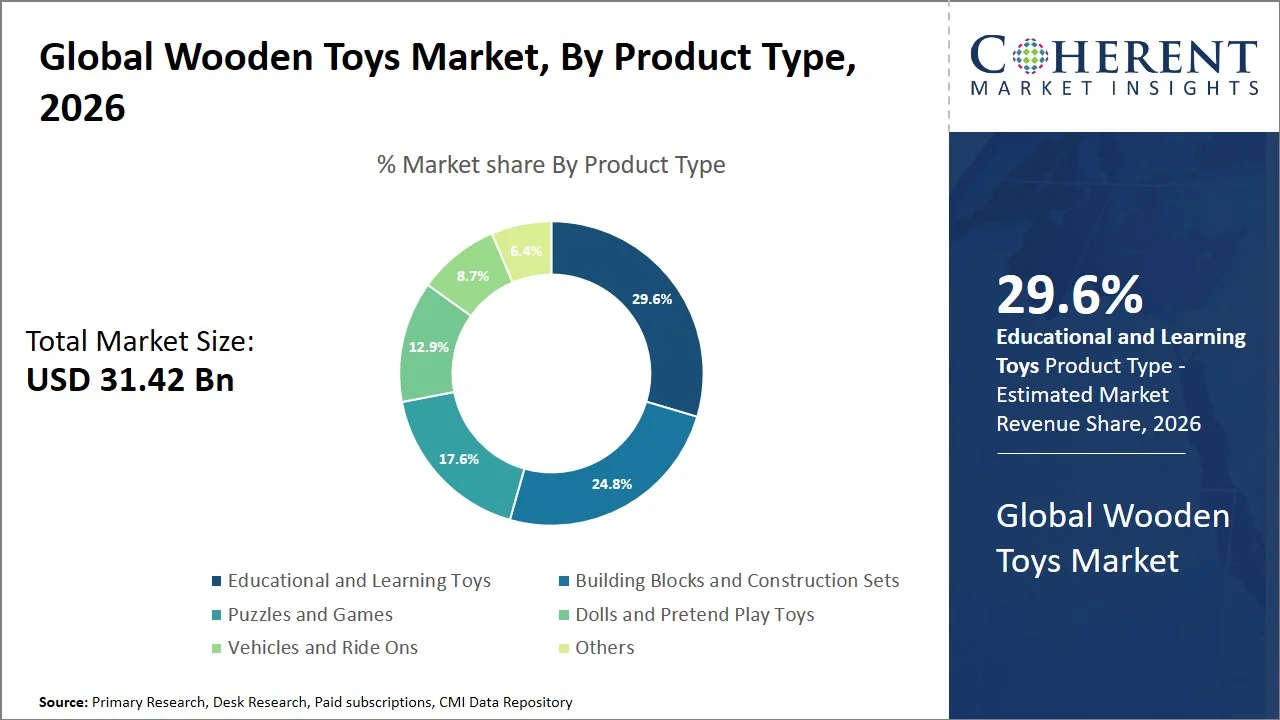
Why Does Educational and Learning Toys Dominate the Global Wooden Toys Market?
Educational and learning toys are expected to dominate the global wooden toys market with 29.6% share in 2026, as parents and preschools increasingly prefer toys that combine screen-free play with skill development. The segment leads because wooden alphabets, counting boards, shape sorters, activity cubes, and logic-based play sets support fine motor control, early numeracy, language recognition, and problem-solving without overstimulation. On the supply side, brands can create modular, durable, and age-graded learning sets using precision cutting, safer coatings, and illustrated activity guides. Adoption is the strongest across homes, daycare centers, preschools, specialty toy stores, and online learning-led toy categories. In September 2024, Melissa & Doug launched Blockables, a wooden snap-and-play block range designed for problem-solving, matching, storytelling, confidence, and fine motor skills, supporting the segment’s learning-led positioning.
Why Does Hardwood Represent the Largest Wood Type in the Global Wooden Toys Market?
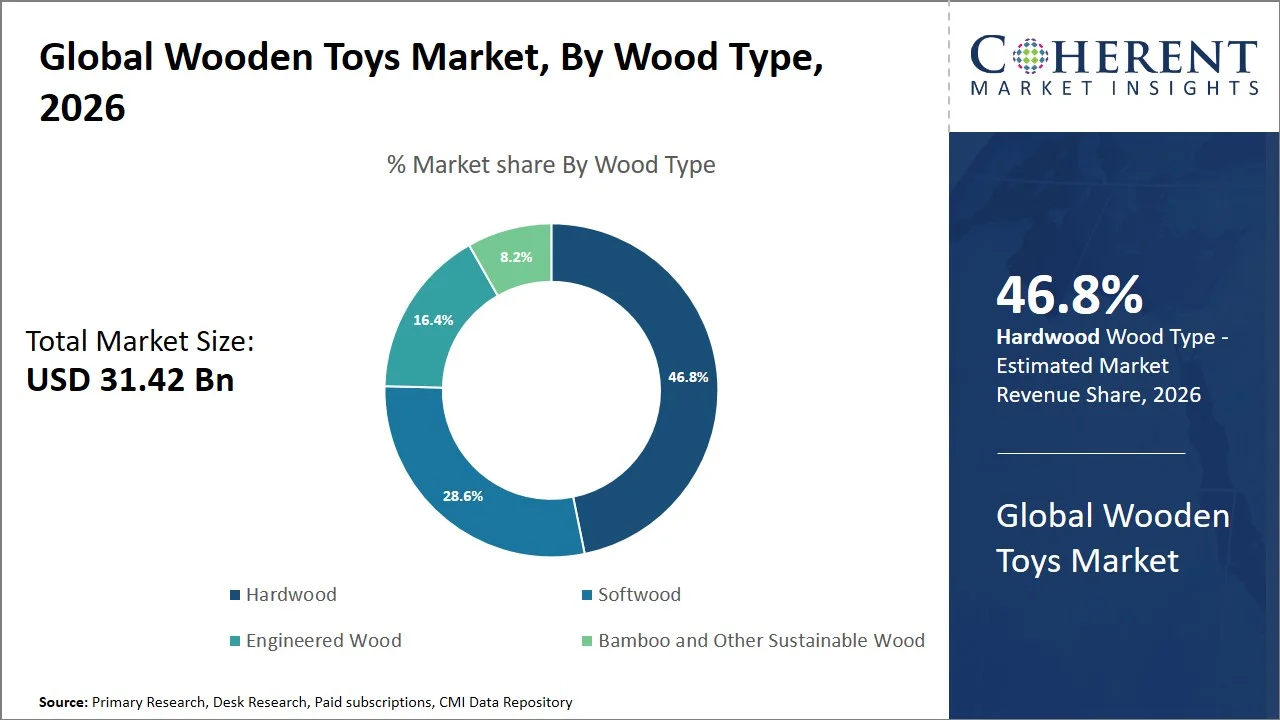
Hardwood is expected to represent the largest wood type with 46.8% share in 2026, as it offers the durability, density, and premium finish needed for products handled repeatedly by young children. The segment dominates because hardwoods such as rubberwood, beech, maple, and acacia are better suited for blocks, dollhouses, kitchens, puzzles, ride-ons, and pretend-play sets where surface smoothness and long product life are critical. Manufacturers also prefer hardwood because it supports precision shaping, sanding, non-toxic dye absorption, and lower breakage risk in premium toy formats. Demand is the strongest from parents, schools, and specialty retailers seeking heirloom-quality and safer play products. In February 2025, PlanToys introduced PlanSpaces, a modular playhouse crafted using sustainably sourced rubberwood, upcycled sawdust, and water-based dyes, reinforcing hardwood’s role in premium sustainable toy design.
Why Does 0 to 3 Years Dominate the Global Wooden Toys Market?
The 0 to 3 years age group is expected to dominate the global wooden toys market with 32.7% share in 2026, as this age bracket requires simple, safe, tactile, and development-supportive play products. Parents in this segment prioritize rounded edges, large parts, smooth textures, non-toxic finishes, and toys that support grasping, stacking, sorting, crawling, and first-stage problem-solving. Supply-side innovation is focused on lightweight wooden blocks, stacking rings, shape sorters, pull toys, musical toys, and sensory formats designed for repeat handling and mouthing safety. Adoption is the strongest in households, baby gifting, childcare centers, and early learning environments. In June 2024, Fisher-Price unveiled Fisher-Price Wood for children aged six months to five years, including puzzles, blocks, role-play, and music-making toys designed to support creativity, fine motor skills, and problem-solving.
Global Wooden Toys Market Dynamics
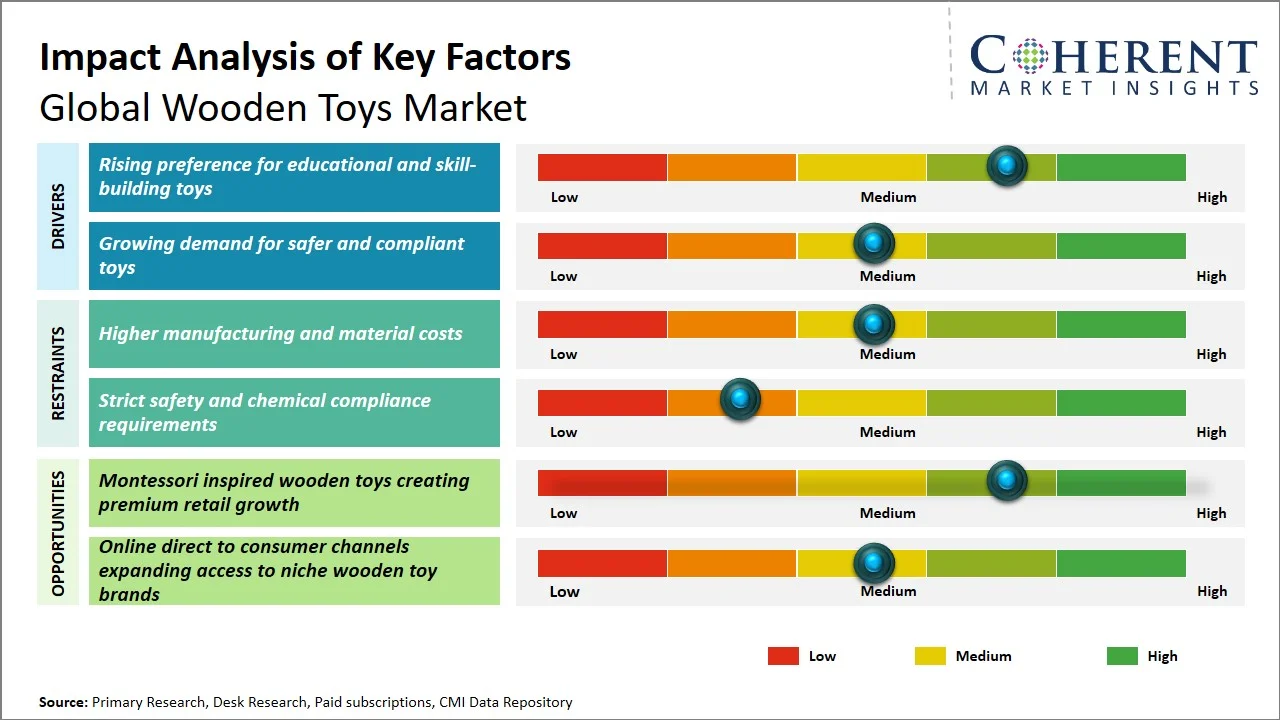
Market Drivers
- Rising Preference for Educational and Skill-Building Toys: Educational and learning toys are gaining strong commercial importance as parents, preschools, and specialty retailers prioritize products that support motor skills, early literacy, counting, problem-solving, and sensory development. Wooden toys fit this demand because they are tactile, durable, and suitable for repeated open-ended play. The segment also benefits from growing interest in Montessori-inspired learning formats and low-stimulation play environments. In January 2026, Spielwarenmesse’s What’s New Guide highlighted wooden toys made from natural materials and educational toys as dedicated product areas, showing continued retailer focus on learning-led toy assortments.
- Growing Demand for Safer and Compliant Toys: Safety compliance is a major purchase driver in the wooden toys market because these products are widely used by infants and children under five. Parents and retailers increasingly look for products with non-toxic paints, rounded edges, age-appropriate design, chemical safety, and validated testing. This supports the demand for certified wooden toys and increases the importance of third-party testing for exporters and importers. In April 2024, ASTM F963-23 became the mandatory U.S. toy safety standard, strengthening requirements around mechanical, chemical, warning label, and performance safety aspects for toys.
- Shift Toward Sustainable and Natural Materials: Wooden toys are benefiting from the broader shift away from disposable plastic toys toward long-life, repairable, and responsibly sourced products. Hardwood, rubberwood, bamboo, and upcycled wood-based materials are becoming important for brands targeting premium and eco-conscious buyers. Sustainability positioning also helps companies command higher shelf value in Europe and North America. This driver is especially relevant as retailers increasingly ask suppliers for responsible sourcing, recyclable packaging, and traceable material documentation.
- Expansion of Specialty Toy Stores and Online Retail: Specialty toy stores remain important because parents often prefer to physically assess texture, durability, finishing quality, and safety details before purchasing wooden toys. At the same time, online retail is expanding access to niche wooden toy brands, Montessori-style products, and premium international ranges. Digital channels also help small and mid-sized manufacturers reach parents directly through product storytelling, certifications, age filters, and bundled play kits. This dual-channel model improves visibility for educational toys, puzzles, and pretend-play sets.
Top 5 Trends in the Global Wooden Toys Market
- Montessori-Inspired Product Positioning: Wooden toys are increasingly designed around Montessori-style learning, simple shapes, natural finishes, and self-directed play. This trend supports premium pricing and improves adoption across homes, preschools, and therapy-based learning environments.
- Gender-Neutral Pretend Play: Brands are moving away from narrowly gendered toy themes and focusing on inclusive kitchens, dollhouses, tools, vehicles, and role-play sets. This expands the addressable customer base and improves repeat purchases across families with multiple children.
- Sustainable Packaging Integration: Wooden toy companies are reducing plastic packaging and using paper-based, recyclable, or reusable packaging formats. This improves brand perception and supports retail acceptance in markets with strong sustainability expectations.
- Premiumization Through Durability: Consumers increasingly view wooden toys as long-life products that can be passed between siblings or resold. This strengthens demand for high-quality finishes, premium woods, and timeless toy designs.
- Hybrid Retail and D2C Growth: Wooden toy brands are using online stores, marketplaces, social media, and specialty retailers together to improve discovery and conversion. This helps niche manufacturers compete against larger toy brands through storytelling, learning benefits, and sustainability claims.
Market Challenges
- Higher Manufacturing and Material Costs: Wooden toys generally require better-quality raw materials, cutting, sanding, finishing, painting, and safety checks compared with low-cost plastic toys. This increases production costs and makes pricing less competitive in value-sensitive markets. Manufacturers also face margin pressure when wood, labor, logistics, and testing costs rise together.
- Strict Safety and Chemical Compliance Requirements: Wooden toys must meet safety rules related to small parts, sharp edges, paint migration, flammability, phthalates, coatings, and age grading. Compliance failures can lead to recalls, rejected shipments, and reputational damage. Smaller manufacturers may struggle with testing costs, documentation, and certification requirements across the U.S., Europe, and Asia Pacific.
- Supply Chain Dependence on Certified Wood: The global wooden toys market depends on reliable access to sustainably sourced wood and compliant coatings. Any disruption in certified wood supply, freight movement, or regulatory documentation can delay production and exports. This challenge is more visible for brands selling in Europe and North America, where buyers increasingly request traceability and responsible sourcing evidence.
Current Events and their Impact
Current Events | Description and its Impact |
EU Toy Safety Regulation Entry into Force – January 2026 |
|
U.S. CPSC Certificate eFiling Rule – July 2026 onward |
|
Regional Insights
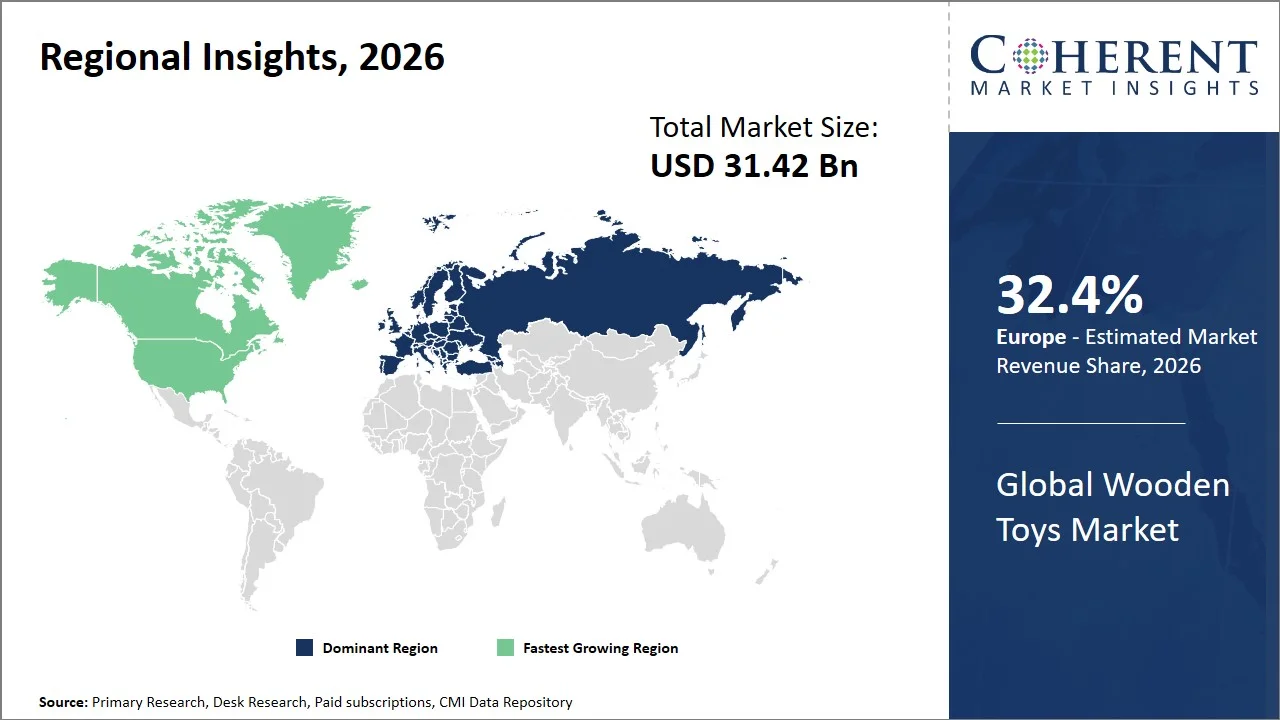
Why Does Europe Dominate the Global Wooden Toys Market?
Europe is expected to dominate the global wooden toys market with 32.4% share in 2026, supported by strong consumer preference for safe, sustainable, and premium-quality toys. Parents in Germany, the U.K., France, the Nordics, and other mature European markets are highly receptive to wooden learning toys, puzzles, pretend-play sets, and Montessori-inspired products. The region also benefits from well-established specialty toy retail, strict toy safety rules, and higher acceptance of certified wood and non-toxic finishes. European buyers often prioritize product durability and responsible sourcing over low price, helping premium wooden toy brands maintain strong positioning. In March 2026, the European Commission reported that Safety Gate alerts reached a record 4,671 in 2025, with toys among the major reported categories, reinforcing Europe’s strict product-safety environment.
Why is North America Emerging as the Fastest-Growing Region in the Global Wooden Toys Market?
North America is expected to be the fastest-growing region in the global wooden toys market with 28.6% share in 2026, supported by strong spending on early childhood products, rising preference for screen-free play, and fast expansion of online toy discovery. Parents in the U.S. and Canada increasingly value toys that support sensory development, fine motor skills, emotional comfort, and low-tech family play. Wooden toys fit this demand because they offer tactile value, durability, and a premium gifting appeal across infant, preschool, and educational categories. Retailers are also using curated toy aisles, e-commerce filters, and parent-focused product storytelling to promote natural-material play products. In February 2026, The Toy Association unveiled 2026 toy trends at Toy Fair in New York, highlighting creativity, comfort, self-expression, and no-tech play as key consumer directions.
Global Wooden Toys Market Outlook for Key Countries
Why is the U.S. a Key Market for the Global Wooden Toys Market?
The U.S. is expected to remain a key market for the global wooden toys market with 24.8% share in 2026, owing to its large specialty toy retail base, strong gifting culture, and high parental focus on developmental play. Wooden toys are widely adopted across homes, daycare centers, preschools, and online retail platforms, especially in learning toys, shape sorters, blocks, puzzles, and pretend-play formats. The market also benefits from strict consumer safety enforcement, which increases demand for tested, age-graded, and compliant wooden toys. Premium brands can differentiate through non-toxic coatings, larger parts for younger children, and clear safety labeling. In December 2025, the U.S. CPSC warned consumers to stop using TooyBing Wooden Toys because the Montessori bead toys violated the small-parts ban, showing the importance of safety-led product design in the U.S.
Why is China Important in the Global Wooden Toys Market?
China is expected to account for 13.2% share in 2026, making it one of the most important countries in the global wooden toys market. The country plays a central role as a manufacturing and sourcing base for wooden toys, educational toys, puzzles, blocks, pretend-play items, and export-oriented toy components. China’s advantage comes from large-scale production clusters, supplier depth, packaging capability, tooling expertise, and established trade links with Europe and North America. Domestic demand is also supported by urban families seeking early-learning and premium child-development products. Hong Kong continues to act as a key sourcing and trade gateway for Chinese toy suppliers. In January 2025, HKTDC positioned the Hong Kong Toys & Games Fair as Asia’s flagship toy fair, supporting international buyer access to Asian toy manufacturers and product innovation pipelines.
Why Does India Support Growth in the Global Wooden Toys Market?
India is expected to hold 6.7% share in 2026, supported by improving domestic toy manufacturing, strong handicraft skills, access to woodcraft clusters, and rising demand for affordable educational toys. Wooden toys have strong relevance in India because they align with preschool learning, traditional craft-based play, Montessori products, and gifting demand across urban households. The country also has cost advantages in labor-intensive sanding, finishing, assembly, painting, and small-batch customization. Supply-side growth is supported by quality-control reforms, local manufacturing promotion, and export-market interest from buyers seeking alternatives to single-country sourcing. In June 2026, DPIIT issued guidelines for the Transition Facilitation Quality Control Order, creating an alternative quality-certification pathway for sectors including toys, which can help manufacturers manage compliance while scaling production.
Why is Germany a Strategic Country in the Global Wooden Toys Market?
Germany is expected to be a strategic country in the global wooden toys market with 7.9% share in 2026, supported by its strong premium toy culture, advanced woodworking tradition, and consumer preference for sustainable, durable, and educational products. German parents and educators are highly receptive to open-ended wooden toys, building sets, puzzles, and early-learning products that support creativity and independent play. The country also has strong brand equity in quality-led wooden toys, supported by specialty retailers, kindergarten usage, and sustainability-conscious buyers. On the supply side, German manufacturers benefit from design expertise, high finishing standards, and strong compliance orientation for EU markets. In March 2026, Studio 100 International signed HABA for its first complete licensed product line with Maya the Bee for the German-speaking market, combining education, sustainability, and child-development play.
Why is the U.K. an Important Growth Market for the Global Wooden Toys Market?
The U.K. is expected to account for 6.4% share in 2026, supported by strong specialty toy retail, independent toy shops, online marketplaces, and parent interest in safer educational play products. Wooden toys are well positioned in the U.K. across infant toys, puzzles, pretend play, stacking toys, and preschool learning sets because buyers value durability, tactile design, and lower screen dependence. The market is also shaped by strict product safety, UKCA and CE marking requirements, and retailer sensitivity to unsafe imports. This supports demand for compliant suppliers with strong labeling, traceability, and testing documentation. In March 2025, the UK government updated guidance on the Toys Safety Regulations 2011, clarifying obligations for manufacturers, importers, distributors, conformity assessment, CE/UKCA marking, and technical documentation.
Technology Adoption Landscape in the Global Wooden Toys Market
Technology | Adoption Level | Key Application Area | Business Impact |
CNC Wood Cutting and Shaping | High | Blocks, puzzles, vehicles, dollhouses | Improves precision, repeatability, and production scalability |
Laser Cutting and Engraving | Medium | Personalized toys, puzzles, alphabet toys | Enables customization, fine detailing, and premium product formats |
Non-Toxic Water-Based Coating Systems | High | Infant toys, learning toys, pretend-play sets | Supports safety compliance and improves parent trust |
Automated Sanding and Surface Finishing | Medium | Hardwood and softwood toys | Reduces defects, improves tactile quality, and supports mass production |
Digital 3D Design and Prototyping | Medium | New toy concepts and modular play sets | Shortens product development cycles and improves design accuracy |
Traceability and Supplier Documentation Platforms | Medium | Certified wood sourcing and export compliance | Strengthens regulatory readiness and supports sustainability claims |
How are Sustainable Materials and Learning-Focused Product Designs Creating New Growth Opportunities in the Global Wooden Toys Market?
Sustainable materials and learning-focused designs are creating strong growth opportunities in the global wooden toys market by aligning product value with parent expectations, retail preferences, and regulatory direction. Wooden toys already carry a premium perception because they are durable, tactile, and suitable for long-term use. Manufacturers can build on this advantage by combining certified wood, natural finishes, modular design, and developmental play benefits into differentiated product lines. Educational toys, building blocks, puzzles, and pretend-play sets offer strong commercial potential because they address cognitive, motor, sensory, and social development needs across early age groups. Companies that invest in safe coatings, better finishing, recyclable packaging, and age-specific product design can improve acceptance across specialty stores, online retail, preschools, and premium gift channels. The opportunity is commercially important because it supports higher margins, repeat purchases, export readiness, and stronger brand positioning in markets where consumers are actively shifting from low-cost plastic toys to trusted, sustainable, and purposeful play products.
Market Players, Key Development, and Competitive Intelligence
Recent Developments
- In February 2026, Hape Toys and The Metropolitan Museum of Art unveiled the Hape x The Met toy collection at New York Toy Fair 2026, featuring wooden puzzles, stacking and building toys, sensory play items, and imaginative blocks inspired by art. This move shows how licensed educational content and premium design are being used to differentiate wooden toys.
- In January 2025, Bigjigs Toys announced that it would launch over 100 new products throughout 2025, including an exclusive Montessori collection, Simply Scandi wood and silicone toys, themed wooden rail sets, wooden food play sets, and educational puzzles. This is important for the global wooden toys market because it supports product-line expansion across learning, pretend play, and sustainable wooden toy categories.
- In January 2024, Spin Master Corp completed the acquisition of Melissa & Doug for USD 950 million. The deal gave Spin Master a stronger position in early childhood play, wooden toys, sustainable toys, puzzles, and developmental toy categories.
Competitive Landscape
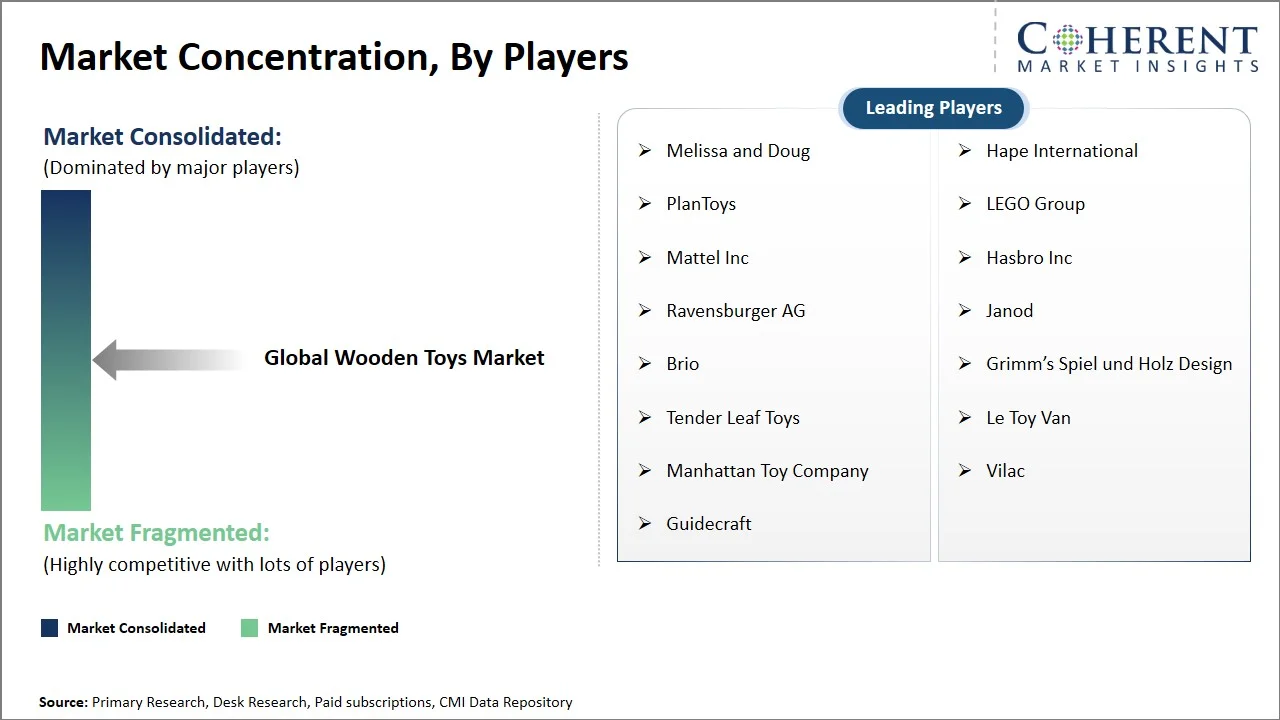
The global wooden toys market is moderately fragmented, with competition spread across global toy companies, specialty wooden toy brands, regional manufacturers, private-label suppliers, and online-first brands. Companies compete on product safety, design quality, sustainability claims, price, distribution access, educational value, and compliance readiness. Premium brands focus on certified wood, better finishes, and developmental benefits, while mass-market players compete through scale, affordability, and wider retail reach.
Key focus areas include
- Product quality and differentiation through durable wood, smooth finishing, and age-specific designs
- Technology adoption for CNC cutting, laser detailing, coating precision, and rapid prototyping
- Pricing and cost competitiveness, especially against low-cost plastic and mass-market toys
- Capacity expansion and supply reliability for seasonal demand and export orders
- Certifications, compliance, and quality control across ASTM, EN, BIS, and other safety standards
- Distribution network expansion through specialty toy stores, online retail, supermarkets, and D2C channels
- Product format differentiation through Montessori toys, puzzles, pretend-play sets, blocks, and ride-ons
- Sustainable positioning through certified wood, recyclable packaging, non-toxic coatings, and long-life design
Competitive Landscape Table
Company | Headquarters | Key Wooden Toys Brands / Lines | Primary Market Segment |
Melissa & Doug | Wilton, Connecticut, U.S. | Melissa & Doug wooden puzzles, pretend-play sets, Blockables, wooden learning toys | Educational and learning toys; puzzles; pretend play |
Hape International | Lucerne, Switzerland / Global operations | Hape wooden toys, Quadrilla, railway sets, kitchen sets, early developmental toys | Educational toys; baby and toddler toys; wooden construction and role play |
PlanToys | Bangkok, Thailand | PlanToys, PlanWood, PlanSpaces, sustainable rubberwood toys | Sustainable wooden toys; pretend play; early learning |
LEGO Group | Billund, Denmark | Historic LEGO wooden toys; currently mainly LEGO construction systems | Construction toys and building systems; limited current wooden toy relevance |
Mattel Inc. | El Segundo, California, U.S. | Fisher-Price Wood | Infant and toddler wooden toys; early learning; premium developmental toys |
Hasbro Inc. | Pawtucket, Rhode Island, U.S.; moving headquarters to Boston by end-2026 | Limited dedicated wooden toy portfolio; broader Playskool/Hasbro preschool and creative play brands | Preschool toys; creative play; broader toy and game portfolio |
Ravensburger AG | Ravensburg, Germany | Ravensburger puzzles and games; BRIO under Ravensburger Group | Puzzles, games, and preschool play |
Janod | Orgelet / Jura, France | Janod wooden and cardboard toys, puzzles, pretend-play toys, ride-ons | Wooden educational toys; puzzles; pretend play |
BRIO | Malmö, Sweden | BRIO World, wooden railway sets, wooden trains, tracks, vehicles | Wooden railway toys; construction play; preschool vehicles |
Grimm’s Spiel und Holz Design | Hochdorf, Germany | Grimm’s wooden blocks, stacking rainbows, puzzles, Waldorf-inspired toys | Open-ended play; Waldorf/Montessori-style wooden toys |
Tender Leaf Toys | San Gabriel, California, U.S.; designed in England/manufactured in Indonesia | Tender Leaf Toys wooden role-play sets, dollhouses, furniture, early learning toys | Sustainable wooden pretend play; dolls and learning toys |
Le Toy Van | Ascot, Berkshire, U.K. | Le Toy Van wooden dollhouses, role-play food sets, vehicles, educational toys | Premium wooden pretend play; dollhouses; vehicles |
Manhattan Toy Company | Minneapolis, Minnesota, U.S. | Manhattan Toy wooden baby toys, Skwish, wooden activity toys | Infant and toddler toys; sensory and developmental wooden toys |
Vilac | Moirans-en-Montagne, Jura, France | Vilac wooden ride-ons, puzzles, games, cars, early learning toys | Traditional wooden toys; ride-ons; puzzles and games |
Guidecraft | Tuxedo Park, New York, U.S. | Guidecraft wooden blocks, STEM toys, unit blocks, educational toys | Educational wooden toys; STEM; preschool and classroom play |
Market Report Scope
Wooden Toys Market Report Coverage
| Report Coverage | Details | ||
|---|---|---|---|
| Base Year: | 2025 | Market Size in 2026: | USD 31.42 Bn |
| Historical Data for: | 2020 To 2024 | Forecast Period: | 2026 To 2033 |
| Forecast Period 2026 to 2033 CAGR: | 6.7% | 2033 Value Projection: | USD 49.47 Bn |
| Geographies covered: |
| ||
| Segments covered: |
| ||
| Companies covered: | Melissa and Doug, Hape International, PlanToys, LEGO Group, Mattel Inc, Hasbro Inc, Ravensburger AG, Janod, Brio, Grimm’s Spiel und Holz Design, Tender Leaf Toys, Le Toy Van, Manhattan Toy Company, Vilac, and Guidecraft | ||
| Growth Drivers: |
| ||
| Restraints & Challenges: |
| ||
Analyst Opinion (Expert Opinion)
- The global wooden toys market is likely to move beyond traditional toy replacement demand and evolve into a premium “purposeful play” category over the forecast period. Future growth will be shaped by how effectively brands combine child-development value, sustainable material storytelling, and modern design aesthetics. Companies that can position wooden toys as long-lasting learning assets rather than occasional play products are expected to gain stronger pricing power and customer loyalty.
- Transformative opportunities are expected to emerge from modular toy systems, Montessori-inspired formats, personalization, and licensed educational collections. These trends can shift the market from single-product purchases toward expandable play ecosystems, where parents buy add-on sets, themed kits, and age-progressive learning products. This will support higher repeat purchase potential and help wooden toy brands compete more effectively against plastic, electronic, and app-based toys.
- Key risks include high production costs, strict safety compliance, certified wood availability, and pricing pressure from plastic toys. Market players should focus on certified sourcing, non-toxic coatings, modular product design, digital retail visibility, and stronger compliance documentation to gain competitive advantage and improve acceptance across premium and export markets.
Speak to the analyst
Want personalized insights?
Take the findings above to one of our principal consultants, or have the report rebuilt around the segments, geographies and competitors you actually track.
Market Segmentation
- Product Type Insights (Revenue, USD Bn, 2021 - 2033)
- Educational and Learning Toys
- Building Blocks and Construction Sets
- Puzzles and Games
- Dolls and Pretend Play Toys
- Vehicles and Ride Ons
- Others
- Wood Type Insights (Revenue, USD Bn, 2021 - 2033)
- Hardwood
- Softwood
- Engineered Wood
- Bamboo and Other Sustainable Wood
- Age Group Insights (Revenue, USD Bn, 2021 - 2033)
- 0 to 3 Years
- 3 to 5 Years
- 6 to 8 Years
- Above 8 Years
- Distribution Channel Insights (Revenue, USD Bn, 2021 - 2033)
- Specialty Toy Stores
- Online Retail
- Supermarkets and Hypermarkets
- Department Stores
- Others
- Regional Insights (Revenue, USD Bn, 2021 - 2033)
- North America
- U.S.
- Canada
- Latin America
- Brazil
- Argentina
- Mexico
- Rest of Latin America
- Europe
- Germany
- U.K.
- Spain
- France
- Italy
- Russia
- Rest of Europe
- Asia Pacific
- China
- India
- Japan
- Australia
- South Korea
- ASEAN
- Rest of Asia Pacific
- Middle East
- GCC Countries
- Israel
- Rest of Middle East
- Africa
- South Africa
- North Africa
- Central Africa
- North America
- Key Players Insights
- Melissa and Doug
- Hape International
- PlanToys
- LEGO Group
- Mattel Inc
- Hasbro Inc
- Ravensburger AG
- Janod
- Brio
- Grimm’s Spiel und Holz Design
- Tender Leaf Toys
- Le Toy Van
- Manhattan Toy Company
- Vilac
- Guidecraft
Source
Primary Research Interviews
- Interviews were conducted with industry experts such as John Smith, Maria Lopez, and David Chen to gather insights for the current drafted content.
Company and Industry Sources Used
- Company websites, press releases, product pages, and official updates of Mattel / Fisher-Price, Melissa & Doug, PlanToys, Janod, Bigjigs Toys, Hape Toys, LEGO Group, Ravensburger AG, BRIO, Grimm’s Spiel und Holz Design, Tender Leaf Toys, Le Toy Van, Manhattan Toy Company, Vilac, and Guidecraft
- Official and credible company developments used for wooden toy product launches, premium wooden toy lines, sustainability commitments, educational toy positioning, brand validation, and competitive landscape mapping
- The Toy Association and Spielwarenmesse sources used for industry trend validation related to educational toys, wooden toys, natural-material toys, no-tech play, and toy retail direction
Government / Regulatory Sources Used
- U.S. Consumer Product Safety Commission for toy safety warnings, certificate requirements, and imported toy compliance guidance
- Federal Register for ASTM F963-23 mandatory toy safety standard adoption in the U.S.
- European Commission for EU Toy Safety Regulation, Safety Gate dangerous product alerts, and EU Deforestation Regulation implementation
- UK Government for Toys Safety Regulations 2011, UKCA/CE marking, manufacturer obligations, importer duties, and technical documentation requirements
- India Ministry of Commerce and Industry / PIB and DPIIT for toy manufacturing, toy exports, imports, quality control, and certification-related policy updates
Trade / Market Data Sources Used
- HKTDC sources used for Asian toy trade fair, international sourcing, and toy manufacturing ecosystem relevance
- Industry association and trade-fair sources used for toy category trends, buyer demand direction, and global wooden toy retail positioning
Proprietary Elements
- CMI Data Analytics Tool, Proprietary CMI Existing Repository of information for last 10 years.
Get access to 250+ pages report
Every segment, forecast, competitor profile and data table behind the analysis above — available for instant download.
- ESOMAR Member
- ISO 9001:2015 Certified
- D-U-N-S Registered
- GDPR & CCPA Compliant
Missing comfort of reading report in your local language? Find your preferred language:
Transform your Strategy with Exclusive Trending Reports
Frequently Asked Questions
The CAGR of the global wooden toys market is projected to be 6.7% from 2026 to 2033.
The global wooden toys market is estimated to be valued at USD 31.42 billion in 2026 and is expected to reach USD 49.47 billion by 2033.
The market includes wooden learning toys, blocks, puzzles, games, pretend-play sets, dolls, vehicles, ride-ons, and other child-development toys.
Montessori-style wooden toys are gaining demand as they support independent learning, sensory play, problem-solving, and motor skill development.
Sustainability is increasing demand for responsibly sourced wood, non-toxic paints, recyclable packaging, and durable toys with longer product life.
Key safety factors include smooth edges, non-toxic coatings, age-appropriate design, large parts for infants, and compliance with toy safety standards.
Preschools and daycare centers use wooden toys for hands-on learning, group activities, sensory development, and early education programs.