

Global Zinc Compounds Market Size and Forecast – 2026 To 2033
The global zinc compounds market is estimated to be valued at USD 10.64 Bn in 2026 and is expected to reach USD 15.17 Bn by 2033, exhibiting a compound annual growth rate (CAGR) of 5.2% from 2026 to 2033. This steady growth is supported by strong demand from the rubber and tire manufacturing, agriculture, pharmaceuticals, personal care, coatings, and chemical processing industries. Zinc oxide remains a key compound in rubber vulcanization and tire durability, while zinc sulfate is widely used as an agricultural micronutrient to improve crop nutrition and address zinc deficiency in soils.
Market expansion is also supported by regulatory acceptance of zinc oxide in sunscreen formulations and continued use of zinc compounds in fertilizers and specialty chemical applications. For instance, India’s National Food Security and Nutrition Mission FY 2025–26 guidelines include zinc sulphate under crop demonstration interventions, highlighting institutional support for agricultural zinc use. (Source: National Food Security and Nutrition Mission, Government of India)
Key Takeaways of the Global Zinc Compounds Market
- Industrial grade is expected to hold 55.2 % of the market share in 2026, anchoring zinc compounds demand across rubber, ceramics, paints, and industrial chemicals. The segment benefits from large-volume, performance-critical applications where purity and consistency matter. For instance, in April 2024, a study by the American Chemical Society (ACS) highlighted zinc oxide’s continued role as a tire vulcanization activator, reinforcing industrial-grade demand. (Source: ACS Sustainable Chemistry & Engineering)
- Zinc oxide is projected to account for 48.6 % of the market share in 2026, making it the leading compound type due to broad use in rubber, tires, ceramics, coatings, and personal care. In March 2025, Smithers emphasized zinc oxide’s essential role in tire manufacturing for strength, performance, and durability, supporting its commercial dominance. (Source: Smithers)
- Powder is expected to capture 58.4 % of the market share in 2026, supported by easier blending, dosing, and dispersion in rubber, paints, ceramics, fertilizers, and feed formulations. In July 2025, Arihant Reclamation Pvt. Ltd. (ARPL) highlighted bulk zinc oxide supply for tire compounders, paint producers, and ceramic users, reflecting powder’s strong industrial handling advantage. (Source: Arihant Reclamation Pvt. Ltd)
- Asia Pacific is expected to dominate with 42.5 % of the market share in 2026, supported by tire manufacturing, agriculture, ceramics, and specialty chemical production in China, India, Japan, and Southeast Asia. In September 2025, a ATMA–PwC report projected India’s tire industry production volume to expand nearly four times by 2047, strengthening regional zinc compound consumption. (Source: PwC India)
- North America is expected to hold 22.4 % of the market share in 2026 and remain the fastest-growing regional opportunity, supported by reshoring of mineral supply chains, tire demand, and specialty zinc applications.
- Micronutrient Fertilizer Expansion: Zinc compounds are gaining traction in agriculture as soil health, crop nutrition, and biofortification become commercial priorities. Zinc sulfate remains important due to its solubility and crop uptake efficiency.
- Energy Storage Opportunity: Zinc-based batteries are emerging as a specialty demand avenue for zinc chemistry, particularly where safety, recyclability, and lower critical-mineral dependence are valued. In April 2025, the Zinc Battery Initiative joined RECHARGE, the European rechargeable battery association, strengthening industry collaboration around commercialization and policy support for zinc battery technologies. (Source: The Zinc Battery Initiative (ZBI))
Segmental Insights
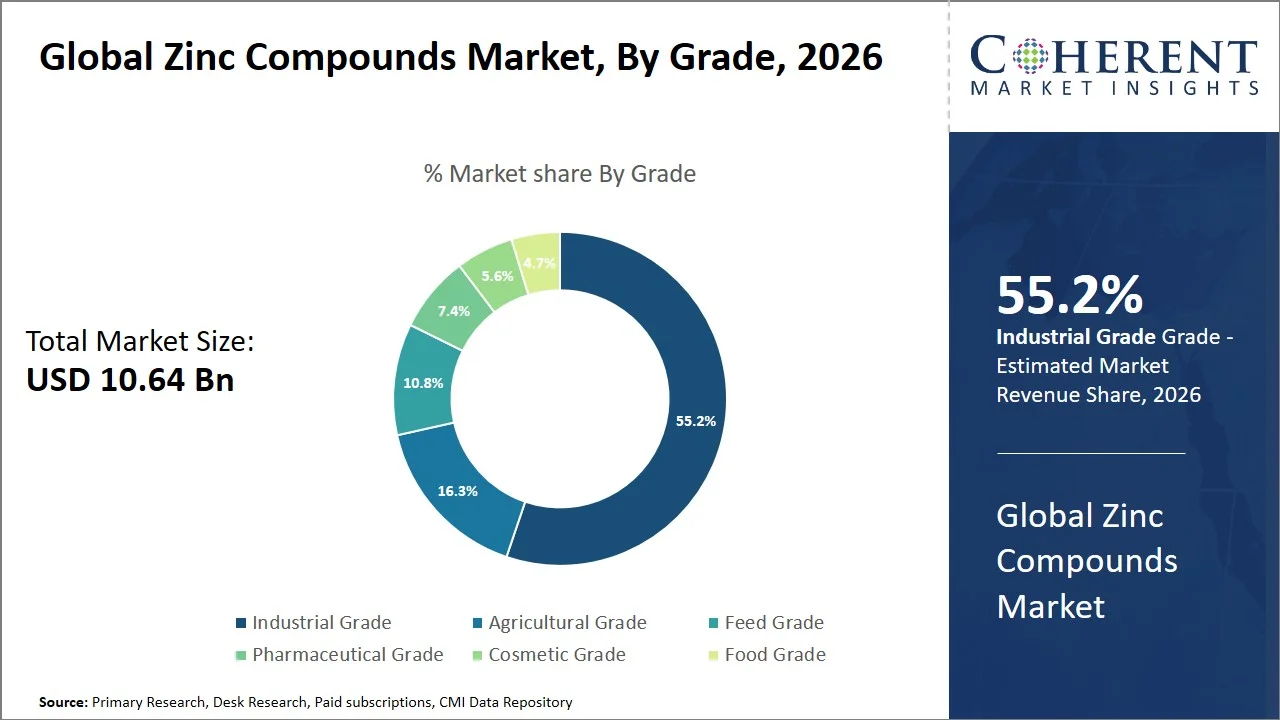
Why Does Industrial Grade Dominate the Global Zinc Compounds Market?
The industrial grade segment is expected to dominate with 55.2% share in 2026, mainly because large-volume industrial users need cost-efficient zinc chemistry with reliable functional performance rather than high-purity specialty grades. The segment is strongly linked to rubber processing, tire production, ceramics, glass, paints, coatings, and chemical intermediates, where zinc compounds support curing, opacity, thermal stability, corrosion resistance, and surface performance. Demand is also reinforced by automotive and infrastructure-linked consumption, especially in Asia. On the supply side, industrial-grade compounds are easier to scale through established zinc oxide, zinc sulfate, and zinc chloride production routes. For Instance, In November 2024, Bridgestone’s US$ 85 million investment in India to expand passenger tire production capacity from 2025, supporting industrial zinc compound demand in rubber applications (Source: Bridgestone Corporation)
- Current Industry Events of 2026
- Market Size Estimation
- Regional Breakdown
- Competitive Landscape
- Customer Intelligence
- Segmental Analysis
- Pricing Analysis
- Key Market Drivers, Challenges & Future Trends
- Customized Insights Section
Why Does Zinc Oxide Represent the Largest Compound Type Segment in the Zinc Compounds Market?
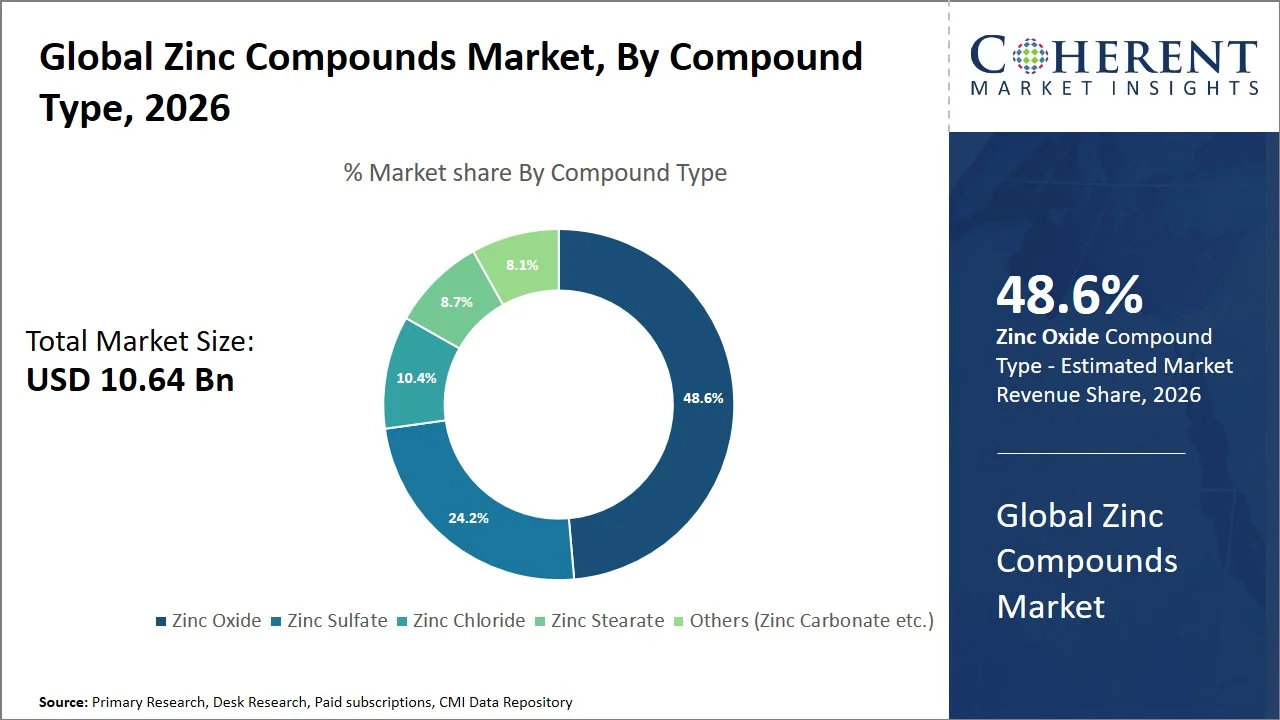
Zinc oxide is expected to lead the compound type segment with 48.6% share in 2026, as it serves multiple high-volume and high-value applications including rubber, ceramics, coatings, pharmaceuticals, cosmetics, chemicals, and batteries. Its dominance comes from its role as a functional additive rather than only a basic chemical input. In rubber and tire manufacturing, zinc oxide improves vulcanization performance and contributes to finished product strength, stability, and durability. In ceramics and coatings, it supports whiteness, opacity, gloss control, and thermal resistance. Supply-side advantages also support dominance, as both direct and indirect process grades are commercially available for different purity and particle-size requirements. EverZinc, for instance, highlights zinc oxide as essential in most rubber products and offers grades such as EPM, White Seal, and Red Seal for tire and rubber applications. (Source: EverZinc)
Why Does the Powder Form Dominate the Global Zinc Compounds Market?
Powder is expected to dominate with 58.4% share in 2026, as most zinc compound users prefer materials that can be accurately weighed, blended, dispersed, and processed in dry or semi-dry formulations. Powdered zinc compounds are especially relevant in rubber compounding, ceramic glazes, paints, coatings, fertilizers, animal feed premixes, and pharmaceutical formulations, where particle distribution directly affects product consistency. Demand-side preference comes from flexible packaging sizes, easier formulation control, and compatibility with batch processing. Supply-side factors include mature milling, calcination, drying, and particle-size control technologies, which allow producers to supply different grades for industrial and specialty users. A relevant instance is Advance ZincTek’s EcoZinc non-nano zinc oxide powder, produced using solar power and positioned for sunscreen and skincare formulations with controlled BET ranges. (Source: Advanced ZincTek)
Currents Events and their Impact
Current Events | Description and its Impact |
EU Updates Cosmetic Rules for Water-Soluble Zinc Salts (April–May 2026 onward) |
|
EU Revised CLP Regulation Strengthens Chemical Labeling Requirements (December 2024 onward) |
|
India Issues Refined Zinc Quality Control Order (April 2025 onward) |
|
U.S. FDA Maintains Zinc Oxide Relevance in Sunscreen Regulation (September 2025 onward) |
|
EU Publishes New Waste Battery Recycling Rules (July 2025 onward) |
|
(Source: European Commission, & U.S. FDA)
Global Zinc Compounds Market Dynamics
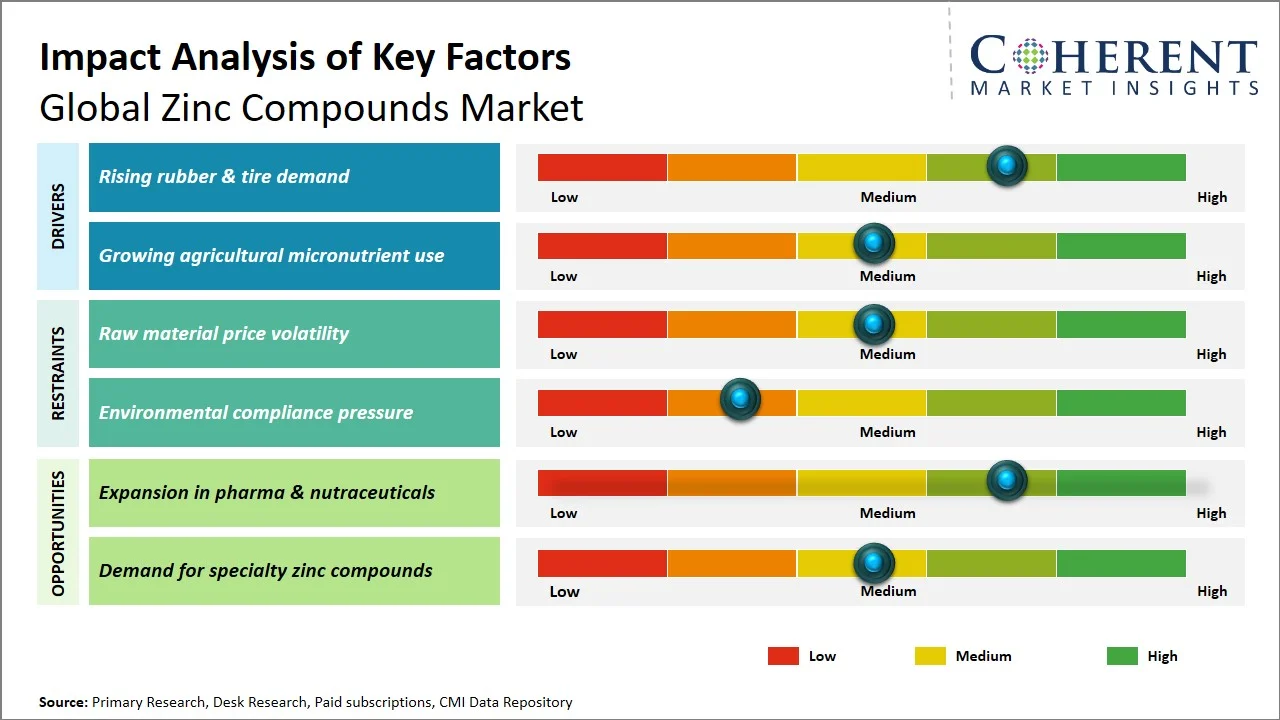
Market Drivers
- Rising Rubber & Tire Demand Strengthens Industrial Zinc Oxide Consumption: Zinc compounds, particularly zinc oxide, remain essential to rubber and tire production because they support vulcanization efficiency, tensile strength, heat resistance, and long-term tire durability. As tire manufacturers manage higher replacement demand, premium vehicle tires, EV-ready tire designs, and commercial mobility needs, zinc oxide consumption remains closely tied to rubber compounding volumes. This makes rubber and tire manufacturing the most commercially important demand pool for the zinc compounds market. For instance, in July 2025, the U.S. Tire Manufacturers Association forecasted growth in replacement tire shipments across passenger, light truck, and truck categories, signaling sustained demand for rubber compounds.
- Growing Agricultural Micronutrient Use Expands Zinc Sulfate Demand: Zinc compounds are gaining stronger relevance in agriculture as governments and growers focus on correcting micronutrient deficiencies, improving crop productivity, and supporting nutrient-dense food production. Zinc sulfate is especially important because it is widely used in soil application, foliar sprays, and crop demonstration programs where zinc deficiency affects cereal, pulse, and coarse grain yields. This supports recurring demand from fertilizer producers, agrochemical distributors, and government-backed crop nutrition initiatives. For instance, in April 2025, India’s National Food Security and Nutrition Mission operational guidelines for FY 2025–2026 include zinc sulphate 21% in crop demonstrations, reinforcing institutional demand for agricultural zinc inputs. (Source: Food Security Mission)
Emerging Trends
- Shift Toward High-Purity Zinc Compounds for Regulated End Uses: A key emerging trend in the zinc compounds market is the shift from commodity-grade materials toward high-purity, specification-driven zinc compounds used in cosmetics, pharmaceuticals, nutraceuticals, oral care, and personal care formulations. Buyers in these sectors increasingly require tighter impurity controls, stronger documentation, consistent particle size, and compliance with ingredient safety standards. This trend is improving the value proposition of pharmaceutical, cosmetic, and food-grade zinc compounds even though industrial grade remains the largest segment. Regulatory scrutiny around zinc oxide and zinc salts in sunscreens, oral care, and personal care products is pushing suppliers to improve quality assurance, traceability, and formulation support, especially for export-oriented customers. (Source: U.S. Food and Drug Administration)
- Zinc-Based Energy Storage Creates Specialty Growth Pathways: Zinc compounds are increasingly being evaluated in battery and energy storage applications because zinc offers advantages related to material availability, safety profile, recyclability, and lower dependence on critical battery metals. This trend is creating new opportunities for battery-grade zinc chemicals, advanced zinc oxide, zinc salts, and related specialty inputs used in zinc-air, zinc-ion, and aqueous zinc battery systems. Although this remains smaller than rubber, agriculture, and coatings applications, it can support premium pricing and technical collaboration between material suppliers, battery developers, and energy storage integrators. The trend is commercially important because it positions zinc compounds beyond traditional industrial uses and links the market to long-term grid storage and clean energy investment themes. (Source: Zinc Battery Initiative)
Regional Insights
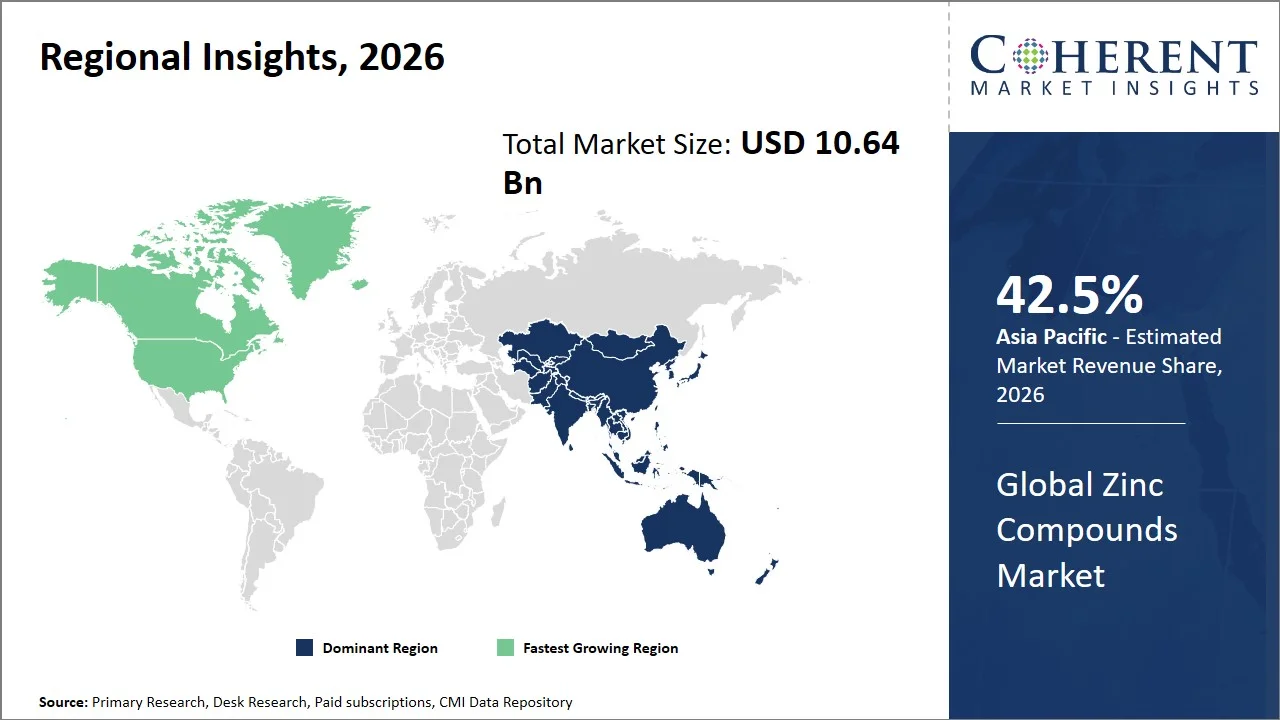
Why Does Asia Pacific Dominate the Global Zinc Compounds Market?
Asia Pacific is expected to dominate the global zinc compounds market with 42.5% share in 2026, supported by its large tire manufacturing base, strong ceramics and glass production, expanding agriculture sector, and rising industrial chemical consumption. China, India, and Japan remain key demand centers for zinc oxide, zinc sulfate, and other zinc-based compounds used in rubber vulcanization, fertilizers, coatings, feed additives, and specialty formulations. The region also benefits from cost-competitive manufacturing, established zinc processing capacity, and strong downstream demand from automotive and construction industries. A recent instance is Bridgestone India’s US$ 85 million investment announced in November 2024 to expand capacity at Pune and Indore plants, with expansion scheduled from 2025, supporting zinc oxide demand in tire manufacturing.
Why is North America Emerging as the Fastest-Growing Region in the Zinc Compounds Market?
North America is expected to be the fastest-growing region, with 22.4% share in 2026, supported by strengthening automotive manufacturing, EV tire production, infrastructure maintenance, specialty chemicals, and reshoring of critical mineral supply chains. Zinc compounds are gaining relevance in tire rubber, coatings, corrosion protection, agriculture micronutrients, and advanced energy storage applications. The region’s growth is also supported by investment in cleaner manufacturing and domestic industrial supply security. A recent example is Goodyear’s more than USD 411.46 million investments in its Napanee, Ontario facility to modernize production and expand capacity for EV and all-terrain tires, strengthening regional rubber and zinc oxide consumption. (Source: The Goodyear Tire & Rubber Company)
Global Zinc Compounds Market Outlook for Key Countries
Why is China Emerging as a Key Manufacturing Hub for the Zinc Compounds Market?
China is a critical country in the zinc compounds market due to its large-scale tire, rubber, ceramics, coatings, and chemical manufacturing ecosystem. Zinc oxide demand is closely linked to rubber vulcanization, while zinc sulfate and other zinc compounds serve agriculture, feed, and industrial processing applications. China’s dominance is reinforced by integrated manufacturing clusters, export-oriented tire production, and strong availability of downstream industrial customers. The country also remains important for global zinc supply balancing, as local refined zinc and downstream compound demand influence international trade flows. A recent instance is the China International Tyre Industry Conference 2025, which highlighted that China’s rubber tire casing output reached 1.17 billion units in 2024, showing the scale of zinc oxide-linked tire demand.
Why is the U.S. Leading Innovation and Specialty Adoption in the Zinc Compounds Market?
The U.S. is important in the zinc compounds market because of its advanced rubber, coatings, agriculture, defense, electronics, and specialty chemical industries. Demand is supported by tire manufacturing, corrosion-control chemicals, feed and fertilizer micronutrients, and growing interest in zinc-based energy and semiconductor-adjacent materials. The country is also prioritizing domestic processing to reduce exposure to imported refined zinc and strategic mineral supply risks. For instance, in December 2025, Korea Zinc’s decision to select Tennessee for its first U.S. operations, announcing a US$ 6.6 billion investment across Clarksville and Gordonsville, with 740 jobs and a major non-ferrous metals processing project. This strengthens domestic zinc and related mineral supply resilience. (Source: Korea Zinc)
Is Japan a Favorable Market for High-Value Zinc Compounds?
Japan plays an important role in the zinc compounds market through high-value applications in advanced materials, automotive components, electronics, batteries, rubber, coatings, and personal care formulations. While Japan is not the largest volume producer, it has strong relevance in technology-led zinc applications where purity, particle control, safety, and performance are important. Zinc oxide demand is supported by tires, ceramics, cosmetics, and electronics, while zinc-air and zinc-based storage systems are creating new specialty opportunities. A recent instance is Sharp’s October 2025 memorandum of understanding with Australia’s ESI to collaborate on zinc-air flow battery technology. Sharp stated that the technology uses abundant, inexpensive zinc as an energy storage material, highlighting Japan’s innovation role in advanced zinc applications. (Source: Sharp Corporation)
Is India Emerging as a High-Growth Hub for the Zinc Compounds Market?
India is a key country in the zinc compounds market because of its growing tire industry, expanding agriculture micronutrient demand, large rubber-processing base, and rising domestic chemical manufacturing capacity. Zinc oxide consumption is supported by tires, rubber goods, paints, ceramics, and pharmaceuticals, while zinc sulfate remains relevant in correcting zinc deficiency in crops. India is also emerging in zinc-based battery research, which can create longer-term specialty demand. A recent instance is the Government of India’s November 2025 announcement that Bengaluru-based scientists developed a cathode material for zinc-ion batteries, improving energy density and cycle stability. This supports India’s positioning beyond traditional rubber and fertilizer uses into advanced zinc chemistry. (Source: Press Information Bureau)
Is Saudi Arabia Becoming a New Manufacturing Opportunity for the Zinc Compounds Market?
Saudi Arabia is gaining importance in the zinc compounds market as it builds local automotive, tire, mining, and industrial manufacturing capacity under its diversification agenda. Zinc oxide demand is expected to benefit from tire manufacturing, rubber processing, coatings, construction materials, and industrial chemicals. The country’s relevance is also supported by investments in mineral development and downstream manufacturing, reducing dependence on imports over time. A recent instance is the PIF–Pirelli joint venture announced to establish a tire manufacturing facility in Saudi Arabia, with total investment of around US$ 550 million and production expected to start in 2026. This directly supports future domestic zinc oxide use in tire rubber formulations. (Source: Pirelli & C. S.p.A)
Technology Adoption Landscape – Global Zinc Compounds Market
Technology | Key Features | Clinical / Application Advantage | Market Relevance |
Direct & Indirect Zinc Oxide Production | Scalable production, consistent purity, suitable for bulk industrial output | Improves rubber vulcanization, tire durability, ceramic brightness, and coating performance | Supports zinc oxide dominance across rubber, tire, ceramics, paints, and industrial applications |
Wet-Chemical Zinc Oxide Processing | Better particle-size control, higher surface area, improved reactivity | Enhances performance in specialty rubber, cosmetics, pharma, and high-performance coatings | Helps suppliers shift from commodity zinc oxide to value-added specialty grades |
Particle Size Control & Surface Treatment | Micronization, coating, dispersion control, improved stability | Supports better UV protection, opacity, smooth texture, and uniform blending | Important for sunscreens, cosmetics, coatings, plastics, and premium powder applications |
Granulation Technology for Zinc Fertilizers | Improved flowability, controlled nutrient delivery, easier blending with NPK fertilizers | Enhances zinc availability in soil and supports crop yield improvement | Strengthens agricultural-grade zinc sulfate and zinc oxide demand |
High-Purity Zinc Salt Processing | Low impurity levels, controlled composition, regulatory-grade quality | Supports safe use in oral care, nutraceuticals, pharmaceuticals, and personal care products | Expands demand for cosmetic, pharmaceutical, food, and feed-grade zinc compounds |
Digital Quality Control & Traceability Systems | Batch tracking, SDS management, compliance documentation, impurity monitoring | Improves product safety, consistency, and regulatory acceptance | Supports export readiness and supplier preference in regulated markets |
Secondary Zinc Recovery & Recycling | Uses recycled zinc-bearing residues, reduces raw material dependence | Improves sustainability and supply security for industrial zinc compounds | Supports circular economy positioning and cost resilience |
Battery-Grade Zinc Chemistry | High-purity zinc salts and zinc-based materials for energy storage | Enables safer, recyclable, and lower-cost zinc battery systems | Creates emerging growth opportunity beyond traditional rubber, fertilizer, and coatings uses |
How are technological advancements in zinc-based applications creating new growth opportunities in the global zinc compounds market?
Technological advancements in battery-grade zinc chemistry, engineered zinc oxide, and high-purity zinc salts are creating new growth opportunities in the global zinc compounds market. Traditionally, demand has been concentrated in rubber, tires, fertilizers, coatings, and ceramics; however, advanced applications such as zinc-ion batteries, zinc-air batteries, specialty cosmetics, pharmaceuticals, and high-performance coatings are increasing the value potential of zinc compounds. Innovation in cathode materials, particle-size control, and purity enhancement is supporting better energy density, stability, dispersion, and end-use performance. This is expected to expand demand for specialty zinc oxide, zinc salts, and battery-grade zinc compounds beyond conventional industrial uses. For instance, in February 2026, India’s Department of Science & Technology reported that scientists developed a novel cathode material that enhances the performance and stability of aqueous zinc-ion batteries for grid storage. The development highlights how zinc-based technologies are moving toward higher-value clean energy applications. (Source: Department of Science & Technology (DST))
Market Players, Key Development, and Competitive Intelligence
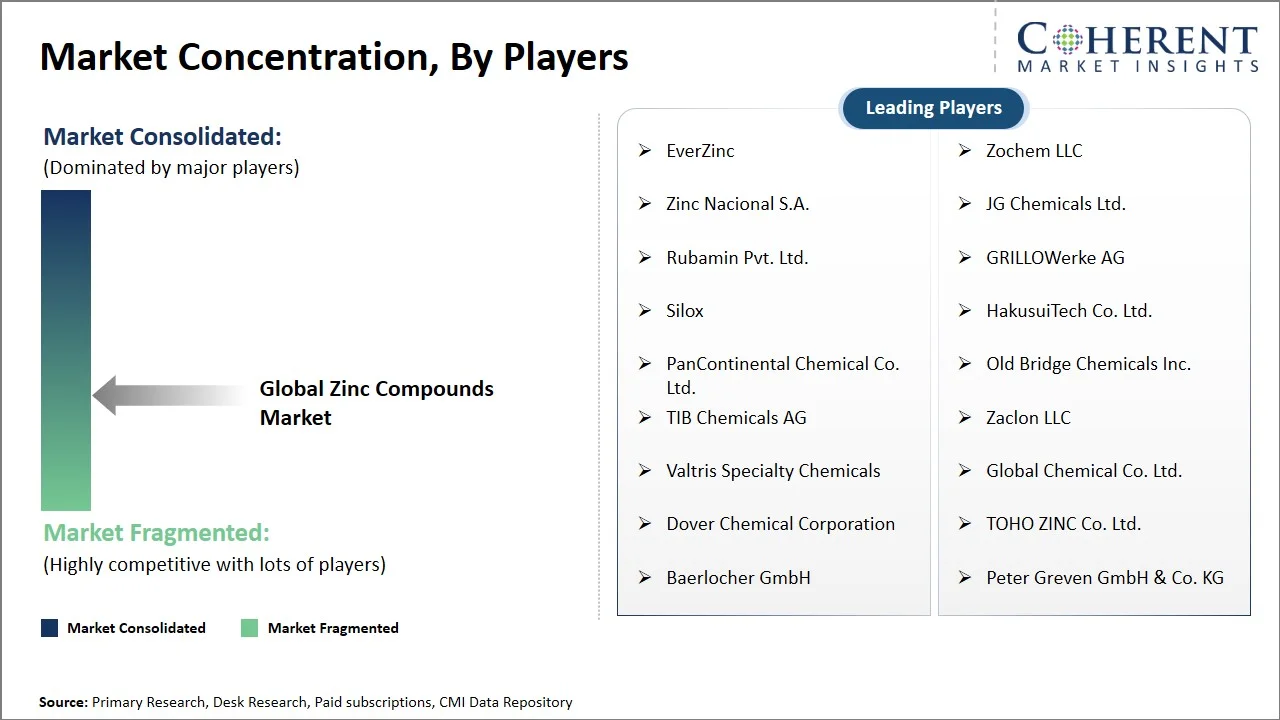
Key Developments
- In December 2025, EverZinc completed its acquisition by affiliates of Cerberus Capital Management. The transaction is expected to support EverZinc’s future growth, innovation roadmap, and specialty zinc product portfolio, including zinc oxides, zinc powders, and Zano ultrafine zinc oxide.
- In January 2025, following the September 2024 fire at its zinc sulphate plant, GRILLO began partial commissioning of a new incinerator and modernized sulphur dioxide plant. However, the older zinc sulphate-related production lines remained unavailable during the recovery and restart phase.
Competitive Landscape
The global zinc compounds market is moderately fragmented, with competition spread across integrated zinc producers, zinc oxide manufacturers, zinc sulfate producers, specialty zinc chemical suppliers, and recycling-based zinc recovery companies. Competition is largely based on product purity, grade consistency, particle-size control, regulatory compliance, application-specific formulation support, feedstock security, and regional supply reliability. Key companies are strengthening their portfolios across zinc oxide, zinc sulfate, zinc powders, high-purity zinc salts, cosmetic-grade zinc oxide, feed-grade zinc compounds, and battery-grade zinc materials.
Key focus areas include
- Specialty zinc compounds: Development of high-purity zinc compounds for cosmetics, pharma, oral care, and personal care applications.
- Application-specific zinc oxide grades: Expansion of zinc oxide grades for rubber, tires, ceramics, coatings, and specialty chemicals.
- Agricultural zinc portfolios: Strengthening zinc sulfate and agricultural-grade products for fertilizers, feed, mining, and water treatment.
- Recycling and zinc recovery: Adoption of secondary zinc recovery to improve raw material security and circular economy positioning.
- Battery-grade zinc materials: Focus on zinc powders and zinc compounds for zinc-based batteries and energy storage.
- Regulatory compliance: Greater emphasis on traceability, safety documentation, and export-ready compliance standards.
Market Report Scope
Zinc Compounds Market Report Coverage
| Report Coverage | Details | ||
|---|---|---|---|
| Base Year: | 2025 | Market Size in 2026: | USD 10.64 Bn |
| Historical Data for: | 2020 To 2024 | Forecast Period: | 2026 To 2033 |
| Forecast Period 2026 to 2033 CAGR: | 5.2% | 2033 Value Projection: | USD 15.17 Bn |
| Geographies covered: |
| ||
| Segments covered: |
| ||
| Companies covered: | EverZinc, Zochem LLC, Zinc Nacional S.A., JG Chemicals Ltd., Rubamin Pvt. Ltd., GRILLOWerke AG, Silox, HakusuiTech Co. Ltd., PanContinental Chemical Co. Ltd., Old Bridge Chemicals Inc., TIB Chemicals AG, Zaclon LLC, Valtris Specialty Chemicals, Global Chemical Co. Ltd., Dover Chemical Corporation, TOHO ZINC Co. Ltd., Baerlocher GmbH, and Peter Greven GmbH & Co. KG | ||
| Growth Drivers: |
| ||
| Restraints & Challenges: |
| ||
Analyst Opinion (Expert Opinion)
- The global zinc compounds market is expected to witness steady long-term growth due to sustained demand from rubber and tire manufacturing, agriculture micronutrients, paints and coatings, ceramics, animal feed, and personal care applications. Zinc oxide will remain the core volume driver, while zinc sulfate demand is expected to gain support from crop nutrition and fertilizer programs.
- The highest near-term opportunities are likely to remain in Asia Pacific, where China, India, and Japan have strong industrial bases across tires, ceramics, coatings, agriculture, and specialty chemicals. North America is expected to create faster growth opportunities through specialty zinc compounds, battery-grade zinc materials, regulated personal care formulations, and domestic supply-chain strengthening.
- To gain a competitive advantage, market participants should focus on high-purity zinc compounds, application-specific zinc oxide grades, agricultural-grade zinc sulfate, recycling-based zinc recovery, and battery-grade zinc materials. Companies with strong technical support, consistent product quality, regulatory documentation, and secure zinc feedstock access are expected to strengthen their position in the global market.
Speak to the analyst
Want personalized insights?
Take the findings above to one of our principal consultants, or have the report rebuilt around the segments, geographies and competitors you actually track.
Market Segmentation
- Grade Insights (Revenue, USD Bn, 2021 - 2033)
- Industrial Grade
- Agricultural Grade
- Feed Grade
- Pharmaceutical Grade
- Cosmetic Grade
- Food Grade
- Compound Type Insights (Revenue, USD Bn, 2021 - 2033)
- Zinc Oxide
- Zinc Sulfate
- Zinc Chloride
- Zinc Stearate
- Others (Zinc Carbonate etc.)
- Form Insights (Revenue, USD Bn, 2021 - 2033)
- Powder
- Granules
- Liquid
- Others
- End-use Application Insights (Revenue, USD Bn, 2021 - 2033)
- Rubber & Tire Manufacturing
- Agriculture & Fertilizers
- Animal Feed & Nutrition
- Paints Coatings & Pigments
- Ceramics & Glass
- Pharmaceuticals & Nutraceuticals
- Others
- Sales Channel Insights (Revenue, USD Bn, 2021 - 2033)
- Direct Sales
- Indirect Sales
- Regional Insights (Revenue, USD Bn, 2021 - 2033)
- North America
- U.S.
- Canada
- Latin America
- Brazil
- Argentina
- Mexico
- Rest of Latin America
- Europe
- Germany
- U.K.
- Spain
- France
- Italy
- Russia
- Rest of Europe
- Asia Pacific
- China
- India
- Japan
- Australia
- South Korea
- ASEAN
- Rest of Asia Pacific
- Middle East
- GCC Countries
- Israel
- Rest of Middle East
- Africa
- South Africa
- North Africa
- Central Africa
- North America
- Key Players Insights
- EverZinc
- Zochem LLC
- Zinc Nacional S.A.
- JG Chemicals Ltd.
- Rubamin Pvt. Ltd.
- GRILLOWerke AG
- Silox
- HakusuiTech Co. Ltd.
- PanContinental Chemical Co. Ltd.
- Old Bridge Chemicals Inc.
- TIB Chemicals AG
- Zaclon LLC
- Valtris Specialty Chemicals
- Global Chemical Co. Ltd.
- Dover Chemical Corporation
- TOHO ZINC Co. Ltd.
- Baerlocher GmbH
- Peter Greven GmbH & Co. KG
Sources
Primary Research Interviews
- Zinc oxide, zinc sulfate, zinc chloride, and zinc stearate manufacturers
- Specialty zinc compound producers and technical formulation experts
- Rubber and tire compounders using zinc oxide in vulcanization processes
- Fertilizer and micronutrient manufacturers using zinc sulfate and zinc oxide
- Animal feed and nutrition companies using feed-grade zinc compounds
- Paints, coatings, pigments, ceramics, and glass manufacturers
- Cosmetic, pharmaceutical, nutraceutical, and oral care formulation specialists
- Refined zinc suppliers, zinc recyclers, and secondary zinc recovery companies
- Chemical distributors, traders, and technical service providers dealing in zinc compounds
- Regulatory, quality assurance, and compliance professionals from specialty chemical companies
Stakeholders
- Zinc compound manufacturers and specialty chemical producers
- Refined zinc producers, smelters, and zinc recyclers
- Zinc oxide and zinc sulfate producers
- Specialty chemical distributors and industrial raw material suppliers
- Fertilizer, feed, rubber, coatings, cosmetics, and pharmaceutical formulation companies
- End-use Sectors
- Rubber and tire manufacturing companies
- Agriculture and fertilizer manufacturers
- Animal feed and nutrition companies
- Paints, coatings, and pigment manufacturers
- Ceramics and glass manufacturers
- Pharmaceutical and nutraceutical companies
- Cosmetics, sunscreen, and oral care product manufacturers
- Battery and energy storage material developers
- Industrial chemical and specialty formulation companies
Regulatory & Industry Bodies
- U.S. Environmental Protection Agency (EPA)
- U.S. Food and Drug Administration (FDA)
- European Chemicals Agency (ECHA)
- European Commission – REACH, CLP, and Cosmetics Regulation
- Bureau of Indian Standards (BIS)
- Ministry of Mines, Government of India
- Central Insecticides Board and Registration Committee (CIBRC), India
- Food Safety and Standards Authority of India (FSSAI)
- European Food Safety Authority (EFSA)
- China Ministry of Industry and Information Technology (MIIT)
- National Medical Products Administration (NMPA), China
- Ministry of Agriculture and Farmers Welfare, India
Databases
- UN Comtrade Database
- World Bank Commodity Markets Database
- International Lead and Zinc Study Group (ILZSG) Statistics
- U.S. Geological Survey (USGS) Mineral Commodity Summaries
- European Chemicals Agency (ECHA) Substance Database
- FDA Inactive Ingredient Database
- OECD Chemical Safety Database
- India Import Export Data / DGFT Trade Statistics
- FAOSTAT Fertilizer and Agriculture Database
- World Integrated Trade Solution (WITS) Database
Magazines
- Chemical & Engineering News
- Chemical Week
- Rubber News
- European Rubber Journal
- Coatings World
- Paint & Coatings Industry Magazine
- Fertilizer International
- Industrial Minerals
- Specialty Chemicals Magazine
- Cosmetics & Toiletries
Journals
- Journal of Industrial and Engineering Chemistry
- Journal of Rubber Research
- Rubber Chemistry and Technology
- Journal of Cleaner Production
- Materials Today Chemistry
- ACS Applied Materials & Interfaces
- Journal of Agricultural and Food Chemistry
- Agronomy Journal
- Journal of Trace Elements in Medicine and Biology
- International Journal of Cosmetic Science
Newspapers
- The Economic Times
Associations
- International Zinc Association (IZA)
- International Lead and Zinc Study Group (ILZSG)
- U.S. Tire Manufacturers Association (USTMA)
- Automotive Tyre Manufacturers’ Association (ATMA), India
- European Tyre and Rubber Manufacturers’ Association (ETRMA)
- The Fertilizer Association of India (FAI)
- International Fertilizer Association (IFA)
- American Coatings Association (ACA)
- European Chemical Industry Council (Cefic)
- Personal Care Products Council
Public Domain Sources
- U.S. Geological Survey (USGS) – Zinc Mineral Commodity Summaries
- U.S. EPA – Chemical Safety and Hazard Communication Information
- U.S. FDA – Sunscreen, Food, Pharmaceutical, and Cosmetic Ingredient Regulations
- European Commission – REACH, CLP, Cosmetics, and Battery Regulations
- ECHA – Zinc Oxide and Zinc Compound Classification Data
- Government of India – Ministry of Mines and BIS Quality Control Orders
- FAO – Agriculture, Fertilizer, and Micronutrient Use Data
- World Bank – Industrial, Agriculture, and Trade Indicators
- UN Comtrade – Zinc Compound Trade Data
- OECD – Chemical Safety and Environmental Policy Data
Proprietary Elements
- CMI Data Analytics Tool, Proprietary CMI Existing Repository of information for last 10 years.
Get access to 250+ pages report
Every segment, forecast, competitor profile and data table behind the analysis above — available for instant download.
- ESOMAR Member
- ISO 9001:2015 Certified
- D-U-N-S Registered
- GDPR & CCPA Compliant
Missing comfort of reading report in your local language? Find your preferred language:
Transform your Strategy with Exclusive Trending Reports
Frequently Asked Questions
The CAGR of the global zinc compounds market is projected to be 5.2% from 2026 to 2033.
The global zinc compounds market is estimated to be valued at USD 10.64 billion in 2026 and is expected to reach USD 15.17 billion by 2033
China is the largest producer in the zinc compounds value chain, supported by leading zinc mine and refined zinc output.
Yes, the zinc compounds market is profitable due to steady demand from rubber, fertilizers, coatings, feed, and specialty applications.
Rising rubber & tire demand and growing agricultural micronutrient use are the major factors driving the growth of the global zinc compounds market.
Raw material price volatility and environmental compliance pressure are the major factors hampering the growth of the global zinc compounds market.
In terms of grade, industrial grade is estimated to dominate the market revenue share in 2026.