Discount sale is live
all report title image

Digital Health Market Analysis & Forecast: 2025-2032

Digital Health Market, By Technology (Telehealthcare, mHealth, Health Analytics, Digital Health Systems, Telemedicine, and Others), By Component (Software, Hardware, Services, Connected Devices, and Others), By End User (Hospitals & Clinics and Health Insurance Firms), By Region (North America, Europe, Asia Pacific, Latin America, Middle East, and Africa)

  • Published In : 04 Jul, 2025
  • Code : CMI1909
  • Pages :150
  • Formats :
      Excel and PDF
  • Industry : Healthcare IT
  • Historical Range: 2020 - 2024
  • Forecast Period: 2025 - 2032

Digital Health Market Size and Forecast 

Digital Health Market is estimated to be valued at USD 350.42 Bn in 2025 and is expected to reach USD 1,143.01 Bn in 2032, exhibiting a compound annual growth rate (CAGR) of 18.4% from 2025 to 2032.

Key Takeaways

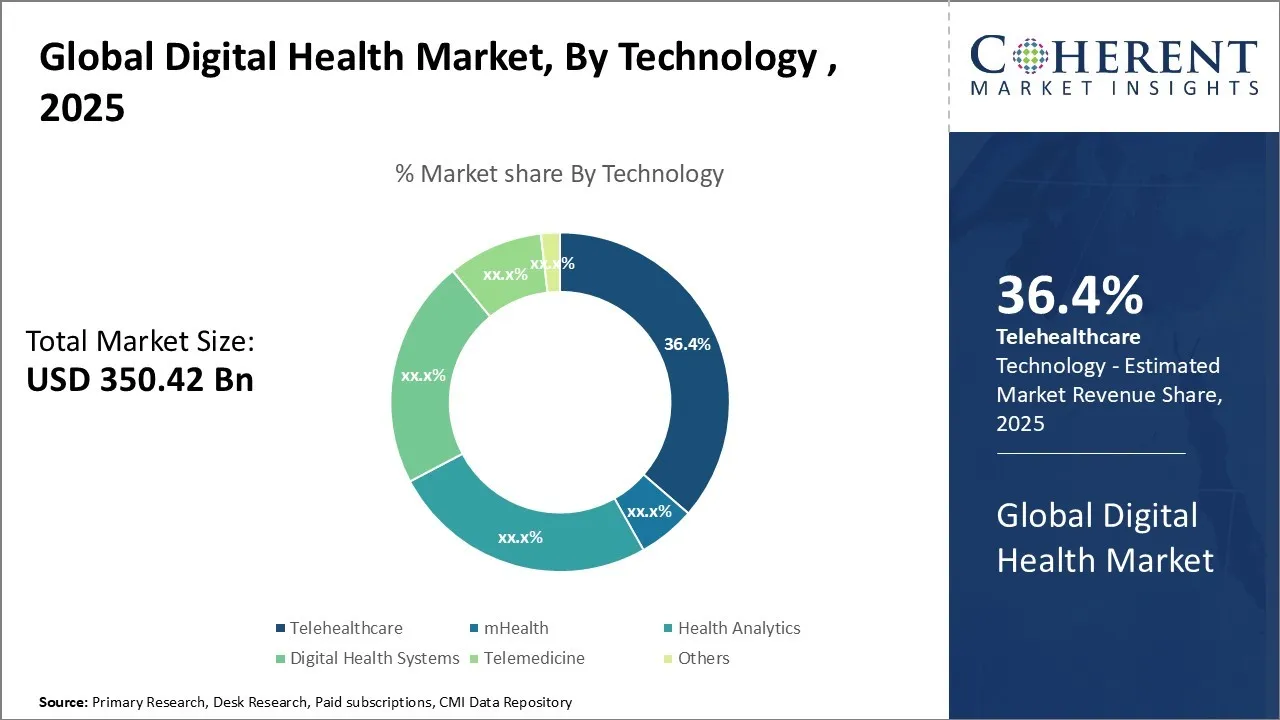
  • By Technology, Telehealthcare acquired the prominent share of in 2025 owing to the rising prevalence of chronic diseases.
  • By Component, Software holds the largest market share in 2025 owing to its growing demand for data-driven healthcare.
  • By End User, Hospital & Clinics dominates the overall market in 2025 owing to its need for enhanced patient care and outcomes.
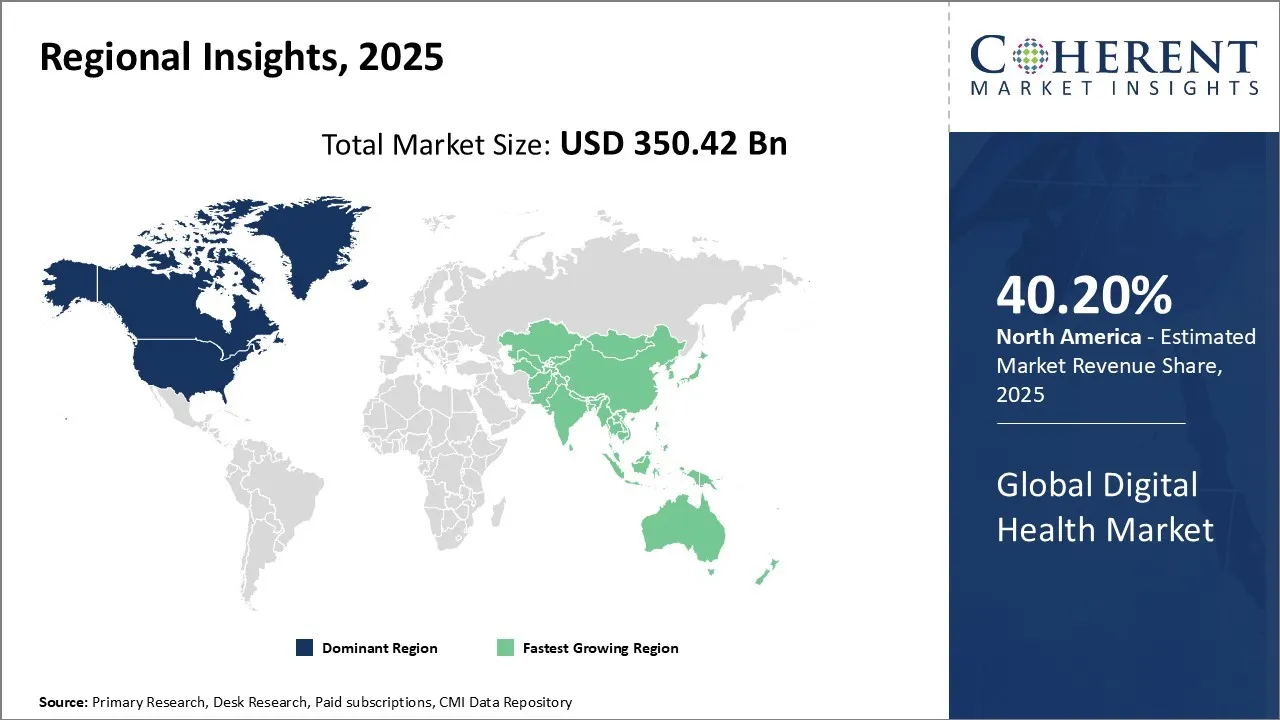
  • By Region, North America dominates the overall market in 2025 owing to its rising burden of chronic disease & aging population.

Market Overview

Technology and healthcare are converging to rapidly transform the digital health market. Companies and providers are actively deploying innovations like telemedicine, mobile health apps, wearable devices, and AI-driven platforms to revolutionize how care is delivered, monitored, and managed. Patients increasingly seek remote consultations, real-time health tracking, and personalized, data-driven care. Additionally, governments continue to implement supportive policies, while rising healthcare costs and chronic disease cas es push hospitals, clinics, and home care providers to accelerate their adoption of digital health solutions worldwide.

Current Events and their Impact on the Digital Health Market

Current Events

Description and its impact

U.S. Telehealth Policy Shifts

  • Description: Expiration of Temporary Telehealth Waivers
  • Impact: Reduced patient access to virtual care, declining telehealth adoption, and revenue losses for providers if waivers lapse without replacement.
  • Description: Congressional Spending Bill Extension
  • Impact: Sustained Medicare reimbursement flexibility, enabling continued investment in telehealth infrastructure and service expansion.

European Health Data Space (EHDS) Implementation

  • Description: Mandatory National Digital Health Authority Appointments
  • Impact: Accelerated standardization of EHR systems, boosting interoperability and cross-border health data exchange.
  • Description: EU-Wide Electronic Health Record Adoption
  • Impact: Increased demand for interoperable health tech solutions, creating opportunities for AI-driven diagnostics and data analytics.

Emerging Market Digital Health Expansions

  • Description: India’s Ayushman Bharat AI Integration
  • Impact: Scalable telemedicine adoption and EHR-linked AI tools, expanding access to 740M+ ABHA ID holders and fueling market growth.
  • Description: China’s Cross-Border Health Data Regulations
  • Impact: Restricted international data sharing, complicating global health collaborations while strengthening domestic data governance.

Uncover macros and micros vetted on 75+ parameters: Get instant access to report

Role of Artificial Intelligence (AI) in the Digital Health Market

Artificial Intelligence (AI) is transforming the digital health industry by enabling faster, more accurate diagnoses, predictive analytics, and personalized treatment plans. AI algorithms actively analyze vast medical data, helping healthcare professionals identify patterns, assess risks, and make well-informed clinical decisions. Solutions such as medical imaging analysis, virtual health assistants, and workflow automation enhance clinical efficiency and improve patient outcomes. As digital health advances, AI continues to drive innovation, making healthcare more proactive, data-centric, and widely accessible.

In July 2025, Blue Cloud Softech Solutions Limited (BCSSL) launched BluHealth Platform v2.0, an enterprise-grade AI-powered healthcare solution. Aimed at large-scale healthcare delivery, it features AI-driven clinical decision support, rapid diagnostics, intelligent patient routing, non-invasive HbA1c testing, and 60-second facial scan screenings using specialized hardware.

End-user Feedback and Unmet Needs in the Digital Health Market

  • Need for Seamless Interoperability: End-users report frustration with fragmented systems that cannot share data across providers or platforms. Lack of interoperability leads to repeated tests, delayed diagnoses, and inefficient care. Users seek unified digital ecosystems that allow seamless communication between hospitals, labs, insurers, and pharmacies to improve care coordination and continuity.
  • Demand for User-Friendly Interfaces: Patients and providers often struggle with complex interfaces in digital health apps and platforms. Seniors, rural users, and those with limited digital literacy require simpler, intuitive designs. There is a clear unmet need for multilingual support, visual guidance, and accessible features to ensure inclusivity and ease of use.
  • Concerns Over Data Privacy and Security: Many users express concern over the safety of their personal health information. Data breaches and unclear consent protocols create distrust in digital platforms. End-users demand stronger encryption, transparent data policies, and better control over how their information is collected, shared, and stored.

Segmental Insights

Digital Health Market By Technology Type

To learn more about this report, Download Free Sample

Digital Health Market Insights, by Technology

Telehealthcare contribute the highest share of the market owing to its cost-effectiveness and healthcare burden reduction

Telehealthcare forms a crucial part of the digital health sector by enabling remote access to medical services through virtual consultations, remote monitoring, and mobile health platforms. It improves care delivery by reducing reliance on in-person visits, especially in chronic disease management and rural healthcare access. Clinics and hospitals increasingly adopt telehealth to enhance productivity and patient convenience. Advancements in communication technology and rising consumer demand for on-demand care continue to propel the global expansion of telehealthcare across healthcare systems. For instance, in November 2023, AstraZeneca launched the Evinova telehealthcare solution, positioning it as a leading provider of digital health services designed to better support patients, healthcare professionals, and regulators. This is further proliferating the digital health market share.
Digital Health Market Insights, by Component

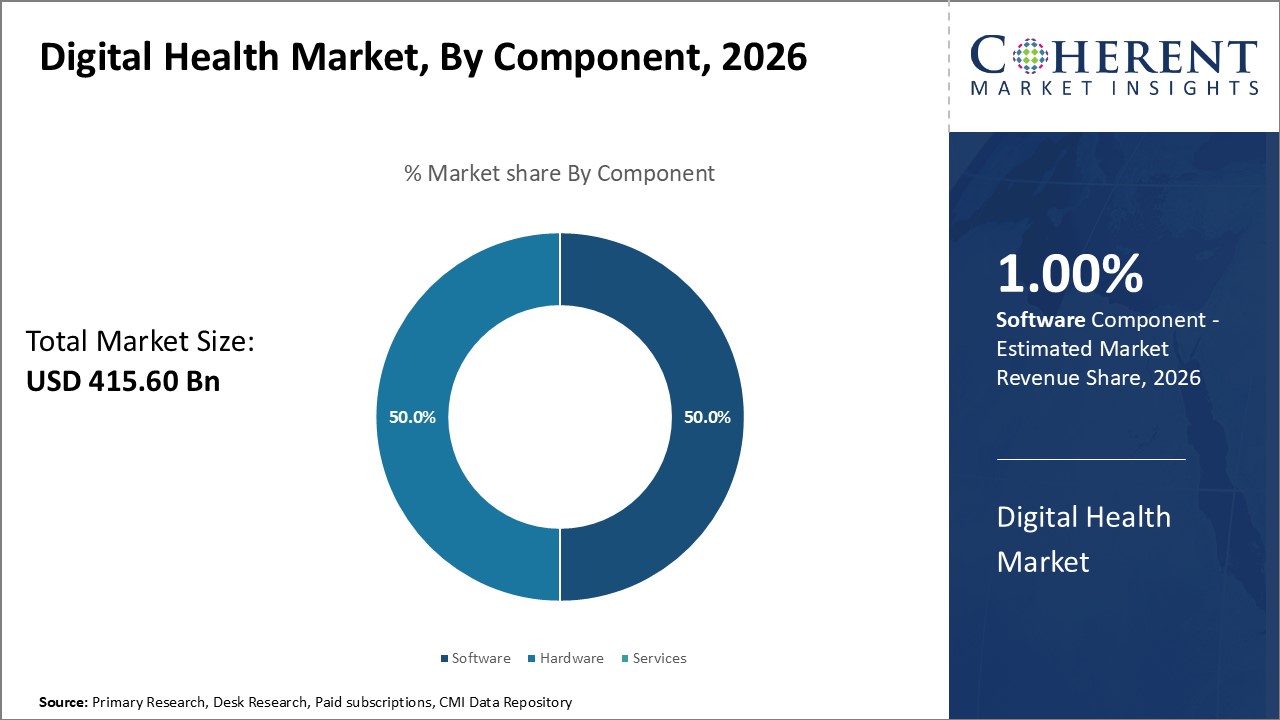
Software contributes the highest share of the market owing to its integration of ai and machine learning

Software drives the core of the digital health market by operating electronic health records, telehealth platforms, remote monitoring tools, and clinical decision support systems. Healthcare providers actively use software to optimize workflows, improve data accuracy, and boost patient engagement. By integrating artificial intelligence and machine learning, software enables predictive analytics and supports personalized treatment approaches. As healthcare organizations focus on improving efficiency and outcomes, they increasingly adopt secure, interoperable, and high-performing digital health software to meet evolving demands.

For instance, in February 2025, the Owens & Minor family launched ByramConnect™, a personalized digital health program powered by the Welldoc App. Using advanced AI, the program analyzes member data across six health dimensions to help improve outcomes for individuals with type 1 or type 2 diabetes. Byram members receive actionable insights and reports to share with their healthcare providers and care teams.

Digital Health Market Insights, by End User

Hospital & Clinics contribute the highest share of the market owing to its government incentives and regulatory compliance

Hospitals and clinics are actively adopting digital health by integrating electronic health records, telemedicine, remote monitoring, and clinical decision support systems into daily operations. They use these digital tools to improve diagnostic accuracy, streamline administrative processes, and boost patient engagement through online scheduling and secure communication. Providers rely on data-driven insights to refine treatment plans and manage resources effectively. As patient expectations grow and healthcare systems prioritize efficiency and quality, hospitals and clinics continue to implement secure, interoperable digital solutions to enhance care in both inpatient and outpatient environments. For instance, in January 2025, Apollo Hospitals in India partnered with the University of Leicester in England to establish a research centre focused on digital health and precision medicine.
Regional Insights

Digital Health Market Regional Insights

To learn more about this report, Download Free Sample

North America Digital Health Market Trends

North America dominates the overall market with a share with a share of 40.20%. Telemedicine, AI-powered diagnostics, and remote patient monitoring are actively transforming the North American digital health sector by enhancing care delivery and operational efficiency. Providers and startups are investing in mobile health apps and wearable technology to deliver personalized and convenient patient experiences. Health systems are increasingly focusing on interoperability and secure data exchange to streamline workflows across various care environments. At the same time, supportive government regulations and insurer reimbursement continue to strengthen the foundation and adoption of digital health platforms across the region.

For instance, Royal Philips is enhancing clinical decision support for healthcare technicians by integrating artificial intelligence (AI) and smart workflow automation into its CT 5300 system, which the company is launching in North America.

Asia Pacific Digital Health Market Trends

Nations across the Asia-Pacific region are actively deploying telemedicine to bridge healthcare access gaps in rural areas and relieve pressure on crowded urban hospitals. As mobile and internet connectivity expand, virtual consultations, AI-powered triage tools, and video follow-ups have become standard, especially in China, India, and Southeast Asia. Startups and established companies are launching region-specific apps with bilingual interfaces, affordable subscription plans, and AI-driven features tailored to local healthcare needs.

For instance, in November 2024, Alphind Healthcare (Alphind), a Whole Person Care intelligence activation company, opened its APAC headquarters in Singapore. The new headquarters will feature the Xealei™ Experience Arena—a hub for collaborative research and development in eldercare and caregiving—and will also include the formation of a regional Advisory Panel.

United States Digital Health Market Trends

Patients and clinicians across the United States have widely adopted telemedicine since the pandemic, firmly establishing it as a standard method of healthcare delivery. Clinicians now regularly integrate secure phone and video visits into daily routines, supported by platforms like Doximity that enhance virtual care access and chronic disease management. Leading tech and healthcare companies such as Amazon, Nvidia, and Oracle are actively embedding AI into diagnostics, imaging, clinical documentation, and administrative processes to improve efficiency and clinical outcomes.

For instance, in April 2025, Amara Therapeutics, a medtech company specializing in women's health, launched a clinical trial in the United States to evaluate its digital therapeutic solution for women with overactive bladders (OAB).

India Digital Health Market Trends

India actively addresses healthcare inequities by using telemedicine platforms like eSanjeevani and SEHAT to deliver specialist consultations to remote regions. The government simplifies virtual care access through Telemedicine Practice Guidelines and linked digital health IDs. Under the Ayushman Bharat Digital Mission (ABDM), it issues unique health IDs and develops interoperable health records. Physicians now receive real-time data on vital signs such as blood pressure and glucose through wearables and IoT devices, enabling continuous remote monitoring and timely preventive interventions.

For instance, in February 2025, the World Economic Forum (WEF) has launched the India Digital Health Activator, aiming to accelerate digital health adoption, enhance interoperability, and drive innovation through collaboration between the public and private sectors.

Market Report Scope

Digital Health Market Report Coverage

Report Coverage Details
Base Year: 2024 Market Size in 2025: USD 350.42 Bn
Historical Data for: 2020 To 2024 Forecast Period: 2025 To 2032
Forecast Period 2025 to 2032 CAGR: 18.4% 2032 Value Projection: USD 1,143.01 Bn
Geographies covered:
  • North America: U.S. and Canada
  • Latin America: Brazil, Argentina, Mexico, and Rest of Latin America
  • Europe: Germany, U.K., Spain, France, Italy, Russia, and Rest of Europe
  • Asia Pacific: China, India, Japan, Australia, South Korea, ASEAN, and Rest of Asia Pacific
  • Middle East: GCC Countries, Israel, and Rest of Middle East
  • Africa: South Africa, North Africa, and Central Africa
Segments covered:
  • By Technology: Telehealthcare, mHealth, Health Analytics, Digital Health Systems, Telemedicine, and Others    
  • By Component: Software, Hardware,  Services, Connected Devices, and Others
  • By End User: Hospitals & Clinics and Health Insurance Firms
Companies covered:

Teladoc Health, American Well Corporation, Doctor on Demand, MDLIVE, Maple, Steady Health, Anthropic, CloudMedx, Babylon, and Buoy Health

Growth Drivers:
  • Growing Geriatric Population
  • Rising Investment in Telehealth and Telemedicine
Restraints & Challenges:
  • Lack of Awareness in Developing Nations

Uncover macros and micros vetted on 75+ parameters: Get instant access to report

Digital Health Market Trend

Surge in Telemedicine Adoption

Telemedicine has become a mainstream mode of healthcare delivery, driven by the need for accessible, contactless care. Virtual consultations, video-based follow-ups, and AI-driven triage systems are being widely used across primary, specialty, and mental health services. Both public and private healthcare providers are investing in digital platforms to extend their reach, improve patient convenience, and manage chronic diseases more efficiently.

Integration of Artificial Intelligence in Clinical Workflows

Artificial Intelligence is being actively integrated into diagnostics, imaging, clinical decision support, and administrative tasks. Hospitals and health tech companies are deploying AI tools to improve diagnostic accuracy, predict patient risk, automate documentation, and personalize treatment plans. Applications like AI-powered radiology tools, chatbots, and predictive analytics platforms are streamlining operations and enhancing outcomes.

Digital Health Market Opportunity

Expanding Access to Underserved Populations

Digital health offers a powerful opportunity to extend care to remote, rural, and underserved communities. With mobile connectivity and cloud-based platforms, healthcare providers can deliver consultations, follow-ups, and health education without the need for physical infrastructure. This helps bridge gaps in healthcare access and equity. Governments and NGOs can partner with digital health firms to scale virtual care programs, making healthcare more inclusive and accessible across socio-economic and geographic boundaries.

Digital Health Market News

  • In June 2025, Altera Digital Health introduced Sunrise™ CarePath, a mobile patient engagement platform created to bridge communication gaps and reduce adverse events, readmissions, and financial obstacles.
  • In April 2025, Chief Minister launched the e-SEHAT App in Jammu and Kashmir, introducing a comprehensive one-stop digital solution aimed at addressing the healthcare needs of people in the Union Territory.
  • In July 2025, UK-Estonian health tech start-up Lifeyear raised €2.8 million (£2.4m) to launch its remote patient management platform for cardiovascular care in the UK. The company will use the funding to speed up the platform’s rollout across selected UK hospitals, GP practices, and virtual wards while refining the technology and validating its clinical potential.
  • In April 2025, Ypsomed and Sidekick Health introduced a joint digital health solution to enhance support for individuals with obesity. They are integrating Ypsomed’s autoinjectors into Sidekick’s digital health and chronic condition management app, enabling patients using GLP-1-based injectable therapies to manage their treatment more effectively.

Analyst Opinion (Expert Opinion)

  • The digital health market is undergoing a structural shift, not a trend cycle—and the next decade will define the winners in global healthcare transformation. Telehealth, once a pandemic-driven stopgap, is now embedded into care models; over 38% of U.S. adults used telemedicine in 2023, according to CDC data, and this is rising in specialist fields like mental health, where over 55% of psychiatry visits are now virtual.
  • However, the real disruptor is AI integration. Clinical decision-making, radiology, and triage are increasingly driven by AI systems. For example, Qure.ai's chest X-ray solution is being deployed across Southeast Asia and the Middle East, reducing radiology backlog in public hospitals by up to 65%. Hospitals that adopt such tools are not just innovating—they're redefining their care delivery economics. The shift from “physician-led” to “AI-assisted” care will define clinical productivity metrics moving forward.
  • The interoperability gap, however, remains a critical barrier. Despite massive EHR investments, over 70% of U.S. physicians still report challenges in accessing complete patient data, according to the Office of the National Coordinator for Health IT. The failure to integrate systems across care settings erodes patient safety, increases duplication, and creates massive inefficiencies. Vendors that solve this—particularly via open standards like FHIR—will gain significant enterprise adoption traction.

Market Segmentation

  • By Technology
    • Telehealthcare
    • mHealth
    • Health Analytics
    • Digital Health Systems
    • Telemedicine
    • Others
  • By Component
    • Software
    • Hardware
    • Services
    • Connected Devices
    • Others
  • By End User
    • Hospitals & Clinics
    • Health Insurance Firms
  • By Region
    • North America
      • U.S.
      • Canada
    • Latin America
      • Brazil
      • Argentina
      • Mexico
      • Rest of Latin America
    • Europe
      • Germany
      • U.K.
      • Spain
      • France
      • Italy
      • Russia
      • Rest of Europe
    • Asia Pacific
      • China
      • India
      • Japan
      • Australia
      • South Korea
      • ASEAN
      • Rest of Asia Pacific
    • Middle East
      • GCC Countries
      • Israel
      • Rest of Middle East
    • Africa
      • South Africa
      • North Africa
      • Central Africa
  • Key Players Insights
    • Teladoc Health
    • American Well Corporation
    • Doctor on Demand
    • MDLIVE
    • Maple
    • Steady Health
    • Anthropic
    • CloudMedx
    • Babylon
    • Buoy Health

Sources

Primary Research interviews

  • Healthcare IT directors and CIOs from leading hospitals
  • Telemedicine platform developers and product managers
  • Digital health startup founders and health app developers
  • Physicians using AI-powered diagnostic tools
  • Public health officials managing national digital health programs
  • Health informatics professors and researchers
  • Patients and caregivers using remote monitoring and telehealth services

Databases

  • World Health Organization (WHO) Global Health Observatory
  • U.S. FDA Digital Health Center of Excellence
  • NHS Digital (UK)
  • OECD Health Statistics
  • India Ministry of Health & Family Welfare Digital Health Dashboard
  • National Health Portal of India
  • European Medicines Agency (EMA) eHealth data sources

Magazines

  • Healthcare IT News
  • HealthTech Magazine
  • Forbes Health
  • MedTech Innovation News
  • Wired (Health & Science sections)
  • MobiHealthNews

Journals’

  • The Lancet Digital Health
  • Journal of Medical Internet Research (JMIR)
  • npj Digital Medicine
  • BMC Medical Informatics and Decision Making
  • Telemedicine and e-Health
  • Journal of Biomedical Informatics

Newspapers

  • The New York Times (Health Tech coverage)
  • The Guardian (Digital Health section)
  • The Economic Times (Healthworld)
  • The Washington Post (Health and Technology)
  • South China Morning Post
  • The Hindu (Health & Sci-Tech)

Associations

  • American Telemedicine Association (ATA)
  • Health Level Seven International (HL7)
  • Digital Therapeutics Alliance (DTA)
  • European Connected Health Alliance (ECHAlliance)
  • Indian Health Informatics Association (IHIA)
  • Healthcare Information and Management Systems Society (HIMSS)

Public Domain sources

  • Centers for Disease Control and Prevention (CDC)
  • National Institutes of Health (NIH)
  • U.S. Department of Health and Human Services (HHS)
  • Ayushman Bharat Digital Mission (India)
  • European Commission eHealth portal
  • World Bank HealthTech publications
  • PubMed Central

Proprietary Elements

  • CMI Data Analytics Tool, and Proprietary CMI Existing Repository of information for last 8 years

Share

Share

About Author

Komal Dighe is a Management Consultant with over 8 years of experience in market research and consulting. She excels in managing and delivering high-quality insights and solutions in Health-tech Consulting reports. Her expertise encompasses conducting both primary and secondary research, effectively addressing client requirements, and excelling in market estimation and forecast. Her comprehensive approach ensures that clients receive thorough and accurate analyses, enabling them to make informed decisions and capitalize on market opportunities.

Missing comfort of reading report in your local language? Find your preferred language :

Frequently Asked Questions

The Digital Health Market is estimated to be valued at USD 350.42 Bn in 2025, and is expected to reach USD 1,143.01 Bn by 2032.

Lack of awareness in developing nations is expected to hinder the market growth over the forecast period.

Growing geriatric population and rising investment in telehealth and telemedicine are expected to propel the market growth over the forecast period.

The leading segment in the market is technology due to increasing technologically advanced product launches.

The major market players operating in the digital health market includes Teladoc Health, American Well Corporation, Doctor on Demand, MDLIVE, Maple, Steady Health, Anthropic, CloudMedx, Babylon, Buoy Health.

North America will lead the digital health market.

The CAGR of the Digital Health Market is projected to be 18.4% from 2025 to 2032.

Select a License Type

EXISTING CLIENTELE

Joining thousands of companies around the world committed to making the Excellent Business Solutions.

View All Our Clients

trusted clients logo
© 2025 Coherent Market Insights Pvt Ltd. All Rights Reserved.