

Acetyls Market Size and Forecast – 2026 to 2033
The Acetyls Market is anticipated to grow at a CAGR of 6.3% with USD 32.8 Bn share in 2026 and is expected to reach USD 49.8 Bn in 2033. The chemicals, paints and coatings, adhesives, pharmaceuticals, and packaging industries drive demand for the acetyls market by increasing the use of acetyl-based products across a wide range of industrial and commercial applications. According to our research, the paints and coatings industry is estimated to be surpass USD 268.85 Bn by 2033.
Key Takeaways
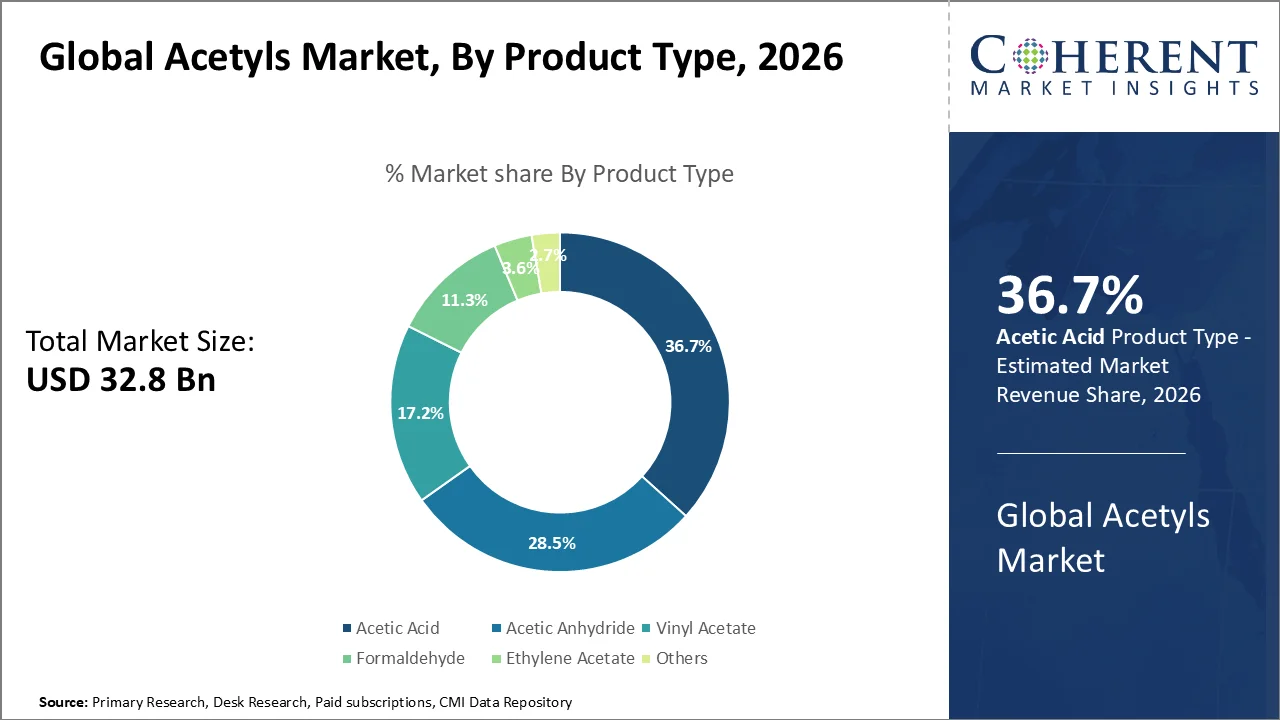
- Acetic Acid hold the largest market share of 36.7% in 2026 owing to its methanol availability and pricing. In FY2023, India's acetic acid production reached approximately 165.5 thousand metric tons.
- Pharmaceutical expected to hold largest market share of 31.7% in 2026 owing to the growing global pharmaceutical production.
- North America is expected to acquire the dominant share of 43.2% in 2026 owing to the robust construction and infrastructure activity. In Canada, building construction investment rose by 1.9% (USD 442.9 million) to USD 23.7 Bn in December.
Current Events and Their Impact on the Acetyls Market
Current Event | Description and its Impact |
EU Carbon Border Adjustment Mechanism (CBAM) – Definitive Phase (2026) |
|
China's 2025 National Catalogue for Hazardous Waste Management |
|
Segmental Insights
- Current Industry Events of 2026
- Market Size Estimation
- Regional Breakdown
- Competitive Landscape
- Customer Intelligence
- Segmental Analysis
- Pricing Analysis
- Key Market Drivers, Challenges & Future Trends
- Customized Insights Section
Why is Acetic Acid Acquiring the Largest Market Share?
Acetic Acid hold the largest market share of 36.7% in 2026. Manufacturers drive acetic acid demand in the acetyls market by using it as a key feedstock to produce vinyl acetate monomer, purified terephthalic acid, acetic anhydride, and acetate esters. Construction, packaging, textile, automotive, and consumer goods industries fuel consumption by increasing production of adhesives, coatings, paints, polyester fibers, and PET packaging. Pharmaceutical and specialty chemical manufacturers further expand demand through greater production activities, while companies strengthen market growth by investing in integrated chemical facilities and adopting advanced process technologies to improve efficiency and supply reliability. In June 2026, Evonik introduced a low-carbon footprint (LCF) peracetic acid to the European market, helping customers reduce Scope 3 emissions while maintaining product performance, quality, and regulatory compliance.
Which End Use segment dominates the market?
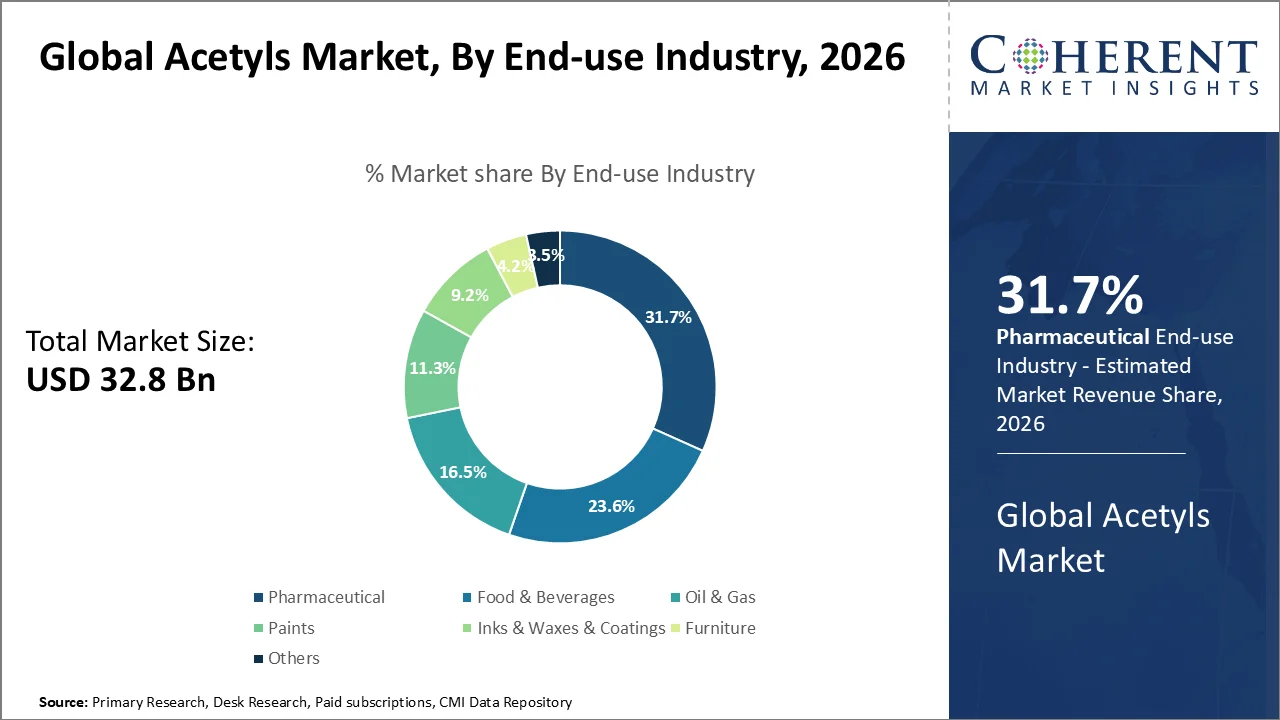
Pharmaceutical expected to hold largest market share of 35.7% in 2026. Manufacturers increase demand in the acetyls market by using acetic acid, acetic anhydride, and acetate solvents to produce active pharmaceutical ingredients, intermediates, and drug formulations. Pharmaceutical companies expand the consumption of acetyl chemicals by producing more generic medicines, specialty drugs, vaccines, and biologics. Rising healthcare needs and aging populations encourage companies to increase manufacturing capacity. By 2030, one in six people globally will be aged 60 years or older. In addition, investments in research, process innovation, and high-purity chemical production enhance manufacturing efficiency and accelerate the adoption of acetyl products across the pharmaceutical industry.
Acetyls Market Trends
- Increasing adoption of lightweight and recyclable packaging materials is driving the use of PET resins and polyester fibers, thereby boosting acetic acid demand for PTA production. According to the International Energy Agency (IEA), plastics account for around 70% of global packaging materials, reinforcing long-term demand for PET-based packaging.
- Growing investments in bio-based and low-carbon acetyl production technologies are encouraging manufacturers to reduce emissions and improve process efficiency. Regulatory initiatives such as the EU Carbon Border Adjustment Mechanism (CBAM) are accelerating investments in lower-carbon chemical manufacturing and emissions monitoring across the acetyl value chain.
Regional Insights
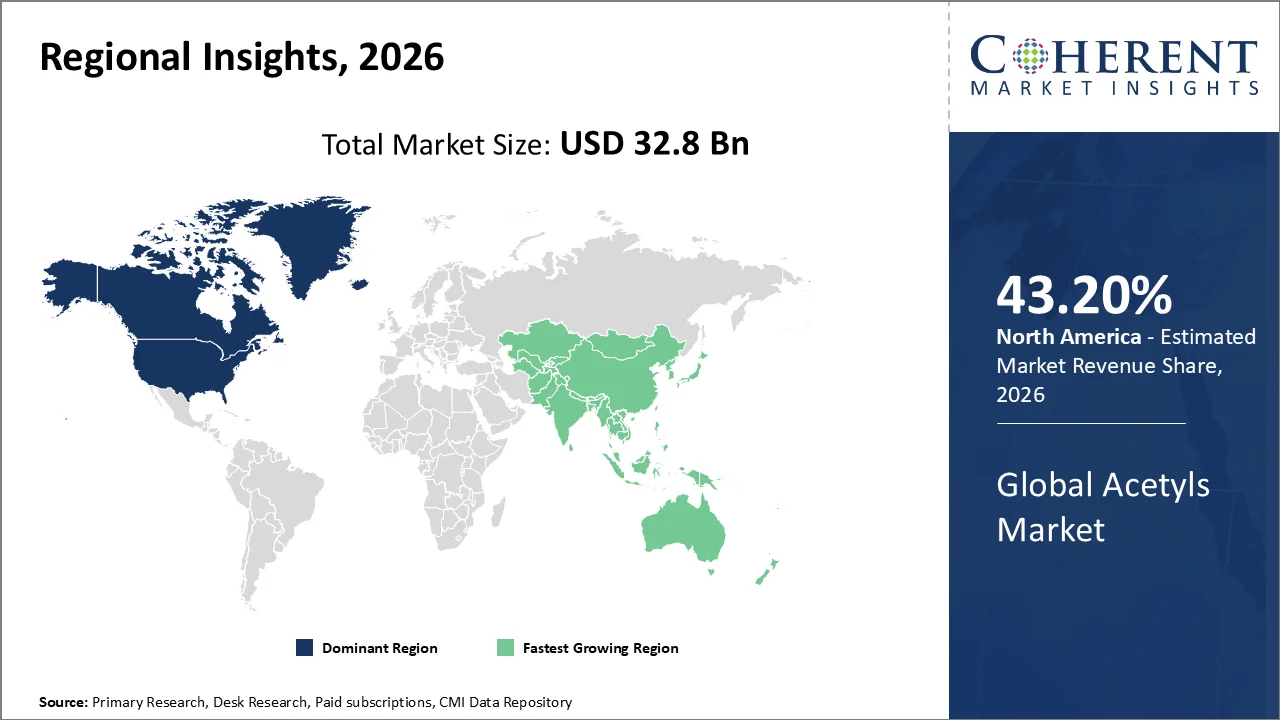
North America dominates owing to well-established petrochemical industry
North America is expected to acquire the dominant share of 43.20% in 2026. Companies across North America drive acetyls market growth by increasing the use of acetyl derivatives in construction, packaging, pharmaceuticals, automotive, and chemical manufacturing applications. Manufacturers boost demand for acetic acid and related products through higher consumption of adhesives, coatings, paints, PET packaging, and specialty chemicals. The region leverages abundant feedstock availability, advanced petrochemical infrastructure, and integrated production networks to maintain reliable supply. Pharmaceutical companies, industrial manufacturers, and chemical producers further expand acetyl product adoption through capacity investments and sustainable technology initiatives. In April 2026, INEOS Acetyls and Sandpiper Chemicals, LLC formed a strategic collaboration to support Sandpiper’s low-carbon methanol production facility in Texas City, Texas.
Asia Pacific Acetyls Market Trends
The Asia Pacific acetyls market grows as industries such as construction, automotive, pharmaceuticals, packaging, textiles, and coatings increase their demand for acetyl-based products. India’s construction industry employs approximately 32 million workers. Manufacturers across China, India, and Southeast Asian countries expand production activities, while rapid industrialization and urban development create new growth opportunities. Companies use acetyl derivatives widely in solvents, adhesives, plastics, and specialty chemicals, supported by rising investments in chemical manufacturing facilities. Advancements in technology and the shift toward sustainable chemical solutions further drive market expansion across the region.
United States Acetyls Market Trends
Strong demand from the pharmaceutical, food, coatings, and chemical industries drives the United States acetyls market. Expanding drug manufacturing, the growing adoption of acetyl-based compounds in industrial applications, and increased specialty chemical production accelerate market growth. Advanced research facilities, leading chemical manufacturers, and rising demand for high-performance materials strengthen the industry’s expansion. Moreover, innovations in chemical processing technologies and sustainable production methods promote continuous development and advancement across the acetyls sector. In October 2025, Neuro Sharp launched its cognitive supplement for aging adults, featuring Huperzine-A from Chinese club moss to support brain function and acetylcholine levels.
Japan Acetyls Market Trends
Japan’s acetyls market grows as industries such as pharmaceuticals, food and beverages, coatings, adhesives, and specialty chemicals increase their demand for acetyl-based products. Japan’s advanced manufacturing sector, commitment to high-quality chemical production, and focus on sustainable materials drive market development. Japan’s manufacturing sector ranks as the world’s third-largest by output, generating approximately USD 1.1 trillion in economic value and employing around 15% of the workforce. Companies are expanding acetyl derivative applications across healthcare, electronics, and industrial processes, creating new growth opportunities. Continuous technological advancements, chemical processing innovations, and a strong industrial foundation help Japan’s chemical sector strengthen its position in the acetyls market.
Who are the Major Companies in Acetyls Industry
Some of the major key players in Acetyls are LyondellBasell Industries Holdings B.V., BP plc, Eastman Chemical Company, Celanese Corporation, Wacker Chemie AG, Daicel Corporation, and The Dow Chemical Company.
Key News
- In February 2026, Neutrogena launched Evenly Clear, its first acne-focused skincare collection for adults, featuring salicylic acid, N-acetyl glucosamine, and a pre- and post-biotic complex to treat acne and support skin health.
Market Report Scope
Acetyls Market Report Coverage
| Report Coverage | Details | ||
|---|---|---|---|
| Base Year: | 2025 | Market Size in 2026: | USD 32.8 Bn |
| Historical Data for: | 2020 To 2024 | Forecast Period: | 2026 To 2033 |
| Forecast Period 2026 to 2033 CAGR: | 6.3% | 2033 Value Projection: | USD 49.8 Bn |
| Geographies covered: |
| ||
| Segments covered: |
| ||
| Companies covered: | LyondellBasell Industries Holdings B.V., BP plc, Eastman Chemical Company, Celanese Corporation, Wacker Chemie AG, Daicel Corporation, and The Dow Chemical Company. | ||
Analyst Opinion
- Acetyls demand is being shaped by industrial necessity rather than short-term market trends. Acetyl derivatives serve as critical building blocks across pharmaceuticals, paints and coatings, adhesives, food ingredients, and advanced materials. For example, acetic acid, one of the most widely used acetyl products, is consumed heavily in the production of vinyl acetate monomer (VAM), which supports applications ranging from construction adhesives to packaging materials.
- Pharmaceutical and healthcare applications remain a major growth catalyst for acetyls, supported by increasing demand for active pharmaceutical ingredients and intermediates. Acetyl compounds play a key role in producing widely used medicines, including acetylsalicylic acid (aspirin) and other acetylated pharmaceutical formulations. With global pharmaceutical production expanding and manufacturers increasing investments in high-value drug development, acetyl chemistry continues to benefit from its role in improving drug stability, efficacy, and formulation performance.
- Sustainability-driven chemical innovation is reshaping the acetyls industry, with bio-based production gaining attention among manufacturers. Companies are increasingly exploring renewable feedstocks and lower-carbon manufacturing routes to reduce dependence on traditional fossil-based processes. For instance, bio-based acetic acid production using biomass-derived ethanol is emerging as an alternative pathway, aligning with stricter environmental regulations and corporate decarbonization goals. This shift is expected to favor producers that can combine cost efficiency with sustainable acetyl solutions.
- Asia-Pacific, particularly Japan and China, remains strategically important for acetyls due to its strong chemical manufacturing ecosystem and downstream industrial base. Japan’s specialty chemical industry, known for high-purity materials and advanced processing capabilities, continues to support acetyl applications in electronics, pharmaceuticals, and performance materials. The growing demand for high-performance polymers and specialty formulations reinforces the importance of acetyl derivatives in next-generation industrial applications.
Speak to the analyst
Want personalized insights?
Take the findings above to one of our principal consultants, or have the report rebuilt around the segments, geographies and competitors you actually track.
Market Segmentation
- By Product Type (Revenue, USD Bn, 2021-2033)
- Acetic Acid
- Acetic Anhydride
- Vinyl Acetate
- Formaldehyde
- Ethylene Acetate
- Others
- By End-use Industry (Revenue, USD Bn, 2021-2033)
- Food & Beverages
- Oil & Gas
- Pharmaceutical
- Paints
- Inks & Waxes & Coatings
- Furniture
- Others
- By Region (Revenue, USD Bn, 2021-2033)
- North America
- U.S.
- Canada
- Latin America
- Brazil
- Mexico
- Argentina
- Rest of Latin America
- Europe
- Germany
- U.K.
- France
- Italy
- Spain
- Russia
- Rest of Europe
- Asia Pacific
- China
- India
- Japan
- Australia
- South Korea
- ASEAN
- Rest of Asia Pacific
- Middle East
- GCC
- Israel
- Rest of Middle East
- Africa
- South Africa
- Central Africa
- North Africa
- North America
Sources
Primary Research Interviews
- Industry experts, manufacturers, suppliers, distributors, traders, and other key stakeholders across the acetyls value chain
- Subject matter experts with knowledge of acetyls production, consumption patterns, pricing trends, applications, and market dynamics
- Key opinion leaders from end-use industries such as coatings, adhesives, pharmaceuticals, chemicals, and food & beverage
Databases
- Government trade databases and import-export statistics
- International trade and customs databases
- Chemical industry production and consumption databases
- Regulatory and environmental databases
- Company annual reports, investor presentations, and financial disclosures
- Publicly available statistical databases related to industrial production and trade
Magazines
- Chemical industry magazines
- Petrochemical and specialty chemical publications
- Manufacturing and industrial processing magazines
- Trade publications covering chemicals, materials, and downstream applications
Journals
- Peer-reviewed journals covering chemical engineering, industrial chemistry, materials science, and process technology
- Academic publications related to acetyls chemistry, derivatives, applications, and production technologies
- Scientific research articles from recognized academic and technical databases
Newspapers
- Business and financial newspapers
- Industry-focused news publications
- Regional and global publications covering chemical sector developments, regulations, investments, and supply chain trends
Associations
- Chemical industry associations
- Trade and manufacturing associations
- Professional organizations related to chemistry, engineering, and industrial applications
- Regulatory and standards organizations
Public Domain Sources
- Government publications and statistical releases
- Regulatory authority reports and notifications
- International trade records and customs information
- Environmental and safety guidelines
- Publicly available company filings and disclosures
- Open-access technical papers and research publications
Proprietary Elements
- CMI Data Analytics Tool
- Proprietary CMI Existing Repository of information for last 10 years
Get access to 250+ pages report
Every segment, forecast, competitor profile and data table behind the analysis above — available for instant download.
- ESOMAR Member
- ISO 9001:2015 Certified
- D-U-N-S Registered
- GDPR & CCPA Compliant
Missing comfort of reading report in your local language? Find your preferred language:
Transform your Strategy with Exclusive Trending Reports
Frequently Asked Questions
Acetyls are a group of chemical compounds derived from acetic acid and are widely used as essential intermediates in the production of pharmaceuticals, coatings, adhesives, solvents, plastics, food additives, and specialty chemicals.
The acetyls market includes products such as acetic acid, vinyl acetate monomer (VAM), acetic anhydride, ethyl acetate, and other acetyl derivatives.
The pharmaceutical, construction, packaging, automotive, food and beverage, textiles, and coatings industries represent major sources of acetyl demand.
The market is influenced by rising demand for pharmaceutical intermediates, increasing use of adhesives and coatings, expansion of chemical manufacturing, and growing adoption of sustainable chemical production methods.
Manufacturers are increasingly investing in cleaner production technologies, renewable feedstocks, and energy-efficient processes to reduce environmental impact.