

Asia Pacific And Global OSS/BSS Market Size and Forecast – 2026 to 2033
The Asia Pacific And Global OSS/BSS Market is anticipated to grow at a CAGR of 13.2% with USD 19.3 Mn in 2026 and is expected to reach USD 66.7 Mn in 2033. Rapid 5G deployment, digital transformation, cloud adoption, increasing data traffic, network automation, and the growing demand for improved customer experiences drive the Asia Pacific and global OSS/BSS market. 5G subscriptions in the region are projected to reach approximately 670 Mn by 2031.
Key Takeaways
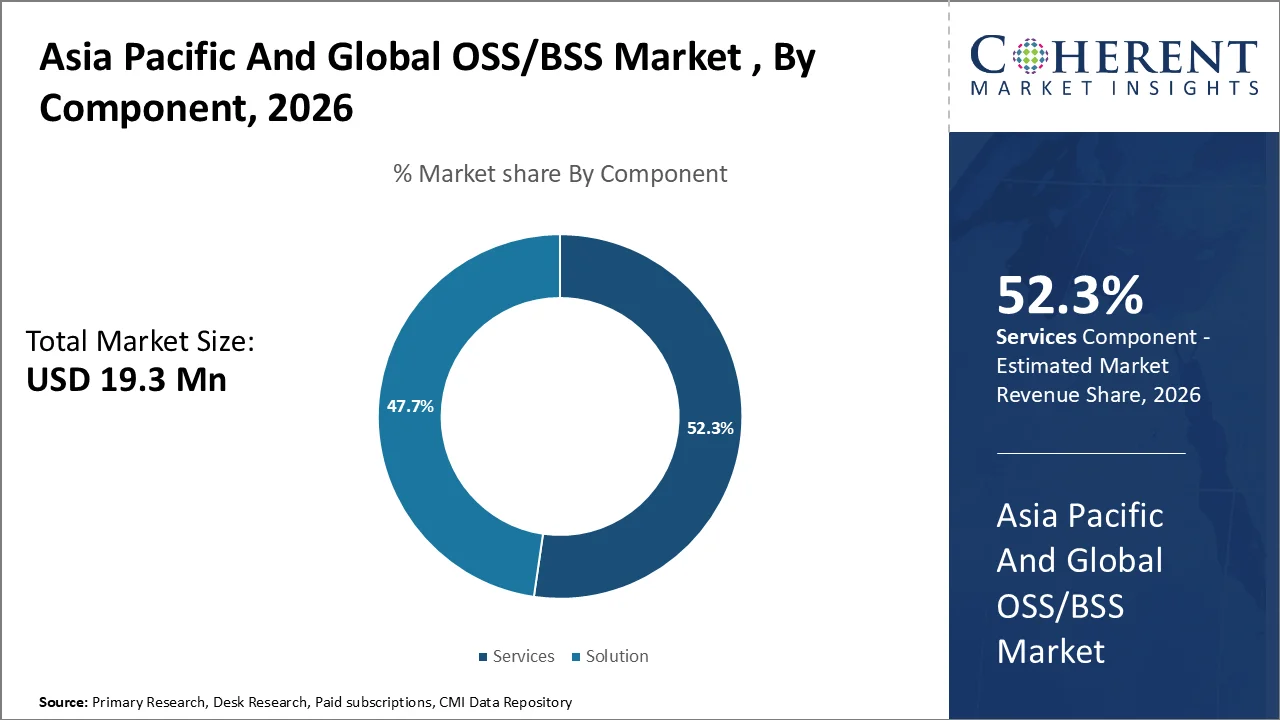
- Services hold the largest market share of 52.3% in 2026 owing to the rapid 5G network deployment. Global 5G subscriptions have exceeded 3 billion, with coverage reaching 60% of the world’s population. Approximately 390 commercial 5G networks are operational worldwide, and adoption is progressing four times faster than the 4G rollout.
- Network Planning & Design expected to hold largest market share of 32.2% in 2026 owing to its growth of network complexity.
- Cloud acquired the prominent market share of 53.4% in 2026 owing to the migration from legacy OSS/BSS systems to cloud-native platforms.
- Small & Medium-sized Enterprises captures the largest market share of 54.6% in 2026 owing to the increasing digital transformation among SMEs.
- Japan is expected to acquire the dominant share of 41.1% in 2026 owing to its advanced 5G network deployment. Japan's 5G network covers over 95% of the population, with nearly 92.4 Mn 5G subscriptions.
Current Events and Their Impact on the Asia Pacific and Global OSS/BSS Market
Current Event | Description and its Impact |
India's Telecommunications Act, 2023 and New Network Authorization Framework |
|
India's Critical Telecommunication Infrastructure (CTI) Rules |
|
Segmental Insights
- Current Industry Events of 2026
- Market Size Estimation
- Regional Breakdown
- Competitive Landscape
- Customer Intelligence
- Segmental Analysis
- Pricing Analysis
- Key Market Drivers, Challenges & Future Trends
- Customized Insights Section
Why is Services Acquiring the Largest Market Share?
Services hold the largest market share of 52.3% in 2026. Rapid 5G deployment, growing network complexity, cloud adoption, digital transformation, and the need for automated telecom operations are driving the growth of services in the Asia-Pacific and global OSS/BSS market. Communication service providers are adopting OSS/BSS services to enhance network performance, improve customer experience, streamline billing processes, and accelerate service delivery. The expansion of IoT, enterprise connectivity, AI-powered automation, and managed services continues to increase demand for advanced OSS/BSS solutions across telecom and digital service ecosystems. For instance, Aria Systems, a leader in AI-powered billing automation, and ServiceNow, an AI platform for business transformation, launched the world’s first agentic Business Support System (BSS) solution designed for communication service providers (CSPs).
Network Planning & Design expected to hold largest market share
Network Planning & Design expected to hold largest market share of 32.2% in 2026 owing to its increasing demand for fiber broadband expansion. Rapid 5G expansion, rising network complexity, and increasing data traffic drive the growth of Network Planning & Design services in the Asia-Pacific and global OSS/BSS market. Global mobile data traffic is projected to grow by 14% annually, while enterprise network traffic is expected to increase by 27% per year, driven by 5G adoption, cloud services, and video streaming, which accounts for nearly 75% of global network traffic. Telecom operators adopt advanced solutions to optimize network capacity, improve coverage, and support technologies such as cloud, IoT, and edge computing. Automation, fiber expansion, private networks, and AI-based optimization further enhance network performance and service delivery. For instance, Eino, an innovator in AI-native network planning, design, and monitoring for enterprise networks, introduced a new solution category called Agentic Network Observability for enterprises.
Cloud acquired the prominent market share
Cloud acquired the prominent market share of 53.4% in 2026. Communication service providers drive cloud adoption in the Asia-Pacific and global OSS/BSS market by seeking scalable, flexible, and cost-efficient telecom operations. They migrate from legacy systems to cloud-based OSS/BSS platforms to enhance service agility, automate processes, and support advanced technologies such as 5G, IoT, and edge computing. Providers also leverage digital services, AI-driven analytics, hybrid cloud environments, and faster deployment capabilities to accelerate cloud adoption across telecom and enterprise ecosystems. For instance, TCS has launched a sovereign cloud solution for European telecom providers. The layered framework enables regional operators to scale edge computing and data lakes across hyperscalers while maintaining localized jurisdictional control.
Which Organization Size segment dominates the market?
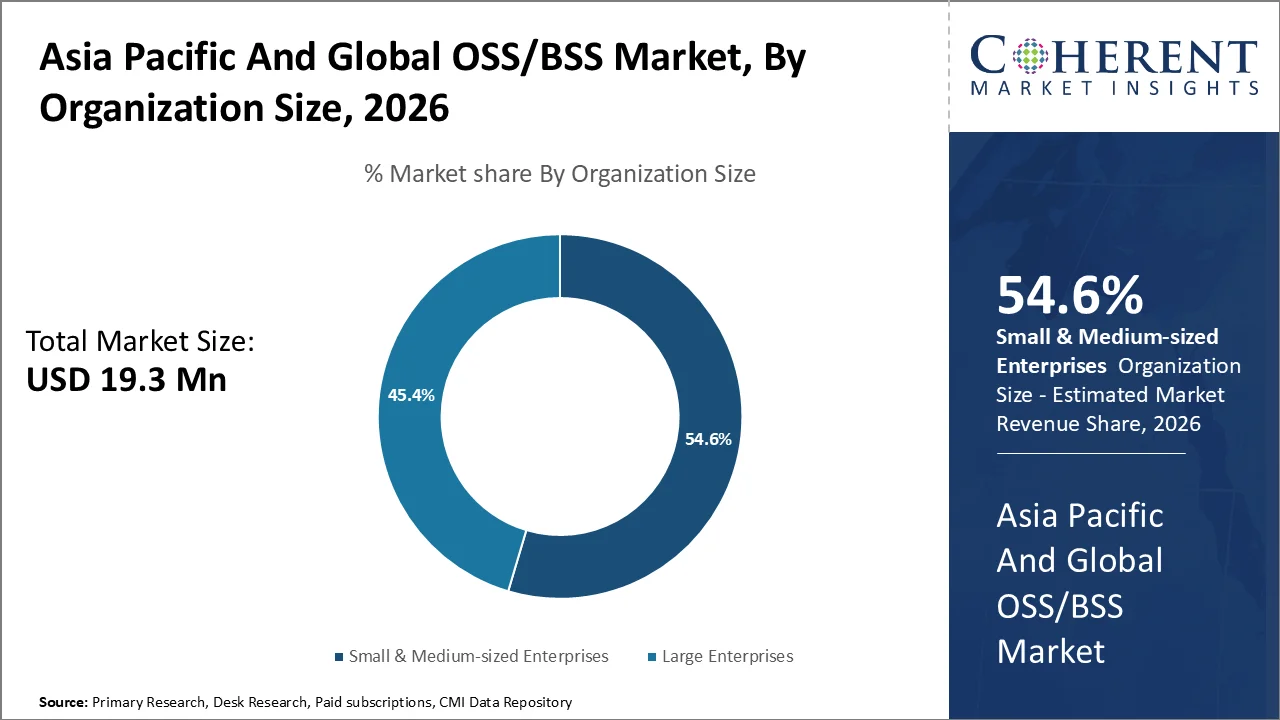
Small & Medium-sized Enterprises captures the largest market share of 54.6% in 2026. Small and medium-sized enterprises (SMEs) accelerate growth in the Asia-Pacific and global OSS/BSS market by adopting digital transformation initiatives, cloud solutions, and efficient communication services. SMEs use OSS/BSS platforms to enhance customer management, automate billing, improve connectivity, and access scalable digital services. They increasingly adopt advanced service management solutions as 5G, IoT, e-commerce, and enterprise applications expand, enabling them to improve operational efficiency, increase flexibility, and support business growth across diverse industries.
Asia Pacific And Global OSS/BSS Market Trends
- Growing adoption of cloud-native OSS/BSS platforms enables telecom operators to improve scalability, reduce infrastructure complexity, and accelerate digital service delivery. 95% of new digital workloads are expected to be deployed on cloud-native platforms, while 61% of communication service providers (CSPs) plan to adopt cloud-native technologies, driving modernization of OSS/BSS environments.
- Increasing demand for 5G network management and automation is accelerating OSS/BSS modernization. Global 5G subscriptions have surpassed 3 billion, while operators continue expanding standalone 5G deployments, increasing demand for advanced network orchestration, service assurance, and automated lifecycle management.
- Telecom operators' focus on digital transformation and customer-centric services is driving adoption of next-generation BSS platforms supporting digital customer journeys, real-time billing, self-service, and personalized offerings. According to TM Forum, operators are increasingly migrating OSS/BSS workloads to hybrid and multi-cloud environments to improve agility and reduce vendor lock-in.
Regional Insights
Japan dominates owing to need for improved customer experience (CX)
Japan is expected to acquire the dominant share of 41.1% in 2026. Advanced telecom infrastructure, 5G expansion, cloud adoption, and digital transformation initiatives drive Japan’s OSS/BSS market growth. Communication service providers upgrade OSS/BSS platforms to automate network operations, enhance customer experiences, and support emerging technologies such as IoT, AI, and edge computing. They also adopt private 5G networks, enterprise connectivity solutions, and smart infrastructure to increase demand for advanced OSS/BSS solutions that improve operational efficiency and enable next-generation digital services. For instance, Rakuten Mobile has extended its large-scale partnership with Netcracker Technology to continue deploying the AI-enabled, cloud-native Netcracker Digital BSS platform, along with professional and managed services, to support its nationwide 4G and 5G network in Japan.
China Asia Pacific And Global OSS/BSS Market Trends
China, Asia Pacific, and global markets drive OSS/BSS growth through rapid digital transformation, expanding telecom infrastructure, and increasing adoption of 5G, cloud services, and artificial intelligence technologies. Telecom operators actively deploy advanced operational and business support systems to enhance efficiency, improve customer experiences, and optimize service delivery. Companies strengthen demand by modernizing networks, implementing automation strategies, and adopting scalable platforms that support innovation across industries. Growing connectivity needs and evolving digital ecosystems continue to accelerate market adoption.
Who are the Major Companies in Asia Pacific And Global OSS/BSS Industry
Some of the major key players in Asia Pacific And Global OSS/BSS are Amdocs, Accenture, IBM Corporation, Hewlett Packard Company, Oracle Corporation, Telefonaktiebolaget LM Ericsson, and Nokia Siemens Networks.
Key News
- In June 2026, Mavenir has launched a billing-grade platform that enables telecom operators to monetize AI tokens through existing BSS, simplifying AI usage tracking and billing.
Market Report Scope
Asia Pacific And Global OSS/BSS Market Report Coverage
| Report Coverage | Details | ||
|---|---|---|---|
| Base Year: | 2025 | Market Size in 2026: | USD 19.3 Mn |
| Historical Data for: | 2020 To 2024 | Forecast Period: | 2026 To 2033 |
| Forecast Period 2026 to 2033 CAGR: | 13.2% | 2033 Value Projection: | USD 66.7 Mn |
| Geographies covered: |
| ||
| Segments covered: |
| ||
| Companies covered: | Amdocs, Accenture, IBM Corporation, Hewlett Packard Company, Oracle Corporation, Telefonaktiebolaget LM Ericsson, and Nokia Siemens Networks. | ||
Analyst Opinion
- The OSS/BSS market is shifting from a traditional telecom support function to a strategic technology layer as operators manage increasingly complex digital networks. The rapid expansion of 5G, cloud-native architectures, IoT connections, and automated network operations is making legacy systems inadequate. According to industry estimates, global 5G connections surpassed 2 billion in recent years, creating significant pressure on telecom providers to adopt intelligent OSS/BSS platforms that can manage real-time service provisioning, assurance, and customer engagement.
- Asia Pacific is emerging as a key transformation hub because telecom operators in markets such as China, India, Japan, and South Korea are aggressively investing in network automation and digital service platforms. China’s large-scale 5G deployment, with millions of installed base stations, demonstrates the need for advanced OSS/BSS solutions capable of handling massive network scale, dynamic resource allocation, and enterprise connectivity services. Operators are increasingly moving beyond basic connectivity offerings toward cloud, edge computing, and industry-specific digital solutions, strengthening demand for next-generation OSS/BSS capabilities.
- The strongest growth opportunity in OSS/BSS will come from artificial intelligence-driven automation and autonomous network management rather than conventional billing and customer management systems. Global telecom operators are increasingly adopting AI-based analytics, predictive maintenance, and self-healing network technologies to reduce operational complexity and improve service reliability. For example, leading operators such as China Mobile and Deutsche Telekom are advancing intelligent network initiatives that rely on automation platforms, highlighting the industry’s transition toward AI-enabled operations.
- Enterprise digitalization will remain a major catalyst for OSS/BSS adoption as telecom providers expand into private networks, cloud services, and connected industry solutions. The growing deployment of IoT devices, which is expected to reach tens of billions of connected devices globally, requires highly scalable service management platforms. Vendors that combine OSS/BSS capabilities with AI, cloud-native technology, and real-time analytics will capture stronger opportunities, while traditional vendors focused only on legacy telecom support systems will face increasing competitive pressure.
Speak to the analyst
Want personalized insights?
Take the findings above to one of our principal consultants, or have the report rebuilt around the segments, geographies and competitors you actually track.
Market Segmentation
- By Component (Revenue, USD Mn, 2021-2033)
- Solution
- Services
- By Solution Type (Revenue, USD Mn, 2021-2033)
- Network Planning & Design
- Service Delivery
- Service Fulfillment
- Service Assurance
- Customer & Product Management
- Billing & Revenue Management
- Network Performance Management
- Others
- By Deployment Mode (Revenue, USD Mn, 2021-2033)
- On-premise
- Cloud
- By Organization Size (Revenue, USD Mn, 2021-2033)
- Small & Medium-sized Enterprises
- Large Enterprises
- By Region (Revenue, USD Mn, 2021-2033)
- Asia Pacific
- China
- India
- Japan
- Australia
- South Korea
- ASEAN
- Rest of Asia Pacific
- Asia Pacific
Sources
Primary Research Interviews
- Telecommunication service providers, mobile network operators, broadband operators, and digital service providers
- OSS/BSS solution architects, network operations professionals, and IT decision-makers
- Product managers, technology specialists, and business transformation leaders
- Industry experts involved in 5G, cloud transformation, network automation, and digital customer experience initiatives
- Key stakeholders across Asia Pacific and global telecom ecosystems
Databases
- Government telecommunications databases and regulatory authority publications
- International telecommunications statistics databases
- Telecom operator annual reports, investor presentations, and technology updates
- Enterprise technology adoption databases
- 5G, cloud computing, IoT, and network infrastructure deployment databases
- Trade and import-export databases related to telecommunications equipment and services
Magazines
- Telecommunications industry magazines
- Digital transformation and enterprise technology publications
- Cloud computing and networking technology magazines
- Wireless communication and 5G-focused publications
- IT infrastructure and automation magazines
Journals
- Peer-reviewed telecommunications and networking journals
- Academic publications covering OSS/BSS architecture, network automation, AI-driven operations, and cloud-native telecom platforms
- Research papers related to 5G, IoT ecosystems, service assurance, and next-generation communication networks
- Technical journals covering telecom operations and business support systems
Newspapers
- Global and regional business newspapers
- Technology and telecommunications news publications
- Digital economy and infrastructure development news sources
- Industry news platforms covering telecom investments, partnerships, and technology advancements
Associations
- International telecommunications standards organizations
- Mobile network operator associations
- Broadband and connectivity industry associations
- Cloud computing and digital infrastructure forums
- Technology standardization bodies focused on telecom networks, automation, and interoperability
Public Domain Sources
- Government telecom ministry publications and regulatory filings
- International organization reports and statistics
- Publicly available company filings, presentations, and press releases
- Open technology standards and technical documentation
- Telecom infrastructure deployment reports
- Public research papers, conference proceedings, and industry white papers
- Open-source telecom ecosystem documentation related to OSS/BSS platforms
Proprietary Elements
- CMI Data Analytics Tool
- Proprietary CMI Existing Repository of information for last 10 years
Get access to 250+ pages report
Every segment, forecast, competitor profile and data table behind the analysis above — available for instant download.
- ESOMAR Member
- ISO 9001:2015 Certified
- D-U-N-S Registered
- GDPR & CCPA Compliant
Missing comfort of reading report in your local language? Find your preferred language:
Transform your Strategy with Exclusive Trending Reports
Frequently Asked Questions
The Asia Pacific And Global OSS/BSS Market is anticipated to grow at a CAGR of 13.2% with USD 19.3 Mn share in 2026 and is expected to reach USD 66.7 Mn in 2033.
Major factor driving the growth of Asia Pacific & global OSS/BSS market during the forecast period are growing adoption of convergent billing systems and rapid growth of the telecommunication sector.
Major factor hampering the growth of the Asia Pacific & global OSS/BSS market during the forecast period is stringent regulatory norms
APAC Asia Pacific & global OSS/BSS market is expected to generate the highest revenue during the forecast period.
Some of the key players operating in the market are Amdocs, Accenture, IBM Corporation, Hewlett Packard Company, Oracle Corporation, Telefonaktiebolaget LM Ericsson, and Nokia Siemens Networks.