

Asphalt Additives Market Size and Forecast — 2026 - 2033
The Global Asphalt Additives Market size is estimated to be valued at USD 9.30 billion in 2026 and is expected to reach USD 13.7 billion by 2033, exhibiting a compound annual growth rate (CAGR) of 5.6% from 2026 to 2033.
Overview
The Asphalt Additives Market offers a range of products designed to enhance the performance, durability, and sustainability of asphalt pavements. Key product categories include polymer modifiers, which improve flexibility and resistance to cracking; anti-stripping agents, which enhance adhesion between asphalt and aggregates; rejuvenators, which restore aged asphalt properties; adhesives and tack coats, which ensure proper layer bonding; and performance enhancers, such as fibers and fillers, which increase strength and longevity. These products are increasingly used to meet growing infrastructure demands, reduce maintenance costs, and support environmentally friendly road construction practices worldwide, driving market growth and innovation.
Key Takeaways
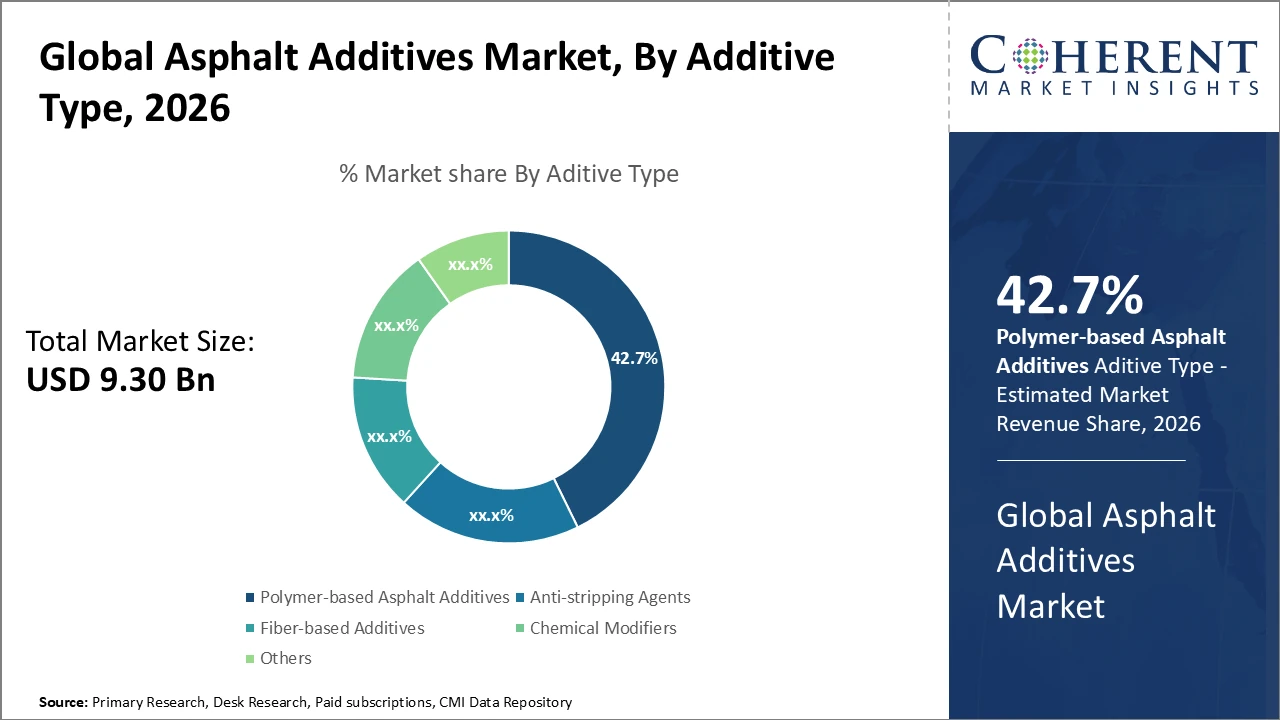
The polymer-based asphalt additive segment dominates the market with a 42.7% share, largely due to superior performance in high-traffic road construction applications.
Road construction remains the largest application, accounting for over 52% of industry revenue, reflecting ongoing global infrastructure projects.
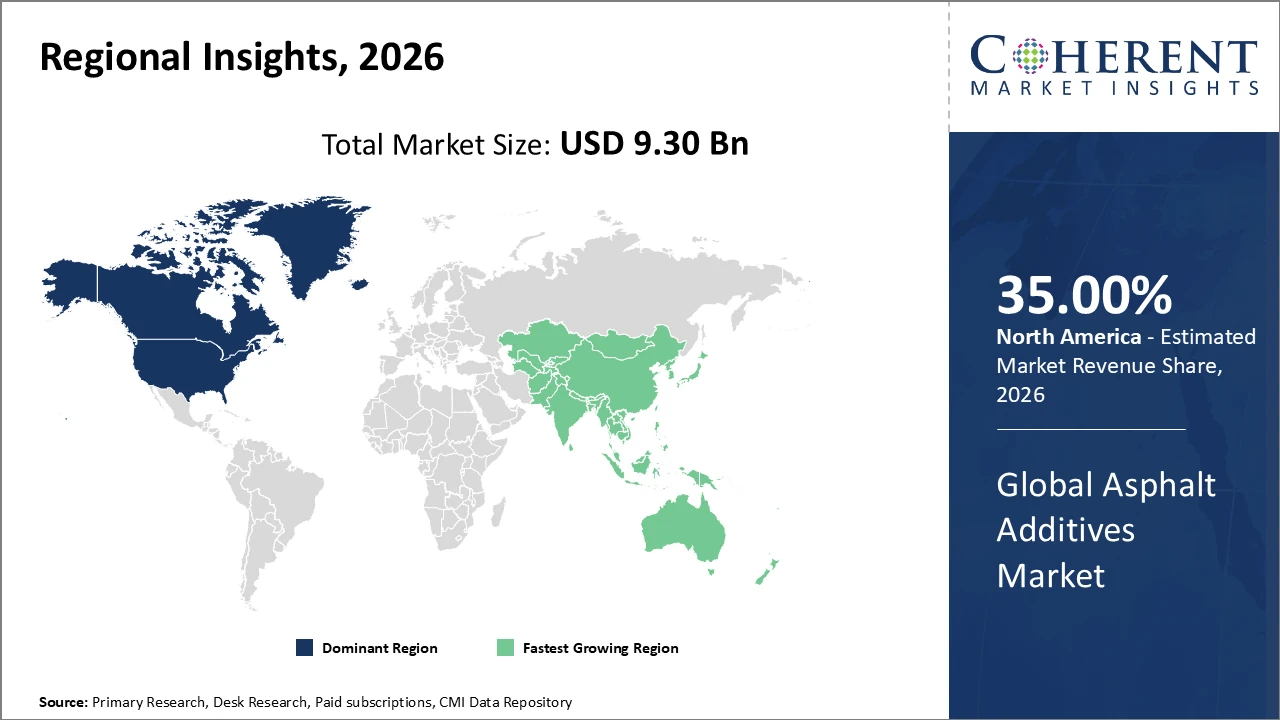
North America leads the Asphalt Additives market share because of extensive highway development and innovation-driven industry players.
Asia Pacific shows the fastest market growth, driven by aggressive urbanization policies and increasing infrastructure budgets.
Europe and the Middle East & Africa contribute steadily, focusing on sustainable development projects and technological adoption.
Asphalt Additives Market Segmentation Analysis
Asphalt Additives Market Insights, By Additive Type
Polymer-based asphalt additives dominate the market with a 42.7% share, driven by their superior mechanical properties and resilience under heavy traffic conditions. Chemical modifiers are the fastest-growing subsegment, fueled by demand for customized solutions that enhance asphalt’s environmental resistance while remaining cost-effective. Anti-stripping agents continue steady growth due to their role in preventing moisture-related damage, ensuring pavement longevity. Fiber-based additives improve tensile strength in roofing, waterproofing, and other construction applications. The Others category includes specialized additives for niche uses, highlighting the market’s expanding scope and the increasing focus on performance, durability, and sustainability in modern infrastructure projects.
Asphalt Additives Market Insights, By Application
Road construction holds the largest market share at 52%, driven by extensive global infrastructure projects that demand durable and high-performance asphalt formulations. Roofing additives are experiencing growth as rapid urbanization increases the need for long-lasting, weather-resistant building materials. Waterproofing applications are steadily expanding, fueled by climate change and the need for resilient construction solutions in flood-prone and high-moisture regions. The Others category includes specialized sectors such as airport runways, industrial flooring, and railways, which contribute smaller but significant shares, reflecting the diverse demand streams and versatile applications of asphalt additives across modern infrastructure and construction projects worldwide.
Asphalt Additives Market Insights, By End-User
Government infrastructure projects dominate the market due to public investments in road modernization and expansion. This subsegment benefits from consistent funding and strict quality standards, ensuring steady demand for high-performance asphalt additives. Private construction companies represent the fastest-growing end-user segment, leveraging innovative additive combinations to gain competitive advantages in commercial and residential infrastructure. Maintenance and repair firms focus on cost-effective and quick-renewal additive solutions to efficiently extend pavement life. The Others category includes niche entities such as airport authorities and specialized contractors, who adapt asphalt additives for unique or specialized applications, reflecting the market’s versatility and broad end-user base.
Asphalt Additives Market Trends
The Asphalt Additives market is moving towards sustainability and digital innovation.
Environmentally-friendly additives, such as bio-polymers and recycled asphalt components, have gained around 10% additional market traction since 2024.
Growth is driven by strict emission norms in Europe and North America.
Digital formulation and AI-augmented process optimization have seen substantial integration.
Projects in East Asia demonstrated improved road durability and reduced lifecycle costs through these technologies.
These innovations are shaping future market trends, aligning with increasing environmental and economic efficiency goals.
Asphalt Additives Market Insights, By Geography
North America Asphalt Additives Market Analysis and Trends
In North America, the Asphalt Additives market is dominated by strong governmental infrastructure initiatives and advanced research and development capabilities. The U.S. leads the region with a 30% market share, driven by extensive highway modernization projects that require high-performance asphalt additives for durability and long-term performance. Leading companies such as BASF SE and Dow Inc. have played a crucial role in sustaining market growth through technological innovations, advanced formulations, and localized production facilities. These efforts ensure consistent supply, meet stringent quality standards, and support expanding infrastructure demands, reinforcing North America’s position as a key contributor to the global Asphalt Additives market.
Asia Pacific Asphalt Additives Market Analysis and Trends
The Asia Pacific region shows the fastest growth in the Asphalt Additives market, with a CAGR of around 7.8%, driven by rapid urbanization, government investments in smart city initiatives, and expanding road infrastructure projects across China, India, and Southeast Asia. Increasing demand for durable and high-performance asphalt solutions is fueling market expansion, while local additive manufacturers are partnering with global players to develop customized products that address diverse climatic and environmental conditions. These collaborations enhance technological capabilities, improve product availability, and support large-scale infrastructure development, further accelerating business growth and solidifying the region’s position as a key driver of the global Asphalt Additives market.
Asphalt Additives Market Outlook for Key Countries
USA Asphalt Additives Market Analysis and Trends
The USA’s Asphalt Additives market is driven by sustained federal and state infrastructure funding exceeding USD 150 billion annually, focused on improving roadway durability and safety. Leading companies emphasize polymer-modified and nano-additive asphalt formulations, which can extend pavement life by up to 30%, demonstrated in recent interstate highway projects. Strategic partnerships with construction firms have enhanced supply chain efficiency in key regions such as California and Texas, boosting market share and business growth. Regulatory support and a growing focus on environmentally friendly additives are also shaping industry trends, promoting sustainable development and innovation in asphalt solutions nationwide.
Germany Asphalt Additives Market Analysis and Trends
Germany’s Asphalt Additives market is driven by stringent environmental regulations, high-quality infrastructure standards, and a focus on sustainable road construction. Polymer-based and anti-stripping additives dominate, enhancing pavement durability and resistance to extreme weather conditions. The market is witnessing growth in eco-friendly solutions, including recycled asphalt and bio-based additives, supported by government incentives and green construction policies. Increasing investments in highway modernization, urban road expansions, and maintenance projects are boosting demand. Technological innovation, such as advanced mix formulations and performance-enhancing fibers, further strengthens the market. Germany’s focus on efficiency, longevity, and sustainability positions it as a key player in Europe’s asphalt additives industry.
Analyst Opinion
The rising demand for polymer-modified asphalt additives is a key supply-side driver, directly influencing market share. In 2025, global production of polymer-based additives increased by 15%, driven by adoption in high-traffic urban highway projects, extending pavement lifespan by up to 30%, as seen in large-scale U.S. road infrastructure projects.
On the demand side, growing infrastructure budgets in Asia Pacific have boosted imports of innovative asphalt additives, with India and China increasing procurement by 18% in 2026 compared to 2024, supported by urbanization and sustainable road construction initiatives.
Nano additives in asphalt formulations are emerging micro-indicators, enhancing material properties at the molecular level. In 2024, nano-clay and carbon nanotube additives improved resistance to rutting and cracking by 25–28% in European pilot projects.
Pricing dynamics remain critical, with crude oil fluctuations affecting asphalt binder and additive costs. An 8% increase in crude oil prices in 2025 led producers to adjust pricing strategies, influencing global revenue patterns and promoting innovation in cost-efficient additives.
- Current Industry Events of 2026
- Market Size Estimation
- Regional Breakdown
- Competitive Landscape
- Customer Intelligence
- Segmental Analysis
- Pricing Analysis
- Key Market Drivers, Challenges & Future Trends
- Customized Insights Section
Market Scope
| Report Coverage | Details | ||
|---|---|---|---|
| Base Year: | 2025 | Market Size in 2026: | USD 9.30 billion |
| Historical Data for: | 2020 To 2024 | Forecast Period: | 2026 To 2033 |
| Forecast Period 2026 to 2033 CAGR: | 5.6% | 2033 Value Projection: | USD 13.7 billion |
| Geographies covered: |
| ||
| Segments covered: |
| ||
| Companies covered: | BASF SE, Evonik Industries AG, Down Inc., Sika AG, Arkema S.A., Eastman Chemical Company, Clariant AG, SI Group Inc., Ashland Inc., Lubrizol Corporation | ||
| Growth Drivers: |
| ||
Asphalt Additives Market Growth Factors
The Asphalt Additives market is experiencing significant growth, driven by rising infrastructural activities in developing economies, where governments have allocated over USD 300 billion to urban development projects through 2026. The growing emphasis on sustainable and long-lasting pavements is increasing the adoption of polymer-based additives, which can reduce road maintenance frequency by approximately 25%. Technological advancements, especially in chemical modifiers, are expanding the market by providing cost-effective solutions that comply with environmental regulations. Additionally, the global trend toward digitizing construction projects improves precision in additive application, further boosting market revenue and contributing to overall industry growth.
Asphalt Additives Market Development
In 2025, BASF SE launched an advanced polymer-modified asphalt additive in Europe, designed to improve road durability and resistance to extreme weather conditions. The product was adopted in several highway renovation projects in Germany and France, demonstrating a 20% improvement in pavement lifespan compared to conventional additives. This development strengthened BASF’s position in the European market while setting new benchmarks for performance-focused asphalt solutions.
Key Players
Leading Companies of the Market
BASF SE
Evonik Industries AG
Dow Inc.
Sika AG
Eastman Chemical Company
Clariant AG
SI Group, Inc.
Ashland Inc.
Arkema S.A.
Lubrizol Corporation
Competitive strategies in the Asphalt Additives market include BASF SE’s expansion into nano-additives technology, which enhanced product efficiency and strengthened its foothold in North America. Similarly, W. R. Grace & Co. leveraged strategic partnerships with regional construction firms in the Asia Pacific, enabling faster market penetration and improving local supply chain efficiency. These approaches have directly contributed to the companies’ market share growth, demonstrating how technological innovation and collaborative regional strategies are key drivers for maintaining a competitive edge in the evolving global Asphalt Additives industry.
Asphalt Additives Market Future Outlook
The future of the Asphalt Additives market is poised for steady growth, driven by increasing global infrastructure investments, urbanization, and the demand for durable, sustainable pavements. Polymer-based and nano-enhanced additives will continue to gain prominence due to their ability to improve road lifespan and reduce maintenance costs. Advances in eco-friendly formulations, including recycled and bio-based additives, align with stricter environmental regulations and green construction initiatives. Additionally, digital construction technologies and AI-driven formulation optimization are expected to enhance precision and efficiency in additive application. Overall, innovation, sustainability, and expanding infrastructure projects will shape the market’s growth trajectory in the coming years.
Asphalt Additives Market Historical Analysis
The Asphalt Additives market has experienced steady growth over the past decade, driven by expanding global infrastructure and rising demand for durable road surfaces. Historically, polymer-modified additives dominated due to their superior performance in high-traffic applications, while anti-stripping agents and rejuvenators gained traction for pavement longevity. Growth was supported by large-scale highway and urban development projects in North America, Europe, and Asia Pacific. Technological advancements, including early chemical modifiers and fiber-based solutions, improved asphalt performance and maintenance efficiency. Regulatory emphasis on quality and sustainability further shaped market dynamics, laying the foundation for innovation and the adoption of environmentally friendly and high-performance asphalt additives.
Sources
Primary Research Interviews:
Road construction engineers
Asphalt additive manufacturers
Civil infrastructure consultants
Government transportation authorities
Contractors specializing in highways and urban roads
Databases:
International Road Federation (IRF) Data
OECD Infrastructure Data
Global Construction Data (GCD)
Magazines:
Asphalt Contractor
Roads & Bridges Magazine
Construction Executive
World Highways
Road Materials & Pavement Design
Journals:
Journal of Materials in Civil Engineering
Construction and Building Materials
Transportation Research Record
Journal of Asphalt Pavements
Newspapers:
The New York Times (Infrastructure/Construction)
The Guardian (Environment & Infrastructure)
Reuters (Global Infrastructure & Energy)
Financial Times (Construction & Materials)
The Hindu (Infrastructure & Urban Development)
Associations:
Asphalt Institute
National Asphalt Pavement Association (NAPA)
International Road Federation (IRF)
World Road Association (PIARC)
American Concrete Pavement Association (ACPA)
Get access to 250+ pages report
Every segment, forecast, competitor profile and data table behind the analysis above — available for instant download.
- ESOMAR Member
- ISO 9001:2015 Certified
- D-U-N-S Registered
- GDPR & CCPA Compliant
Missing comfort of reading report in your local language? Find your preferred language:
Transform your Strategy with Exclusive Trending Reports
Frequently Asked Questions
The dominant players include BASF SE, Evonik Industries AG, Dow Inc., and Sika AG, all recognized for their innovative additive formulations and strong regional presence.
The market size is expected to grow from USD 9.3 billion in 2026 to approximately USD 13.7 billion by 2033, with a CAGR of 5.6%.
Road construction holds the largest growth opportunity, accounting for 52% of market revenue due to extensive infrastructure development globally.
Market trends will focus on environmentally friendly additives and digital solutions to improve efficiency and regulatory compliance, with bio-based and nano additives gaining prominence.
The market is highly competitive, with players emphasizing innovation and strategic partnerships. Key challenges include raw material price volatility and stringent environmental regulations.
Common strategies include regional partnerships, technological collaborations, expanding production capacities, and a focus on sustainable innovation.