

Ataxia Market Size and Share Analysis- Growth Trends and Forecasts (2026-2033)
The Ataxia Market size is anticipated to grow at a CAGR of 8.8% with USD 36.6 Bn in 2026 and is expected to reach USD 65.8 Bn in 2033. The primary drivers are defined by the rising diagnosis of hereditary and acquired ataxias, expansion of pharmacotherapy, increasing access to genetic testing, and growing investment in disease-modifying rare neurology treatments. According to the World Health Organization, March 2024, more than 3 Bn people worldwide were living with a neurological condition. This is strengthening clinical attention toward neurological treatment, rehabilitation, and long-term care pathways.
Key Takeaways
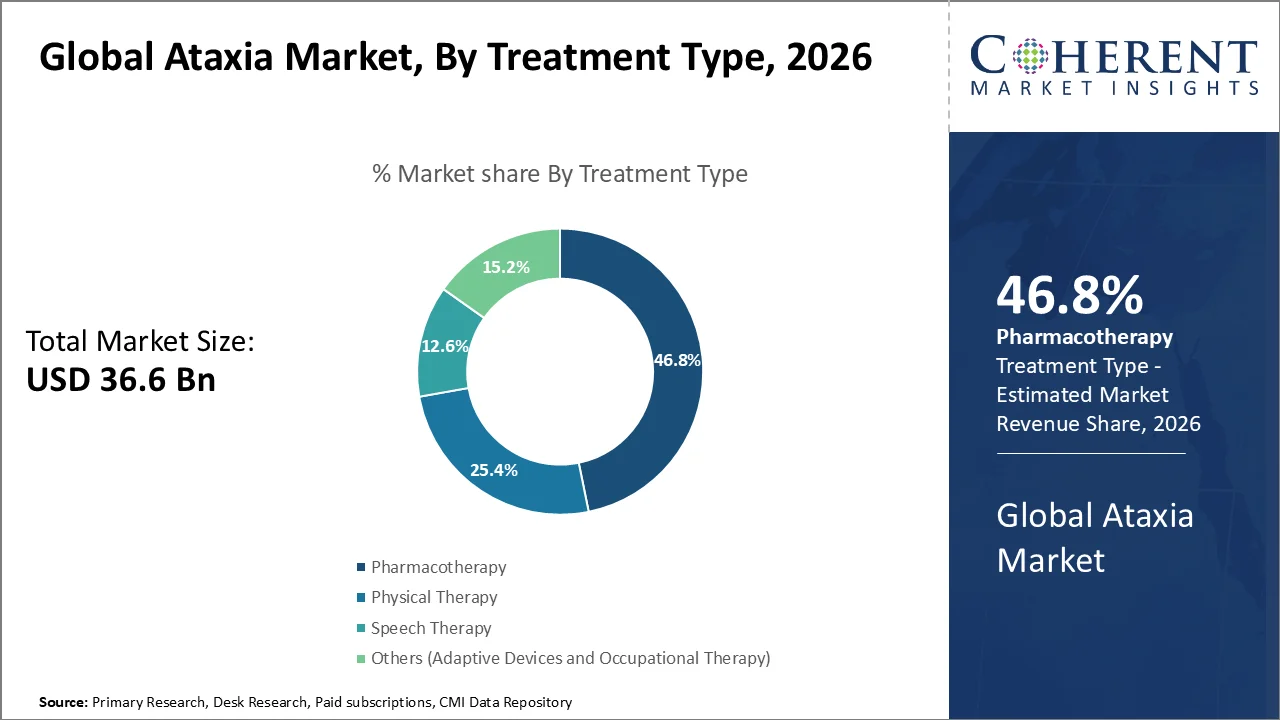
- The pharmacotherapy segment is likely to dominate the market with 46.8% in 2026. The segment’s growth is owing to the approval and adoption of disease-specific drugs, symptomatic medications, and pipeline therapies. According to the U.S. FDA, Skyclarys became the first approved treatment for Friedreich’s ataxia, supporting demand for oral specialty medicines in rare neurology care.
- The friedreich's ataxia segment is set to lead with 36.9% in 2026. The segment’s growth is owing to the its position as the most common inherited ataxia and the availability of the first approved therapy. According to FDA data, Friedreich’s ataxia affects about 1 in every 50,000 people in the U.S., creating a defined treatment population for specialty drug development.
- The hospital pharmacies segment is set to lead with 48.2% in 2026. The ataxia treatment often requires neurologist-led diagnosis, genetic confirmation, monitoring, and specialty drug dispensing. According to the WHO, April 2024, around 2.4 Bn people globally live with conditions that may benefit from rehabilitation, supporting hospital-led multidisciplinary care.
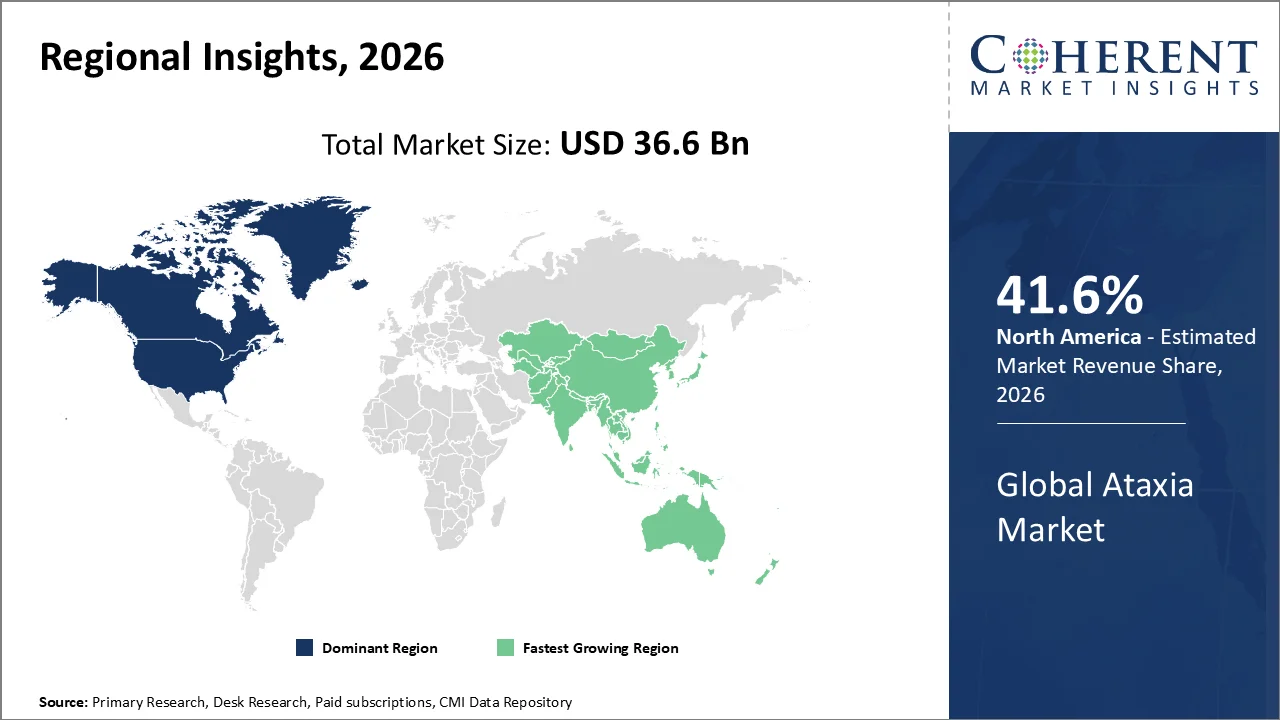
- North America is expected to acquire the prominent share of 41.6% in 2026. The region’s growth is owing to the FDA approvals, rare disease clinical trials, specialty pharmacy infrastructure, and strong patient advocacy networks. In June 2025, Biogen initiated the BRAVE Phase 3 pediatric study of omaveloxolone in children aged 2 to under 16 years, strengthening regional innovation in ataxia therapeutics.
Segmental Insights
Why is Pharmacotherapy Segment Acquiring the Largest Share?
On the basis of treatment type, the pharmacotherapy segment is projected to account for the largest Ataxia Market share of 46.8% in 2026. The segment’s growth is owing to its expanding clinical trial activity and regulatory approvals for disease-modifying therapies in Friedreich’s ataxia.
According to ClinicalTrials.gov, more than 25 active interventional studies are currently recruiting or ongoing for ataxia-related conditions, reflecting strong pharmacological pipeline expansion across gene therapy and mitochondrial-targeted drugs.
In April 2025, Lexeo Therapeutics announced the positive interim Phase 1/2 data for LX2006 in Friedreich ataxia cardiomyopathy. It has received continual regulatory engagement with the U.S. FDA in 2026 for potential accelerated approval evaluation based on the pooled clinical data. These advancements strengthen the prescription growth and neurologist-led pharmacotherapy adoption.
- Current Industry Events of 2026
- Market Size Estimation
- Regional Breakdown
- Competitive Landscape
- Customer Intelligence
- Segmental Analysis
- Pricing Analysis
- Key Market Drivers, Challenges & Future Trends
- Customized Insights Section
Friedreich's Ataxia hold the Largest Market Share
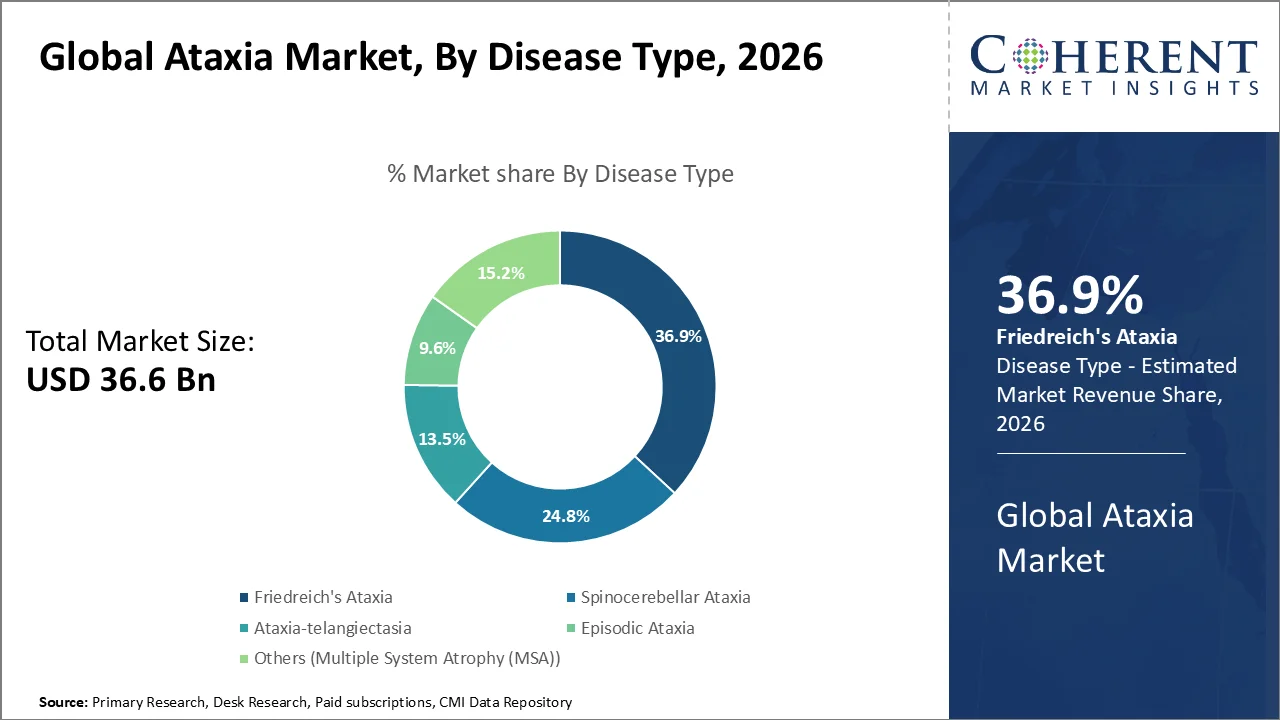
On the basis of disease type, the Friedreich's Ataxia segment lead with a major 36.9% share in 2026. The growth is owing to its position as the most common inherited ataxia, availability of approved pharmacotherapy, high unmet clinical need, and growing pipeline focus on frataxin restoration.
The segment is also supported by major therapeutic innovation. In February 2026, Larimar Therapeutics announced FDA Breakthrough Therapy Designation for nomlabofusp, a frataxin protein replacement therapy for adults and children with Friedreich’s ataxia.
Larimar stated that the planned BLA submission seeking accelerated approval was targeted for June 2026, with U.S. launch targeted for the first half of 2027 if approved. This strengthens the commercial outlook for Friedreich’s ataxia-focused therapies, particularly in the U.S. and Europe.
Market Drivers
Innovations in Rare Neurology Therapies are Transforming the Ataxia Market in Europe
The U.S. remains a key innovation hub for ataxia therapeutics due to FDA rare disease pathways, strong academic neurology centers, genetic testing access, and active clinical development across Friedreich’s ataxia and spinocerebellar ataxias. Innovation is shifting the market from symptom management toward disease-modifying approaches, including Nrf2 activation, frataxin replacement, gene therapy, and regenerative medicine.
In January 2025, Solid Biosciences announced FDA IND clearance for SGT-212, a dual-route gene therapy candidate designed to target both neurological and cardiac manifestations of Friedreich’s ataxia. Later in January 2025, the company received FDA Fast Track Designation for SGT-212.
Frataxin Restoration Gene Therapy: A Major Breakthrough in Ataxia Market
Frataxin restoration therapies represent a major breakthrough in the Ataxia Market. Friedreich’s ataxia is caused by reduced frataxin, a mitochondrial protein essential for cellular energy function. Traditional treatment has focused mainly on managing symptoms, improving balance, reducing complications, and supporting mobility. The newer approaches aim to address the underlying biological cause by increasing frataxin levels through gene therapy, protein replacement, or gene-expression modulation.
In June 2025, Design Therapeutics announced that the first Friedreich ataxia patient had been dosed ex-U.S. in its RESTORE-FA Phase 1/2 MAD trial of DT-216P2, a GeneTAC small molecule designed to restore endogenous frataxin expression. The company stated that data from 12 weeks of dosing are expected in 2026. Such innovations are expected to accelerate the Ataxia Market growth during the forecast period.
Current Events and Their Impact on the Ataxia Market
Current Event | Description and its Impact |
FDA regulatory scrutiny on vatiquinone, August 2025 |
|
Steminent/ReproCELL U.S. Phase II trial expansion, March 2026 |
|
Ataxia Market Trends
- The ataxia market is moving beyond physiotherapy, speech therapy, occupational therapy, and mobility aids toward disease-specific drugs, thereby strengthening the specialist treatment adoption.
- Growing clinical awareness of hereditary and degenerative ataxias is improving diagnosis, genetic counseling, and long-term patient management across neurology centers.
- Companies are targeting root biological causes such as frataxin deficiency. Solid Biosciences’ SGT-212 and Larimar’s nomlabofusp highlight the pipeline shift toward disease-modifying mechanisms rather than symptomatic treatment alone, supporting higher R&D investment, trial activity, and specialty-center demand.
- Genetic confirmation is becoming central to ataxia care because hereditary ataxias include many genes and repeat-expansion disorders. Mayo Clinic Laboratories reports that its inherited ataxia gene panel uses next-generation sequencing to detect variants in 198 genes associated with ataxia. This supports demand for genetic testing, specialist referrals, and precision trial enrollment.
- Premium pricing is becoming a major market access issue for approved therapies. The CDA-AMC review estimated the annual omaveloxolone cost at CAD 346,933 and indicated that a very large price reduction would be needed to meet conventional cost-effectiveness thresholds. This trend is expected to influence payer negotiations, access programs, and country-level uptake.
Regional Insights
North America Dominates Owing to the High Prevalence of Inherited Neurological Disorders and FDA-approved Therapy
The North America region accounts for 41.6% of the market share in 2026. The region’s growth is owing to the FDA-approved therapy, high rare-disease awareness, high prevalence of inherited neurological disorders, strong neurology research infrastructure, clinical trial capacity, and patient advocacy networks.
According to the data from the American Brain Foundation, an estimated 15,000 to 20,000 people in the United States suffer from spinocerebellar ataxia (SCA). In addition, the National Institutes of Health (NIH) notes that Friedreich's Ataxia (FA) is a primary driver, maintaining a global incidence rate of approximately 1 in 29,000 to 50,000 individuals.
The region’s prominence is also supported by active investment in specialty rare disease pipelines. In September 2025, Larimar Therapeutics announced the positive long-term open-label study data and updates to its nomlabofusp program, with 65 participants receiving at least one dose across completed and ongoing studies.
Asia Pacific Ataxia Market Trends
Asia Pacificis expected to witness strong growth in Ataxia Market over the forecast period. The region’s growth is owing to the rising neurological disease awareness, improved access to genetic testing, large aging populations, increasing rare disease policy attention, and expanding clinical development across Japan, China, Australia, South Korea, and India.
According to the Government of China, October 2024, China’s population aged 60 and above reached nearly 297 million in 2023, accounting for 21.1% of the total population. According to India’s Press Information Bureau, October 2025, India’s senior citizen population is projected to reach around 230 million by 2036, representing about 15% of the total population. These demographic shifts are expected to expand demand for neurological diagnosis, rehabilitation, and chronic care services.
In June 2025, Australia’s TGA approved Biogen’s SKYCLARYS (omaveloxolone) for Friedreich’s ataxia in patients aged 16 years and older under its orphan drug pathway. This approval supports regional uptake of oral pharmacotherapy, specialist prescribing, and follow-up monitoring.
Disease Prevalence and Regulatory Breakthroughs are Accelerating the Ataxia Market in United States Ataxia Market
The United States Ataxia Market is driven by the rising disease prevalence and crucial regulatory breakthroughs for rare neurodegenerative disorders. According to National Institutes of Health patient registries, Friedreich’s Ataxia affects an average prevalence of 3 to 4 individuals per 100,000 cases in Caucasian populations, highlighting a substantial pool of patients requiring specialized therapeutics.
In May 2026, U.S. FDA granted Priority Review to IntraBio’s supplemental New Drug Application for levacetylleucine (Aqneursa). This critical development establishes a PDUFA action date for September 19, 2026, positioning it to potentially become the first approved treatment for ataxia-telangiectasia.
Japan Ataxia Market Trends
Japan is expected to grow steadily due to advanced healthcare access, a large elderly population, and increasing attention to rare neurological disorders. According to Japan’s Annual Report on the Ageing Society FY2025, the elderly population share rose to 29.3%, creating strong demand for neurological care, mobility support, rehabilitation, and long-term treatment services.
Japan is also becoming relevant in ataxia clinical and regulatory expansion. In March 2026, REPROCELL stated that Steminent’s licensing partner had communicated with Japanese regulators and expected to submit a drug approval application for Stemchymal within the year. This supports Japan’s role as a high-value access market for advanced regenerative and rare neurology therapies.
Who are the Major Companies in Ataxia Industry
Some of the major key players in Ataxia Market are Pfizer, Inc., CRISPR Therapeutics, Acorda Therapeutics, Capsida Biotherapeutics Inc., Larimar Therapeutics, Inc., Healx, Intellia Therapeutics, Inc., Editas Medicine, bluebird bio, Inc., Sanofi, Merck & Co., Inc., H. Lundbeck A/S, Cellectis SA, Bio-Techne, GlaxoSmithKline plc, and Allergan.
Key News
- In February 2026, Solaxa Inc. entered a global license agreement with Alvogen for the development and commercialization of SLX-100 for Spinocerebellar Ataxia Type 27B (SCA27B). Under the agreement, Alvogen obtained worldwide rights while Solaxa is eligible to receive up to USD 95 million in milestone payments plus double-digit royalties on net sales.
- In March 2025, Health Canada approved Biogen’s SKYCLARYS (omaveloxolone) for Friedreich’s ataxia in patients aged 16 and older, making it the first therapy in Canada targeting disease progression. The approval highlights significant unmet need and was supported by MOXIe Phase 2 trial results demonstrating improved mFARS scores.
Market Report Scope
Ataxia Market Report Coverage
| Report Coverage | Details | ||
|---|---|---|---|
| Base Year: | 2025 | Market Size in 2026: | USD 36.6 Bn |
| Historical Data for: | 2020 To 2024 | Forecast Period: | 2026 To 2033 |
| Forecast Period 2026 to 2033 CAGR: | 8.8% | 2033 Value Projection: | USD 65.8 Bn |
| Geographies covered: |
| ||
| Segments covered: |
| ||
| Companies covered: | Pfizer, Inc., CRISPR Therapeutics, Acorda Therapeutics, Capsida Biotherapeutics Inc., Larimar Therapeutics, Inc., Healx, Intellia Therapeutics, Inc., Editas Medicine, bluebird bio, Inc., Sanofi, Merck & Co., Inc., H. Lundbeck A/S, Cellectis SA, Bio-Techne, GlaxoSmithKline plc, and Allergan | ||
| Growth Drivers: |
| ||
| Restraints & Challenges: |
| ||
Analyst Opinion
- Ataxia market expansion is supported by structural unmet need in rare neurology rather than short-term treatment trends. According to NORD’s February 2026 Rare Disease Day statement, more than 30 million Americans live with rare diseases, while fewer than 5% of more than 10,000 known rare diseases have an approved treatment. This indicates that diagnosis, drug development, and patient advocacy will remain long-term growth pillars for inherited ataxia markets.
- Friedreich’s ataxia remains a key commercial focus because it is the most common hereditary ataxia in the U.S., affecting about 1 in 50,000 people. Its progressive impact on walking, speech, swallowing, and cardiac health supports long-term treatment and monitoring needs.
- Pipeline quality will determine long-term market expansion because ataxia is genetically heterogeneous and many forms still lack approved therapies. GeneReviews 2025 states that up to 40% of adults with late-onset cerebellar ataxia and no family history may still lack an identified genetic cause despite comprehensive evaluation. This means future growth depends on better diagnostics, biomarker development, and therapies targeting broader ataxia subtypes.
Speak to the analyst
Want personalized insights?
Take the findings above to one of our principal consultants, or have the report rebuilt around the segments, geographies and competitors you actually track.
Market Segmentation
- By Treatment Type (Revenue, USD Bn, 2021-2033)
- Pharmacotherapy
- Levodopa
- Pramipexole
- Desvenlafaxine
- Venlafaxine
- Others (Acetazolamide, Scopolamine, Buspirone, Tizanidine, etc.)
- Physical Therapy
- Speech Therapy
- Others (Adaptive Devices and Occupational Therapy)
- Pharmacotherapy
- By Disease Type (Revenue, USD Bn, 2021-2033)
- Friedreich's Ataxia
- Ataxia-telangiectasia
- Spinocerebellar Ataxias
- Episodic Ataxia
- Others (Multiple System Atrophy (MSA))
- By Distribution Channel (Revenue, USD Bn, 2021-2033)
- Hospital Pharmacies
- Retail Pharmacies
- Online Pharmacies
- By Region (Revenue, USD Bn, 2021-2033)
- North America
- U.S.
- Canada
- Latin America
- Brazil
- Mexico
- Argentina
- Rest of Latin America
- Europe
- Germany
- U.K.
- France
- Italy
- Spain
- Russia
- Rest of Europe
- Asia Pacific
- China
- India
- Japan
- Australia
- South Korea
- ASEAN
- Rest of Asia Pacific
- Middle East
- GCC
- Israel
- Rest of Middle East
- Africa
- South Africa
- Central Africa
- North Africa
- North America
Sources
Primary Research Interviews
- Neurologists
- Movement disorder specialists
- Genetic counselors
- Rehabilitation specialists
- Hospital administrators
- Specialty clinic managers
- Pharmaceutical distributors
- Patient advocacy groups
- Key opinion leaders (KOLs) in neurology and rare diseases
Databases
- World Health Organization (WHO)
- Centers for Disease Control and Prevention (CDC)
- National Institutes of Health (NIH)
- National Institute of Neurological Disorders and Stroke (NINDS)
- ClinicalTrials.gov
- U.S. Food and Drug Administration (FDA)
- European Medicines Agency (EMA)
- Orphanet
- National Organization for Rare Disorders (NORD)
Magazines
- NeurologyLive
- Practical Neurology
- Rare Disease Advisor
- Neurology Today
- BioPharma Dive
Journals
- The Lancet Neurology
- Neurology
- Movement Disorders
- Journal of Neurology, Neurosurgery & Psychiatry
- Cerebellum
- Orphanet Journal of Rare Diseases
- Journal of Neurogenetics
Newspapers
- The New York Times
- The Guardian
- The Wall Street Journal
- Financial Times
- Reuters
Associations
- National Ataxia Foundation
- American Academy of Neurology
- European Academy of Neurology
- International Parkinson and Movement Disorder Society
- Friedreich’s Ataxia Research Alliance
- National Organization for Rare Disorders
Public Domain Sources
- Company Annual Reports And Investor Presentations
- Government Health Ministry Publications
- Clinical Trial Registries Such As ClinicalTrials.Gov
- Drug Approval Databases From FDA And EMA
- Rare Disease Registries And Public Health Reports
Proprietary Elements:
- CMI Data Analytics Tool
- Proprietary CMI Existing Repository of Information for Last 10 Years
Get access to 250+ pages report
Every segment, forecast, competitor profile and data table behind the analysis above — available for instant download.
- ESOMAR Member
- ISO 9001:2015 Certified
- D-U-N-S Registered
- GDPR & CCPA Compliant
Missing comfort of reading report in your local language? Find your preferred language:
Transform your Strategy with Exclusive Trending Reports
Frequently Asked Questions
The Ataxia Market is expected to reach USD 65.8 Bn in 2033.
Major players operating in the global Ataxia Market include Pfizer, Inc., CRISPR Therapeutics, Acorda Therapeutics, Capsida Biotherapeutics Inc., Larimar Therapeutics, Inc., Healx, Intellia Therapeutics, Inc., Editas Medicine, bluebird bio, Inc., Sanofi, Merck & Co., Inc., H. Lundbeck A/S, Cellectis SA, Bio-Techne, GlaxoSmithKline plc, and Allergan.
The rarity of the disease and the absence of curative or disease-modifying therapies are the key factors hampering growth of the market.
The rising disease prevalence, advancements in genetic testing, and increased biotech investments targeting rare neurological disorders is boosting the demand for Ataxia.
The Ataxia Market is anticipated to grow at a CAGR of 8.8% between 2026 and 2033.
Among regions, North America is expected to account for a largest market share in the global Ataxia Market over the forecast period.
Friedreich’s ataxia is one of the most studied forms of inherited ataxia due to its relatively higher prevalence among rare ataxias, early onset, and availability of active clinical pipeline programs targeting mitochondrial dysfunction and neuroprotection.