

Automated External Defibrillator Market Size and Share Analysis - 2026 to 2033
The automated external defibrillator market is estimated to be valued at USD 1,037.6 Mn in 2026 and expected to reach USD 1,770.2 Mn by 2033, witnessing a CAGR of 7.8% over the forecast period (2026-2033).
Key Takeaways
- Based on Analysis Type, the fully automated external defibrillator market is expected to hold 57% share in 2026.
- Based on End User, the hospitals/clinics segment is expected to lead the market with 66% share in 2026.
- Based on Region, North America is set to lead the automative external defibrillator market with 43% share in 2026. While, Asia Pacific region is anticipated to be the fastest growing.
Market Overview
Defibrillators are medical devices used to defibrillate or stabilize the heartbeat of an individual in a condition of arrhythmias (irregular heartbeat) and ventricular tachycardia (a heart rhythm disorder). Automated external defibrillators (AEDs) are used to revive someone from sudden cardiac arrest. The automated external defibrillator market is driven by rising cardiovascular diseases, increasing public awareness, government mandates for public access devices, technological advancements, and growing adoption across airports, schools, and workplaces.
Current Event and their Impact Automated External Defibrillator Market
Current Event | Description and its Impact |
AI and Smart Medical Device Integration Revolution |
|
Aging Population Demographics and Cardiac Health Crisis |
|
Can Wider AED Access Transform Cardiac Arrest Survival Rates Worldwide?
Aspect | Without AEDs | With AEDs | Unique Insights |
Global Burden | Millions affected annually; survival <10% | Survival can rise to 50–70% if AED used quickly | Cardiac arrest is the leading cause of death globally, accounting for ~15–20% of all deaths. |
AED Impact | Delayed intervention leads to poor outcomes | Immediate defibrillation drastically improves survival | Each minute of delay reduces survival by 7–10%; AED use within 3 minutes doubles survival chances. |
Public Access Programs | Limited AED coverage in rural/low-income areas | Airports, malls, schools show higher survival rates | Communities with AED programs report survival rates up to 3–5 times higher than those without. |
Response Time | EMS arrival averages 8–12 minutes | AED use by bystanders within 2–4 minutes | Early defibrillation bridges the critical gap before EMS arrives. |
Awareness & Training | Many bystanders hesitate to act | CPR + AED training boosts confidence and usage | Public campaigns (e.g., Restart a Heart Day) increase AED usage rates by 20–30%. |
- Current Industry Events of 2026
- Market Size Estimation
- Regional Breakdown
- Competitive Landscape
- Customer Intelligence
- Segmental Analysis
- Pricing Analysis
- Key Market Drivers, Challenges & Future Trends
- Customized Insights Section
Segmental Insights
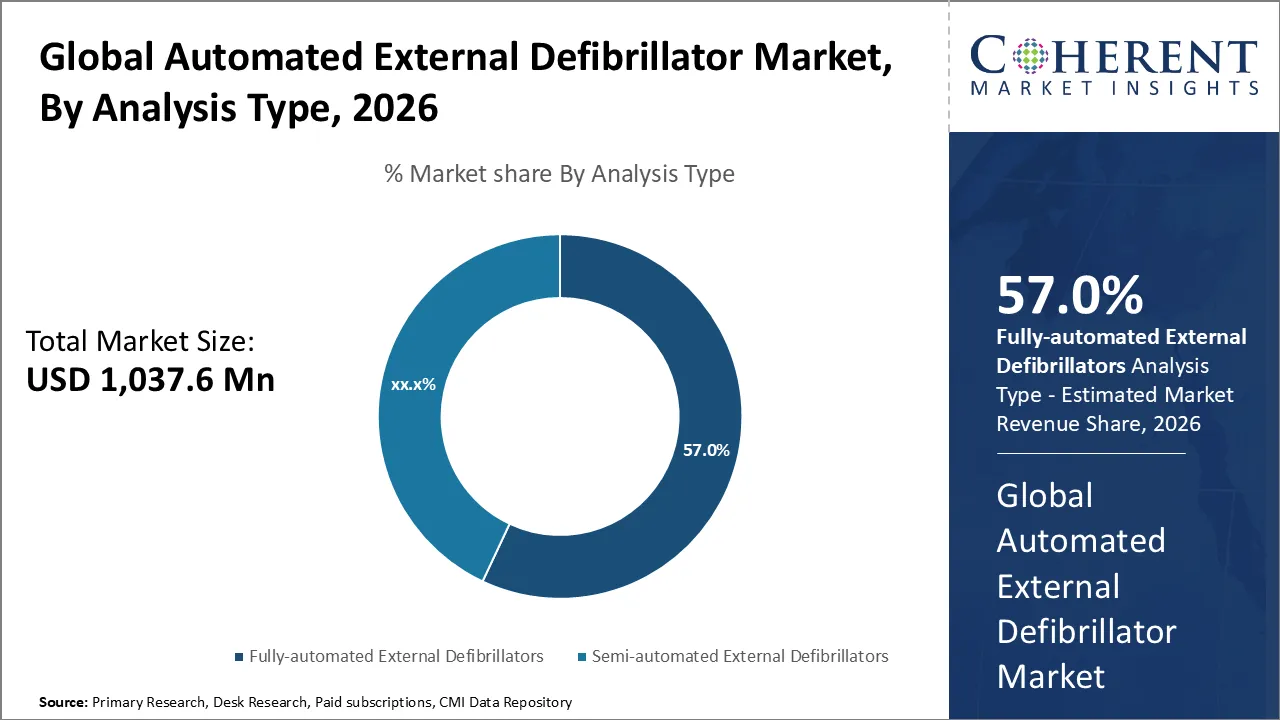
Automated External Defibrillator Market Insights, By Analysis Type: Fully automated external defibrillators dominate due to ease of use and reduced errors
In terms of analysis type, the fully automated external defibrillator segment is expected to hold 57% share in 2026, as they simplify operation for untrained users. They automatically deliver shocks without the need for manual intervention. Public access programs in schools, airports, and workplaces, where regular people use them, are what drives their adoption. They are the best choice in community settings because they have lower error rates and faster response times. This makes them more accessible and improves survival rates in cases of sudden cardiac arrest.
For instance, in January 2026, after acquiring Philips' Emergency Care business, Heartstream has become an independent emergency care company. The company will keep making HeartStart AEDs, professional defibrillators, and monitoring systems. Its main goals are to make automated external defibrillators more available to the public and at home, and to push the envelope in emergency care technology.
Automated External Defibrillator Market Insights, By End User: Hospitals and clinics lead is driven by regulations and emergency preparedness standards
In terms of end user, the hospitals/clinics segment is expected to lead the market with 66% share in 2026, because they have strict emergency preparedness standards, are part of critical care infrastructure, and high volume of patients. Institutions that use AEDs make sure that help is available right away during heart emergencies, which makes them even more powerful. Regulatory requirements and established training protocols make hospitals and clinics the main users.
For instance, in March 2026, the Community Heartbeat Program at Doylestown Hospital donating automated external defibrillators (AEDs) to local groups to help them be more prepared for emergencies and improve survival rates during cardiac arrests. The program makes it easier for people to get their hands on life-saving devices, which means that more people in the community will be ready to act quickly when every second counts.
Regional Insights
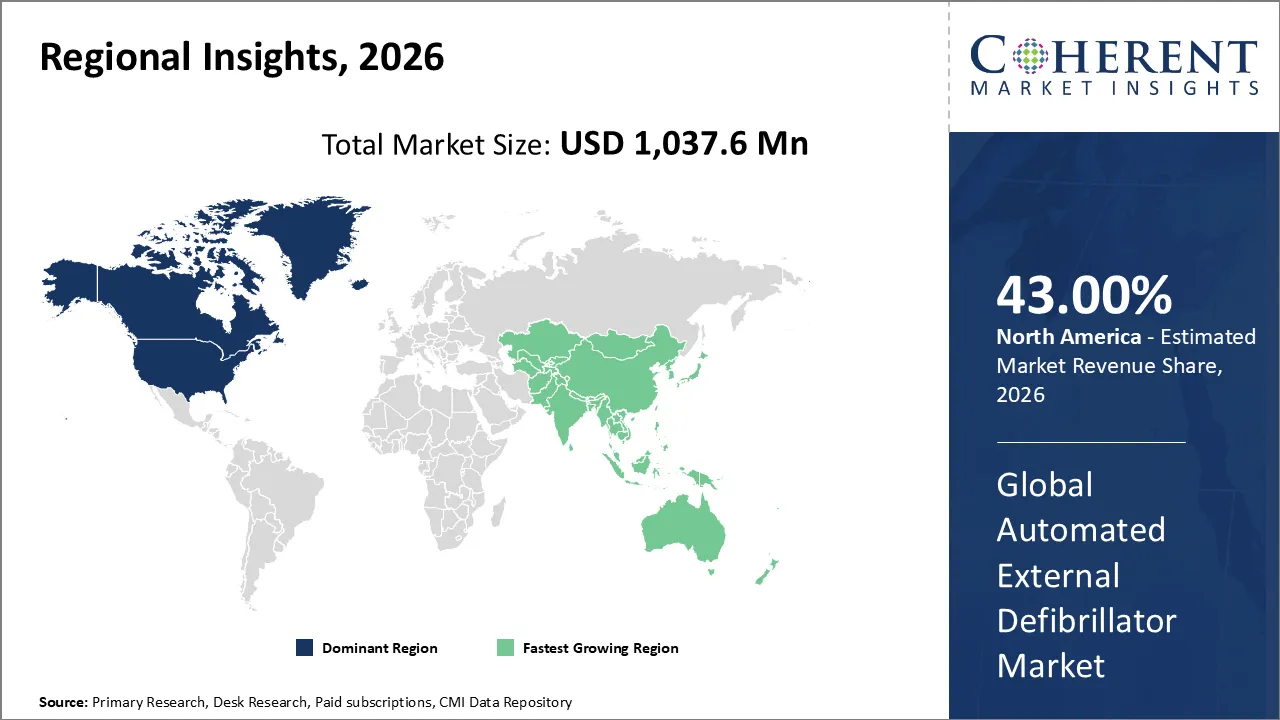
Automated External Defibrillator Market Analysis & Trends
North America is expected to lead the market with 43% share in 2026, due to widespread public access programs, strong government mandates, and advanced healthcare infrastructure. The region is the biggest contributor to global market revenues because of high awareness, extensive CPR/AED training, and installations in airports, schools, and workplaces.
For instance, in February 2026, the city of McKinney, Texas, has started a program to distribute 400 automated external defibrillators (AEDs) to homes. The goal is to increase the number of people who survive sudden cardiac arrest. The program provides AEDs in homes, which makes life-saving technology more available. This means that emergency responders can get to people faster and that the whole region is better prepared for health emergencies.
Asia Pacific Automated External Defibrillator Market Analysis & Trends
Asia Pacific is expected to exhibit the fastest growth, driven by heart disease, the government is supporting health initiatives, and more people in cities are becoming aware of the problem. Affordable portable AEDs and installations in schools, workplaces, and malls in India and China are driving rapid adoption, making the region the fastest-growing in the world.
For instance, in October 2025, A company in Hokkaido has made an AED-themed toy to help people learn how to respond to cardiac arrest. The educational product is meant to help kids and communities understand the importance of automated external defibrillators. It does this by making people more comfortable with and confident in being prepared for emergencies, and by getting more people interested in life-saving technology.
Automated External Defibrillator Market Outlook Country-Wise
The U.S. Automated External Defibrillator Market Trends
In 2026, the demand for automated external defibrillators in the U.S. will be high because of strong government requirements, programs that make them widely available to the public, and advanced healthcare infrastructure. The U.S. is the biggest contributor to global revenues because of high awareness, extensive CPR/AED training, and installations in airports, schools, malls, and workplaces.
For instance, in December 2025, PulsePoint and ZOLL are working together to help the National Emergency AED Registry in the US grow faster. The project makes it easier for people in the community to get to automated external defibrillators by mapping and keeping track of them all over the country. This speeds up emergency response and raises the chances of survival during sudden cardiac arrest events.
Australia Automated External Defibrillator Market Trends
In 2026, demand for automated external defibrillators in Australia is growing owing to strong government health programs, mandatory safety rules at work, and more people knowing about the risks of sudden cardiac arrest. More and more schools, airports, and corporate offices are getting AEDs, and portable AEDs are becoming more affordable. This is making Australia a major contributor to growth in the Asia-Pacific region.
For instance, in October 2025, On Restart a Heart Day, the Ambulance Service of New South Wales released a new AED map that makes it easier for people to find defibrillators in an emergency. The initiative makes it easier for people to get to know about and be ready for sudden cardiac arrest, which means that people in New South Wales will be able to respond more quickly and improve their chances of survival.
Market Report Scope
Automated External Defibrillator Market Report Coverage
| Report Coverage | Details | ||
|---|---|---|---|
| Base Year: | 2025 | Market Size in 2026: | USD 1,037.6 Mn |
| Historical Data for: | 2020 To 2024 | Forecast Period: | 2026 To 2033 |
| Forecast Period 2026 to 2033 CAGR: | 7.8% | 2033 Value Projection: | USD 1,770.2 Mn |
| Geographies covered: |
| ||
| Segments covered: |
| ||
| Companies covered: | CU Medical System Inc., ViVest Medical, BPL Medical Technologies Pvt. Ltd., Mediana Co. Ltd., Stryker Corporation, Schiller AG, Nihon Kohden Corporation, Koninklijke Philips NV, Asahi Kasei Corporation, and Shenzhen Mindray Bio-Medical Electronics Co. Ltd., among others | ||
| Growth Drivers: |
| ||
| Restraints & Challenges: |
| ||
Automated External Defibrillator Market Driver
Increasing prevalence of cardiovascular diseases
The rise in heart disease around the world is a significant health problem that makes it important to find good emergency response solutions. A greater number of individuals are having sudden cardiac arrests because of sedentary lifestyle, are stressed out, and are getting older. This trend is directly driving the Automated External Defibrillator Market growth, as hospitals, public places, and workplaces use AEDs to save more lives. The increasing number of heart-related diseases makes defibrillators necessary, not just optional. This creates strong momentum for new ideas and wider use around the world.
Increasing awareness among people about defibrillators
Public health campaigns and educational programs have made people much more aware of the significance of defibrillators are in saving lives during heart emergencies. Increasingly communities, schools, and businesses are investing in AEDs, and training programs give people the skills they need to use them safely. As people learn more about the important role AEDs play in saving lives, the Automated External Defibrillator Market demand rises. The change from limited medical use to widespread access shows the awareness is changing adoption trends around the world.
Automated External Defibrillator Market Opportunity
Expanding Public Access Programs
As governments and NGOs investing more on AEDs in airports, schools, malls, and workplaces, expanding public access programs are becoming a major factor in the Automated External Defibrillator Market forecast. These projects not only make people more ready for emergencies, but they also give manufacturers new ways to make revenue by reaching more customers than just hospitals. In India, urban areas like Pune are witnessing an increased amount of use in schools and businesses, which shows that people are becoming more interested in community health and safety through easy-to-use defibrillation solutions.
For instance, in March 2026, A Swedish company called Everdrone got €3.4 million to grow its medical drone services. The drones bring automated external defibrillators and other emergency supplies right to the scene of a cardiac arrest, which speeds up response times. The funding helps the organization grow, increases the chances of survival, and makes Sweden a leader in new emergency healthcare solutions.
Recent Developments
- In December 2025, to improve emergency response, Ankara, Turkey, has started a program to set automated external defibrillators (AEDs) all over the city. The goal of the initiative is to lower the number of deaths from cardiac arrest by making life-saving technology more readily available in public places. This will give citizens and responders the tools they need to act quickly when every second counts.
- In September 2025, Safe Life has acquired AED Brands, a top distributor of automated external defibrillators based in Atlanta. The acquisition makes Safe Life stronger in the AED market, making it easier for people to get life-saving devices and services. This action makes communities more ready for emergencies and helps emergency response efforts across the country.
Analyst Opinion (Expert Opinion)
- Prevalence of cardiac arrest and AEDs Impact: In the United States, about 356,000 people die from sudden cardiac arrest outside of a hospital each year. For every minute without defibrillation, the chances of survival drop by 7–10%. Research indicates that immediate use of an AED can boost survival odds to between 50 and 70 percent. Conversely, delaying its deployment significantly diminishes those chances, often dropping them below 10 percent. This information shows importance of AEDs accessibility in public places, workplaces, and homes.
- Deployment and changes in technology: More AEDs are being installed schools, airports, and community centers, which shows that public safety is becoming more important. Fully automated AEDs are less likely to cause mistakes than semi-automated ones. Devices designed for children are made to meet their specific needs. Adding smart features, like connecting to emergency services and real-time monitoring, makes AEDs more effective, improving their reliability and ease of use in emergencies.
Speak to the analyst
Want personalized insights?
Take the findings above to one of our principal consultants, or have the report rebuilt around the segments, geographies and competitors you actually track.
Market Segmentation
- By Analysis Type
- Semi-automated External Defibrillators
- Fully-automated External Defibrillators
- By End User
- Hospitals/Clinics
- Home Care
- Other End Users
- By Region
- North America
- U.S.
- Canada
- Latin America
- Brazil
- Argentina
- Mexico
- Rest of Latin America
- Europe
- Germany
- U.K.
- Spain
- France
- Italy
- Russia
- Rest of Europe
- Asia Pacific
- China
- India
- Japan
- Australia
- South Korea
- ASEAN
- Rest of Asia Pacific
- Middle East & Africa
- GCC Countries
- Israel
- Rest of Middle East & Africa
- North America
- Key Players
- Asahi Kasei Corporation
- Koninklijke Philips NV
- Nihon Kohden Corporation
- Schiller AG
- Shenzhen Mindray Bio-Medical Electronics Co. Ltd
- Stryker Corporation
- CU Medical System Inc.
- Mediana Co. Ltd.
- BPL Medical Technologies Pvt. Ltd.
- ViVest Medical
Sources
Primary Research Interviews
- Automated External Defibrillator Manufacturers
- Defibrillator Component Suppliers
- Emergency Medical Device Distributors
- Hospital Procurement Managers
- Emergency Response and Public Access Defibrillation Consultants
- Others
Databases
- Bloomberg Terminal
- Others
Magazines
- Medical Design & Outsourcing
- MedTech Dive
- EMS World
- Healthcare Business Today
- Others
Journals
- Resuscitation
- Journal of the American Heart Association
- Circulation
- American Journal of Emergency Medicine
- Others
Newspapers
- Financial Times
- The Wall Street Journal
- Reuters
- Bloomberg News
- Others
Associations
- American Heart Association (AHA)
- European Resuscitation Council (ERC)
- Sudden Cardiac Arrest Foundation
- Heart Rhythm Society (HRS)
- Others
Public Domain Sources
- U.S. Food and Drug Administration (FDA)
- National Institutes of Health (NIH)
- Centers for Disease Control and Prevention (CDC)
- World Health Organization (WHO)
- American Heart Association (AHA)
- Others
Proprietary Elements
- CMI Data Analytics Tool
- Proprietary CMI Existing Repository of Information for the Last 8 Years
Get access to 250+ pages report
Every segment, forecast, competitor profile and data table behind the analysis above — available for instant download.
- ESOMAR Member
- ISO 9001:2015 Certified
- D-U-N-S Registered
- GDPR & CCPA Compliant
Missing comfort of reading report in your local language? Find your preferred language:
Transform your Strategy with Exclusive Trending Reports
Frequently Asked Questions
The global Automated External Defibrillator Market size was valued at USD 1,037.6 Mn in 2026 and is expected to reach USD 1,770.2 Mn in 2033.
The global automated external defibrillator market size is estimated to be valued at USD 1,037.6 Mn in 2026 and is expected to exhibit a CAGR of 7.8% between 2026 and 2033.
Increasing prevalence of cardiovascular diseases and increasing awareness among people about defibrillators are fueling the growth of the market.
The fully automated external defibrillators segment is the leading analysis type segment in the market.
Stringent rules and regulations regarding medical devices and lack of awareness about sudden cardiac arrest are major factors restraining growth of the market.
Major players operating in the market are CU Medical System Inc., ViVest Medical, BPL Medical Technologies Pvt. Ltd., Mediana Co. Ltd., Stryker Corporation, Schiller AG, Nihon Kohden Corporation, Koninklijke Philips NV, Asahi Kasei Corporation, and Shenzhen Mindray Bio-Medical Electronics Co. Ltd., among others.