

Benzene Toluene Xylene Market Size and Forecast – 2026 to 2033
The Benzene Toluene Xylene Market is anticipated to grow at a CAGR of 7.2% with USD 291.7 Bn in 2026 and is expected to reach USD 521.6 Bn in 2033. Rising demand for plastics, synthetic fibers, PET packaging, paints, coatings, solvents, and polyurethane products drives the Benzene, Toluene, and Xylene (BTX) Market. Benzene, toluene, and xylene are key aromatic hydrocarbons widely used as feedstocks and solvents in the production of plastics, synthetic fibers, coatings, adhesives, detergents, and other industrial products.
Key Takeaways
- Catalytic Reforming hold the largest market share of 38.8% in 2026 owing to the growing demand for petrochemical feedstocks. Petrochemical feedstocks account for approximately 12% of global oil demand.
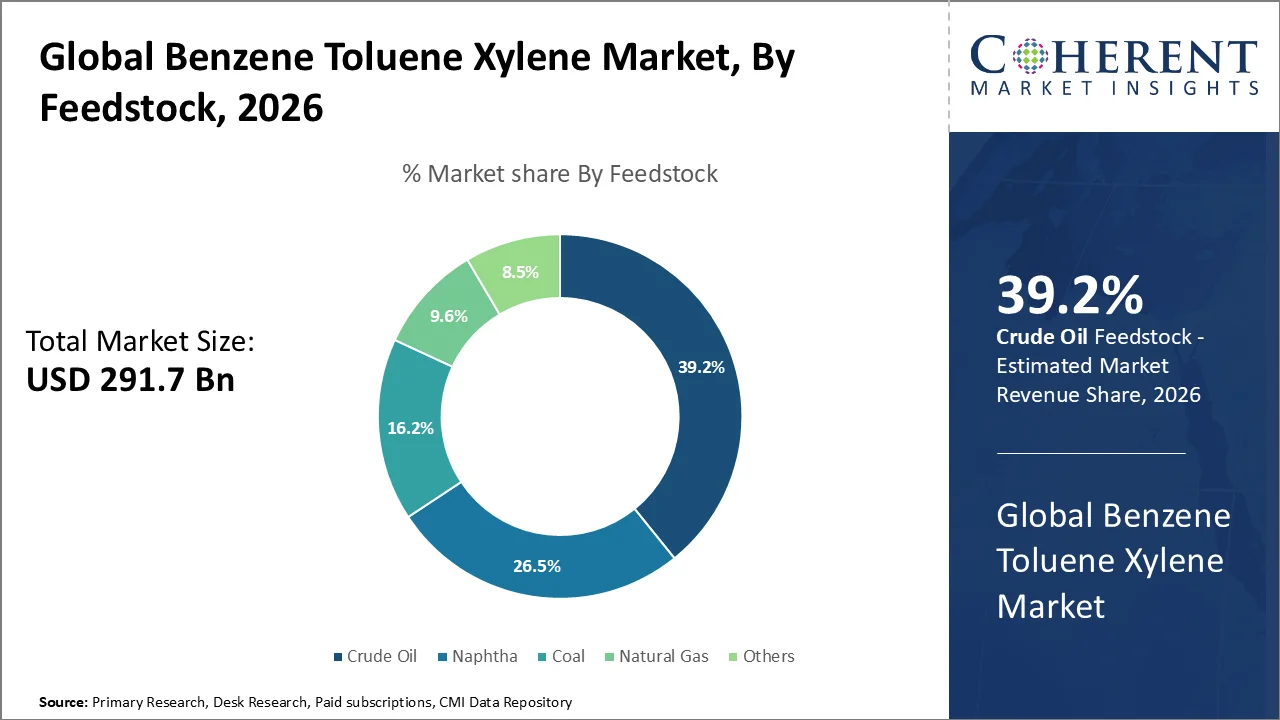
- Crude Oil expected to hold largest market share of 39.2% in 2026 owing to its availability of crude oil and refinery feedstock. The United States is the world’s largest crude oil producer, with total oil production reaching approximately 21.1 million barrels per day in 2025.
- Benzene acquired the prominent market share of 42.2% in 2026 owing to the growing demand for styrene and polystyrene.
- Pharmaceuticals captures the largest market share of 39.9% in 2026 owing to its growth of pharmaceutical manufacturing. India’s pharmaceutical industry ranks third globally by volume and 11th by value, comprising more than 3,000 companies and 10,500 manufacturing facilities.
- North America is expected to acquire the dominant share of 43.7% in 2026 owing to the large refining and petrochemical infrastructure. The Galveston Bay Refinery is the largest oil refinery in the United States, with a crude oil processing capacity of approximately 631,000 barrels per day.
Current Events and Their Impact on the Benzene Toluene Xylene Market
Current Event | Description and its Impact |
South Korea’s Emergency Controls on Petrochemical Feedstocks – April 2026 |
|
U.S. EPA Enforcement of Benzene Controls at Petroleum Refineries – 2025 |
|
Segmental Insights
- Current Industry Events of 2026
- Market Size Estimation
- Regional Breakdown
- Competitive Landscape
- Customer Intelligence
- Segmental Analysis
- Pricing Analysis
- Key Market Drivers, Challenges & Future Trends
- Customized Insights Section
Why is Catalytic Reforming Acquiring the Largest Market Share?
Catalytic Reforming hold the largest market share of 38.8% in 2026. Catalytic reforming drives the Benzene, Toluene and Xylene (BTX) market by converting heavy naphtha into high-octane, aromatics-rich reformate that contains substantial amounts of benzene, toluene, and xylene. Rising refinery throughput, increasing demand for high-octane gasoline, and greater refinery–petrochemical integration encourage reforming activity. Growing demand for BTX-derived products, including plastics, synthetic fibers, resins, and solvents, further promotes aromatics recovery. Moreover, refineries use the hydrogen generated during reforming to support hydrotreating and other hydrogen-intensive operations.
Crude Oil expected to hold largest market share
Crude Oil expected to hold largest market share of 39.2% in 2026 owing to its refinery–petrochemical integration. Crude oil supports the Benzene, Toluene and Xylene (BTX) market by supplying petroleum-derived naphtha, a primary feedstock for aromatics production through catalytic reforming. Refineries increase BTX output when they raise crude processing rates and generate more naphtha. The quality of crude oil also affects naphtha composition and its potential for aromatics production. Greater refinery–petrochemical integration encourages producers to convert crude-derived streams into higher-value BTX products. Strong demand for petrochemical intermediates and high-octane gasoline further encourages crude processing for aromatics-rich reformate.
Which Derivative segment dominates the market?
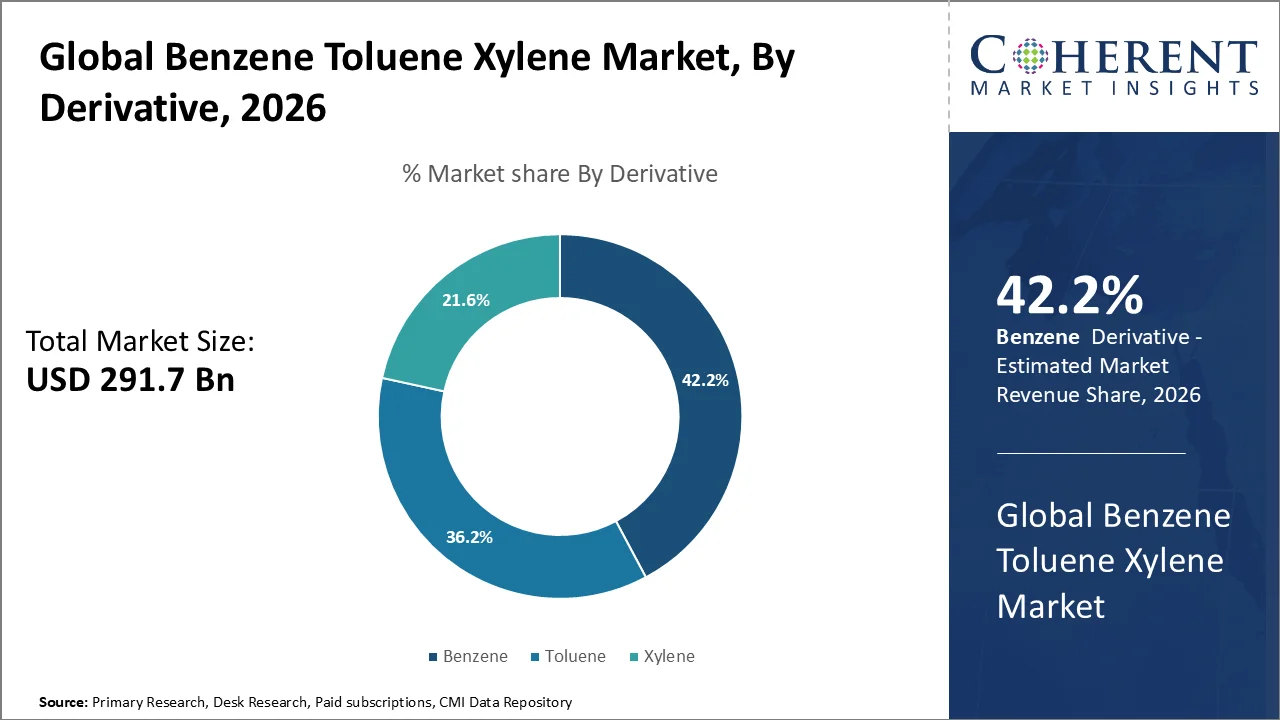
Benzene acquired the prominent market share of 42.2% in 2026. Benzene drives the Benzene, Toluene and Xylene (BTX) market by supporting growing demand across downstream chemical industries. Manufacturers increasingly produce styrene, phenol, cyclohexane, nitrobenzene, and alkylbenzene, which expands benzene consumption in plastics, resins, nylon, detergents, and specialty chemicals. More than 460 million metric tons of plastic are produced globally each year for various applications. Rising demand for packaging, automotive components, construction materials, and synthetic fibers further increases the use of benzene derivatives. Expanding petrochemical capacity and stronger refinery–petrochemical integration improve benzene availability, while pharmaceutical and chemical manufacturers increase demand for benzene-based intermediates.
Benzene Toluene Xylene Market Trends
- Growing petrochemical feedstock demand supports BTX consumption. The International Energy Agency (IEA) reports that global oil consumption in 2024 was 1.3% above 2019 levels, with petrochemical feedstock demand increasing by more than 12% over the previous five years. This sustained growth in petrochemical feedstock use supports demand for aromatics such as benzene, toluene and xylenes used in downstream chemicals and materials.
- Petrochemicals are becoming an increasingly important source of oil demand growth. According to the IEA's Oil 2025outlook, petrochemicals are expected to become the dominant source of global oil-demand growth from 2026 onward. By 2030, production of polymers and synthetic fibers is projected to require 18.4 million barrels of oil per day, equivalent to more than one in every six barrels. This structural shift supports long-term demand for petrochemical feedstocks and aromatic intermediates.
- Asia-Pacific remains central to petrochemical demand growth. The IEA expects China and the United States to lead global petrochemical capacity expansion, while emerging Asian economies contribute substantially to oil-demand growth. India alone is projected to account for approximately 1 million barrels per day of additional oil demand between 2024 and 2030, the largest increase among individual countries. These developments support continued expansion of petrochemical and aromatics value chains in Asia.
- Para-xylene remains closely linked to polyester and PET production. India's Department of Chemicals and Petrochemicals reported 4.02 million tonnes/year of purified terephthalic acid (PTA) capacity and 2.59 million tonnes/year of PET/polyester-chip capacity in 2024–25. PTA is a major downstream product of para-xylene, linking PX demand to polyester and PET manufacturing.
Regional Insights
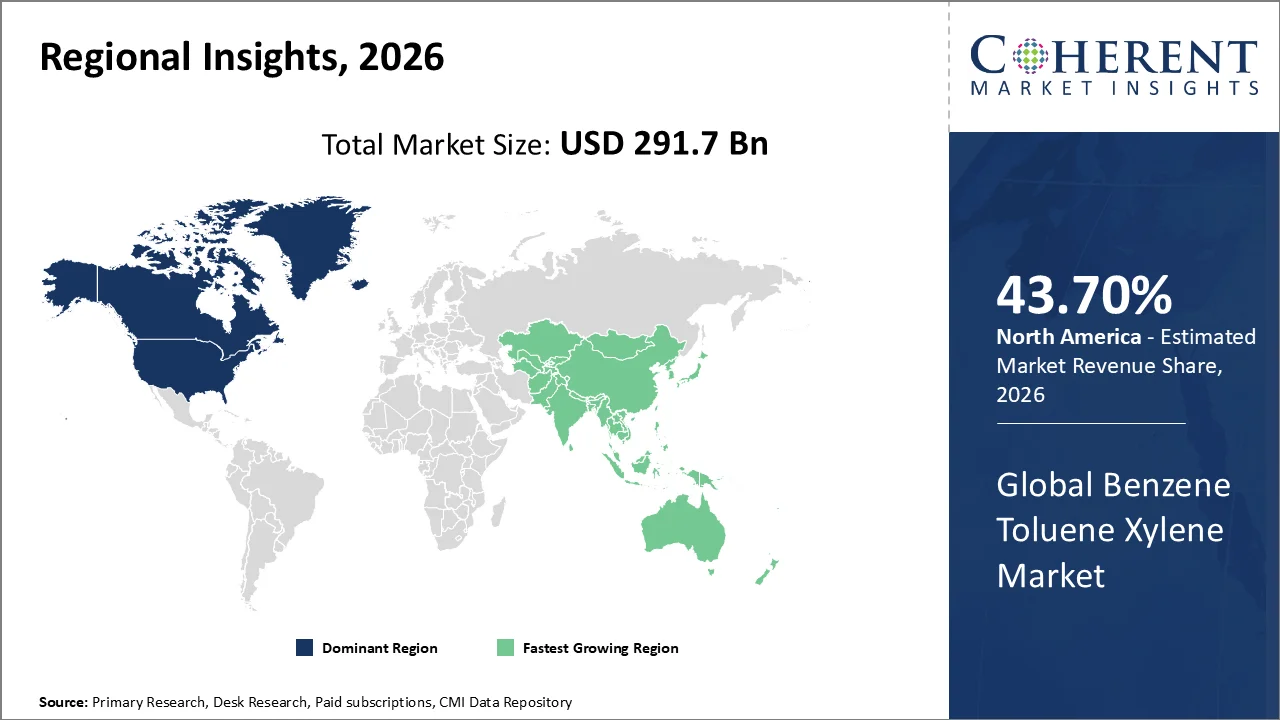
North America dominates owing to demand from automotive and construction industries
North America is expected to acquire the dominant share of 43.70% in 2026. North America strengthens the Benzene, Toluene and Xylene (BTX) market through its extensive refining and petrochemical infrastructure, especially across the U.S. Gulf Coast. The region’s abundant shale-derived feedstocks enable producers to manufacture aromatics competitively, while integrated refinery–petrochemical facilities efficiently convert naphtha and reformate into BTX products. Strong demand from the plastics, resins, synthetic fibers, solvents, automotive, and construction industries further drives consumption. Additionally, rising high-octane gasoline demand and expanding chemical manufacturing capacity support regional BTX production and utilization. The U.S. FDA launched a comprehensive review of butylated hydroxyanisole (BHA), assessing its safety in food and food-contact applications based on the latest scientific evidence.
Asia Pacific Benzene Toluene Xylene Market Trends
Rapid industrialization, expanding petrochemical and refining capacity, and strong downstream demand continue to drive Asia Pacific’s Benzene Toluene Xylene (BTX) market. Automotive, construction, electronics, packaging, textiles, and paints and coatings manufacturers increasingly consume BTX-derived products. China, India, South Korea, and Southeast Asian economies are expanding regional production by investing in integrated refineries and aromatics complexes. Growing demand for polyester, styrene, plastics, synthetic fibers, solvents, and chemical intermediates, combined with urbanization and manufacturing expansion, continues to strengthen the regional BTX market. Rajasthan CM Bhajanlal Sharma said Prime Minister Narendra Modi inaugurated HPCL’s integrated refinery-cum-petrochemical complex at Pachpadra, Balotra, on April 21. The project costs INR 79,459 crore and has a refining capacity of 9 million metric tonnes annually.
United States Benzene Toluene Xylene Market Trends
Strong demand from the petrochemical, automotive, construction, packaging, coatings, and chemical industries drives the United States BTX market. Benzene producers serve growing demand for styrene, phenol, and nylon, while toluene supports gasoline blending, solvent applications, and chemical intermediates. Xylene producers benefit from rising para-xylene demand for PET and polyester manufacturing. Integrated refinery and petrochemical facilities strengthen domestic supply, while expanding downstream applications and manufacturing activity continue to create new opportunities for BTX producers across the United States.
China Benzene Toluene Xylene Market Trends
China’s Benzene, Toluene, and Xylene (BTX) market benefits from expanding petrochemical and refining integration and growing demand for styrene, polyester, solvents, coatings, and other downstream chemicals. Producers are increasing para-xylene output to meet rising xylene demand, while gasoline blending and disproportionation applications continue to support toluene consumption. China also invests in advanced petrochemical complexes and strengthens domestic feedstock supply. In addition, producers leverage export opportunities to manage surplus supply and optimize production and trade flows.
Who are the Major Companies in Benzene Toluene Xylene Industry
Some of the major key players in Benzene Toluene Xylene are Exxon Mobil Corporation, UOP LLC Royal Dutch Shell Plc., Eastman Chemical Company, BASF SE, LyondellBasell Industries N.V. Chevron Phillips Chemical Company LLC. Ashland Inc. Celanese Corporation, DEZA a. s., Honeywell UOP, Huntsman Corporation, INEOS AG, Oil Refineries Ltd., and Petrochem Carless
Key News
- In November 2025, Lotte Chemicalcommenced operations at its KRW 5.7 trillion (approximately $3.9 billion) petrochemical complex in Indonesia, strengthening its presence in the country’s growing, feedstock-driven chemical market.
Market Report Scope
Benzene Toluene Xylene Market Report Coverage
| Report Coverage | Details | ||
|---|---|---|---|
| Base Year: | 2025 | Market Size in 2026: | USD 291.7 Bn |
| Historical Data for: | 2020 To 2024 | Forecast Period: | 2026 To 2033 |
| Forecast Period 2026 to 2033 CAGR: | 7.2% | 2033 Value Projection: | USD 521.6 Bn |
| Geographies covered: |
| ||
| Segments covered: |
| ||
| Companies covered: | Exxon Mobil Corporation, UOP LLC Royal Dutch Shell Plc., Eastman Chemical Company, BASF SE, LyondellBasell Industries N.V., Chevron Phillips Chemical Company LLC., Ashland Inc., Celanese Corporation, DEZA a. s., Honeywell UOP, Huntsman Corporation, INEOS AG, Oil Refineries Ltd., and Petrochem Carless | ||
Analyst Opinion
- China’s BTX market is increasingly shaped by refinery-to-chemical integration rather than standalone aromatics economics. China’s major integrated complexes, including Zhejiang Petrochemical’s Zhoushan project and Hengli Petrochemical’s Dalian complex, have added substantial aromatics capacity alongside refining and downstream units. In my view, this integration gives Chinese producers a structural advantage by allowing them to convert refinery feedstocks directly into higher-value benzene, toluene, and para-xylene, reducing reliance on external feedstock and improving operating flexibility.
- Para-xylene remains the strongest demand anchor within China’s BTX chain, largely because polyester production absorbs enormous volumes of PX through purified terephthalic acid (PTA). China accounts for the dominant share of global polyester manufacturing, while its PTA capacity has expanded rapidly through projects from producers such as Hengli, Zhejiang Yisheng, and Sinopec-linked operations. This creates a powerful internal pull for aromatics: when polyester and PTA margins strengthen, Chinese PX consumption can rise quickly, tightening the wider aromatics balance.
- Benzene demand is being reinforced by China’s expanding styrene and downstream chemical base, supply growth to remain the key constraint on producer margins. China has added large-scale styrene capacity, with integrated petrochemical operators such as Sinochem and Zhejiang Petrochemical strengthening domestic supply. Benzene also feeds phenol, cyclohexane, and aniline production. The important point for investors is that China can rapidly increase benzene availability through refinery utilization and aromatics extraction, meaning strong downstream demand does not automatically translate into sustained benzene price strength.
- Toluene presents a more volatile opportunity because Chinese producers can redirect material between gasoline blending, solvent applications, and chemical conversion. Toluene disproportionation and trans alkylation units allow producers to convert toluene into higher-value aromatics, particularly benzene and PX. This flexibility makes China’s toluene market unusually sensitive to relative aromatics spreads. In my opinion, producers with integrated conversion capacity are better positioned to protect margins when direct toluene demand weakens, while less-integrated suppliers remain more exposed to inventory and price swings.
Speak to the analyst
Want personalized insights?
Take the findings above to one of our principal consultants, or have the report rebuilt around the segments, geographies and competitors you actually track.
Market Segmentation
- By Process (Revenue, USD Bn, 2021-2033)
- Catalytic Reforming
- Steam Cracking
- Hydrodealkylation
- Coke Oven Light Oil
- Others
- By Feedstock (Revenue, USD Bn, 2021-2033)
- Crude Oil
- Naphtha
- Coal
- Natural Gas
- Others
- By Derivative (Revenue, USD Bn, 2021-2033)
- Benzene
- Ethylbenzene
- Cumene
- Cyclohexane
- Aniline
- Others
- Toluene
- Benzene
- Xylene
- Toluene diisocyanate
- Solvents & Others
- Xylene
- Terephthalic acid
- Phthalate Anhydride
- Solvents & Others
- Benzene
- By End Users (Revenue, USD Bn, 2021-2033)
- Pharmaceuticals
- Solvent
- Laboratory Use
- Others
- Chemicals
- Pesticide
- Detergents
- Resins
- Dyes
- Others
- Oilfield
- Additives
- Corrosion Inhibitors
- Others
- Automotive
- Motor Fuel
- Adhesive
- Sealant
- Others
- Paints and Coatings
- Solvent
- Diluents
- Thinner
- Binding Agent
- Others
- Pharmaceuticals
- By Region (Revenue, USD Bn, 2021-2033)
- North America
- U.S.
- Canada
- Latin America
- Brazil
- Mexico
- Argentina
- Rest of Latin America
- Europe
- Germany
- U.K.
- France
- Italy
- Spain
- Russia
- Rest of Europe
- Asia Pacific
- China
- India
- Japan
- Australia
- South Korea
- ASEAN
- Rest of Asia Pacific
- Middle East
- GCC
- Israel
- Rest of Middle East
- Africa
- South Africa
- Central Africa
- North Africa
- North America
Sources
Primary Research interviews
- Petrochemical producers and refinery operators
- BTX plant managers and process engineers
- Aromatics traders and distributors
- PTA, polyester, styrene, and solvent manufacturers
- Feedstock suppliers and downstream chemical buyers
- Industry consultants, technical specialists, and procurement professionals
Databases
- UN Comtrade Database
- International Energy Agency (IEA) databases
- U.S. Energy Information Administration (EIA) databases
- China National Bureau of Statistics databases
- Eurostat
- International Trade Centre (ITC) Trade Map
- World Bank commodity and economic databases
Magazines
- ICIS Chemical Business
- Chemical Week
- Hydrocarbon Processing
- Hydrocarbon Engineering
- Chemical Engineering
- European Chemical News
Journals
- Chemical Engineering Journal
- Industrial & Engineering Chemistry Research
- Fuel Processing Technology
- Petroleum Chemistry
- Applied Catalysis A: General
- Journal of Chemical & Engineering Data
Newspapers
- Reuters
- Financial Times
- The Wall Street Journal
- South China Morning Post
- China Daily
- Nikkei Asia
Associations
- American Fuel & Petrochemical Manufacturers (AFPM)
- American Chemistry Council (ACC)
- European Chemical Industry Council (CEFIC)
- Japan Petrochemical Industry Association (JPCA)
- China Petroleum and Chemical Industry Federation (CPCIF)
- International Aromatics Association
Public Domain sources
- U.S. Environmental Protection Agency (EPA)
- European Chemicals Agency (ECHA)
- U.S. Energy Information Administration (EIA)
- International Energy Agency (IEA)
- World Bank
- UN Statistics Division
- United Nations Comtrade
- China National Bureau of Statistics
- U.S. International Trade Commission (USITC)
- European Commission statistical publications
Proprietary Elements
- CMI Data Analytics Tool
- Proprietary CMI Existing Repository of information for last 10 years
Get access to 250+ pages report
Every segment, forecast, competitor profile and data table behind the analysis above — available for instant download.
- ESOMAR Member
- ISO 9001:2015 Certified
- D-U-N-S Registered
- GDPR & CCPA Compliant
Missing comfort of reading report in your local language? Find your preferred language:
Transform your Strategy with Exclusive Trending Reports
Frequently Asked Questions
The Benzene Toluene Xylene Market is anticipated to grow at a CAGR of 7.2% with USD 291.7 Bn in 2026 and is expected to reach USD 521.6 Bn in 2033.
BTX primarily supports the production of styrene, phenol, cyclohexane, PTA, polyester, solvents, coatings, adhesives, and other petrochemicals.
Para-xylene generally has the strongest structural demand because manufacturers use it extensively to produce PTA, a key feedstock for polyester fibers, PET packaging, and related products.
Benzene prices respond strongly to refinery operating rates, crude-oil and naphtha economics, styrene production, and operating conditions at integrated petrochemical complexes.
China has built extensive refining, aromatics, PTA, polyester, and styrene capacity. This highly integrated production structure allows Chinese manufacturers to influence regional BTX supply, trade flows, and pricing dynamics.
Toluene demand comes from solvents, gasoline blending, and chemical conversion processes such as disproportionation and transalkylation.